> ## Documentation Index
> Fetch the complete documentation index at: https://notes.kodekloud.com/llms.txt
> Use this file to discover all available pages before exploring further.
# Automation and Tooling
> This lesson reviews essential automation and tooling for cloud-native security, highlighting open source and commercial solutions across the application lifecycle.
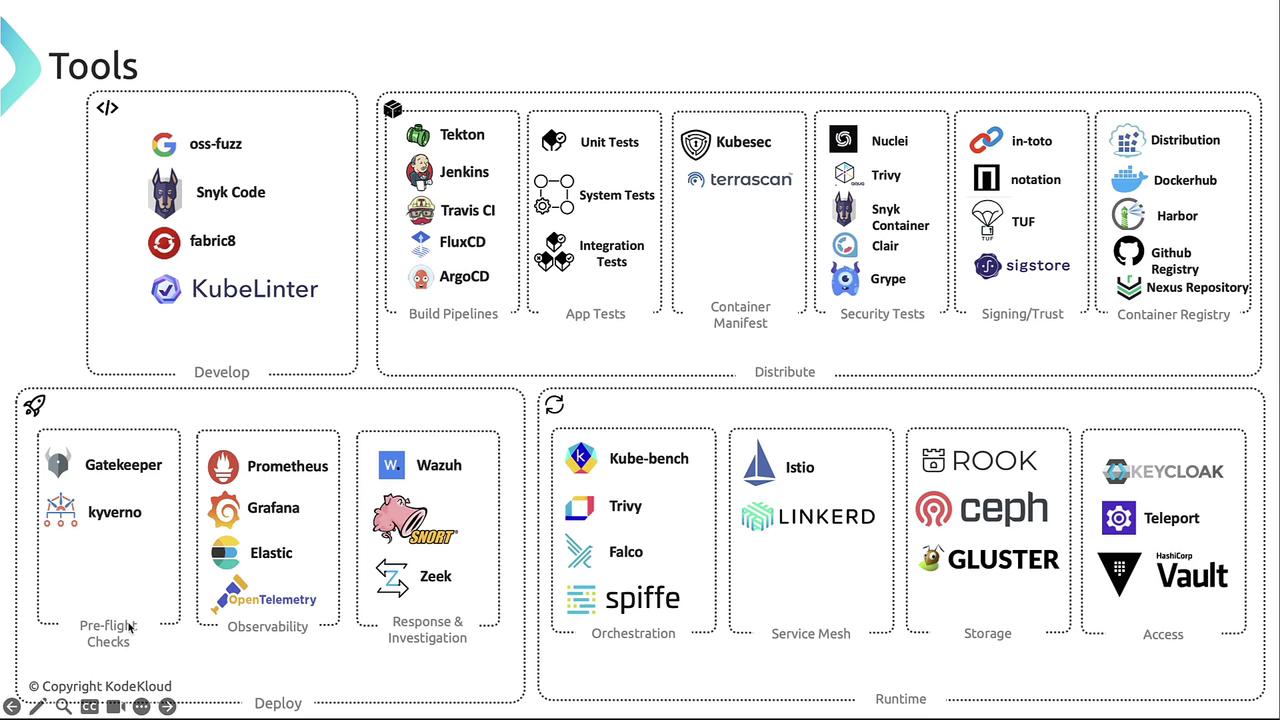
In this lesson, we recap essential automation and tooling for cloud-native security. Throughout this course, you’ve explored multiple open source and commercial solutions. Here, we review those tools, highlight alternatives, and reference key resources such as the **Cloud Native Security Whitepaper** by SIG Security.
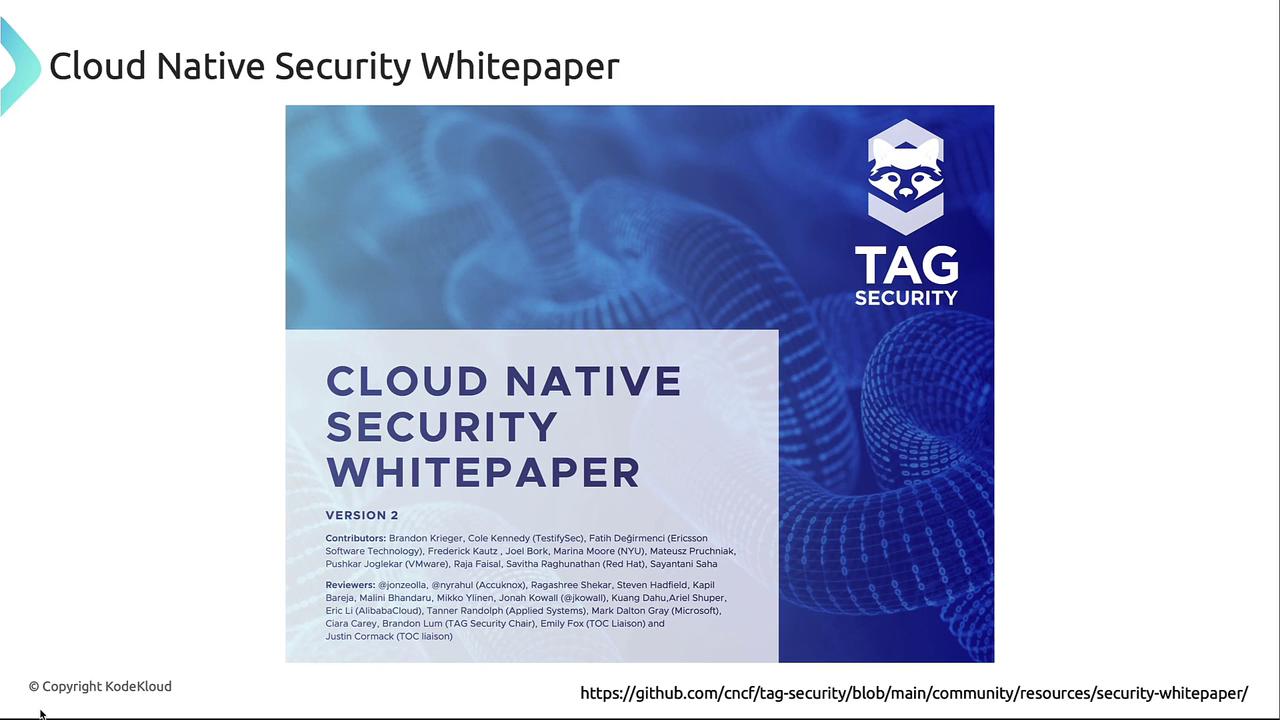
The Cloud Native Security Whitepaper provides foundational guidance authored by industry experts. To interactively explore security tools mapped to each phase of the application lifecycle, visit the Cloud Native Security Map:
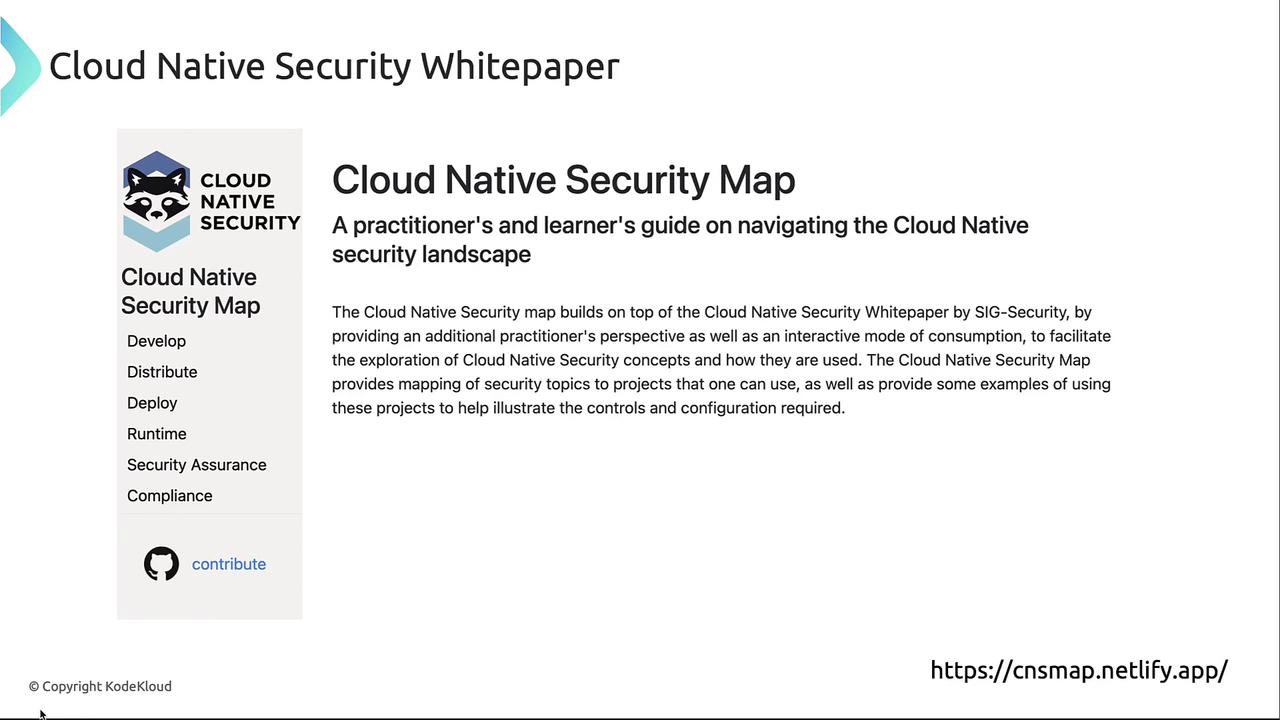
Explore the interactive map at [cnsmap.netfly.app](https://cnsmap.netfly.app) to discover security tools and best practices organized by **Develop**, **Distribute**, **Deploy**, and **Runtime** phases.
***
## Development Phase
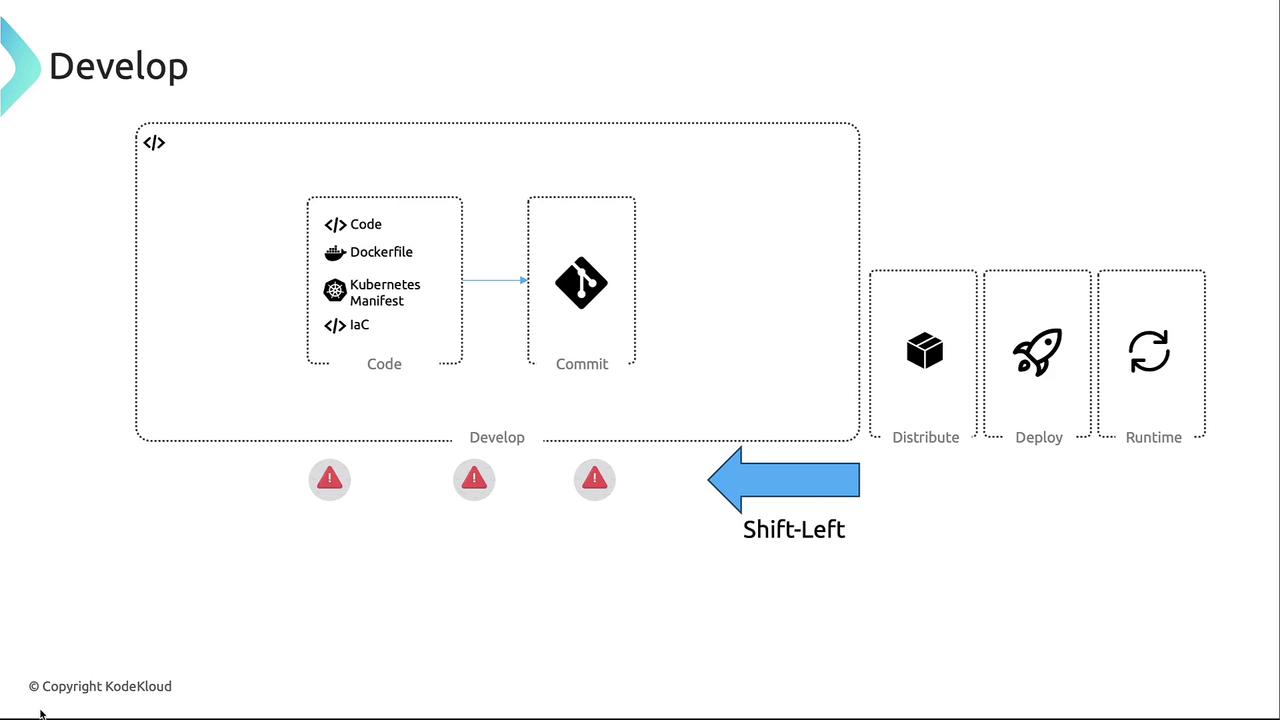
The **Develop** phase emphasizes “shift-left” testing by integrating security early in code, Dockerfile, and infrastructure-as-code creation. Commit artifacts to repositories (GitHub, GitLab, etc.) with automated checks to:
* Block high-severity vulnerabilities when fixes exist
* Enforce non-root container execution
* Restrict allowed base images
### Fuzz Testing with OSS-Fuzz
Google’s \[OSS-Fuzz]\[oss-fuzz] automates fuzz testing of open source projects to discover crashes and undefined behavior.
```python theme={null}
def parse_integer(input_string):
try:
return int(input_string)
except ValueError:
return "Error: Not a valid integer"
```
Below is a simple fuzz harness for `parse_integer`:
```python theme={null}
import random, string
def generate_random_string(length=10):
charset = string.ascii_letters + string.digits + string.punctuation
return ''.join(random.choice(charset) for _ in range(length))
def fuzz_test_parse_integer(iterations=10):
for _ in range(iterations):
rand_in = generate_random_string(random.randint(1, 20))
print(f"Testing: '{rand_in}' -> {parse_integer(rand_in)}")
fuzz_test_parse_integer()
```
Example output:
```plaintext theme={null}
Testing: '@123$%' -> Error: Not a valid integer
Testing: '87ab1' -> Error: Not a valid integer
Testing: '' -> Error: Not a valid integer
Testing: '42' -> 42
```
### IDE & CLI Security Extensions
* **\[Snyk VS Code Extension]\[snyk-vscode]**
* **Fabricate by Red Hat** (VS Code plugin)
* **\[kube-linter]\[kube-linter]** – Scan Kubernetes YAML:
```bash theme={null}
kube-linter lint pod.yaml
```
***
## Distribution Phase
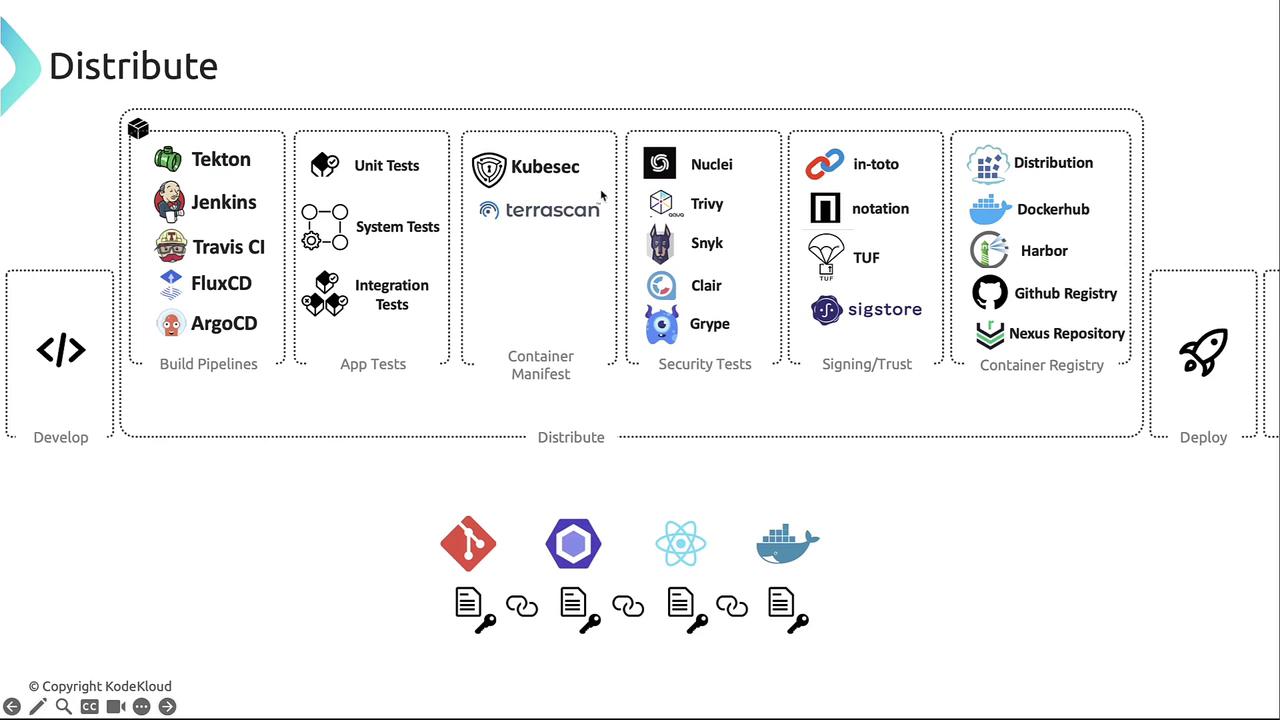
In the **Distribute** phase, CI/CD pipelines build, test, and push container images to registries. Common tools include:
| CI/CD Pipeline Tool | Use Case |
| ------------------- | ------------------------------- |
| Tekton | Kubernetes-native pipelines |
| Jenkins | Extensible automation server |
| Travis CI | Cloud-hosted continuous testing |
| CircleCI | Container-based CI |
| Flux CD | GitOps continuous delivery |
| Argo CD | Declarative GitOps controller |
Before building images, enforce policy compliance on manifests:
* **\[KubeSec]\[kubesec]** scans Kubernetes YAML for misconfigurations.
* **TeraScan** validates IaC (Terraform, Dockerfile, Helm, CloudFormation) against CIS, NIST, GDPR, HIPAA.
```plaintext theme={null}
Violation Details =
Description: [Enabling S3 versioning allows easy recovery]
file: modules/s3/main.tf
Severity: 101
Rule ID: AWS.S3Bucket.IAM.High.0370
```
Always validate manifests before image builds to prevent deployment of insecure configurations.
After validation, build and scan images:
| Scanner | Scope | Example Command |
| ------- | ---------------------------------------- | ------------------------ |
| Trivy | Container images, filesystems, Git repos | trivy image myapp:latest |
| Clair | Static image analysis via API | API integration |
| Grype | Images & filesystem scanning | grype myimage:tag |
| Nuclei | Custom checks via YAML templates | nuclei -t templates/ |
To secure the software supply chain, use signing frameworks:
* **\[in-toto]\[in-toto]** – End-to-end supply chain security
* **\[Notary]\[notary]**, **\[TUF]\[tuf]**, **\[Sigstore]\[sigstore]**
***
## Deployment Phase
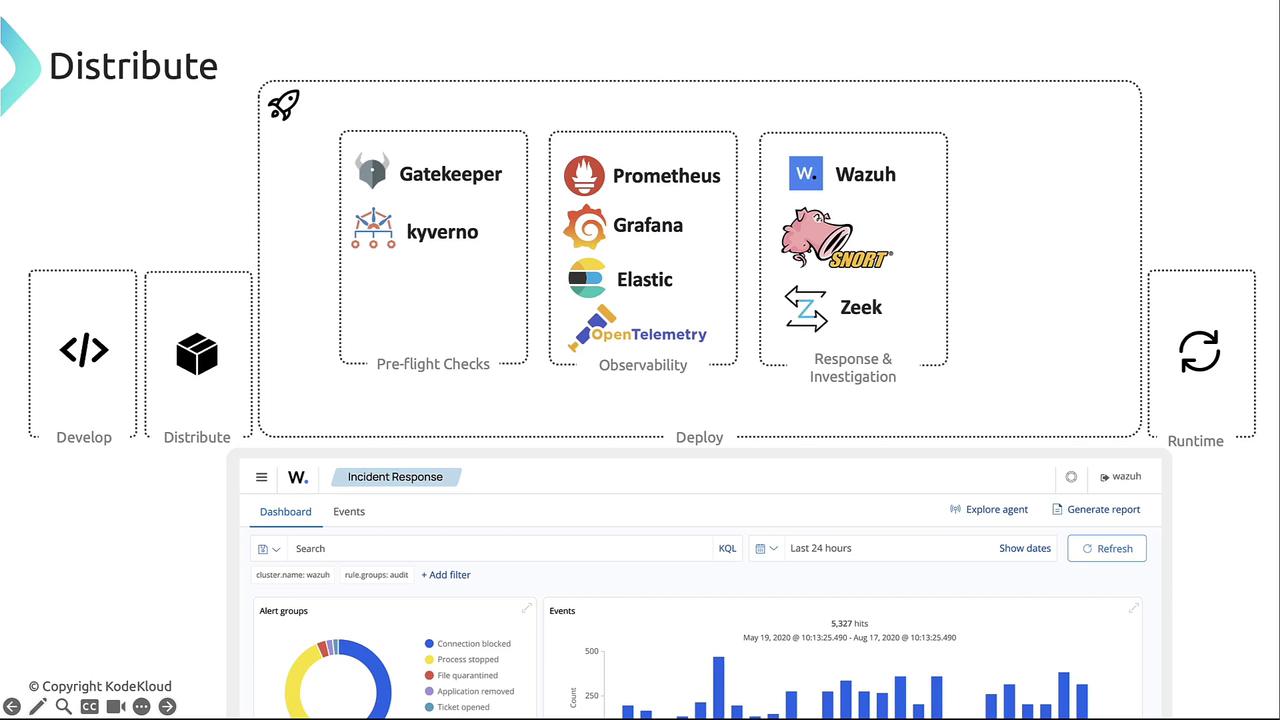
The **Deploy** phase covers pre-flight checks, observability, and incident response:
* **Pre-flight Checks**
* **\[OPA Gatekeeper]\[gatekeeper]** – Policies in Rego
* **\[Kyverno]\[kyverno]** – YAML-based policy management
* **Observability**
* **\[Prometheus]\[prometheus]** + **\[Grafana]\[grafana]**
* **\[Elasticsearch]\[elasticsearch]** + **\[Kibana]\[kibana]**
* **\[OpenTelemetry]\[otel]**
* **Response & Investigation**
* **\[Wazuh]\[wazuh]**
* **\[Snort]\[snort]**
* **\[Zeek]\[zeek]**
***
## Runtime Phase
Once applications are live, enforce continuous security and reliability:
* **CIS Benchmarking**
* **\[kube-bench]\[kube-bench]** – CIS checks for Kubernetes clusters:
```plaintext theme={null}
[FAIL] 1.1.1 Ensure --allow-privileged is false
[PASS] 1.1.2 Ensure --anonymous-auth is not set
```
* **Runtime Security**
* **Falco** – System call monitoring
* **Trivy** – Continuous workload scanning
* **SPIFFE** – Workload identity via certificates
* **Service Mesh**
* **Istio**, **Linkerd**
* **Storage Orchestration**
* **Rook**, **Ceph**, **Gluster**
* **Access Management**
* **Keycloak**, **Teleport**, **HashiCorp Vault**
***
## Summary
Map these tools to your cloud-native lifecycle for improved security and efficiency:
* **Develop**: Shift-left scanners & IDE plugins
* **Distribute**: CI/CD pipelines, manifest & image scanners, signing frameworks
* **Deploy**: Policy enforcement, observability, incident response
* **Runtime**: Continuous monitoring, service mesh, access & storage management
***
## Links and References
* OSS-Fuzz: [https://github.com/google/oss-fuzz](https://github.com/google/oss-fuzz)
* Snyk VS Code Extension: [https://marketplace.visualstudio.com/items?itemName=snyk-security.snyk-vulnerability-scanner](https://marketplace.visualstudio.com/items?itemName=snyk-security.snyk-vulnerability-scanner)
* kube-linter: [https://github.com/stackrox/kube-linter](https://github.com/stackrox/kube-linter)
* KubeSec: [https://github.com/controlplaneio/kubesec](https://github.com/controlplaneio/kubesec)
* in-toto: [https://github.com/in-toto/in-toto](https://github.com/in-toto/in-toto)
* Notary: [https://github.com/theupdateframework/notary](https://github.com/theupdateframework/notary)
* The Update Framework (TUF): [https://theupdateframework.io/](https://theupdateframework.io/)
* Sigstore: [https://sigstore.dev/](https://sigstore.dev/)
* OPA Gatekeeper: [https://github.com/open-policy-agent/gatekeeper](https://github.com/open-policy-agent/gatekeeper)
* Kyverno: [https://kyverno.io/](https://kyverno.io/)
* Prometheus: [https://prometheus.io/](https://prometheus.io/)
* Grafana: [https://grafana.com/](https://grafana.com/)
* Elasticsearch: [https://www.elastic.co/elasticsearch](https://www.elastic.co/elasticsearch)
* Kibana: [https://www.elastic.co/kibana](https://www.elastic.co/kibana)
* OpenTelemetry: [https://opentelemetry.io/](https://opentelemetry.io/)
* Wazuh: [https://wazuh.com/](https://wazuh.com/)
* Snort: [https://www.snort.org/](https://www.snort.org/)
* Zeek: [https://zeek.org/](https://zeek.org/)
* kube-bench: [https://github.com/aquasecurity/kube-bench](https://github.com/aquasecurity/kube-bench)
* Tekton: [https://tekton.dev/](https://tekton.dev/)
* Jenkins: [https://www.jenkins.io/](https://www.jenkins.io/)
* Travis CI: [https://travis-ci.org/](https://travis-ci.org/)
* CircleCI: [https://circleci.com/](https://circleci.com/)
* Flux CD: [https://fluxcd.io/](https://fluxcd.io/)
* Argo CD: [https://argo-cd.readthedocs.io/](https://argo-cd.readthedocs.io/)
* Docker Hub: [https://hub.docker.com/](https://hub.docker.com/)
* Harbor: [https://goharbor.io/](https://goharbor.io/)
* GitHub Container Registry: [https://github.com/features/packages](https://github.com/features/packages)
* Nexus Repository: [https://www.sonatype.com/product-nexus-repository](https://www.sonatype.com/product-nexus-repository)