> ## Documentation Index
> Fetch the complete documentation index at: https://notes.kodekloud.com/llms.txt
> Use this file to discover all available pages before exploring further.
# Service Mesh Monolithics vs Microservices
> This article discusses the evolution from monolithic applications to microservices and the role of Service Meshes in modern cloud-native environments.
Before diving into [Service Mesh](https://en.wikipedia.org/wiki/Service_mesh) and [Istio](https://istio.io/), it helps to understand how software architecture has evolved—from monolithic applications to distributed microservices. This background sets the stage for why Service Meshes are crucial in modern cloud-native environments.
## Evolution of Software Development
### The Agile Revolution
In the early 2000s, lengthy, rigid development cycles often meant that delivered software no longer matched business needs. The publication of the [Agile Manifesto](https://agilemanifesto.org/) in 2001 ushered in a new era:
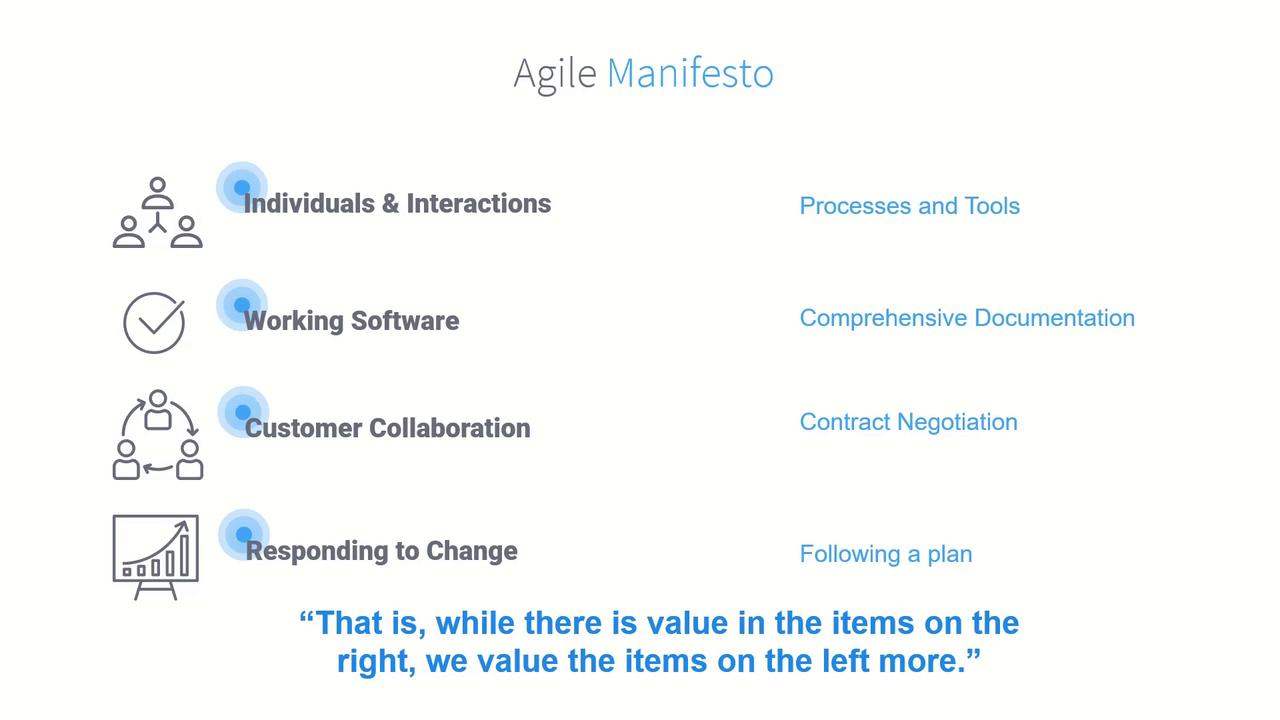
> We value **Individuals & Interactions** over processes and tools\
> **Working Software** over comprehensive documentation\
> **Customer Collaboration** over contract negotiation\
> **Responding to Change** over following a plan
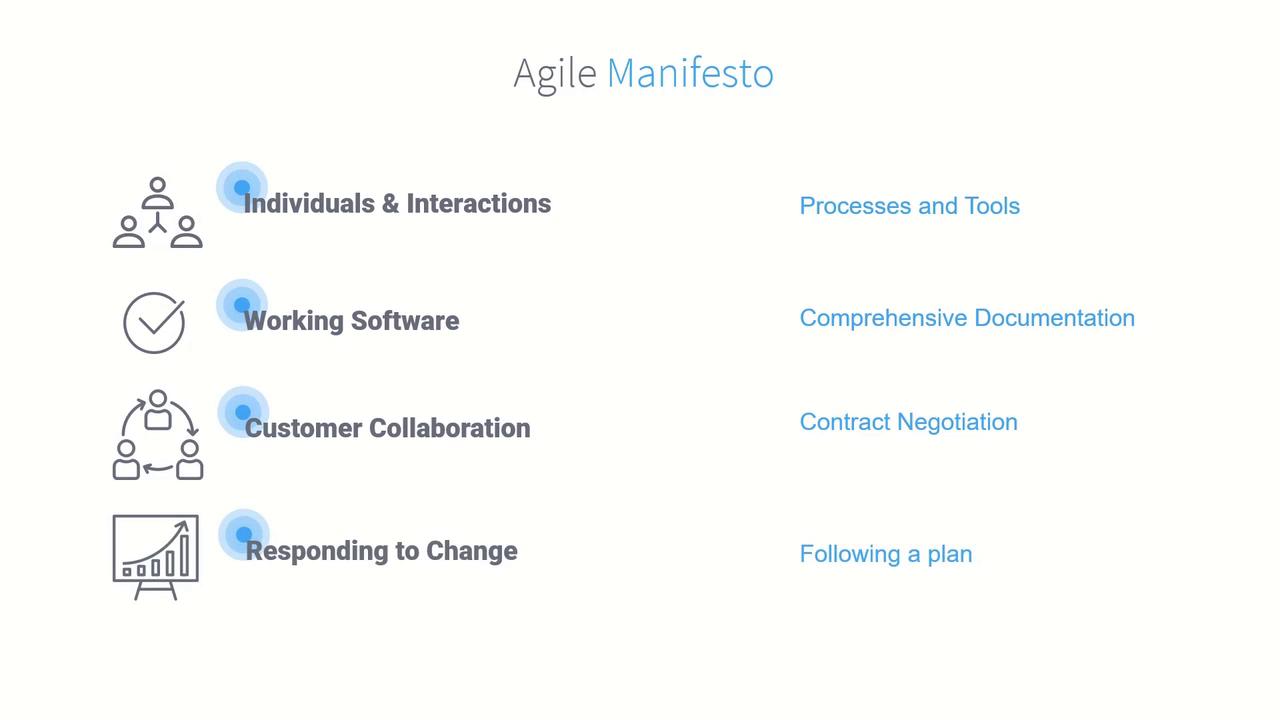
This shift encouraged faster feedback loops, closer customer engagement, and iterative releases that adapt to real-world feedback.
## Why Break Up Monoliths?
Monolithic applications bundle all features—presentation, business logic, data access—into a single deployable unit. While simple at first, they become bottlenecks for scaling, team autonomy, and innovation.
### Monolithic Architecture
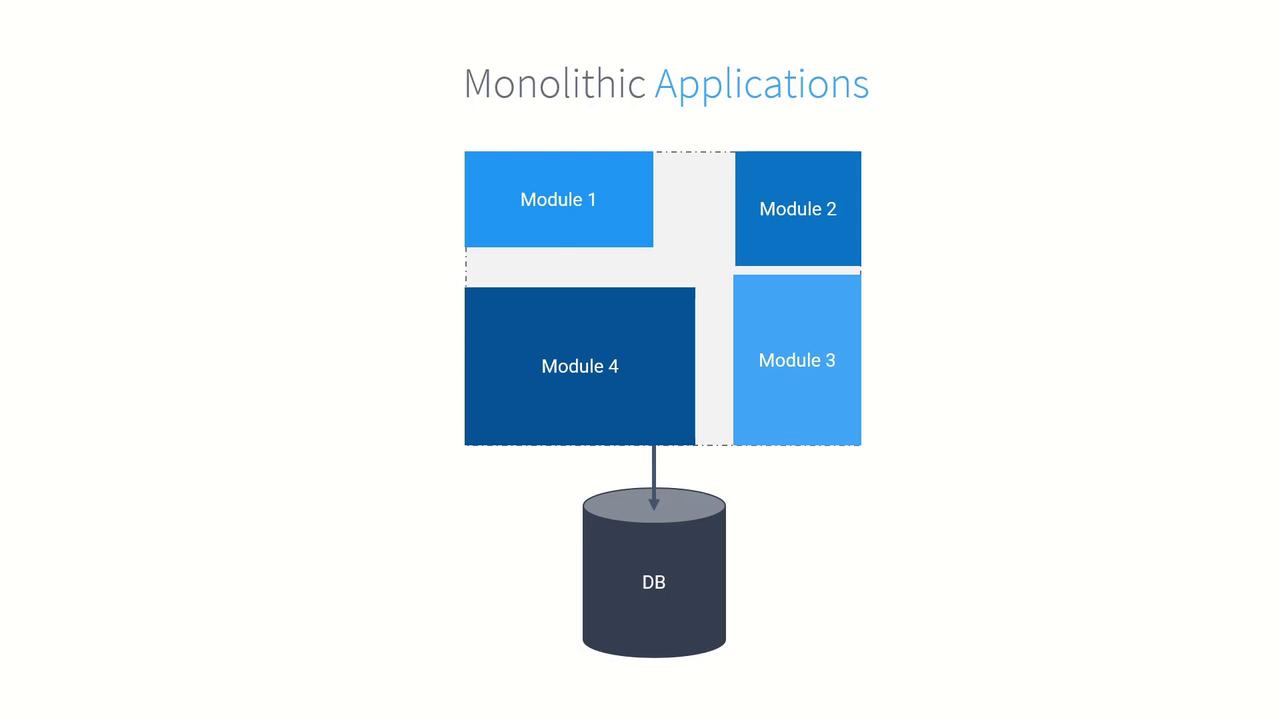
A **monolith** shares one codebase, one process, and typically a single database. Any update, no matter how small, requires redeploying the entire system.
#### Example: Book Info Monolith
Imagine a Book Info application in Java containing:
* **Details**
* **Reviews**
* **Ratings**
* **Product Page**
All modules live in one jar, calling each other and sharing a database.

Key drawbacks of this approach:
* Any change requires a full redeploy.
* You scale all modules together, even if only one needs it.
* Introducing new languages or modules means reworking the entire app.
* A single failure can bring down the whole system.
Over time, this pattern often devolves into a tangled “big ball of mud.”
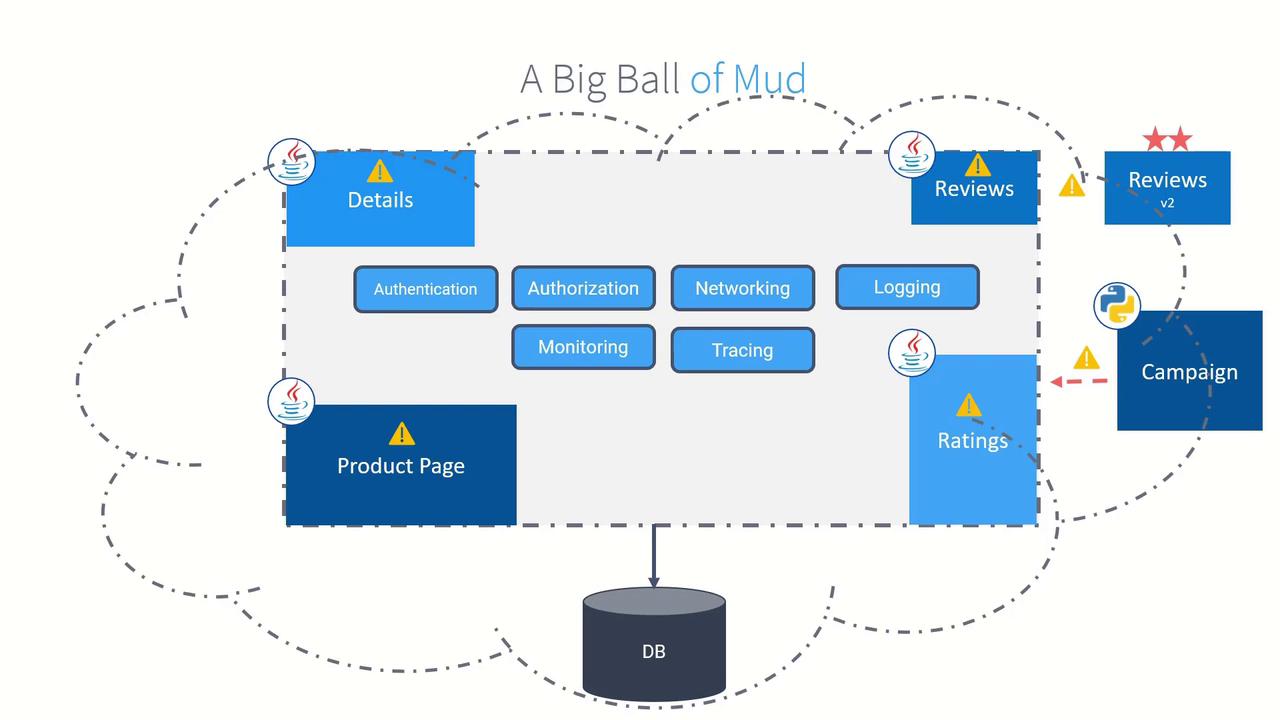
Refactoring a large monolith into services is a complex journey—both technically and culturally.
## Transition to Microservices
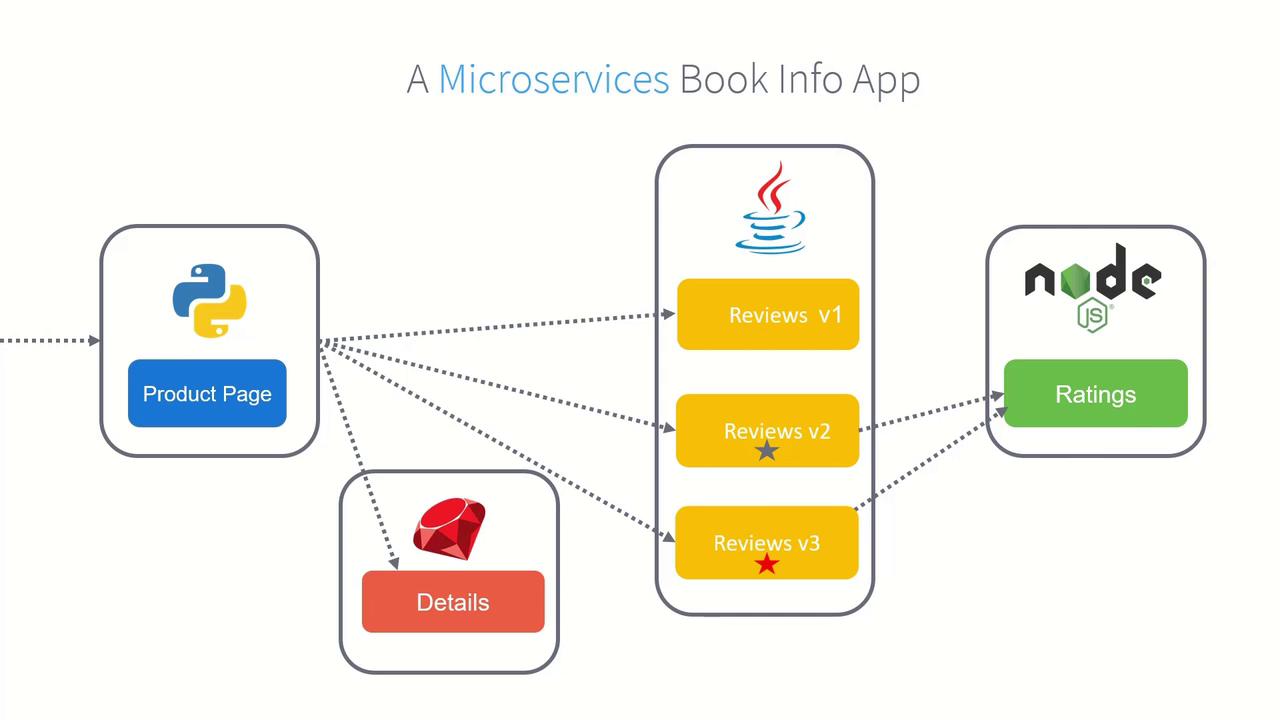
Breaking your application into independently deployable services addresses many monolithic drawbacks. In our Book Info example:
* **Product Page** → Python service
* **Details** → Ruby app
* **Reviews** → Java service (now with A/B versions: no stars, black stars, red stars)
* **Ratings** → Node.js microservice
Users still see a unified page, but each component is separately scalable and upgradable.
### Benefits of Microservices
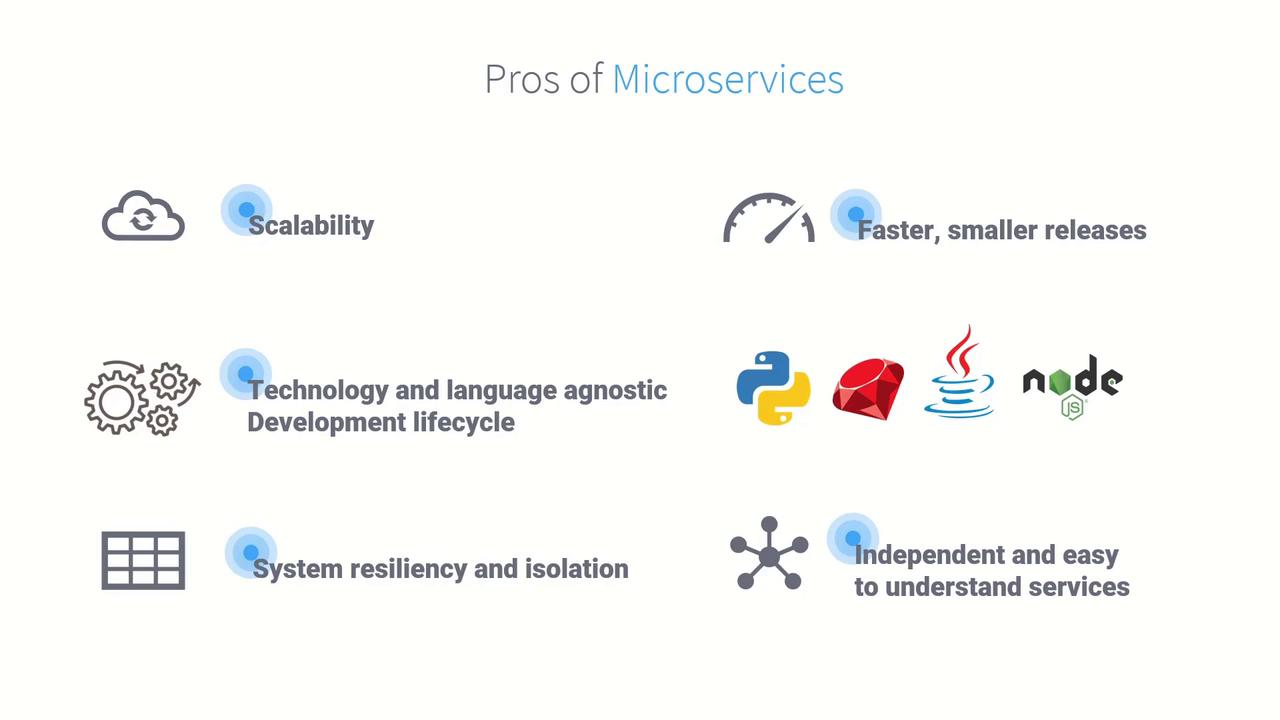
| Benefit | Description |
| ---------------------- | ---------------------------------------------- |
| Scalability | Scale only the services under load |
| Faster Releases | Deploy small changes independently |
| Technology Agnosticism | Use the best language or framework per service |
| Resilience | Isolate failures and limit blast radius |
| Team Autonomy | Teams own services end-to-end |
### New Challenges with Microservices
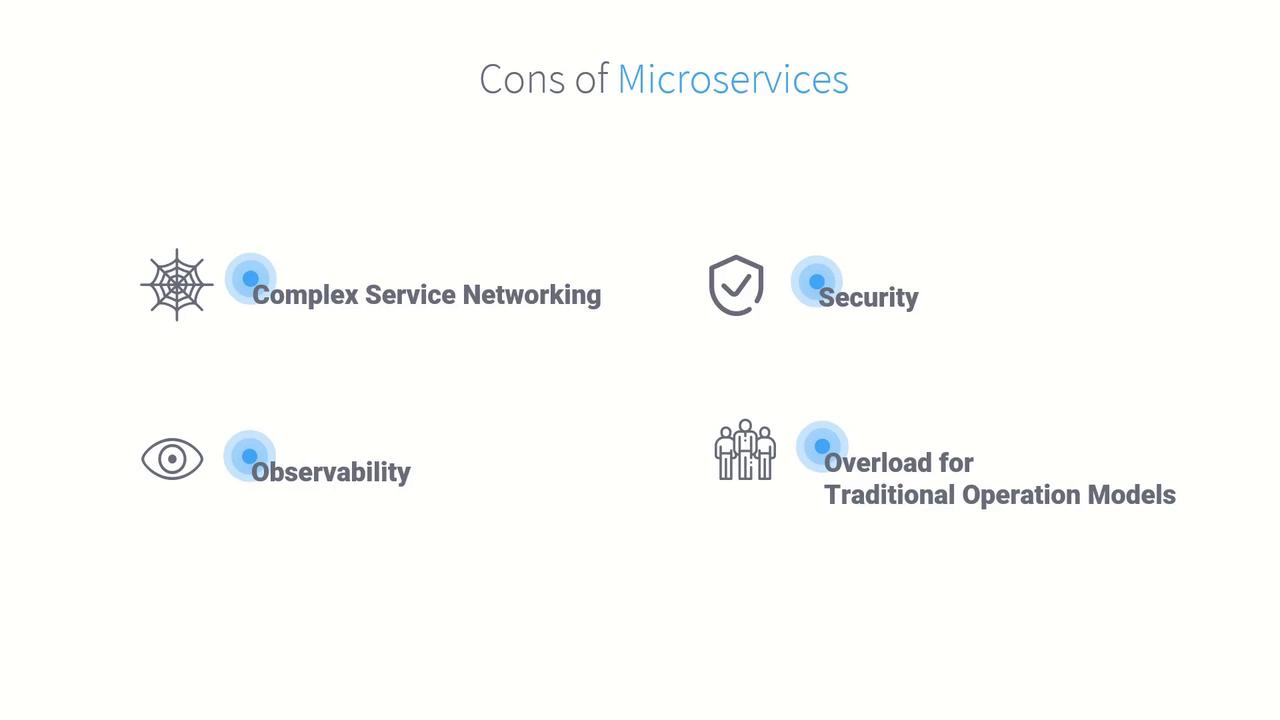
While microservices solve many monolithic issues, they introduce cross-cutting concerns:
| Challenge | Impact |
| -------------------- | ----------------------------------------------------------------- |
| Service Discovery | How services locate and communicate with each other |
| Security | Encrypting and authenticating inter-service and client-to-service |
| Observability | Correlating logs, metrics, and traces across distributed services |
| Operational Overhead | Managing multiple frameworks, languages, and deployment patterns |
Without a consistent platform for networking, security, and telemetry, microservices can become as difficult to manage as monoliths.
Emerging practices like [DevOps](https://en.wikipedia.org/wiki/DevOps) bridge development and operations, but a dedicated layer—namely a Service Mesh—is often needed to handle these complexities at scale.
***
In upcoming sections, we’ll explore how Service Meshes simplify networking, security, and observability across microservices.
## References
* [Agile Manifesto](https://agilemanifesto.org/)
* [Service Mesh Overview](https://en.wikipedia.org/wiki/Service_mesh)
* [Istio](https://istio.io/)