> ## Documentation Index
> Fetch the complete documentation index at: https://notes.kodekloud.com/llms.txt
> Use this file to discover all available pages before exploring further.
# Service Mesh
> A service mesh is an infrastructure layer managing service-to-service communication in microservices, enhancing resilience, security, and observability without altering application code.
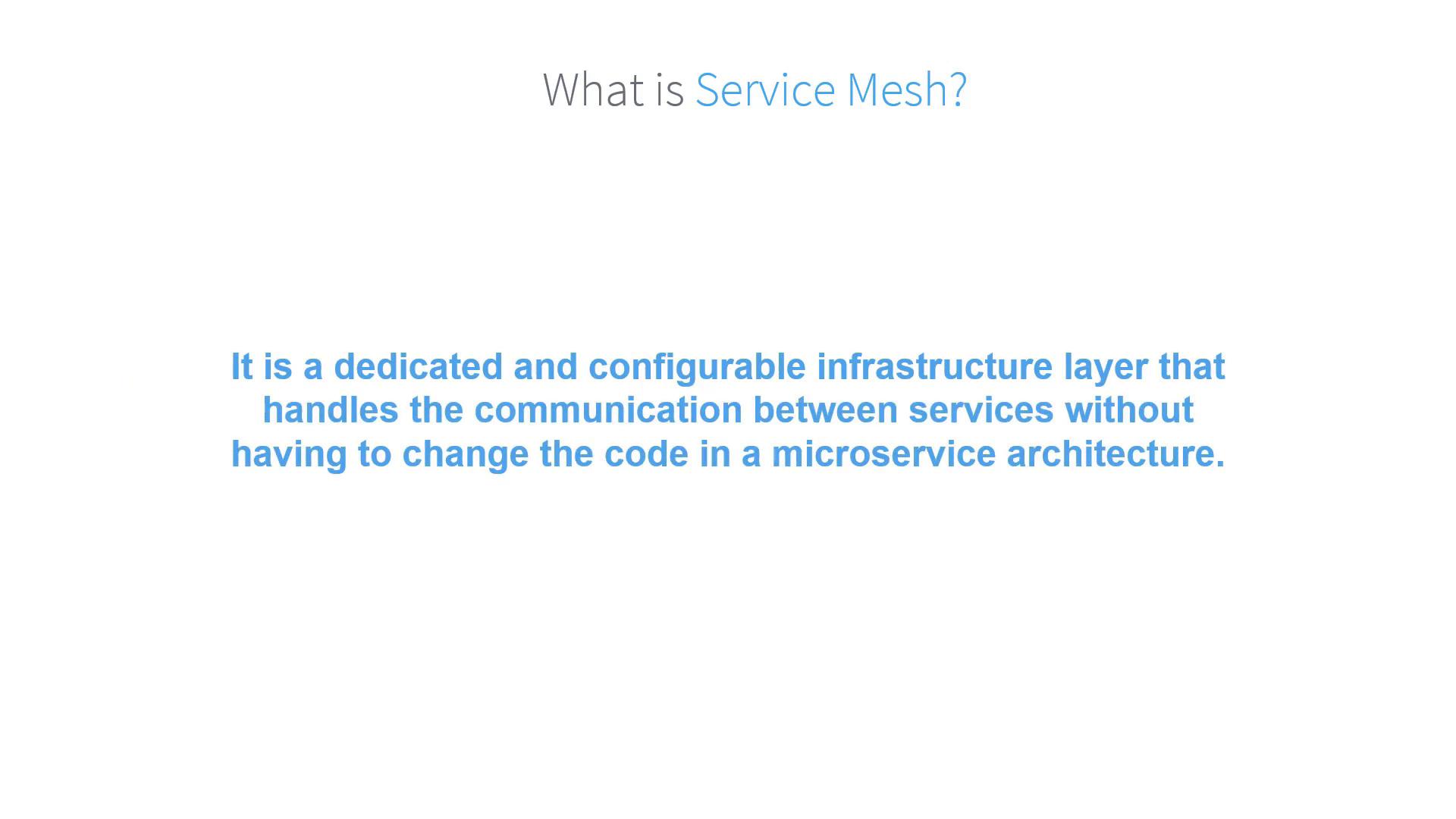
A **service mesh** is a dedicated infrastructure layer that handles service-to-service communication in microservices architectures. By offloading networking logic to this layer, developers can focus on business functionality without modifying application code for resilience, security, or observability.
## Architecture Overview
Rather than embedding networking concerns within each microservice, a service mesh injects a sidecar proxy alongside every service instance. These proxies form the **data plane**, managing all east–west traffic. A **control plane** centrally configures and orchestrates the proxies, enabling dynamic routing, security policies, and telemetry collection.
Key benefits include:
* **Dynamic Traffic Routing**: Canary releases, blue/green deployments, circuit breaking, retries
* **Mutual TLS (mTLS)**: Automatic encryption and authentication of service calls
* **Observability**: End-to-end metrics, logs, and distributed tracing
* **Service Discovery**: Automatic registration and lookup of service instances
A service mesh is platform-agnostic—popular implementations include [Istio](https://istio.io/), [Linkerd](https://linkerd.io/), and [Consul Connect](https://www.consul.io/).
## Core Responsibilities
The following table summarizes a service mesh’s primary capabilities:
| Capability | Description | Example Tools/Config |
| ------------------ | -------------------------------------------------------------------------- | -------------------------------------------------- |
| Service Discovery | Maintains registry of healthy instances for dynamic lookup | Envoy, Consul Catalog |
| Health Checking | Removes unresponsive instances to prevent routing to unhealthy pods | HTTP/gRPC probes, custom health checks |
| Load Balancing | Distributes traffic based on round-robin, least connections, or locality | Envoy LB algorithms |
| Security (mTLS) | Encrypts and authenticates all inter-service traffic | Istio PeerAuthentication, Linkerd identity service |
| Traffic Management | Applies retries, timeouts, fault injection, and traffic splitting policies | Istio VirtualService, Linkerd ServiceProfile |
| Observability | Collects metrics, logs, and traces for end-to-end visibility | Prometheus, Jaeger, Grafana |
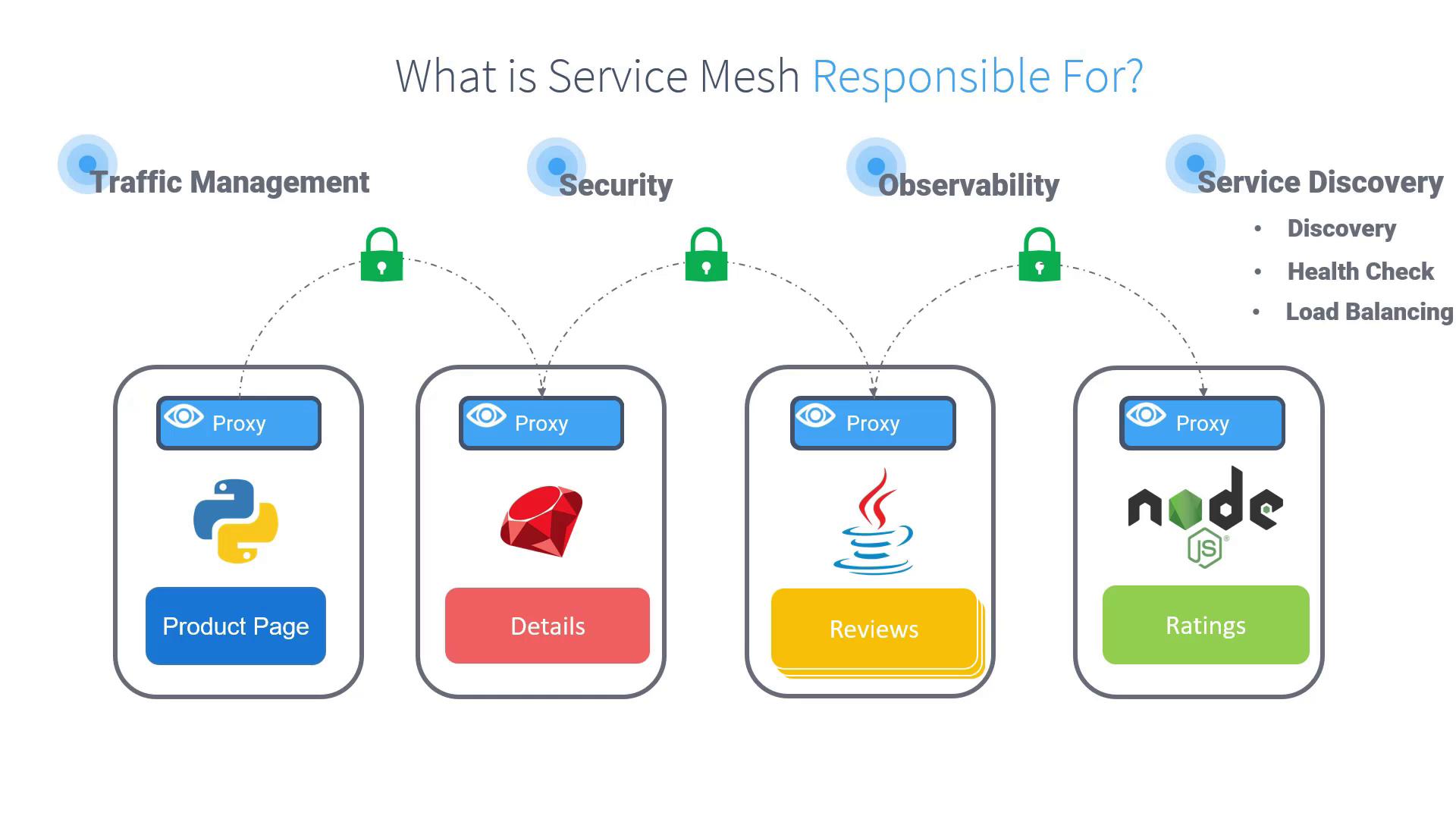
* **Service Discovery**\
Proxies query a centralized registry to resolve healthy service endpoints dynamically.
* **Health Checks**\
Continuous probing ensures unresponsive instances are excluded from load-balancing pools.
* **Load Balancing**\
Traffic is distributed using configurable algorithms (e.g., round-robin, least requests).
* **Security (mTLS)**\
Automatic certificate issuance and rotation secure all traffic with mutual TLS.
* **Traffic Management**\
Fine-grained policies for fault tolerance: retries, timeouts, circuit breakers, and canary releases.
* **Observability**\
Telemetry from each proxy yields metrics, logs, and distributed traces, aiding root-cause analysis.
## Next Steps and References
In the upcoming sections, we'll explore how to configure each capability with code examples, best practices for policy design, and real-world use cases.
## Links and References
* [Kubernetes Networking Basics](https://kubernetes.io/docs/concepts/cluster-administration/networking/)
* [Istio Documentation](https://istio.io/latest/docs/)
* [Linkerd Documentation](https://linkerd.io/2/reference/)
* [Envoy Proxy](https://www.envoyproxy.io/docs)