> ## Documentation Index
> Fetch the complete documentation index at: https://notes.kodekloud.com/llms.txt
> Use this file to discover all available pages before exploring further.
# Building Blocks of LangChain
> Overview of LangChain's core components and how they integrate LLMs, embeddings, vector stores, prompts, chains, memory, retrieval, and agents to build modular AI applications.
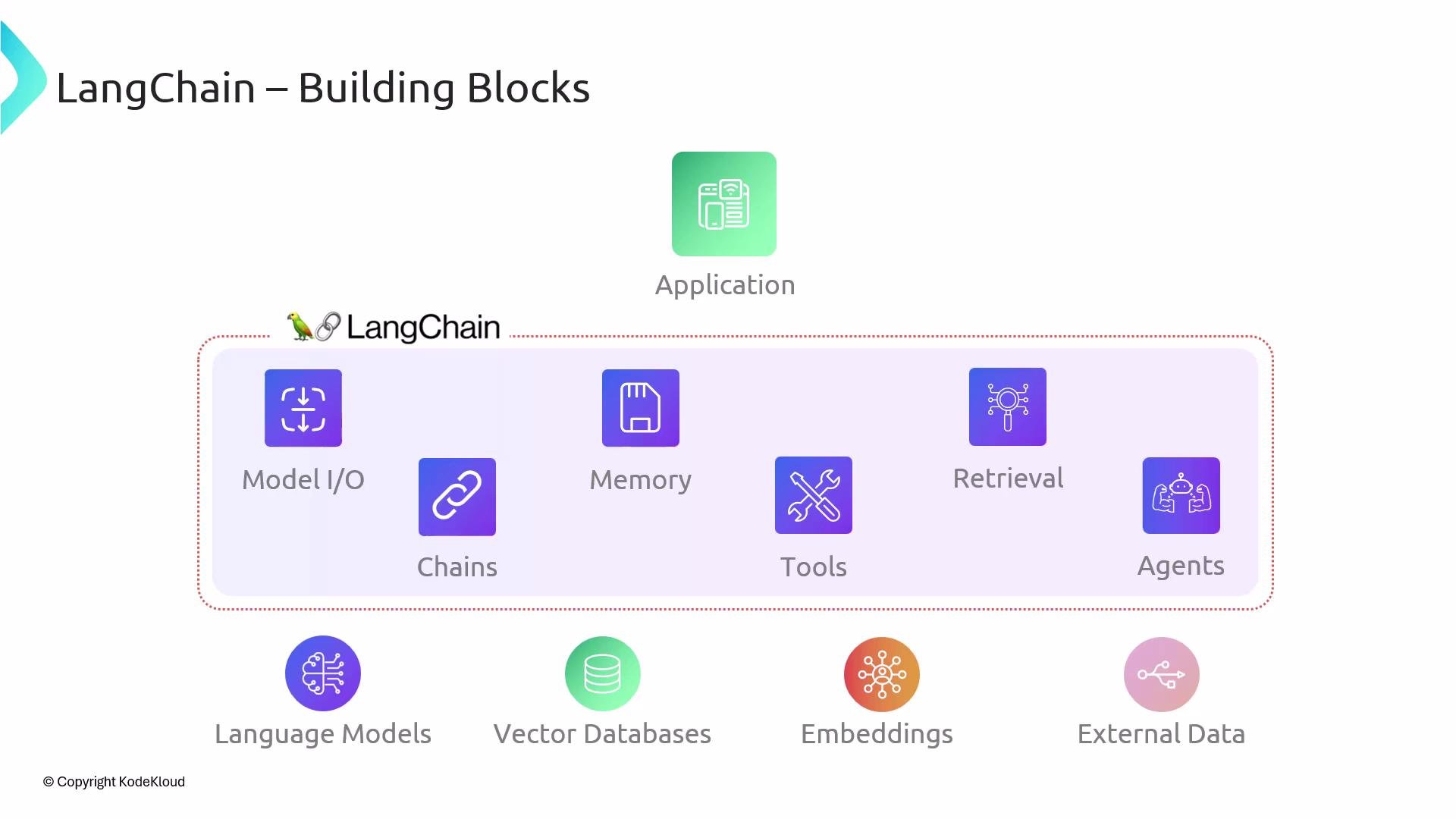
This article examines the core building blocks of LangChain and how they fit into real-world applications. At a high level, LangChain acts as middleware between your application and external services—language models (LLMs), embedding models, vector databases, and other data sources. It provides abstractions to compose prompts, preserve state, retrieve relevant context, and orchestrate complex behaviors.
Below is the big-picture overview of the components that live inside the LangChain layer.
 Summary table — quick reference
| Building Block | Purpose | Typical components / examples |
| ----------------------------- | ---------------------------------------------------------------------------------------- | --------------------------------------------------------------------------------------------- |
| Model I/O (LLMs & Embeddings) | Interface with LLMs for generation and with embedding models for vector representations. | `OpenAI` wrappers, alternative LLM providers, embedding models, tokenizers, streaming support |
| Prompts | Structured templates and utilities for consistent prompt construction. | `PromptTemplate` classes, formatting helpers, few-shot/example injection |
| Chains | Composable workflows chaining model calls, tools, and logic. | Sequential chains, branching/control-flow chains, orchestration helpers |
| Memory | Maintain conversational or task state across interactions. | In-memory buffers, session stores, persistent key-value stores |
| Retrieval | Retrieve relevant documents or facts to augment prompts (RAG). | Vector stores (FAISS, Weaviate, Pinecone), retriever abstractions, indexing utilities |
| Agents & Tools | Let models choose tools or actions to perform external tasks. | Tool wrappers, ReAct-style controllers, safety/authorization layers |
The sections below expand each building block in the order you’ll typically encounter them when designing a LangChain system.
1. Model I/O (LLMs and Embeddings)
* What it is: Wrappers and interfaces for language models (text generation/completion) and embedding models (vector encodings).
* Role: Provide natural language generation, completions, and semantic embeddings used for tasks like RAG (retrieval-augmented generation) and similarity search.
* Typical components:
* LLM provider wrappers (e.g., `OpenAI`, other hosted or self-hosted models)
* Embedding APIs and models
* Tokenizer utilities and streaming output handling
* Provider-specific configuration (temperature, max tokens, batching)
2. Prompts (Prompt Templates and Formatting)
* What it is: Structured templates and utilities for building repeatable prompts.
* Role: Encapsulate prompt patterns, inject variables safely, and enable prompt engineering best practices (reusability, testability).
* Typical components:
* `PromptTemplate` classes and formatters
* Few-shot/example injection helpers and conditioning utilities
* Prompt validation and safety checks
3. Chains (Composable Workflows)
* What it is: Sequences or graphs that compose multiple steps—model calls, retrievals, tool invocations, and business logic.
* Role: Turn atomic operations into higher-level pipelines (e.g., user question → retrieve docs → summarize → respond).
* Typical components:
* Simple sequential chains for linear workflows
* Branching/conditional chains for decision points
* Orchestration utilities for error handling, retries, and parallelism
4. Memory (State and Context Management)
* What it is: Mechanisms for persisting conversational or application state between calls to the model.
* Role: Maintain context across multi-turn interactions so LLMs can reference prior exchanges, user preferences, or saved facts.
* Typical components:
* In-memory buffers for short-lived sessions
* Session-based memory for per-user conversations
* Persistent integrations (databases, key-value stores) for long-term memory
5. Retrieval (Indexes and Vector Stores)
* What it is: Retrieval systems that provide relevant context—often powered by embeddings and vector similarity search.
* Role: Ground model outputs with external data by augmenting prompts with relevant documents or knowledge snippets (RAG).
* Typical components:
* Vector stores and indexers: FAISS, Weaviate, Pinecone, etc.
* Retriever interfaces and similarity search utilities
* Document loaders and preprocessing/indexing pipelines
6. Agents and Tools (Decision-Making & External Actions)
* What it is: Agent frameworks enabling models to select and call external tools or APIs.
* Role: Let models do more than generate text—search, interact with APIs, run code, or perform automated workflows based on model reasoning.
* Typical components:
* Tool wrappers (custom actions, API clients)
* Agent controllers and reasoning patterns (e.g., ReAct)
* Safety, authorization, and sandboxing layers to limit agent actions
These building blocks are designed to be combined into complete applications. A common flow is: create embeddings (Model I/O) → index documents (Retrieval) → compose a retrieval-augmented prompt (Prompts + Chains) → maintain conversation history (Memory) → hand off to an agent when external actions are required.
Why this decomposition matters
* Modularity: Each block can be replaced or upgraded independently (swap vector DB, change LLM provider).
* Testability: Smaller, focused components are easier to unit test and validate.
* Maintainability: Clear separation of responsibilities helps manage complexity as features grow.
* Reusability: Standardized prompts, chains, and tools accelerate building new capabilities.
Links and references
* LangChain documentation: [https://python.langchain.com/](https://python.langchain.com/)
* Retrieval & Vector DBs: FAISS ([https://github.com/facebookresearch/faiss](https://github.com/facebookresearch/faiss)), Weaviate ([https://www.semi.technology/](https://www.semi.technology/)), Pinecone ([https://www.pinecone.io/](https://www.pinecone.io/))
* OpenAI: [https://platform.openai.com/](https://platform.openai.com/)
Understanding these components sets the stage for practical patterns and code examples. Later sections will deep-dive into each building block with concrete integrations, sample code, and design patterns for production systems.
Summary table — quick reference
| Building Block | Purpose | Typical components / examples |
| ----------------------------- | ---------------------------------------------------------------------------------------- | --------------------------------------------------------------------------------------------- |
| Model I/O (LLMs & Embeddings) | Interface with LLMs for generation and with embedding models for vector representations. | `OpenAI` wrappers, alternative LLM providers, embedding models, tokenizers, streaming support |
| Prompts | Structured templates and utilities for consistent prompt construction. | `PromptTemplate` classes, formatting helpers, few-shot/example injection |
| Chains | Composable workflows chaining model calls, tools, and logic. | Sequential chains, branching/control-flow chains, orchestration helpers |
| Memory | Maintain conversational or task state across interactions. | In-memory buffers, session stores, persistent key-value stores |
| Retrieval | Retrieve relevant documents or facts to augment prompts (RAG). | Vector stores (FAISS, Weaviate, Pinecone), retriever abstractions, indexing utilities |
| Agents & Tools | Let models choose tools or actions to perform external tasks. | Tool wrappers, ReAct-style controllers, safety/authorization layers |
The sections below expand each building block in the order you’ll typically encounter them when designing a LangChain system.
1. Model I/O (LLMs and Embeddings)
* What it is: Wrappers and interfaces for language models (text generation/completion) and embedding models (vector encodings).
* Role: Provide natural language generation, completions, and semantic embeddings used for tasks like RAG (retrieval-augmented generation) and similarity search.
* Typical components:
* LLM provider wrappers (e.g., `OpenAI`, other hosted or self-hosted models)
* Embedding APIs and models
* Tokenizer utilities and streaming output handling
* Provider-specific configuration (temperature, max tokens, batching)
2. Prompts (Prompt Templates and Formatting)
* What it is: Structured templates and utilities for building repeatable prompts.
* Role: Encapsulate prompt patterns, inject variables safely, and enable prompt engineering best practices (reusability, testability).
* Typical components:
* `PromptTemplate` classes and formatters
* Few-shot/example injection helpers and conditioning utilities
* Prompt validation and safety checks
3. Chains (Composable Workflows)
* What it is: Sequences or graphs that compose multiple steps—model calls, retrievals, tool invocations, and business logic.
* Role: Turn atomic operations into higher-level pipelines (e.g., user question → retrieve docs → summarize → respond).
* Typical components:
* Simple sequential chains for linear workflows
* Branching/conditional chains for decision points
* Orchestration utilities for error handling, retries, and parallelism
4. Memory (State and Context Management)
* What it is: Mechanisms for persisting conversational or application state between calls to the model.
* Role: Maintain context across multi-turn interactions so LLMs can reference prior exchanges, user preferences, or saved facts.
* Typical components:
* In-memory buffers for short-lived sessions
* Session-based memory for per-user conversations
* Persistent integrations (databases, key-value stores) for long-term memory
5. Retrieval (Indexes and Vector Stores)
* What it is: Retrieval systems that provide relevant context—often powered by embeddings and vector similarity search.
* Role: Ground model outputs with external data by augmenting prompts with relevant documents or knowledge snippets (RAG).
* Typical components:
* Vector stores and indexers: FAISS, Weaviate, Pinecone, etc.
* Retriever interfaces and similarity search utilities
* Document loaders and preprocessing/indexing pipelines
6. Agents and Tools (Decision-Making & External Actions)
* What it is: Agent frameworks enabling models to select and call external tools or APIs.
* Role: Let models do more than generate text—search, interact with APIs, run code, or perform automated workflows based on model reasoning.
* Typical components:
* Tool wrappers (custom actions, API clients)
* Agent controllers and reasoning patterns (e.g., ReAct)
* Safety, authorization, and sandboxing layers to limit agent actions
These building blocks are designed to be combined into complete applications. A common flow is: create embeddings (Model I/O) → index documents (Retrieval) → compose a retrieval-augmented prompt (Prompts + Chains) → maintain conversation history (Memory) → hand off to an agent when external actions are required.
Why this decomposition matters
* Modularity: Each block can be replaced or upgraded independently (swap vector DB, change LLM provider).
* Testability: Smaller, focused components are easier to unit test and validate.
* Maintainability: Clear separation of responsibilities helps manage complexity as features grow.
* Reusability: Standardized prompts, chains, and tools accelerate building new capabilities.
Links and references
* LangChain documentation: [https://python.langchain.com/](https://python.langchain.com/)
* Retrieval & Vector DBs: FAISS ([https://github.com/facebookresearch/faiss](https://github.com/facebookresearch/faiss)), Weaviate ([https://www.semi.technology/](https://www.semi.technology/)), Pinecone ([https://www.pinecone.io/](https://www.pinecone.io/))
* OpenAI: [https://platform.openai.com/](https://platform.openai.com/)
Understanding these components sets the stage for practical patterns and code examples. Later sections will deep-dive into each building block with concrete integrations, sample code, and design patterns for production systems.