> ## Documentation Index
> Fetch the complete documentation index at: https://notes.kodekloud.com/llms.txt
> Use this file to discover all available pages before exploring further.
# LangGraph Intermediate Preview
> Intermediate guide for scaling LangGraph projects to production with multi-agent orchestration, long-term memory, observability, durability, and human-in-the-loop deployment patterns.
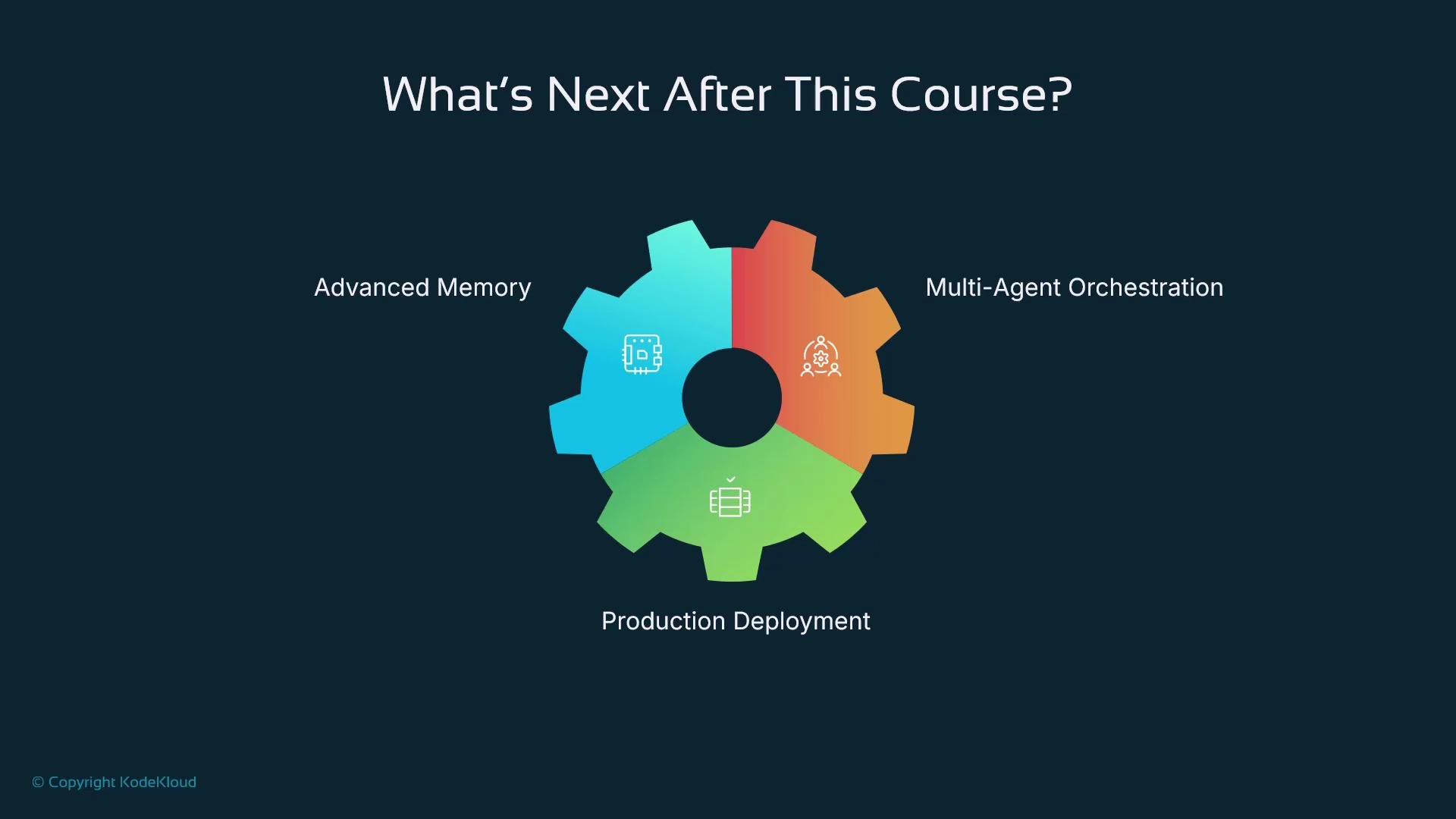
You have a solid foundation — now it’s time to scale up. This intermediate preview outlines the next steps for taking LangGraph projects from prototypes to production-ready systems: advanced memory architectures, multi-agent orchestration, and robust deployment patterns.
 What you'll learn
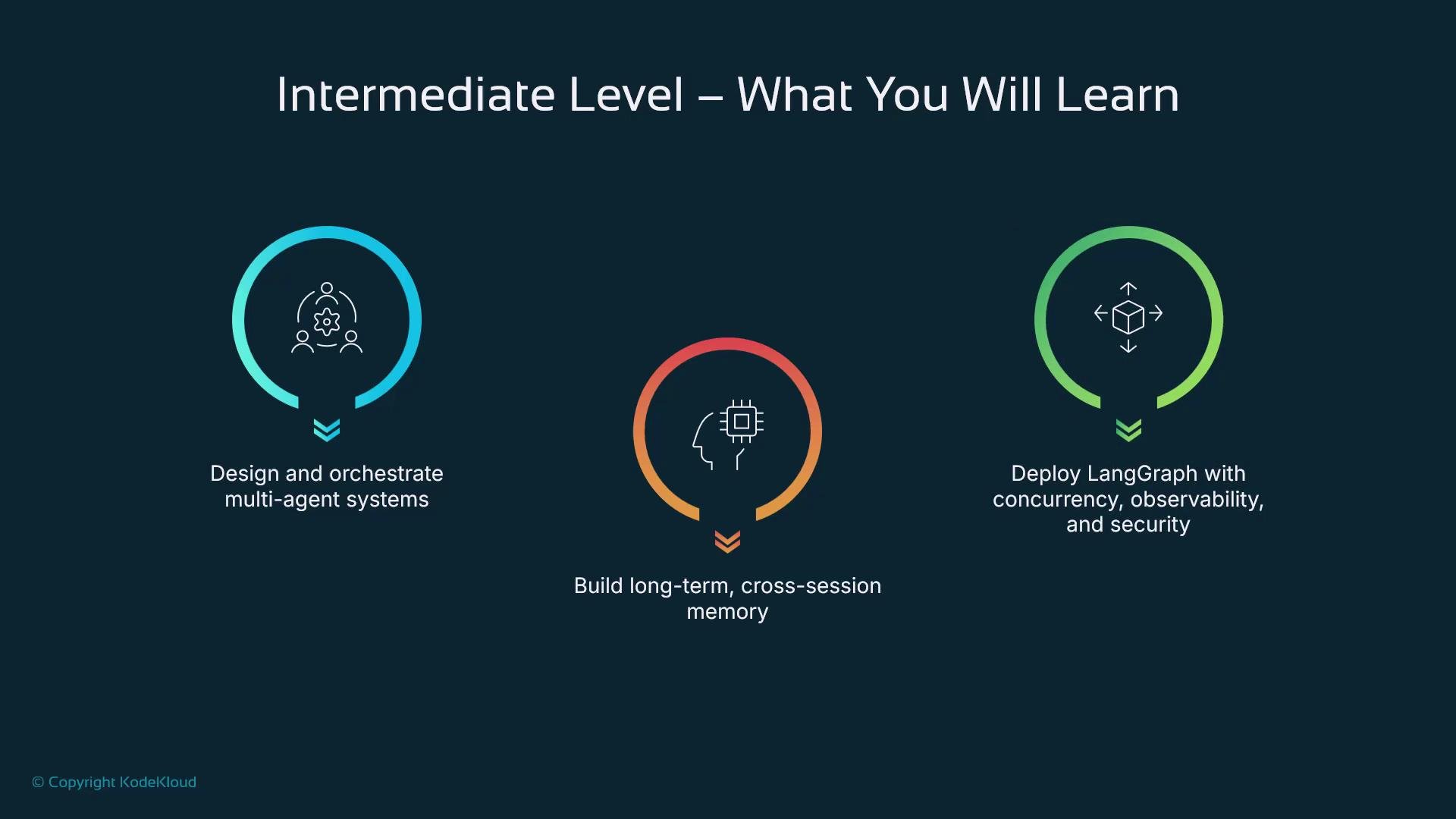
* Design multi-agent workflows where each agent has a clear role and edge logic, reducing tight coupling and improving maintainability.
* Implement long-term memory that persists across sessions, with reliable embedding storage and retrieval.
* Deploy LangGraph in production environments that require concurrency, observability, durability, and security.
What you'll learn
* Design multi-agent workflows where each agent has a clear role and edge logic, reducing tight coupling and improving maintainability.
* Implement long-term memory that persists across sessions, with reliable embedding storage and retrieval.
* Deploy LangGraph in production environments that require concurrency, observability, durability, and security.
 Key capabilities and practical outcomes
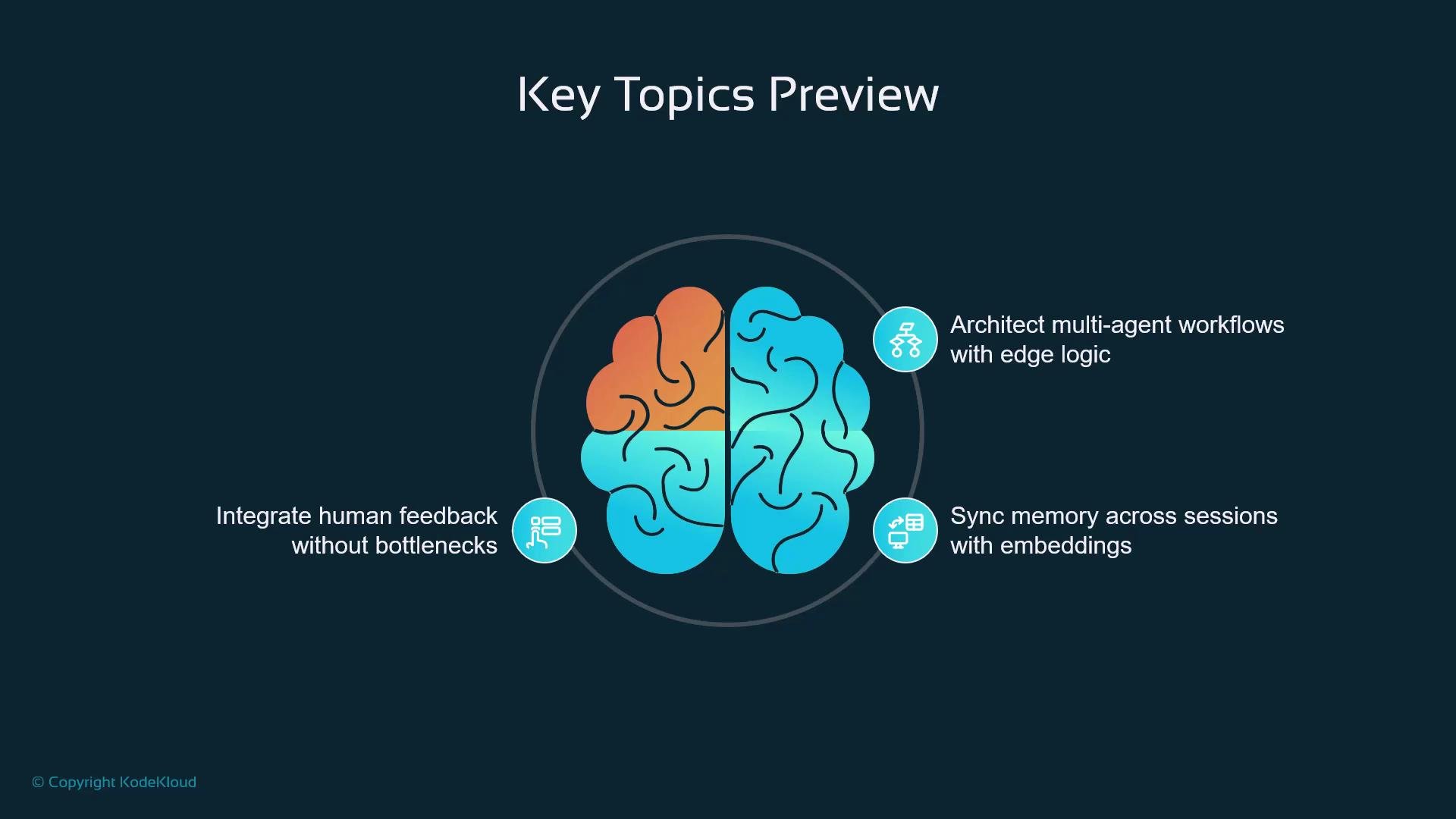
* Architecting multi-agent workflows with separation of concerns and explicit communication channels.
* Syncing memory across sessions and persisting embeddings with resilience to failures.
* Incorporating human-in-the-loop feedback in a way that improves models without creating operational bottlenecks.
Key capabilities and practical outcomes
* Architecting multi-agent workflows with separation of concerns and explicit communication channels.
* Syncing memory across sessions and persisting embeddings with resilience to failures.
* Incorporating human-in-the-loop feedback in a way that improves models without creating operational bottlenecks.
 Durability and production patterns
* Persistence: store canonical data for recovery and audit.
* Time travel: snapshot and replay state transitions for debugging and compliance.
* Observability: add tracing, metrics, and logs to see agent decisions and state changes in real time.
* Safety: enforce access controls, rate limits, and human review gates where needed.
Table: Core topics and production examples
| Topic | Why it matters | Example outcome |
| -------------------------- | -------------------------------------------------------- | ----------------------------------------------------------------------------------- |
| Multi-agent orchestration | Breaks complex workflows into focused, testable units | A coordinator agent routes tasks to specialists (search, summarization, validation) |
| Long-term memory | Improves personalization and consistency across sessions | Persisted embeddings enable context-aware retrieval for returning users |
| Observability & durability | Enables safe rollouts and faster incident triage | Metrics + replayable state let you diagnose regressions without data loss |
| Human-in-the-loop | Balances automation and oversight | Human approvals for high-risk decisions to prevent model drift |
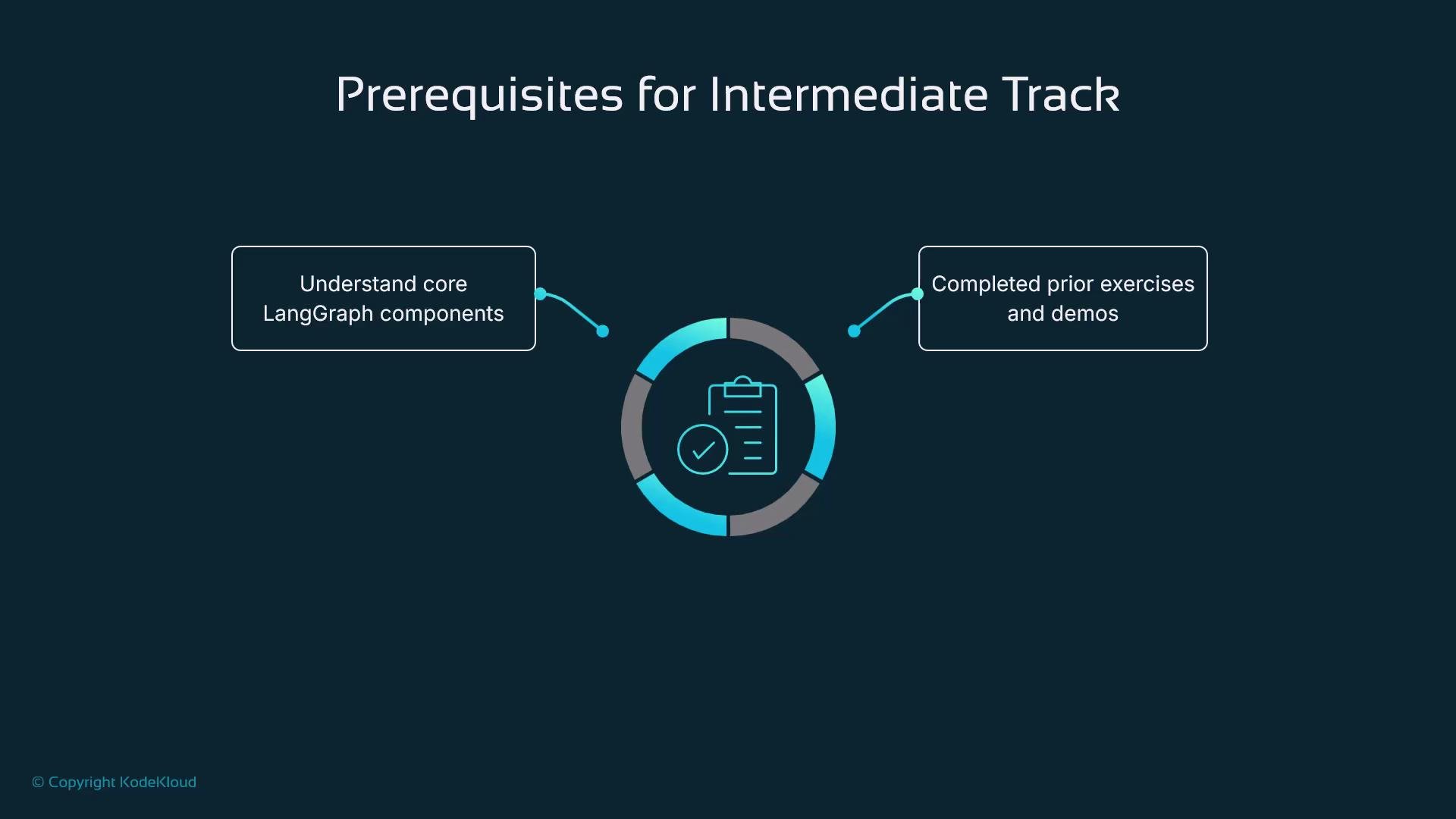
Prerequisites: familiarity with core LangGraph concepts — Paths, State Reducers, Context, Human-in-the-Loop, and Observability — will help you move faster. Basic Python experience and knowledge of [LangChain](https://python.langchain.com/) APIs are helpful but not required; the course emphasizes architecture and production patterns.
Durability and production patterns
* Persistence: store canonical data for recovery and audit.
* Time travel: snapshot and replay state transitions for debugging and compliance.
* Observability: add tracing, metrics, and logs to see agent decisions and state changes in real time.
* Safety: enforce access controls, rate limits, and human review gates where needed.
Table: Core topics and production examples
| Topic | Why it matters | Example outcome |
| -------------------------- | -------------------------------------------------------- | ----------------------------------------------------------------------------------- |
| Multi-agent orchestration | Breaks complex workflows into focused, testable units | A coordinator agent routes tasks to specialists (search, summarization, validation) |
| Long-term memory | Improves personalization and consistency across sessions | Persisted embeddings enable context-aware retrieval for returning users |
| Observability & durability | Enables safe rollouts and faster incident triage | Metrics + replayable state let you diagnose regressions without data loss |
| Human-in-the-loop | Balances automation and oversight | Human approvals for high-risk decisions to prevent model drift |
Prerequisites: familiarity with core LangGraph concepts — Paths, State Reducers, Context, Human-in-the-Loop, and Observability — will help you move faster. Basic Python experience and knowledge of [LangChain](https://python.langchain.com/) APIs are helpful but not required; the course emphasizes architecture and production patterns.
 How to prepare and what to practice
* Revisit your existing LangGraph flows and identify single points of failure or tightly coupled components.
* Practice persisting embeddings and recovering state from durable storage.
* Add lightweight observability (tracing spans or structured logs) to at least one flow.
* Prototype a small human-in-the-loop checkpoint for validation or safety review.
Final takeaways
* The intermediate path pushes you to think like a systems architect: design for scale, resiliency, and safety.
* Focus on clear role boundaries for agents, reliable memory layers, and production-ready observability to move confidently from prototype to deployed application.
How to prepare and what to practice
* Revisit your existing LangGraph flows and identify single points of failure or tightly coupled components.
* Practice persisting embeddings and recovering state from durable storage.
* Add lightweight observability (tracing spans or structured logs) to at least one flow.
* Prototype a small human-in-the-loop checkpoint for validation or safety review.
Final takeaways
* The intermediate path pushes you to think like a systems architect: design for scale, resiliency, and safety.
* Focus on clear role boundaries for agents, reliable memory layers, and production-ready observability to move confidently from prototype to deployed application.
 Further reading and references
* [LangChain Documentation](https://python.langchain.com/)
* Consider resources on distributed systems and observability (tracing, metrics) to complement the course material.
Further reading and references
* [LangChain Documentation](https://python.langchain.com/)
* Consider resources on distributed systems and observability (tracing, metrics) to complement the course material.