> ## Documentation Index
> Fetch the complete documentation index at: https://notes.kodekloud.com/llms.txt
> Use this file to discover all available pages before exploring further.
# Suggested Self Challenge
> A suggested self-challenge to build a LangGraph multi-step assistant emphasizing structured state, human-in-the-loop interruption points, modular nodes, persistence, testing, and sharing for learning and production readiness
## Why self-challenges matter
Completing this course is a major milestone. The best way to lock in your knowledge is to build something real.
Self-challenges convert passive learning into active skill building. They give you space to experiment, make mistakes, and discover the edges of the LangGraph system while applying its components to your own ideas.
## Your challenge
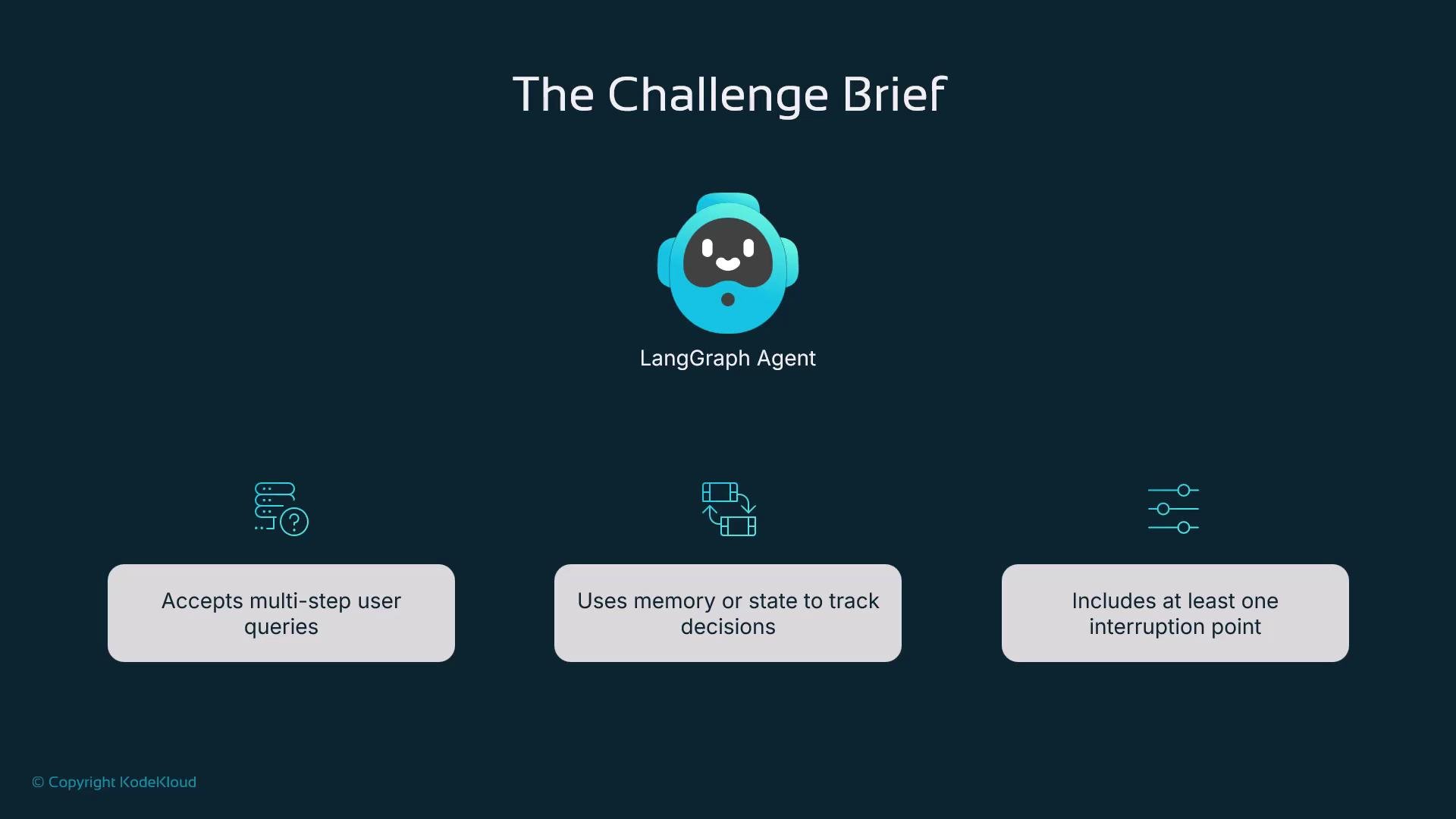
Design and implement a LangGraph application that moves beyond single-step chains. Core requirements:
* Accept multi-step user queries (examples: planning a trip, diagnosing a technical issue, or guiding a multi-stage purchase).
* Maintain structured state to track decisions or accumulated context across the interaction.
* Include at least one interruption point where a human can review, approve, or modify the flow.
Think of this as a small assistant that adapts over time and can be paused for human oversight.
 ## Implementation tips and architecture ideas
Model the workflow clearly and keep nodes focused:
* Represent the flow as a directed graph of nodes. Each node should have a single responsibility: input parsing, decision logic, external API call, state update, or human review.
* Use dedicated state nodes (or a small set of them) to represent session state. Avoid passing opaque blobs; model the specific fields you need (for example: itinerary, constraints, user preferences, last action).
* Design explicit interruption nodes that halt automated progress and surface a concise summary for a human reviewer. Make these nodes easy to trigger and to resume from after approval.
* Keep each step idempotent and logful so you can retry or resume safely after failures.
* Add small automated tests for key transitions (for example: “given state `X` and input `Y`, graph should produce action `Z`”).
Example node responsibilities (use this as a starting checklist):
| Node type | Responsibility | Example outputs |
| -------------- | -------------------------------------- | ------------------------------------- |
| Input parser | Normalize and validate user input | `intent`, `entities` |
| Decision logic | Compute next step or branching choice | `next_node_id` |
| External API | Fetch or post external data | `flight_options`, `diagnostic_report` |
| State updater | Mutate typed session fields | `itinerary`, `preferences` |
| Human review | Pause and present summary for approval | `approval_status` |
When modeling state, prefer well-typed, minimal fields. Example state shape:
```json theme={null}
{
"sessionId": "abc123",
"itinerary": {
"destinations": [],
"dates": {}
},
"preferences": {
"budget": "moderate",
"flightClass": "economy"
},
"lastAction": "search_flights"
}
```
When designing state, favor small, well-typed fields over opaque blobs — it makes debugging, testing, and persistence far easier.
### Practical tips for interruptions and resumption
* Surface a compact summary at interruption nodes: top-level context, outstanding choices, and recommended action.
* Implement authorization guards so only authorized reviewers can approve or modify flows.
* Store a resumable checkpoint of the graph position and the minimal state needed to continue.
* Log decisions and reviewer comments for auditability.
## Implementation tips and architecture ideas
Model the workflow clearly and keep nodes focused:
* Represent the flow as a directed graph of nodes. Each node should have a single responsibility: input parsing, decision logic, external API call, state update, or human review.
* Use dedicated state nodes (or a small set of them) to represent session state. Avoid passing opaque blobs; model the specific fields you need (for example: itinerary, constraints, user preferences, last action).
* Design explicit interruption nodes that halt automated progress and surface a concise summary for a human reviewer. Make these nodes easy to trigger and to resume from after approval.
* Keep each step idempotent and logful so you can retry or resume safely after failures.
* Add small automated tests for key transitions (for example: “given state `X` and input `Y`, graph should produce action `Z`”).
Example node responsibilities (use this as a starting checklist):
| Node type | Responsibility | Example outputs |
| -------------- | -------------------------------------- | ------------------------------------- |
| Input parser | Normalize and validate user input | `intent`, `entities` |
| Decision logic | Compute next step or branching choice | `next_node_id` |
| External API | Fetch or post external data | `flight_options`, `diagnostic_report` |
| State updater | Mutate typed session fields | `itinerary`, `preferences` |
| Human review | Pause and present summary for approval | `approval_status` |
When modeling state, prefer well-typed, minimal fields. Example state shape:
```json theme={null}
{
"sessionId": "abc123",
"itinerary": {
"destinations": [],
"dates": {}
},
"preferences": {
"budget": "moderate",
"flightClass": "economy"
},
"lastAction": "search_flights"
}
```
When designing state, favor small, well-typed fields over opaque blobs — it makes debugging, testing, and persistence far easier.
### Practical tips for interruptions and resumption
* Surface a compact summary at interruption nodes: top-level context, outstanding choices, and recommended action.
* Implement authorization guards so only authorized reviewers can approve or modify flows.
* Store a resumable checkpoint of the graph position and the minimal state needed to continue.
* Log decisions and reviewer comments for auditability.
 ## Stretch goals (optional)
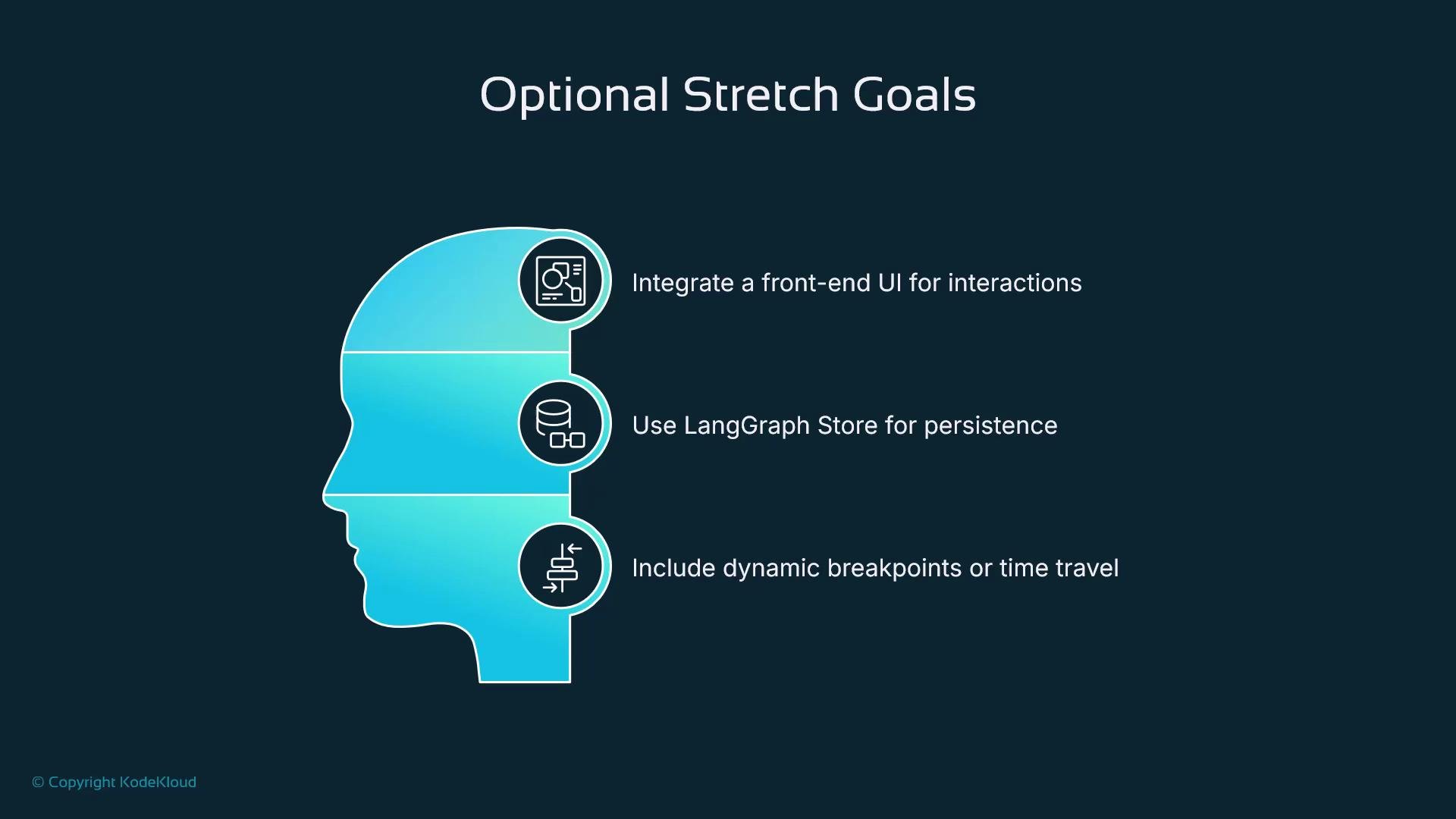
If you want an extra challenge, try one or more of these:
* Integrate a front-end UI with richer interactions (buttons, forms, visual timelines).
* Persist user sessions so state survives restarts and can be audited.
* Add debugging tools such as breakpoints, inspectable traces, or time travel for replaying previous steps.
These map to common production patterns and help you learn advanced design trade-offs.
## Evaluation: how to judge your work
Assess your project against these core dimensions:
| Dimension | What to look for |
| ------------------------ | --------------------------------------------------------------------------------- |
| Modularity & readability | Is the graph organized into clear, reusable nodes? |
| Meaningful use of state | Are you storing and using structured state rather than just passing data through? |
| Human-in-the-loop value | Does human review improve safety, correctness, or user experience? |
| Robustness | Does the graph handle retries, unexpected inputs, and errors gracefully? |
You don't need to be perfect — the goal is to learn by building and iterating.
## Sharing and community
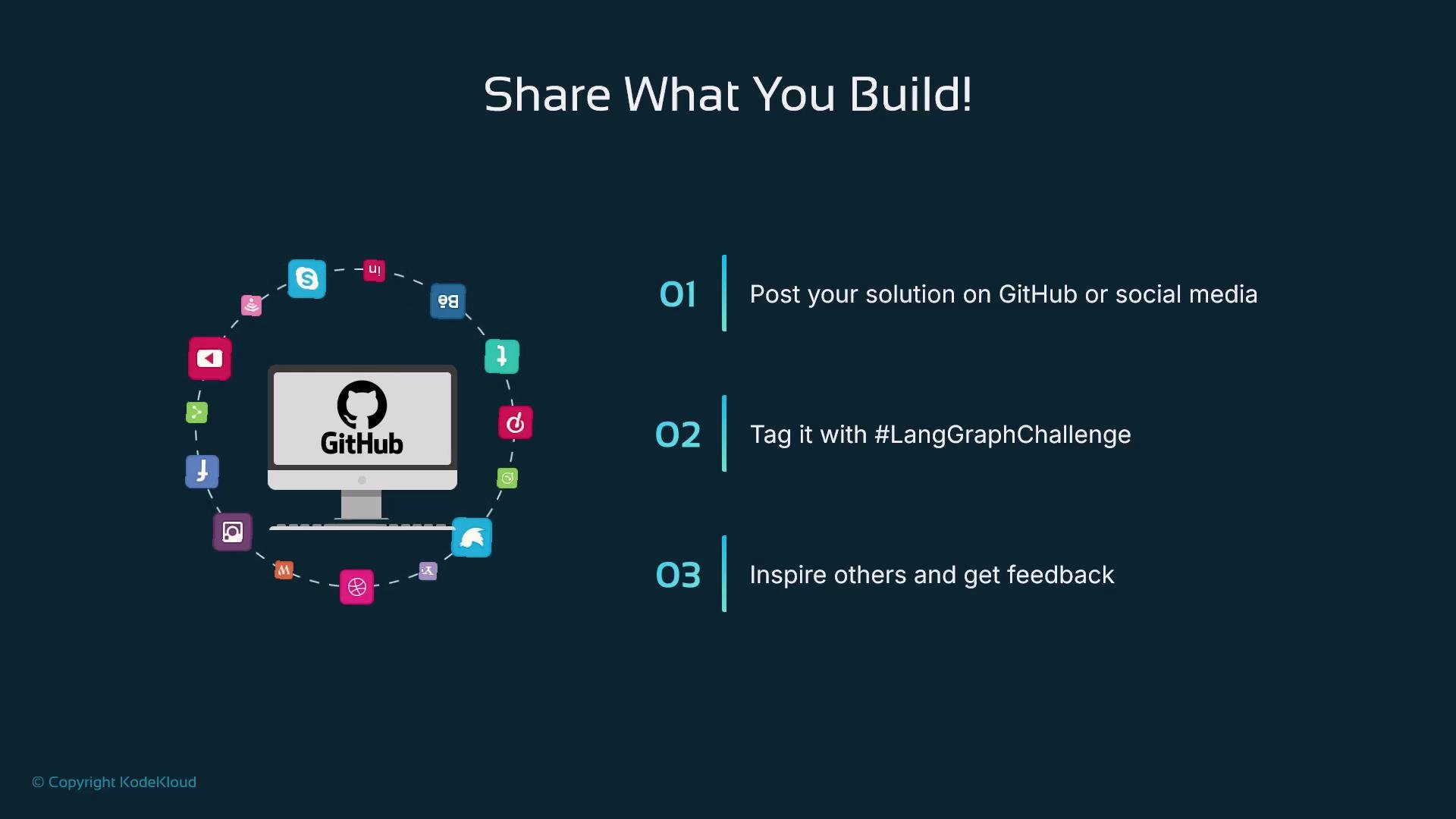
When you're finished, share your project. Publish the graph on [GitHub](https://github.com), write a short article or tweet about your approach, and tag it with `#LangGraphChallenge`. Sharing helps you get feedback, discover better patterns, and inspire others.
## Stretch goals (optional)
If you want an extra challenge, try one or more of these:
* Integrate a front-end UI with richer interactions (buttons, forms, visual timelines).
* Persist user sessions so state survives restarts and can be audited.
* Add debugging tools such as breakpoints, inspectable traces, or time travel for replaying previous steps.
These map to common production patterns and help you learn advanced design trade-offs.
## Evaluation: how to judge your work
Assess your project against these core dimensions:
| Dimension | What to look for |
| ------------------------ | --------------------------------------------------------------------------------- |
| Modularity & readability | Is the graph organized into clear, reusable nodes? |
| Meaningful use of state | Are you storing and using structured state rather than just passing data through? |
| Human-in-the-loop value | Does human review improve safety, correctness, or user experience? |
| Robustness | Does the graph handle retries, unexpected inputs, and errors gracefully? |
You don't need to be perfect — the goal is to learn by building and iterating.
## Sharing and community
When you're finished, share your project. Publish the graph on [GitHub](https://github.com), write a short article or tweet about your approach, and tag it with `#LangGraphChallenge`. Sharing helps you get feedback, discover better patterns, and inspire others.
 This is a great way to connect and grow. The self-challenge is the bridge from learner to builder — use what you learned about LangGraph patterns to create something uniquely yours.
## Key takeaways
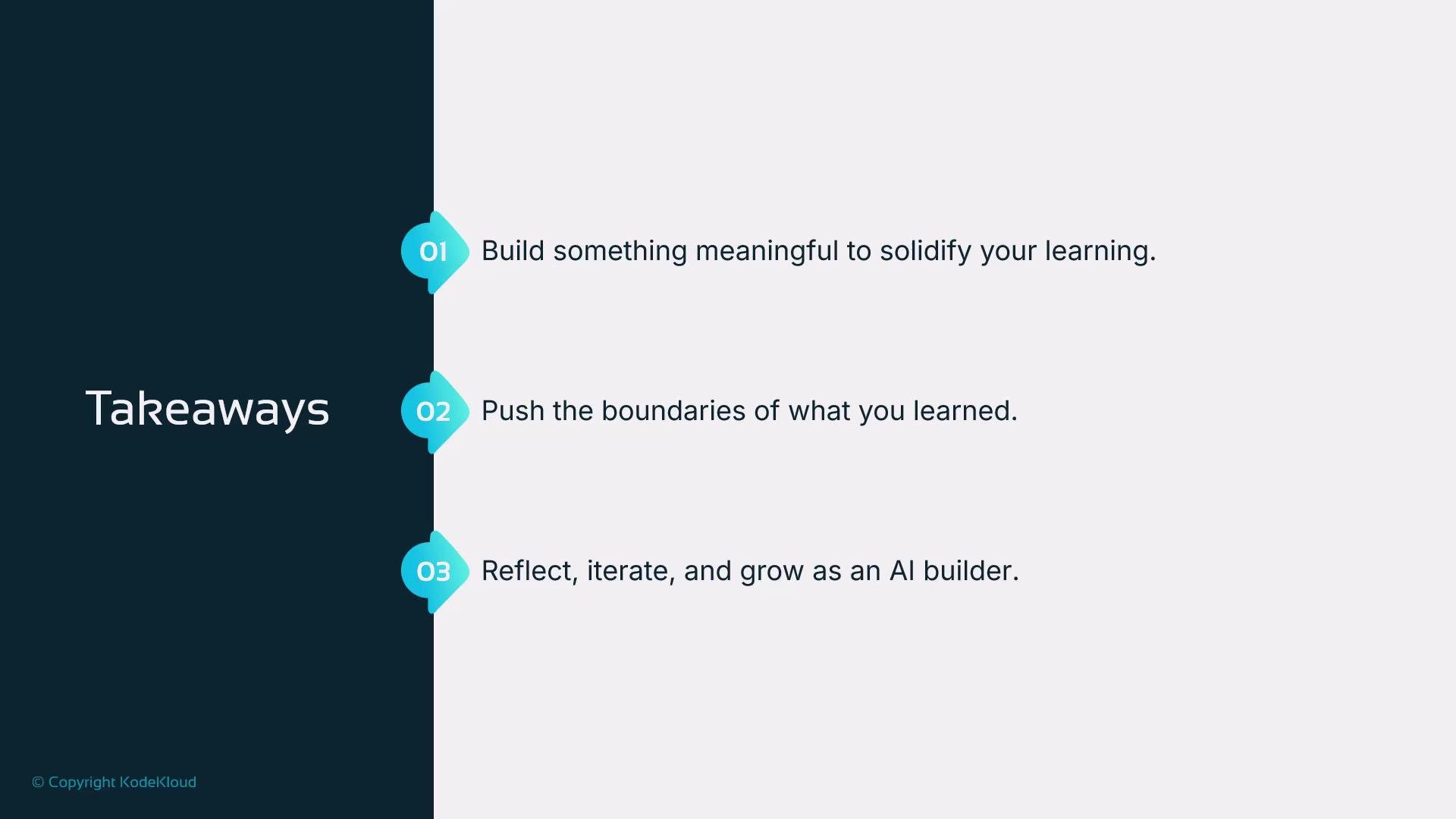
* Build something meaningful to solidify learning.
* Push the boundaries of what you learned: state handling, human-in-the-loop, persistence, and debugging.
* Reflect, iterate, and grow as an AI builder — each iteration teaches you more about design trade-offs and system behavior.
This is a great way to connect and grow. The self-challenge is the bridge from learner to builder — use what you learned about LangGraph patterns to create something uniquely yours.
## Key takeaways
* Build something meaningful to solidify learning.
* Push the boundaries of what you learned: state handling, human-in-the-loop, persistence, and debugging.
* Reflect, iterate, and grow as an AI builder — each iteration teaches you more about design trade-offs and system behavior.
 Be mindful of user privacy and safety: never store sensitive personal data or API secrets in cleartext state. Add guards to interruption points to prevent accidental exposure of sensitive content.
Good luck — explore, build, and share what you create.
## Resources and references
* [LangGraph documentation](https://github.com) (start by searching for LangGraph repos and examples)
* [Kubernetes Basics](https://kubernetes.io/docs/concepts/overview/what-is-kubernetes/) — for deployment patterns
* [GitHub](https://github.com) — share your project and tag it with `#LangGraphChallenge`
Be mindful of user privacy and safety: never store sensitive personal data or API secrets in cleartext state. Add guards to interruption points to prevent accidental exposure of sensitive content.
Good luck — explore, build, and share what you create.
## Resources and references
* [LangGraph documentation](https://github.com) (start by searching for LangGraph repos and examples)
* [Kubernetes Basics](https://kubernetes.io/docs/concepts/overview/what-is-kubernetes/) — for deployment patterns
* [GitHub](https://github.com) — share your project and tag it with `#LangGraphChallenge`