> ## Documentation Index
> Fetch the complete documentation index at: https://notes.kodekloud.com/llms.txt
> Use this file to discover all available pages before exploring further.
# Automations
> Explains automation in loop engineering by repeating tasks, evaluating results, applying incremental fixes, saving progress, using timer or run-until-done loops, and enforcing guardrails for safe improvement.
An automation is the engine that powers a loop — it runs tasks repeatedly, evaluates results, and acts on those results until the work is done. Automation turns a one-off try into a reliable loop and is the first of the six parts of loop engineering.
Common loop-triggering commands in AI tooling look like:
```bash theme={null}
/go run until done
/loop repeat on a schedule
/ralph-loop repeat a prompt
```
The core idea is simple: repeat the same prompt (or task), check the result, act on it, and keep repeating until a clear stop signal appears. Repeat, check, repeat — that is automation.
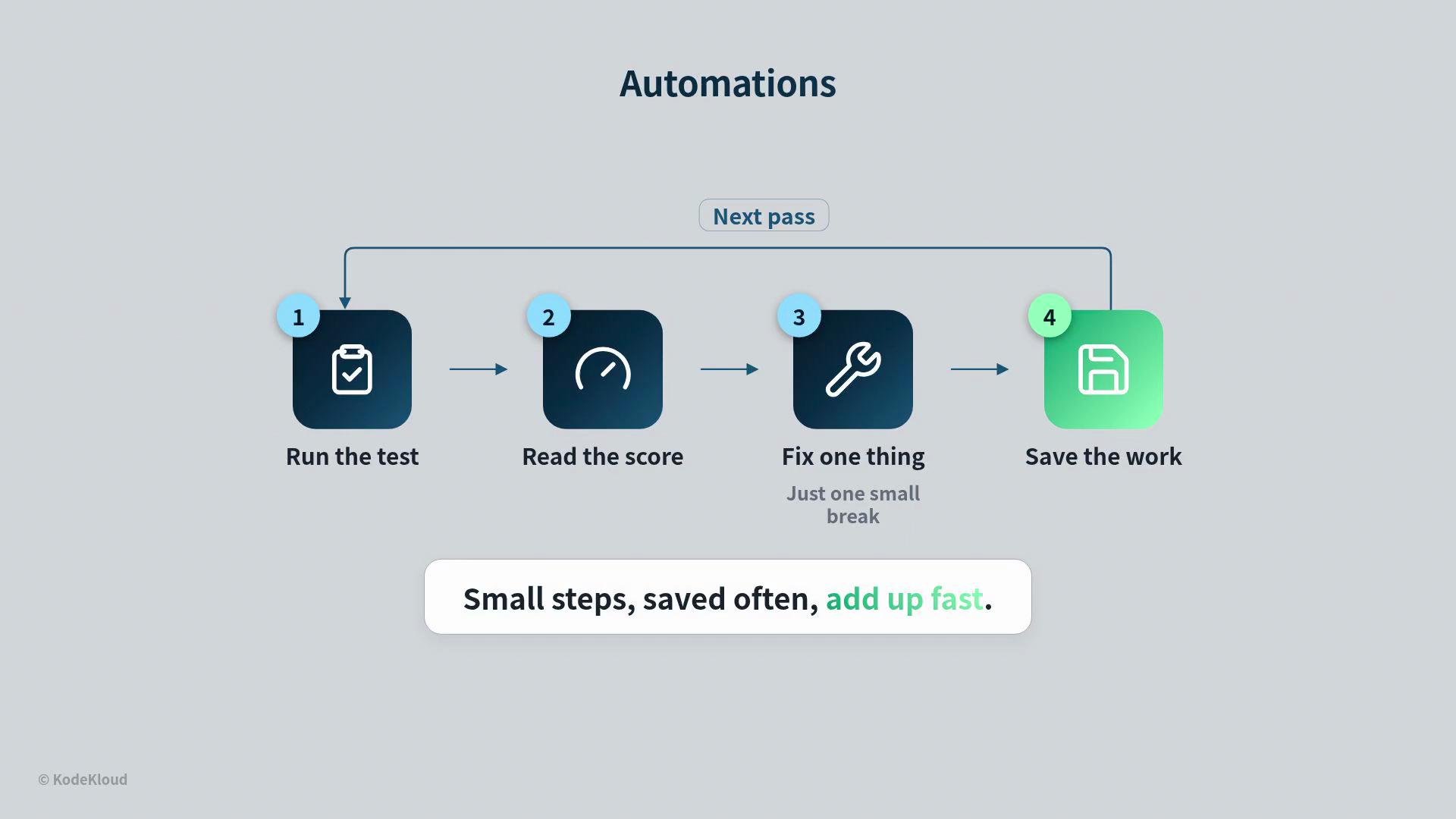
How one pass through the loop works
1. Run the test (or produce an output).
2. Read the score (evaluate the result against a metric).
3. Fix one small failing thing — not everything at once. Focused, incremental fixes are key.
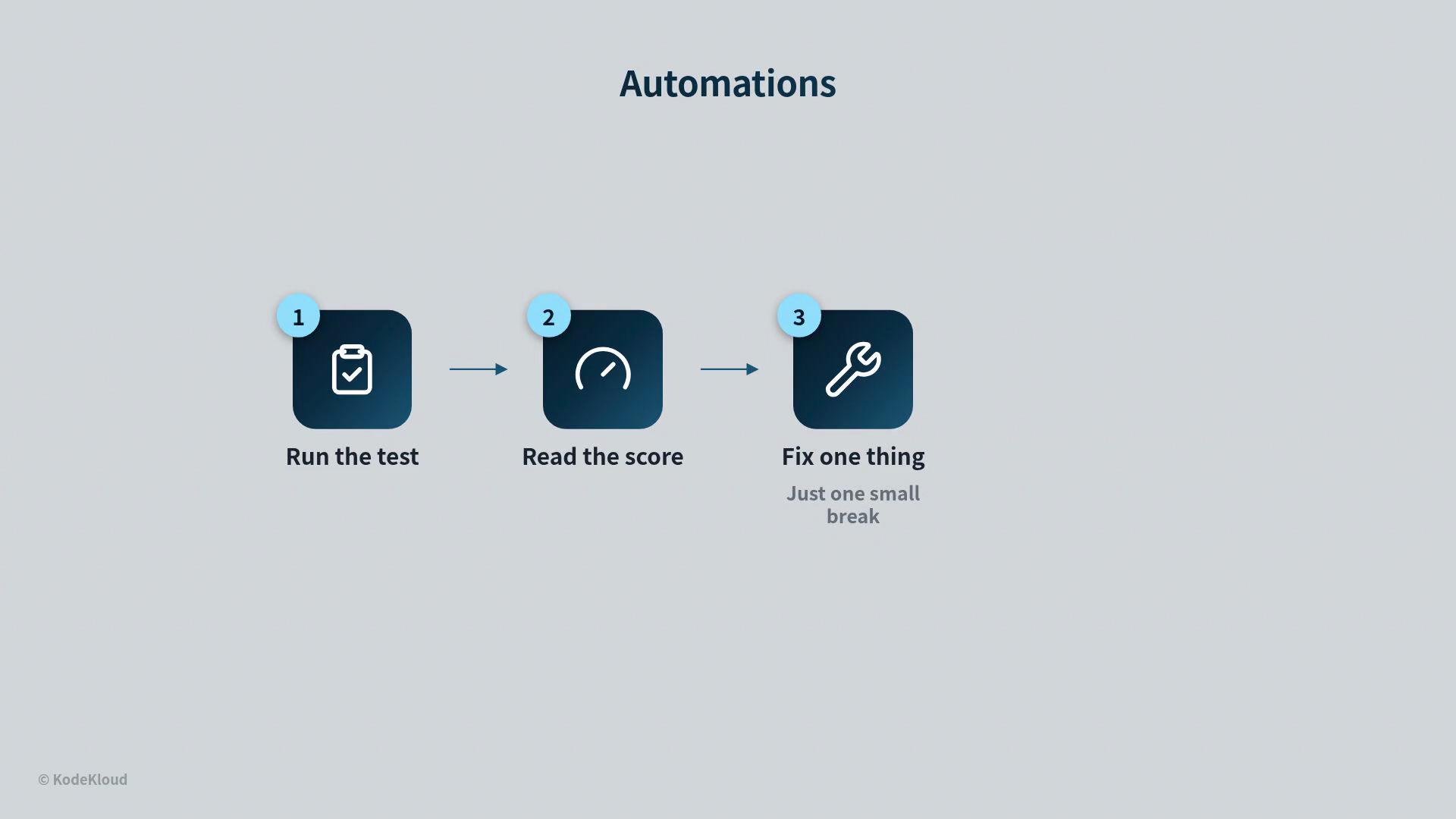 4. Save the good work (commit or persist the improvement). Then start the next pass. Small steps, saved frequently, compound into rapid, reliable progress.
 Two common loop styles
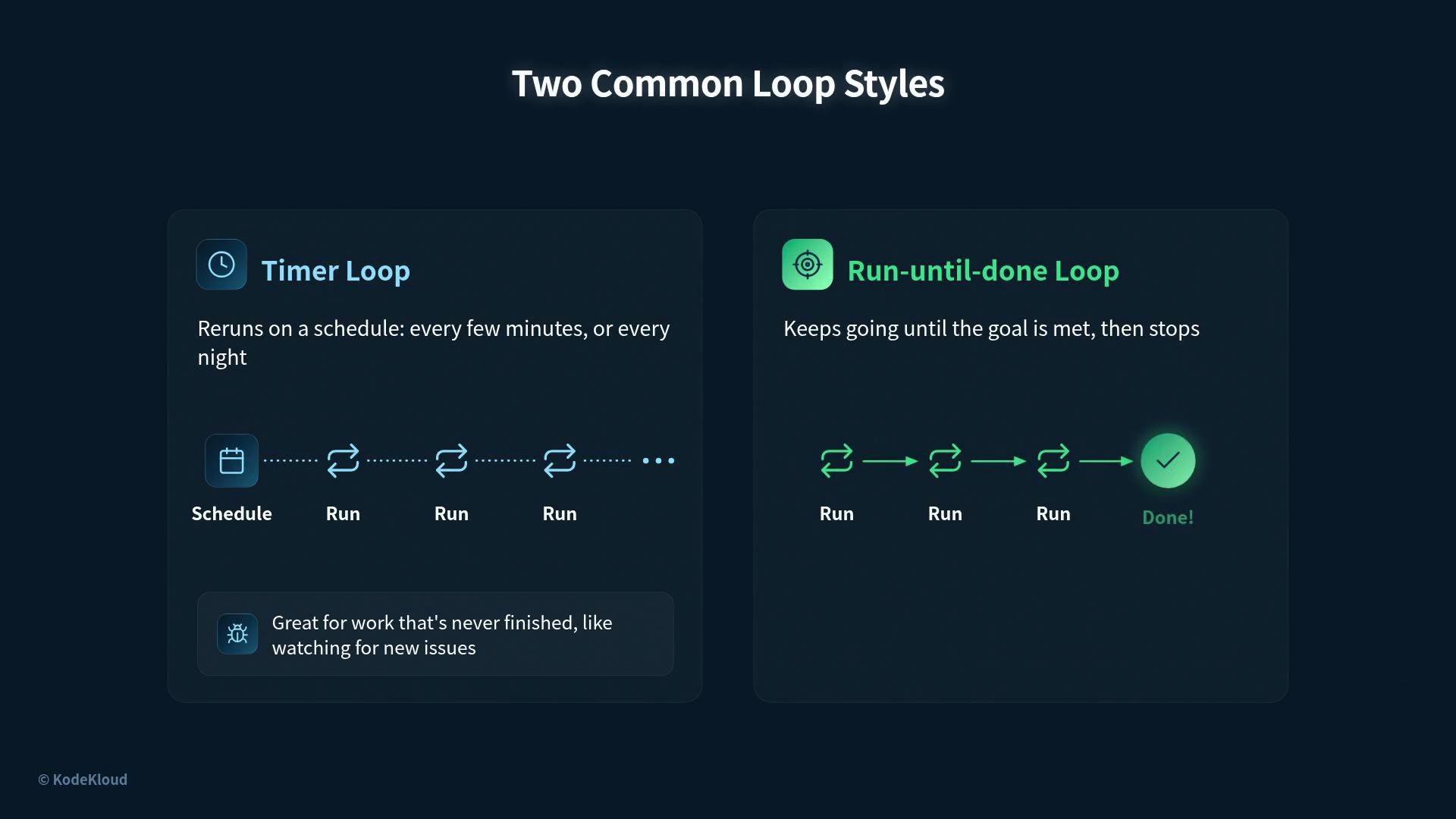
* Timer loop: runs on a schedule (every few minutes, hourly, nightly). Acts like a cron job and is best for continuous monitoring (e.g., watching for new issues and acting on them).
* Run-until-done loop: repeats immediately as needed until a finish signal appears, then stops. Requires a precise definition of “done” (for example, “all checks pass”).
Choose a timer loop for ongoing monitoring and maintenance. Choose a run-until-done loop when you have a concrete goal and a reliable finish signal (for example, all checks pass).
Two common loop styles
* Timer loop: runs on a schedule (every few minutes, hourly, nightly). Acts like a cron job and is best for continuous monitoring (e.g., watching for new issues and acting on them).
* Run-until-done loop: repeats immediately as needed until a finish signal appears, then stops. Requires a precise definition of “done” (for example, “all checks pass”).
Choose a timer loop for ongoing monitoring and maintenance. Choose a run-until-done loop when you have a concrete goal and a reliable finish signal (for example, all checks pass).
 Quick reference: loop styles
| Loop style | Schedule | Best for | Example trigger |
| -------------- | ------------------------------- | ---------------------------------------------- | ----------------------------------- |
| Timer loop | Scheduled intervals (cron-like) | Continuous monitoring, periodic checks | `every 5 minutes` or cron |
| Run-until-done | Immediate repeats until finish | Short-term automation with clear finish signal | `/go` or `run until all tests pass` |
Guardrails for a repeating engine
A repeating engine can be extremely effective — and potentially destructive — so add guardrails. Two rules matter most:
1. The score must only go up, never down. If a change reduces the score, the loop should undo that change automatically. Progress only counts when it holds.
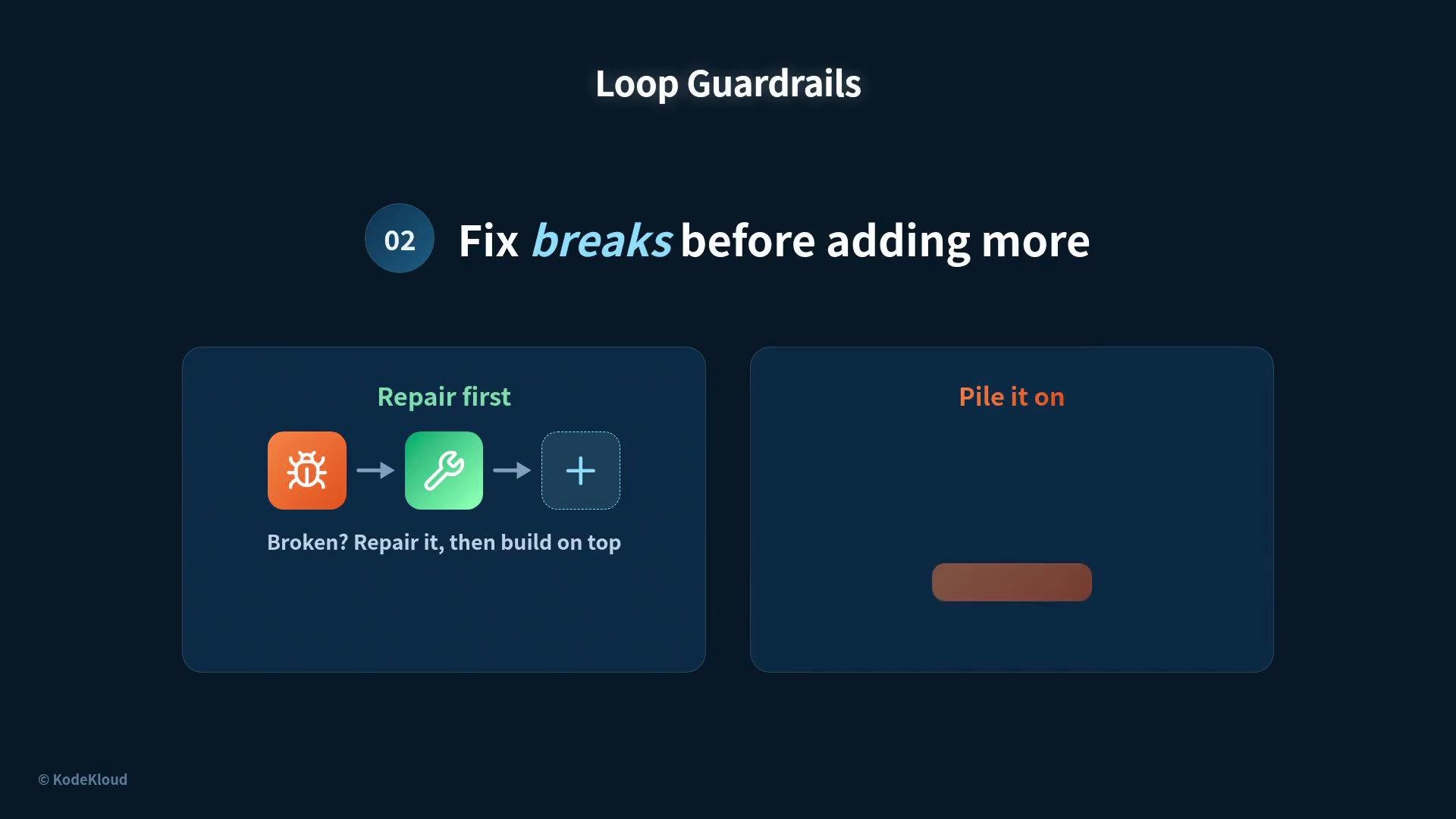
2. Fix breaks before adding more. If something is broken, repair it first; layering new work on a broken base compounds risk.
Quick reference: loop styles
| Loop style | Schedule | Best for | Example trigger |
| -------------- | ------------------------------- | ---------------------------------------------- | ----------------------------------- |
| Timer loop | Scheduled intervals (cron-like) | Continuous monitoring, periodic checks | `every 5 minutes` or cron |
| Run-until-done | Immediate repeats until finish | Short-term automation with clear finish signal | `/go` or `run until all tests pass` |
Guardrails for a repeating engine
A repeating engine can be extremely effective — and potentially destructive — so add guardrails. Two rules matter most:
1. The score must only go up, never down. If a change reduces the score, the loop should undo that change automatically. Progress only counts when it holds.
2. Fix breaks before adding more. If something is broken, repair it first; layering new work on a broken base compounds risk.
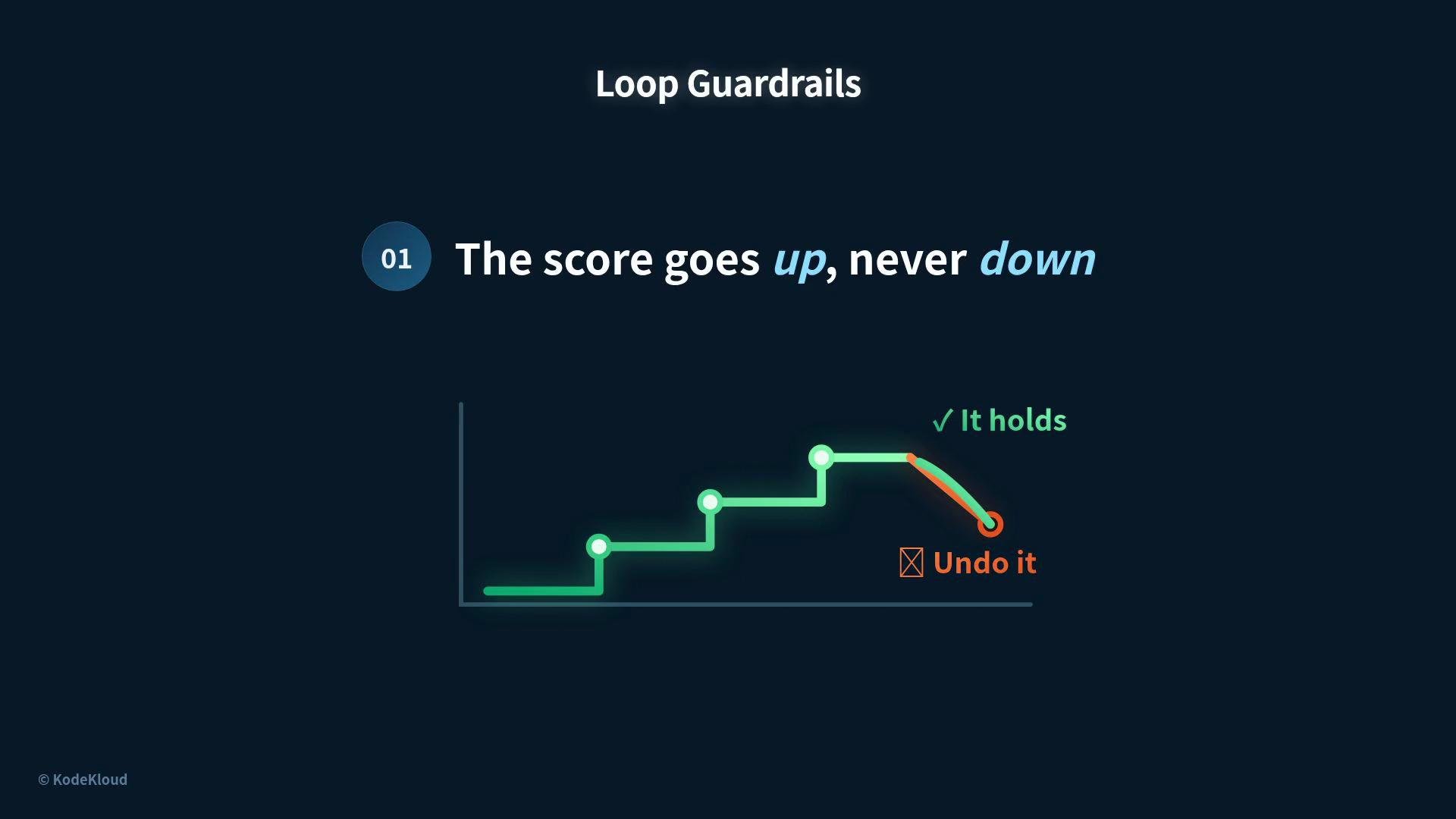 If an automated step decreases the score, ensure the loop can roll back that change automatically. Never accept regressions as forward progress.
 When these guardrails are enforced, the engine can run autonomously: it makes consistent, incremental improvements, persists each win, and stops when the finish signal appears. That is the purpose of automation — continuous progress without manual supervision.
Recap
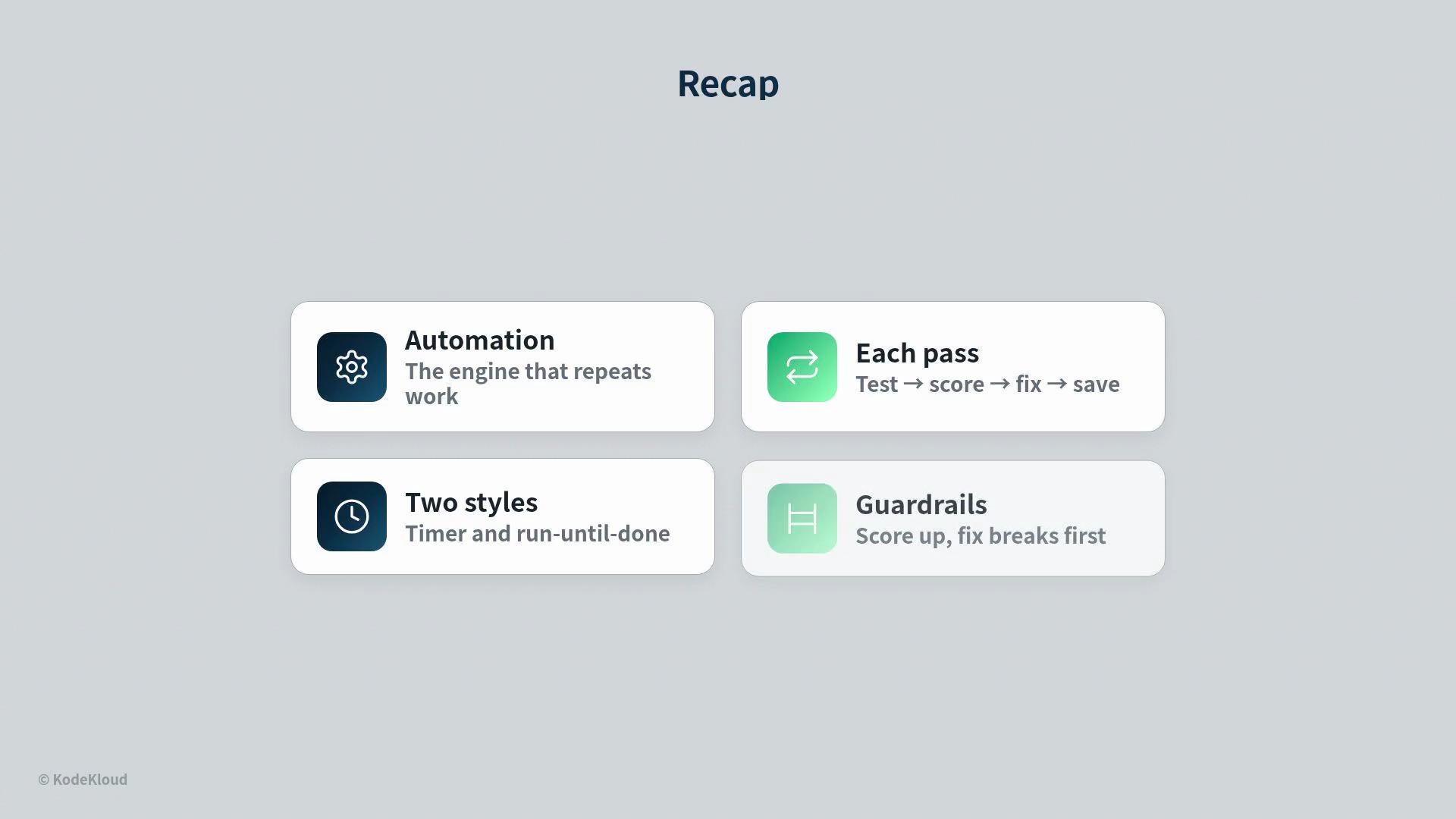
* Automation is the engine that repeats work and evaluates outcomes.
* Each pass: run the test, read the score, fix one small break, and save.
* Timer loops repeat on a schedule; run-until-done loops stop when the goal is met.
* Guardrails ensure the score never regresses and that fixes come before new additions.
When these guardrails are enforced, the engine can run autonomously: it makes consistent, incremental improvements, persists each win, and stops when the finish signal appears. That is the purpose of automation — continuous progress without manual supervision.
Recap
* Automation is the engine that repeats work and evaluates outcomes.
* Each pass: run the test, read the score, fix one small break, and save.
* Timer loops repeat on a schedule; run-until-done loops stop when the goal is met.
* Guardrails ensure the score never regresses and that fixes come before new additions.
 The score should go up, never down, and bugs get fixed first.
Links and references
* Cron (scheduling): [https://en.wikipedia.org/wiki/Cron](https://en.wikipedia.org/wiki/Cron)
* Continuous integration concepts: [https://en.wikipedia.org/wiki/Continuous\_integration](https://en.wikipedia.org/wiki/Continuous_integration)
The score should go up, never down, and bugs get fixed first.
Links and references
* Cron (scheduling): [https://en.wikipedia.org/wiki/Cron](https://en.wikipedia.org/wiki/Cron)
* Continuous integration concepts: [https://en.wikipedia.org/wiki/Continuous\_integration](https://en.wikipedia.org/wiki/Continuous_integration)