> ## Documentation Index
> Fetch the complete documentation index at: https://notes.kodekloud.com/llms.txt
> Use this file to discover all available pages before exploring further.
# A Brief History of Machine Learning
> A concise history of machine learning tracing its evolution from rule based systems to deep learning and transformers, highlighting key milestones like backpropagation, AlexNet, AlphaGo.
Most people picture machine learning as a recent invention — the kind of thing you ask ChatGPT to do — but the idea of building systems that improve from experience predates modern AI assistants by decades.
Long before models could write code, generate images, or finish homework, researchers asked a foundational question: can a machine get better at a task without being given every single rule explicitly? That question shaped the field from its earliest days.
## Early foundations (1950s–1960s)
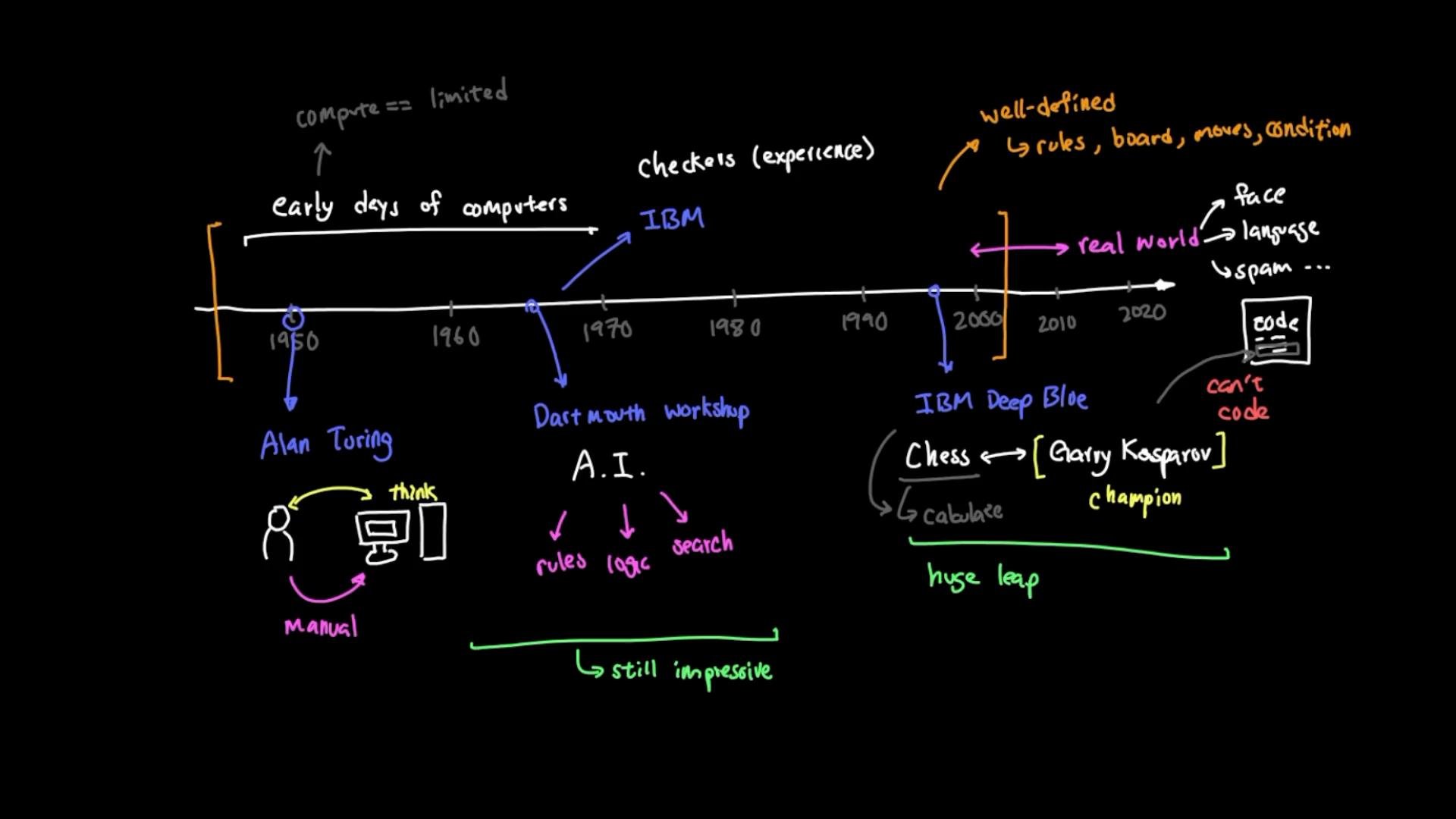
In 1950, [Alan Turing](https://www.csee.umbc.edu/courses/471/papers/turing.pdf) posed the question of whether machines could imitate human intelligence. The 1956 [Dartmouth workshop](https://en.wikipedia.org/wiki/Dartmouth_workshop) formalized artificial intelligence as a research field. Around the same era, [Arthur Samuel](https://en.wikipedia.org/wiki/Arthur_Samuel_\(computer_scientist\)) at IBM developed a checkers-playing program capable of improving through experience — an early practical demonstration of learning from data.
At the time, hardware and datasets were extremely limited, so many systems relied on rules, logic, and search. Researchers encoded intelligence manually:
* If this condition, then do that.
* If the board looks like this, make this move.
* If the user asks X, return Y.
These rule-based approaches produced remarkable results in narrow domains. For example, [IBM’s Deep Blue](https://en.wikipedia.org/wiki/Deep_Blue_\(chess_computer\)) defeated [Garry Kasparov](https://en.wikipedia.org/wiki/Garry_Kasparov) in 1997 by evaluating chess positions far more effectively than any human — yet Deep Blue was a specialized system and could not generalize to problems outside its domain (like debugging code).
Environments such as chess are well-defined: clear rules, finite legal moves, and precise objectives. Most real-world problems—face recognition, language translation, spam detection, recommendations, and autonomous driving—are messier, noisy, and ambiguous. Writing explicit rules for every possible scenario in those domains is impractical. That gap motivated the move toward learning systems.
 ## From rules to examples: the essence of machine learning
Instead of hard-coding every rule, machine learning systems use examples. We supply data and allow algorithms to discover patterns and relationships that generalize to new inputs. In short:
* Traditional software = humans write rules.
* Machine learning = humans design systems that learn from examples.
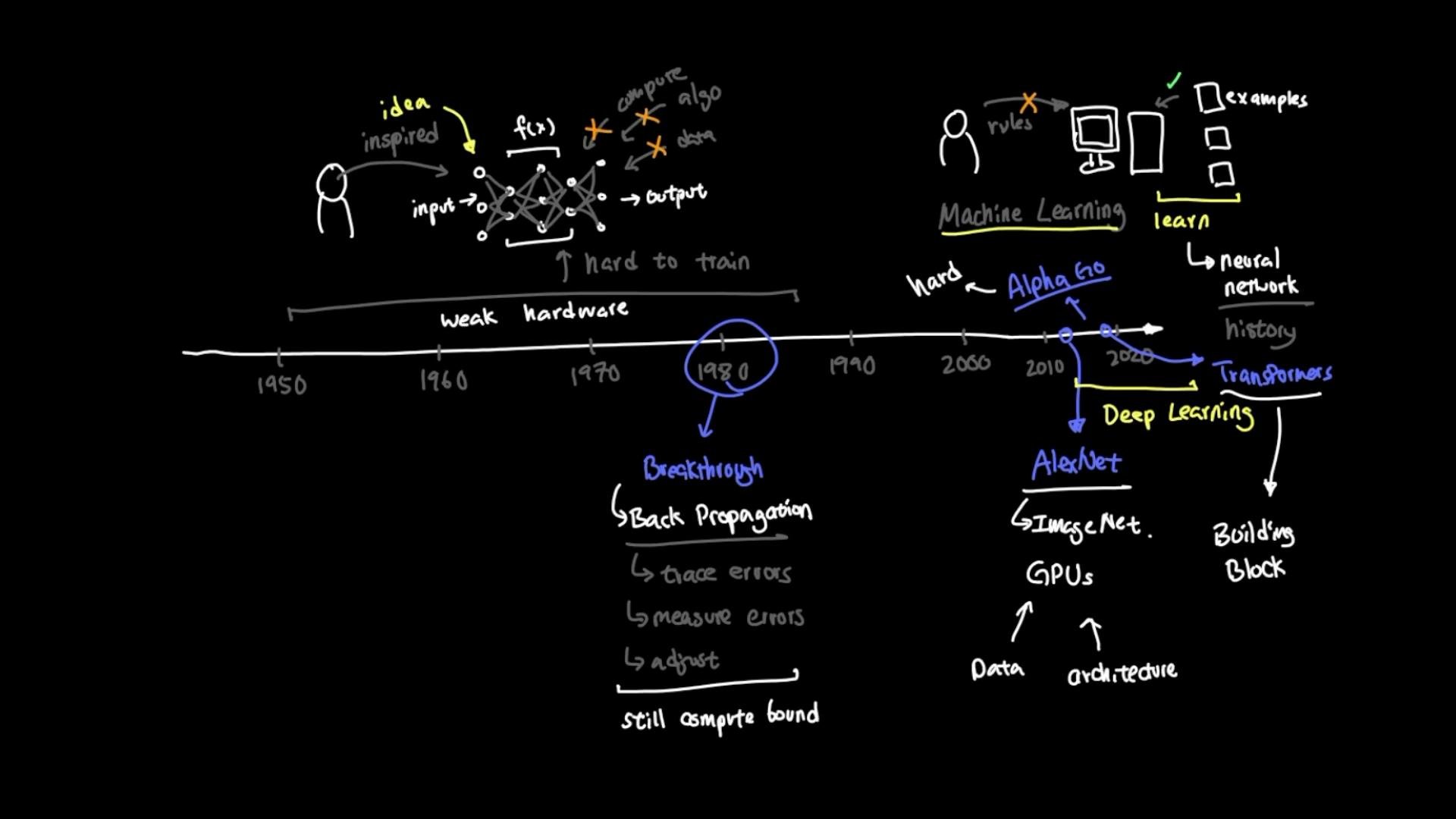
A central idea that helped accelerate this shift was the neural network — loosely inspired by the brain. A neural network maps inputs through layers of weighted connections and nonlinear functions to produce outputs. For many years these networks were difficult to train reliably because hardware was weak and datasets were small.
### Backpropagation and the practical training of networks
A key technical advance was the adoption of backpropagation in the 1980s. Backpropagation provides a practical algorithm to propagate errors backward through a network and update weights based on those errors.
Backpropagation: the model predicts an output, measures the prediction error, and then adjusts internal weights to reduce that error next time. This made multilayer neural networks trainable in practice and enabled deeper architectures as compute and data improved.
Even with backpropagation, progress was gradual until compute power and large datasets aligned.
## Deep learning breakthrough: AlexNet and beyond (2012 onward)
The watershed moment came in 2012 when [AlexNet](https://en.wikipedia.org/wiki/AlexNet) dramatically outperformed previous methods on the [ImageNet](https://www.image-net.org/) visual-recognition challenge by leveraging GPUs for training. That result proved that neural networks, when paired with big data and fast hardware, could scale to previously intractable vision tasks.
After AlexNet, deep learning quickly advanced across many fields:
* Computer vision (object detection, segmentation)
* Speech recognition and synthesis
* Machine translation and NLP
* Recommendation systems
* Reinforcement learning for games and robotics
A landmark example combining these advances is [AlphaGo](https://en.wikipedia.org/wiki/AlphaGo), which used deep neural networks, reinforcement learning, and search to beat top human players at Go — a problem far harder for brute-force search than chess, and one that required learning strategies rather than only hand-coded rules.
## The transformer era and modern large models
In 2017 the transformer architecture was introduced and changed the landscape of natural language processing. Transformers use attention mechanisms to model relationships across sequences efficiently, enabling much larger and more capable language models. These architectures are the backbone of modern large language models (LLMs) and many state-of-the-art systems across modalities.
## From rules to examples: the essence of machine learning
Instead of hard-coding every rule, machine learning systems use examples. We supply data and allow algorithms to discover patterns and relationships that generalize to new inputs. In short:
* Traditional software = humans write rules.
* Machine learning = humans design systems that learn from examples.
A central idea that helped accelerate this shift was the neural network — loosely inspired by the brain. A neural network maps inputs through layers of weighted connections and nonlinear functions to produce outputs. For many years these networks were difficult to train reliably because hardware was weak and datasets were small.
### Backpropagation and the practical training of networks
A key technical advance was the adoption of backpropagation in the 1980s. Backpropagation provides a practical algorithm to propagate errors backward through a network and update weights based on those errors.
Backpropagation: the model predicts an output, measures the prediction error, and then adjusts internal weights to reduce that error next time. This made multilayer neural networks trainable in practice and enabled deeper architectures as compute and data improved.
Even with backpropagation, progress was gradual until compute power and large datasets aligned.
## Deep learning breakthrough: AlexNet and beyond (2012 onward)
The watershed moment came in 2012 when [AlexNet](https://en.wikipedia.org/wiki/AlexNet) dramatically outperformed previous methods on the [ImageNet](https://www.image-net.org/) visual-recognition challenge by leveraging GPUs for training. That result proved that neural networks, when paired with big data and fast hardware, could scale to previously intractable vision tasks.
After AlexNet, deep learning quickly advanced across many fields:
* Computer vision (object detection, segmentation)
* Speech recognition and synthesis
* Machine translation and NLP
* Recommendation systems
* Reinforcement learning for games and robotics
A landmark example combining these advances is [AlphaGo](https://en.wikipedia.org/wiki/AlphaGo), which used deep neural networks, reinforcement learning, and search to beat top human players at Go — a problem far harder for brute-force search than chess, and one that required learning strategies rather than only hand-coded rules.
## The transformer era and modern large models
In 2017 the transformer architecture was introduced and changed the landscape of natural language processing. Transformers use attention mechanisms to model relationships across sequences efficiently, enabling much larger and more capable language models. These architectures are the backbone of modern large language models (LLMs) and many state-of-the-art systems across modalities.
 ## Timeline of major milestones
| Year | Milestone | Why it matters |
| - | - | - |
| 1950 | Alan Turing's question about machine intelligence | Framed the foundational question of AI |
| 1956 | Dartmouth workshop | Established AI as a formal research field |
| 1950s–60s | Rule-based systems and symbolic AI | Solved narrow tasks with hand-crafted rules |
| 1959–1960s | Arthur Samuel's checkers program | Early system that improved through experience |
| 1980s | Backpropagation becomes practical | Enabled training of multilayer neural networks |
| 1997 | Deep Blue defeats Kasparov | Powerful specialized search-based system |
| 2012 | AlexNet wins ImageNet using GPUs | Demonstrated the power of deep learning + data + compute |
| 2016 | AlphaGo defeats top Go player | Combined deep learning and RL to solve complex strategy game |
| 2017 | Transformer architecture introduced | Enabled the current generation of LLMs and sequence models |
## What it means for a system to “learn”
Learning, in practical terms, means using data to adjust parameters of a model so that the model generalizes well to new, unseen inputs. Designing learning algorithms involves choosing:
* A model or architecture (e.g., neural networks, decision trees)
* A loss function that quantifies error
* An optimization algorithm to minimize that loss (e.g., SGD, Adam)
* Appropriate data and preprocessing
* Evaluation metrics and validation strategies
As hardware, datasets, and algorithms improved, systems moved from narrow, rule-based behaviors toward flexible learning-based approaches that can adapt to a wide range of tasks.
## Further reading and references
* [Alan Turing — Computing Machinery and Intelligence (1950)](https://www.csee.umbc.edu/courses/471/papers/turing.pdf)
* [Dartmouth workshop (1956) — Wikipedia](https://en.wikipedia.org/wiki/Dartmouth_workshop)
* [Arthur Samuel — Wikipedia](https://en.wikipedia.org/wiki/Arthur_Samuel_\(computer_scientist\))
* [Deep Blue — Wikipedia](https://en.wikipedia.org/wiki/Deep_Blue_\(chess_computer\))
* [Backpropagation — Wikipedia](https://en.wikipedia.org/wiki/Backpropagation)
* [AlexNet — Wikipedia](https://en.wikipedia.org/wiki/AlexNet)
* [ImageNet — Official site](https://www.image-net.org/)
* [AlphaGo — Wikipedia](https://en.wikipedia.org/wiki/AlphaGo)
* [Attention Is All You Need (Transformer paper)](https://arxiv.org/abs/1706.03762)
If you want a concise takeaway: machine learning evolved from rule-based systems to data-driven models because real-world tasks are noisy and complex. Key enablers were algorithms (e.g., backpropagation), big datasets, and accelerating hardware (GPUs/TPUs), culminating in architectures like transformers that power today’s AI systems.
This documentation is built and hosted on [Mintlify](https://mintlify.com), a developer documentation platform.
## Timeline of major milestones
| Year | Milestone | Why it matters |
| - | - | - |
| 1950 | Alan Turing's question about machine intelligence | Framed the foundational question of AI |
| 1956 | Dartmouth workshop | Established AI as a formal research field |
| 1950s–60s | Rule-based systems and symbolic AI | Solved narrow tasks with hand-crafted rules |
| 1959–1960s | Arthur Samuel's checkers program | Early system that improved through experience |
| 1980s | Backpropagation becomes practical | Enabled training of multilayer neural networks |
| 1997 | Deep Blue defeats Kasparov | Powerful specialized search-based system |
| 2012 | AlexNet wins ImageNet using GPUs | Demonstrated the power of deep learning + data + compute |
| 2016 | AlphaGo defeats top Go player | Combined deep learning and RL to solve complex strategy game |
| 2017 | Transformer architecture introduced | Enabled the current generation of LLMs and sequence models |
## What it means for a system to “learn”
Learning, in practical terms, means using data to adjust parameters of a model so that the model generalizes well to new, unseen inputs. Designing learning algorithms involves choosing:
* A model or architecture (e.g., neural networks, decision trees)
* A loss function that quantifies error
* An optimization algorithm to minimize that loss (e.g., SGD, Adam)
* Appropriate data and preprocessing
* Evaluation metrics and validation strategies
As hardware, datasets, and algorithms improved, systems moved from narrow, rule-based behaviors toward flexible learning-based approaches that can adapt to a wide range of tasks.
## Further reading and references
* [Alan Turing — Computing Machinery and Intelligence (1950)](https://www.csee.umbc.edu/courses/471/papers/turing.pdf)
* [Dartmouth workshop (1956) — Wikipedia](https://en.wikipedia.org/wiki/Dartmouth_workshop)
* [Arthur Samuel — Wikipedia](https://en.wikipedia.org/wiki/Arthur_Samuel_\(computer_scientist\))
* [Deep Blue — Wikipedia](https://en.wikipedia.org/wiki/Deep_Blue_\(chess_computer\))
* [Backpropagation — Wikipedia](https://en.wikipedia.org/wiki/Backpropagation)
* [AlexNet — Wikipedia](https://en.wikipedia.org/wiki/AlexNet)
* [ImageNet — Official site](https://www.image-net.org/)
* [AlphaGo — Wikipedia](https://en.wikipedia.org/wiki/AlphaGo)
* [Attention Is All You Need (Transformer paper)](https://arxiv.org/abs/1706.03762)
If you want a concise takeaway: machine learning evolved from rule-based systems to data-driven models because real-world tasks are noisy and complex. Key enablers were algorithms (e.g., backpropagation), big datasets, and accelerating hardware (GPUs/TPUs), culminating in architectures like transformers that power today’s AI systems.
This documentation is built and hosted on [Mintlify](https://mintlify.com), a developer documentation platform.