> ## Documentation Index
> Fetch the complete documentation index at: https://notes.kodekloud.com/llms.txt
> Use this file to discover all available pages before exploring further.
# Word Completion vs Chat Completion
> This article explains the differences between word completion and chat completion in OpenAIs GPT-3.5 Turbo model.
Before integrating a chatbot into your application, it’s essential to understand the difference between **word completion** and **chat completion**. Although both use the same underlying GPT-3.5-Turbo model, their usage patterns—and the way they manage context—are very different.
## What Is Word Completion?
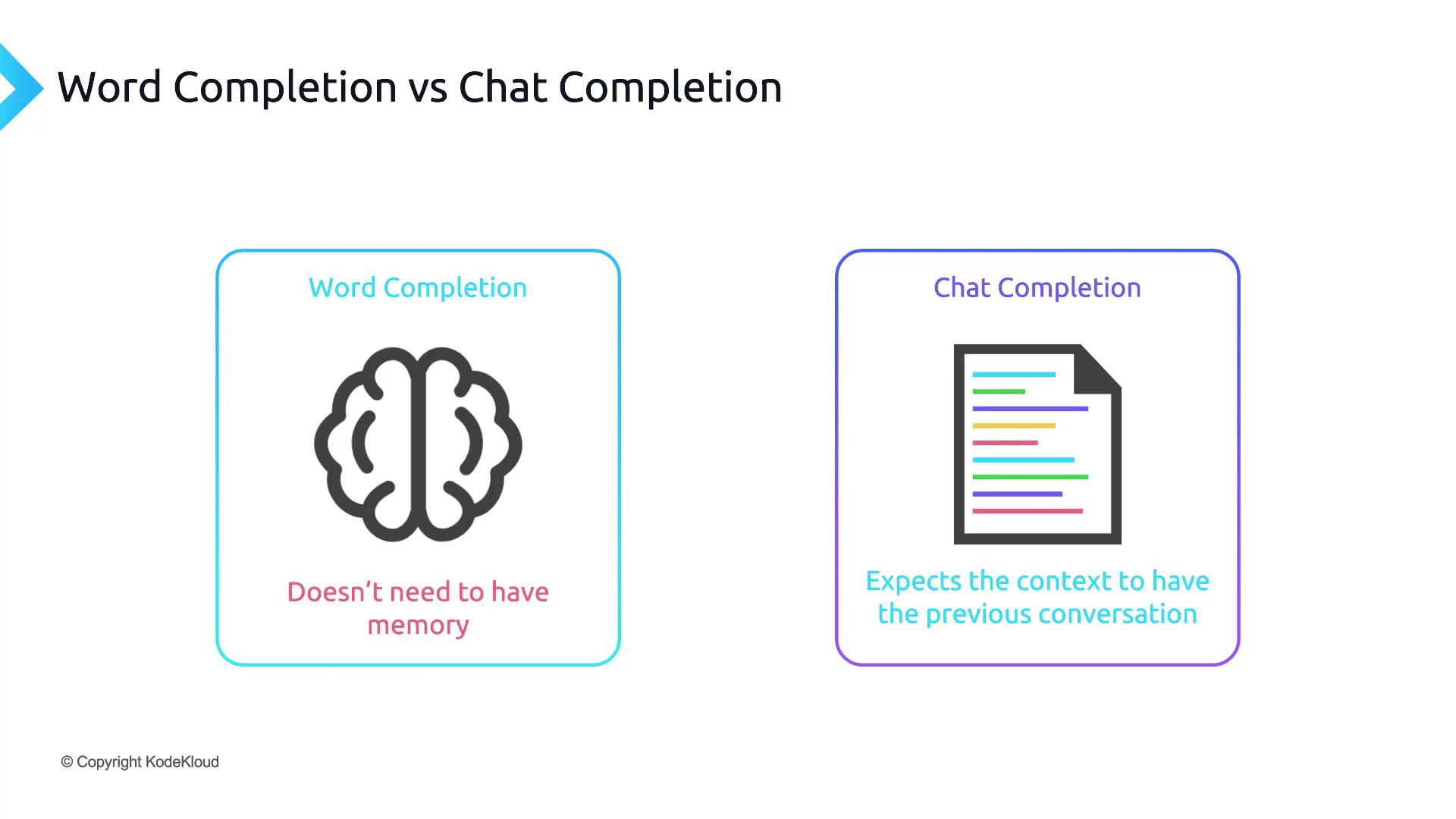
Word completion is a **stateless** API call. You send a single prompt, and the model returns a continuation without retaining any memory of previous interactions.
Key characteristics:
* Single-shot responses
* No conversation history
* Simpler, lower token usage
## What Is Chat Completion?
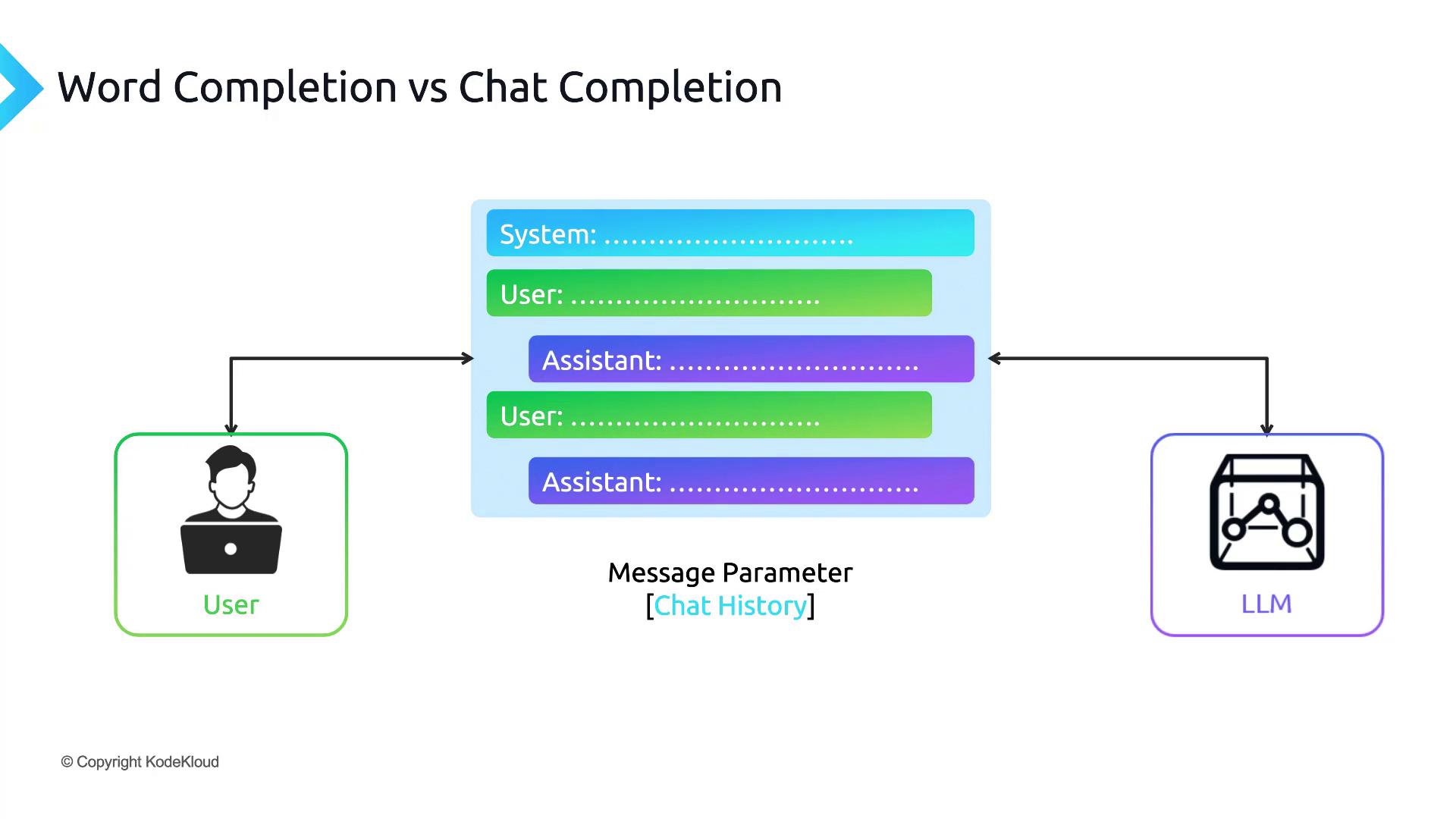
Chat completion is **stateful**. You maintain a record of all messages in a `messages` array, allowing the model to build on past user and assistant exchanges.
### How Chat Completion Works
1. You create an ordered `messages` list.
2. Each entry has a `role`: **system**, **user**, or **assistant**.
3. You submit the full history each time you call the API.
4. The model returns a response that accounts for all previous context.
### Roles in the `messages` Array
| Role | Description | Example |
| --------- | ---------------------------------------------------------------- | ---------------------------------------------------------------- |
| system | Sets global instructions or persona | “You are a physics professor.” |
| user | Represents the human’s input at each turn | “Explain quantum mechanics in simple terms.” |
| assistant | Model-generated responses that continue the conversation context | “Quantum mechanics is the study of matter at very small scales…” |
* Use **word completion** for simple text continuations, code generation, or single-turn tasks.
* Use **chat completion** for multi-turn conversations, contextual assistants, and applications that require stateful interaction.
## Sample Chat Completion Request
```json theme={null}
POST https://api.openai.com/v1/chat/completions
Content-Type: application/json
Authorization: Bearer YOUR_API_KEY
{
"model": "gpt-3.5-turbo",
"messages": [
{ "role": "system", "content": "You are a helpful assistant." },
{ "role": "user", "content": "Explain photosynthesis." }
]
}
```
## Comparison at a Glance
| Feature | Word Completion | Chat Completion |
| ----------------- | --------------------- | -------------------------------- |
| Context Handling | Stateless | Stateful via `messages` array |
| Best for | Single-turn prompts | Multi-turn conversations |
| Token Efficiency | Fewer overhead tokens | More overhead tokens for history |
| Recommended Model | GPT-3.5-Turbo | GPT-3.5-Turbo |
## Further Reading and References
* [OpenAI Chat Completion API Reference](https://platform.openai.com/docs/guides/chat)
* [OpenAI Completion API Reference](https://platform.openai.com/docs/api-reference/completions)
* [Kubernetes Basics](https://kubernetes.io/docs/concepts/overview/what-is-kubernetes/)
* [Terraform Registry](https://registry.terraform.io/)