> ## Documentation Index
> Fetch the complete documentation index at: https://notes.kodekloud.com/llms.txt
> Use this file to discover all available pages before exploring further.
# OpenAI Model Variants
> OpenAI’s API offers various model families and variants optimized for specific use cases, balancing performance, cost, and accuracy.
OpenAI’s API provides a rich set of model families and variants, each optimized for specific use cases—from code completion to conversational AI. Choosing the right model can help you balance performance, cost, and accuracy.
## Model Families and Variants
A **model family** groups related variants by their primary function. Each **variant** carries a version identifier reflecting its training improvements and feature set. Below is a high-level overview:
| Model Family (Use Case) | Variant | Optimized For |
| --------------------------- | ------------------ | --------------------------------------- |
| Davinci (Natural Language) | `text-davinci-002` | Instruction following |
| | `text-davinci-003` | Advanced NLU and generation |
| Codex (Code Completion) | `code-davinci-002` | Code autocomplete and synthesis |
| GPT-3.5 (Chat & Completion) | `gpt-3.5-turbo` | Low-latency chat and multi-turn support |
### GPT-3.5 Variants Overview
The GPT-3.5 series balances capability and cost with varying token limits and data cutoffs:
| Variant | Max Tokens | Training Data Through | Primary Use Case |
| ------------------ | ---------- | --------------------- | ---------------------- |
| `text-davinci-003` | 4,096 | June 2021 | Natural language tasks |
| `gpt-3.5-turbo` | 4,096 | September 2021 | Chat-style interfaces |
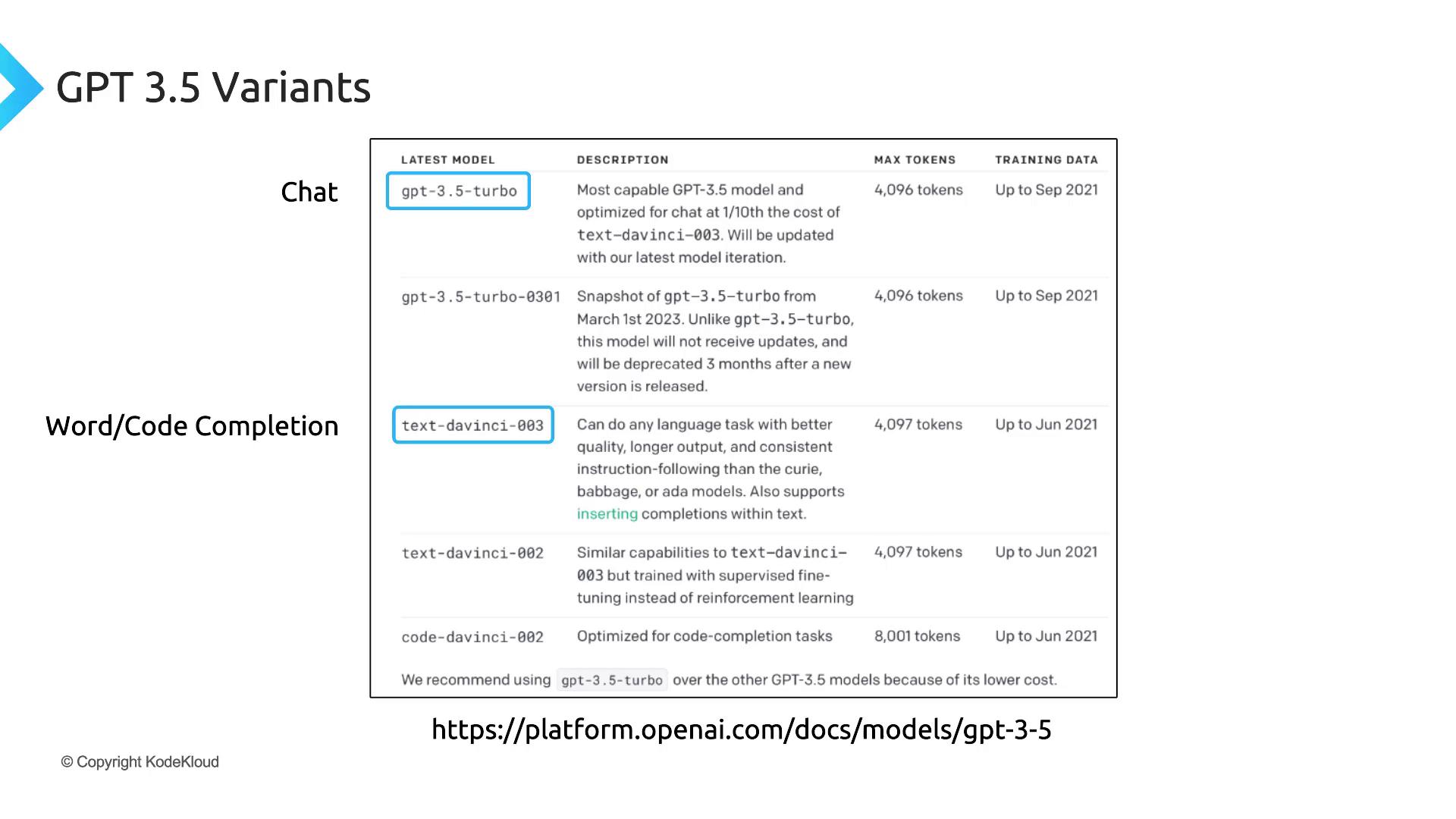
`gpt-3.5-turbo` is optimized for multi-turn dialogues and often delivers lower latency and cost for chat applications.
OpenAI continually refines these variants, improving response quality, speed, and cost-effectiveness.
## Fine-Tuning Models
Fine-tuning allows you to customize a base model on your domain-specific dataset. Benefits include:
* Domain-tailored responses with higher relevance
* Shorter prompts, reducing token usage and cost
* Faster inference, since context is baked into the model
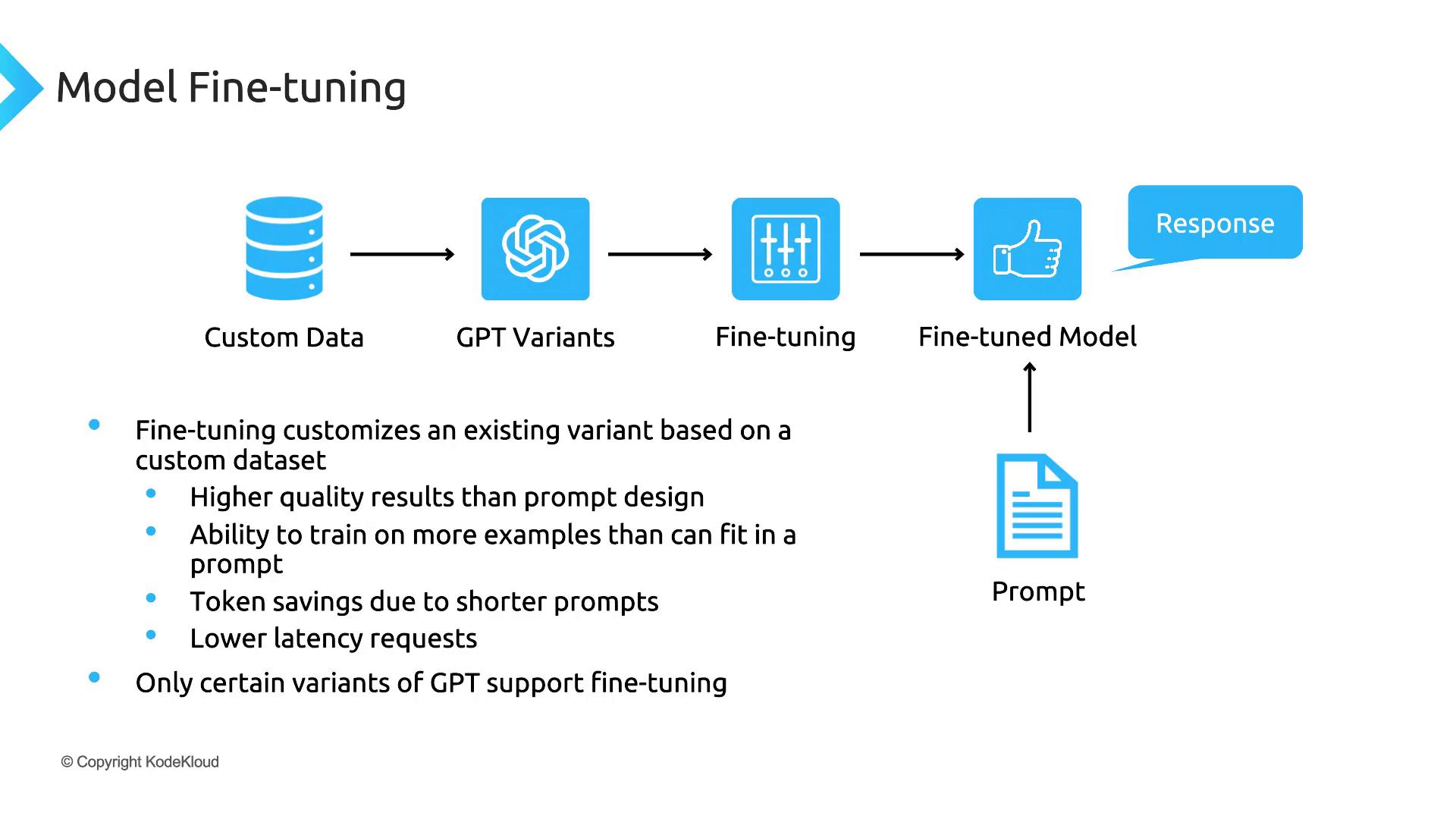
### Fine-Tuning Workflow
1. Format your dataset in JSONL with prompt–completion pairs.
2. Upload data and create a fine-tuning job via the CLI or API.
3. Monitor training, evaluate performance, and deploy your custom endpoint.
Ensure your training data is clean, balanced, and representative. Low-quality data can degrade performance.
## Embeddings and Semantic Search
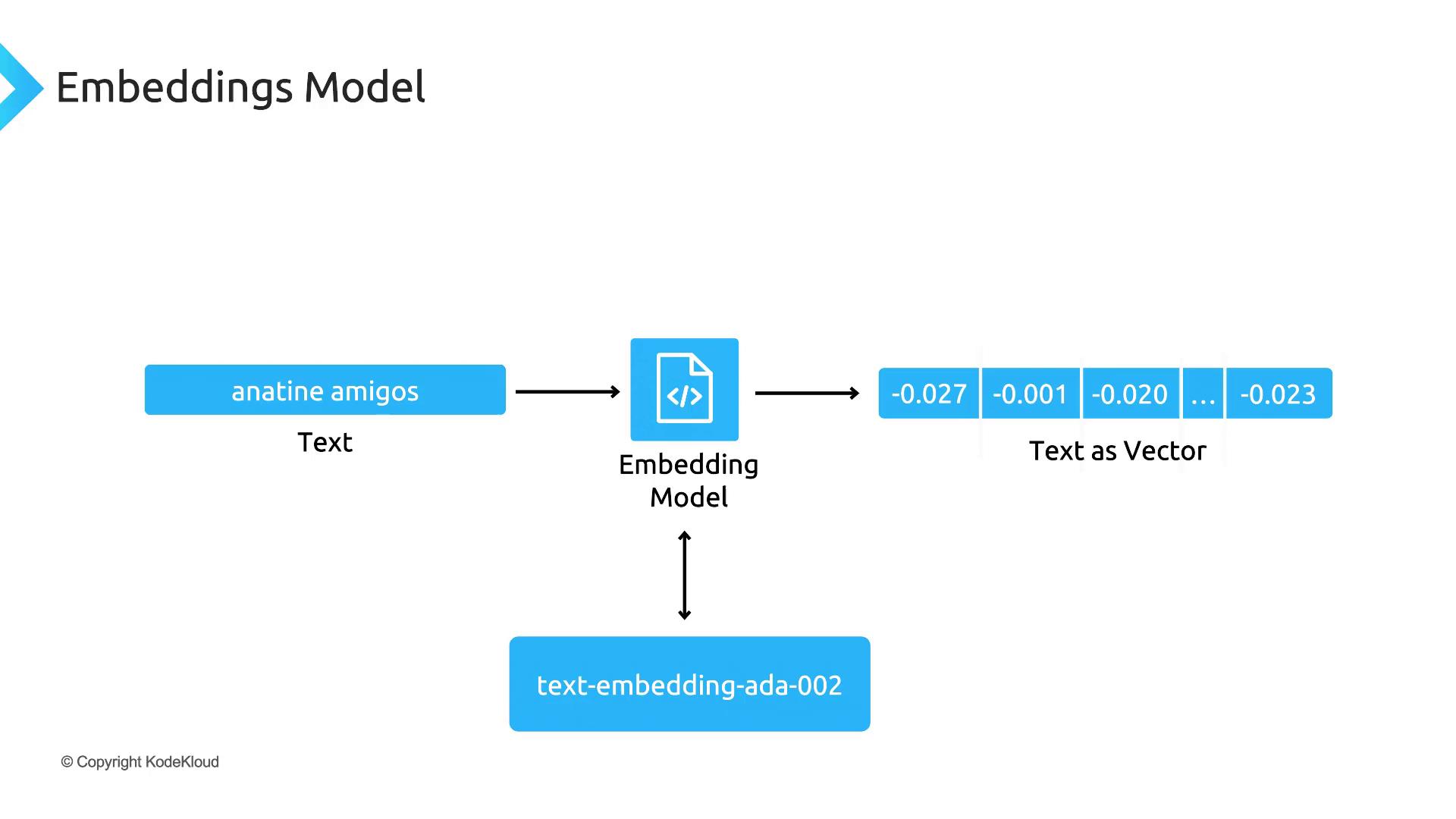
Embeddings convert text into vector representations for advanced applications:
| Use Case | Description |
| --------------------- | ---------------------------------------------- |
| Semantic Search | Retrieve documents based on contextual meaning |
| Recommendation | Suggest similar content or products |
| Entity Classification | Categorize text into predefined classes |
OpenAI’s `text-embedding-ada-002` model generates high-quality embeddings at scale.
## Other Model Families
OpenAI’s ecosystem extends beyond GPT and Codex:
* [DALL·E 2](https://platform.openai.com/docs/models/images/dall-e-2) – Image generation (beta)
* [Whisper 1](https://platform.openai.com/docs/models/speech-to-text) – Speech-to-text (beta)
***
## Links and References
* [OpenAI API Documentation](https://platform.openai.com/docs/)
* [Fine-tuning Guide](https://platform.openai.com/docs/guides/fine-tuning)
* [Embeddings Overview](https://platform.openai.com/docs/guides/embeddings)
* [DALL·E 2 Documentation](https://platform.openai.com/docs/models/images/dall-e-2)