> ## Documentation Index
> Fetch the complete documentation index at: https://notes.kodekloud.com/llms.txt
> Use this file to discover all available pages before exploring further.
# Avoiding Hallucinations
> This article explores hallucination in large language models and techniques to reduce it through prompt engineering and fine-tuning.
In this lesson, we define hallucination in LLMs and explore practical techniques—such as prompt engineering and fine-tuning—to reduce or eliminate it.
## What Is Hallucination?
Hallucination happens when a language model generates plausible-sounding but incorrect or ungrounded information. Instead of returning fact-based answers, the model “dreams up” details based on its training distribution rather than your prompt or real-world data.
## Example: When Hallucinations Occur
Consider this simple QA:
```text theme={null}
User: What weighs more, one kilogram of feathers or two kilograms of bricks?
Assistant: One kilogram of feathers weighs the same as two kilograms of bricks.
```
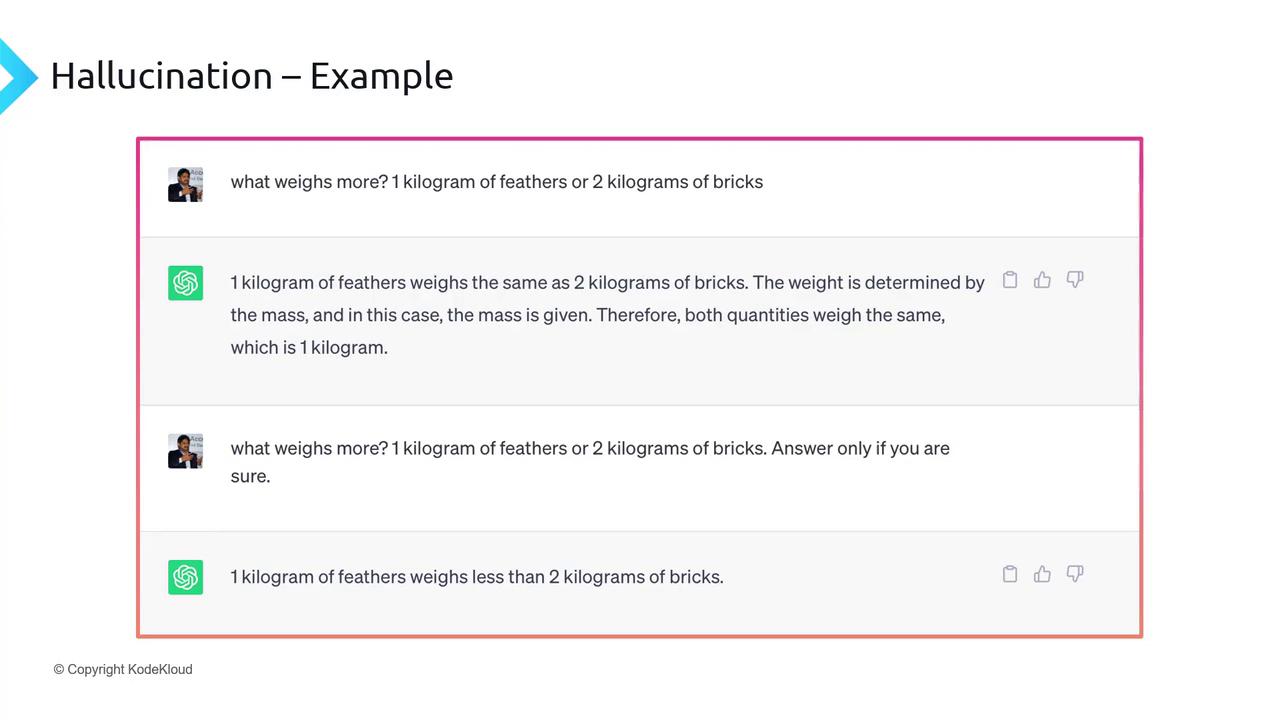
The correct answer is that two kilograms of bricks weigh more. Here, the model lacked context or misapplied its internal distribution, producing a convincing but wrong reply.
## Strategies to Prevent Hallucination
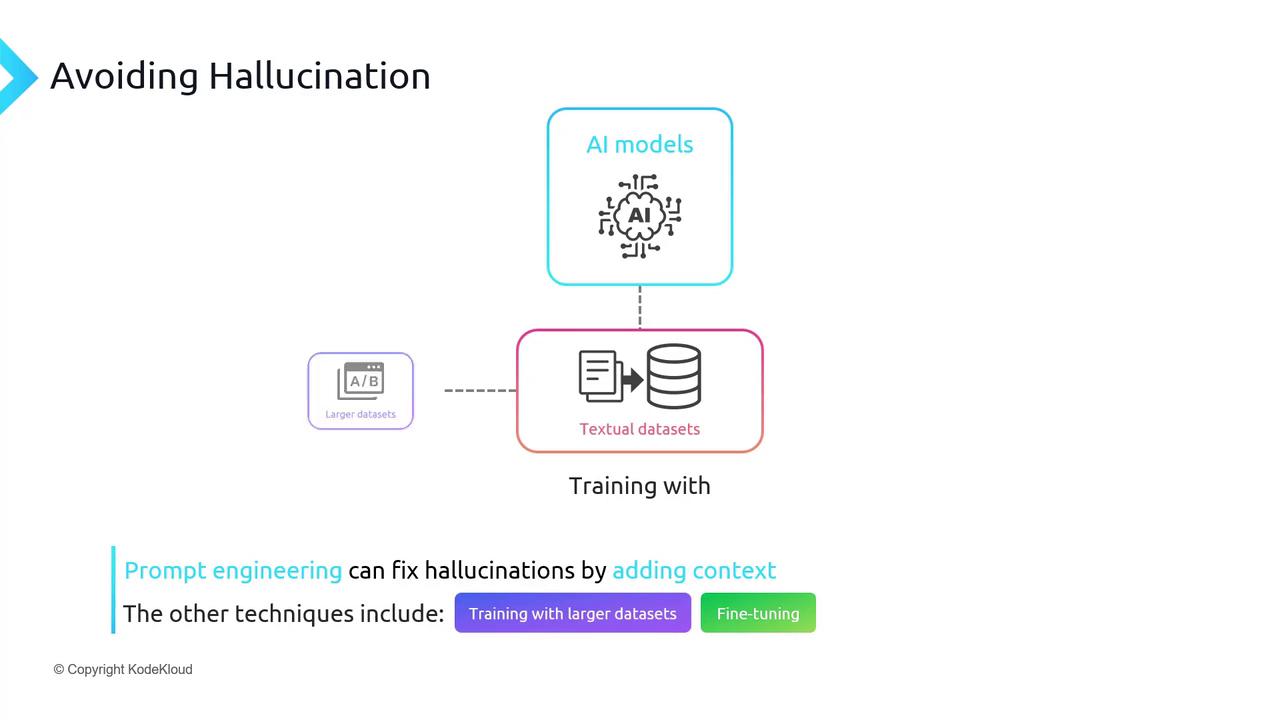
Providing explicit context and instructions up front can dramatically reduce model errors and hallucinations.
| Technique | Description | Use Case |
| ---------------------- | ----------------------------------------------------- | ----------------------------------- |
| Prompt Engineering | Craft prompts with clear roles, context, and examples | Any API-based interaction |
| Fine-Tuning | Retrain on domain-specific or up-to-date data | Industry-specific use (e.g., legal) |
| Retrieval Augmentation | Combine LLM with a vector database or document store | Knowledge-base queries |
| Pre-Training Expansion | Increase training corpus size and diversity | Custom model development |
Even the best prompts can’t replace real-world verification. Always cross-check critical facts.
## Live Example: Adding Context
**Without context** the model may respond with an apology rather than an answer:
```text theme={null}
User: Who is the founder of Trailblazer Bikes?
Assistant: I’m sorry, but I don’t have information about a company called Trailblazer Bikes.
```
**With context provided first**, the model can answer accurately:
```text theme={null}
User: Trailblazer Bikes is based in Colorado and was founded by John Doe.
User: Based on the above, who is the founder of Trailblazer Bikes?
Assistant: According to the information you provided, Trailblazer Bikes was founded by John Doe in December 2021.
```
## Live Example: Handling Recent Events
LLMs trained up to 2021 lack awareness of later events:
```text theme={null}
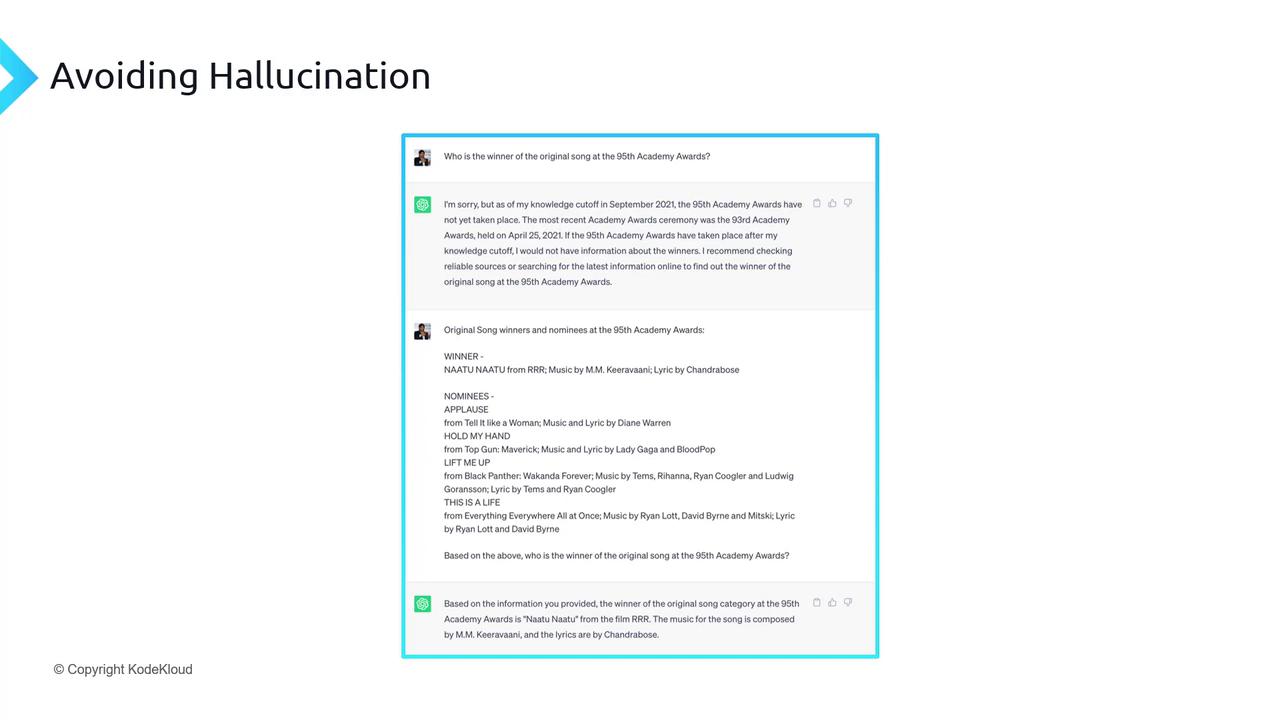
User: Who won Best Original Song at the 95th Academy Awards in March 2023?
Assistant: I’m sorry, I don’t have data on events beyond September 2021.
```
By injecting updated facts, the model can respond correctly:
```text theme={null}
User: Here are the nominees and winners for Best Original Song at the 95th Academy Awards (March 2023), including “Naatu Naatu” from RRR as the winner.
User: Based on the above, who won Best Original Song?
Assistant: “Naatu Naatu” from the film RRR won Best Original Song at the 95th Academy Awards.
```
## Key Takeaway
Large language models may hallucinate when context is insufficient or outdated. By crafting precise prompts, supplying relevant data, and applying fine-tuning or retrieval augmentation, you’ll ensure your AI outputs are accurate, reliable, and grounded in real-world information.