> ## Documentation Index
> Fetch the complete documentation index at: https://notes.kodekloud.com/llms.txt
> Use this file to discover all available pages before exploring further.
# Introduction to Generative AI
> Generative AI enables the creation of new content by learning patterns from large datasets, transforming creativity and problem-solving through accessible tools.
Generative AI is a rapidly advancing branch of deep learning that empowers users to create new, high-quality content—text, images, audio, and video—by learning the underlying patterns of large datasets. Once limited to research labs, generative AI tools are now accessible via web APIs and user-friendly interfaces, transforming how we automate creativity and problem solving.
## Discriminative AI vs. Generative AI
Deep learning approaches generally fall into two categories:
| Model Type | Learning Paradigm | Primary Function | Input Data |
| -------------- | ----------------------------------------------- | ----------------------------- | ------------------- |
| Discriminative | Supervised (labeled data) | Classification and prediction | Images, tabular |
| Generative | Unsupervised / Semi-supervised (unlabeled data) | Content generation | Text, images, video |
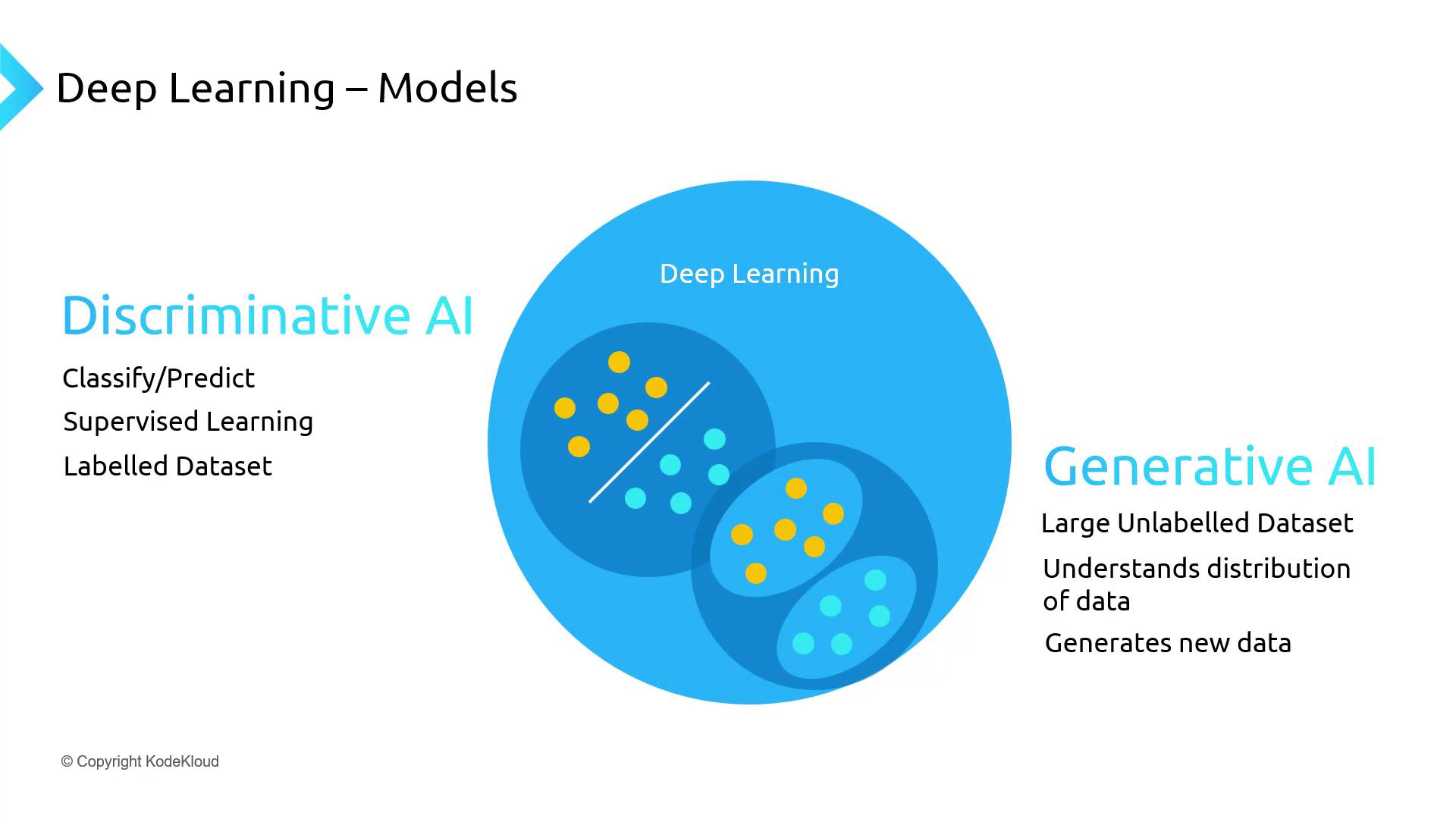
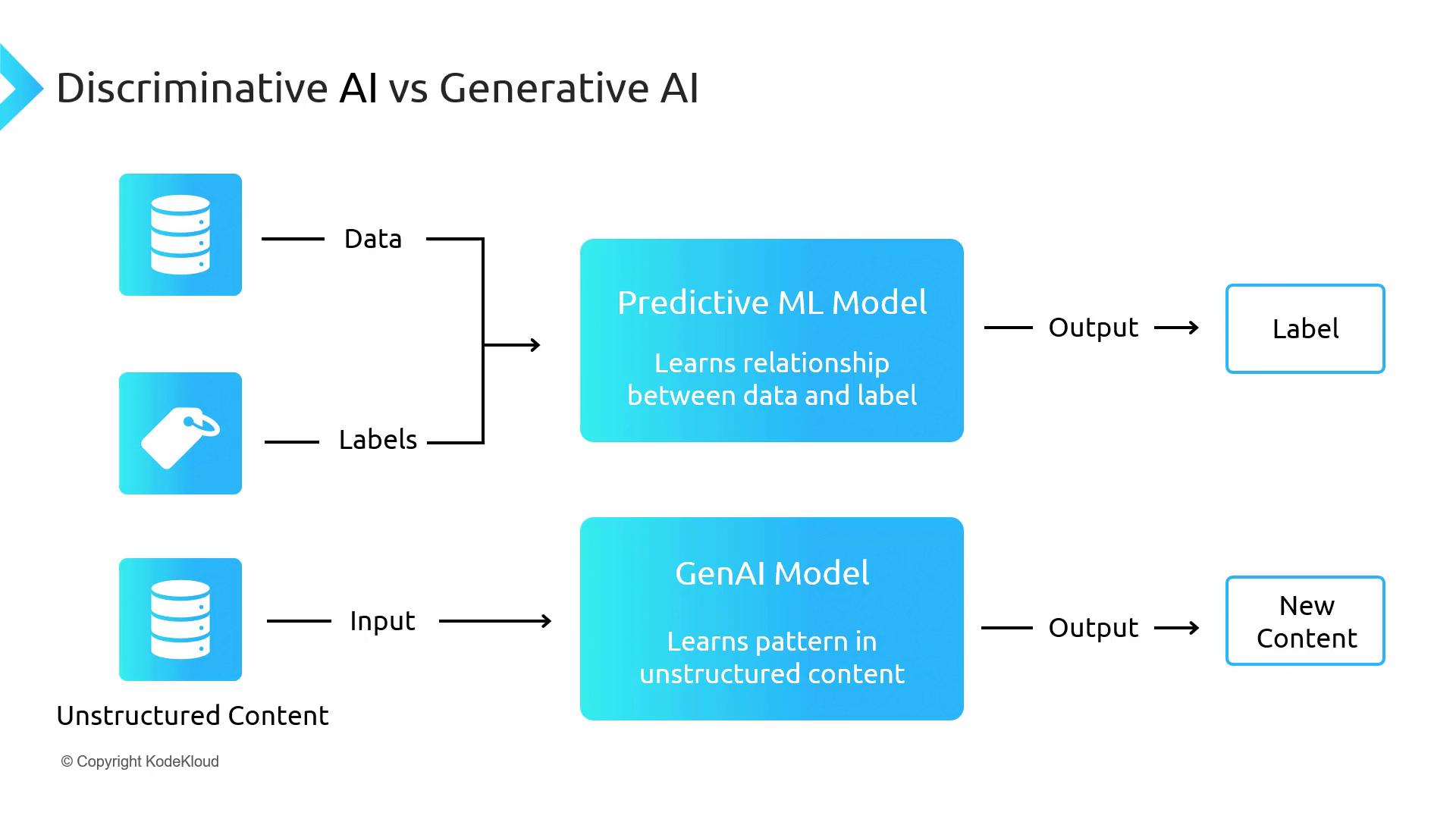
Discriminative models estimate the probability of labels given inputs (`P(y|x)`), whereas generative models learn the joint probability of inputs and outputs (`P(x, y)`) to create fresh data.
### Practical Example
* **Discriminative AI**\
Input: Photo of a dog\
Output: Label “dog”
* **Generative AI**\
Input: Photo of a dog + prompt “dog wearing goggles”\
Output: New image of a dog with goggles
## Core Capabilities of Generative AI
Generative models transform raw patterns into rich, novel outputs:
* **Text generation**\
Articles, summaries, code snippets in English and multiple languages
* **Image and artwork creation**\
Photorealistic renders, illustrations, style transfers
* **Video sequence synthesis**\
Frame interpolation, short clips, animation
* **Audio and speech**\
Music composition, voice cloning, sound effects
## Foundation Models: The Backbone of Generative AI
Foundation models are large-scale architectures pretrained on vast, diverse datasets. They serve as the starting point for fine-tuning on specific tasks:
* **Examples**
* GPT family (OpenAI)
* BERT and RoBERTa (Google)
* Stable Diffusion (Stability AI)
* **Benefits**
* Reduced training time
* Transfer learning for specialized applications
* Robust performance on unseen inputs
Always verify generated content for factual accuracy and potential biases. Generative AI can inadvertently replicate harmful patterns from its training data.
## Further Reading and References
* [OpenAI GPT-3 Documentation](https://platform.openai.com/docs)
* [Hugging Face Models](https://huggingface.co/models)
* [Deep Learning Overview](https://www.deeplearning.ai/tutorials/)
* [Ethics in AI](https://www.partnershiponai.org/)