> ## Documentation Index
> Fetch the complete documentation index at: https://notes.kodekloud.com/llms.txt
> Use this file to discover all available pages before exploring further.
# Derivatives and Gradients Part 2
> Explains derivatives and differentiation rules including the power rule, interpreting rates of change, tangents, and applications in motion, self driving, and computer vision
Let's start with a few definitions and notation.
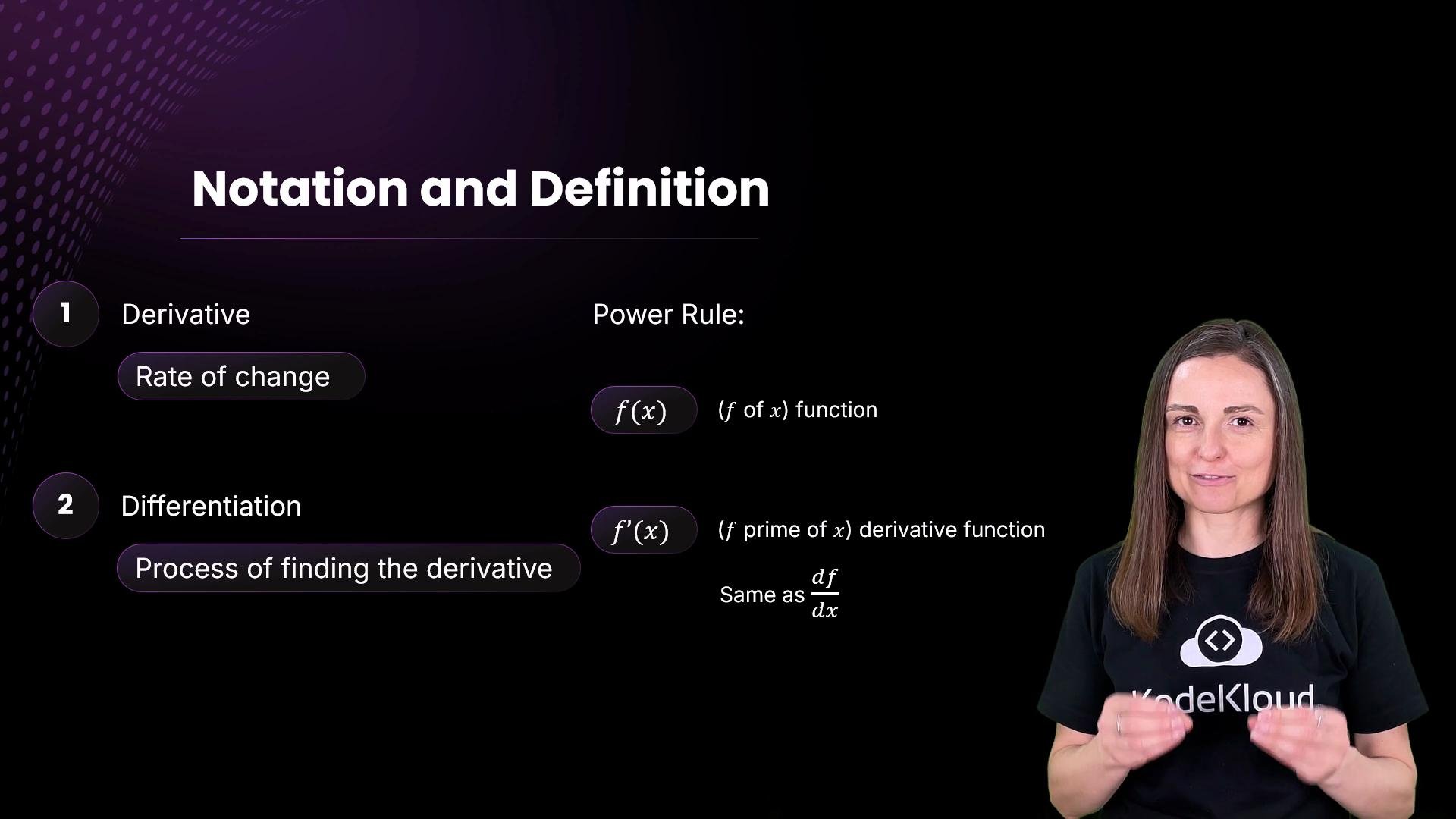
A derivative represents the instantaneous rate of change of a function. The process of finding a derivative is called differentiation. If `f(x)` denotes a function, then `f'(x)` denotes its derivative — the instantaneous rate of change of `f` at `x`. Understanding derivatives is essential for physics, engineering, machine learning, and computer vision.
 Constant functions
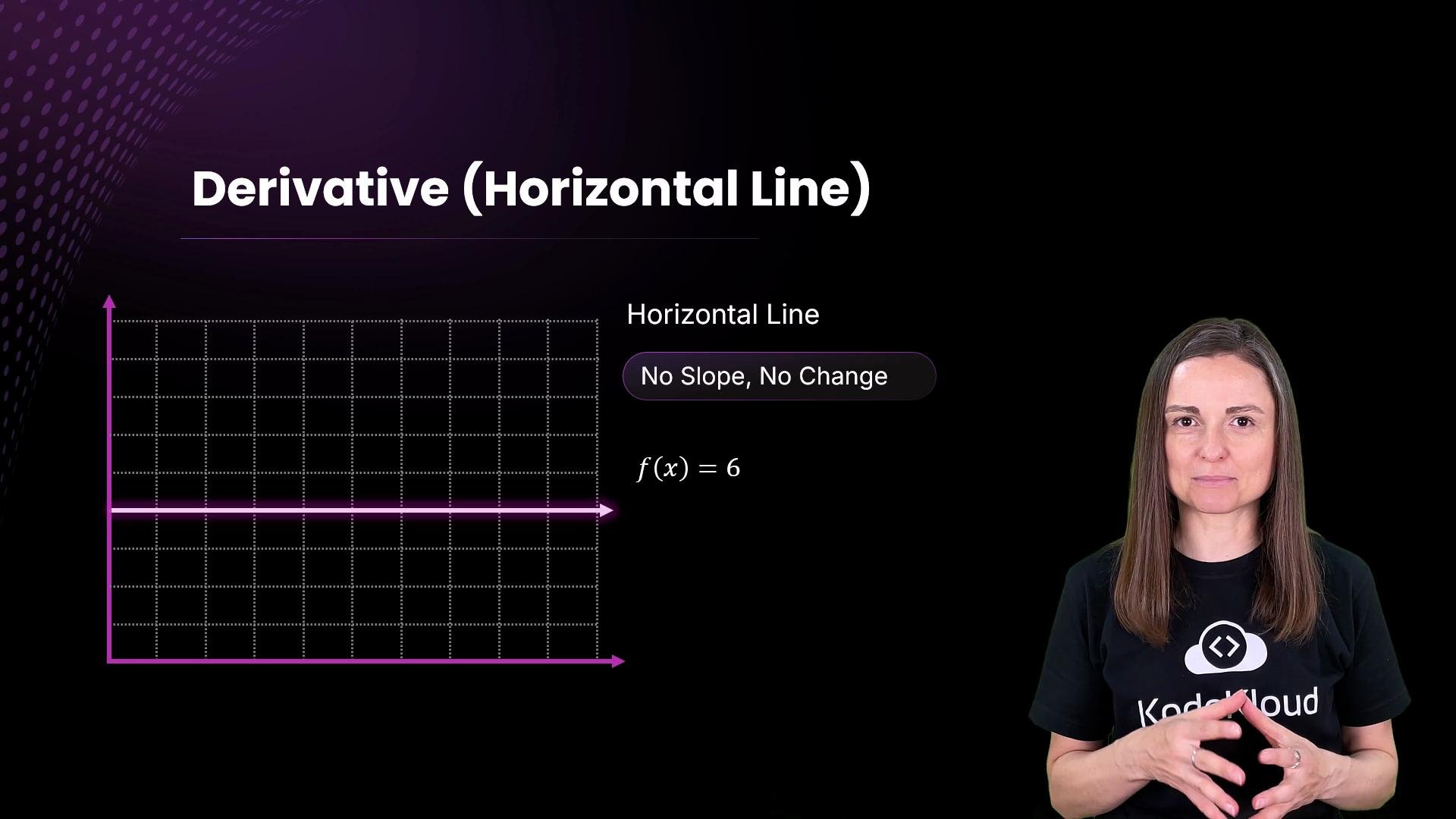
If a function is constant — for example `f(x) = 6` — its value does not change as `x` changes. The derivative measures change, so the derivative of a constant is zero:
```text theme={null}
f(x) = 6
f'(x) = 0
```
Constant functions
If a function is constant — for example `f(x) = 6` — its value does not change as `x` changes. The derivative measures change, so the derivative of a constant is zero:
```text theme={null}
f(x) = 6
f'(x) = 0
```
 Linear functions and slope
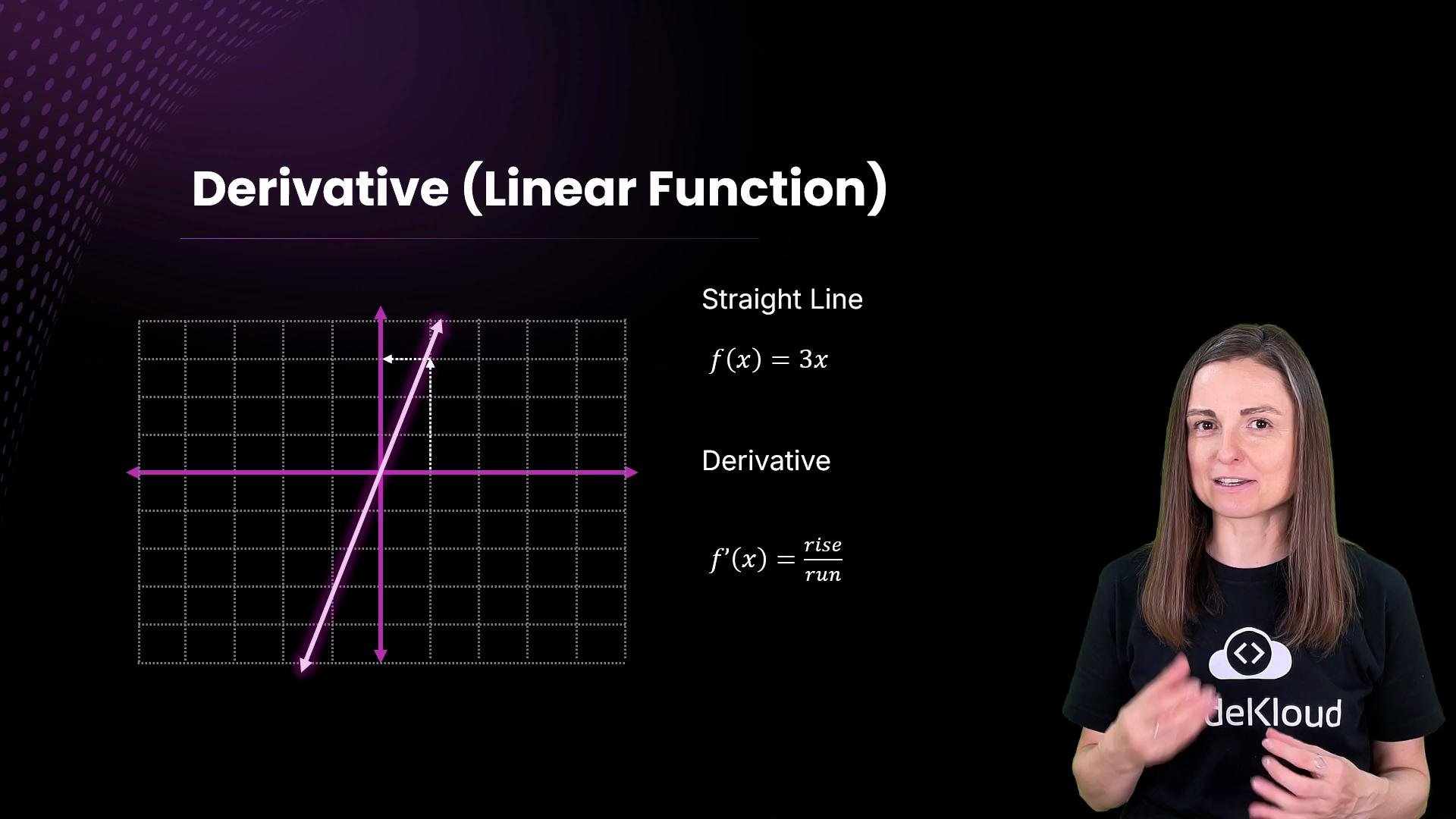
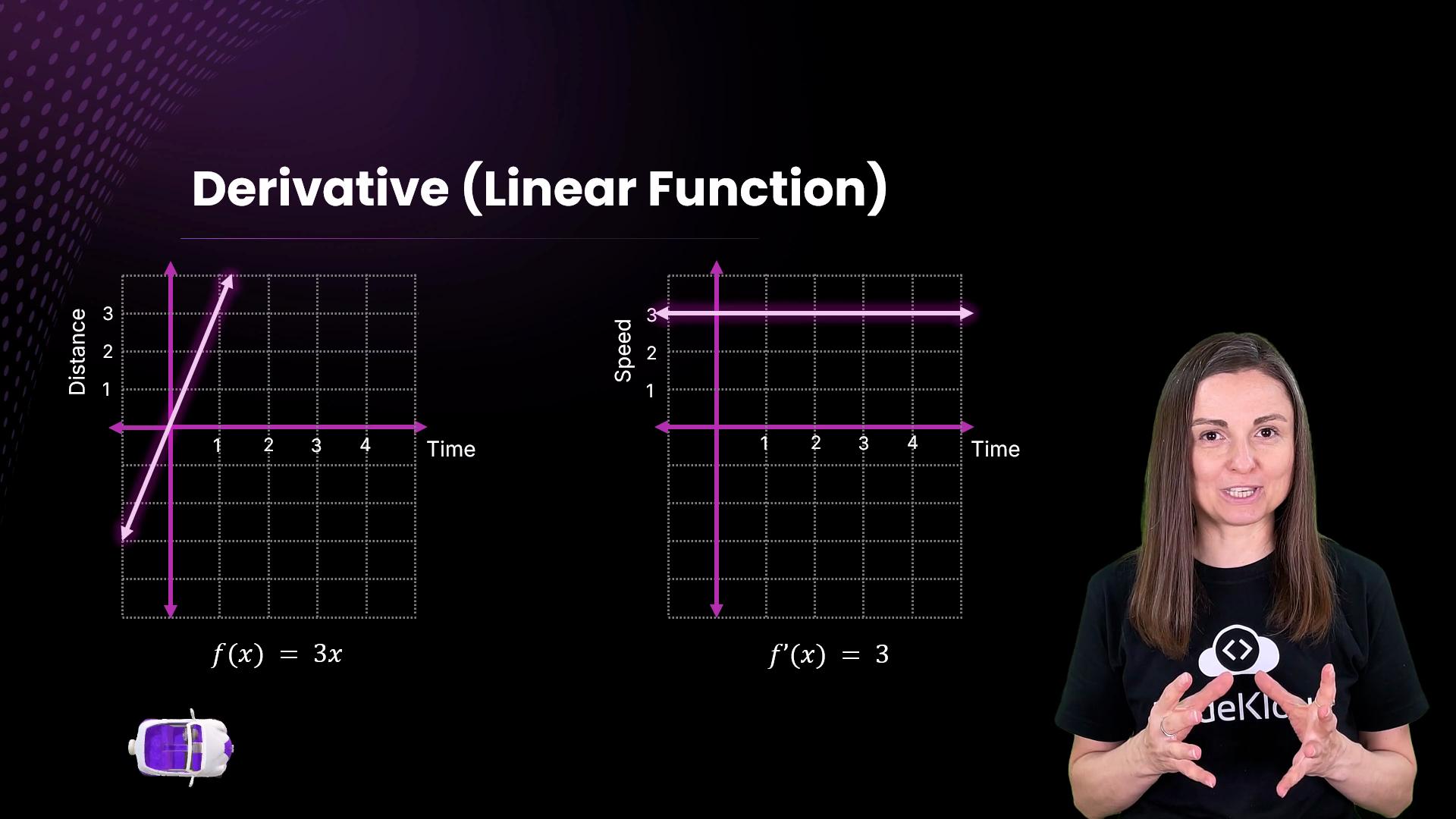
For a straight-line function the rate of change is constant. The derivative of a linear function equals its slope, computed as rise over run (vertical change divided by horizontal change). For example, `f(x) = 3x` has slope 3: if the rise is 3 and the run is 1, the slope is 3. If `f(x)` models distance over time, the speed is constant.
Linear functions and slope
For a straight-line function the rate of change is constant. The derivative of a linear function equals its slope, computed as rise over run (vertical change divided by horizontal change). For example, `f(x) = 3x` has slope 3: if the rise is 3 and the run is 1, the slope is 3. If `f(x)` models distance over time, the speed is constant.
 Visualizing distance and speed for a linear function helps connect math to intuition: distance grows linearly and speed (derivative) is constant.
 Non-linear functions and tangents
For non-linear functions the slope varies with `x`. To find the slope at a specific point we draw the tangent line — the straight line that just touches the curve at that point — and measure its slope there.
Consider the quadratic `f(x) = x^2`. The slope (derivative) differs at various `x` values:
* At `x = −1`, the tangent slopes downward: `f'(−1) = −2`.
* At `x = 0`, the tangent is horizontal: `f'(0) = 0`.
* At `x = 1`, the tangent slopes upward: `f'(1) = 2`.
Plotting these derivative values against `x` yields `f'(x) = 2x` — the derivative of `x^2`.
When `f(x)` represents distance and `f'(x)` represents velocity, the steepness of the distance graph corresponds to speed: steep = fast, flat = slow, zero slope = stopped. A sign change in the derivative indicates a change in direction.
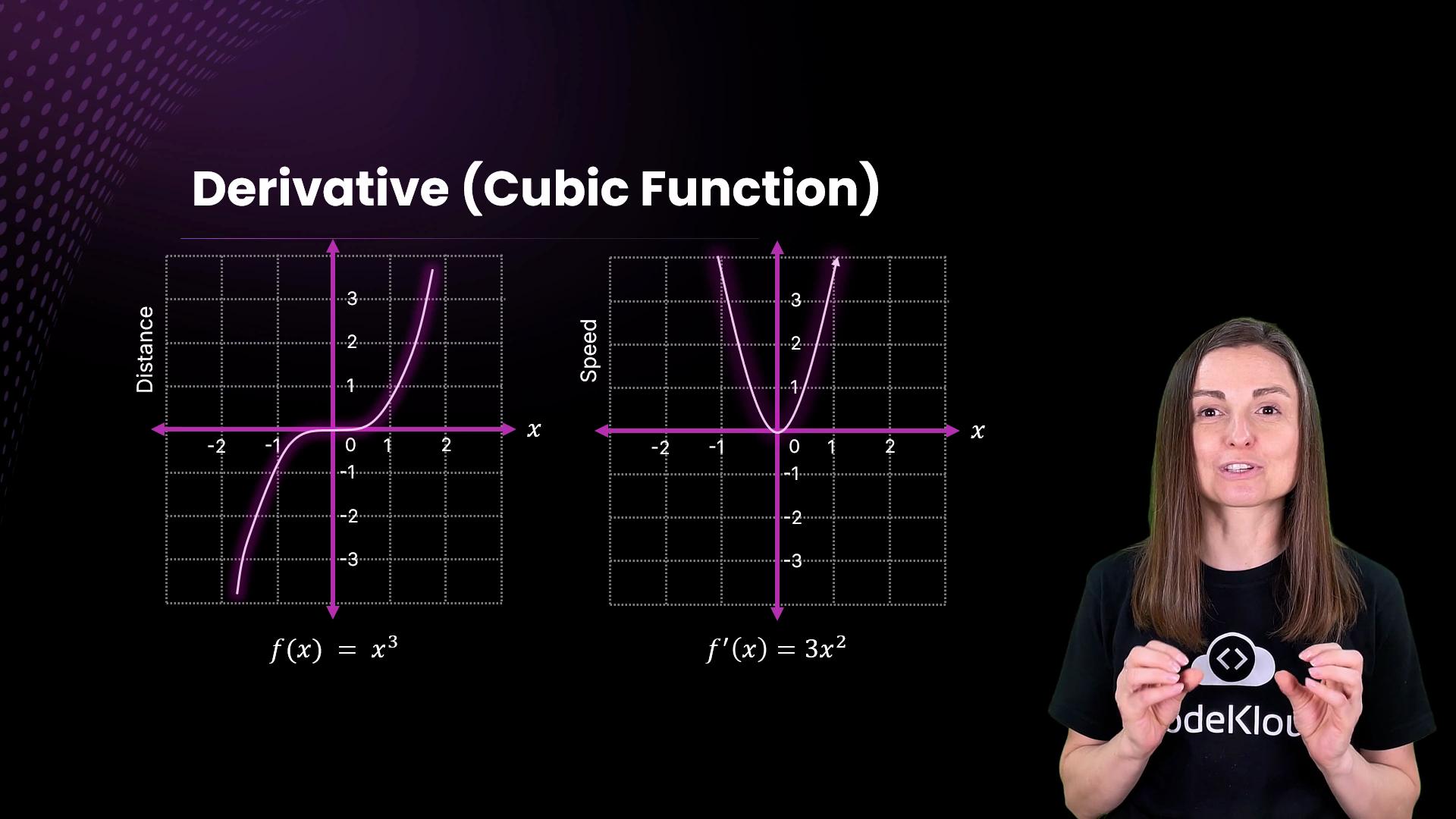
For higher powers the pattern continues. Example: for `f(x) = x^3`, the derivative is `f'(x) = 3x^2`. The distance and derivative graphs together capture slowing, stopping, and speeding up.
Non-linear functions and tangents
For non-linear functions the slope varies with `x`. To find the slope at a specific point we draw the tangent line — the straight line that just touches the curve at that point — and measure its slope there.
Consider the quadratic `f(x) = x^2`. The slope (derivative) differs at various `x` values:
* At `x = −1`, the tangent slopes downward: `f'(−1) = −2`.
* At `x = 0`, the tangent is horizontal: `f'(0) = 0`.
* At `x = 1`, the tangent slopes upward: `f'(1) = 2`.
Plotting these derivative values against `x` yields `f'(x) = 2x` — the derivative of `x^2`.
When `f(x)` represents distance and `f'(x)` represents velocity, the steepness of the distance graph corresponds to speed: steep = fast, flat = slow, zero slope = stopped. A sign change in the derivative indicates a change in direction.
For higher powers the pattern continues. Example: for `f(x) = x^3`, the derivative is `f'(x) = 3x^2`. The distance and derivative graphs together capture slowing, stopping, and speeding up.
 The power rule
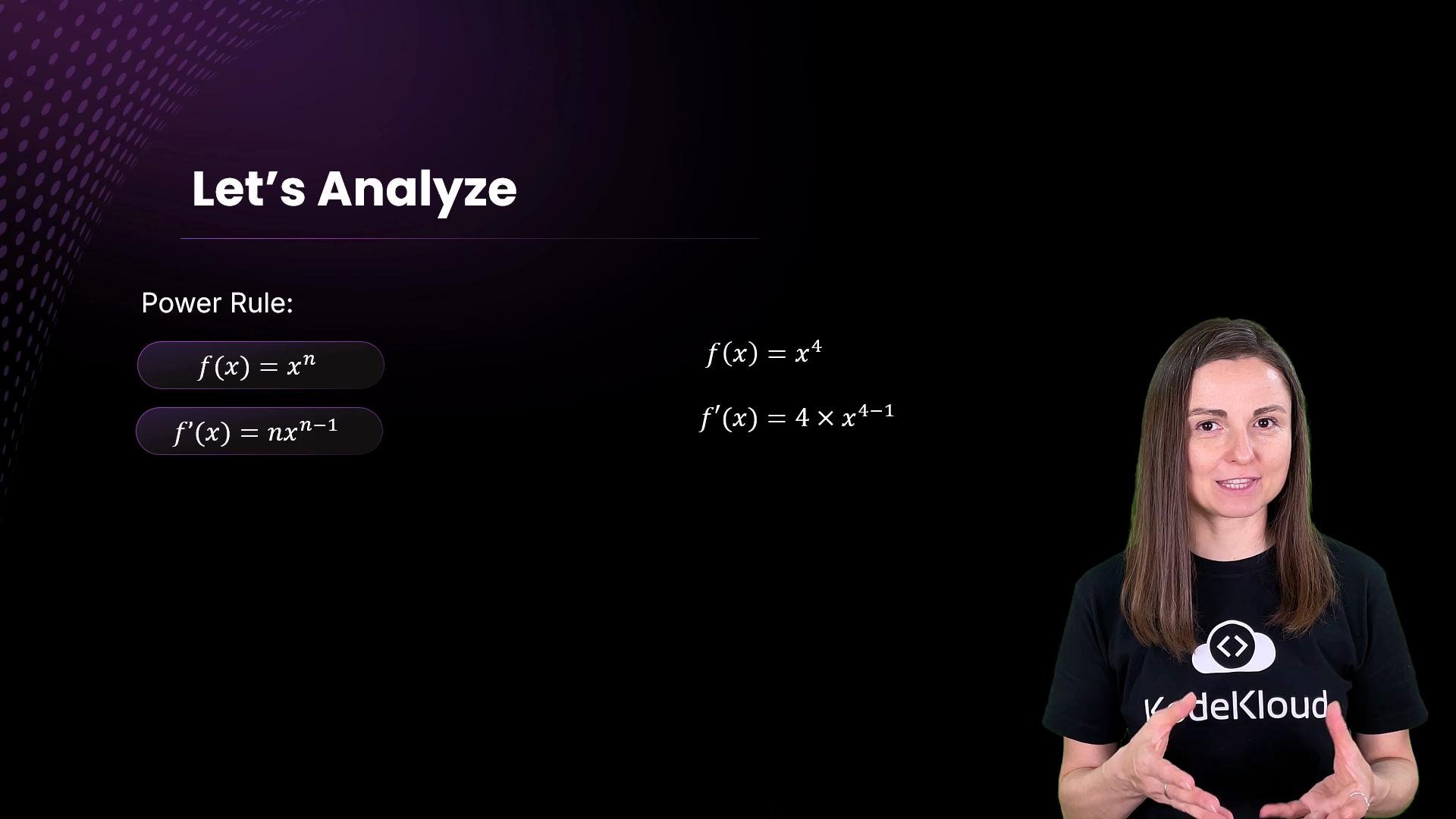
From these examples we arrive at the power rule — a compact, efficient recipe for differentiating polynomials.
```text theme={null}
If f(x) = x^n, then f'(x) = n x^(n-1)
```
Apply the power rule to `f(x) = x^4` and you get `f'(x) = 4x^3`.
The power rule
From these examples we arrive at the power rule — a compact, efficient recipe for differentiating polynomials.
```text theme={null}
If f(x) = x^n, then f'(x) = n x^(n-1)
```
Apply the power rule to `f(x) = x^4` and you get `f'(x) = 4x^3`.
 Common extensions and rules
The power rule pairs with two common, useful extensions:
* Constant multiple rule: if a constant `a` multiplies the power, multiply the coefficient by the power.
```text theme={null}
f(x) = a x^n
f'(x) = a * n x^(n-1)
```
Example: `f(x) = 5x^3` → `f'(x) = 15x^2`.
* Linearity (sum rule): differentiate each term separately.
Example:
```text theme={null}
f(x) = 4x^3 + 5x^2 − 7
d/dx[4x^3] = 12x^2
d/dx[5x^2] = 10x
d/dx[−7] = 0
So f'(x) = 12x^2 + 10x
```
Quick reference table
| Rule | Formula | Example |
| ----------------- | ----------------------------------- | --------------------------------- |
| Power rule | `d/dx[x^n] = n x^(n-1)` | `d/dx[x^4] = 4x^3` |
| Constant multiple | `d/dx[a·g(x)] = a·g'(x)` | `d/dx[5x^3] = 5·3x^2 = 15x^2` |
| Sum/Difference | `d/dx[g(x) ± h(x)] = g'(x) ± h'(x)` | `d/dx[4x^3 + 5x^2] = 12x^2 + 10x` |
| Constant | `d/dx[c] = 0` | `d/dx[7] = 0` |
Back to the car example
Suppose the distance-to-roadworks as a function of time is:
```text theme={null}
f(x) = x^2 - 80x + 400
```
Differentiate term-by-term using the power rule:
```text theme={null}
f'(x) = 2x - 80
```
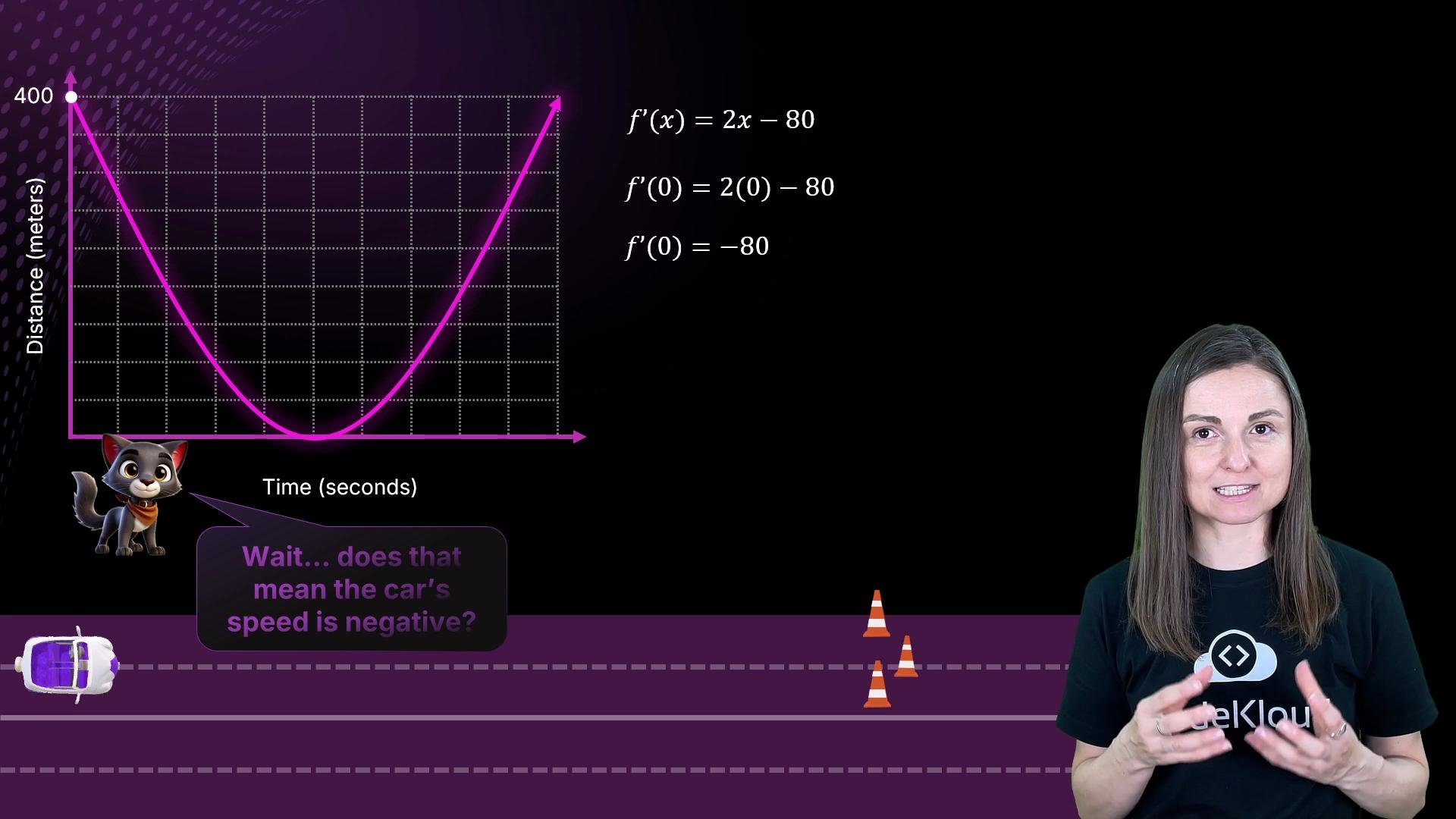
The derivative `f'(x)` gives the instantaneous rate of change of distance with respect to time. For instance:
```text theme={null}
f'(0) = 2*0 - 80 = -80
```
`f'(0) = -80` means the distance is decreasing at 80 units per time unit at `x = 0`. The derivative is a signed rate (negative indicates motion toward the roadworks). Speed, as commonly used, is the non-negative magnitude of velocity.
Common extensions and rules
The power rule pairs with two common, useful extensions:
* Constant multiple rule: if a constant `a` multiplies the power, multiply the coefficient by the power.
```text theme={null}
f(x) = a x^n
f'(x) = a * n x^(n-1)
```
Example: `f(x) = 5x^3` → `f'(x) = 15x^2`.
* Linearity (sum rule): differentiate each term separately.
Example:
```text theme={null}
f(x) = 4x^3 + 5x^2 − 7
d/dx[4x^3] = 12x^2
d/dx[5x^2] = 10x
d/dx[−7] = 0
So f'(x) = 12x^2 + 10x
```
Quick reference table
| Rule | Formula | Example |
| ----------------- | ----------------------------------- | --------------------------------- |
| Power rule | `d/dx[x^n] = n x^(n-1)` | `d/dx[x^4] = 4x^3` |
| Constant multiple | `d/dx[a·g(x)] = a·g'(x)` | `d/dx[5x^3] = 5·3x^2 = 15x^2` |
| Sum/Difference | `d/dx[g(x) ± h(x)] = g'(x) ± h'(x)` | `d/dx[4x^3 + 5x^2] = 12x^2 + 10x` |
| Constant | `d/dx[c] = 0` | `d/dx[7] = 0` |
Back to the car example
Suppose the distance-to-roadworks as a function of time is:
```text theme={null}
f(x) = x^2 - 80x + 400
```
Differentiate term-by-term using the power rule:
```text theme={null}
f'(x) = 2x - 80
```
The derivative `f'(x)` gives the instantaneous rate of change of distance with respect to time. For instance:
```text theme={null}
f'(0) = 2*0 - 80 = -80
```
`f'(0) = -80` means the distance is decreasing at 80 units per time unit at `x = 0`. The derivative is a signed rate (negative indicates motion toward the roadworks). Speed, as commonly used, is the non-negative magnitude of velocity.
 Find when the instantaneous rate is zero by solving `f'(x) = 0`:
```text theme={null}
2x - 80 = 0
=> x = 40
```
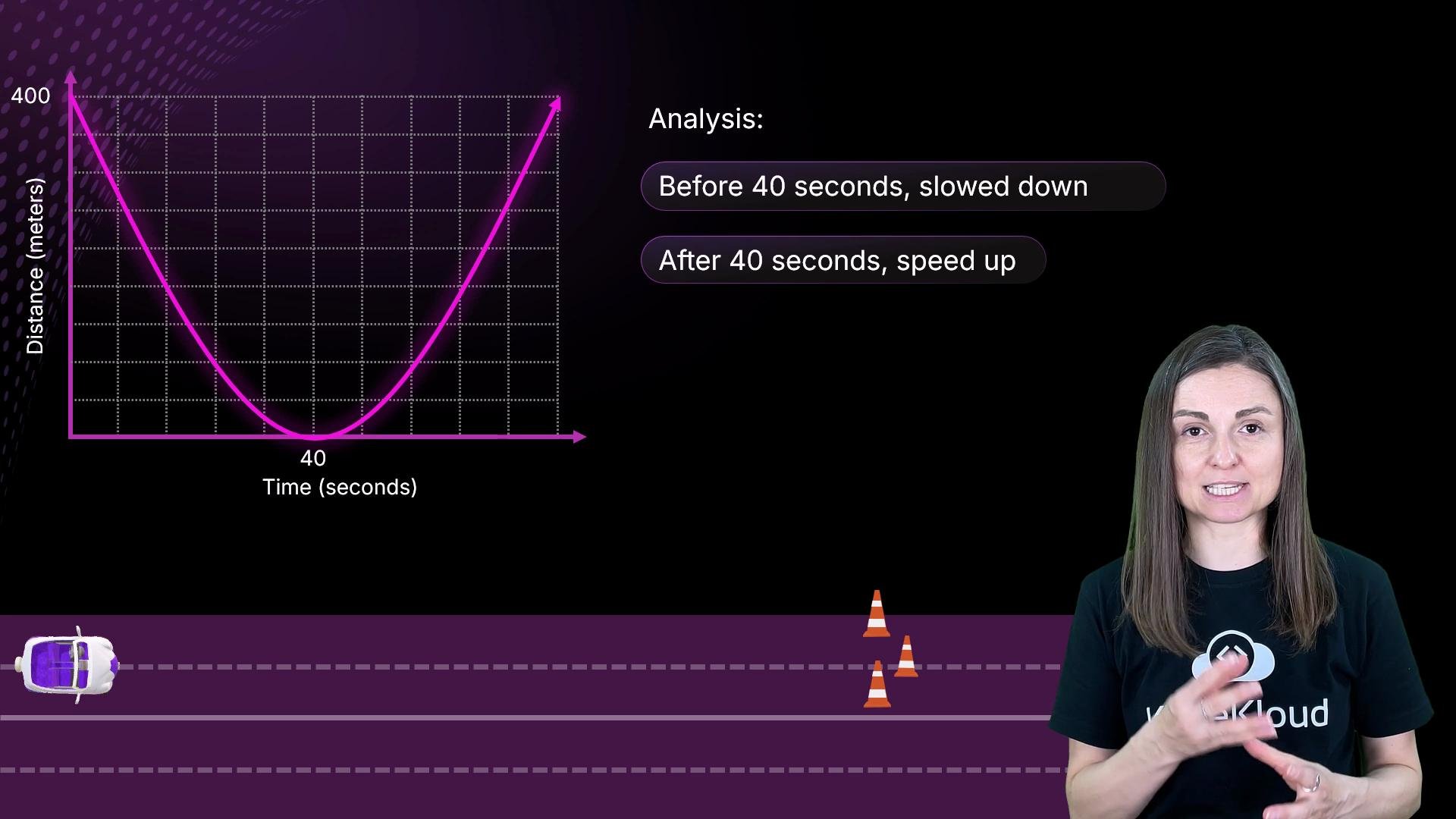
So `f'(40) = 0`. At `x = 40` seconds the distance is neither increasing nor decreasing — the car is at its closest point to the roadworks. Before `x = 40` the distance is decreasing (`f'(x) < 0`); after `x = 40` it is increasing (`f'(x) > 0`).
Find when the instantaneous rate is zero by solving `f'(x) = 0`:
```text theme={null}
2x - 80 = 0
=> x = 40
```
So `f'(40) = 0`. At `x = 40` seconds the distance is neither increasing nor decreasing — the car is at its closest point to the roadworks. Before `x = 40` the distance is decreasing (`f'(x) < 0`); after `x = 40` it is increasing (`f'(x) > 0`).
 Why derivatives matter (applications)
Derivatives are fundamental across engineering and computer science. Examples:
* Self-driving cars
* compute instantaneous speed and direction (is distance increasing or decreasing),
* decide braking or acceleration,
* smooth acceleration/braking for comfort,
* predict trajectories for safe lane changes and collision avoidance.
* Computer vision and machine learning
* an image is a grid of pixel intensities (e.g., `0` to `255`),
* computing differences between neighboring pixels approximates discrete derivatives,
* these discrete derivatives highlight edges and motion (sharp local changes appear as peaks),
* repeated derivatives across rows/columns help detect shapes and moving objects.
Summary
* A derivative measures how fast a quantity changes at a point.
* The power rule (`f(x) = x^n` → `f'(x) = n x^(n-1)`) makes differentiating polynomials quick and systematic.
* Interpreting derivatives connects math to real-world systems (self-driving cars) and machine perception (edge detection).
Further reading and references
* [Khan Academy — Derivatives Intuition](https://www.khanacademy.org/math/calculus-1/cs1-derivatives)
* [MIT OpenCourseWare — Single Variable Calculus](https://ocw.mit.edu/courses/mathematics/18-01sc-single-variable-calculus-fall-2010/)
* [Stanford — Computer Vision: Edge Detection Concepts](http://cs231n.github.io/convolutional-networks/#conv)
Why derivatives matter (applications)
Derivatives are fundamental across engineering and computer science. Examples:
* Self-driving cars
* compute instantaneous speed and direction (is distance increasing or decreasing),
* decide braking or acceleration,
* smooth acceleration/braking for comfort,
* predict trajectories for safe lane changes and collision avoidance.
* Computer vision and machine learning
* an image is a grid of pixel intensities (e.g., `0` to `255`),
* computing differences between neighboring pixels approximates discrete derivatives,
* these discrete derivatives highlight edges and motion (sharp local changes appear as peaks),
* repeated derivatives across rows/columns help detect shapes and moving objects.
Summary
* A derivative measures how fast a quantity changes at a point.
* The power rule (`f(x) = x^n` → `f'(x) = n x^(n-1)`) makes differentiating polynomials quick and systematic.
* Interpreting derivatives connects math to real-world systems (self-driving cars) and machine perception (edge detection).
Further reading and references
* [Khan Academy — Derivatives Intuition](https://www.khanacademy.org/math/calculus-1/cs1-derivatives)
* [MIT OpenCourseWare — Single Variable Calculus](https://ocw.mit.edu/courses/mathematics/18-01sc-single-variable-calculus-fall-2010/)
* [Stanford — Computer Vision: Edge Detection Concepts](http://cs231n.github.io/convolutional-networks/#conv)