> ## Documentation Index
> Fetch the complete documentation index at: https://notes.kodekloud.com/llms.txt
> Use this file to discover all available pages before exploring further.
# Matrix Operations Part 3
> Explains how to compute and verify the inverse of a 2×2 matrix, why the determinant matters, and applications to correcting sensor data and solving linear systems.
In this lesson we compute the inverse of a 2×2 matrix, verify the result by multiplication, and explain why the determinant determines invertibility. Understanding 2×2 inversion is a foundation for solving linear systems, correcting sensor data, and many other applied problems in engineering and computer vision.
What is a matrix inverse?
* For numbers: a × a^{-1} = 1.
* For matrices: A × A^{-1} = I, where I is the identity matrix (1s on the diagonal, 0s elsewhere).
Multiplying any matrix by the identity leaves it unchanged, so the inverse is the matrix analog of a reciprocal.
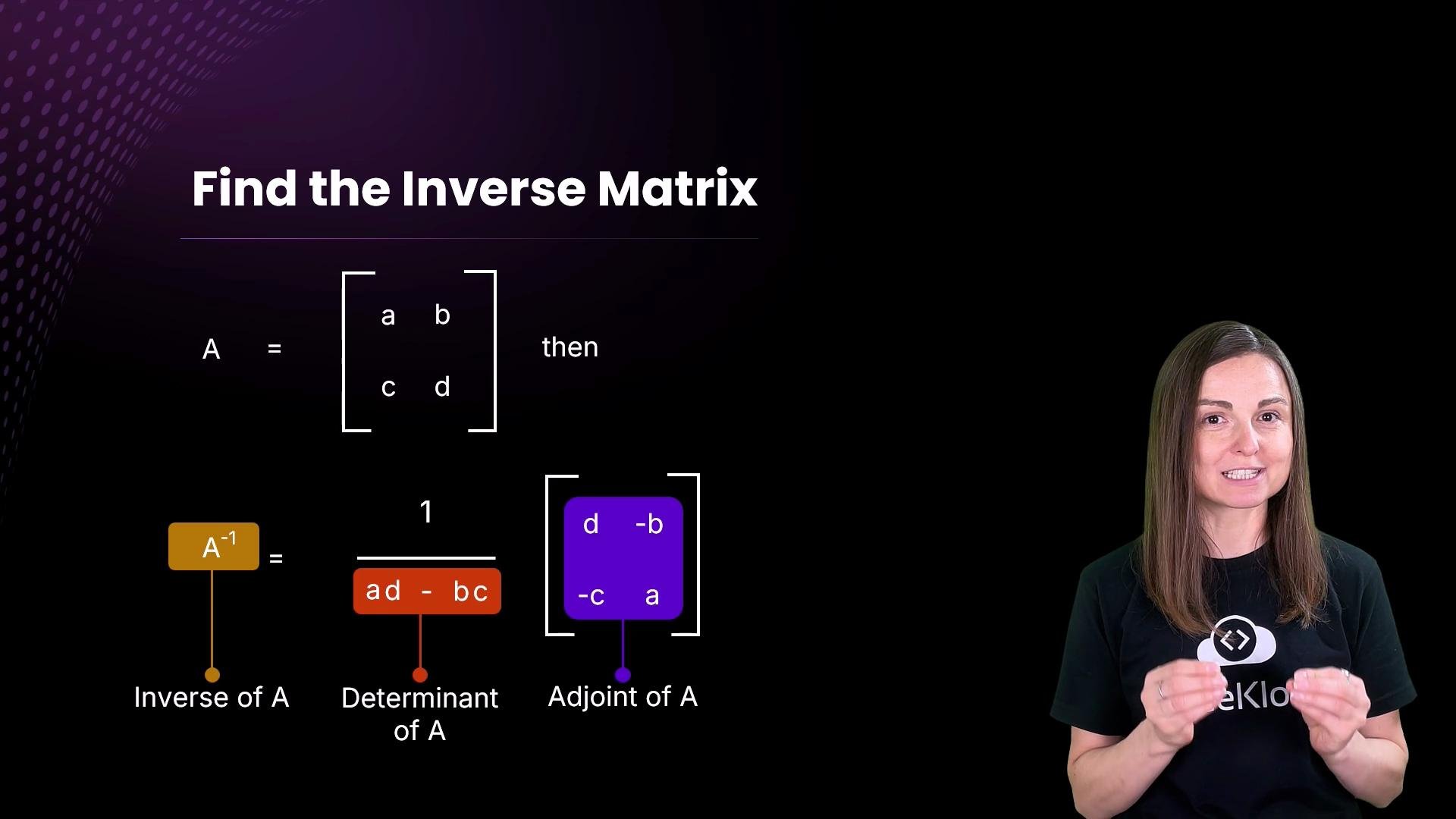
Formula for the inverse of a 2×2 matrix
Given A:
\[ \[a, b],
\[c, d] ]
The inverse (when it exists) is:
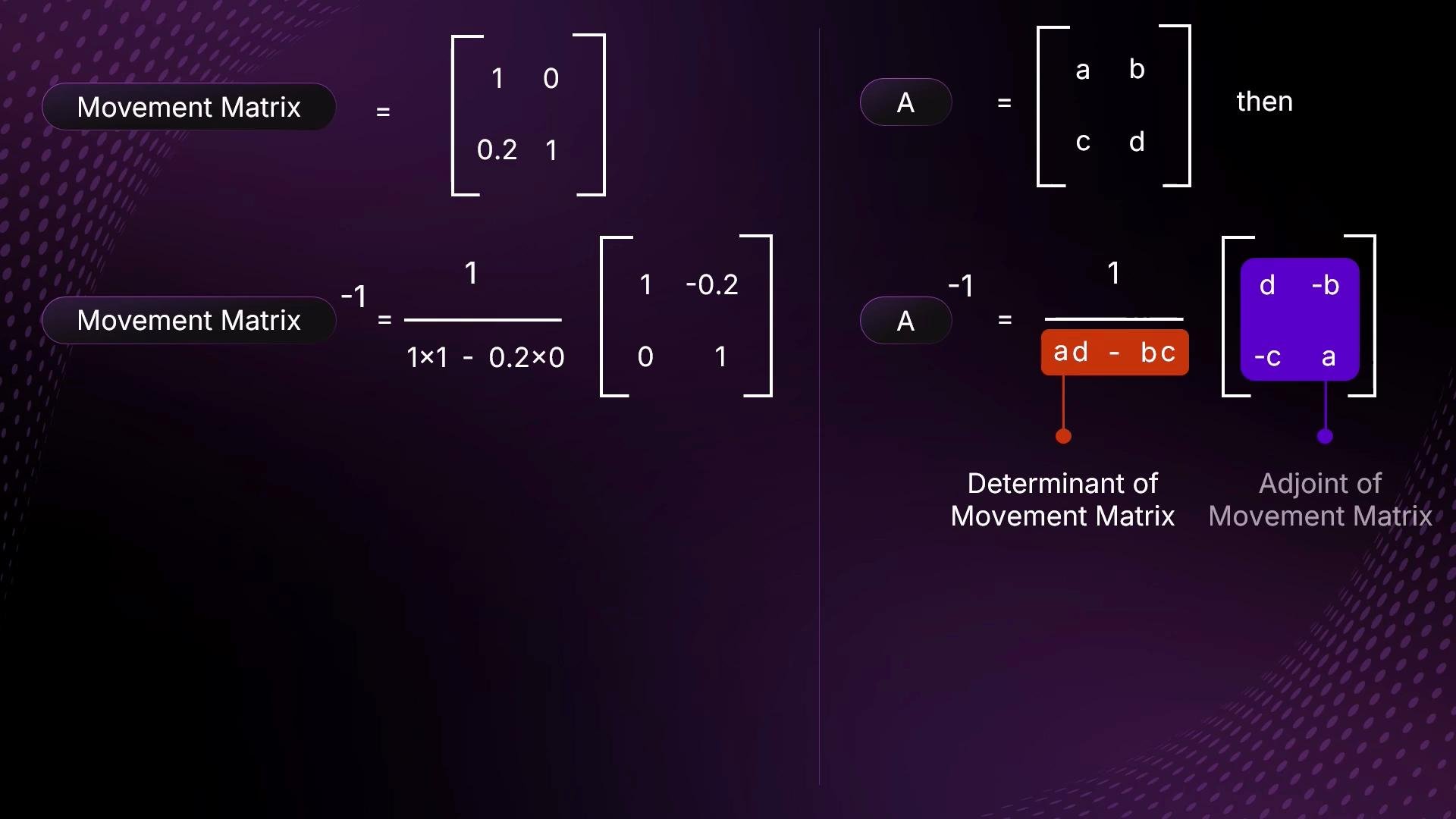
A^{-1} = (1 / (ad − bc)) × adj(A)
where:
* `ad − bc` is the determinant of A.
* `adj(A)` (the adjugate) is formed by swapping `a` and `d`, and negating `b` and `c`:
adj(A) = \[ \[ d, −b ],
\[ −c, a ] ]
 Step-by-step example
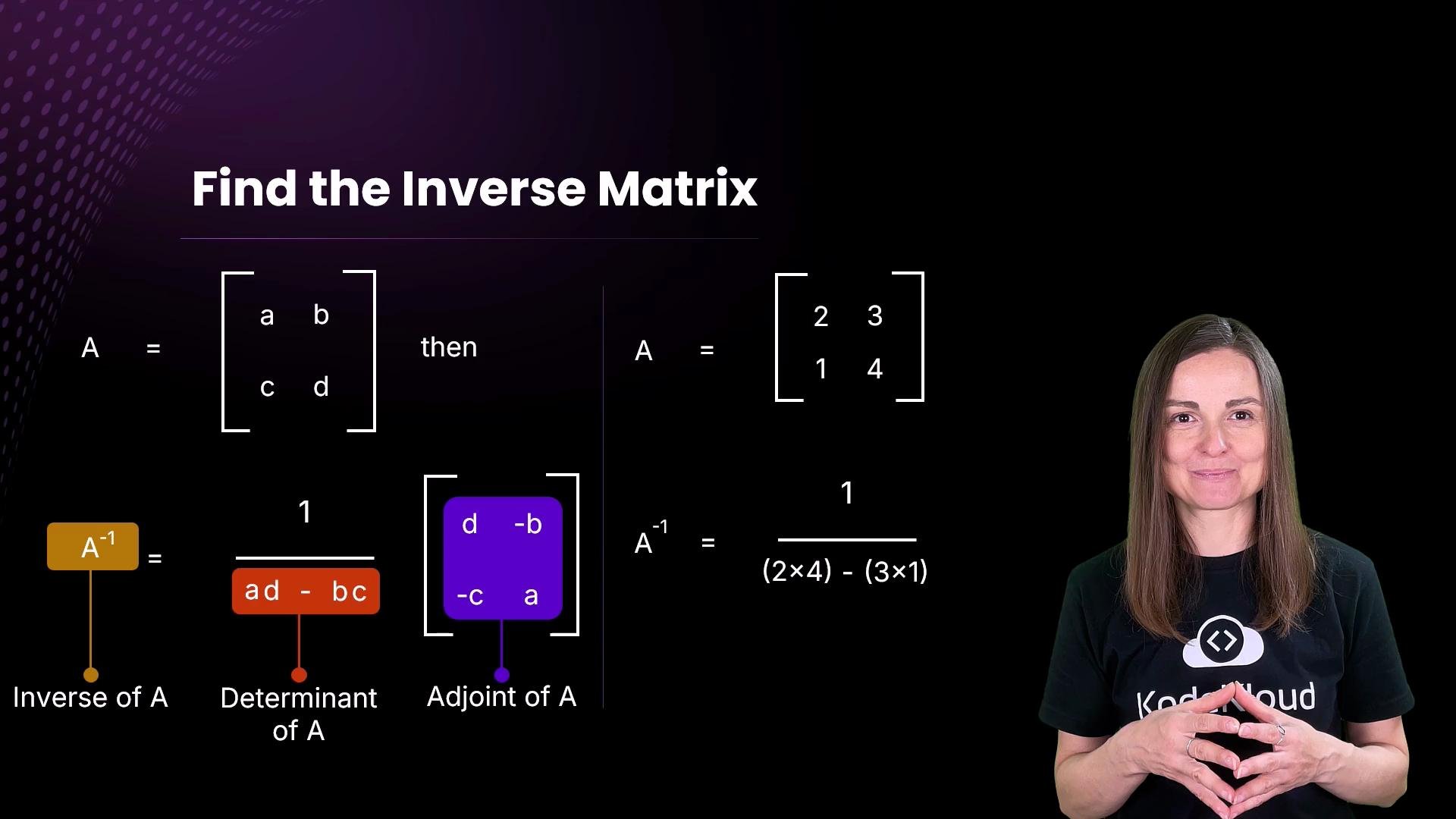
Let A have entries `a = 2, b = 3, c = 1, d = 4`.
1. Compute the determinant:
det(A) = ad − bc = 2×4 − 3×1 = 8 − 3 = 5
2. Form the adjugate by swapping `a` and `d` and negating `b` and `c`:
adj(A) = \[ \[ 4, −3 ],
\[ −1, 2 ] ]
3. Multiply the adjugate by `1/det(A)`:
A^{-1} = (1/5) × \[ \[ 4, −3 ],
\[ −1, 2 ] ]
Step-by-step example
Let A have entries `a = 2, b = 3, c = 1, d = 4`.
1. Compute the determinant:
det(A) = ad − bc = 2×4 − 3×1 = 8 − 3 = 5
2. Form the adjugate by swapping `a` and `d` and negating `b` and `c`:
adj(A) = \[ \[ 4, −3 ],
\[ −1, 2 ] ]
3. Multiply the adjugate by `1/det(A)`:
A^{-1} = (1/5) × \[ \[ 4, −3 ],
\[ −1, 2 ] ]
 Verify by multiplication
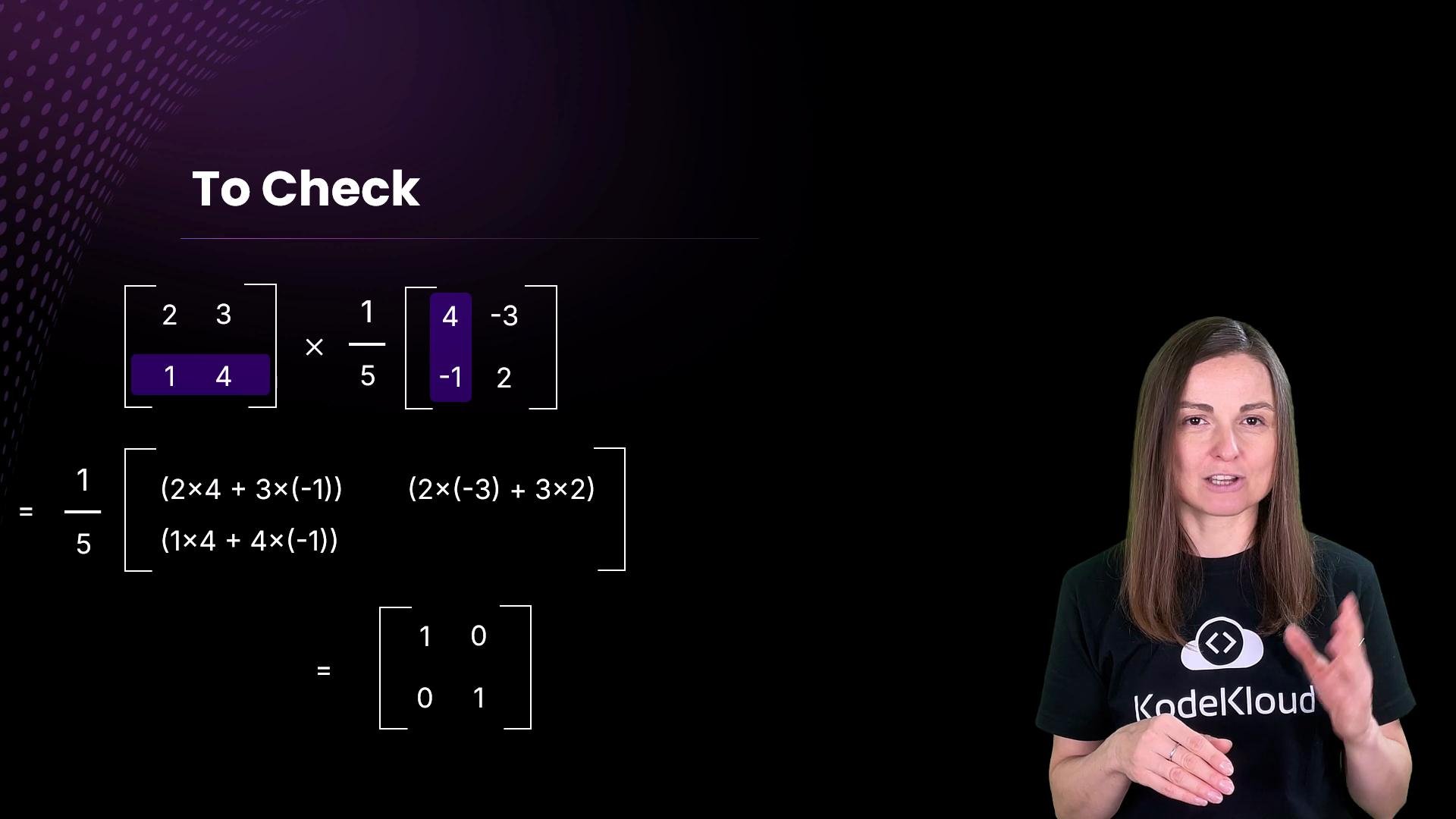
To confirm A^{-1} is correct, multiply A by A^{-1} and check you get the identity matrix `I = [ [1,0], [0,1] ]`. Do the four scalar dot-products in the usual order:
* row 1 of A × column 1 of A^{-1}
* row 1 of A × column 2 of A^{-1}
* row 2 of A × column 1 of A^{-1}
* row 2 of A × column 2 of A^{-1}
Compute the raw products before scaling by `1/5`, then apply the scalar factor:
* (row1·col1) = 2×4 + 3×(−1) = 8 − 3 = 5
* (row1·col2) = 2×(−3) + 3×2 = −6 + 6 = 0
* (row2·col1) = 1×4 + 4×(−1) = 4 − 4 = 0
* (row2·col2) = 1×(−3) + 4×2 = −3 + 8 = 5
Raw result matrix = \[ \[5, 0], \[0, 5] ].
Multiplying by the scalar `1/5` gives `I = [ [1,0], [0,1] ]`, confirming the inverse.
Verify by multiplication
To confirm A^{-1} is correct, multiply A by A^{-1} and check you get the identity matrix `I = [ [1,0], [0,1] ]`. Do the four scalar dot-products in the usual order:
* row 1 of A × column 1 of A^{-1}
* row 1 of A × column 2 of A^{-1}
* row 2 of A × column 1 of A^{-1}
* row 2 of A × column 2 of A^{-1}
Compute the raw products before scaling by `1/5`, then apply the scalar factor:
* (row1·col1) = 2×4 + 3×(−1) = 8 − 3 = 5
* (row1·col2) = 2×(−3) + 3×2 = −6 + 6 = 0
* (row2·col1) = 1×4 + 4×(−1) = 4 − 4 = 0
* (row2·col2) = 1×(−3) + 4×2 = −3 + 8 = 5
Raw result matrix = \[ \[5, 0], \[0, 5] ].
Multiplying by the scalar `1/5` gives `I = [ [1,0], [0,1] ]`, confirming the inverse.
 Why the determinant matters
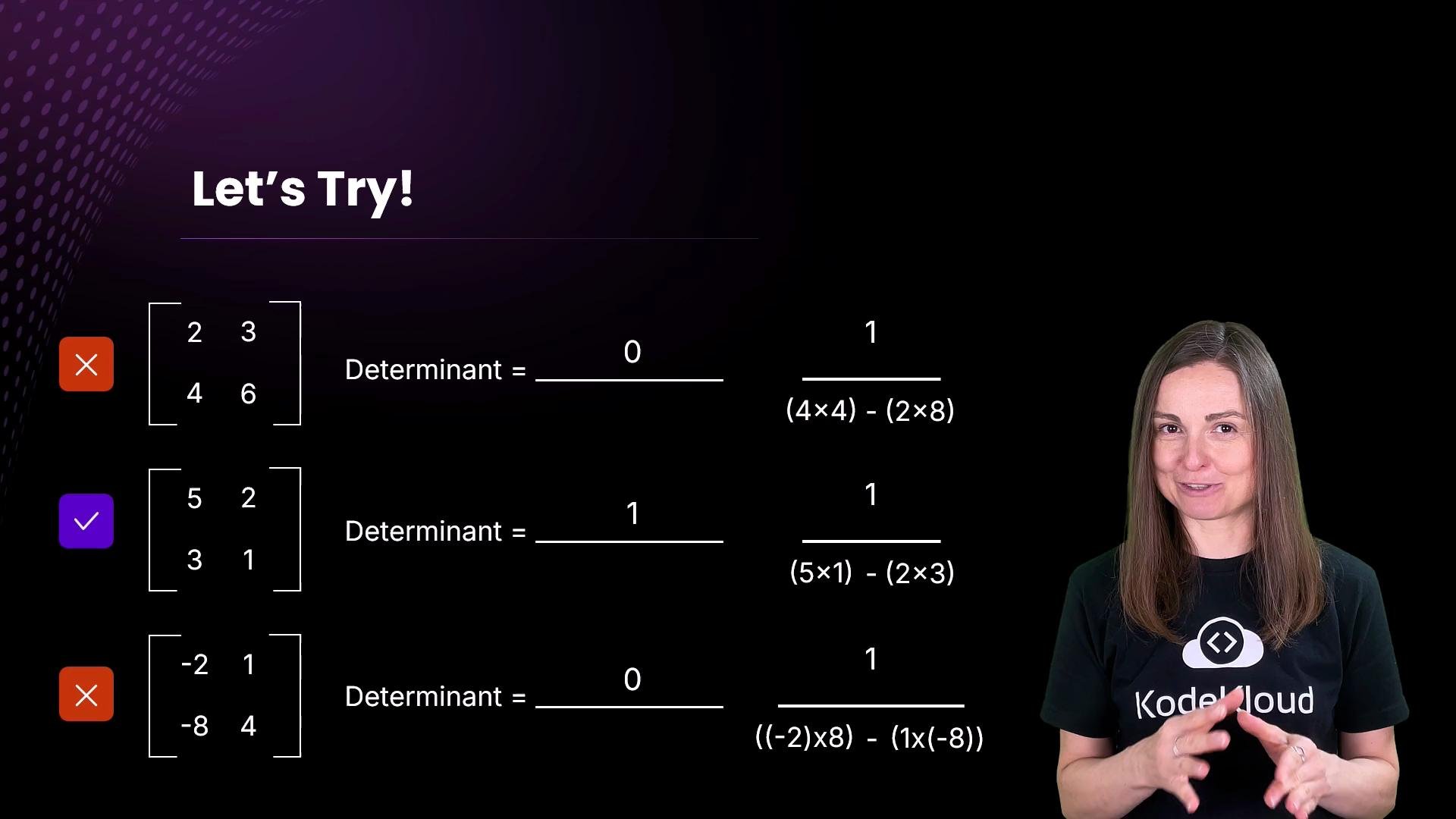
The determinant `ad − bc` appears in the denominator of the inverse formula. If the determinant is zero, the formula would divide by zero and no inverse exists. Such matrices are called singular or non-invertible.
Example of a zero determinant:
det = 2×6 − 4×3 = 12 − 12 = 0
If the determinant equals zero the matrix has no inverse. Such matrices are called singular.
You can apply this determinant test to any small square matrix: only square matrices with nonzero determinant have inverses.
Why the determinant matters
The determinant `ad − bc` appears in the denominator of the inverse formula. If the determinant is zero, the formula would divide by zero and no inverse exists. Such matrices are called singular or non-invertible.
Example of a zero determinant:
det = 2×6 − 4×3 = 12 − 12 = 0
If the determinant equals zero the matrix has no inverse. Such matrices are called singular.
You can apply this determinant test to any small square matrix: only square matrices with nonzero determinant have inverses.
 Quick reference table
| Item | Formula / Rule | Notes |
| ----------------- | ------------------------------------------- | ----------------------------------- |
| Inverse (2×2) | `A^{-1} = (1/(ad-bc)) × [[d, -b], [-c, a]]` | Requires `ad − bc ≠ 0` |
| Determinant (2×2) | `ad − bc` | If zero → singular (no inverse) |
| Verification | `A × A^{-1} = I` | Multiply and check you get identity |
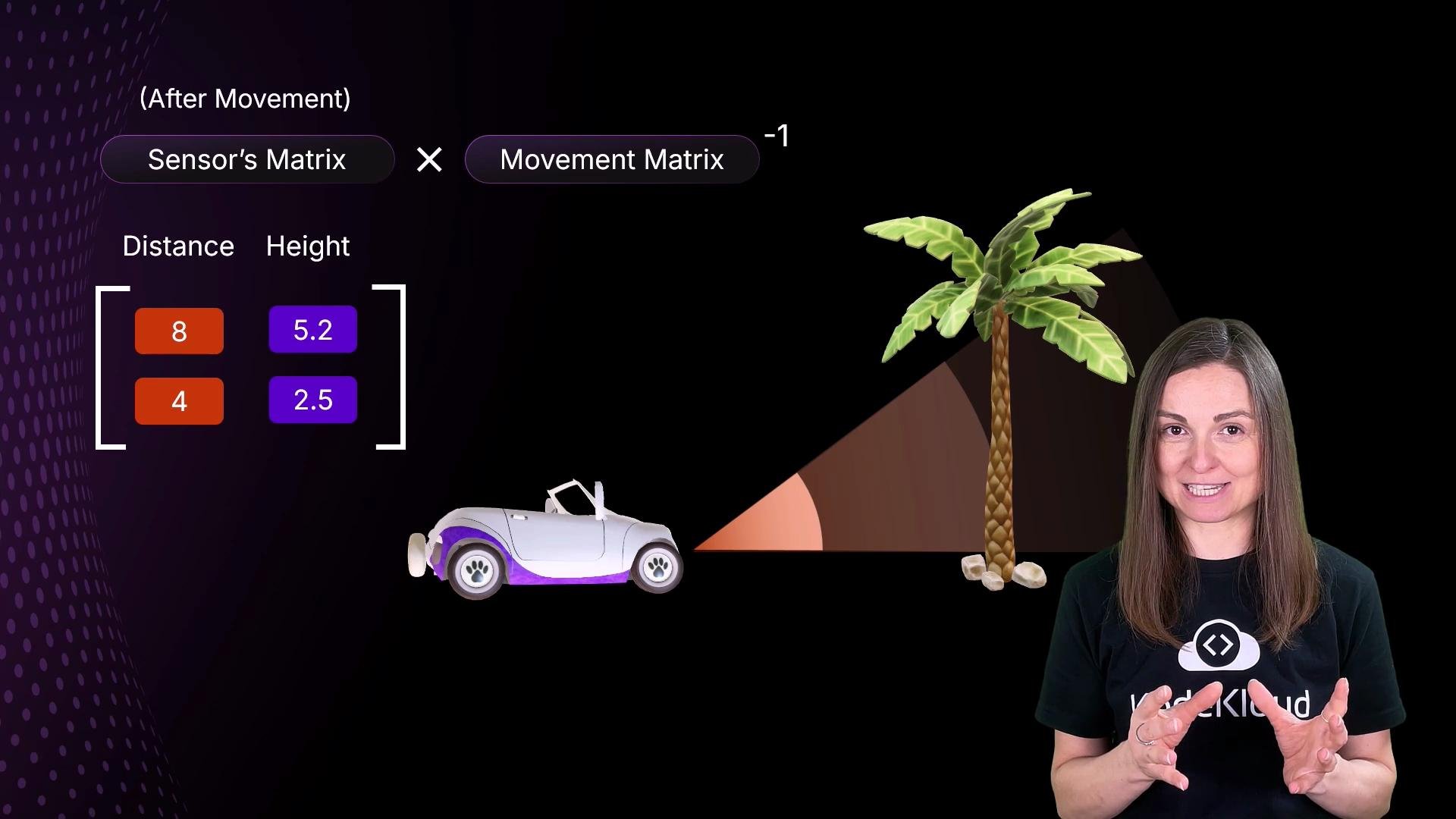
Practical example: correcting sensor readings for movement
Imagine sensor readings distorted by vehicle motion. The motion can be modeled by a movement matrix that transforms the true sensor matrix. To recover the original readings, multiply the measured sensor matrix by the appropriate correction matrix (the inverse of the movement matrix).
Quick reference table
| Item | Formula / Rule | Notes |
| ----------------- | ------------------------------------------- | ----------------------------------- |
| Inverse (2×2) | `A^{-1} = (1/(ad-bc)) × [[d, -b], [-c, a]]` | Requires `ad − bc ≠ 0` |
| Determinant (2×2) | `ad − bc` | If zero → singular (no inverse) |
| Verification | `A × A^{-1} = I` | Multiply and check you get identity |
Practical example: correcting sensor readings for movement
Imagine sensor readings distorted by vehicle motion. The motion can be modeled by a movement matrix that transforms the true sensor matrix. To recover the original readings, multiply the measured sensor matrix by the appropriate correction matrix (the inverse of the movement matrix).
 Apply the same inversion steps: compute `(1/det)` and the adjugate (swap `a` and `d`, negate `b` and `c`), then multiply that inverse by the sensor readings matrix to correct them.
 After computing the inverse, multiply the sensor matrix by the correction matrix (again: row×column for each entry) and simplify to obtain corrected values.
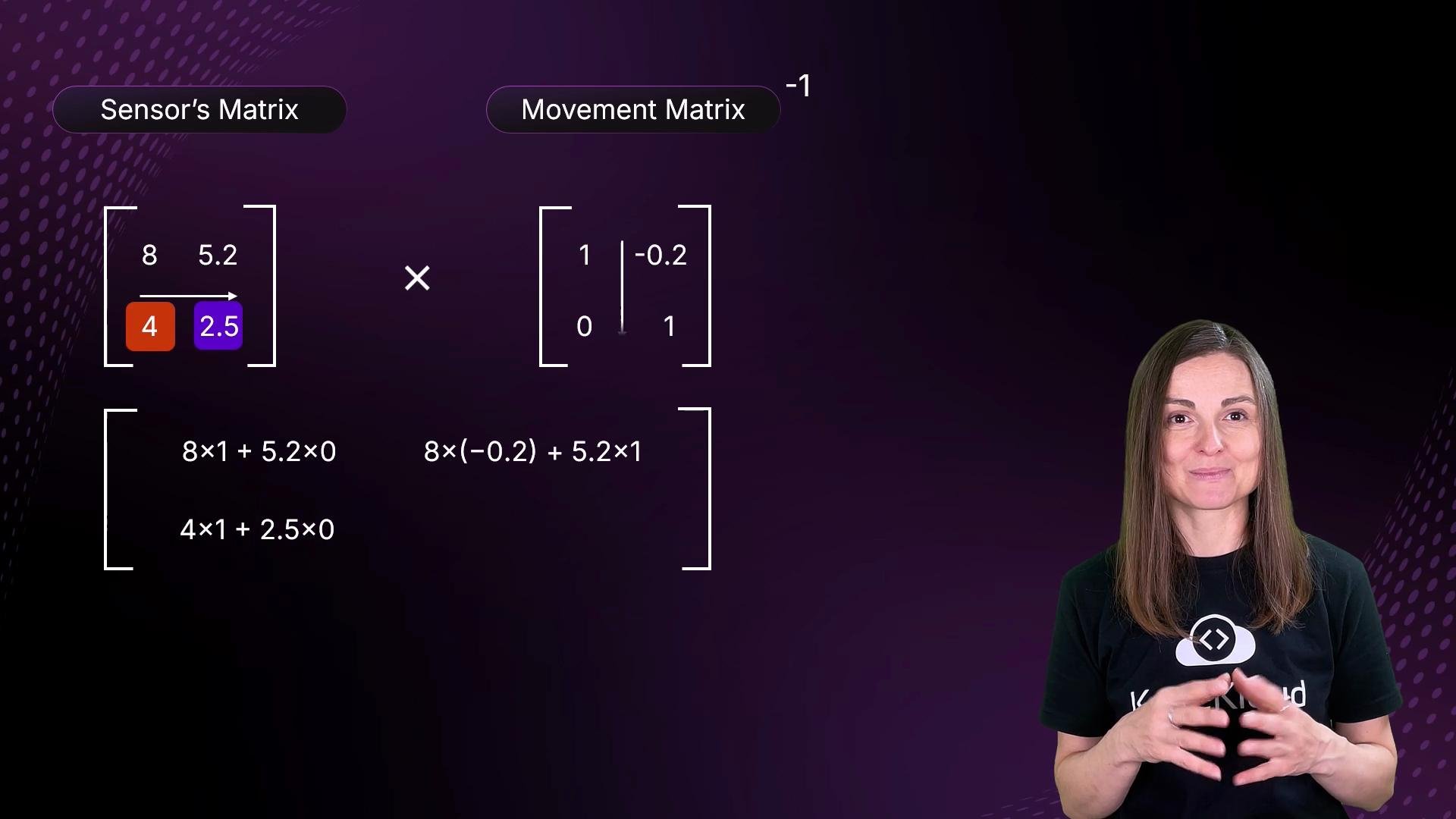 Compact example calculation
```text theme={null}
Sensor's Matrix
[ 8 5.2 ]
[ 4 2.5 ]
Movement Matrix (correction)
[ 1 -0.2 ]
[ 0 1 ]
Multiplication (Sensor × Movement)
[ 8×1 + 5.2×0 8×(-0.2) + 5.2×1 ]
[ 4×1 + 2.5×0 4×(-0.2) + 2.5×1 ]
Result
[ 8 3.6 ]
[ 4 1.7 ]
```
This small example shows how a correction (movement) matrix can restore readings closer to the intended values. In real systems, matrices are larger and numerically precise; matrix inversion and multiplication are central to sensor fusion, calibration, and real-time decision-making.
Compact example calculation
```text theme={null}
Sensor's Matrix
[ 8 5.2 ]
[ 4 2.5 ]
Movement Matrix (correction)
[ 1 -0.2 ]
[ 0 1 ]
Multiplication (Sensor × Movement)
[ 8×1 + 5.2×0 8×(-0.2) + 5.2×1 ]
[ 4×1 + 2.5×0 4×(-0.2) + 2.5×1 ]
Result
[ 8 3.6 ]
[ 4 1.7 ]
```
This small example shows how a correction (movement) matrix can restore readings closer to the intended values. In real systems, matrices are larger and numerically precise; matrix inversion and multiplication are central to sensor fusion, calibration, and real-time decision-making.
 Summary
* For a 2×2 matrix A = \[ \[a, b], \[c, d] ], the inverse is `A^{-1} = (1/(ad−bc)) × adj(A)`.
* The determinant `ad − bc` must be nonzero for the inverse to exist.
* Verification via `A × A^{-1} = I` confirms correctness.
* Applications: inverse and multiplication are used for correcting sensor measurements, calibration, and many applied linear-algebra tasks in robotics and autonomous systems.
Further reading and references
* [Khan Academy — Matrix inverses](https://www.khanacademy.org/math/linear-algebra/matrix-transformations/inverse-of-a-matrix)
* [MIT OCW — Linear Algebra](https://ocw.mit.edu/courses/18-06-linear-algebra/)
* [Wikipedia — Matrix inverse](https://en.wikipedia.org/wiki/Inverse_matrix)
Summary
* For a 2×2 matrix A = \[ \[a, b], \[c, d] ], the inverse is `A^{-1} = (1/(ad−bc)) × adj(A)`.
* The determinant `ad − bc` must be nonzero for the inverse to exist.
* Verification via `A × A^{-1} = I` confirms correctness.
* Applications: inverse and multiplication are used for correcting sensor measurements, calibration, and many applied linear-algebra tasks in robotics and autonomous systems.
Further reading and references
* [Khan Academy — Matrix inverses](https://www.khanacademy.org/math/linear-algebra/matrix-transformations/inverse-of-a-matrix)
* [MIT OCW — Linear Algebra](https://ocw.mit.edu/courses/18-06-linear-algebra/)
* [Wikipedia — Matrix inverse](https://en.wikipedia.org/wiki/Inverse_matrix)