> ## Documentation Index
> Fetch the complete documentation index at: https://notes.kodekloud.com/llms.txt
> Use this file to discover all available pages before exploring further.
# Demo Custom Transformer OWASP Dependency Check 2
> Shows building a custom transformer that converts Jenkins OWASP Dependency Check stages into GitHub Actions steps, parsing additionalArguments to set format and failOnCVSS and upload reports
This lesson shows how to build a custom transformer that converts an OWASP Dependency-Check Jenkins stage into an equivalent GitHub Actions step. The transformer:
* Parses the Jenkins plugin configuration to find `additionalArguments`.
* Extracts key flags such as `--format` and `--failOnCVSS`.
* Emits a GitHub Actions step that runs the `dependency-check/Dependency-Check_Action` and uploads generated reports.
Goal: produce a GitHub Actions job step that runs dependency-check, writes reports to `reports/`, and uploads those artifacts.
Desired GitHub Actions step (excerpt)
```yaml theme={null}
jobs:
depchecktest:
runs-on: ubuntu-latest
name: depcheck_test
steps:
- name: Checkout
uses: actions/checkout@v2
- name: Build project with Maven
run: mvn clean install
- name: Depcheck
uses: dependency-check/Dependency-Check_Action@main
id: Depcheck
with:
project: "test"
path: "."
format: "HTML"
out: "reports" # default; no need to specify unless overriding
args: >
--failOnCVSS 7
--enableRetired
- name: Upload Test results
uses: actions/upload-artifact@master
with:
name: Depcheck report
path: ${{ github.workspace }}/reports
```
What data do we get from Jenkins?
The Dependency-Check plugin configuration appears as a structured hash. The important field is `additionalArguments` (a multi-line string). Example:
```ruby theme={null}
{
"name" => "dependencyCheck",
"arguments" => [
{
"key" => "additionalArguments",
"value" => {
"isLiteral" => true,
"value" => "
--scan './'
--out './'
--format 'ALL'
--disableYarnAudit --prettyPrint --failOnCVSS 9"
}
},
{
"key" => "nvdCredentialsId",
"value" => {
"isLiteral" => true,
"value" => "owasp-dependency-check"
}
},
{
"key" => "odcInstallation",
"value" => {
"isLiteral" => true,
"value" => "OWASP-DepCheck-10"
}
}
]
},
{
"name" => "dependencyCheckPublisher",
"arguments" => [
{
...
}
]
}
```
What we need to parse from `additionalArguments`
| Flag | Purpose | Regex used to extract | Default if missing |
| -------------- | -------------------------------------------------------- | ------------------------------------ | ------------------ |
| `--format` | Which report format(s) to generate (e.g., `HTML`, `ALL`) | `/--format\s+['"]?([^'"\s]+)['"]?/i` | `ALL` |
| `--failOnCVSS` | CVSS threshold that makes dependency-check exit non-zero | `/--failOnCVSS\s+(\d+(?:\.\d+)?)/i` | `9` |
Transformer scaffolding and environment
Add or reuse your transformer (example filename: `ci-pipeline-transformer.rb`). You can set up a runner and environment variables for the transformer runtime. Example runner/env config:
```ruby theme={null}
runner "us-west-1-ubuntu-22", "ubuntu-latest"
env "MONGO_USERNAME", "superuser"
env "MONGO_PASSWORD", secret("mongo_db_password")
env "MONGO_DB_CREDS", nil
```
Transformer implementation
The transformer locates the `additionalArguments` string, applies regular expressions to extract `--format` and `--failOnCVSS`, and builds the step hash for GitHub Actions. Defaults are applied if values are absent.
```ruby theme={null}
transform "dependencyCheck" do |item|
# Extract additional arguments (string)
additional_args = item["arguments"].find { |arg| arg["key"] == "additionalArguments" }["value"]["value"]
# Parse key parameters from additional arguments
# Accept quoted or unquoted format values
format = additional_args.match(/--format\s+['"]?([^'"\s]+)['"]?/i)&.captures&.first || "ALL"
# Accept integer or decimal CVSS thresholds
fail_on_cvss = additional_args.match(/--failOnCVSS\s+(\d+(?:\.\d+)?)/i)&.captures&.first || "9"
{
"name" => "OWASP Dependency Check",
# Ensure that, even if the check fails, we continue to the artifact upload step
"continue-on-error" => true,
"uses" => "dependency-check/Dependency-Check_Action@main",
"with" => {
"project" => "test",
"path" => ".",
"format" => format,
"out" => "reports",
"args" => "--failOnCVSS #{fail_on_cvss}"
}
}
end
```
Skip the publisher stage
Jenkins' `dependencyCheckPublisher` can be omitted for GitHub Actions because the dependency-check action writes the reports directly. Return `nil` in the transformer to skip that identifier:
```ruby theme={null}
transform "dependencyCheckPublisher" do |item|
next nil
end
```
Run a dry-run import
Validate the transformation with a dry-run using the importer tool:
```bash theme={null}
gh actions-importer dry-run jenkins \
--source-url http://139.84.149.83:8080/job/ci-pipeline-poll-scm/ \
--output-dir tmp/dry-run \
--custom-transformers ss-pipeline-transformer.rb
```
When you run a real migration, the tool can create a pull request in the target repo:
```bash theme={null}
gh actions-importer migrate jenkins \
--target-url https://github.com/jenkins-demo-org/solar-system \
--output-dir tmp/migrate \
--source-url http://139.84.149.83:8080/job/ci-pipeline-poll-scm/ \
--custom-transformers ss-pipeline-transformer.rb
# Output:
# Pull request: 'https://github.com/jenkins-demo-org/solar-system/pull/1'
```
Pull request and converted workflow
The generated workflow keeps the original environment, runners, and converted jobs. The OWASP job contains the dependency-check action and a subsequent upload-artifact step to collect reports.
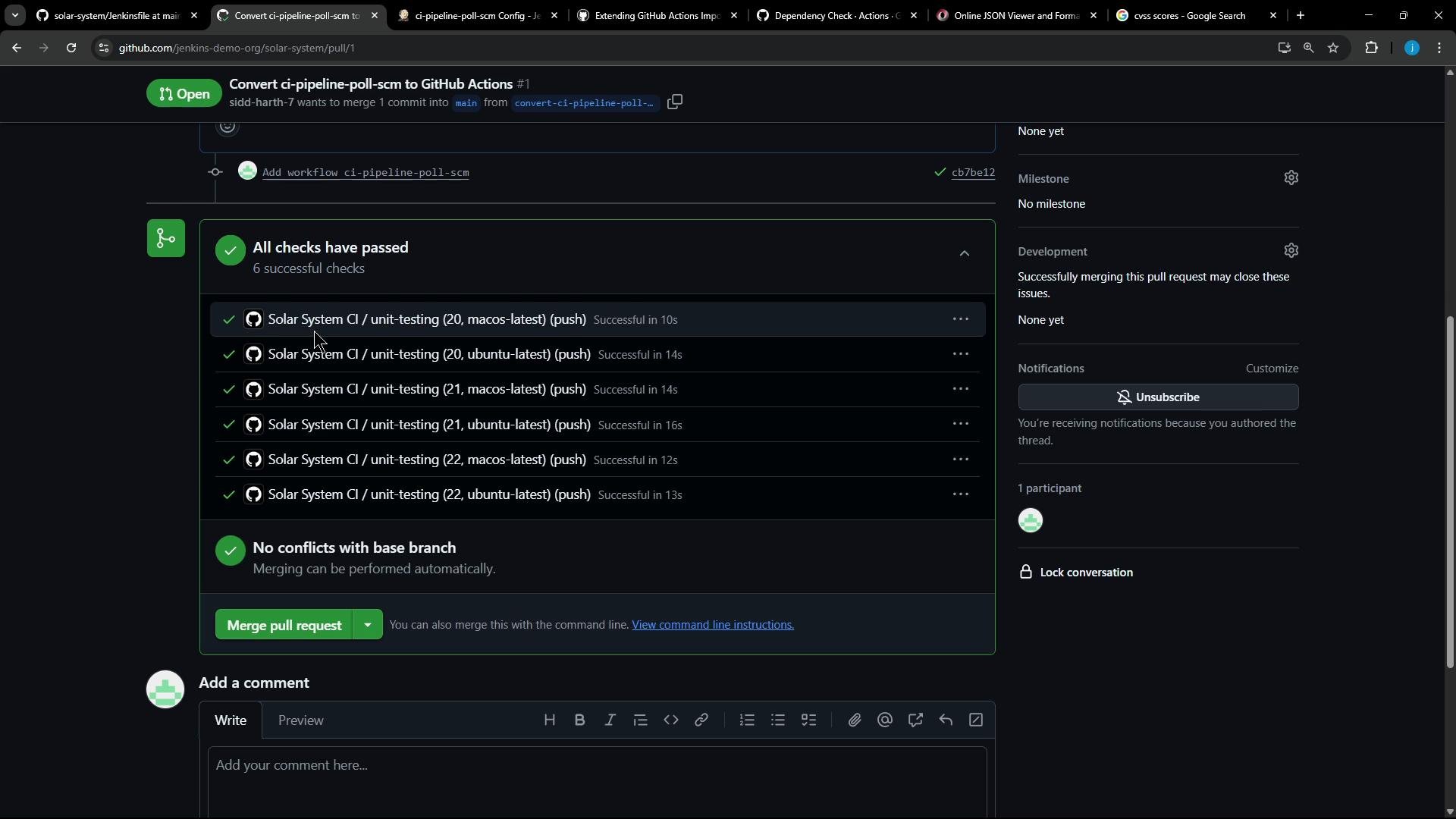 Excerpt of the generated workflow (converted OWASP job)
```yaml theme={null}
Dependency_Scanning_OWASP_Dependency_Check:
name: Dependency Scanning - OWASP Dependency Check
runs-on:
- ubuntu-latest
needs: Installing_Dependencies
steps:
- name: checkout
uses: actions/checkout@v4.1.0
- name: OWASP Dependency Check
continue-on-error: true
uses: dependency-check/Dependency-Check_Action@main
with:
project: test
path: "."
format: ALL
out: reports
args: "--failOnCVSS 9"
- name: Upload Artifacts
uses: actions/upload-artifact@v4.1.0
with:
if-no-files-found: ignore
name: Dependency Check HTML Report
path: "reports"
```
Execute the workflow and read logs
When the action runs it triggers dependency-check, which generates multiple formats (XML, HTML, JSON, CSV, SARIF, JUnit). The action receives the `--format`, `--out`, and `--failOnCVSS` settings from the `with.args` we provided.
Sample logs (trimmed):
```bash theme={null}
[INFO] Analysis Complete (4 seconds)
[INFO] Writing XML report to: /github/workspace/reports/dependency-check-report.xml
[INFO] Writing HTML report to: /github/workspace/reports/dependency-check-report.html
[INFO] Writing JSON report to: /github/workspace/reports/dependency-check-report.json
[INFO] Writing CSV report to: /github/workspace/reports/dependency-check-report.csv
[INFO] Writing SARIF report to: /github/workspace/reports/dependency-check-report.sarif
[INFO] Writing JUNIT report to: /github/workspace/reports/dependency-check-report-junit.xml
# Upload Artifacts
Uploaded bytes 209207
Finished uploading artifact content to blob storage!
SHA256 hash of uploaded artifact .zip is a71f06a5ae4d09e7be41f18401a6a577ba0635a86cecfa2f13cad1376a0a1c5f
Finished artifact upload
```
Handling failures and ensuring artifact upload
If dependency-check finds vulnerabilities above the `--failOnCVSS` threshold the process exits non-zero and the step fails. By adding `continue-on-error: true` to the dependency-check step, the job will continue and the `upload-artifact` step will still run so you can download the reports for inspection.
Example error when threshold is exceeded:
```text theme={null}
Error:
One or more dependencies were identified with vulnerabilities that have a CVSS score greater than or equal to '2.0':
package-lock.json?formidable (pkg:npm/formidable@2.1.2): GHSA-75v8-2h7p-7m2m (3.1), CVE-2025-46653 (6.9)
See the dependency-check report for more details.
```
Because `continue-on-error: true` is set, the Upload Artifacts step still runs and uploads the reports for inspection.
Excerpt of the generated workflow (converted OWASP job)
```yaml theme={null}
Dependency_Scanning_OWASP_Dependency_Check:
name: Dependency Scanning - OWASP Dependency Check
runs-on:
- ubuntu-latest
needs: Installing_Dependencies
steps:
- name: checkout
uses: actions/checkout@v4.1.0
- name: OWASP Dependency Check
continue-on-error: true
uses: dependency-check/Dependency-Check_Action@main
with:
project: test
path: "."
format: ALL
out: reports
args: "--failOnCVSS 9"
- name: Upload Artifacts
uses: actions/upload-artifact@v4.1.0
with:
if-no-files-found: ignore
name: Dependency Check HTML Report
path: "reports"
```
Execute the workflow and read logs
When the action runs it triggers dependency-check, which generates multiple formats (XML, HTML, JSON, CSV, SARIF, JUnit). The action receives the `--format`, `--out`, and `--failOnCVSS` settings from the `with.args` we provided.
Sample logs (trimmed):
```bash theme={null}
[INFO] Analysis Complete (4 seconds)
[INFO] Writing XML report to: /github/workspace/reports/dependency-check-report.xml
[INFO] Writing HTML report to: /github/workspace/reports/dependency-check-report.html
[INFO] Writing JSON report to: /github/workspace/reports/dependency-check-report.json
[INFO] Writing CSV report to: /github/workspace/reports/dependency-check-report.csv
[INFO] Writing SARIF report to: /github/workspace/reports/dependency-check-report.sarif
[INFO] Writing JUNIT report to: /github/workspace/reports/dependency-check-report-junit.xml
# Upload Artifacts
Uploaded bytes 209207
Finished uploading artifact content to blob storage!
SHA256 hash of uploaded artifact .zip is a71f06a5ae4d09e7be41f18401a6a577ba0635a86cecfa2f13cad1376a0a1c5f
Finished artifact upload
```
Handling failures and ensuring artifact upload
If dependency-check finds vulnerabilities above the `--failOnCVSS` threshold the process exits non-zero and the step fails. By adding `continue-on-error: true` to the dependency-check step, the job will continue and the `upload-artifact` step will still run so you can download the reports for inspection.
Example error when threshold is exceeded:
```text theme={null}
Error:
One or more dependencies were identified with vulnerabilities that have a CVSS score greater than or equal to '2.0':
package-lock.json?formidable (pkg:npm/formidable@2.1.2): GHSA-75v8-2h7p-7m2m (3.1), CVE-2025-46653 (6.9)
See the dependency-check report for more details.
```
Because `continue-on-error: true` is set, the Upload Artifacts step still runs and uploads the reports for inspection.
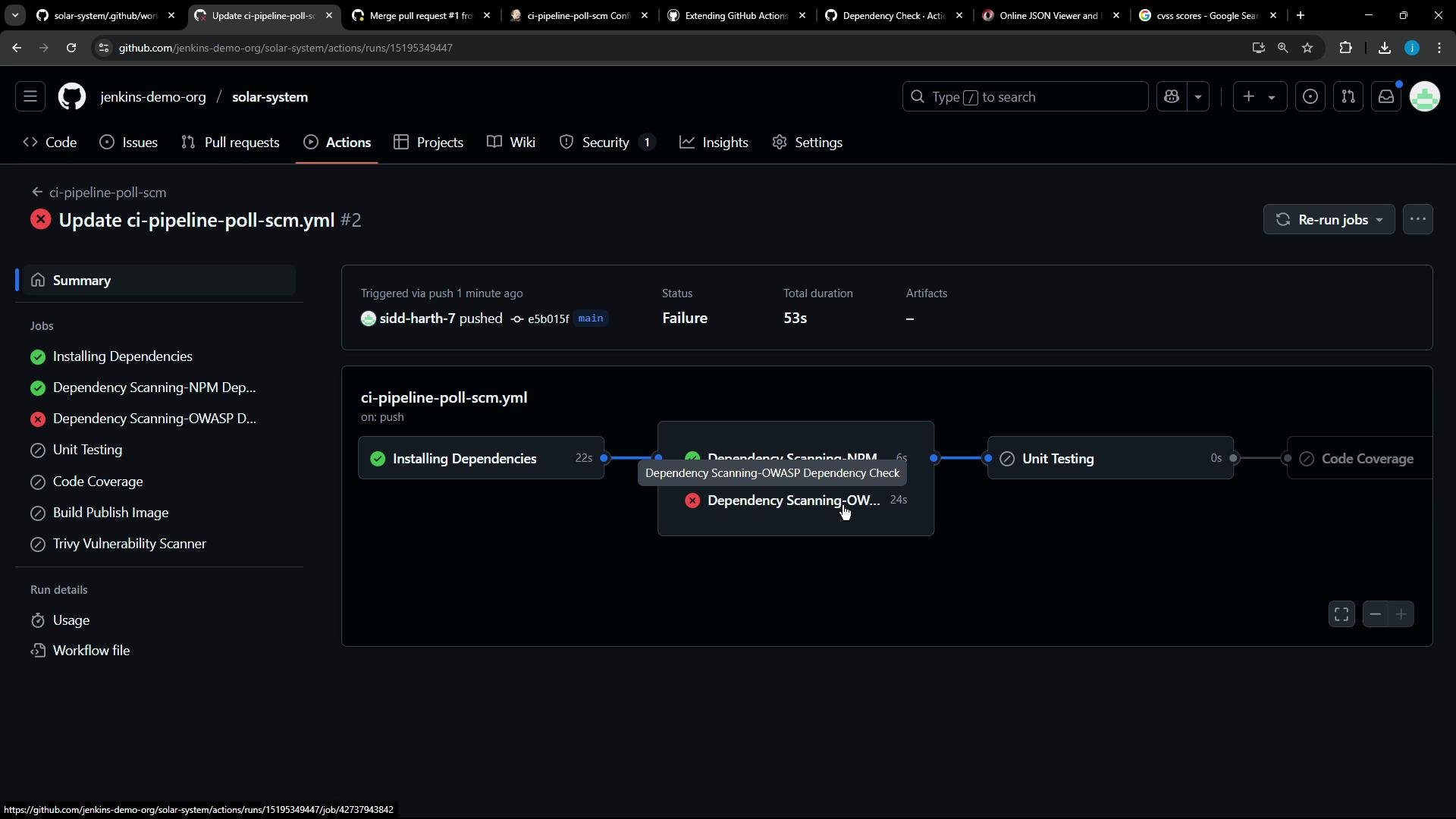 Using `continue-on-error: true` for the dependency-check step lets subsequent steps (for example, uploading artifacts) run even if dependency-check exits non-zero. If you prefer the job to fail on vulnerabilities, omit `continue-on-error` (or set it to `false`) and make the upload conditional (for example, `if: failure()` or use `if: always()` for unconditional uploads depending on your policy).
Final notes and verification
* After merging the generated PR, your repository will contain the converted GitHub Actions workflow. The OWASP dependency check will run as a job, produce multiple report formats, and upload them as artifacts.
* To have the job fail on vulnerability findings, keep the required `--failOnCVSS` value and remove `continue-on-error`.
* To always collect reports regardless of findings, keep `continue-on-error: true` and upload artifacts afterward.
* The example transformer is intentionally simple: it extracts `--format` and `--failOnCVSS` and hard-codes `project`, `path`, and `out`. Extend the transformer to pull additional parameters (project name, report directory, credentials, etc.) from other Jenkins arguments as needed.
Using `continue-on-error: true` for the dependency-check step lets subsequent steps (for example, uploading artifacts) run even if dependency-check exits non-zero. If you prefer the job to fail on vulnerabilities, omit `continue-on-error` (or set it to `false`) and make the upload conditional (for example, `if: failure()` or use `if: always()` for unconditional uploads depending on your policy).
Final notes and verification
* After merging the generated PR, your repository will contain the converted GitHub Actions workflow. The OWASP dependency check will run as a job, produce multiple report formats, and upload them as artifacts.
* To have the job fail on vulnerability findings, keep the required `--failOnCVSS` value and remove `continue-on-error`.
* To always collect reports regardless of findings, keep `continue-on-error: true` and upload artifacts afterward.
* The example transformer is intentionally simple: it extracts `--format` and `--failOnCVSS` and hard-codes `project`, `path`, and `out`. Extend the transformer to pull additional parameters (project name, report directory, credentials, etc.) from other Jenkins arguments as needed.
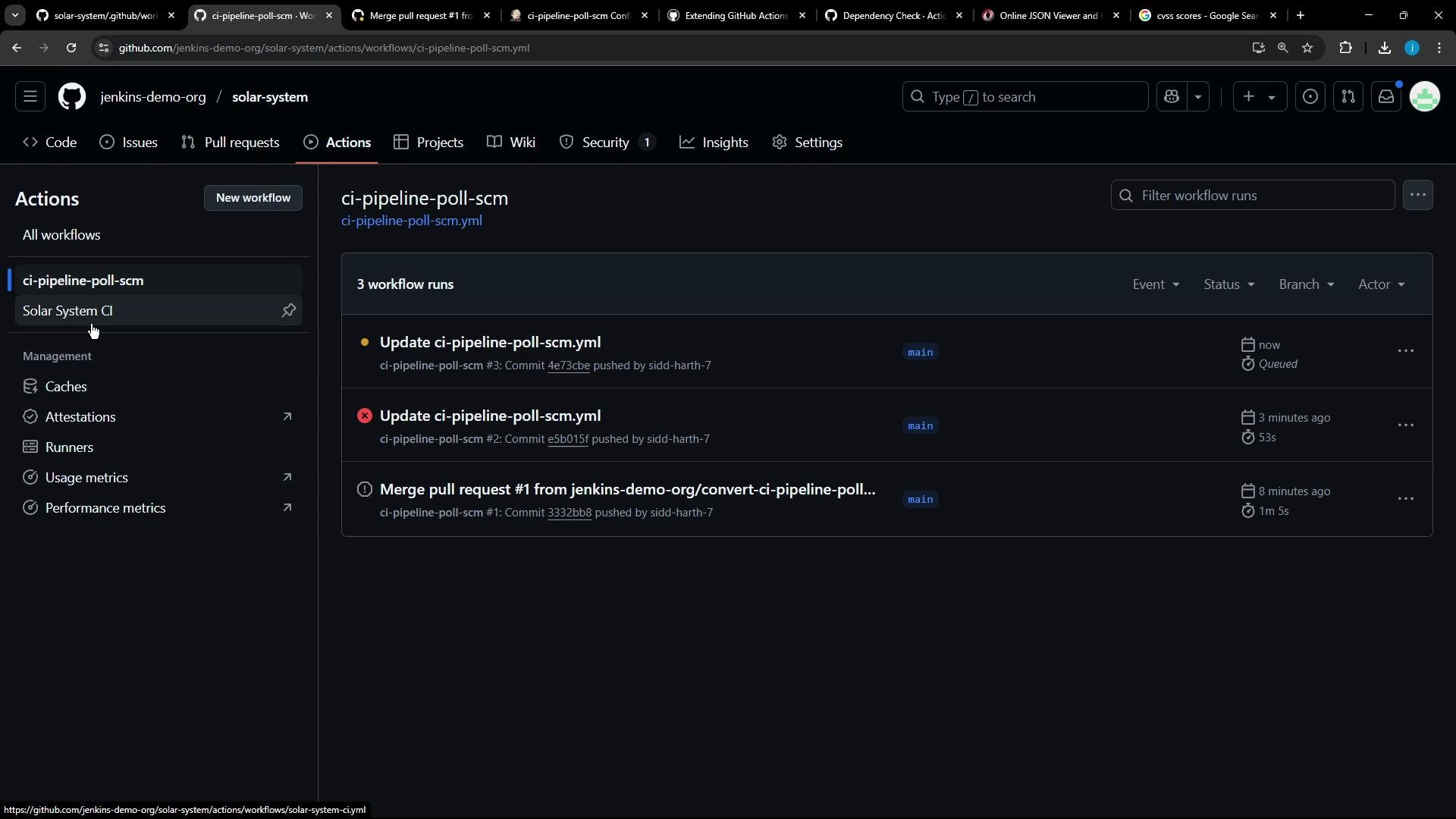 That's the complete flow: parse Jenkins `additionalArguments`, implement a custom transformer that emits a GitHub Actions step using `dependency-check/Dependency-Check_Action@main`, ensure reports are written to a defined `out` directory, and upload those reports as artifacts even if the scanner step flags vulnerabilities.