> ## Documentation Index
> Fetch the complete documentation index at: https://notes.kodekloud.com/llms.txt
> Use this file to discover all available pages before exploring further.
# Why Migrate from Jenkins to GitHub Actions
> Migrating CI/CD from Jenkins to GitHub Actions to simplify workflows, leverage native GitHub integration, YAML workflows, hosted runners, marketplace actions, and reduce maintenance
If your source repositories already live on GitHub, moving CI/CD pipelines from Jenkins to [GitHub Actions](https://learn.kodekloud.com/user/courses/github-actions) can simplify operations, reduce maintenance, and speed up developer feedback loops. This guide summarizes the primary reasons teams migrate and shows concise examples and comparisons to help you evaluate whether a migration makes sense for your projects.
Summary:
* Native GitHub integration removes manual webhook and plugin configuration.
* Declarative YAML workflows are easier to review and version.
* Hosted runners scale without managing build servers or agents.
* A large Actions Marketplace reduces custom scripting.
* Managed service means less infrastructure maintenance.
Quick comparison
| Area | Jenkins | GitHub Actions |
| ----------------------- | --------------------------------- | ------------------------------------- |
| Integration with GitHub | Webhooks + plugins required | Native, event-driven triggers |
| Workflow definition | Groovy pipelines / UI | YAML in `.github/workflows` |
| Scaling | Manage masters/agents | Hosted runners + matrix/parallel jobs |
| Extensibility | Plugin ecosystem (self-managed) | Marketplace actions (managed) |
| Maintenance | Server/OS/plugin updates required | Managed by GitHub (less ops) |
## 1) Native GitHub integration
GitHub Actions is built into GitHub and triggers workflows directly from repository events (push, pull\_request, release, etc.). You don’t need to configure external webhooks or expose a Jenkins server for GitHub to contact—this removes an operational step and potential security surface.
Example trigger configuration in a GitHub Actions workflow:
```yaml theme={null}
# .github/workflows/ci.yml (triggers)
on:
push:
branches: [ main ]
pull_request:
branches: [ main ]
```
## 2) Simplified YAML-based workflows
Workflows are stored with your code under `.github/workflows`, making them easy to review, track in pull requests, and version alongside application changes. Compared to Groovy-based Jenkinsfiles or GUI configuration, YAML workflows are typically more accessible to developers and reviewers.
A simple CI workflow example:
```yaml theme={null}
# .github/workflows/ci.yml
name: CI
on:
push:
branches: [ main ]
pull_request:
branches: [ main ]
jobs:
build:
runs-on: ubuntu-latest
steps:
- uses: actions/checkout@v4
- run: npm install
- run: npm test
```
## 3) Cloud-native scalability
GitHub-hosted runners provide automatic scaling for CI workloads. You can run matrix builds and parallel jobs without provisioning or maintaining dedicated build servers or Jenkins agents. This eliminates the operational burden of capacity planning and agent lifecycle management.
## 4) Extensive Marketplace of pre-built Actions
The GitHub Actions Marketplace offers many community and vendor-maintained actions for tasks such as:
* Building and pushing container images
* Deploying to cloud providers (AWS, Azure, GCP)
* Notifying chat systems (Slack, Teams)
* Managing artifact storage and caching
Using marketplace actions reduces the amount of custom scripting and plugin management compared to Jenkins, where several plugins or bespoke scripts might be required for equivalent integrations.
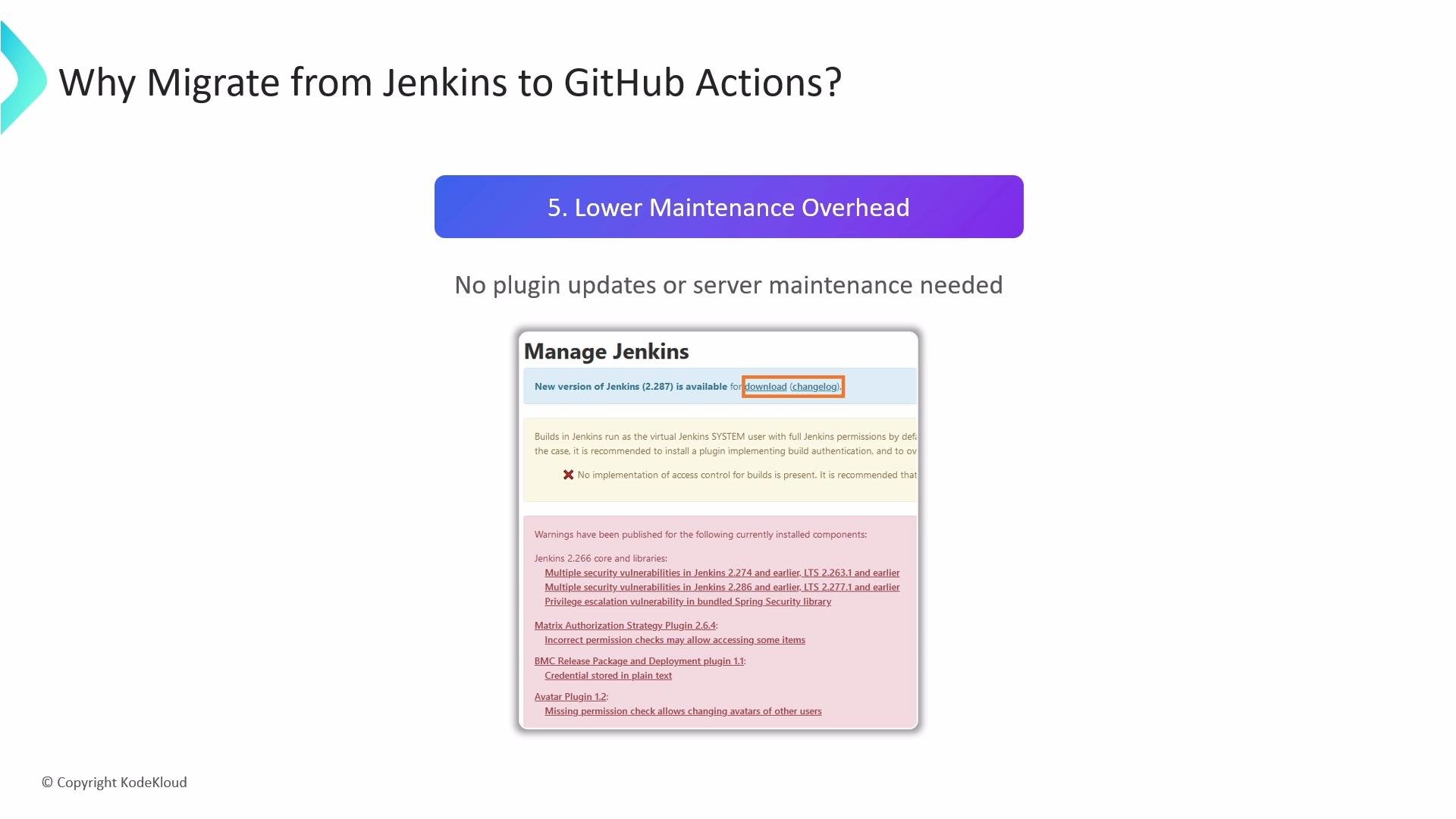
## 5) Lower maintenance overhead
Jenkins requires ongoing server maintenance, plugin updates, and security patching—typically handled by platform or DevOps teams. GitHub Actions, as a managed service, shifts most of this operational work to GitHub and reduces platform overhead for teams.
 Overall, for teams already using GitHub, adopting GitHub Actions can reduce DevOps toil and simplify CI/CD through native integration, readable YAML workflows, scalable hosted runners, reusable marketplace components, and lower maintenance.
[Jenkins](https://learn.kodekloud.com/user/courses/jenkins) remains a powerful choice for advanced on‑premises use cases that require heavy customization, unique plugin ecosystems, or strict network isolation. Evaluate migration based on your specific requirements, compliance constraints, and plugin dependencies.
When to consider staying with Jenkins
* You depend on proprietary or niche plugins only available for Jenkins.
* Your build infrastructure must run in a strictly isolated network with no outbound access.
* You have complex, long-running pipeline orchestration tightly coupled to existing Jenkins jobs and components.
When GitHub Actions is a good fit
* Repositories are hosted on GitHub and you want event-driven workflows.
* You prefer configuration-as-code stored alongside the application.
* You want a managed CI solution with minimal server maintenance and easy scaling.
References and further reading
* [GitHub Actions documentation](https://docs.github.com/actions)
* [Jenkins documentation](https://www.jenkins.io/doc/)
* [GitHub Actions Marketplace](https://github.com/marketplace?type=actions)
To conclude: Jenkins is still a valid and capable CI/CD platform for specific, advanced scenarios. For many teams already on GitHub, GitHub Actions simplifies CI/CD with native integration, YAML workflows, automatic scaling, a large marketplace of actions, and reduced maintenance.
Overall, for teams already using GitHub, adopting GitHub Actions can reduce DevOps toil and simplify CI/CD through native integration, readable YAML workflows, scalable hosted runners, reusable marketplace components, and lower maintenance.
[Jenkins](https://learn.kodekloud.com/user/courses/jenkins) remains a powerful choice for advanced on‑premises use cases that require heavy customization, unique plugin ecosystems, or strict network isolation. Evaluate migration based on your specific requirements, compliance constraints, and plugin dependencies.
When to consider staying with Jenkins
* You depend on proprietary or niche plugins only available for Jenkins.
* Your build infrastructure must run in a strictly isolated network with no outbound access.
* You have complex, long-running pipeline orchestration tightly coupled to existing Jenkins jobs and components.
When GitHub Actions is a good fit
* Repositories are hosted on GitHub and you want event-driven workflows.
* You prefer configuration-as-code stored alongside the application.
* You want a managed CI solution with minimal server maintenance and easy scaling.
References and further reading
* [GitHub Actions documentation](https://docs.github.com/actions)
* [Jenkins documentation](https://www.jenkins.io/doc/)
* [GitHub Actions Marketplace](https://github.com/marketplace?type=actions)
To conclude: Jenkins is still a valid and capable CI/CD platform for specific, advanced scenarios. For many teams already on GitHub, GitHub Actions simplifies CI/CD with native integration, YAML workflows, automatic scaling, a large marketplace of actions, and reduced maintenance.