> ## Documentation Index
> Fetch the complete documentation index at: https://notes.kodekloud.com/llms.txt
> Use this file to discover all available pages before exploring further.
# Keeping in Touch
> Practical guidance for staying updated on Datadog resources, release notes, learning materials, and community channels, plus tips for sharing them with your team.
Hi — welcome to the final lesson.
In this lesson we'll cover practical ways to stay connected with Datadog’s latest updates, learning materials, and community resources. Sharing these with your team helps everyone stay informed about product announcements, best practices, and new learning opportunities.
## Official Datadog resources to follow
Below are a few official Datadog resources worth bookmarking and recommending to your team.
| Resource | What it offers | Link |
| --------------------------- | ------------------------------------------------------------------------------------------------------------------------------------- | ---------------------------------------------------------------------------------- |
| Datadog Architecture Center | Architecture reference material and design patterns to plan and scale your monitoring and observability environment. | [https://www.datadoghq.com/architecture/](https://www.datadoghq.com/architecture/) |
| Datadog Blog | Posts from Datadog engineers and community contributors with product deep dives, case studies, and best practices. | [https://www.datadoghq.com/blog/](https://www.datadoghq.com/blog/) |
| Datadog Learning Resources | A centralized hub for documentation, webinars, enablement sessions, and guided learning paths—ideal for onboarding and hands-on labs. | [https://learn.datadoghq.com/](https://learn.datadoghq.com/) |
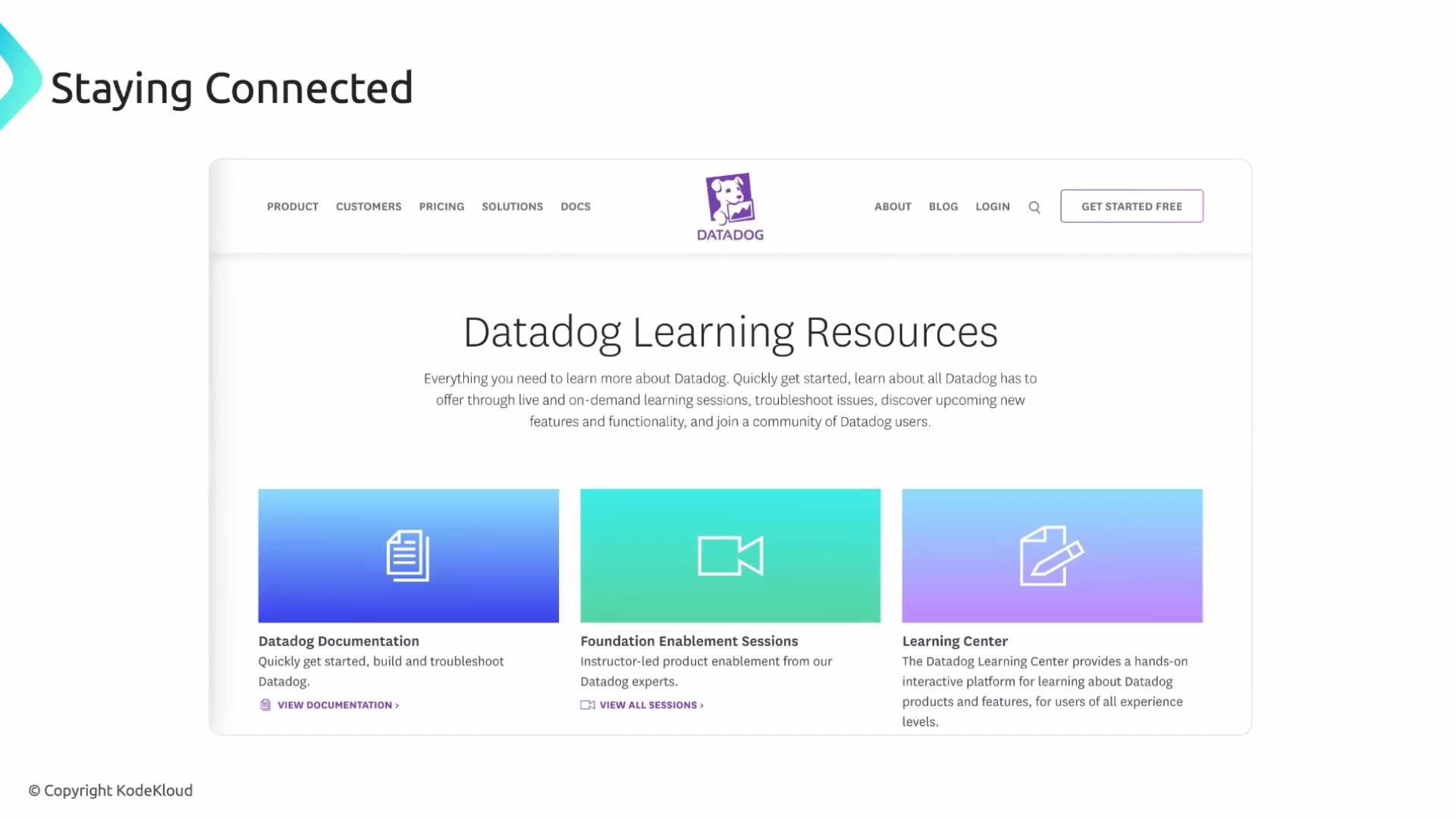 Another complementary hub provides on-demand courses, labs, live streams, and webinars to deepen practical skills across the Datadog platform.
Practical ways to stay up to date: subscribe to Datadog’s [release notes](https://docs.datadoghq.com/release_notes/) and [blog](https://www.datadoghq.com/blog/) RSS feeds, follow Datadog on LinkedIn and Twitter, join community forums or Slack groups, and bookmark the [status](https://status.datadoghq.com/) and [documentation](https://docs.datadoghq.com/) pages for quick reference.
## How to share these resources with your team
* Create a shared onboarding checklist that links to the Learning Resources and Architecture Center.
* Add a “Datadog updates” channel in your team chat for curated release notes, blog posts, and relevant webinars.
* Schedule regular brown-bag sessions to review new features and platform changes highlighted in release notes or the blog.
* Maintain a single source of truth (wiki or internal docs) that aggregates links, runbooks, and recommended learning paths.
## Quick checklist for staying current
* Subscribe to release notes and blog RSS.
* Follow Datadog on social media (LinkedIn, Twitter).
* Enroll teammates in guided learning paths or hands-on labs from Learning Resources.
* Monitor status and documentation pages for operational alerts and API changes.
* Participate in community forums for practical tips and troubleshooting patterns.
## Links and references
* Datadog Architecture Center: [https://www.datadoghq.com/architecture/](https://www.datadoghq.com/architecture/)
* Datadog Blog: [https://www.datadoghq.com/blog/](https://www.datadoghq.com/blog/)
* Datadog Learning Resources: [https://learn.datadoghq.com/](https://learn.datadoghq.com/)
* Release notes: [https://docs.datadoghq.com/release\_notes/](https://docs.datadoghq.com/release_notes/)
* Status page: [https://status.datadoghq.com/](https://status.datadoghq.com/)
* Documentation: [https://docs.datadoghq.com/](https://docs.datadoghq.com/)
This is the final lesson. I hope you enjoyed the content as much as I enjoyed teaching it. If you have questions or want to continue the conversation, feel free to reach out on LinkedIn or other social channels.
See you around!
Another complementary hub provides on-demand courses, labs, live streams, and webinars to deepen practical skills across the Datadog platform.
Practical ways to stay up to date: subscribe to Datadog’s [release notes](https://docs.datadoghq.com/release_notes/) and [blog](https://www.datadoghq.com/blog/) RSS feeds, follow Datadog on LinkedIn and Twitter, join community forums or Slack groups, and bookmark the [status](https://status.datadoghq.com/) and [documentation](https://docs.datadoghq.com/) pages for quick reference.
## How to share these resources with your team
* Create a shared onboarding checklist that links to the Learning Resources and Architecture Center.
* Add a “Datadog updates” channel in your team chat for curated release notes, blog posts, and relevant webinars.
* Schedule regular brown-bag sessions to review new features and platform changes highlighted in release notes or the blog.
* Maintain a single source of truth (wiki or internal docs) that aggregates links, runbooks, and recommended learning paths.
## Quick checklist for staying current
* Subscribe to release notes and blog RSS.
* Follow Datadog on social media (LinkedIn, Twitter).
* Enroll teammates in guided learning paths or hands-on labs from Learning Resources.
* Monitor status and documentation pages for operational alerts and API changes.
* Participate in community forums for practical tips and troubleshooting patterns.
## Links and references
* Datadog Architecture Center: [https://www.datadoghq.com/architecture/](https://www.datadoghq.com/architecture/)
* Datadog Blog: [https://www.datadoghq.com/blog/](https://www.datadoghq.com/blog/)
* Datadog Learning Resources: [https://learn.datadoghq.com/](https://learn.datadoghq.com/)
* Release notes: [https://docs.datadoghq.com/release\_notes/](https://docs.datadoghq.com/release_notes/)
* Status page: [https://status.datadoghq.com/](https://status.datadoghq.com/)
* Documentation: [https://docs.datadoghq.com/](https://docs.datadoghq.com/)
This is the final lesson. I hope you enjoyed the content as much as I enjoyed teaching it. If you have questions or want to continue the conversation, feel free to reach out on LinkedIn or other social channels.
See you around!