> ## Documentation Index
> Fetch the complete documentation index at: https://notes.kodekloud.com/llms.txt
> Use this file to discover all available pages before exploring further.
# Lessons Learned
> Post-migration lessons for evolving an observability platform with continuous feedback, engineer enablement, cross-team collaboration, safe experimentation, and regular dependency maintenance.
Now that the migration is complete and the new platform is live, teams are operating against the modernized environment and technical debt items have been captured for ongoing tracking. In this post-migration phase, the goal is to turn lessons learned into repeatable practices that improve future projects and day-to-day operations.
Key principles to carry forward:
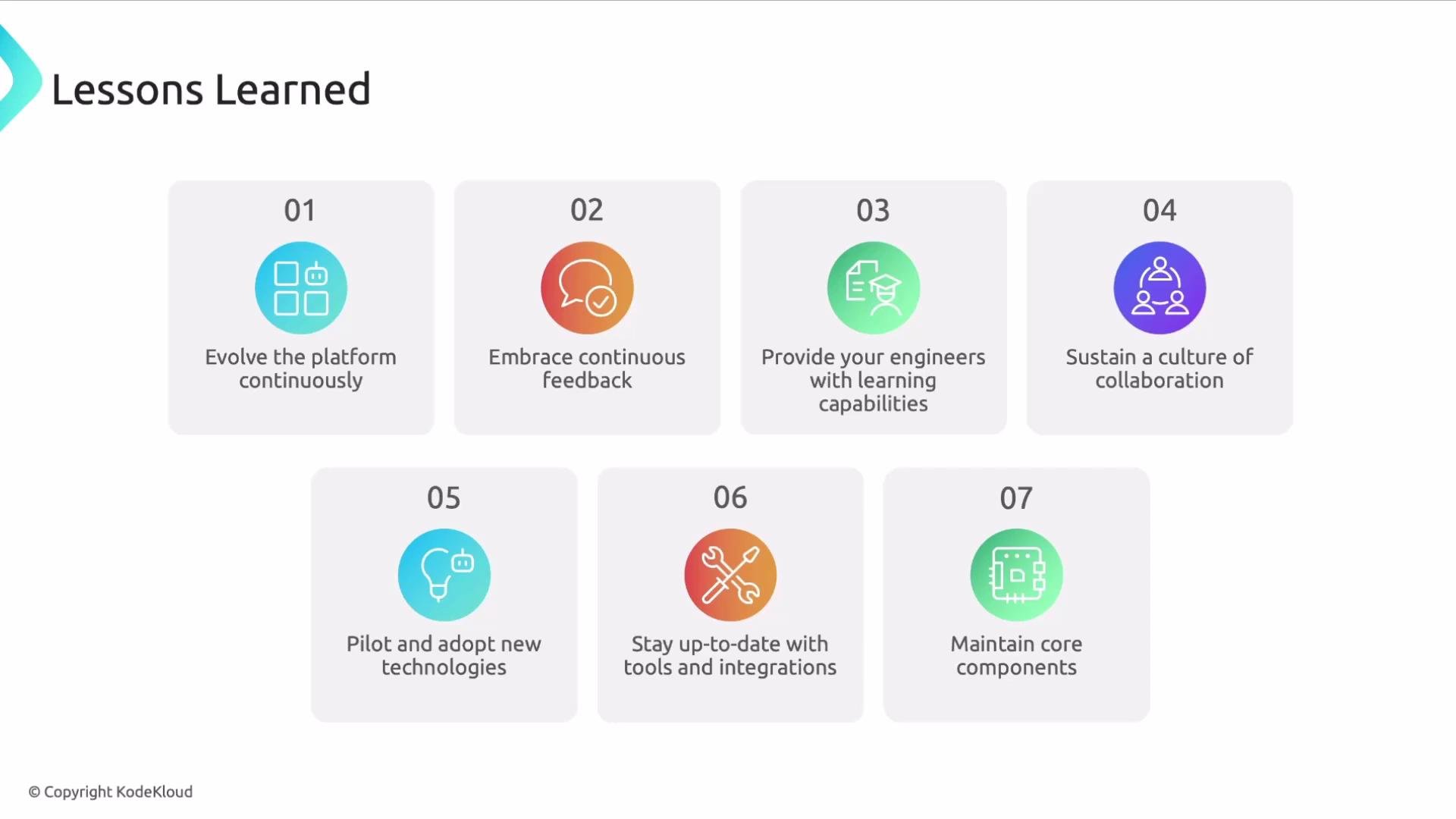
* Continuously evolve the platform using user feedback. Treat monitoring and observability as living products that improve incrementally.
* Provide engineers with ongoing learning and improvement opportunities so they can propose enhancements and add features.
* Foster a collaborative culture across teams to encourage idea-sharing and cross-functional experimentation.
* Encourage curiosity and safe experimentation with new features and integrations to validate value quickly.
* Keep core components properly maintained and versioned — update container images, libraries, and dependencies on a regular cadence.
 Summary table — quick reference for post-migration best practices:
| Focus area | What to do | Why it matters |
| -------------------- | ----------------------------------------------------------- | ------------------------------------------------------------------------------- |
| Platform evolution | Continuously collect and act on user feedback | Keeps observability and monitoring aligned with actual usage and pain points |
| Skills & enablement | Provide training, office hours, and playbooks for engineers | Empowers teams to propose and implement improvements |
| Collaboration | Create cross-team forums and shared experiment spaces | Reduces silos and accelerates discovery of useful patterns |
| Safe experimentation | Offer staging environments and feature flags for testing | Lowers risk while validating new integrations or workflows |
| Dependency hygiene | Enforce versioning, scheduled upgrades, and image scanning | Prevents drift, reduces security exposure, and leverages vendor/community fixes |
Actionable next steps
1. Shorten the feedback loop: instrument usage metrics and solicit qualitative feedback from teams on a regular cadence.
2. Prioritize technical debt items alongside feature work and track them in your backlog.
3. Establish a maintenance schedule for container images, SDKs, and monitoring libraries.
4. Run periodic retrospectives to surface platform friction and convert findings into small, testable improvements.
Keep the feedback loop short: collect usage data and team feedback, prioritize improvements, and roll out incremental changes so the platform stays relevant and reliable.
Further reading and references
* [Kubernetes Documentation](https://kubernetes.io/docs/) — general guidance on deployments and version management
* [Docker Hub](https://hub.docker.com/) — best practices for container images and tagging
* [Datadog Documentation](https://docs.datadoghq.com/) — monitoring and observability patterns
That’s it. I hope you found it useful.
Summary table — quick reference for post-migration best practices:
| Focus area | What to do | Why it matters |
| -------------------- | ----------------------------------------------------------- | ------------------------------------------------------------------------------- |
| Platform evolution | Continuously collect and act on user feedback | Keeps observability and monitoring aligned with actual usage and pain points |
| Skills & enablement | Provide training, office hours, and playbooks for engineers | Empowers teams to propose and implement improvements |
| Collaboration | Create cross-team forums and shared experiment spaces | Reduces silos and accelerates discovery of useful patterns |
| Safe experimentation | Offer staging environments and feature flags for testing | Lowers risk while validating new integrations or workflows |
| Dependency hygiene | Enforce versioning, scheduled upgrades, and image scanning | Prevents drift, reduces security exposure, and leverages vendor/community fixes |
Actionable next steps
1. Shorten the feedback loop: instrument usage metrics and solicit qualitative feedback from teams on a regular cadence.
2. Prioritize technical debt items alongside feature work and track them in your backlog.
3. Establish a maintenance schedule for container images, SDKs, and monitoring libraries.
4. Run periodic retrospectives to surface platform friction and convert findings into small, testable improvements.
Keep the feedback loop short: collect usage data and team feedback, prioritize improvements, and roll out incremental changes so the platform stays relevant and reliable.
Further reading and references
* [Kubernetes Documentation](https://kubernetes.io/docs/) — general guidance on deployments and version management
* [Docker Hub](https://hub.docker.com/) — best practices for container images and tagging
* [Datadog Documentation](https://docs.datadoghq.com/) — monitoring and observability patterns
That’s it. I hope you found it useful.