> ## Documentation Index
> Fetch the complete documentation index at: https://notes.kodekloud.com/llms.txt
> Use this file to discover all available pages before exploring further.
# Python Package for Bag of Words Classification
> Recommends scikit-learn for traditional bag-of-words text classification and contrasts it with deep learning frameworks like PyTorch and TensorFlow
Question 15.
Which Python package would be the most appropriate for implementing a traditional bag-of-words text classification model? [Scikit-learn](https://scikit-learn.org/stable/) or [PyTorch](https://pytorch.org/)?
Answer: [Scikit-learn](https://scikit-learn.org/stable/).
[Scikit-learn](https://scikit-learn.org/stable/) is the most suitable choice for building traditional bag-of-words (BoW) text classification pipelines. It provides simple, well-tested tools for BoW feature extraction (`CountVectorizer`, `TfidfVectorizer`), pipeline composition, feature selection, and a wide range of classical classifiers (e.g., `LogisticRegression`, `MultinomialNB`, `SGDClassifier`). Its consistent API and lightweight dependencies make it ideal for small- to medium-scale problems and rapid prototyping.
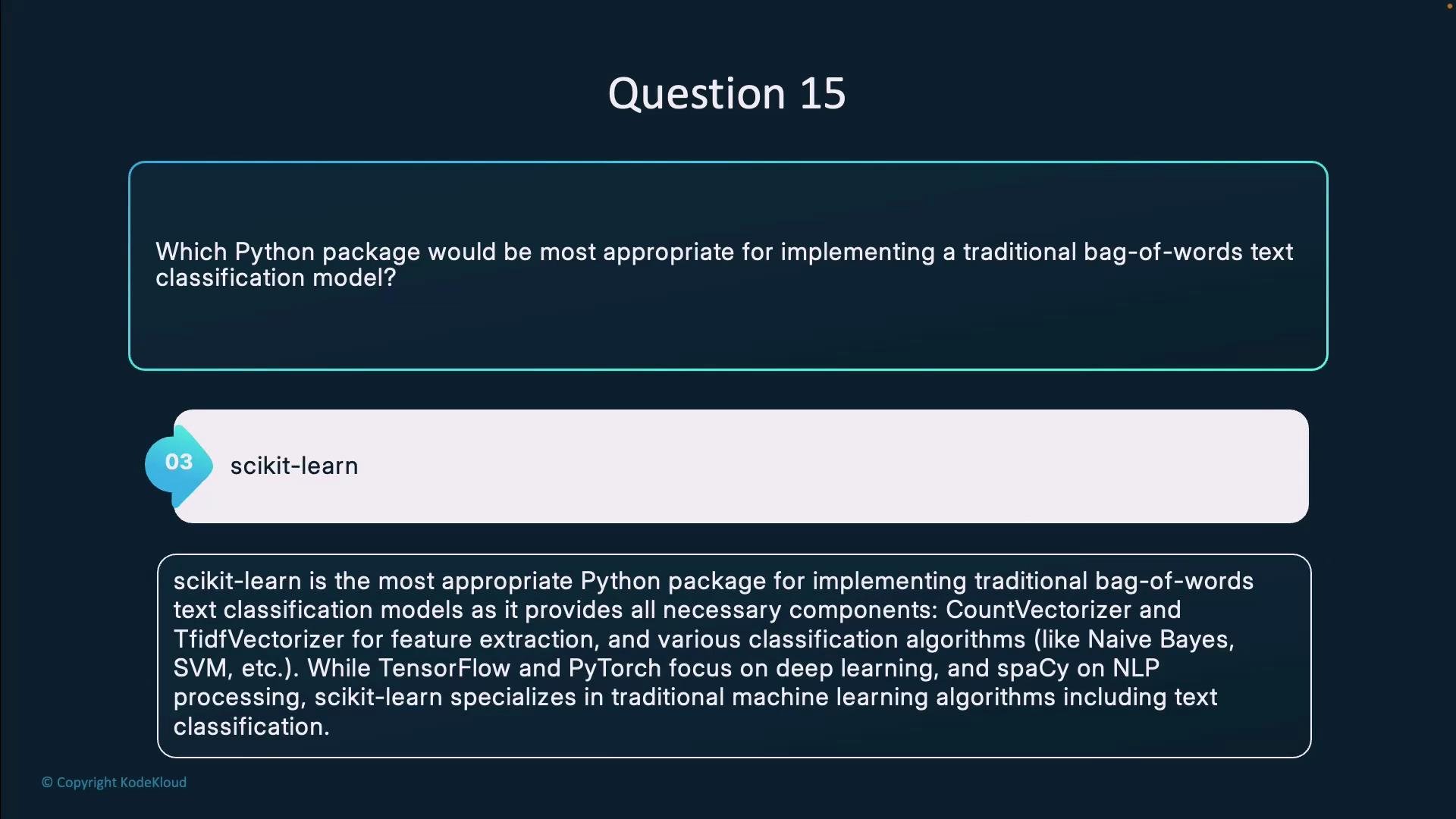 While deep-learning frameworks like [TensorFlow](https://www.tensorflow.org/) and [PyTorch](https://pytorch.org/) excel at training neural networks (transformers, RNNs, CNNs) and learning representations end-to-end on accelerators, they are typically heavier than necessary for classic BoW approaches. [spaCy](https://spacy.io/) is a great choice for robust NLP preprocessing (tokenization, lemmatization, pipelines), but for straightforward BoW feature extraction plus supervised classifiers, scikit-learn is usually the fastest path to results.
Use [scikit-learn](https://scikit-learn.org/stable/) to quickly prototype bag-of-words pipelines. Migrate to deep-learning frameworks only when you need learned embeddings, complex sequence modeling, or GPU-accelerated training for large datasets.
Comparison at a glance:
| Library | Best for | Typical components |
| ------------------------------------------------ | ------------------------------------------------------- | --------------------------------------------------------------------------------------- |
| [scikit-learn](https://scikit-learn.org/stable/) | Traditional BoW pipelines, classical ML | `CountVectorizer`, `TfidfVectorizer`, `Pipeline`, `LogisticRegression`, `MultinomialNB` |
| [spaCy](https://spacy.io/) | Fast NLP preprocessing and tokenization | Tokenization, lemmatization, named-entity recognition |
| [PyTorch](https://pytorch.org/) | Custom neural networks, research, GPU training | Custom models, autograd, transformers via libraries |
| [TensorFlow](https://www.tensorflow.org/) | Production-grade deep learning and large-scale training | Keras models, TF ecosystem tools |
Example — minimal scikit-learn pipeline using TF-IDF and logistic regression:
```python theme={null}
from sklearn.feature_extraction.text import TfidfVectorizer
from sklearn.pipeline import make_pipeline
from sklearn.linear_model import LogisticRegression
# Build a simple TF-IDF + Logistic Regression pipeline
pipeline = make_pipeline(
TfidfVectorizer(ngram_range=(1, 2), max_df=0.9, min_df=2),
LogisticRegression(max_iter=1000)
)
# Example training data
X_train = [
"This movie was fantastic and thrilling",
"Terrible film, I hated it",
"Great story and excellent acting",
"Not my taste, very boring"
]
y_train = [1, 0, 1, 0]
pipeline.fit(X_train, y_train)
# Predict on new documents
preds = pipeline.predict(["An exciting and well-made movie"])
print(preds) # e.g., [1]
```
Summary
* Choose [scikit-learn](https://scikit-learn.org/stable/) for traditional bag-of-words workflows: vectorizers + classical classifiers with fast, interpretable results.
* Use [PyTorch](https://pytorch.org/) or [TensorFlow](https://www.tensorflow.org/) when you require neural-network models, learned representations (embeddings/transformers), or GPU-accelerated training.
* Combine [spaCy](https://spacy.io/) for preprocessing with [scikit-learn](https://scikit-learn.org/stable/) for modeling when you want robust tokenization and a lightweight modeling stack.
Links and references
* [Scikit-learn — Official Documentation](https://scikit-learn.org/stable/)
* [PyTorch — Official Documentation](https://pytorch.org/)
* [TensorFlow — Official Documentation](https://www.tensorflow.org/)
* [spaCy — Official Documentation](https://spacy.io/)
While deep-learning frameworks like [TensorFlow](https://www.tensorflow.org/) and [PyTorch](https://pytorch.org/) excel at training neural networks (transformers, RNNs, CNNs) and learning representations end-to-end on accelerators, they are typically heavier than necessary for classic BoW approaches. [spaCy](https://spacy.io/) is a great choice for robust NLP preprocessing (tokenization, lemmatization, pipelines), but for straightforward BoW feature extraction plus supervised classifiers, scikit-learn is usually the fastest path to results.
Use [scikit-learn](https://scikit-learn.org/stable/) to quickly prototype bag-of-words pipelines. Migrate to deep-learning frameworks only when you need learned embeddings, complex sequence modeling, or GPU-accelerated training for large datasets.
Comparison at a glance:
| Library | Best for | Typical components |
| ------------------------------------------------ | ------------------------------------------------------- | --------------------------------------------------------------------------------------- |
| [scikit-learn](https://scikit-learn.org/stable/) | Traditional BoW pipelines, classical ML | `CountVectorizer`, `TfidfVectorizer`, `Pipeline`, `LogisticRegression`, `MultinomialNB` |
| [spaCy](https://spacy.io/) | Fast NLP preprocessing and tokenization | Tokenization, lemmatization, named-entity recognition |
| [PyTorch](https://pytorch.org/) | Custom neural networks, research, GPU training | Custom models, autograd, transformers via libraries |
| [TensorFlow](https://www.tensorflow.org/) | Production-grade deep learning and large-scale training | Keras models, TF ecosystem tools |
Example — minimal scikit-learn pipeline using TF-IDF and logistic regression:
```python theme={null}
from sklearn.feature_extraction.text import TfidfVectorizer
from sklearn.pipeline import make_pipeline
from sklearn.linear_model import LogisticRegression
# Build a simple TF-IDF + Logistic Regression pipeline
pipeline = make_pipeline(
TfidfVectorizer(ngram_range=(1, 2), max_df=0.9, min_df=2),
LogisticRegression(max_iter=1000)
)
# Example training data
X_train = [
"This movie was fantastic and thrilling",
"Terrible film, I hated it",
"Great story and excellent acting",
"Not my taste, very boring"
]
y_train = [1, 0, 1, 0]
pipeline.fit(X_train, y_train)
# Predict on new documents
preds = pipeline.predict(["An exciting and well-made movie"])
print(preds) # e.g., [1]
```
Summary
* Choose [scikit-learn](https://scikit-learn.org/stable/) for traditional bag-of-words workflows: vectorizers + classical classifiers with fast, interpretable results.
* Use [PyTorch](https://pytorch.org/) or [TensorFlow](https://www.tensorflow.org/) when you require neural-network models, learned representations (embeddings/transformers), or GPU-accelerated training.
* Combine [spaCy](https://spacy.io/) for preprocessing with [scikit-learn](https://scikit-learn.org/stable/) for modeling when you want robust tokenization and a lightweight modeling stack.
Links and references
* [Scikit-learn — Official Documentation](https://scikit-learn.org/stable/)
* [PyTorch — Official Documentation](https://pytorch.org/)
* [TensorFlow — Official Documentation](https://www.tensorflow.org/)
* [spaCy — Official Documentation](https://spacy.io/)