> ## Documentation Index
> Fetch the complete documentation index at: https://notes.kodekloud.com/llms.txt
> Use this file to discover all available pages before exploring further.
# Selecting Vector Databases for RAG
> Guidance on selecting vector databases for RAG, prioritizing effective approximate nearest neighbor search, index types, similarity metrics, scalability, filtering, and operational features
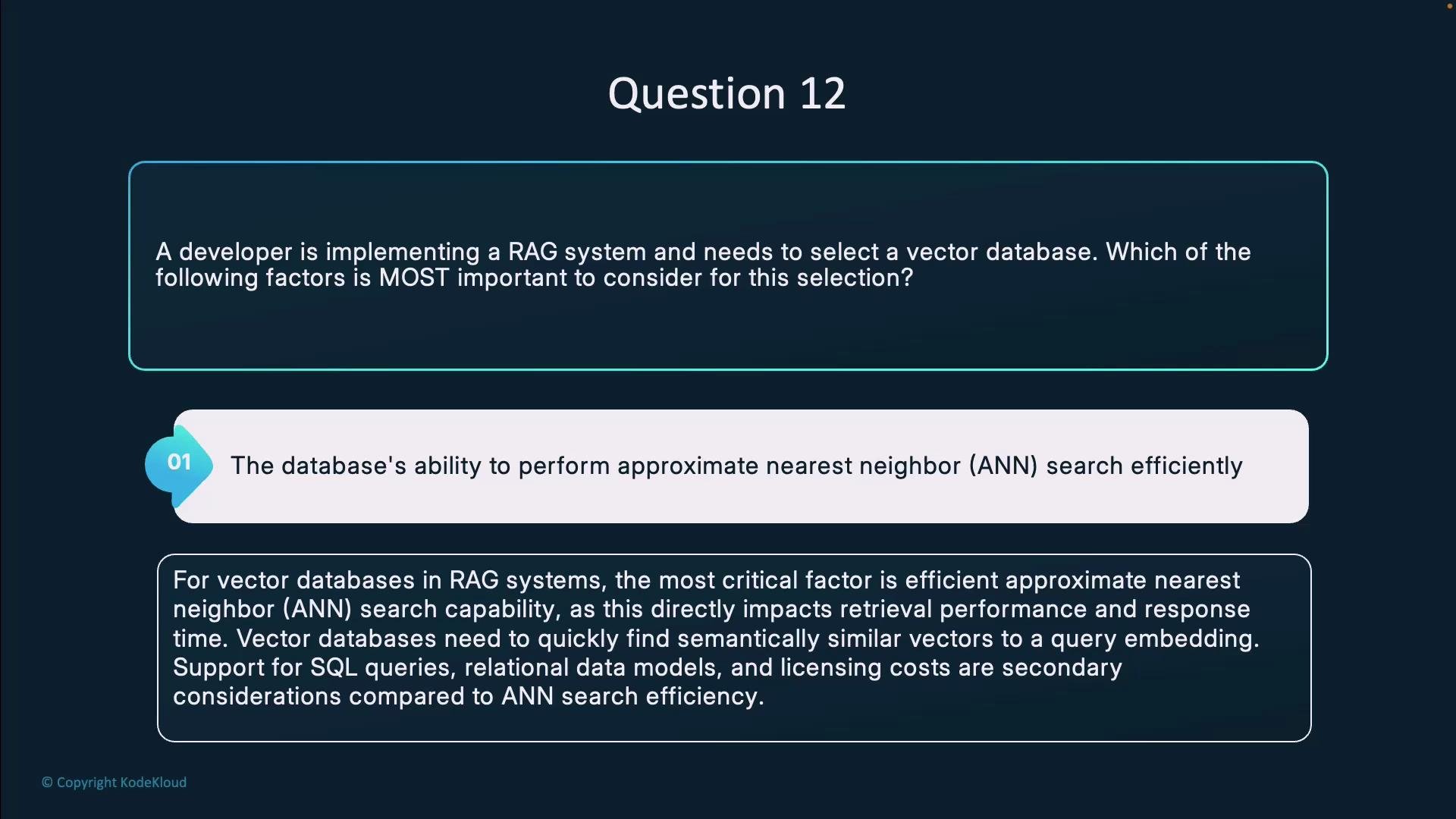
Question 12.
A developer is implementing a RAG system and needs to select a vector database.
Which of the following factors is most important to consider for this selection?
* The database's ability to perform approximate nearest neighbor, or ANN, search effectively
* Whether the database supports SQL queries
* The database's ability to handle relational data models
* The licensing cost of the database software
Which of these is most important to consider?
Best answer: the database's ability to perform approximate nearest neighbor (ANN) search effectively.
Why this matters
* Retrieval-augmented generation (RAG) relies on retrieving semantically relevant documents using vector embeddings. The retrieval step is fundamentally a nearest-neighbor search in high-dimensional space.
* ANN performance determines both relevance (recall) and operational metrics (latency, throughput) as your vector corpus scales to millions or billions of vectors.
* A vector database that implements robust ANN indexes and tuning options will directly impact the quality and responsiveness of the RAG pipeline.
Key considerations for ANN-capable vector databases
* Index/algorithm support: HNSW, IVF, PQ, OPQ, product quantization and hybrid schemes offer different speed/accuracy/memory trade-offs. Choose index types suited to your dataset size and latency requirements.
* Similarity metrics: Ensure the DB supports the metric you need (cosine similarity, dot product, or L2 distance) and that embeddings are handled/normalized consistently.
* Scalability & performance: Look for GPU acceleration, sharding, multi-threaded query execution, and efficient persistence to meet production SLAs.
* Operational features: incremental inserts/deletes, consistency, replication, backup, and low-latency streaming inserts are important for production usage.
* Filtering & metadata: Ability to apply boolean or scalar filters (pre- or post-ANN) is essential for scoped retrieval in many RAG use cases.
* Monitoring & tuning: Observability, metrics, and index-rebuild workflows matter for long-term operation.
Trade-offs vs. secondary factors
* SQL support and relational modeling matter when you must integrate closely with transactional systems or existing data warehouses—but these are secondary to retrieval quality.
* Licensing and cost are important in procurement decisions but should be evaluated after confirming the database meets ANN, performance, and reliability requirements.
Detailed checklist for evaluating vector DBs for RAG
* Does it support appropriate ANN algorithms (e.g., HNSW, IVF, PQ)?
* Which similarity metrics are supported and how are embeddings normalized?
* What are the expected latencies at your target corpus size? Are there benchmarks or reproducible tests?
* Is there GPU support or hardware acceleration?
* Does it support metadata filtering and hybrid queries with boolean constraints?
* How are inserts/deletes handled (batch vs streaming)?
* What persistence, replication, and backup options exist for reliability?
* What operational tooling exists for monitoring, index maintenance, and tuning?
Comparison table — primary vs secondary selection factors
| Factor | Why it matters for RAG | Priority |
| ----------------------------------------- | -------------------------------------------------------------- | ----------- |
| ANN search quality & index types | Directly affects recall, latency, and throughput for retrieval | High |
| Metric support (cosine/dot/L2) | Ensures embeddings are compared correctly | High |
| Scalability (sharding, GPU, threading) | Enables production-level throughput and low latency | High |
| Metadata filtering & hybrid queries | Required for scoped, context-aware retrieval | High |
| Incremental inserts/deletes & persistence | Operational needs for dynamic corpora | Medium-High |
| SQL / relational modeling | Useful for mixed workloads and integrations | Medium |
| Licensing / cost | Procurement and TCO considerations | Medium |
Further reading and references
* HNSW paper: [https://arxiv.org/abs/1603.09320](https://arxiv.org/abs/1603.09320)
* Overview of ANN/indexing techniques: [https://ann-benchmarks.com/](https://ann-benchmarks.com/)
* Vector DB comparisons and benchmarks: search vendor documentation and independent benchmarks for reproducible results
When evaluating vector databases for RAG, prioritize ANN capabilities (index types, recall/speed trade-offs, metric support, and scaling options). Then consider integration features (metadata filtering, persistence, API) and operational factors (cost, licensing, and tooling).