> ## Documentation Index
> Fetch the complete documentation index at: https://notes.kodekloud.com/llms.txt
> Use this file to discover all available pages before exploring further.
# Evaluating LLM Quality Without Single Correct Answer
> Evaluating open-ended language model quality when no single correct answer exists, advocating RLHF with human preference-based reward modeling, workflow, comparisons, and practical trade-offs.
Welcome to the experimentation section.
Question 1.
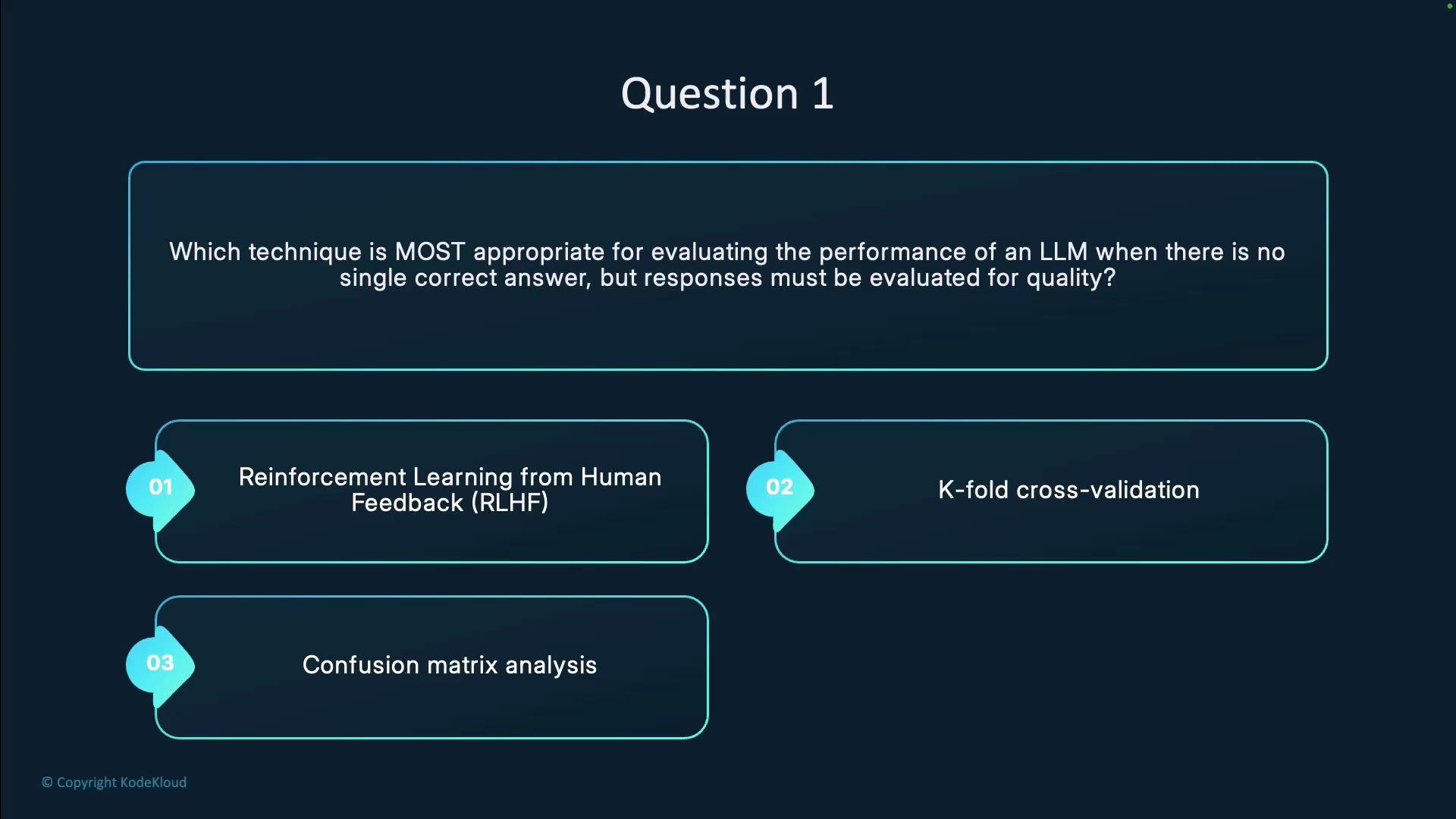
Which technique is most appropriate for evaluating the performance of a language model when there is no single correct answer, but responses must be evaluated for quality: Reinforcement Learning from Human Feedback (RLHF), k-fold cross-validation, confusion matrix analysis, or mean squared error calculation?
 Answer: RLHF (Reinforcement Learning from Human Feedback).
Why RLHF is the best fit
* RLHF is designed for open-ended tasks where multiple valid responses may exist and quality is subjective.
* Human evaluators provide comparative judgments or ratings of model outputs. Those judgments are used to train a reward model that represents human preference.
* A reinforcement learning algorithm (commonly Proximal Policy Optimization — PPO) is then used to fine-tune the policy (the LLM) to maximize the learned reward signal, aligning outputs with human preferences rather than a single deterministic label.
Typical RLHF workflow: collect human preference data → train a reward model on that data → fine-tune the LLM using reinforcement learning to maximize the reward model's score → evaluate outputs with human raters and automated checks.
Quick comparison of the candidate techniques
| Technique | Best suited for | Why it fails for subjective / open-ended quality |
| ------------------------------------------------- | --------------------------------------------------------- | -------------------------------------------------------------------------------------------- |
| Reinforcement Learning from Human Feedback (RLHF) | Aligning model outputs to human judgments and preferences | Explicitly models subjective preferences via a learned reward signal and policy optimization |
| K-fold cross-validation | Supervised tasks with fixed ground-truth labels | Assumes a single correct label per input; not suitable when multiple responses are valid |
| Confusion matrix analysis | Classification with known discrete classes | Requires discrete labels and does not capture nuanced or preference-based quality |
| Mean squared error (MSE) | Numeric regression tasks | Measures distance to a numeric target; meaningless for open-ended text generation |
Why the other choices are less appropriate
* K-fold cross-validation: Good for estimating generalization in supervised learning, but it requires definitive ground-truth labels for each sample. Open-ended generation lacks a single correct target, so cross-validation doesn’t capture subjective quality or preference.
* Confusion matrix analysis: This is for classification—true positives, false negatives, etc.—and assumes a closed set of classes. It doesn’t measure fluency, relevance, helpfulness, or preference among many valid responses.
* Mean squared error (MSE): A regression metric that quantifies numeric error. It cannot meaningfully evaluate semantic quality, style, or relevance in text outputs.
Practical considerations and trade-offs
* Cost and scale: RLHF requires human raters and careful annotation protocols, making it more expensive and time-consuming than purely automated metrics.
* Rater quality and bias: Reward models reflect the preferences of annotators. Clear guidelines, rater training, and diverse annotator pools are necessary to reduce bias.
* Overfitting to preferences: Models can over-optimize for specific annotator tastes or for the reward model’s weaknesses. Use holdout evaluations, diverse scenarios, and periodic human audits.
* Complementary evaluation: Combine RLHF with automated metrics (e.g., BLEU, ROUGE, or embedding-based similarity) and human evaluations for a robust assessment strategy.
Further reading and references
* Christiano, et al., “Deep Reinforcement Learning from Human Preferences” (arXiv): [https://arxiv.org/abs/1706.03741](https://arxiv.org/abs/1706.03741)
* OpenAI, Learning from Human Preferences: [https://openai.com/research/learning-from-human-preferences](https://openai.com/research/learning-from-human-preferences)
* Schulman, et al., “Proximal Policy Optimization Algorithms” (PPO): [https://arxiv.org/abs/1707.06347](https://arxiv.org/abs/1707.06347)
Note: RLHF is the recommended approach when objective labels don't exist and the evaluation target is human judgment of quality, relevance, or preference.
Answer: RLHF (Reinforcement Learning from Human Feedback).
Why RLHF is the best fit
* RLHF is designed for open-ended tasks where multiple valid responses may exist and quality is subjective.
* Human evaluators provide comparative judgments or ratings of model outputs. Those judgments are used to train a reward model that represents human preference.
* A reinforcement learning algorithm (commonly Proximal Policy Optimization — PPO) is then used to fine-tune the policy (the LLM) to maximize the learned reward signal, aligning outputs with human preferences rather than a single deterministic label.
Typical RLHF workflow: collect human preference data → train a reward model on that data → fine-tune the LLM using reinforcement learning to maximize the reward model's score → evaluate outputs with human raters and automated checks.
Quick comparison of the candidate techniques
| Technique | Best suited for | Why it fails for subjective / open-ended quality |
| ------------------------------------------------- | --------------------------------------------------------- | -------------------------------------------------------------------------------------------- |
| Reinforcement Learning from Human Feedback (RLHF) | Aligning model outputs to human judgments and preferences | Explicitly models subjective preferences via a learned reward signal and policy optimization |
| K-fold cross-validation | Supervised tasks with fixed ground-truth labels | Assumes a single correct label per input; not suitable when multiple responses are valid |
| Confusion matrix analysis | Classification with known discrete classes | Requires discrete labels and does not capture nuanced or preference-based quality |
| Mean squared error (MSE) | Numeric regression tasks | Measures distance to a numeric target; meaningless for open-ended text generation |
Why the other choices are less appropriate
* K-fold cross-validation: Good for estimating generalization in supervised learning, but it requires definitive ground-truth labels for each sample. Open-ended generation lacks a single correct target, so cross-validation doesn’t capture subjective quality or preference.
* Confusion matrix analysis: This is for classification—true positives, false negatives, etc.—and assumes a closed set of classes. It doesn’t measure fluency, relevance, helpfulness, or preference among many valid responses.
* Mean squared error (MSE): A regression metric that quantifies numeric error. It cannot meaningfully evaluate semantic quality, style, or relevance in text outputs.
Practical considerations and trade-offs
* Cost and scale: RLHF requires human raters and careful annotation protocols, making it more expensive and time-consuming than purely automated metrics.
* Rater quality and bias: Reward models reflect the preferences of annotators. Clear guidelines, rater training, and diverse annotator pools are necessary to reduce bias.
* Overfitting to preferences: Models can over-optimize for specific annotator tastes or for the reward model’s weaknesses. Use holdout evaluations, diverse scenarios, and periodic human audits.
* Complementary evaluation: Combine RLHF with automated metrics (e.g., BLEU, ROUGE, or embedding-based similarity) and human evaluations for a robust assessment strategy.
Further reading and references
* Christiano, et al., “Deep Reinforcement Learning from Human Preferences” (arXiv): [https://arxiv.org/abs/1706.03741](https://arxiv.org/abs/1706.03741)
* OpenAI, Learning from Human Preferences: [https://openai.com/research/learning-from-human-preferences](https://openai.com/research/learning-from-human-preferences)
* Schulman, et al., “Proximal Policy Optimization Algorithms” (PPO): [https://arxiv.org/abs/1707.06347](https://arxiv.org/abs/1707.06347)
Note: RLHF is the recommended approach when objective labels don't exist and the evaluation target is human judgment of quality, relevance, or preference.