> ## Documentation Index
> Fetch the complete documentation index at: https://notes.kodekloud.com/llms.txt
> Use this file to discover all available pages before exploring further.
# Isolating Impact of Training Dataset Size on LLM Performance
> Examines how training dataset size affects LLM performance by comparing identical architectures trained on progressively larger data subsets while controlling confounding variables.
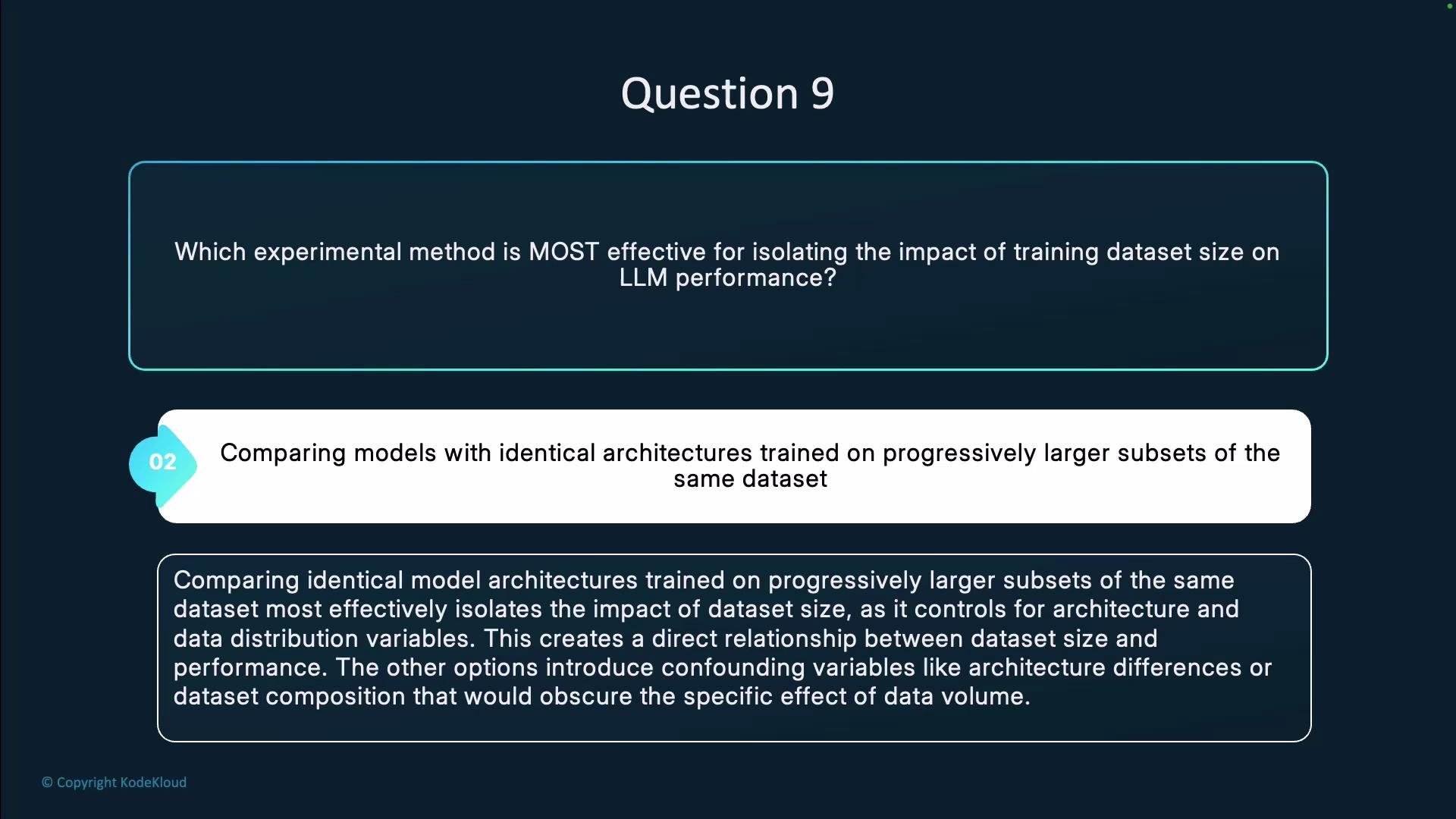
Question 9.
Which experimental method most effectively isolates the impact of training dataset size on LLM performance?
* Comparing models with different architectures trained on the same dataset.
* Comparing models with identical architectures trained on progressively larger subsets of the same dataset.
* Comparing a single model before and after fine-tuning.
* Comparing models trained on completely different datasets of the same size.
Compare models with identical architectures trained on progressively larger subsets of the same dataset.
Why this approach is the best choice
* Controls for architecture: Using the same model architecture removes architectural differences as a confounder, so observed performance changes can be attributed to dataset size.
* Keeps distribution consistent: Drawing progressively larger subsets from the same dataset preserves the underlying data distribution, isolating dataset size as the primary variable.
* Produces clear learning curves: With fixed hyperparameters and evaluation protocols, you can build a reliable performance vs. dataset-size curve that reveals scaling behavior.
Key comparisons at a glance
| Method | Verdict | Why it fails or succeeds |
| ----------------------------------------------------------- | ----------- | ------------------------------------------------------------------------------------------------------------------ |
| Comparing different architectures on the same dataset | Not ideal | Architectural changes confound results; improvements may reflect model capacity, not dataset size. |
| Comparing identical architectures on larger subsets | Best choice | Isolates dataset size while keeping model and data distribution constant. |
| Comparing a single model before/after fine-tuning | Not ideal | Fine-tuning changes both objective and data distribution; effects are not attributable solely to dataset size. |
| Comparing models trained on different datasets of same size | Not ideal | Different datasets likely have different distributions and signal content, so size is not the only varying factor. |
Recommended experimental best practices
* Fix the model architecture, optimizer, learning rate schedule, batch size, and all other hyperparameters across runs.
* Use random, reproducible subsets by setting a seed so results are repeatable and comparable.
* Reserve a single, held-out evaluation set that is never used for training across any subset.
* Plot performance vs. dataset size (learning curve) using both mean estimates and confidence intervals or standard errors.
* Run multiple seeds per subset size to measure variance and compute statistical significance.
* Where practical, report compute used (GPU-hours, FLOPs) in addition to dataset size to contextualize results.
 Avoid confounding variables: architecture changes, dataset composition shifts, or fine-tuning procedures will obscure the effect of dataset size. Always document dataset sampling method and training conditions.
Further reading and references
* Kaplan et al., "Scaling Laws for Neural Language Models" — [https://arxiv.org/abs/2001.08361](https://arxiv.org/abs/2001.08361)
* Practical guidance on experimental design for ML: [https://www.microsoft.com/en-us/research/publication/rigorous-evaluation-machine-learning/](https://www.microsoft.com/en-us/research/publication/rigorous-evaluation-machine-learning/)
* For learning-curve visualization and statistical tests, see common resources on model evaluation and reproducibility.
Avoid confounding variables: architecture changes, dataset composition shifts, or fine-tuning procedures will obscure the effect of dataset size. Always document dataset sampling method and training conditions.
Further reading and references
* Kaplan et al., "Scaling Laws for Neural Language Models" — [https://arxiv.org/abs/2001.08361](https://arxiv.org/abs/2001.08361)
* Practical guidance on experimental design for ML: [https://www.microsoft.com/en-us/research/publication/rigorous-evaluation-machine-learning/](https://www.microsoft.com/en-us/research/publication/rigorous-evaluation-machine-learning/)
* For learning-curve visualization and statistical tests, see common resources on model evaluation and reproducibility.