> ## Documentation Index
> Fetch the complete documentation index at: https://notes.kodekloud.com/llms.txt
> Use this file to discover all available pages before exploring further.
# Reliable Baseline for Evaluating LLM Task Performance
> Guidance on selecting reliable baselines for LLM task evaluation, emphasizing human performance, SOTA comparisons, controlled model variants, and best practices for fair measurement
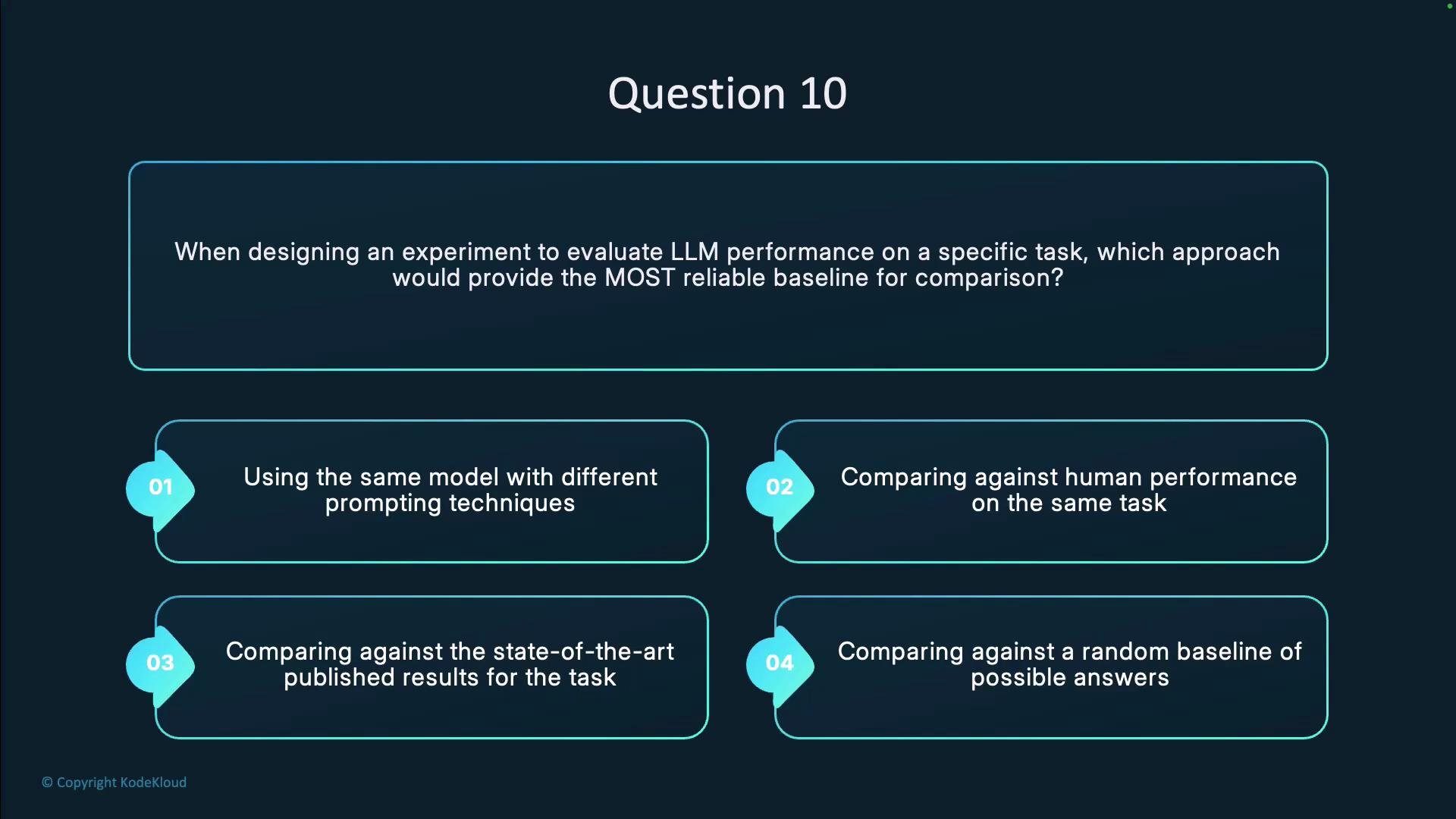
Question 10.
When designing an experiment to evaluate LLM performance on a specific task, which approach would provide the most reliable baseline for comparison?
* Using the same model with different prompting techniques?
* Comparing against human performance on the same task?
* Comparing against state-of-the-art published results for the task?
* Or comparing against a random baseline of possible answers?
 Answer: Comparing against human performance on the same task.
Why human baselines are the most reliable
* Real-world reference: Human performance sets a practical target for many applications (e.g., summarization, question answering, content moderation, creative writing).
* Task nuance and ambiguity: Human judgments expose acceptable answer variation, common failure modes, and trade-offs (accuracy vs. fluency vs. style).
* Metric validation: Comparing models to humans helps you choose evaluation metrics that align with end-user expectations and perceived quality.
* Interpretability: A human baseline grounds model performance in observable behavior rather than purely statistical improvement.
When to use other baselines
| Baseline | Use case | When it’s helpful |
| ---------------------------------------------- | ----------------------------------------------------------------------------------------------- | --------------------------------------------------------------------------------------------------------------------------------------------------- |
| Same model with different prompting techniques | Measuring the effect of prompt engineering, few-shot examples, or temperature/decoding settings | Use for ablation studies and to quantify gains from prompt design or in-model tuning |
| State-of-the-art (SOTA) published results | Situating progress relative to academic/industry benchmarks | Use to compare against the field and to report competitive performance on established datasets; combine with human baseline for practical relevance |
| Random or trivial baseline | Sanity checks and lower-bound expectations | Use as a minimal control to ensure your evaluation discriminates useful models from chance |
Best practices for robust baselines
* Combine baselines: include a human baseline for real-world relevance, SOTA for research context, controlled model variants for ablation/prompting insights, and a random/trivial baseline as a sanity check.
* Match conditions: collect human annotations under the same instructions, time limits, and evaluation metrics as the model outputs.
* Report variability: provide inter-annotator agreement (e.g., Cohen’s kappa, Fleiss’ kappa) and confidence intervals so differences are interpretable.
* Use appropriate metrics: align automatic metrics (BLEU, ROUGE, METEOR, BERTScore, or task-specific measures) with human judgments; validate metric choice by correlating with human evaluations when possible.
* Statistical testing: apply significance tests (e.g., bootstrap resampling, paired t-test, or permutation tests) for robust claims about improvements.
* Document everything: include dataset splits, prompt templates, model versions, evaluation scripts, and the exact annotation protocol for reproducibility.
Useful references
* Hugging Face Evaluate documentation: [https://huggingface.co/docs/evaluate](https://huggingface.co/docs/evaluate)
* PapersWithCode (for SOTA comparisons): [https://paperswithcode.com/](https://paperswithcode.com/)
* Human evaluation guidelines and best practices: search for “human evaluation in NLP” and review ACL/NAACL workshop resources for annotation protocols and agreement metrics.
Collect the human baseline under the same conditions and using the same evaluation metrics as the model. Document inter-annotator agreement and variability so comparisons are fair and interpretable.
Answer: Comparing against human performance on the same task.
Why human baselines are the most reliable
* Real-world reference: Human performance sets a practical target for many applications (e.g., summarization, question answering, content moderation, creative writing).
* Task nuance and ambiguity: Human judgments expose acceptable answer variation, common failure modes, and trade-offs (accuracy vs. fluency vs. style).
* Metric validation: Comparing models to humans helps you choose evaluation metrics that align with end-user expectations and perceived quality.
* Interpretability: A human baseline grounds model performance in observable behavior rather than purely statistical improvement.
When to use other baselines
| Baseline | Use case | When it’s helpful |
| ---------------------------------------------- | ----------------------------------------------------------------------------------------------- | --------------------------------------------------------------------------------------------------------------------------------------------------- |
| Same model with different prompting techniques | Measuring the effect of prompt engineering, few-shot examples, or temperature/decoding settings | Use for ablation studies and to quantify gains from prompt design or in-model tuning |
| State-of-the-art (SOTA) published results | Situating progress relative to academic/industry benchmarks | Use to compare against the field and to report competitive performance on established datasets; combine with human baseline for practical relevance |
| Random or trivial baseline | Sanity checks and lower-bound expectations | Use as a minimal control to ensure your evaluation discriminates useful models from chance |
Best practices for robust baselines
* Combine baselines: include a human baseline for real-world relevance, SOTA for research context, controlled model variants for ablation/prompting insights, and a random/trivial baseline as a sanity check.
* Match conditions: collect human annotations under the same instructions, time limits, and evaluation metrics as the model outputs.
* Report variability: provide inter-annotator agreement (e.g., Cohen’s kappa, Fleiss’ kappa) and confidence intervals so differences are interpretable.
* Use appropriate metrics: align automatic metrics (BLEU, ROUGE, METEOR, BERTScore, or task-specific measures) with human judgments; validate metric choice by correlating with human evaluations when possible.
* Statistical testing: apply significance tests (e.g., bootstrap resampling, paired t-test, or permutation tests) for robust claims about improvements.
* Document everything: include dataset splits, prompt templates, model versions, evaluation scripts, and the exact annotation protocol for reproducibility.
Useful references
* Hugging Face Evaluate documentation: [https://huggingface.co/docs/evaluate](https://huggingface.co/docs/evaluate)
* PapersWithCode (for SOTA comparisons): [https://paperswithcode.com/](https://paperswithcode.com/)
* Human evaluation guidelines and best practices: search for “human evaluation in NLP” and review ACL/NAACL workshop resources for annotation protocols and agreement metrics.
Collect the human baseline under the same conditions and using the same evaluation metrics as the model. Document inter-annotator agreement and variability so comparisons are fair and interpretable.