> ## Documentation Index
> Fetch the complete documentation index at: https://notes.kodekloud.com/llms.txt
> Use this file to discover all available pages before exploring further.
# Rigorous Experimental Design for Zero Shot LLM Testing
> Guidelines for rigorous zero-shot evaluation of LLMs using strictly unseen test sets, predefined metrics, standardized preprocessing, controlled prompts, and reproducibility practices
Question 3.
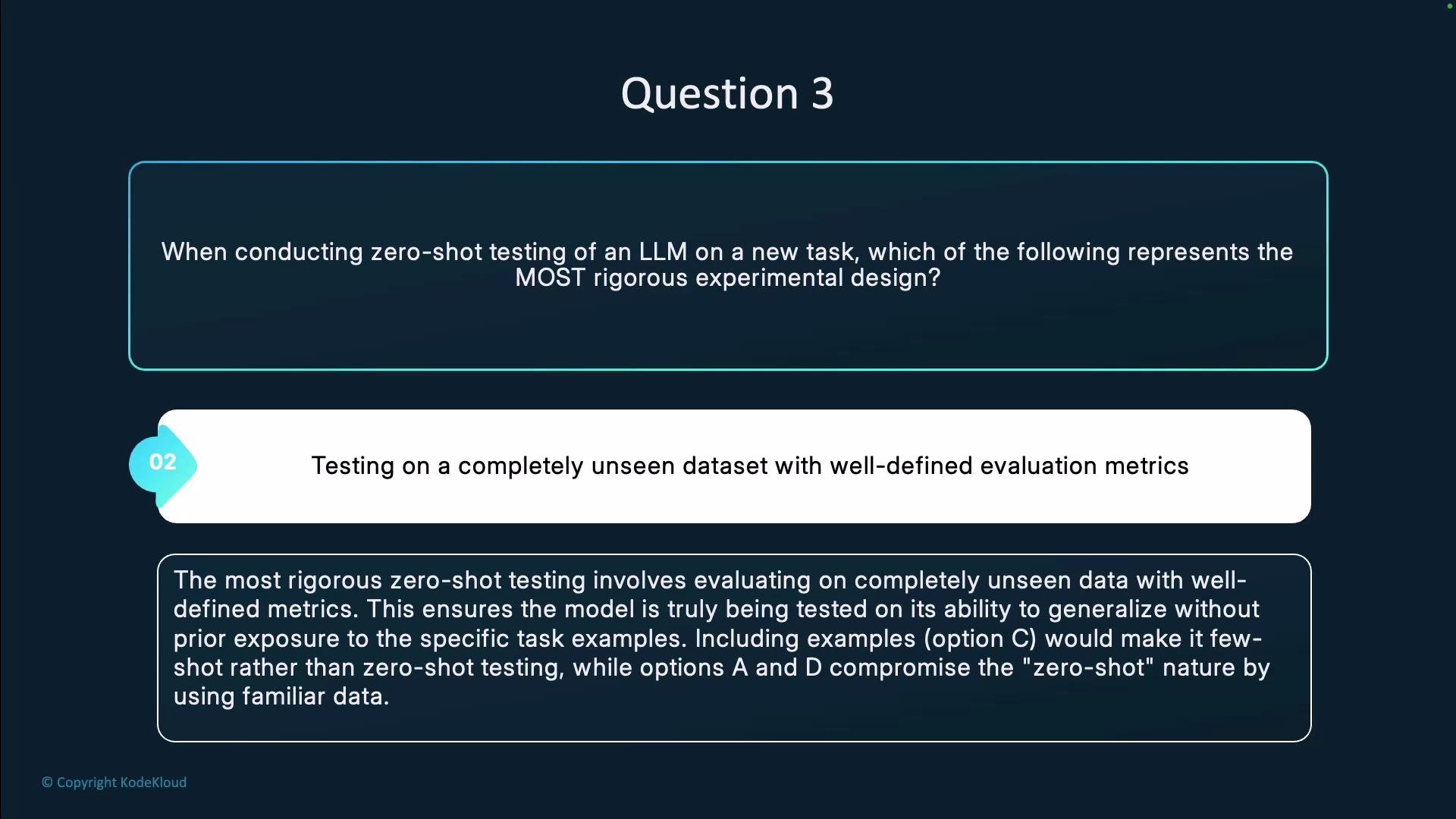
When conducting zero-shot testing of an LLM on a new task, which of the following represents the most rigorous experimental design?
* A. Testing on a dataset that was partially included in the model's training data
* B. Testing on a completely unseen dataset with well-defined evaluation metrics
* C. Testing with prompts that include examples of expected outputs
* D. Testing on tasks that are similar to those in the training data
Answer: B — Testing on a completely unseen dataset with well-defined evaluation metrics.
Why B is correct:
* True zero-shot evaluation requires strictly held-out data that the model has never seen during training to avoid data leakage and inflated performance estimates.
* Clear, objective evaluation metrics (accuracy, F1, exact match, BLEU/ROUGE for generation, etc.) are essential for reproducibility and meaningful comparison across models.
* This combination isolates the model’s ability to generalize rather than its memorization or familiarity with task-specific examples.
 Why the other options are suboptimal:
* Option C: Including example outputs in the prompt converts the setup to few-shot evaluation, which is a different experimental condition and no longer zero-shot.
* Option A: Using datasets that overlap with training data introduces data leakage and can artificially boost performance.
* Option D: Testing on tasks similar to training tasks risks overestimating generalization because the model may rely on pattern reuse rather than genuine transfer.
Comparison table
| Option | Why it fails as rigorous zero-shot evaluation |
| -------------------------------------- | ------------------------------------------------------------------------------ |
| A. Partially included in training data | Risk of data leakage; evaluation measures memorization, not generalization |
| B. Completely unseen + defined metrics | Correct: preserves zero-shot premise and enables reproducibility |
| C. Prompts with example outputs | Turns evaluation into few-shot; not zero-shot |
| D. Similar tasks to training data | Inflates performance via task similarity; weak evidence of real generalization |
Practical checklist for rigorous zero-shot evaluation
* Ensure dataset provenance: document sources, timestamps, and any possible overlap with model training corpora.
* Hold out a strict unseen test set: never use it during prompt development, hyperparameter tuning, or any model selection.
* Define metrics before running experiments: choose task-appropriate metrics (e.g., accuracy/F1 for classification, EM/F1 for QA, BLEU/ROUGE for generation).
* Standardize preprocessing and tokenization: report these steps so others can reproduce results.
* Control prompts: keep prompts consistent across models and document exact wording and temperature/top-p settings.
* Run statistical tests and report variance: include confidence intervals or bootstrap estimates to show result stability.
* Compare to baselines: rule-based or simple heuristics help contextualize model performance.
* Publish artifacts when possible: test set (or a reproducible sampling procedure), prompts, and evaluation scripts.
Common evaluation metrics by task
* Classification: accuracy, precision, recall, F1
* Question answering (extractive): exact match (EM), F1
* Generation/summarization: BLEU, ROUGE, METEOR (and human evaluation)
* Ranking/retrieval: MRR, MAP, NDCG
Resources and further reading
* [Papers With Code — Evaluation](https://paperswithcode.com/): benchmarks and metrics across NLP tasks
* [Practical recommendations for evaluating generative models](https://arxiv.org/abs/2103.00020) (example research on best practices)
* [Checklist for Reproducible NLP Experiments](https://www.aclweb.org/anthology/2020.findings-emnlp.206/) — guidelines for experimental rigor
For rigorous zero-shot testing: use strictly held-out datasets, define evaluation metrics up front, and document any pre-processing or prompt engineering to ensure reproducibility.
Why the other options are suboptimal:
* Option C: Including example outputs in the prompt converts the setup to few-shot evaluation, which is a different experimental condition and no longer zero-shot.
* Option A: Using datasets that overlap with training data introduces data leakage and can artificially boost performance.
* Option D: Testing on tasks similar to training tasks risks overestimating generalization because the model may rely on pattern reuse rather than genuine transfer.
Comparison table
| Option | Why it fails as rigorous zero-shot evaluation |
| -------------------------------------- | ------------------------------------------------------------------------------ |
| A. Partially included in training data | Risk of data leakage; evaluation measures memorization, not generalization |
| B. Completely unseen + defined metrics | Correct: preserves zero-shot premise and enables reproducibility |
| C. Prompts with example outputs | Turns evaluation into few-shot; not zero-shot |
| D. Similar tasks to training data | Inflates performance via task similarity; weak evidence of real generalization |
Practical checklist for rigorous zero-shot evaluation
* Ensure dataset provenance: document sources, timestamps, and any possible overlap with model training corpora.
* Hold out a strict unseen test set: never use it during prompt development, hyperparameter tuning, or any model selection.
* Define metrics before running experiments: choose task-appropriate metrics (e.g., accuracy/F1 for classification, EM/F1 for QA, BLEU/ROUGE for generation).
* Standardize preprocessing and tokenization: report these steps so others can reproduce results.
* Control prompts: keep prompts consistent across models and document exact wording and temperature/top-p settings.
* Run statistical tests and report variance: include confidence intervals or bootstrap estimates to show result stability.
* Compare to baselines: rule-based or simple heuristics help contextualize model performance.
* Publish artifacts when possible: test set (or a reproducible sampling procedure), prompts, and evaluation scripts.
Common evaluation metrics by task
* Classification: accuracy, precision, recall, F1
* Question answering (extractive): exact match (EM), F1
* Generation/summarization: BLEU, ROUGE, METEOR (and human evaluation)
* Ranking/retrieval: MRR, MAP, NDCG
Resources and further reading
* [Papers With Code — Evaluation](https://paperswithcode.com/): benchmarks and metrics across NLP tasks
* [Practical recommendations for evaluating generative models](https://arxiv.org/abs/2103.00020) (example research on best practices)
* [Checklist for Reproducible NLP Experiments](https://www.aclweb.org/anthology/2020.findings-emnlp.206/) — guidelines for experimental rigor
For rigorous zero-shot testing: use strictly held-out datasets, define evaluation metrics up front, and document any pre-processing or prompt engineering to ensure reproducibility.