> ## Documentation Index
> Fetch the complete documentation index at: https://notes.kodekloud.com/llms.txt
> Use this file to discover all available pages before exploring further.
# Robust Experimental Control for Measuring Fine Tuning Impact
> Evaluating fine-tuning effects on LLMs by comparing models to their pre-fine-tuning baselines, using held-out test sets and rigorous controls to isolate causal performance changes.
Question 8.
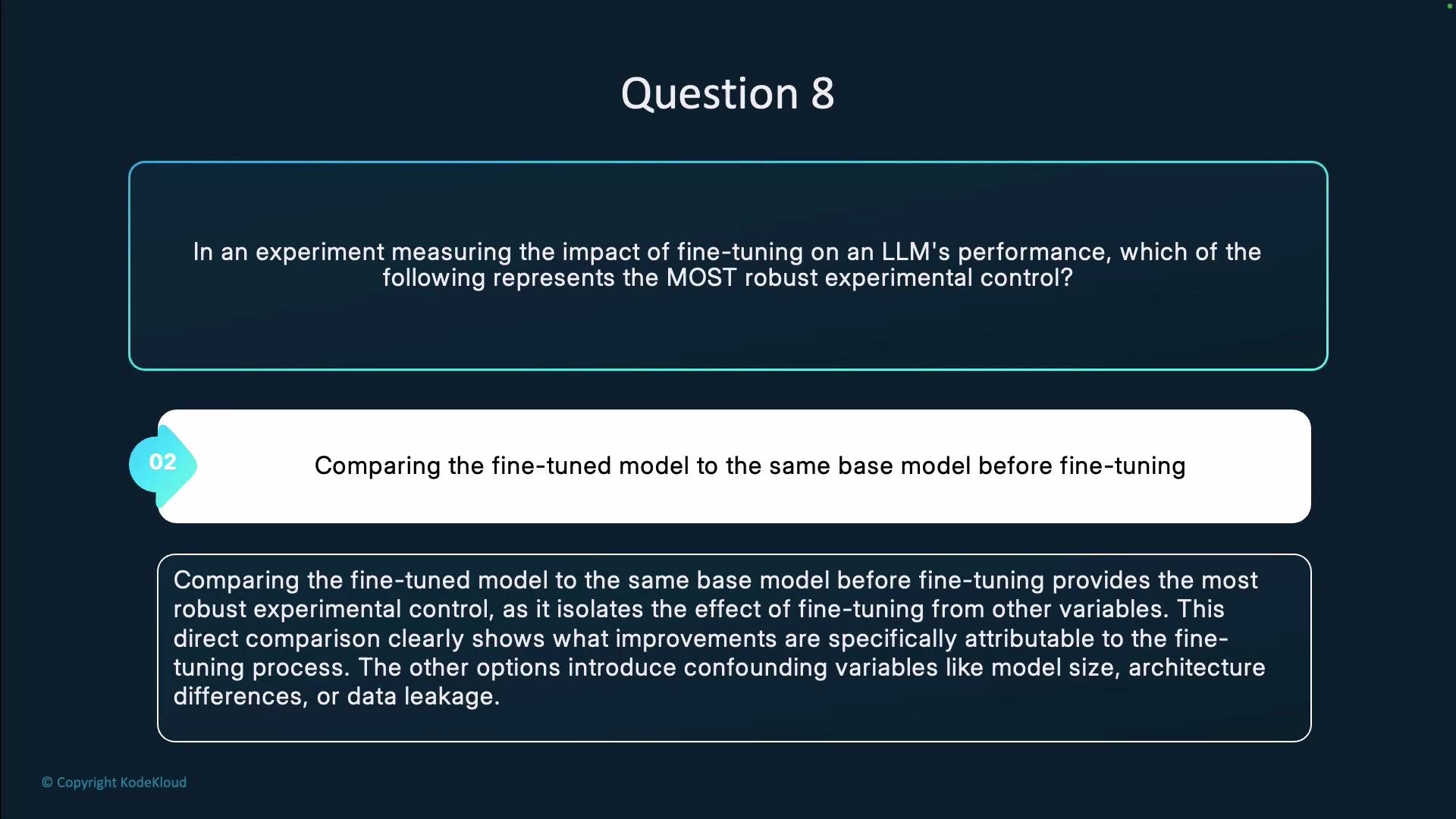
In an experiment measuring the impact of fine-tuning on an LLM's performance, which of the following represents the most robust experimental control?
* Comparing the fine-tuned model to a larger, more advanced model
* Comparing the fine-tuned model to the same base model before fine-tuning
* Comparing the fine-tuned model to a completely different architecture
* Comparing the fine-tuned model only on the training dataset
Answer: Comparing the fine-tuned model to the same base model before fine-tuning.
This comparison provides the cleanest control because it isolates the variable of interest—fine-tuning—while keeping model capacity, architecture, and pretraining constant.
 Why this is the most robust control
* Direct attribution: Using the same base model before and after fine-tuning ensures that observed performance differences are attributable to the fine-tuning procedure rather than differences in architecture, capacity, or pretraining data.
* Reduced confounders: Other comparisons (larger models, different architectures) introduce confounding variables such as increased parameters, different inductive biases, or varied optimization dynamics.
* Generalization check: Measuring on held-out test sets (not just the training data) verifies that improvements reflect generalization rather than memorization.
Comparison of options
| Option | Why it is less robust |
| --------------------------------------------------- | ------------------------------------------------------------------------------------------------------------------------------------ |
| Comparing to a larger, more advanced model | Conflates fine-tuning effects with model capacity and architecture differences—hard to tell which factor caused performance changes. |
| Comparing to the same base model before fine-tuning | Best practice: isolates fine-tuning as the independent variable and supports causal interpretation of results. |
| Comparing to a completely different architecture | Different inductive biases and training dynamics make attribution ambiguous. |
| Comparing only on the training dataset | Measures memorization rather than generalization; does not reveal real-world performance gains. |
Best practices for measuring fine-tuning impact
* Use the same pre-fine-tuned base model as the control (pre/post comparison).
* Evaluate on held-out test sets representative of the target use cases to measure generalization.
* Report multiple metrics (accuracy, F1, calibration, fairness) and confidence intervals.
* Run repeated trials or cross-validation to quantify variance from random seeds and data shuffles.
* Consider ablation studies to separate contributions from dataset size, hyperparameters, and training strategy. See more on ablation methodology: [Ablation study](https://en.wikipedia.org/wiki/Ablation_study).
* Monitor for overfitting and memorization; review examples where the model changed predictions after fine-tuning. Learn about overfitting: [Overfitting (Wikipedia)](https://en.wikipedia.org/wiki/Overfitting).
For robust evaluation, compare the fine-tuned model to its own pre-fine-tuning baseline and measure performance on held-out test sets that reflect intended production use cases. Include repeated runs and clear reporting of metrics to support reproducible, interpretable conclusions.
References and further reading
* [Practical tips for reproducible ML experiments](https://www.paperswithcode.com/methods)
* [Evaluating machine learning models — best practices](https://en.wikipedia.org/wiki/Model_evaluation)
Why this is the most robust control
* Direct attribution: Using the same base model before and after fine-tuning ensures that observed performance differences are attributable to the fine-tuning procedure rather than differences in architecture, capacity, or pretraining data.
* Reduced confounders: Other comparisons (larger models, different architectures) introduce confounding variables such as increased parameters, different inductive biases, or varied optimization dynamics.
* Generalization check: Measuring on held-out test sets (not just the training data) verifies that improvements reflect generalization rather than memorization.
Comparison of options
| Option | Why it is less robust |
| --------------------------------------------------- | ------------------------------------------------------------------------------------------------------------------------------------ |
| Comparing to a larger, more advanced model | Conflates fine-tuning effects with model capacity and architecture differences—hard to tell which factor caused performance changes. |
| Comparing to the same base model before fine-tuning | Best practice: isolates fine-tuning as the independent variable and supports causal interpretation of results. |
| Comparing to a completely different architecture | Different inductive biases and training dynamics make attribution ambiguous. |
| Comparing only on the training dataset | Measures memorization rather than generalization; does not reveal real-world performance gains. |
Best practices for measuring fine-tuning impact
* Use the same pre-fine-tuned base model as the control (pre/post comparison).
* Evaluate on held-out test sets representative of the target use cases to measure generalization.
* Report multiple metrics (accuracy, F1, calibration, fairness) and confidence intervals.
* Run repeated trials or cross-validation to quantify variance from random seeds and data shuffles.
* Consider ablation studies to separate contributions from dataset size, hyperparameters, and training strategy. See more on ablation methodology: [Ablation study](https://en.wikipedia.org/wiki/Ablation_study).
* Monitor for overfitting and memorization; review examples where the model changed predictions after fine-tuning. Learn about overfitting: [Overfitting (Wikipedia)](https://en.wikipedia.org/wiki/Overfitting).
For robust evaluation, compare the fine-tuned model to its own pre-fine-tuning baseline and measure performance on held-out test sets that reflect intended production use cases. Include repeated runs and clear reporting of metrics to support reproducible, interpretable conclusions.
References and further reading
* [Practical tips for reproducible ML experiments](https://www.paperswithcode.com/methods)
* [Evaluating machine learning models — best practices](https://en.wikipedia.org/wiki/Model_evaluation)