> ## Documentation Index
> Fetch the complete documentation index at: https://notes.kodekloud.com/llms.txt
> Use this file to discover all available pages before exploring further.
# Software Design Principle for Evolving LLM Applications
> Advocating dependency injection to decouple and enable swapping LLM models, providers, and adapters for testability, configurability, and extensibility in evolving LLM applications.
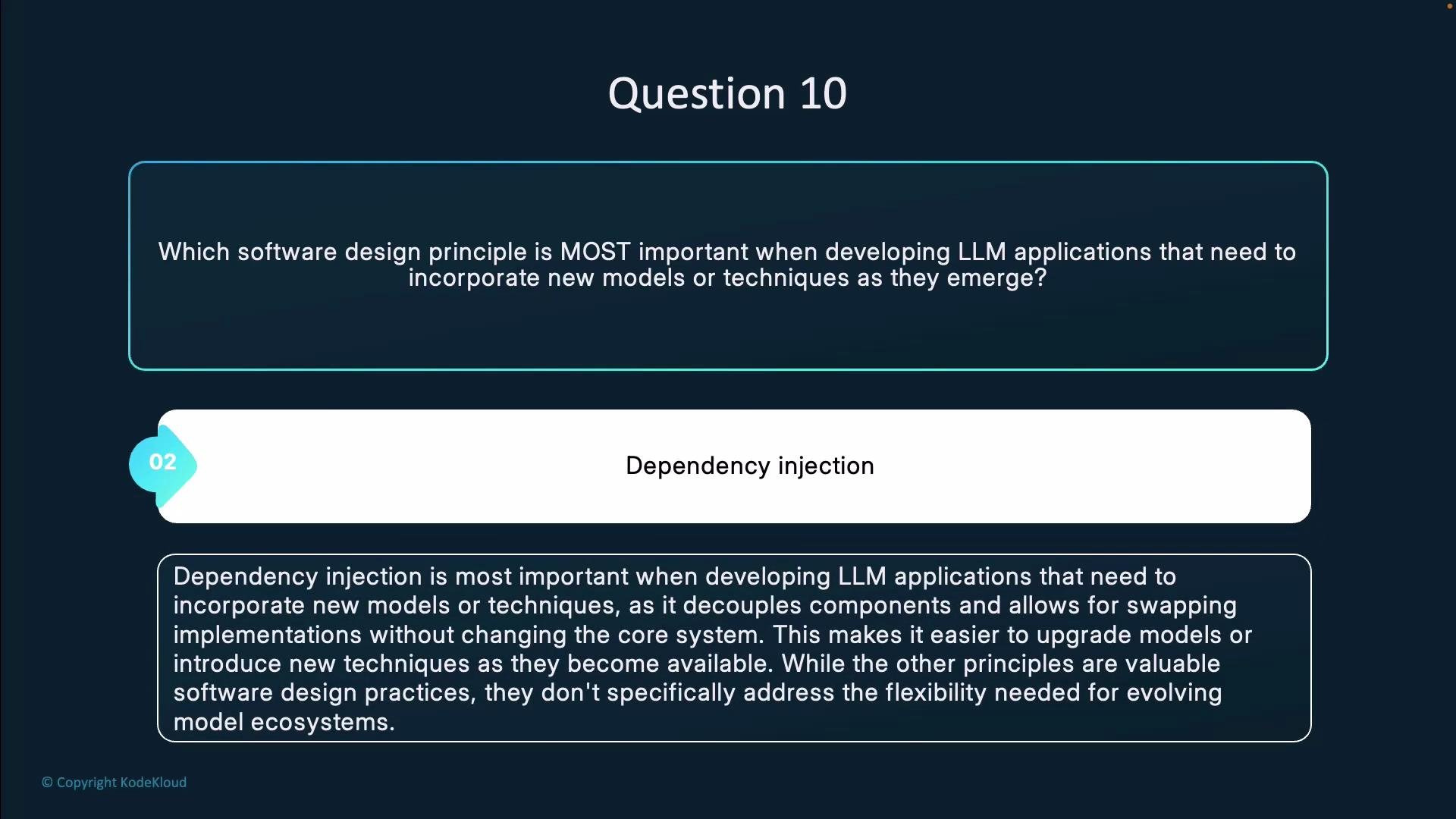
Question 10.
Which software design principle is most important when developing LLM applications that need to incorporate new models or techniques as they emerge?
Options: Command pattern, Dependency Injection, Single Responsibility Principle, or Immutability?
Answer: Dependency Injection
Dependency Injection (DI) is the most important design principle for LLM applications that must evolve to incorporate new models, inference backends, or processing techniques. DI decouples components so implementations can be swapped without changing core application logic—making upgrades, experimentation, and multi-provider support far easier.
 Why Dependency Injection matters for LLM systems
* Decoupling: Keep model selection, loading, and runtime invocation separate from business logic so the core pipeline remains stable when models change.
* Testability: Inject mock or stub model implementations for unit and integration tests without altering application code.
* Configurability: Select models, providers, or strategies through configuration, dependency injection containers, or plugin registries at runtime.
* Extensibility: Add new model adapters (e.g., local runtime, cloud API, experimental prototype) by implementing a defined interface and registering it with the DI system.
Practical guidance
* Define clear interfaces for: model inference, tokenization, input validation, and output postprocessing.
* Use factories or a DI container to bind concrete implementations (e.g., local model adapter, remote API client, or experimental adapter).
* Keep wiring and configuration separate from business logic so feature teams can swap implementations via config changes or environment variables.
* Combine DI with feature flags or strategy patterns for safe rollouts and A/B testing of new models or techniques.
When designing an LLM system, define interfaces for inference, tokenization, and data pipelines. Use factories or a DI container to wire concrete implementations (local models, cloud APIs, or experimental prototypes) so switching or testing them requires minimal changes.
Comparison with other principles
| Principle | Role in evolving LLM apps | Why it's less central than DI for swapping implementations |
| ------------------------------------- | ---------------------------------------------------------------: | -------------------------------------------------------------------------------------------------------------------------- |
| Command pattern | Encapsulates actions and sequences; useful for complex workflows | Helps organize requests but does not by itself enable runtime replacement of model implementations. |
| Single Responsibility Principle (SRP) | Encourages small, maintainable components | Important for clarity and maintainability, but SRP alone doesn't provide a mechanism to inject alternative model backends. |
| Immutability | Improves reliability and concurrency safety | Valuable for predictable data flows but does not address substituting components or selecting different model providers. |
Best practice summary
* Prioritize DI to enable model/provider swapping, runtime selection, and easier testing.
* Apply SRP to keep components small and focused so DI bindings are simple and predictable.
* Use immutability where appropriate (e.g., for request payloads) to reduce side effects in concurrent systems.
* Employ the command pattern or strategy pattern for complex orchestration, but wire those patterns through DI so their implementations remain replaceable.
Further reading and references
* [Dependency Injection (Martin Fowler)](https://martinfowler.com/articles/injection.html)
* [Design Patterns: Strategy and Factory](https://refactoring.guru/design-patterns)
* [Best practices for ML system design](https://ml-ops.org/)
Why Dependency Injection matters for LLM systems
* Decoupling: Keep model selection, loading, and runtime invocation separate from business logic so the core pipeline remains stable when models change.
* Testability: Inject mock or stub model implementations for unit and integration tests without altering application code.
* Configurability: Select models, providers, or strategies through configuration, dependency injection containers, or plugin registries at runtime.
* Extensibility: Add new model adapters (e.g., local runtime, cloud API, experimental prototype) by implementing a defined interface and registering it with the DI system.
Practical guidance
* Define clear interfaces for: model inference, tokenization, input validation, and output postprocessing.
* Use factories or a DI container to bind concrete implementations (e.g., local model adapter, remote API client, or experimental adapter).
* Keep wiring and configuration separate from business logic so feature teams can swap implementations via config changes or environment variables.
* Combine DI with feature flags or strategy patterns for safe rollouts and A/B testing of new models or techniques.
When designing an LLM system, define interfaces for inference, tokenization, and data pipelines. Use factories or a DI container to wire concrete implementations (local models, cloud APIs, or experimental prototypes) so switching or testing them requires minimal changes.
Comparison with other principles
| Principle | Role in evolving LLM apps | Why it's less central than DI for swapping implementations |
| ------------------------------------- | ---------------------------------------------------------------: | -------------------------------------------------------------------------------------------------------------------------- |
| Command pattern | Encapsulates actions and sequences; useful for complex workflows | Helps organize requests but does not by itself enable runtime replacement of model implementations. |
| Single Responsibility Principle (SRP) | Encourages small, maintainable components | Important for clarity and maintainability, but SRP alone doesn't provide a mechanism to inject alternative model backends. |
| Immutability | Improves reliability and concurrency safety | Valuable for predictable data flows but does not address substituting components or selecting different model providers. |
Best practice summary
* Prioritize DI to enable model/provider swapping, runtime selection, and easier testing.
* Apply SRP to keep components small and focused so DI bindings are simple and predictable.
* Use immutability where appropriate (e.g., for request payloads) to reduce side effects in concurrent systems.
* Employ the command pattern or strategy pattern for complex orchestration, but wire those patterns through DI so their implementations remain replaceable.
Further reading and references
* [Dependency Injection (Martin Fowler)](https://martinfowler.com/articles/injection.html)
* [Design Patterns: Strategy and Factory](https://refactoring.guru/design-patterns)
* [Best practices for ML system design](https://ml-ops.org/)