> ## Documentation Index
> Fetch the complete documentation index at: https://notes.kodekloud.com/llms.txt
> Use this file to discover all available pages before exploring further.
# Data Privacy Best Practices for LLMs
> Guidance on data privacy best practices for LLMs, focusing on data minimization, purpose limitation, retention policies, security controls, and user transparency
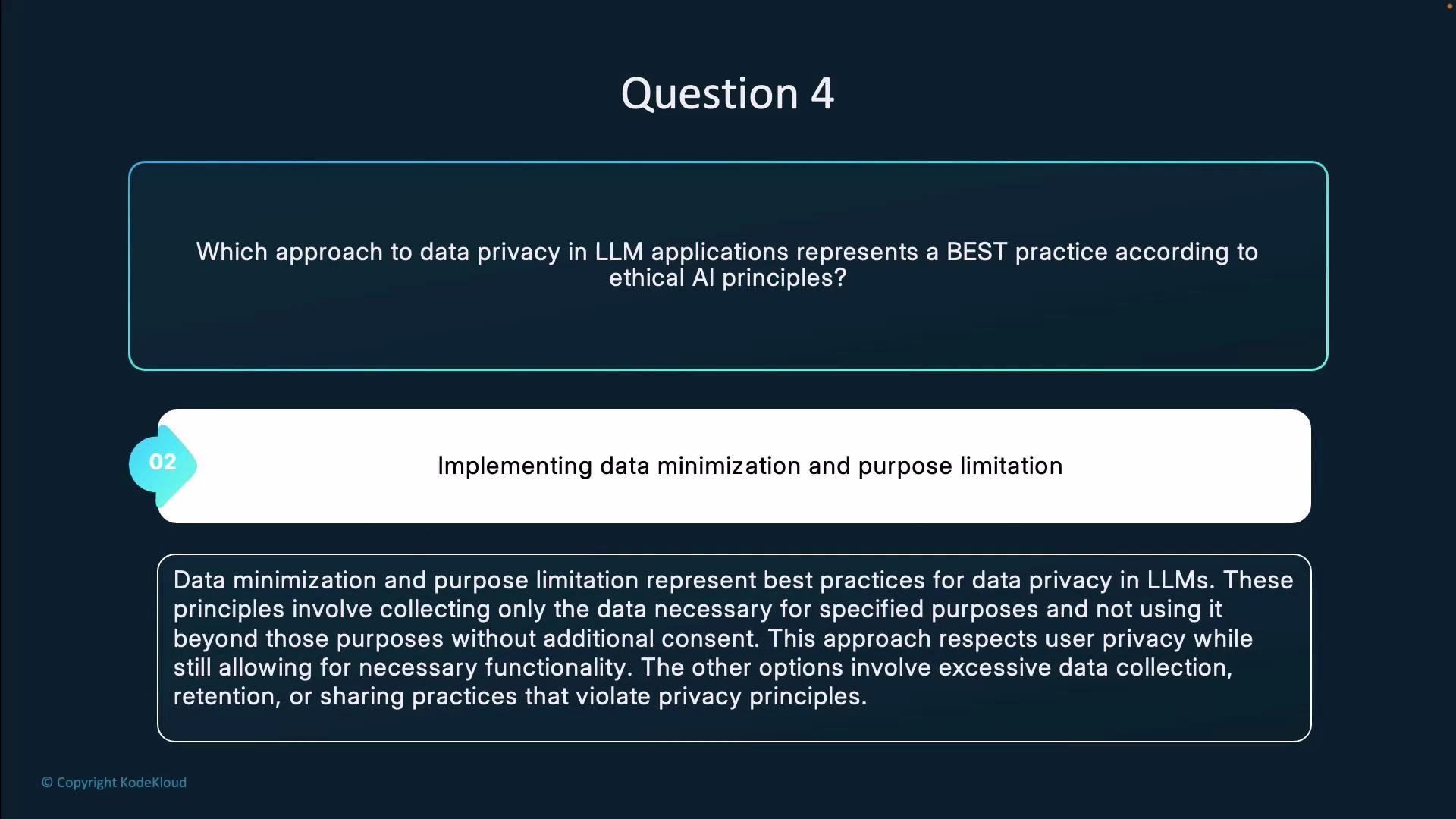
Question 4 — Which approach to data privacy in LLM applications represents a best practice according to ethical AI principles?
* Collecting all available user data to improve model performance.
* Implementing data minimization and purpose limitation.
* Storing user interaction data indefinitely for future analysis.
* Sharing user data across applications without specific consent.
Answer: Implementing data minimization and purpose limitation.
Implementing data minimization and purpose limitation means collecting only the data strictly necessary for a stated purpose and not using it beyond that purpose without additional consent. This approach balances utility with privacy and aligns with ethical and legal data-protection frameworks.
 Why this is the best practice
* Data minimization: Collect only the data required to deliver the requested functionality (for example, short-lived session context needed to fulfill a prompt). Avoid broad, unrelated telemetry or personal data collection.
* Purpose limitation: Define and document the explicit purposes for data collection up front. Do not repurpose data for analytics, training, or third-party sharing without clear, informed consent.
* Privacy-preserving controls: Use technical controls such as role-based access control, end-to-end encryption (in transit and at rest), aggregation, anonymization/pseudonymization, and techniques like differential privacy when aggregating usage data for analytics or model improvement.
* Retention and disposal: Implement and enforce retention schedules so personal or sensitive data is deleted or irreversibly anonymized once it is no longer needed.
* Transparency and user rights: Provide clear privacy notices, enable users to access, correct, or delete their data, and require explicit consent for new processing activities beyond the original scope.
Comparison: approaches and risks
| Approach | Why teams choose it | Risks / Why it's not best practice |
| ----------------------------------------------------- | -------------------------------------------------------------------------: | ----------------------------------------------------------------- |
| Implementing data minimization and purpose limitation | Balances model utility and compliance; reduces legal and reputational risk | Requires upfront planning and scope discipline |
| Collecting all available user data | May seem to improve model performance or analytics depth | Increases attack surface, noncompliance risk, and user mistrust |
| Storing data indefinitely | Enables long-term analysis and future research | Magnifies breach impact, conflicts with many regulations |
| Sharing data across applications without consent | Facilitates cross-product features quickly | Violates user expectations and many privacy laws; high legal risk |
Why the other options are harmful
* Collecting everything: Indiscriminate collection increases exposure to breaches and regulatory penalties while offering diminishing returns on model performance.
* Storing indefinitely: Long retention periods multiply breach impact and often violate data-protection principles like storage limitation.
* Sharing without consent: Unconsented sharing undermines user trust and usually contravenes legal frameworks such as GDPR, CCPA, and other privacy laws.
Key takeaways
* Adopt a privacy-by-design posture: bake minimization, purpose limitation, and retention policies into system design and development workflows.
* Use technical and organizational safeguards together: encryption, access controls, logging, and regular audits.
* Document policies and obtain explicit consent for secondary uses or model training that rely on user data.
* Monitor legal and ethical guidance: stay aligned with frameworks such as GDPR, ISO 27001, and NIST privacy recommendations.
Further reading and references
* [GDPR Overview](https://gdpr.eu/)
* [NIST Privacy Framework](https://www.nist.gov/privacy-framework)
* [Differential Privacy — Google Research](https://research.google/pubs/pub46419/)
Why this is the best practice
* Data minimization: Collect only the data required to deliver the requested functionality (for example, short-lived session context needed to fulfill a prompt). Avoid broad, unrelated telemetry or personal data collection.
* Purpose limitation: Define and document the explicit purposes for data collection up front. Do not repurpose data for analytics, training, or third-party sharing without clear, informed consent.
* Privacy-preserving controls: Use technical controls such as role-based access control, end-to-end encryption (in transit and at rest), aggregation, anonymization/pseudonymization, and techniques like differential privacy when aggregating usage data for analytics or model improvement.
* Retention and disposal: Implement and enforce retention schedules so personal or sensitive data is deleted or irreversibly anonymized once it is no longer needed.
* Transparency and user rights: Provide clear privacy notices, enable users to access, correct, or delete their data, and require explicit consent for new processing activities beyond the original scope.
Comparison: approaches and risks
| Approach | Why teams choose it | Risks / Why it's not best practice |
| ----------------------------------------------------- | -------------------------------------------------------------------------: | ----------------------------------------------------------------- |
| Implementing data minimization and purpose limitation | Balances model utility and compliance; reduces legal and reputational risk | Requires upfront planning and scope discipline |
| Collecting all available user data | May seem to improve model performance or analytics depth | Increases attack surface, noncompliance risk, and user mistrust |
| Storing data indefinitely | Enables long-term analysis and future research | Magnifies breach impact, conflicts with many regulations |
| Sharing data across applications without consent | Facilitates cross-product features quickly | Violates user expectations and many privacy laws; high legal risk |
Why the other options are harmful
* Collecting everything: Indiscriminate collection increases exposure to breaches and regulatory penalties while offering diminishing returns on model performance.
* Storing indefinitely: Long retention periods multiply breach impact and often violate data-protection principles like storage limitation.
* Sharing without consent: Unconsented sharing undermines user trust and usually contravenes legal frameworks such as GDPR, CCPA, and other privacy laws.
Key takeaways
* Adopt a privacy-by-design posture: bake minimization, purpose limitation, and retention policies into system design and development workflows.
* Use technical and organizational safeguards together: encryption, access controls, logging, and regular audits.
* Document policies and obtain explicit consent for secondary uses or model training that rely on user data.
* Monitor legal and ethical guidance: stay aligned with frameworks such as GDPR, ISO 27001, and NIST privacy recommendations.
Further reading and references
* [GDPR Overview](https://gdpr.eu/)
* [NIST Privacy Framework](https://www.nist.gov/privacy-framework)
* [Differential Privacy — Google Research](https://research.google/pubs/pub46419/)