> ## Documentation Index
> Fetch the complete documentation index at: https://notes.kodekloud.com/llms.txt
> Use this file to discover all available pages before exploring further.
# Demonstrating Transparency in LLM Deployment
> Discussion of transparency in LLM deployment emphasizing clear documentation of capabilities, limitations, evaluation, biases, provenance, and policies to support trust, accountability, and responsible use
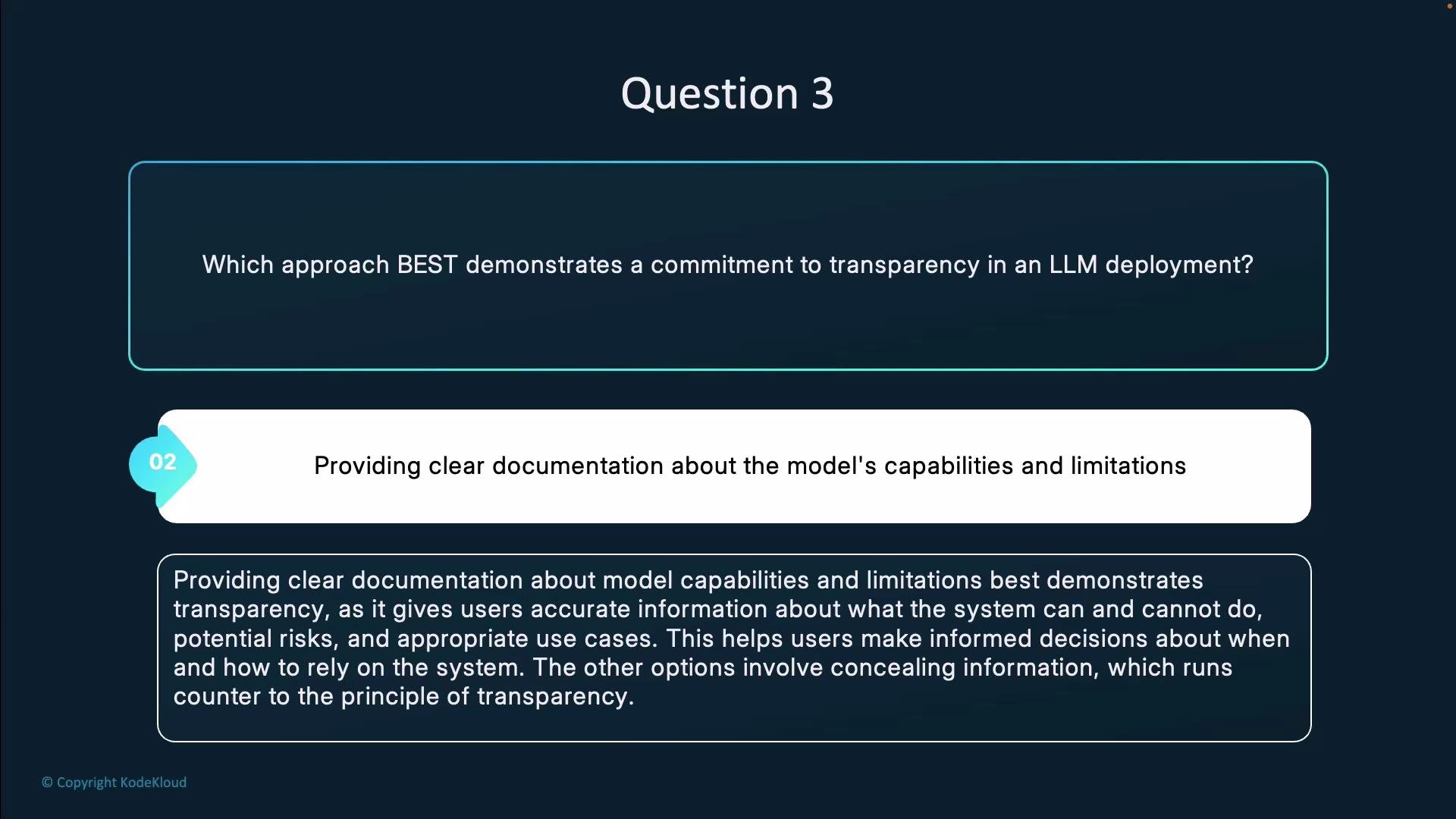
Question 3.
Which approach best demonstrates a commitment to transparency in an LLM deployment?
* Keeping model architecture details confidential, providing clear documentation about the model's capabilities and limitations
* Using a black-box API without disclosing the underlying model
* Automatically filtering all sensitive topics without user awareness
Answer: providing clear documentation about the model's capabilities and limitations.
Providing clear, accessible documentation about a model's capabilities and limitations is the best way to demonstrate transparency in an LLM deployment. Clear documentation empowers users to understand expected behavior, known failure modes, and appropriate safeguards. It also enables better risk assessment, encourages responsible use, and supports accountability and auditing over time.
Good documentation should include: intended use cases, known limitations and failure modes, evaluation metrics and results, known biases, data provenance (where appropriate), update/change history, and guidance for safe/appropriate use.
 Why the other choices reduce transparency
* Using a black-box API without disclosure hides provenance and system behavior, making it difficult for users or auditors to assess reliability, bias, or misuse risks.
* Automatically filtering sensitive topics without informing users leads to unexplained denials or redactions; users cannot tell whether a refusal was policy-driven, an artifact of training data, or an error.
Both practices reduce user trust, hinder accountability, and make it harder to design appropriate mitigations.
Comparison at a glance
| Approach | Transparency Impact | Recommended Practices |
| ------------------------------------------------------------ | ---------------------------------------------------------------- | --------------------------------------------------------------------------------------- |
| Provide clear documentation about capabilities & limitations | High — enables user understanding, auditing, and responsible use | Publish a model card, evaluation results, known biases, and update logs |
| Use a black-box API without disclosing the underlying model | Low — hides provenance and behavior | If necessary, disclose high-level model family, version, and limitations |
| Automatically filter topics without user awareness | Low — produces opaque denials and reduces trust | Make filtering policies visible; explain denials and provide appeal or fallback options |
Links and references
* [Model Cards for Model Reporting](https://ai.google/project-model-cards/) — guidelines for documenting model details and intended uses
* [Datasheets for Datasets](https://arxiv.org/abs/1803.09010) — documenting dataset provenance and collection processes
* [NIST AI Risk Management Framework](https://www.nist.gov/itl/ai-risk-management) — guidance on documentation, transparency, and governance
By prioritizing clear, structured documentation and transparent policies, organizations show a genuine commitment to trustworthy LLM deployment and enable safer, more accountable adoption.
Why the other choices reduce transparency
* Using a black-box API without disclosure hides provenance and system behavior, making it difficult for users or auditors to assess reliability, bias, or misuse risks.
* Automatically filtering sensitive topics without informing users leads to unexplained denials or redactions; users cannot tell whether a refusal was policy-driven, an artifact of training data, or an error.
Both practices reduce user trust, hinder accountability, and make it harder to design appropriate mitigations.
Comparison at a glance
| Approach | Transparency Impact | Recommended Practices |
| ------------------------------------------------------------ | ---------------------------------------------------------------- | --------------------------------------------------------------------------------------- |
| Provide clear documentation about capabilities & limitations | High — enables user understanding, auditing, and responsible use | Publish a model card, evaluation results, known biases, and update logs |
| Use a black-box API without disclosing the underlying model | Low — hides provenance and behavior | If necessary, disclose high-level model family, version, and limitations |
| Automatically filter topics without user awareness | Low — produces opaque denials and reduces trust | Make filtering policies visible; explain denials and provide appeal or fallback options |
Links and references
* [Model Cards for Model Reporting](https://ai.google/project-model-cards/) — guidelines for documenting model details and intended uses
* [Datasheets for Datasets](https://arxiv.org/abs/1803.09010) — documenting dataset provenance and collection processes
* [NIST AI Risk Management Framework](https://www.nist.gov/itl/ai-risk-management) — guidance on documentation, transparency, and governance
By prioritizing clear, structured documentation and transparent policies, organizations show a genuine commitment to trustworthy LLM deployment and enable safer, more accountable adoption.