> ## Documentation Index
> Fetch the complete documentation index at: https://notes.kodekloud.com/llms.txt
> Use this file to discover all available pages before exploring further.
# RAGs Role in LLM Trustworthiness
> Explains how Retrieval Augmented Generation (RAG) grounds LLM responses in external sources to improve factual accuracy, traceability, and reduce hallucinations while requiring curated, verified knowledge bases
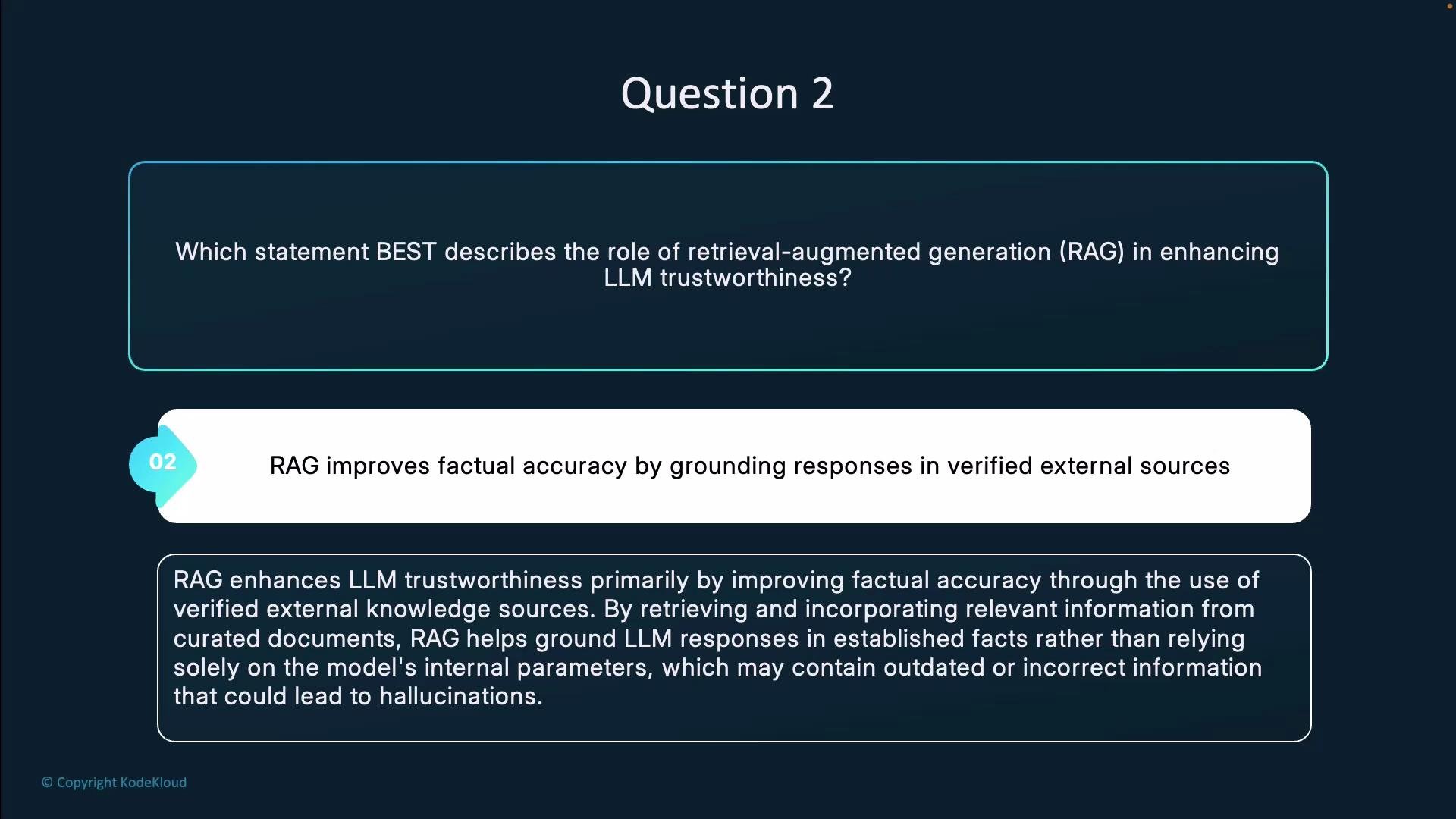
Question 2.
Which statement best describes the role of Retrieval Augmented Generation (RAG) in enhancing LLM trustworthiness?
* RAG automatically removes biased content from model outputs.
* RAG improves factual accuracy by grounding responses in verified external resources.
* RAG increases computational efficiency to reduce energy consumption.
* RAG restricts sensitive information in the knowledge base.
Answer: RAG improves factual accuracy by grounding responses in verified external sources.
Explanation
Retrieval-Augmented Generation (RAG) enhances the trustworthiness of large language models by providing external, contextual evidence that the generator conditions on. Instead of depending solely on the model’s internal weights, RAG retrieves relevant documents or passages from a curated knowledge base and uses those retrieved items to ground responses. This reduces unsupported claims and lowers the risk of hallucination.
Key points:
* The retrieval step supplies current or domain-specific evidence for the generator to reference, increasing factual accuracy and traceability.
* The effectiveness of RAG hinges on retrieval quality: indexing, search relevance, and the quality of source material directly affect output reliability.
* RAG is not a silver bullet for bias or data-sensitivity issues — these require explicit curation, filtering, and governance at the source and application layers.
* For higher trustworthiness, combine RAG with source citations, verification strategies, and downstream moderation/policy controls.
Comparison of options
| Option | Why it’s correct / incorrect |
| ------------------------------------------------------------------------------------ | ------------------------------------------------------------------------------------------------------------------------ |
| RAG improves factual accuracy by grounding responses in verified external resources. | Correct — RAG retrieves and conditions on external evidence to reduce hallucinations and improve factuality. |
| RAG automatically removes biased content from model outputs. | Incorrect — RAG can surface biased sources; bias must be mitigated through source selection and filtering. |
| RAG increases computational efficiency to reduce energy consumption. | Incorrect — RAG typically adds retrieval overhead; efficiency gains are not its primary purpose. |
| RAG restricts sensitive information in the knowledge base. | Incorrect — Restriction requires explicit policies and filters; RAG itself does not automatically redact sensitive data. |
References and further reading
* [Retrieval-Augmented Generation (RAG) — original paper and overviews](https://arxiv.org/abs/2005.11401)
* [Best practices for knowledge base curation and source verification](https://www.microsoft.com/en-us/research/publication/grounding-language-models/)
RAG helps make outputs more factual by grounding answers in retrieved evidence, but it is only as reliable as the sources and retrieval strategy. Validate and curate the knowledge base and include citation/verification steps for higher trustworthiness.