> ## Documentation Index
> Fetch the complete documentation index at: https://notes.kodekloud.com/llms.txt
> Use this file to discover all available pages before exploring further.
# Pre Requisite Kubernetes Introduction
> Introduction to container orchestration and Kubernetes, explaining why orchestration is needed, comparing tools like Docker Swarm and Mesos, and outlining Kubernetes advantages and next learning steps.
Hello — welcome to this lesson on container orchestration.\
My name is Mumshad Mannambeth.
This lesson introduces container orchestration and explains why it's essential when you run containerized applications in production. It assumes you already know how to package applications into Docker containers.
Prerequisite: familiarity with containers and basic Docker workflows (building images, running containers, pushing to registries). If you need a refresher, see the official Docker docs: [https://docs.docker.com/get-started/](https://docs.docker.com/get-started/).
Why do we need orchestration? Consider these real-world operational concerns:
* Applications often depend on other containers (databases, caches, message brokers, etc.).
* Traffic and user load change over time; you must scale instances up and down.
* During low demand, you want to save resources by reducing instances.
* Containers need reliable networking and service discovery so they can communicate.
* You need consistent, repeatable deployment and lifecycle management across many machines.
Container orchestration platforms manage these problems for you: they schedule containers across a cluster of machines, connect services, monitor container health, and automatically scale and repair applications. This automated deployment and lifecycle management is called container orchestration.
Kubernetes is the most widely adopted container orchestration platform in use today.
There are multiple orchestration technologies available:
* Docker Swarm — simple to set up and tight Docker integration; good for smaller deployments.
* Kubernetes — feature-rich, highly extensible, supported across all major cloud providers and on-premises.
* Apache Mesos — very powerful and flexible, but more complex to operate for many teams.
 Compare the main orchestration options:
| Orchestration | Strengths | Trade-offs | Typical use case / Example |
| - | - | - | - |
| Docker Swarm | Easy to get started; native Docker integration | Fewer advanced features for large-scale production | Small to medium clusters; quick deployments |
| Kubernetes | Rich feature set (scheduling, service discovery, auto-scaling, self-healing); large ecosystem and cloud support | Steeper learning curve and more setup | Production-grade microservices at scale; supported on GCP, AWS, Azure |
| Apache Mesos | Highly flexible; supports diverse workloads | More operational complexity | Large, heterogeneous environments with custom resource needs |
Kubernetes has broad ecosystem support and is available across all major cloud providers (GCP, Azure, AWS) and on-premises. The Kubernetes project is also one of the most active open-source projects on GitHub.
Key advantages of container orchestration (and Kubernetes specifically)
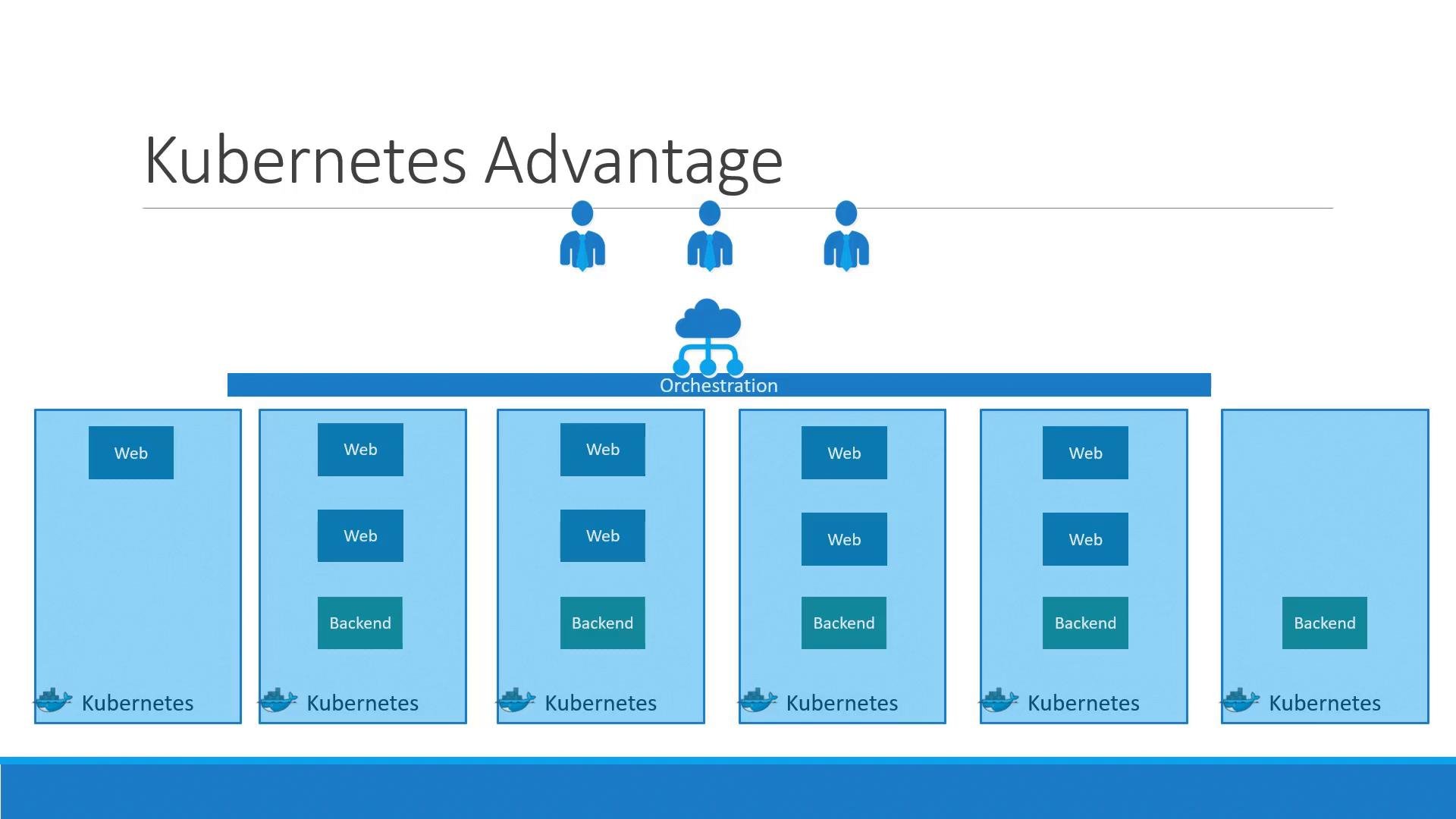
* High availability: run multiple instances across different worker nodes so a single machine failure doesn't take your service down.
* Load balancing: distribute incoming traffic across container instances to avoid bottlenecks.
* Rapid scaling: scale application replicas up or down (manually or automatically) in response to load.
* Node scaling: add or remove nodes in the cluster when capacity changes — without downtime.
* Declarative management: declare desired state in configuration files (YAML/JSON), and the platform will reconcile the cluster to match that state.
Compare the main orchestration options:
| Orchestration | Strengths | Trade-offs | Typical use case / Example |
| - | - | - | - |
| Docker Swarm | Easy to get started; native Docker integration | Fewer advanced features for large-scale production | Small to medium clusters; quick deployments |
| Kubernetes | Rich feature set (scheduling, service discovery, auto-scaling, self-healing); large ecosystem and cloud support | Steeper learning curve and more setup | Production-grade microservices at scale; supported on GCP, AWS, Azure |
| Apache Mesos | Highly flexible; supports diverse workloads | More operational complexity | Large, heterogeneous environments with custom resource needs |
Kubernetes has broad ecosystem support and is available across all major cloud providers (GCP, Azure, AWS) and on-premises. The Kubernetes project is also one of the most active open-source projects on GitHub.
Key advantages of container orchestration (and Kubernetes specifically)
* High availability: run multiple instances across different worker nodes so a single machine failure doesn't take your service down.
* Load balancing: distribute incoming traffic across container instances to avoid bottlenecks.
* Rapid scaling: scale application replicas up or down (manually or automatically) in response to load.
* Node scaling: add or remove nodes in the cluster when capacity changes — without downtime.
* Declarative management: declare desired state in configuration files (YAML/JSON), and the platform will reconcile the cluster to match that state.
 In short, Kubernetes is a container orchestration platform designed to deploy and manage large numbers of containers across clusters. It provides scheduling, service discovery, load balancing, self-healing, and scaling capabilities — all essential for running resilient, scalable production systems.
Choosing the right orchestration tool depends on your scale, team expertise, and operational needs. Kubernetes offers the most features and portability, but requires more upfront learning and operational practices.
Next steps: in following lessons we'll dive deeper into Kubernetes architecture and core concepts (pods, deployments, services, and the control plane). For reference and further reading, see:
* Kubernetes documentation: [https://kubernetes.io/docs/](https://kubernetes.io/docs/)
* Docker Swarm overview: [https://docs.docker.com/engine/swarm/](https://docs.docker.com/engine/swarm/)
* Apache Mesos: [https://mesos.apache.org/](https://mesos.apache.org/)
That is all for this lesson. Thank you for reading.
This documentation is built and hosted on [Mintlify](https://mintlify.com), a developer documentation platform.
In short, Kubernetes is a container orchestration platform designed to deploy and manage large numbers of containers across clusters. It provides scheduling, service discovery, load balancing, self-healing, and scaling capabilities — all essential for running resilient, scalable production systems.
Choosing the right orchestration tool depends on your scale, team expertise, and operational needs. Kubernetes offers the most features and portability, but requires more upfront learning and operational practices.
Next steps: in following lessons we'll dive deeper into Kubernetes architecture and core concepts (pods, deployments, services, and the control plane). For reference and further reading, see:
* Kubernetes documentation: [https://kubernetes.io/docs/](https://kubernetes.io/docs/)
* Docker Swarm overview: [https://docs.docker.com/engine/swarm/](https://docs.docker.com/engine/swarm/)
* Apache Mesos: [https://mesos.apache.org/](https://mesos.apache.org/)
That is all for this lesson. Thank you for reading.
This documentation is built and hosted on [Mintlify](https://mintlify.com), a developer documentation platform.