> ## Documentation Index
> Fetch the complete documentation index at: https://notes.kodekloud.com/llms.txt
> Use this file to discover all available pages before exploring further.
# What are Modules
> This article explains modules in OpenTofu, detailing their structure, usage, and benefits for organizing infrastructure code.
A **module** in OpenTofu (a Terraform fork) is any directory that contains configuration files. When you run OpenTofu commands inside that directory, it becomes the **root module**, orchestrating resources defined within.
## Root Module Example
Suppose your workspace looks like this:
```bash theme={null}
$ ls /root/opentofu-projects/aws-instance
main.tf variables.tf
```
– **main.tf**
```hcl theme={null}
# /root/opentofu-projects/aws-instance/main.tf
resource "aws_instance" "webserver" {
ami = var.ami
instance_type = var.instance_type
key_name = var.key
}
```
– **variables.tf**
```hcl theme={null}
# /root/opentofu-projects/aws-instance/variables.tf
variable "ami" {
type = string
default = "ami-0edab43b6fa892279"
description = "Ubuntu AMI ID in the ca-central-1 region"
}
```
Running `tofu init`, `tofu plan`, or `tofu apply` inside `aws-instance` treats it as the **root module**.
## Calling Child Modules
To avoid duplicating infrastructure code, package a directory as a **child module** and invoke it:
```bash theme={null}
$ mkdir -p /root/opentofu-projects/development
```
Create a `main.tf` in `development`:
```hcl theme={null}
# /root/opentofu-projects/development/main.tf
module "dev-webserver" {
source = "../aws-instance"
}
```
* `module "dev-webserver"` assigns a logical name.
* `source = "../aws-instance"` points to the child module’s path.
Now `development` is the **root module**, calling the `../aws-instance` **child module**.
***
## Building a Reusable Payroll App Module
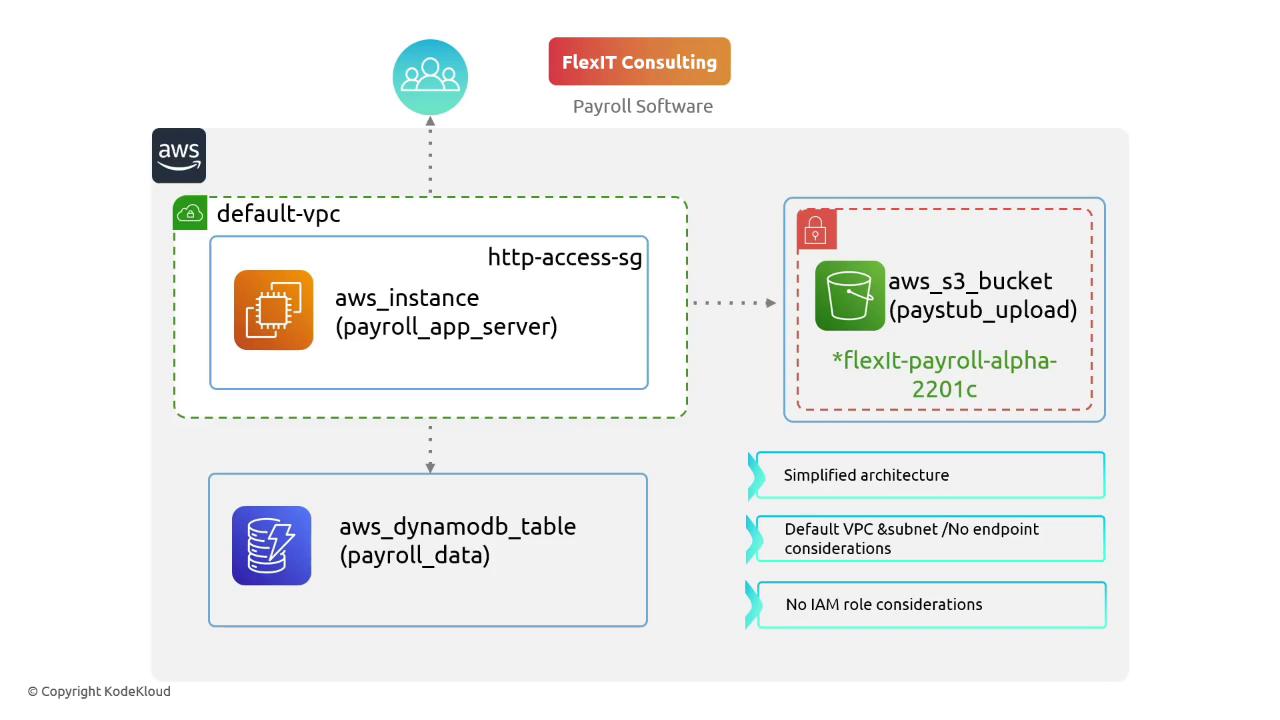
FlexIT Consulting needs the same payroll stack in multiple regions. The architecture uses:
* One EC2 instance (custom AMI)
* One DynamoDB table
* One S3 bucket
All resources live in the default VPC:
### Define the Module
Organize reusable code under `modules/payroll-app`:
```bash theme={null}
$ mkdir -p /root/opentofu-projects/modules/payroll-app
$ ls /root/opentofu-projects/modules/payroll-app
app_server.tf dynamodb_table.tf s3_bucket.tf variables.tf
```
#### app\_server.tf
```hcl theme={null}
# modules/payroll-app/app_server.tf
resource "aws_instance" "app_server" {
ami = var.ami
instance_type = "t2.medium"
tags = {
Name = "${var.app_region}-app-server"
}
depends_on = [
aws_dynamodb_table.payroll_db,
aws_s3_bucket.payroll_data
]
}
```
#### s3\_bucket.tf
```hcl theme={null}
# modules/payroll-app/s3_bucket.tf
resource "aws_s3_bucket" "payroll_data" {
bucket = "${var.app_region}-${var.bucket}"
}
```
#### dynamodb\_table.tf
```hcl theme={null}
# modules/payroll-app/dynamodb_table.tf
resource "aws_dynamodb_table" "payroll_db" {
name = "user_data"
billing_mode = "PAY_PER_REQUEST"
hash_key = "EmployeeID"
attribute {
name = "EmployeeID"
type = "S"
}
}
```
#### variables.tf
```hcl theme={null}
# modules/payroll-app/variables.tf
variable "app_region" {
type = string
}
variable "bucket" {
type = string
default = "flexit-payroll-alpha-22001c"
}
variable "ami" {
type = string
}
```
* **Hardcoded**: instance type, DynamoDB table name, and hash key.
* **Configurable**: AMI, region, bucket via variables.
***
## Deploy in US East (us-east-1)
Create a root module for the US deployment:
```bash theme={null}
$ mkdir /root/opentofu-projects/us-payroll-app
```
– **provider.tf**
```hcl theme={null}
# /root/opentofu-projects/us-payroll-app/provider.tf
provider "aws" {
region = "us-east-1"
}
```
– **main.tf**
```hcl theme={null}
# /root/opentofu-projects/us-payroll-app/main.tf
module "us_payroll" {
source = "../modules/payroll-app"
app_region = "us-east-1"
ami = "ami-24e140119877avm"
}
```
Initialize and apply:
```bash theme={null}
$ cd /root/opentofu-projects/us-payroll-app
$ tofu init
```
```bash theme={null}
$ tofu apply
```
You’ll see:
```HCL theme={null}
module.us_payroll.aws_dynamodb_table.payroll_db will be created
module.us_payroll.aws_instance.app_server will be created
module.us_payroll.aws_s3_bucket.payroll_data will be created
```
The S3 bucket name combines the region prefix with the default bucket variable.
***
## Deploy in London (eu-west-2)
Repeat for the UK region:
```bash theme={null}
$ mkdir /root/opentofu-projects/uk-payroll-app
```
– **provider.tf**
```hcl theme={null}
# /root/opentofu-projects/uk-payroll-app/provider.tf
provider "aws" {
region = "eu-west-2"
}
```
– **main.tf**
```hcl theme={null}
# /root/opentofu-projects/uk-payroll-app/main.tf
module "uk_payroll" {
source = "../modules/payroll-app"
app_region = "eu-west-2"
ami = "ami-35e140119877avm"
}
```
```bash theme={null}
$ cd /root/opentofu-projects/uk-payroll-app
$ tofu init && tofu apply
```
Resources provisioned under:
```HCL theme={null}
module.uk_payroll.aws_instance.app_server
module.uk_payroll.aws_s3_bucket.payroll_data
module.uk_payroll.aws_dynamodb_table.payroll_db
```
***
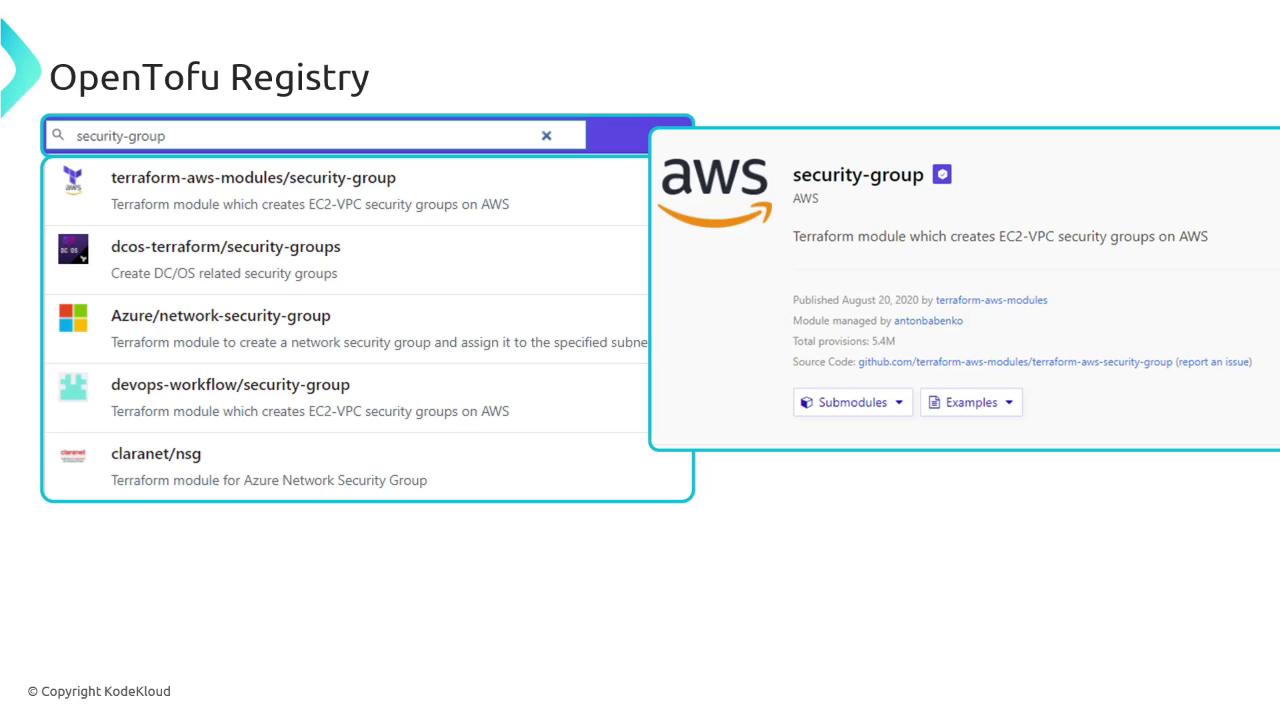
OpenTofu can source community or verified modules from the registry, just like Terraform. For example, to provision a security group:
```hcl theme={null}
module "security_group_ssh" {
source = "terraform-aws-modules/security-group/aws/modules/ssh"
version = "3.16.0"
vpc_id = "vpc-7d8d215"
ingress_cidr_blocks = ["10.10.0.0/16"]
name = "ssh-access"
}
```
Always pin the `version` to prevent unexpected module changes. Use `tofu get` or `tofu init` to fetch registry modules.
***
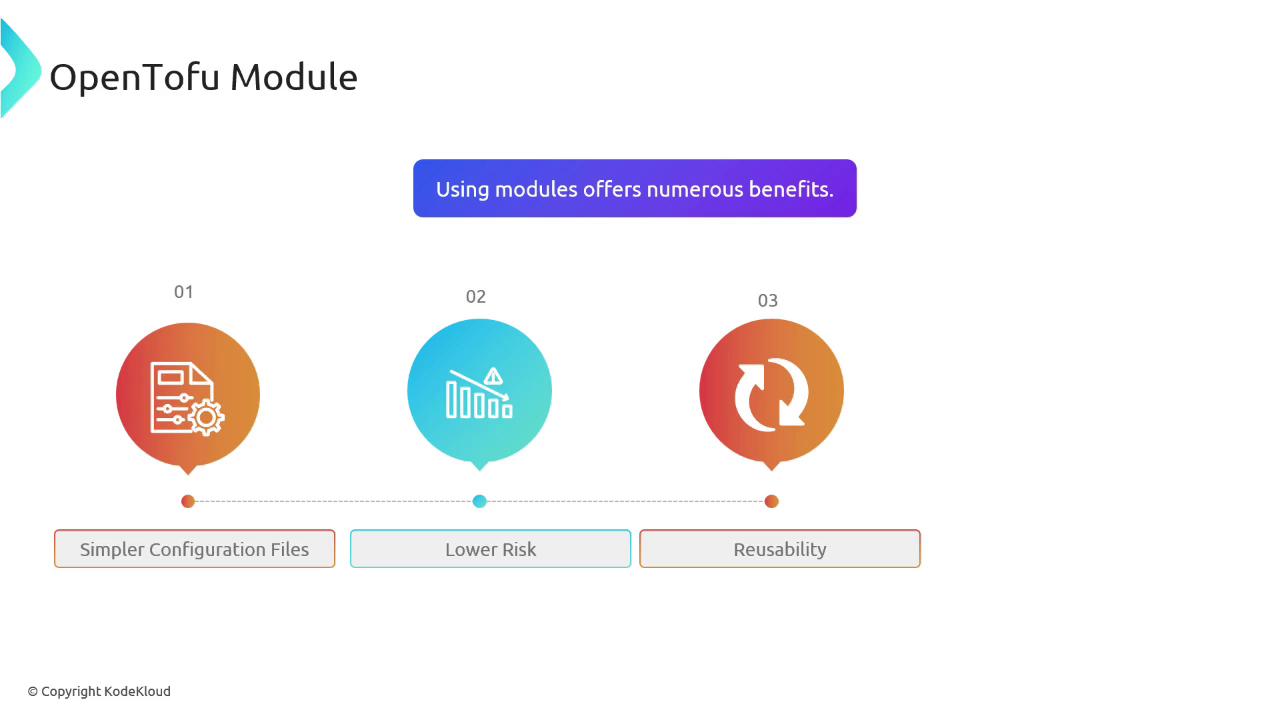
| Benefit | Description |
| --------------- | ---------------------------------------------------------------- |
| Simpler configs | Keep root modules concise for easier maintenance |
| Reusability | Share the same module across multiple projects |
| Stability | Enforce default settings and reduce configuration drift |
| Reduced errors | Leverage tested modules from your team or the community registry |
***
## Links and References
* [OpenTofu Documentation](https://github.com/opentofu)
* [Terraform Module Registry](https://registry.terraform.io/)
* [AWS Provider for Terraform](https://registry.terraform.io/providers/hashicorp/aws/latest)