> ## Documentation Index
> Fetch the complete documentation index at: https://notes.kodekloud.com/llms.txt
> Use this file to discover all available pages before exploring further.
# Introduction to Argo Workflows and Features
> Overview of Argo Workflows, a Kubernetes-native engine orchestrating containerized CI/CD, data processing, and ML pipelines using DAGs, templates, and observability.
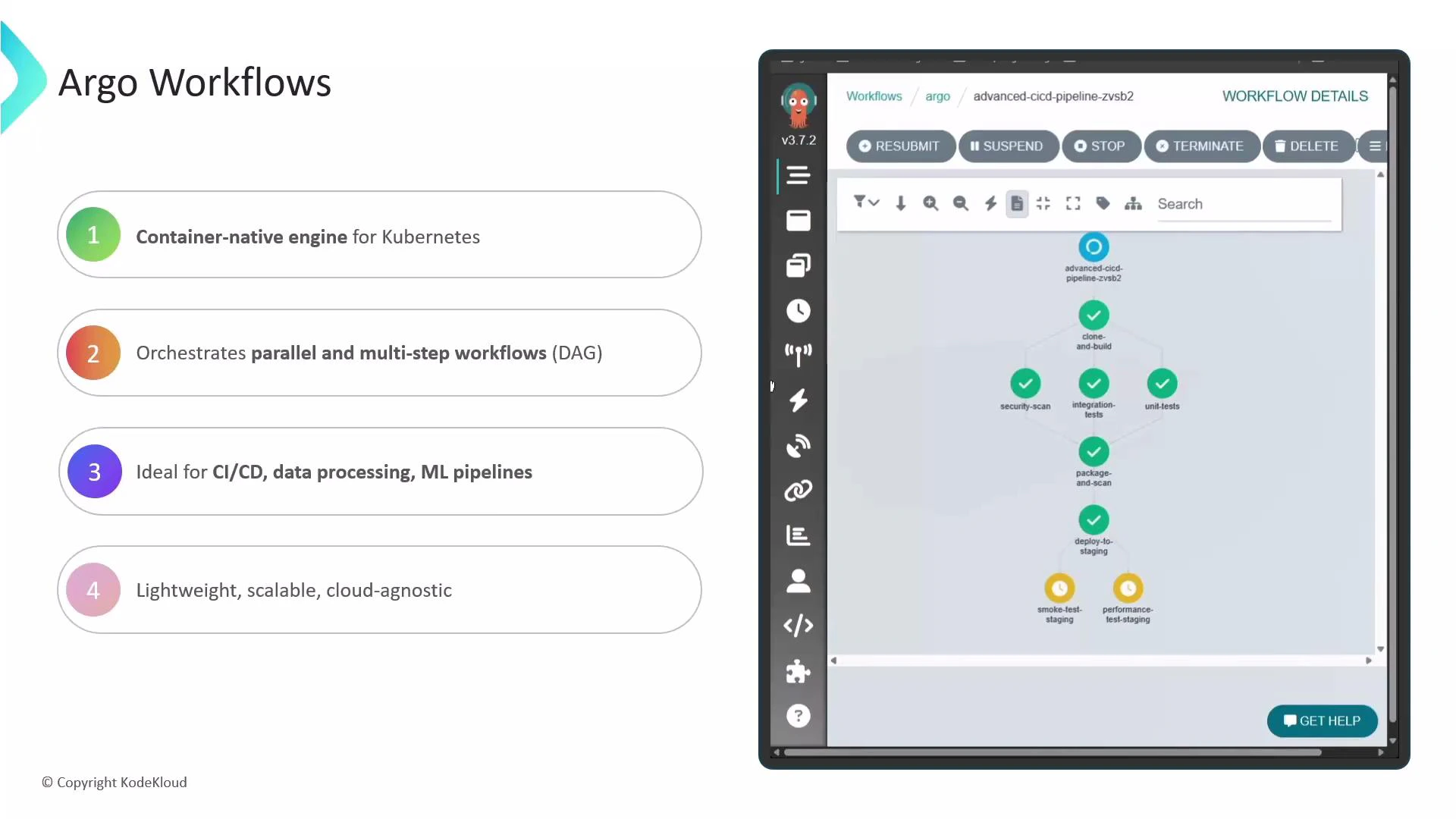
Argo Workflows is a container-native workflow engine for Kubernetes that orchestrates parallel and sequential jobs using containers. It lets you express complex multi-step processes as either a linear sequence of steps or a directed acyclic graph (DAG), where each step executes in its own container. Because Argo runs inside Kubernetes, it is lightweight, scalable, and cloud-agnostic — with no external orchestration dependency.
Argo is commonly used for CI/CD pipelines, data processing pipelines, and machine learning workflows that need to run directly on Kubernetes clusters. Its Kubernetes-native design gives you access to Kubernetes primitives (RBAC, namespaces, resource quotas, storage) while providing higher-level workflow constructs.
 ## Key capabilities
Argo Workflows provides a rich set of features for running container-native workloads on Kubernetes:
* Declarative workflow definitions: author workflows with YAML manifests that describe steps, DAGs, templates, and inputs/outputs.
* Control-flow primitives: built-in support for conditional execution, loops, fan-in/fan-out, and parallel steps.
* Reusability & parameterization: define reusable WorkflowTemplate and ClusterWorkflowTemplate objects and pass parameters between templates.
* Visualization & observability: the Argo Server UI visualizes DAGs, provides per-step logs, and shows execution state for debugging.
* Execution control: timeouts, suspend/resume, retries, and backoff policies to control runtime behavior.
* Data passing and artifacts: first-class artifact support (S3, GCS, HTTP, and more) plus parameters and outputs for step-to-step data transfer.
* Concurrency & resource management: configure parallelism at workflow, template, and step levels to guard resource consumption.
* Long-running services: sidecars and daemon steps let you run background services alongside workflow steps.
* SDKs & clients: official Go and Python SDKs (and community SDKs for other languages) enable programmatic workflow control.
* Exit handlers & cleanup: onExit handlers, TTL strategies, and garbage-collection options help automate cleanup and teardown.
## Minimal declarative example
Below is a minimal Argo Workflow YAML that demonstrates the declarative style and a simple sequence of steps. Save this to a file (e.g., minimal-workflow\.yaml) and submit it with `argo submit` when you have an Argo controller running.
```yaml theme={null}
apiVersion: argoproj.io/v1alpha1
kind: Workflow
metadata:
generateName: hello-argo-
spec:
entrypoint: hello-sequence
templates:
- name: hello-sequence
steps:
- - name: step-1
template: echo
arguments:
parameters:
- name: msg
value: "Hello from step 1"
- - name: step-2
template: echo
arguments:
parameters:
- name: msg
value: "Hello from step 2"
- name: echo
inputs:
parameters:
- name: msg
container:
image: alpine:3.17
command: [sh, -c]
args: ["echo {{inputs.parameters.msg}}"]
```
## Feature summary (quick reference)
| Feature area | Use case | Example |
| ------------------- | --------------------------------- | --------------------------------------------------- |
| Workflow types | Sequential or DAG orchestration | `spec.templates[].steps` or `spec.templates[].dag` |
| Artifacts & storage | Share files between steps | S3/GCS/HTTP artifact locations |
| Control flow | Conditional logic, loops | `when` clauses, `withItems`, `withParam` |
| Observability | UI and logs | Argo Server web UI + kubectl logs |
| Execution control | Timeouts, suspend/resume, retries | `activeDeadlineSeconds`, `suspend`, `retryStrategy` |
| Reusability | Templates and libraries | `WorkflowTemplate`, `ClusterWorkflowTemplate` |
## When to choose Argo Workflows
* You need Kubernetes-native orchestration with fine-grained control over containers and resources.
* Your workloads require parallelism, complex DAGs, or passing artifacts between steps.
* You want UI-based visualization of pipeline execution and per-step logs.
* You prefer declarative YAML workflow definitions that integrate with GitOps and CI/CD tooling.
Argo runs natively on Kubernetes, so you'll need a Kubernetes cluster (local or cloud) to run workflows and to use the [Argo Server / UI](https://argoproj.github.io/argo-workflows/) for visualization and control.
## Links and references
* Official Argo Workflows docs: [https://argoproj.github.io/argo-workflows/](https://argoproj.github.io/argo-workflows/)
* Kubernetes documentation: [https://kubernetes.io/docs/](https://kubernetes.io/docs/)
* Argo GitHub repository: [https://github.com/argoproj/argo-workflows](https://github.com/argoproj/argo-workflows)
* Argo Python SDK: [https://github.com/argoproj-labs/argo-python-sdk](https://github.com/argoproj-labs/argo-python-sdk)
For hands-on practice, deploy a lightweight Kubernetes cluster (minikube, kind, or a cloud cluster), install Argo Workflows, and try submitting the minimal workflow above.
## Key capabilities
Argo Workflows provides a rich set of features for running container-native workloads on Kubernetes:
* Declarative workflow definitions: author workflows with YAML manifests that describe steps, DAGs, templates, and inputs/outputs.
* Control-flow primitives: built-in support for conditional execution, loops, fan-in/fan-out, and parallel steps.
* Reusability & parameterization: define reusable WorkflowTemplate and ClusterWorkflowTemplate objects and pass parameters between templates.
* Visualization & observability: the Argo Server UI visualizes DAGs, provides per-step logs, and shows execution state for debugging.
* Execution control: timeouts, suspend/resume, retries, and backoff policies to control runtime behavior.
* Data passing and artifacts: first-class artifact support (S3, GCS, HTTP, and more) plus parameters and outputs for step-to-step data transfer.
* Concurrency & resource management: configure parallelism at workflow, template, and step levels to guard resource consumption.
* Long-running services: sidecars and daemon steps let you run background services alongside workflow steps.
* SDKs & clients: official Go and Python SDKs (and community SDKs for other languages) enable programmatic workflow control.
* Exit handlers & cleanup: onExit handlers, TTL strategies, and garbage-collection options help automate cleanup and teardown.
## Minimal declarative example
Below is a minimal Argo Workflow YAML that demonstrates the declarative style and a simple sequence of steps. Save this to a file (e.g., minimal-workflow\.yaml) and submit it with `argo submit` when you have an Argo controller running.
```yaml theme={null}
apiVersion: argoproj.io/v1alpha1
kind: Workflow
metadata:
generateName: hello-argo-
spec:
entrypoint: hello-sequence
templates:
- name: hello-sequence
steps:
- - name: step-1
template: echo
arguments:
parameters:
- name: msg
value: "Hello from step 1"
- - name: step-2
template: echo
arguments:
parameters:
- name: msg
value: "Hello from step 2"
- name: echo
inputs:
parameters:
- name: msg
container:
image: alpine:3.17
command: [sh, -c]
args: ["echo {{inputs.parameters.msg}}"]
```
## Feature summary (quick reference)
| Feature area | Use case | Example |
| ------------------- | --------------------------------- | --------------------------------------------------- |
| Workflow types | Sequential or DAG orchestration | `spec.templates[].steps` or `spec.templates[].dag` |
| Artifacts & storage | Share files between steps | S3/GCS/HTTP artifact locations |
| Control flow | Conditional logic, loops | `when` clauses, `withItems`, `withParam` |
| Observability | UI and logs | Argo Server web UI + kubectl logs |
| Execution control | Timeouts, suspend/resume, retries | `activeDeadlineSeconds`, `suspend`, `retryStrategy` |
| Reusability | Templates and libraries | `WorkflowTemplate`, `ClusterWorkflowTemplate` |
## When to choose Argo Workflows
* You need Kubernetes-native orchestration with fine-grained control over containers and resources.
* Your workloads require parallelism, complex DAGs, or passing artifacts between steps.
* You want UI-based visualization of pipeline execution and per-step logs.
* You prefer declarative YAML workflow definitions that integrate with GitOps and CI/CD tooling.
Argo runs natively on Kubernetes, so you'll need a Kubernetes cluster (local or cloud) to run workflows and to use the [Argo Server / UI](https://argoproj.github.io/argo-workflows/) for visualization and control.
## Links and references
* Official Argo Workflows docs: [https://argoproj.github.io/argo-workflows/](https://argoproj.github.io/argo-workflows/)
* Kubernetes documentation: [https://kubernetes.io/docs/](https://kubernetes.io/docs/)
* Argo GitHub repository: [https://github.com/argoproj/argo-workflows](https://github.com/argoproj/argo-workflows)
* Argo Python SDK: [https://github.com/argoproj-labs/argo-python-sdk](https://github.com/argoproj-labs/argo-python-sdk)
For hands-on practice, deploy a lightweight Kubernetes cluster (minikube, kind, or a cloud cluster), install Argo Workflows, and try submitting the minimal workflow above.