> ## Documentation Index
> Fetch the complete documentation index at: https://notes.kodekloud.com/llms.txt
> Use this file to discover all available pages before exploring further.
# Demo Templates with Infrastructure
> Building a Backstage scaffolder template that creates a Node.js Express app, templatizes and publishes infra and app repos, registers catalog entities, and provisions an EC2 instance with Terraform
In this lesson you'll build a Backstage scaffolder template that creates a Node.js + Express API repository and provisions the underlying infrastructure (an EC2 instance) with Terraform. The template will:
* Clone an infrastructure blueprint (Terraform code), templatize it, and publish it as a new repo.
* Register the resulting Resource entity in the Backstage catalog.
* Clone an application blueprint (Node.js + Express skeleton), templatize it, publish it as a new repo, and register the Component in the catalog.
* Wire the created Component to depend on the newly created Resource so relations appear in Backstage.
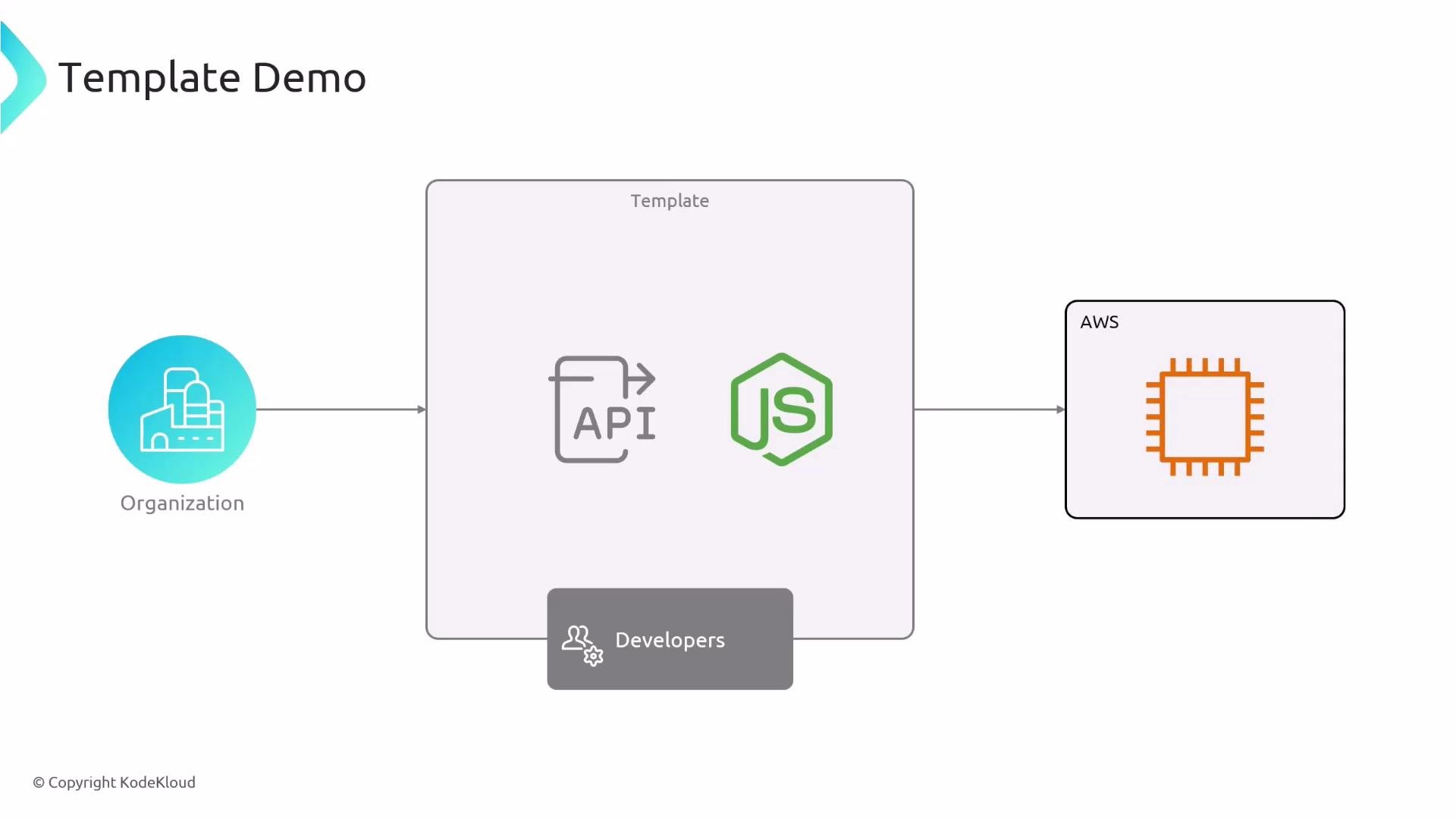 ## Flow overview
1. Platform/infrastructure teams maintain blueprint repositories:
* `infrastructure-IAC` — core infra managed by the infra team (VPCs, shared resources).
* `ec2-infra-blueprint` — per-app Terraform module/skeleton used by the template.
* `backstage-express-api-blueprint` — Node.js + Express app skeleton.
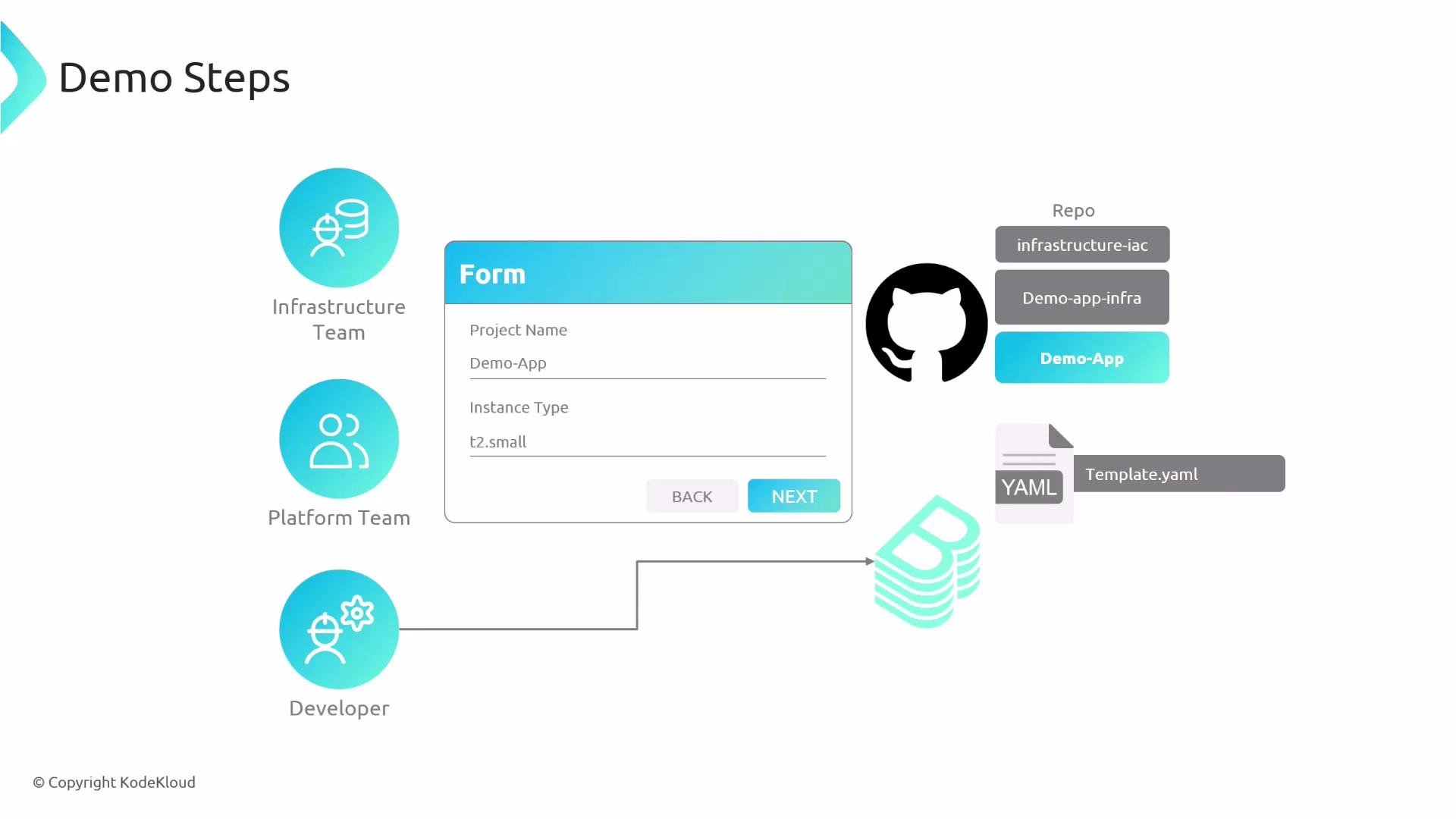
2. A developer opens the Backstage template UI, supplies project metadata (name, owner, destination repo), and selects an EC2 instance size.
3. Backstage templatizes the infra blueprint, publishes it as `-infra`, and registers a Resource entity (type: `compute`).
4. Backstage templatizes the app blueprint, publishes it as ``, and registers a Component entity that declares a `dependsOn` relation to the infra Resource.
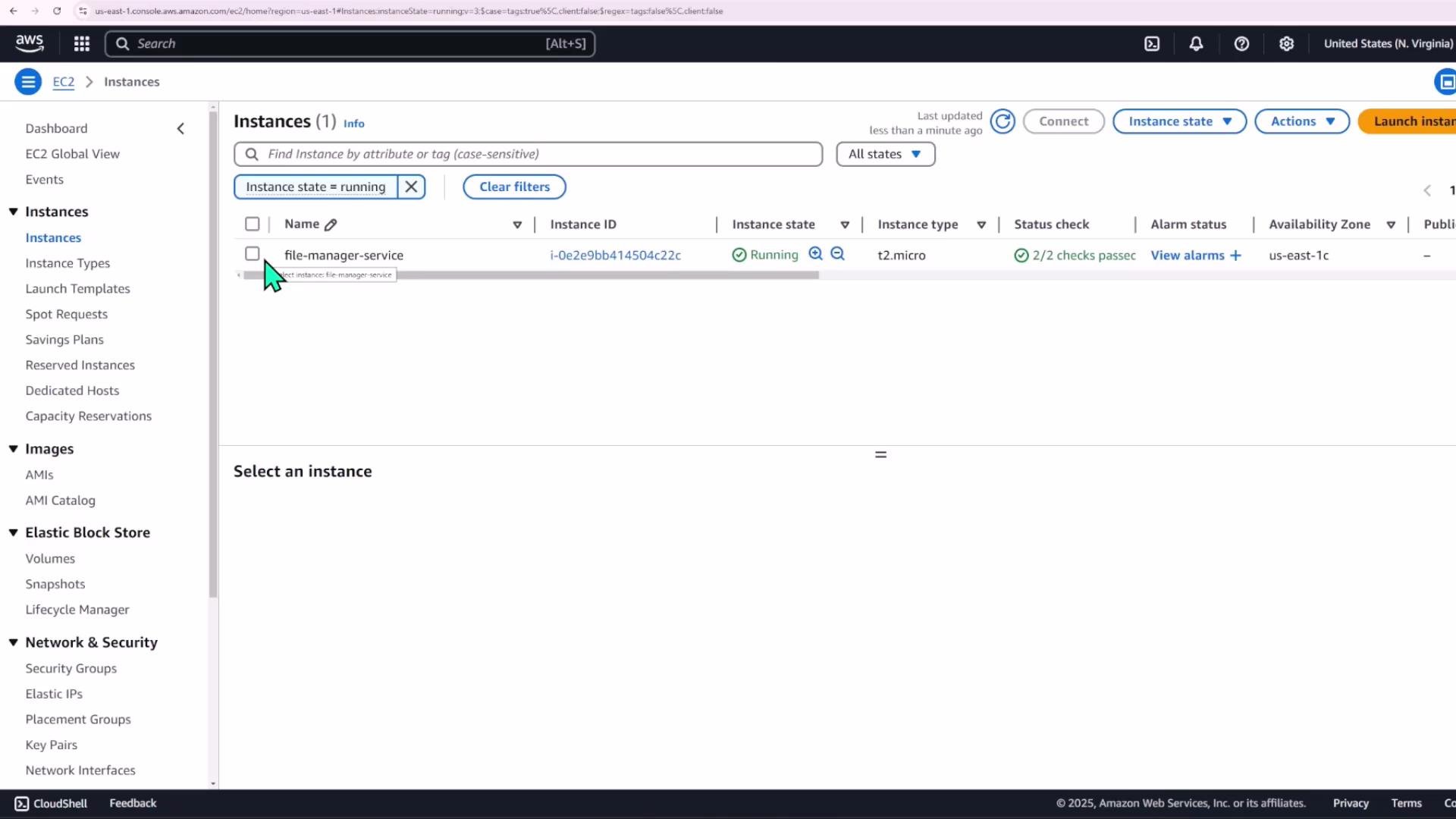
5. Terraform Cloud (or another runner) performs `terraform apply` for the new infra repo, provisioning the EC2 instance.
Below is a compact sequence illustration of these steps.
## Flow overview
1. Platform/infrastructure teams maintain blueprint repositories:
* `infrastructure-IAC` — core infra managed by the infra team (VPCs, shared resources).
* `ec2-infra-blueprint` — per-app Terraform module/skeleton used by the template.
* `backstage-express-api-blueprint` — Node.js + Express app skeleton.
2. A developer opens the Backstage template UI, supplies project metadata (name, owner, destination repo), and selects an EC2 instance size.
3. Backstage templatizes the infra blueprint, publishes it as `-infra`, and registers a Resource entity (type: `compute`).
4. Backstage templatizes the app blueprint, publishes it as ``, and registers a Component entity that declares a `dependsOn` relation to the infra Resource.
5. Terraform Cloud (or another runner) performs `terraform apply` for the new infra repo, provisioning the EC2 instance.
Below is a compact sequence illustration of these steps.
 ## Roles and repositories
Use this quick reference for which team owns which repository:
| Role / Team | Repository | Purpose |
| ------------------- | --------------------------------- | -------------------------------------------------------------------------------- |
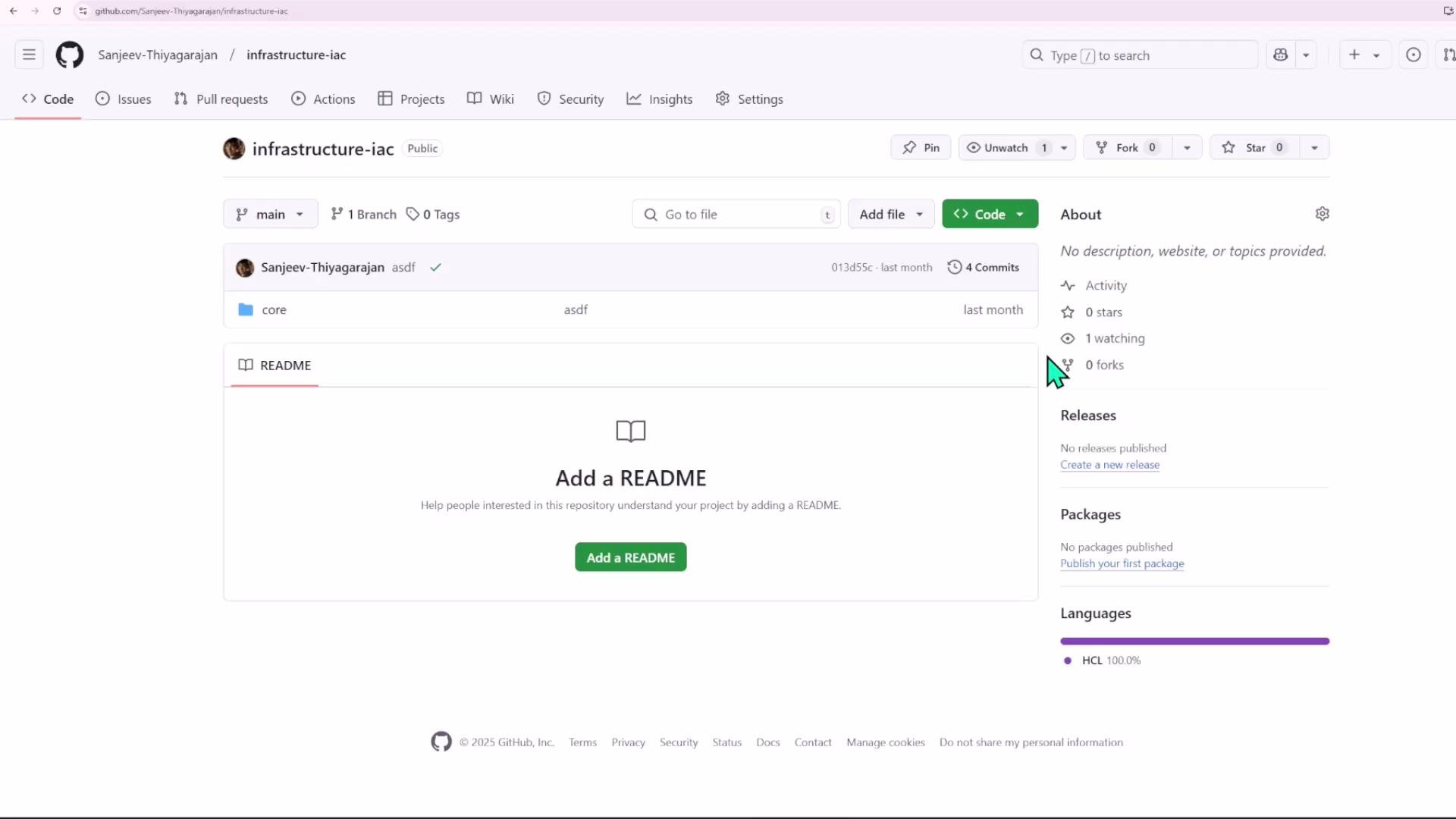
| Infrastructure team | `infrastructure-IAC` | Core shared Terraform state and shared resources (VPCs, subnets). |
| Infra blueprint | `ec2-infra-blueprint` | Per-application Terraform skeleton/module that gets templatized. |
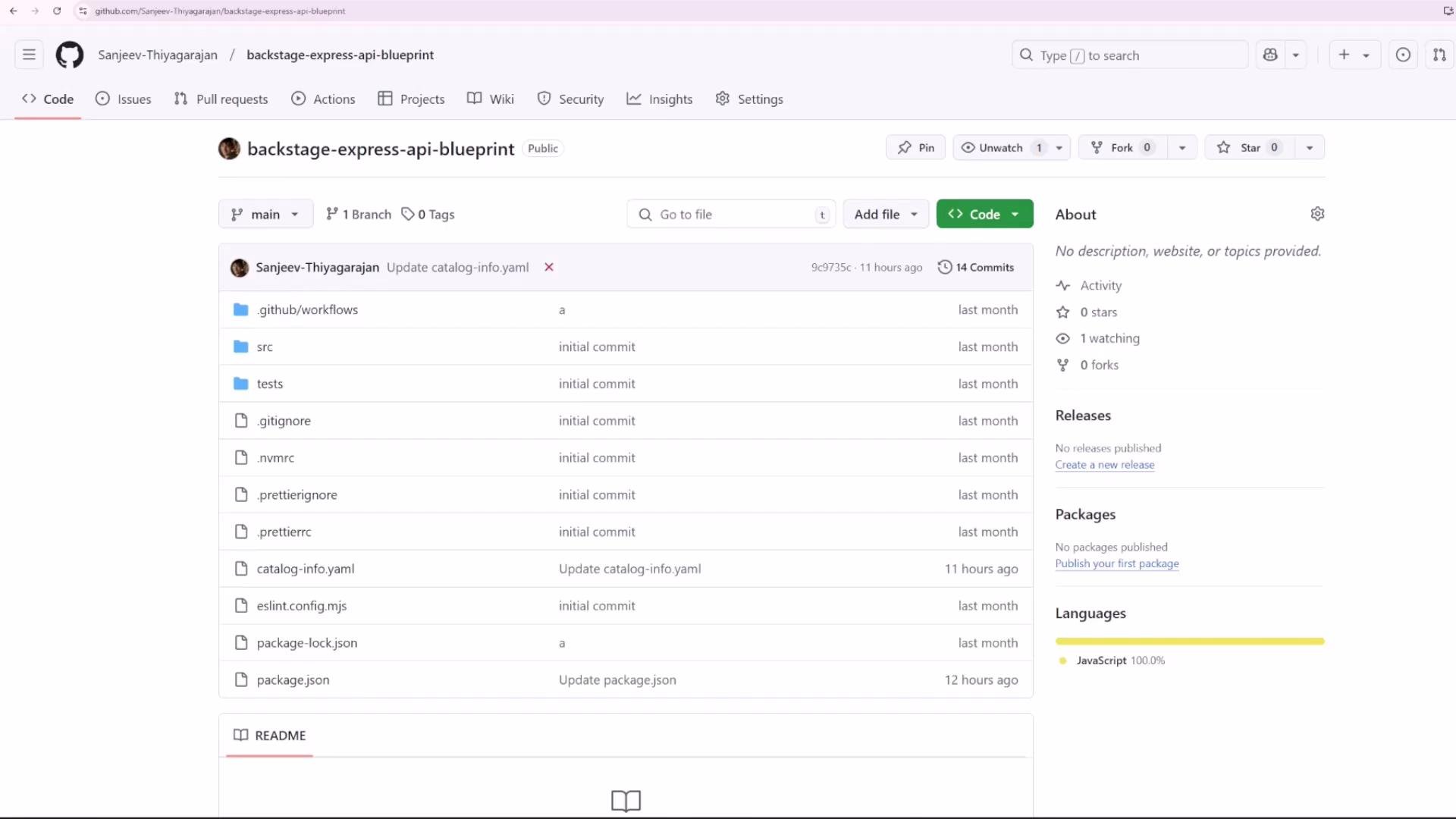
| App blueprint | `backstage-express-api-blueprint` | Node.js + Express scaffolding used to create new services. |
| Template repo | (your templates repo) | Contains the scaffolder YAML (`nodejs-ec2-template`) that coordinates the steps. |
Example: here’s the Express API skeleton used as the app blueprint.
## Roles and repositories
Use this quick reference for which team owns which repository:
| Role / Team | Repository | Purpose |
| ------------------- | --------------------------------- | -------------------------------------------------------------------------------- |
| Infrastructure team | `infrastructure-IAC` | Core shared Terraform state and shared resources (VPCs, subnets). |
| Infra blueprint | `ec2-infra-blueprint` | Per-application Terraform skeleton/module that gets templatized. |
| App blueprint | `backstage-express-api-blueprint` | Node.js + Express scaffolding used to create new services. |
| Template repo | (your templates repo) | Contains the scaffolder YAML (`nodejs-ec2-template`) that coordinates the steps. |
Example: here’s the Express API skeleton used as the app blueprint.
 And this is the main organization infra repository that contains shared Terraform configuration other per-app infra will reference:
 ## Example infra blueprint (ec2-infra-blueprint)
The infra blueprint accepts templated inputs:
* `name` — project name used for resource naming.
* `instance_type` — EC2 size chosen by the developer.
It references the `infrastructure-IAC` remote state to obtain a subnet ID. An example main Terraform module (simplified):
```terraform theme={null}
terraform {
required_providers {
aws = {
source = "hashicorp/aws"
version = "~> 4.16"
}
}
required_version = ">= 1.2.0"
}
provider "aws" {
region = "us-east-1"
}
data "terraform_remote_state" "core" {
backend = "remote"
config = {
organization = "sanjeevkt720"
workspaces = {
name = "infrastructure-iac"
}
}
}
module "my_ec2" {
source = "app.terraform.io/sanjeevkt720/ec2-infra/aws"
version = "1.0.0"
name = "file-manager-service" # to be templatized
instance_type = "t2.micro" # to be templatized
subnet = data.terraform_remote_state.core.outputs.subnet3_id
}
```
Resource entity for the EC2 instance (`resource.yaml` in the infra blueprint):
```yaml theme={null}
apiVersion: backstage.io/v1alpha1
kind: Resource
metadata:
name: file-manager-service-ec2 # to be templatized, e.g. "${{ values.name + '-ec2' }}"
description: EC2 instance for "file-manager-service"
spec:
type: compute
owner: infra
```
## Template form and user experience
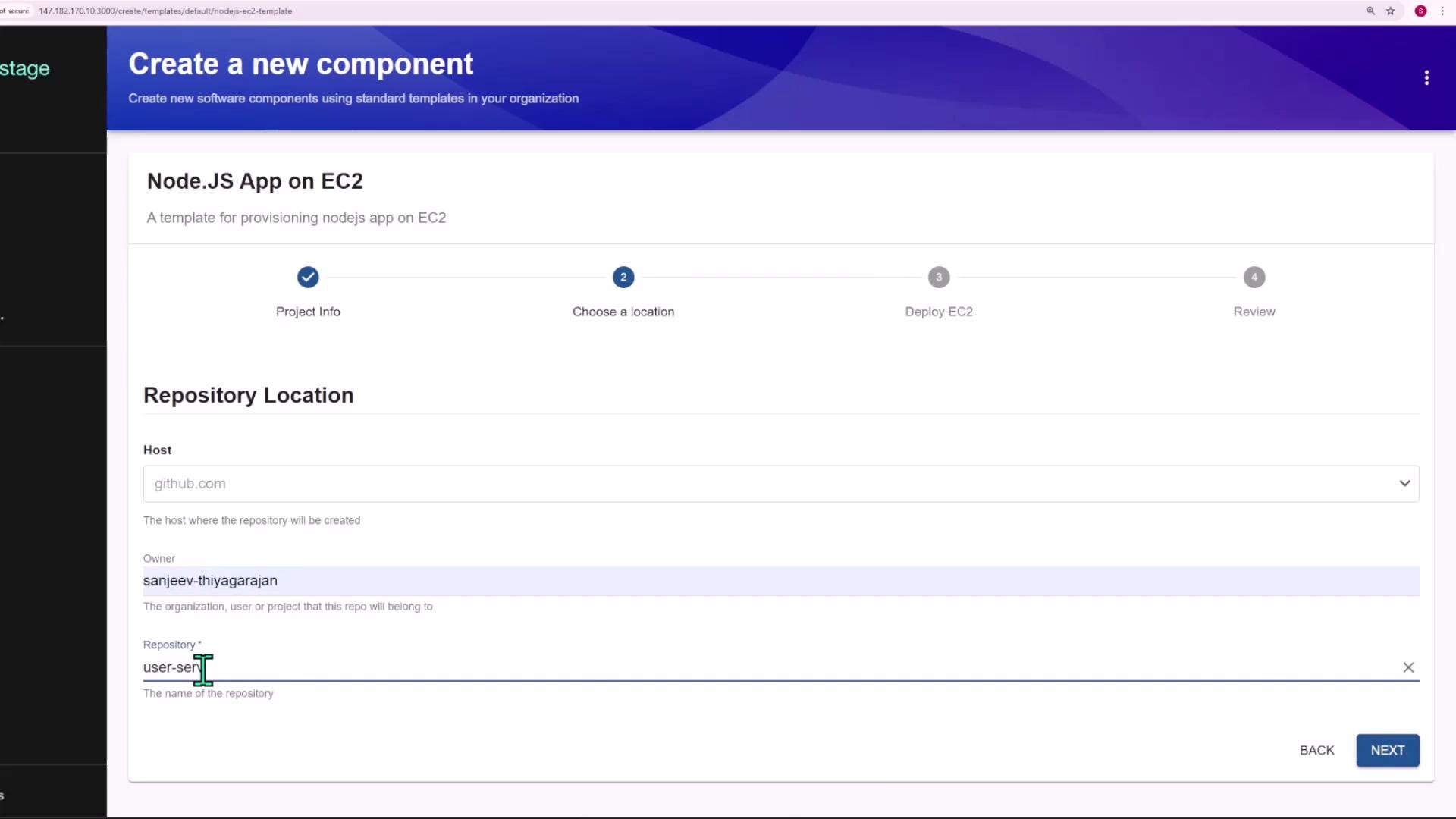
The template provides a multi-step Create flow in Backstage:
* Project Info — component name and metadata.
* Choose Location — repository location / owner.
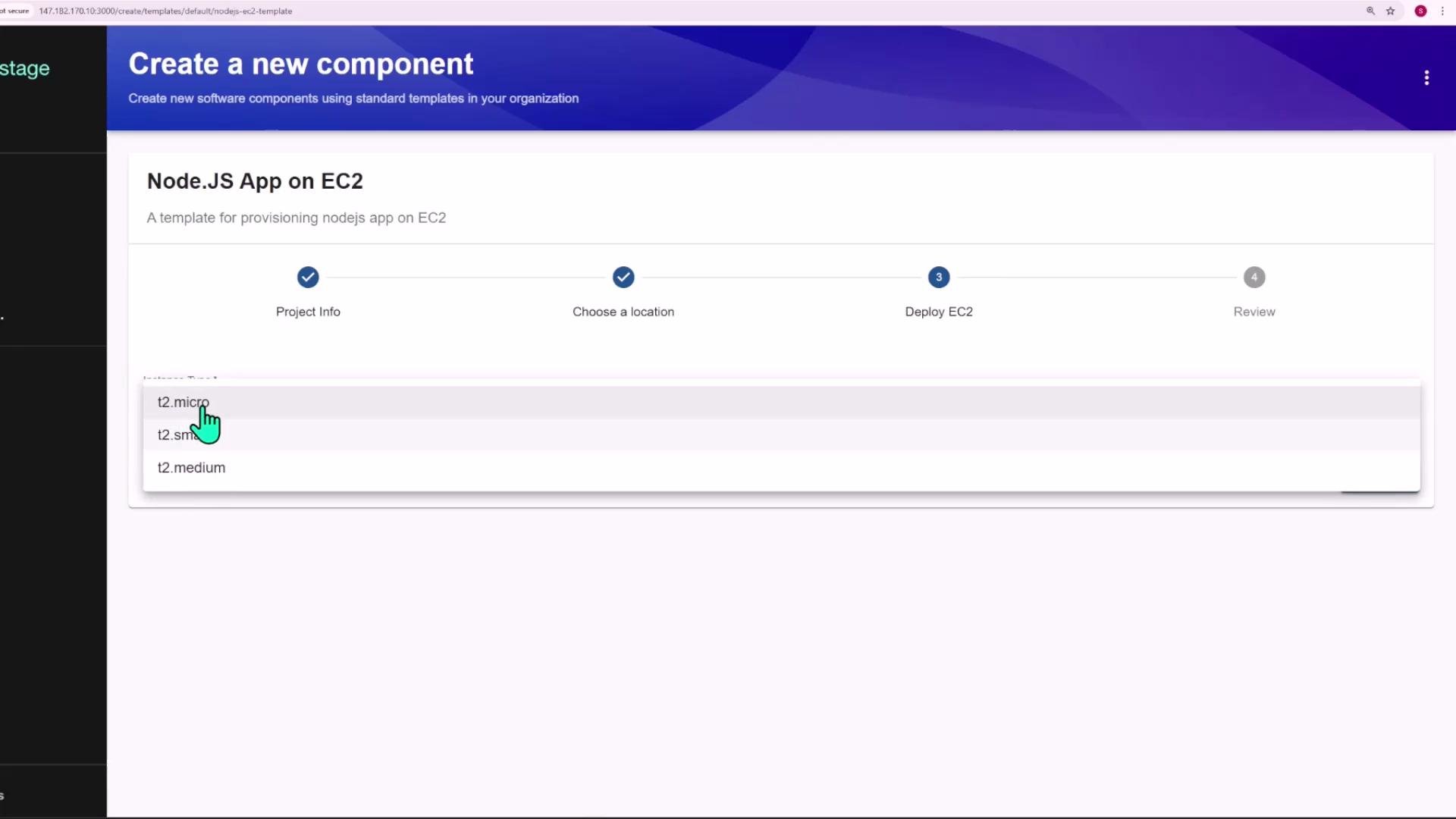
* Deploy EC2 — select instance size (e.g., `t2.micro`, `t2.small`, `t2.medium`).
Example Create flow UI:
## Example infra blueprint (ec2-infra-blueprint)
The infra blueprint accepts templated inputs:
* `name` — project name used for resource naming.
* `instance_type` — EC2 size chosen by the developer.
It references the `infrastructure-IAC` remote state to obtain a subnet ID. An example main Terraform module (simplified):
```terraform theme={null}
terraform {
required_providers {
aws = {
source = "hashicorp/aws"
version = "~> 4.16"
}
}
required_version = ">= 1.2.0"
}
provider "aws" {
region = "us-east-1"
}
data "terraform_remote_state" "core" {
backend = "remote"
config = {
organization = "sanjeevkt720"
workspaces = {
name = "infrastructure-iac"
}
}
}
module "my_ec2" {
source = "app.terraform.io/sanjeevkt720/ec2-infra/aws"
version = "1.0.0"
name = "file-manager-service" # to be templatized
instance_type = "t2.micro" # to be templatized
subnet = data.terraform_remote_state.core.outputs.subnet3_id
}
```
Resource entity for the EC2 instance (`resource.yaml` in the infra blueprint):
```yaml theme={null}
apiVersion: backstage.io/v1alpha1
kind: Resource
metadata:
name: file-manager-service-ec2 # to be templatized, e.g. "${{ values.name + '-ec2' }}"
description: EC2 instance for "file-manager-service"
spec:
type: compute
owner: infra
```
## Template form and user experience
The template provides a multi-step Create flow in Backstage:
* Project Info — component name and metadata.
* Choose Location — repository location / owner.
* Deploy EC2 — select instance size (e.g., `t2.micro`, `t2.small`, `t2.medium`).
Example Create flow UI:
 Choosing an instance size:
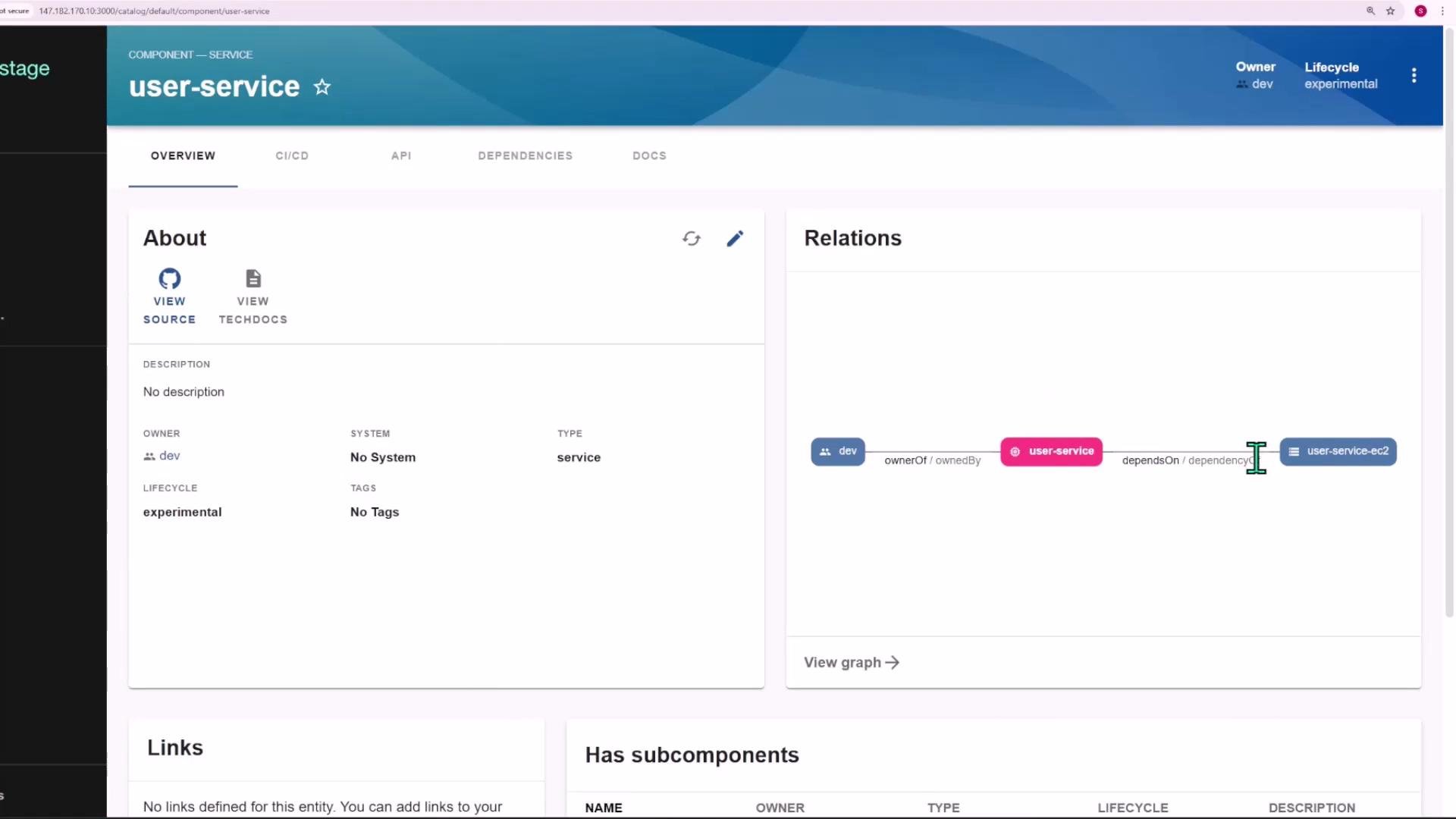
 High-level result: the template produces two repositories:
* `file-manager-service` — application code (from the app blueprint).
* `file-manager-service-infra` — Terraform code to provision the EC2 instance (from the infra blueprint).
Backstage will display the Component and Resource relations once both entities are registered.
High-level result: the template produces two repositories:
* `file-manager-service` — application code (from the app blueprint).
* `file-manager-service-infra` — Terraform code to provision the EC2 instance (from the infra blueprint).
Backstage will display the Component and Resource relations once both entities are registered.
 ## Template design — parameters and ordered steps
The single scaffolder template (`nodejs-ec2-template`) will:
* Show a three-page form (project info, repo location, deploy EC2).
* Execute the following steps, in order:
1. fetch infra base (clone `ec2-infra-blueprint` into `./infra` and provide values)
2. publish infra (push `./infra` to a new repo `-infra`)
3. register infra Resource (`catalog:register` using `resource.yaml`)
4. fetch app base (clone `backstage-express-api-blueprint` into `./code` and provide values)
5. publish app (push `./code` to ``)
6. register app Component (`catalog:register` using `catalog-info.yaml`)
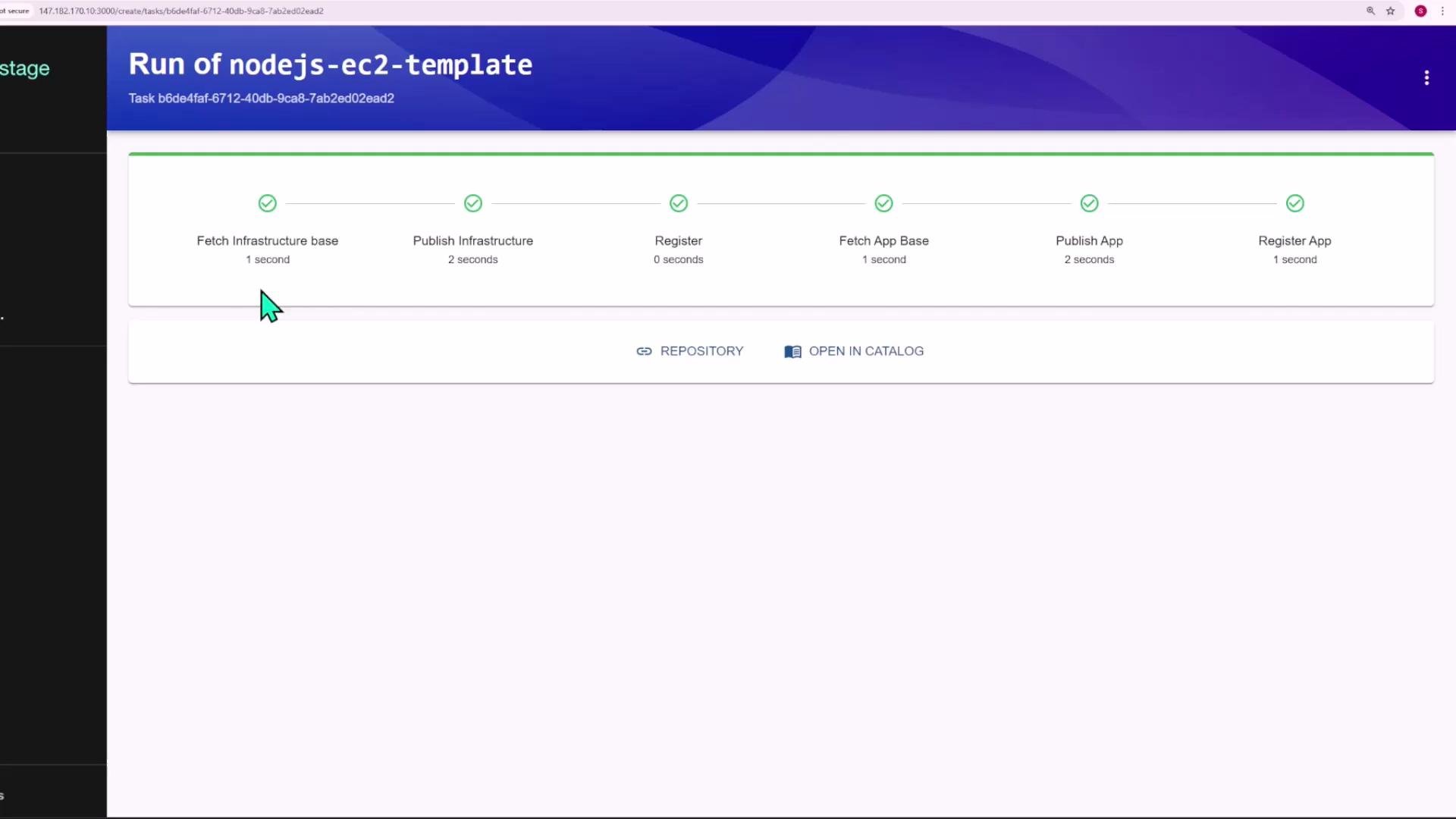
7. provide output links (Repository, Open in Catalog)
Below is a complete example Backstage Scaffolder template. Make sure your Backstage instance has the `fetch:template`, `publish:github` and `catalog:register` actions installed and configured.
```yaml theme={null}
apiVersion: scaffolder.backstage.io/v1beta3
kind: Template
metadata:
name: nodejs-ec2-template
title: Node.JS App on EC2
description: A template for provisioning a Node.js app and an EC2 instance via Terraform
spec:
owner: user:guest
type: service
parameters:
- title: Project Info
required:
- name
properties:
name:
title: Name
type: string
description: Unique name of the component
ui:autofocus: true
- title: Choose Location
required:
- repoUrl
properties:
repoUrl:
title: Repository Location
type: string
ui:field: RepoUrlPicker
ui:options:
allowedHosts:
- github.com
owner:
title: Owner
type: string
description: Owner of the component
ui:field: OwnerPicker
ui:options:
catalogFilter:
- kind: [User, Group]
- title: Deploy EC2
properties:
instanceType:
title: Instance Type
type: string
description: What size EC2 instance
default: "t2.micro"
enum:
- "t2.micro"
- "t2.small"
- "t2.medium"
steps:
# 1) Fetch and templatize infrastructure skeleton into ./infra
- id: fetch-infra-base
name: Fetch Infrastructure base
action: fetch:template
input:
url: https://github.com/Sanjeev-Thiyagarajan/ec2-infra-blueprint
targetPath: ./infra
values:
name: ${{ parameters.name }}
owner: ${{ parameters.owner }}
instanceType: ${{ parameters.instanceType }}
# 2) Publish infra (push ./infra to repoUrl + "-infra")
- id: publish-infra
name: Publish Infrastructure
action: publish:github
input:
sourcePath: ./infra
repoUrl: ${{ parameters.repoUrl }}-infra
description: This is ${{ parameters.name }}-infra
allowedHosts: ["github.com"]
# 3) Register resource created by infra (resource.yaml)
- id: register-infra
name: Register Infrastructure Resource
action: catalog:register
input:
repoContentsUrl: ${{ steps['publish-infra'].output.repoContentsUrl }}
catalogInfoPath: /resource.yaml
# 4) Fetch and templatize app skeleton into ./code
- id: fetch-app-base
name: Fetch App base
action: fetch:template
input:
url: https://github.com/Sanjeev-Thiyagarajan/backstage-express-api-blueprint
targetPath: ./code
values:
name: ${{ parameters.name }}
owner: ${{ parameters.owner }}
# 5) Publish app (push ./code to repoUrl)
- id: publish-app
name: Publish App
action: publish:github
input:
sourcePath: ./code
repoUrl: ${{ parameters.repoUrl }}
description: This is ${{ parameters.name }}
allowedHosts: ["github.com"]
# 6) Register the app component (catalog-info.yaml)
- id: register-app
name: Register App
action: catalog:register
input:
repoContentsUrl: ${{ steps['publish-app'].output.repoContentsUrl }}
catalogInfoPath: /catalog-info.yaml
output:
links:
- title: Repository
url: ${{ steps['publish-app'].output.remoteUrl }}
- title: Open in Catalog
url: ${{ steps['register-app'].output.entityRef }}
```
## Templatizing blueprints — key snippets
Infra blueprint: replace placeholders in `main.tf` and `resource.yaml` with scaffolder values. Example module block (templated):
```terraform theme={null}
module "my_ec2" {
source = "app.terraform.io/sanjeevkt720/ec2-infra/aws"
version = "1.0.0"
name = "${{ values.name }}"
instance_type = "${{ values.instanceType }}"
subnet = data.terraform_remote_state.core.outputs.subnet3_id
}
```
Templatized `resource.yaml`:
```yaml theme={null}
apiVersion: backstage.io/v1alpha1
kind: Resource
metadata:
name: "${{ values.name + '-ec2' }}"
description: EC2 instance for "${{ values.name }}"
spec:
type: compute
owner: infra
```
App blueprint: update `catalog-info.yaml` so the Component depends on the infra Resource:
```yaml theme={null}
apiVersion: backstage.io/v1alpha1
kind: Component
metadata:
name: ${{ values.name | dump }}
spec:
type: service
owner: ${{ values.owner }}
lifecycle: experimental
dependsOn:
- "${{ 'resource:' + values.name + '-ec2' }}"
```
## Note about Terraform execution
This example uses Terraform Cloud to detect new infra repositories and run `terraform apply`. If you do not use Terraform Cloud (or a similar runner), you must add an extra step that runs Terraform (for example, a CI workflow or a scaffolder action that executes `terraform init` and `terraform apply`) after publishing the infra repository.
## Running the template
* Add the `nodejs-ec2-template` YAML to your templates repo and let Backstage pick it up.
* From the Backstage Create flow, select *Node.js App on EC2*, fill out project name, owner, repo location, and instance type, then run the template.
* The template creates two Git repositories: `` (app) and `-infra` (Terraform).
* Catalog registration will create a Component entity for the app and a Resource entity for the EC2 instance. The Component will declare a `dependsOn` relation to the Resource.
Example run completion UI:
## Template design — parameters and ordered steps
The single scaffolder template (`nodejs-ec2-template`) will:
* Show a three-page form (project info, repo location, deploy EC2).
* Execute the following steps, in order:
1. fetch infra base (clone `ec2-infra-blueprint` into `./infra` and provide values)
2. publish infra (push `./infra` to a new repo `-infra`)
3. register infra Resource (`catalog:register` using `resource.yaml`)
4. fetch app base (clone `backstage-express-api-blueprint` into `./code` and provide values)
5. publish app (push `./code` to ``)
6. register app Component (`catalog:register` using `catalog-info.yaml`)
7. provide output links (Repository, Open in Catalog)
Below is a complete example Backstage Scaffolder template. Make sure your Backstage instance has the `fetch:template`, `publish:github` and `catalog:register` actions installed and configured.
```yaml theme={null}
apiVersion: scaffolder.backstage.io/v1beta3
kind: Template
metadata:
name: nodejs-ec2-template
title: Node.JS App on EC2
description: A template for provisioning a Node.js app and an EC2 instance via Terraform
spec:
owner: user:guest
type: service
parameters:
- title: Project Info
required:
- name
properties:
name:
title: Name
type: string
description: Unique name of the component
ui:autofocus: true
- title: Choose Location
required:
- repoUrl
properties:
repoUrl:
title: Repository Location
type: string
ui:field: RepoUrlPicker
ui:options:
allowedHosts:
- github.com
owner:
title: Owner
type: string
description: Owner of the component
ui:field: OwnerPicker
ui:options:
catalogFilter:
- kind: [User, Group]
- title: Deploy EC2
properties:
instanceType:
title: Instance Type
type: string
description: What size EC2 instance
default: "t2.micro"
enum:
- "t2.micro"
- "t2.small"
- "t2.medium"
steps:
# 1) Fetch and templatize infrastructure skeleton into ./infra
- id: fetch-infra-base
name: Fetch Infrastructure base
action: fetch:template
input:
url: https://github.com/Sanjeev-Thiyagarajan/ec2-infra-blueprint
targetPath: ./infra
values:
name: ${{ parameters.name }}
owner: ${{ parameters.owner }}
instanceType: ${{ parameters.instanceType }}
# 2) Publish infra (push ./infra to repoUrl + "-infra")
- id: publish-infra
name: Publish Infrastructure
action: publish:github
input:
sourcePath: ./infra
repoUrl: ${{ parameters.repoUrl }}-infra
description: This is ${{ parameters.name }}-infra
allowedHosts: ["github.com"]
# 3) Register resource created by infra (resource.yaml)
- id: register-infra
name: Register Infrastructure Resource
action: catalog:register
input:
repoContentsUrl: ${{ steps['publish-infra'].output.repoContentsUrl }}
catalogInfoPath: /resource.yaml
# 4) Fetch and templatize app skeleton into ./code
- id: fetch-app-base
name: Fetch App base
action: fetch:template
input:
url: https://github.com/Sanjeev-Thiyagarajan/backstage-express-api-blueprint
targetPath: ./code
values:
name: ${{ parameters.name }}
owner: ${{ parameters.owner }}
# 5) Publish app (push ./code to repoUrl)
- id: publish-app
name: Publish App
action: publish:github
input:
sourcePath: ./code
repoUrl: ${{ parameters.repoUrl }}
description: This is ${{ parameters.name }}
allowedHosts: ["github.com"]
# 6) Register the app component (catalog-info.yaml)
- id: register-app
name: Register App
action: catalog:register
input:
repoContentsUrl: ${{ steps['publish-app'].output.repoContentsUrl }}
catalogInfoPath: /catalog-info.yaml
output:
links:
- title: Repository
url: ${{ steps['publish-app'].output.remoteUrl }}
- title: Open in Catalog
url: ${{ steps['register-app'].output.entityRef }}
```
## Templatizing blueprints — key snippets
Infra blueprint: replace placeholders in `main.tf` and `resource.yaml` with scaffolder values. Example module block (templated):
```terraform theme={null}
module "my_ec2" {
source = "app.terraform.io/sanjeevkt720/ec2-infra/aws"
version = "1.0.0"
name = "${{ values.name }}"
instance_type = "${{ values.instanceType }}"
subnet = data.terraform_remote_state.core.outputs.subnet3_id
}
```
Templatized `resource.yaml`:
```yaml theme={null}
apiVersion: backstage.io/v1alpha1
kind: Resource
metadata:
name: "${{ values.name + '-ec2' }}"
description: EC2 instance for "${{ values.name }}"
spec:
type: compute
owner: infra
```
App blueprint: update `catalog-info.yaml` so the Component depends on the infra Resource:
```yaml theme={null}
apiVersion: backstage.io/v1alpha1
kind: Component
metadata:
name: ${{ values.name | dump }}
spec:
type: service
owner: ${{ values.owner }}
lifecycle: experimental
dependsOn:
- "${{ 'resource:' + values.name + '-ec2' }}"
```
## Note about Terraform execution
This example uses Terraform Cloud to detect new infra repositories and run `terraform apply`. If you do not use Terraform Cloud (or a similar runner), you must add an extra step that runs Terraform (for example, a CI workflow or a scaffolder action that executes `terraform init` and `terraform apply`) after publishing the infra repository.
## Running the template
* Add the `nodejs-ec2-template` YAML to your templates repo and let Backstage pick it up.
* From the Backstage Create flow, select *Node.js App on EC2*, fill out project name, owner, repo location, and instance type, then run the template.
* The template creates two Git repositories: `` (app) and `-infra` (Terraform).
* Catalog registration will create a Component entity for the app and a Resource entity for the EC2 instance. The Component will declare a `dependsOn` relation to the Resource.
Example run completion UI:
 ## Post-run verification
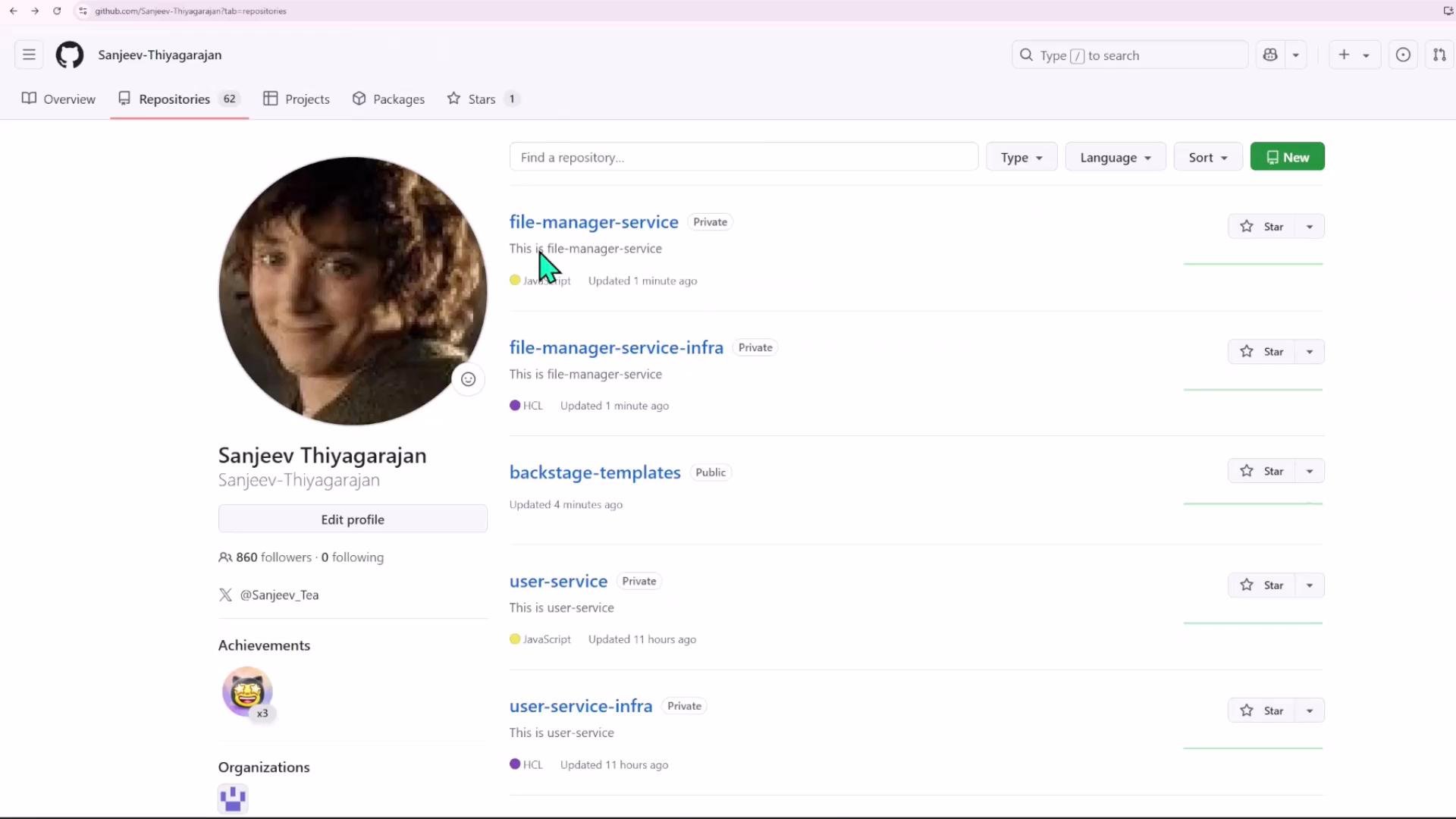
* Confirm the two GitHub repositories were created:
* `file-manager-service` — app skeleton with templated `catalog-info.yaml`.
* `file-manager-service-infra` — contains `main.tf` with `name` and `instance_type` set according to inputs.
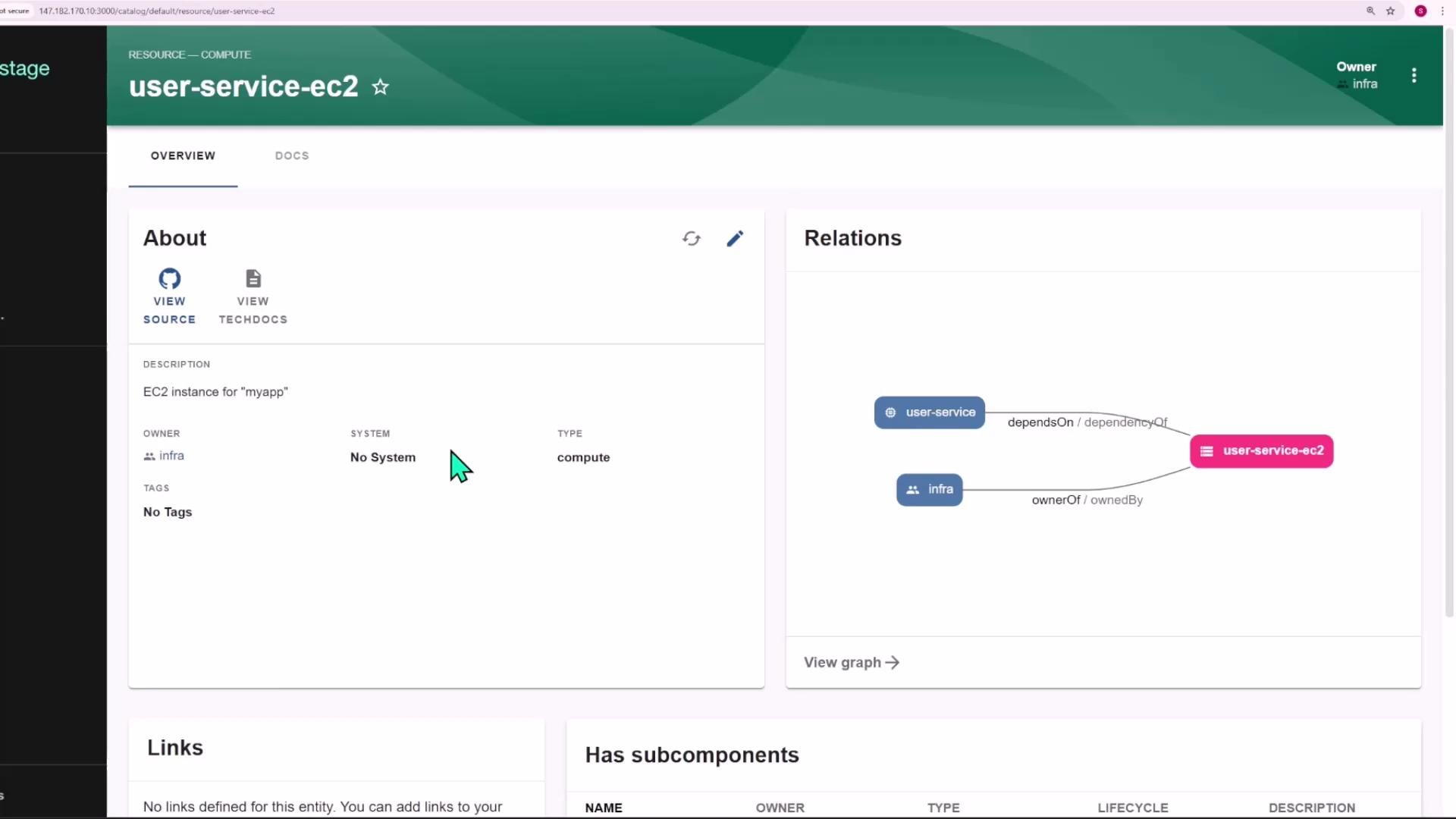
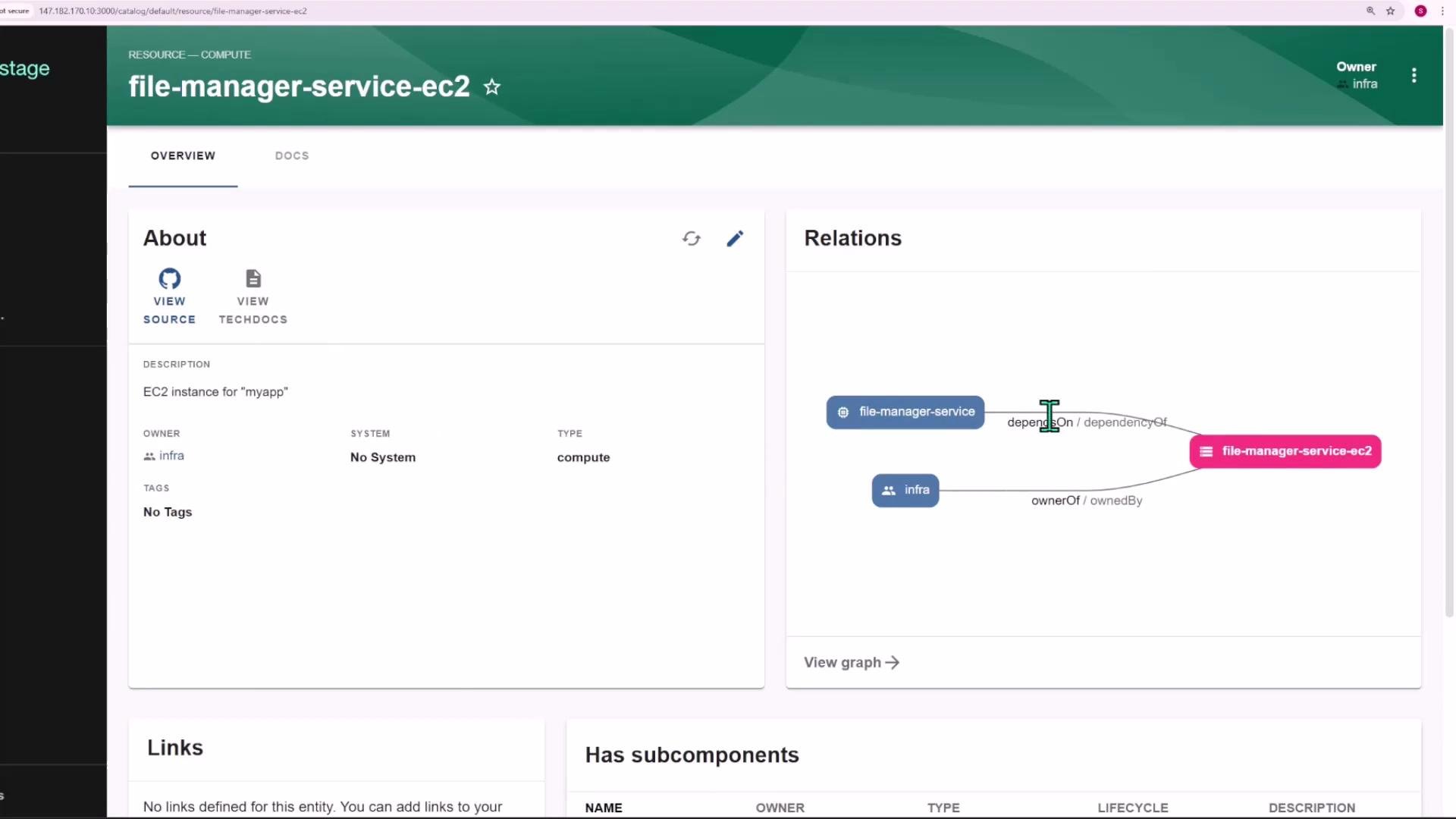
* In Backstage catalog, inspect the Component and Resource entities. The Component should depend on the `file-manager-service-ec2` Resource and relations should be visible.
Example GitHub profile with created repos:
## Post-run verification
* Confirm the two GitHub repositories were created:
* `file-manager-service` — app skeleton with templated `catalog-info.yaml`.
* `file-manager-service-infra` — contains `main.tf` with `name` and `instance_type` set according to inputs.
* In Backstage catalog, inspect the Component and Resource entities. The Component should depend on the `file-manager-service-ec2` Resource and relations should be visible.
Example GitHub profile with created repos:
 Example resource and relation in Backstage:
 If Terraform Cloud (or your runner) performs the apply, you should see a running EC2 instance in AWS:
 ## Summary and next steps
* This pattern connects repository templating, GitHub publishing, Backstage catalog registration, and infrastructure provisioning.
* You can extend it to provision other resource types (databases, load balancers, clusters) by creating additional infra blueprints and wiring them into the template steps.
* Decide where Terraform should run (Terraform Cloud, CI runner, or a Backstage action) and update the scaffolder actions accordingly.
Useful links and references:
* [Backstage](https://backstage.io/)
* [Terraform Cloud](https://www.terraform.io/cloud)
* [Terraform documentation](https://www.terraform.io/docs)
* [Node.js](https://nodejs.org/)
* [Express](https://expressjs.com/)
## Summary and next steps
* This pattern connects repository templating, GitHub publishing, Backstage catalog registration, and infrastructure provisioning.
* You can extend it to provision other resource types (databases, load balancers, clusters) by creating additional infra blueprints and wiring them into the template steps.
* Decide where Terraform should run (Terraform Cloud, CI runner, or a Backstage action) and update the scaffolder actions accordingly.
Useful links and references:
* [Backstage](https://backstage.io/)
* [Terraform Cloud](https://www.terraform.io/cloud)
* [Terraform documentation](https://www.terraform.io/docs)
* [Node.js](https://nodejs.org/)
* [Express](https://expressjs.com/)