> ## Documentation Index
> Fetch the complete documentation index at: https://notes.kodekloud.com/llms.txt
> Use this file to discover all available pages before exploring further.
# GitOps Tool Landscape ArgoCD vs Flux
> Comparing Argo CD and Flux GitOps engines, their architectures, features, tradeoffs, and guidance for choosing based on team preferences, multi cluster strategy, and ecosystem integrations.
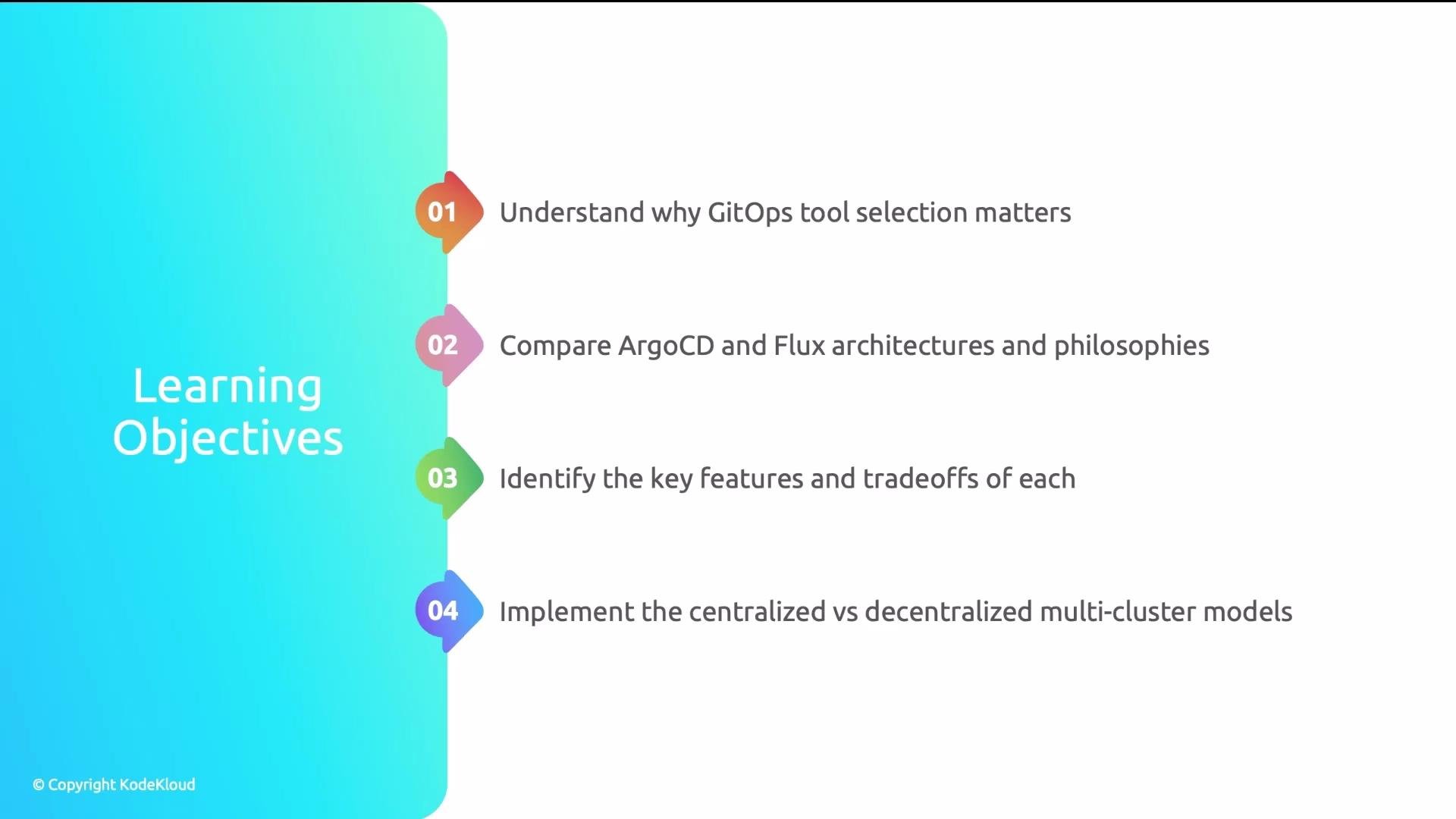
You've adopted GitOps: your repository is organized, configurations are parameterized, and now you need an engine — a controller that watches Git and keeps clusters in sync.
Two CNCF-graduated projects dominate this space: [Argo CD](https://argo-cd.readthedocs.io/en/stable/) and [Flux](https://fluxcd.io/). Both are production-ready and implement GitOps principles correctly, but they follow different philosophies and operational models. Choosing the right GitOps engine for your team reduces long-term friction, improves reliability, and aligns with your multi-cluster strategy.
 Real-world example
A financial services company initially adopted Flux. The deployment team — primarily junior engineers — found Flux’s CLI-first workflow difficult to use when troubleshooting cluster drift or visualizing resource trees. Their typical command looked like:
```bash theme={null}
$ flux get kustomizations
NAME REVISION SUSPENDED READY MESSAGE
apps main@sha256:... False Unknown Reconciliation in progress...
```
After six months they migrated to Argo CD to gain a centralized web UI and clearer visibility into application state. The migration required about three months of effort: each Flux Kustomization was converted to an Argo CD Application, webhooks were rewired, and runbooks were updated. This move underscores an important point: Flux wasn’t “wrong” for them — it simply didn’t match their operational needs.
Why the choice matters
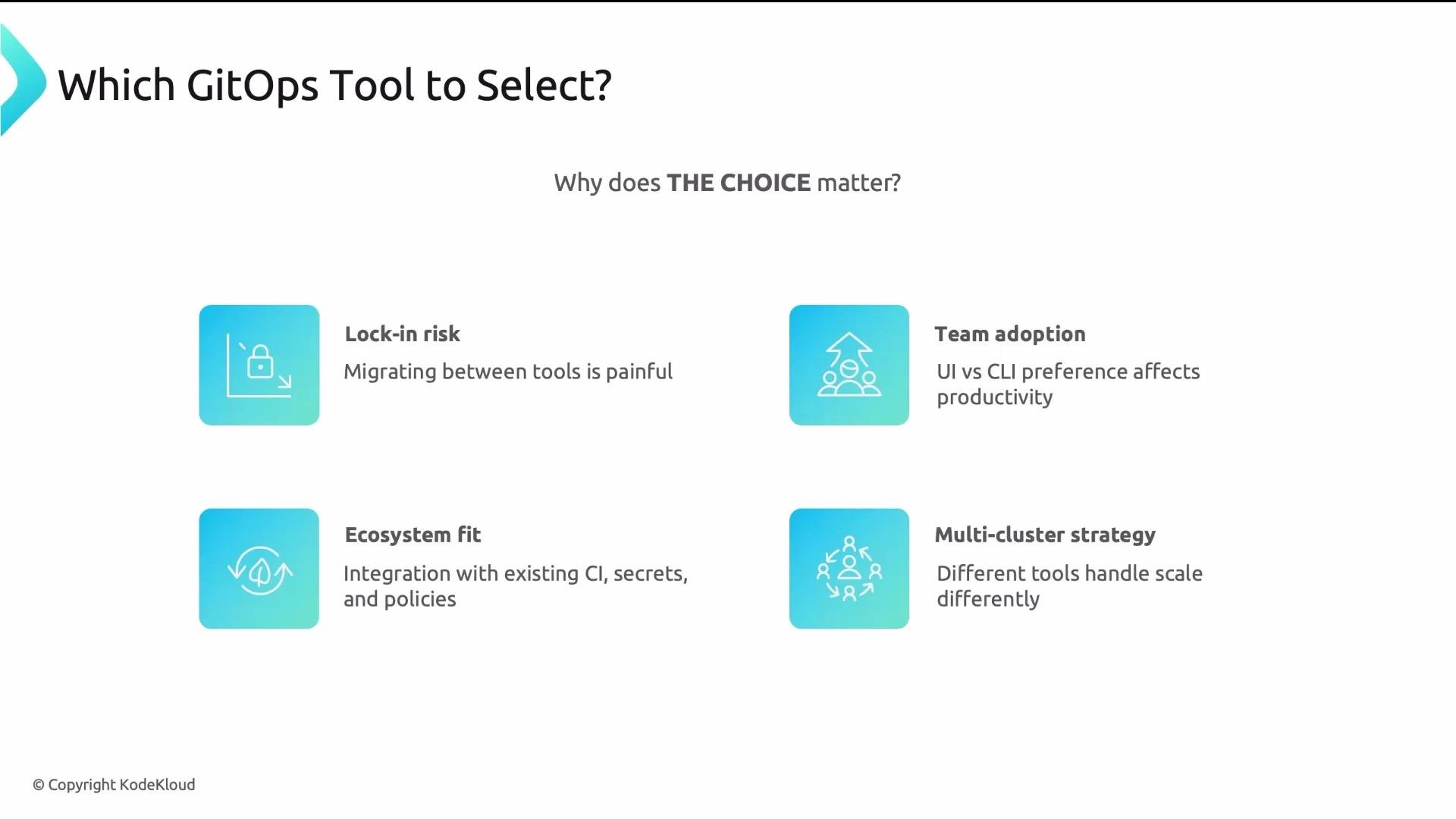
When selecting a GitOps engine, evaluate these critical factors:
* Lock-in risk: Migrating between GitOps tools is non-trivial. Resource CRD models, webhooks, RBAC, and integrations typically need changes.
* Team adoption: If your team relies on a visual dashboard for troubleshooting and onboarding, a CLI-only approach introduces friction. Conversely, teams that prefer Git- and CLI-driven workflows may find a UI-heavy tool unnecessary.
* Ecosystem fit: How well the tool integrates with your CI, secret management, policy engines (OPA/Gatekeeper), and observability stack matters for operational efficiency.
* Multi-cluster strategy: The number of clusters, their topology (hub-and-spoke vs independent clusters), and tenancy model will influence the best-fit tool.
Real-world example
A financial services company initially adopted Flux. The deployment team — primarily junior engineers — found Flux’s CLI-first workflow difficult to use when troubleshooting cluster drift or visualizing resource trees. Their typical command looked like:
```bash theme={null}
$ flux get kustomizations
NAME REVISION SUSPENDED READY MESSAGE
apps main@sha256:... False Unknown Reconciliation in progress...
```
After six months they migrated to Argo CD to gain a centralized web UI and clearer visibility into application state. The migration required about three months of effort: each Flux Kustomization was converted to an Argo CD Application, webhooks were rewired, and runbooks were updated. This move underscores an important point: Flux wasn’t “wrong” for them — it simply didn’t match their operational needs.
Why the choice matters
When selecting a GitOps engine, evaluate these critical factors:
* Lock-in risk: Migrating between GitOps tools is non-trivial. Resource CRD models, webhooks, RBAC, and integrations typically need changes.
* Team adoption: If your team relies on a visual dashboard for troubleshooting and onboarding, a CLI-only approach introduces friction. Conversely, teams that prefer Git- and CLI-driven workflows may find a UI-heavy tool unnecessary.
* Ecosystem fit: How well the tool integrates with your CI, secret management, policy engines (OPA/Gatekeeper), and observability stack matters for operational efficiency.
* Multi-cluster strategy: The number of clusters, their topology (hub-and-spoke vs independent clusters), and tenancy model will influence the best-fit tool.
 High-level philosophies
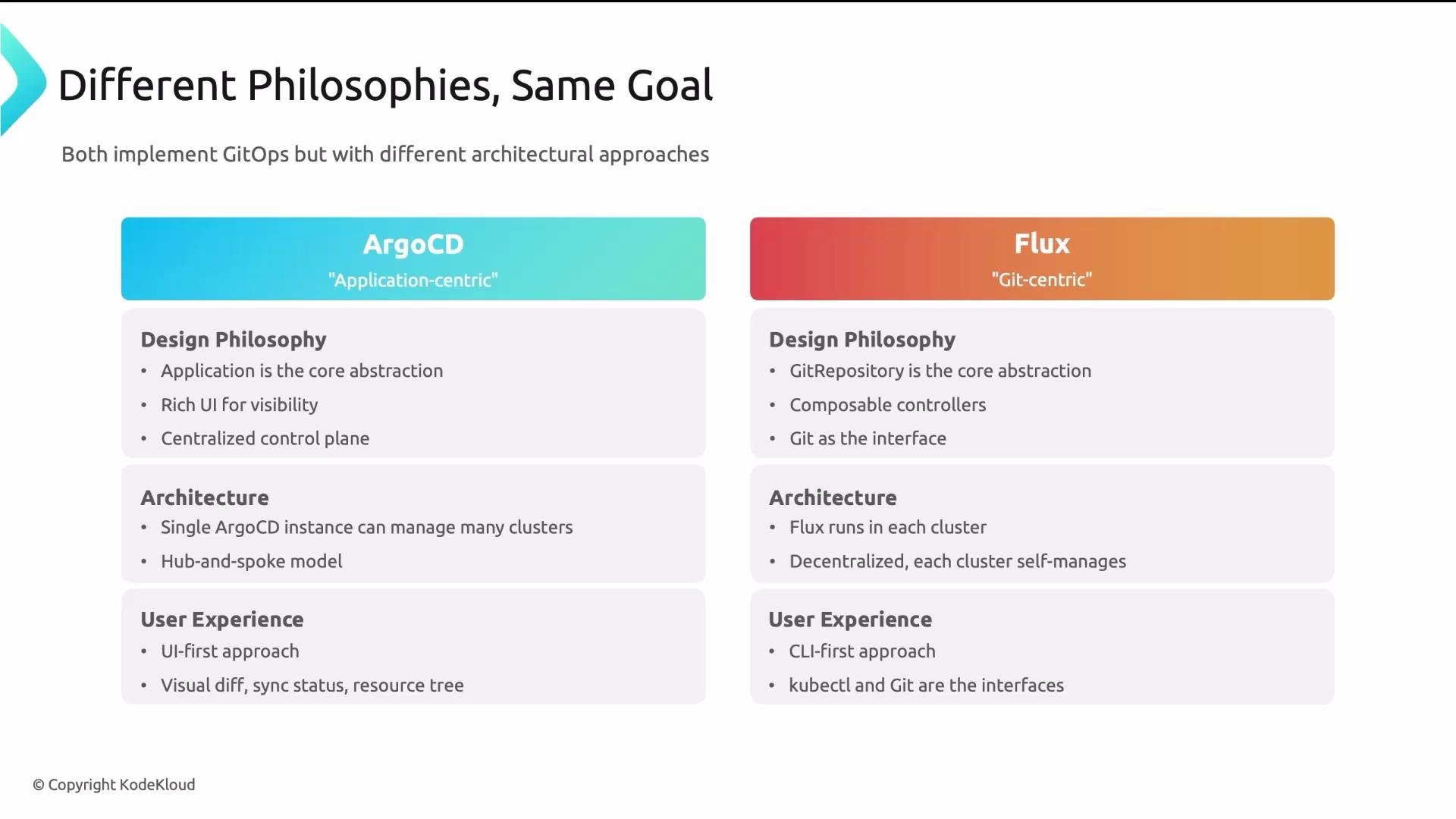
* Argo CD — application-centric: The Application resource is the primary abstraction. It emphasizes a centralized control plane and a rich web UI (hub-and-spoke model).
* Flux — Git-centric: The GitRepository / HelmRepository Source resources are central. Flux is composed of small controllers that typically run in each cluster (decentralized model).
Neither architecture is universally superior; match the tool to your operational model and team preferences.
High-level philosophies
* Argo CD — application-centric: The Application resource is the primary abstraction. It emphasizes a centralized control plane and a rich web UI (hub-and-spoke model).
* Flux — Git-centric: The GitRepository / HelmRepository Source resources are central. Flux is composed of small controllers that typically run in each cluster (decentralized model).
Neither architecture is universally superior; match the tool to your operational model and team preferences.
 Argo CD — deeper look
Architecture (hub-and-spoke)
* An Argo CD server runs on a management/control cluster and can manage many target clusters.
* Key components:
* API server: serves the web UI and handles CLI/API requests.
* Repo server: clones Git repositories and renders manifests from generators like Helm and Kustomize.
* Controller: reconciles Application resources and drives changes to target clusters.
Core concepts
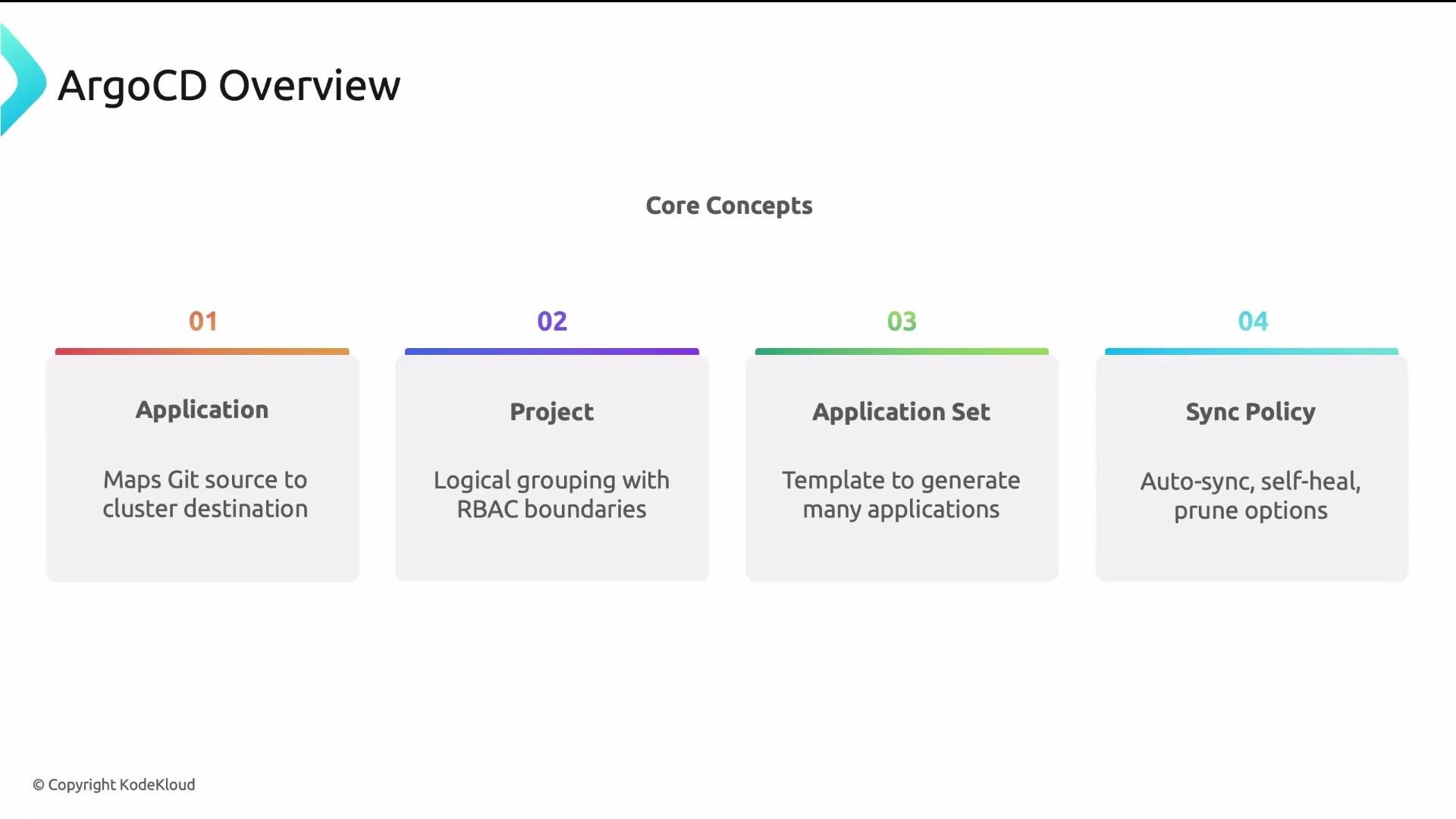
* Application: maps a Git source to a target cluster and namespace; it is the primary unit of sync.
* Project: groups Applications to enforce RBAC, quotas, and allowed destinations — useful for multi-tenancy.
* ApplicationSet: a generator that creates many Applications (e.g., deploying the same app to numerous clusters).
* Sync policy: controls auto-sync, self-heal, pruning, and hooks.
Argo CD highlights
* Rich web UI and visual diffing of desired vs. live state.
* SSO integrations and project-level RBAC.
* Native support for Helm and Kustomize via the repo server.
* Centralized multi-cluster management with a single control plane.
Argo CD — deeper look
Architecture (hub-and-spoke)
* An Argo CD server runs on a management/control cluster and can manage many target clusters.
* Key components:
* API server: serves the web UI and handles CLI/API requests.
* Repo server: clones Git repositories and renders manifests from generators like Helm and Kustomize.
* Controller: reconciles Application resources and drives changes to target clusters.
Core concepts
* Application: maps a Git source to a target cluster and namespace; it is the primary unit of sync.
* Project: groups Applications to enforce RBAC, quotas, and allowed destinations — useful for multi-tenancy.
* ApplicationSet: a generator that creates many Applications (e.g., deploying the same app to numerous clusters).
* Sync policy: controls auto-sync, self-heal, pruning, and hooks.
Argo CD highlights
* Rich web UI and visual diffing of desired vs. live state.
* SSO integrations and project-level RBAC.
* Native support for Helm and Kustomize via the repo server.
* Centralized multi-cluster management with a single control plane.
 Flux — deeper look
Architecture (decentralized, controller-based)
* Flux is composed of multiple, focused controllers that typically run inside each cluster, enabling cluster autonomy.
* Common controllers:
* Source controller: watches `GitRepository` and `HelmRepository` sources.
* Kustomize controller: applies manifests; the `Kustomization` CRD is Flux’s apply unit.
* Helm controller: manages `HelmRelease` CRDs.
* Notification controller: routes alerts and notifications.
* Image controllers: handle image discovery and automation (`ImageRepository`, `ImagePolicy`, `ImageUpdateAutomation`).
Core concepts
* `GitRepository` / `HelmRepository`: declare sources Flux should watch.
* `Kustomization`: applies manifests from a source to a cluster/namespace.
* `HelmRelease`: manages Helm chart lifecycle declaratively.
* `ImagePolicy` / `ImageUpdateAutomation`: enable image automation workflows and policies.
Flux highlights
* Modular — install only the controllers you need.
* Built-in image automation and policies.
* Strong fit for decentralized, per-cluster operations and Git-centric workflows.
* Interactions are primarily via Git and CLI; no central UI by default.
Comparison summary
Flux — deeper look
Architecture (decentralized, controller-based)
* Flux is composed of multiple, focused controllers that typically run inside each cluster, enabling cluster autonomy.
* Common controllers:
* Source controller: watches `GitRepository` and `HelmRepository` sources.
* Kustomize controller: applies manifests; the `Kustomization` CRD is Flux’s apply unit.
* Helm controller: manages `HelmRelease` CRDs.
* Notification controller: routes alerts and notifications.
* Image controllers: handle image discovery and automation (`ImageRepository`, `ImagePolicy`, `ImageUpdateAutomation`).
Core concepts
* `GitRepository` / `HelmRepository`: declare sources Flux should watch.
* `Kustomization`: applies manifests from a source to a cluster/namespace.
* `HelmRelease`: manages Helm chart lifecycle declaratively.
* `ImagePolicy` / `ImageUpdateAutomation`: enable image automation workflows and policies.
Flux highlights
* Modular — install only the controllers you need.
* Built-in image automation and policies.
* Strong fit for decentralized, per-cluster operations and Git-centric workflows.
* Interactions are primarily via Git and CLI; no central UI by default.
Comparison summary
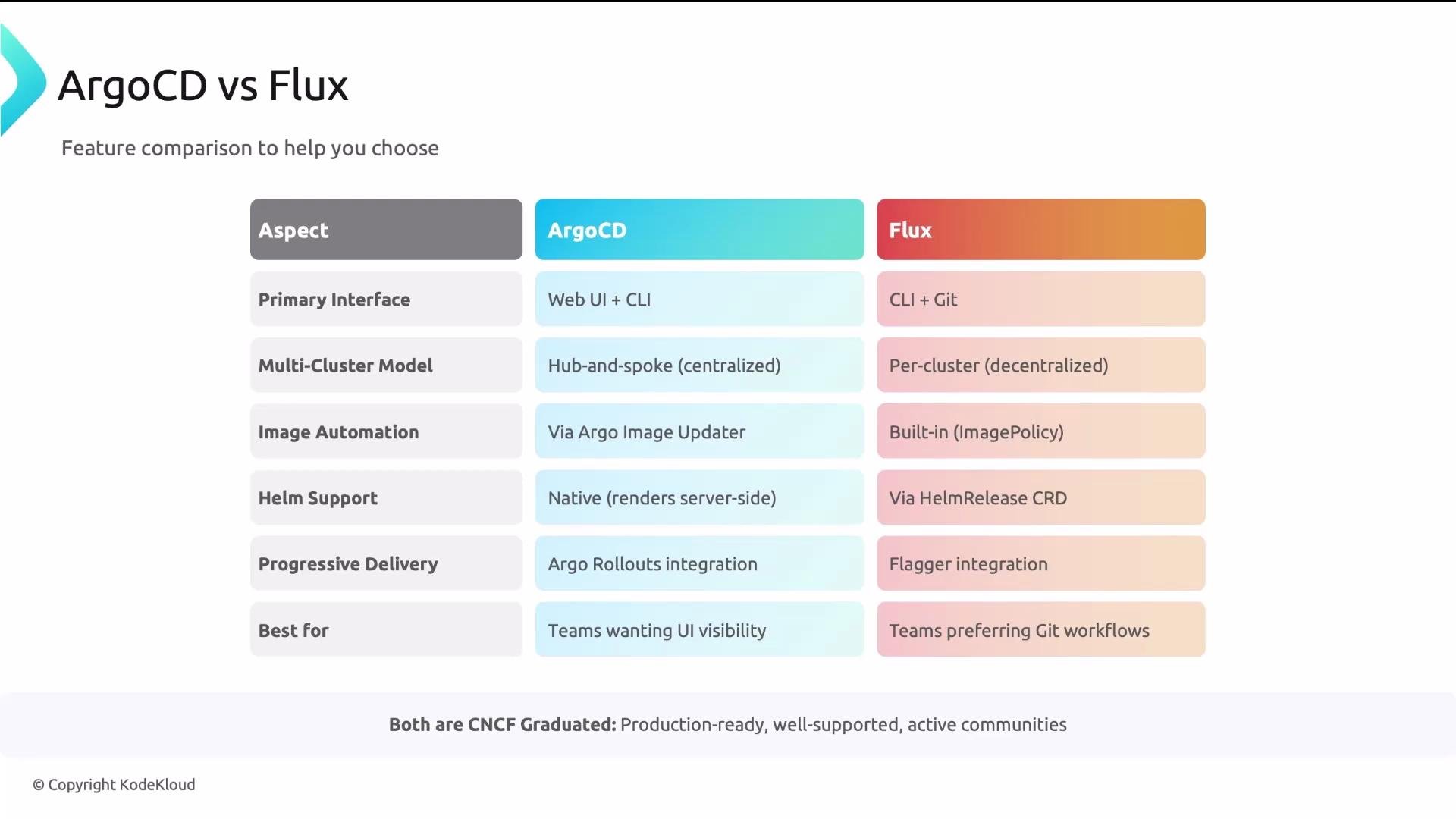 Quick reference (high level)
| Feature | Argo CD | Flux |
| -------------------: | :------------------------------------------------------------------------: | :-----------------------------------------------------------------------------: |
| Primary interface | Web UI + CLI | Git + CLI (no UI by default) |
| Multi-cluster model | Centralized hub-and-spoke | Decentralized (controllers per cluster) |
| Image automation | Supported via `Argo Image Updater` project | Built-in image automation (ImageRepository, ImagePolicy, ImageUpdateAutomation) |
| Helm support | Native via repo server + Application | Via Helm Controller and `HelmRelease` CRD |
| Progressive delivery | Integrates with [Argo Rollouts](https://argoproj.github.io/argo-rollouts/) | Integrates with [Flagger](https://flagger.dev/) |
| Best fit | Teams needing visual dashboards and centralized control | Teams favoring Git-native workflows and cluster autonomy |
Both projects are CNCF-graduated, production-ready, and backed by active communities and vendor ecosystems.
Key takeaways
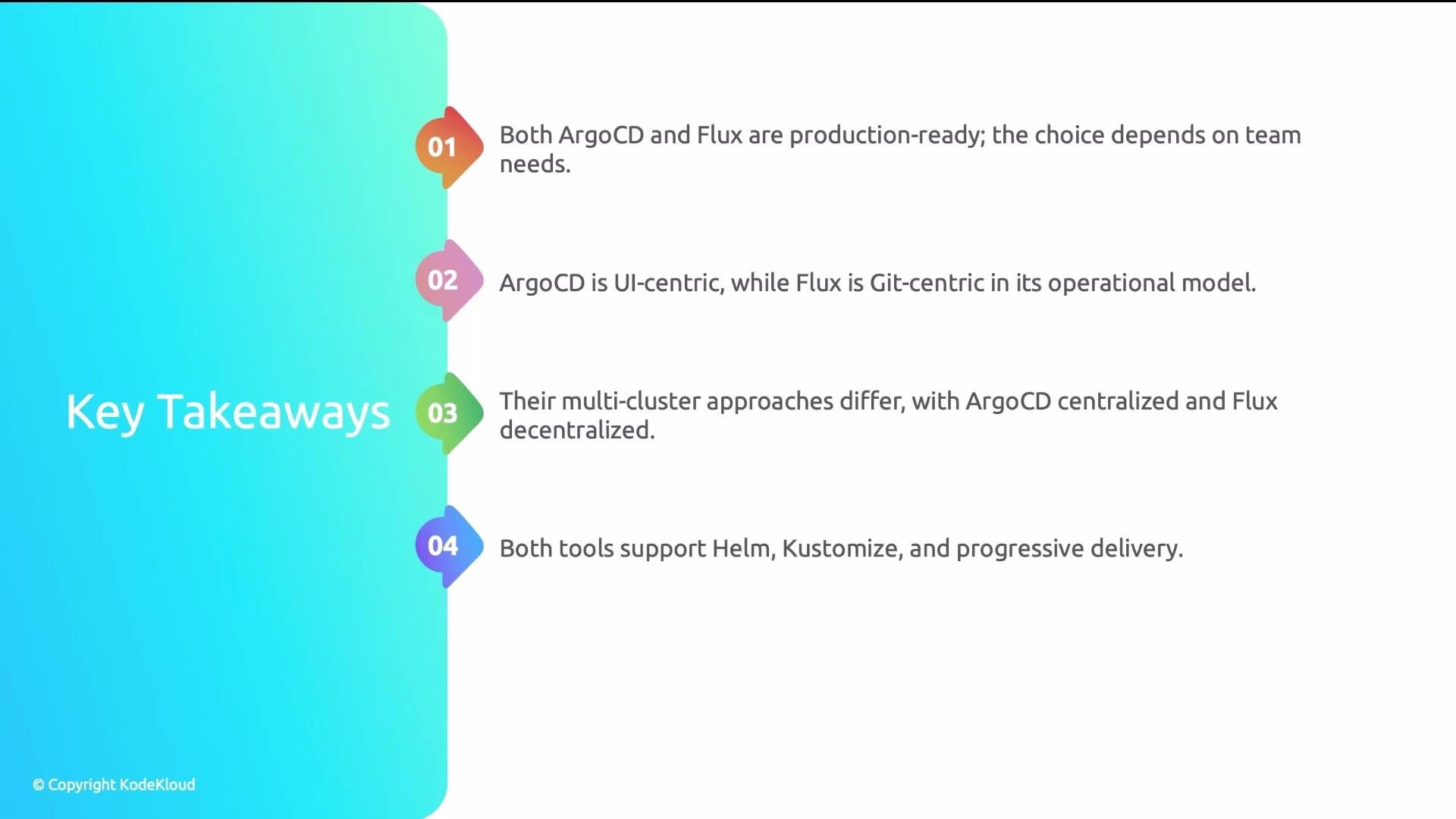
* Both Argo CD and Flux implement GitOps effectively; the decision should be driven by operational fit, not a perceived absolute superiority.
* Argo CD is application- and UI-centric, offering a centralized control plane for multi-cluster management.
* Flux is Git-centric and modular, designed for decentralized installations where each cluster manages itself.
* Evaluate team culture (UI vs CLI/Git), ecosystem integrations (image automation, progressive delivery, CI, secrets), and long-term multi-cluster strategy before committing.
Quick reference (high level)
| Feature | Argo CD | Flux |
| -------------------: | :------------------------------------------------------------------------: | :-----------------------------------------------------------------------------: |
| Primary interface | Web UI + CLI | Git + CLI (no UI by default) |
| Multi-cluster model | Centralized hub-and-spoke | Decentralized (controllers per cluster) |
| Image automation | Supported via `Argo Image Updater` project | Built-in image automation (ImageRepository, ImagePolicy, ImageUpdateAutomation) |
| Helm support | Native via repo server + Application | Via Helm Controller and `HelmRelease` CRD |
| Progressive delivery | Integrates with [Argo Rollouts](https://argoproj.github.io/argo-rollouts/) | Integrates with [Flagger](https://flagger.dev/) |
| Best fit | Teams needing visual dashboards and centralized control | Teams favoring Git-native workflows and cluster autonomy |
Both projects are CNCF-graduated, production-ready, and backed by active communities and vendor ecosystems.
Key takeaways
* Both Argo CD and Flux implement GitOps effectively; the decision should be driven by operational fit, not a perceived absolute superiority.
* Argo CD is application- and UI-centric, offering a centralized control plane for multi-cluster management.
* Flux is Git-centric and modular, designed for decentralized installations where each cluster manages itself.
* Evaluate team culture (UI vs CLI/Git), ecosystem integrations (image automation, progressive delivery, CI, secrets), and long-term multi-cluster strategy before committing.
 Both Argo CD and Flux are mature, production-ready GitOps engines. Choose based on operational model (centralized vs decentralized), team preferences (UI vs Git/CLI), and ecosystem fit (image automation, progressive delivery, CI and secret management).
Plan migrations carefully. Switching GitOps engines often requires converting resource models, updating webhooks, and revising runbooks — expect non-trivial effort and potential downtime windows.
Links and references
* [Argo CD documentation](https://argo-cd.readthedocs.io/en/stable/)
* [Flux Documentation](https://fluxcd.io/)
* [Helm](https://helm.sh/)
* [Kustomize](https://kustomize.io/)
* [Argo Rollouts](https://argoproj.github.io/argo-rollouts/)
* [Flagger](https://flagger.dev/)
* [Argo Image Updater](https://argoproj.github.io/argo-image-updater/)
* [Kubernetes Documentation](https://kubernetes.io/docs/)
Both Argo CD and Flux are mature, production-ready GitOps engines. Choose based on operational model (centralized vs decentralized), team preferences (UI vs Git/CLI), and ecosystem fit (image automation, progressive delivery, CI and secret management).
Plan migrations carefully. Switching GitOps engines often requires converting resource models, updating webhooks, and revising runbooks — expect non-trivial effort and potential downtime windows.
Links and references
* [Argo CD documentation](https://argo-cd.readthedocs.io/en/stable/)
* [Flux Documentation](https://fluxcd.io/)
* [Helm](https://helm.sh/)
* [Kustomize](https://kustomize.io/)
* [Argo Rollouts](https://argoproj.github.io/argo-rollouts/)
* [Flagger](https://flagger.dev/)
* [Argo Image Updater](https://argoproj.github.io/argo-image-updater/)
* [Kubernetes Documentation](https://kubernetes.io/docs/)