> ## Documentation Index
> Fetch the complete documentation index at: https://notes.kodekloud.com/llms.txt
> Use this file to discover all available pages before exploring further.
# Choosing the Right Engine Operators vs Workflows vs Pipelines
> Guide to choosing between Kubernetes Operators, Argo Workflows, and Crossplane by comparing execution models, use cases, anti‑patterns, and patterns for combining tools in platform engineering.
We’ve covered CRDs (CustomResourceDefinitions), Operators, Argo Workflows, and Crossplane — four Kubernetes-native automation primitives. Each can automate infrastructure and application tasks, but they follow different execution models and are optimized for different problem spaces.
This guide provides a concise decision framework so platform teams can choose the right tool quickly and avoid over-engineering. The answer is often a combination of tools, not a single one.
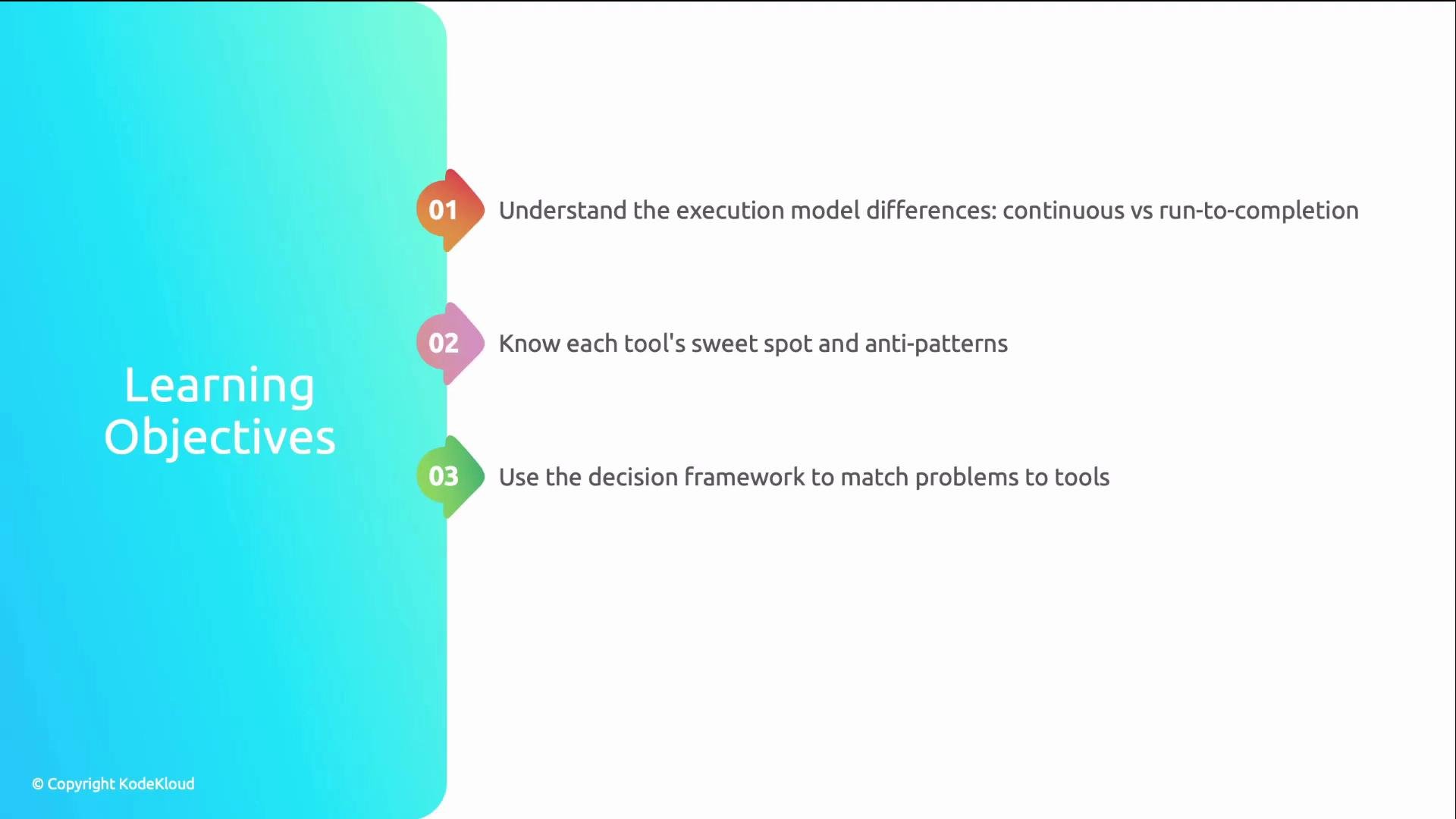
In this article you will:
* Compare execution models and how they affect design.
* Learn each tool’s sweet spots and common anti-patterns.
* Apply a decision framework and platform patterns that combine tools effectively.
 Example: Over-engineered operator vs simple composition
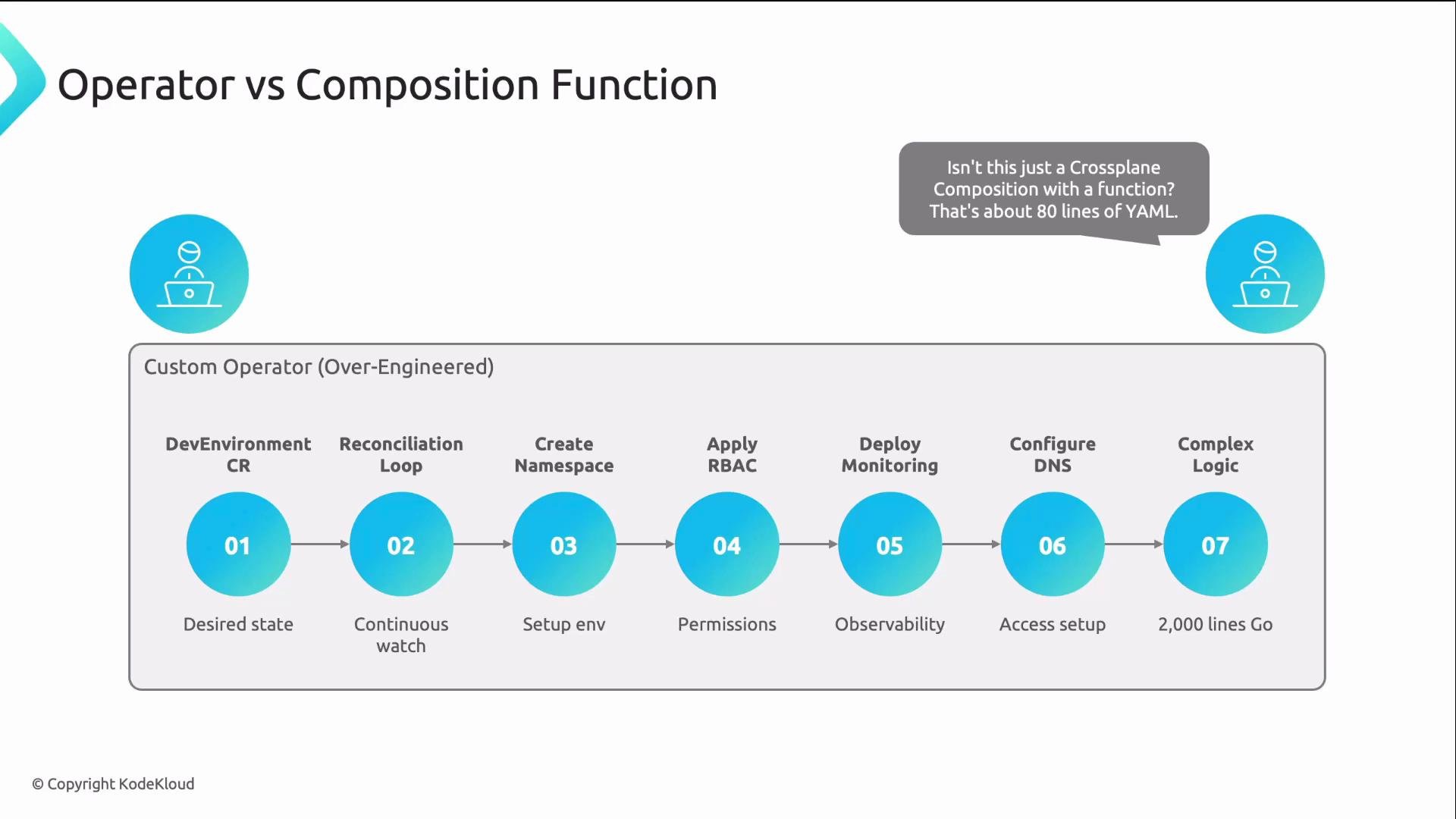
An engineering team built a 2,000-line Go operator to provision dev environments: watch a DevEnvironment CR, create a namespace, apply RBAC, deploy monitoring, configure DNS, and handle errors. It worked, but it was heavy.
A simpler Crossplane Composition plus a function (about 80 lines of YAML) would have satisfied the requirements: this was a run-to-completion provisioning task, not continuous reconciliation. The reconciliation loop in an operator was unnecessary.
Example: Over-engineered operator vs simple composition
An engineering team built a 2,000-line Go operator to provision dev environments: watch a DevEnvironment CR, create a namespace, apply RBAC, deploy monitoring, configure DNS, and handle errors. It worked, but it was heavy.
A simpler Crossplane Composition plus a function (about 80 lines of YAML) would have satisfied the requirements: this was a run-to-completion provisioning task, not continuous reconciliation. The reconciliation loop in an operator was unnecessary.
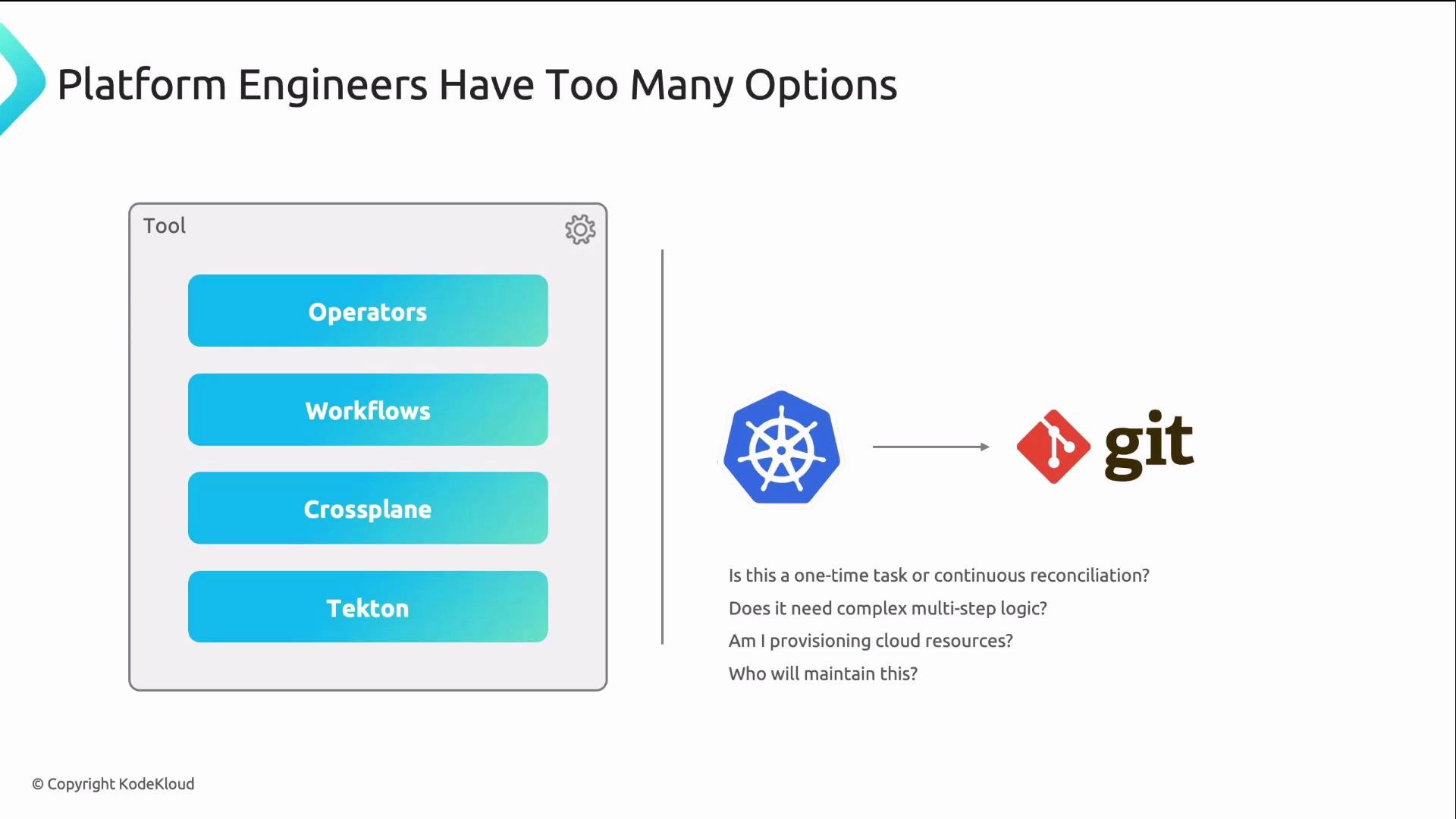
 Use these diagnostic questions to map problems to tools:
* Is this a one-time task (run to completion) or continuous reconciliation?
* Does it require complex, multi-step logic or DAG-style dependencies?
* Am I provisioning cloud resources or managing runtime application state?
* Who will maintain this automation and in which language?
Match answers to the execution model below.
Use these diagnostic questions to map problems to tools:
* Is this a one-time task (run to completion) or continuous reconciliation?
* Does it require complex, multi-step logic or DAG-style dependencies?
* Am I provisioning cloud resources or managing runtime application state?
* Who will maintain this automation and in which language?
Match answers to the execution model below.
 ***
## Operators
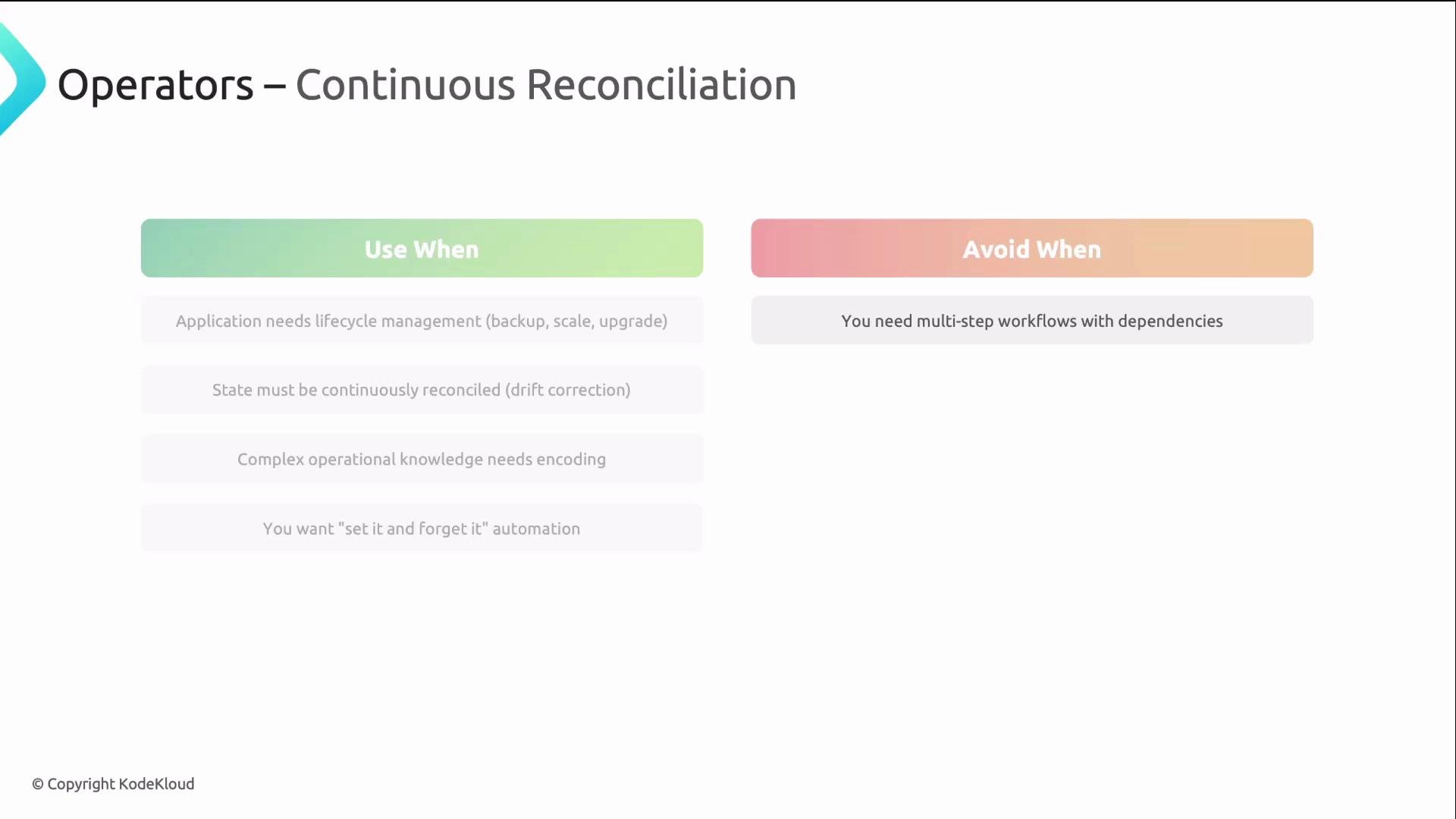
* Sweet spot: continuous reconciliation and operational lifecycle management of stateful applications (backups, scaling, upgrades, failover).
* Use when you need continuous reconciliation: if resources drift or are deleted, the operator enforces desired state.
* Use when operational runbooks and domain knowledge must be encoded (for example, safe zero-downtime PostgreSQL major upgrades).
* Typical implementations: Go using Operator SDK and controller-runtime (also possible with Helm or Ansible-based operators via Operator SDK).
* Anti-pattern: avoid writing an operator for run-to-completion multi-step jobs — the reconciliation loop adds unnecessary complexity.
Real-world examples: Postgres operators, Kafka, Redis, Prometheus operators, cert-manager.
***
## Operators
* Sweet spot: continuous reconciliation and operational lifecycle management of stateful applications (backups, scaling, upgrades, failover).
* Use when you need continuous reconciliation: if resources drift or are deleted, the operator enforces desired state.
* Use when operational runbooks and domain knowledge must be encoded (for example, safe zero-downtime PostgreSQL major upgrades).
* Typical implementations: Go using Operator SDK and controller-runtime (also possible with Helm or Ansible-based operators via Operator SDK).
* Anti-pattern: avoid writing an operator for run-to-completion multi-step jobs — the reconciliation loop adds unnecessary complexity.
Real-world examples: Postgres operators, Kafka, Redis, Prometheus operators, cert-manager.
 Operators are best for long-lived, stateful responsibilities. If you only need to "create once and forget," prefer a composition or workflow instead.
***
## Argo Workflows
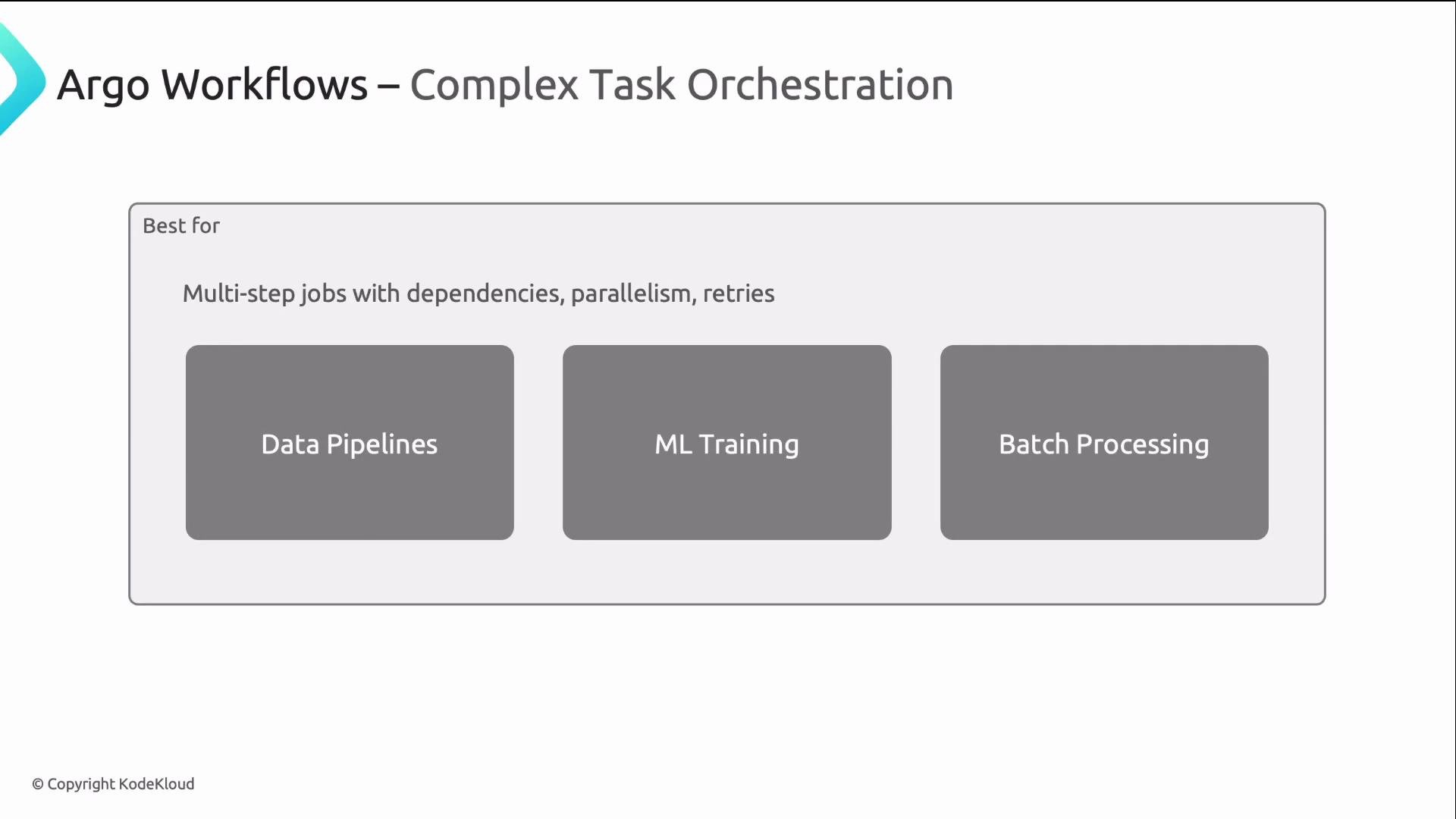
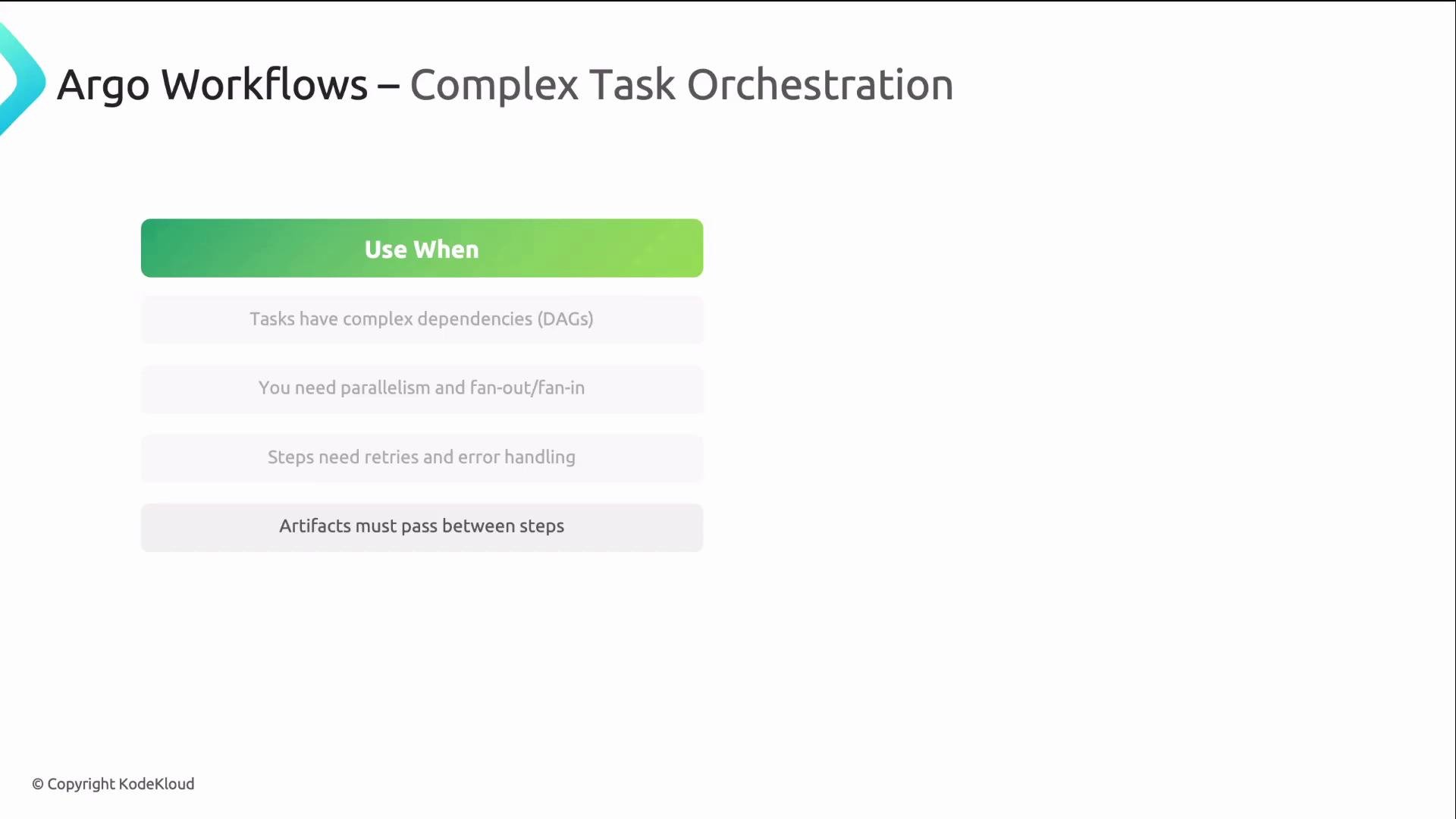
* Sweet spot: complex, run-to-completion jobs with dependent steps and DAG-style orchestration.
* Use when you need task orchestration: sequential or parallel steps, retries with backoff, artifact passing between steps, and conditional branching.
* Workflows execute and exit — they do not perform long-lived reconciliation or drift correction.
* Anti-pattern: do not use Argo Workflows to manage continuous runtime lifecycle of stateful services. For simple, single-container jobs, Kubernetes Job may suffice.
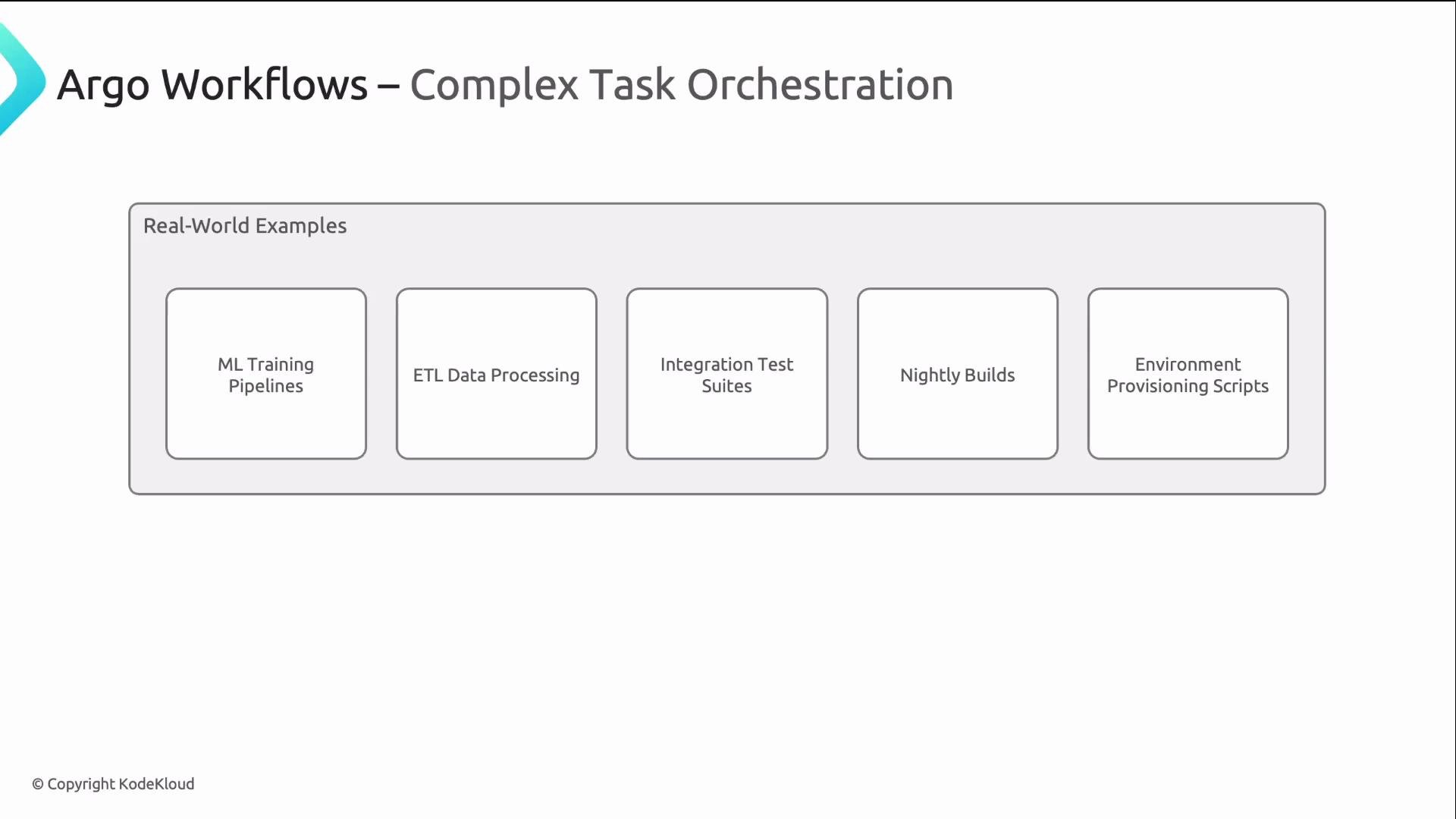
Typical use cases: data pipelines, ML training, ETL, nightly builds, integration test suites, environment provisioning scripts that run once.
Operators are best for long-lived, stateful responsibilities. If you only need to "create once and forget," prefer a composition or workflow instead.
***
## Argo Workflows
* Sweet spot: complex, run-to-completion jobs with dependent steps and DAG-style orchestration.
* Use when you need task orchestration: sequential or parallel steps, retries with backoff, artifact passing between steps, and conditional branching.
* Workflows execute and exit — they do not perform long-lived reconciliation or drift correction.
* Anti-pattern: do not use Argo Workflows to manage continuous runtime lifecycle of stateful services. For simple, single-container jobs, Kubernetes Job may suffice.
Typical use cases: data pipelines, ML training, ETL, nightly builds, integration test suites, environment provisioning scripts that run once.
 ***
## Crossplane
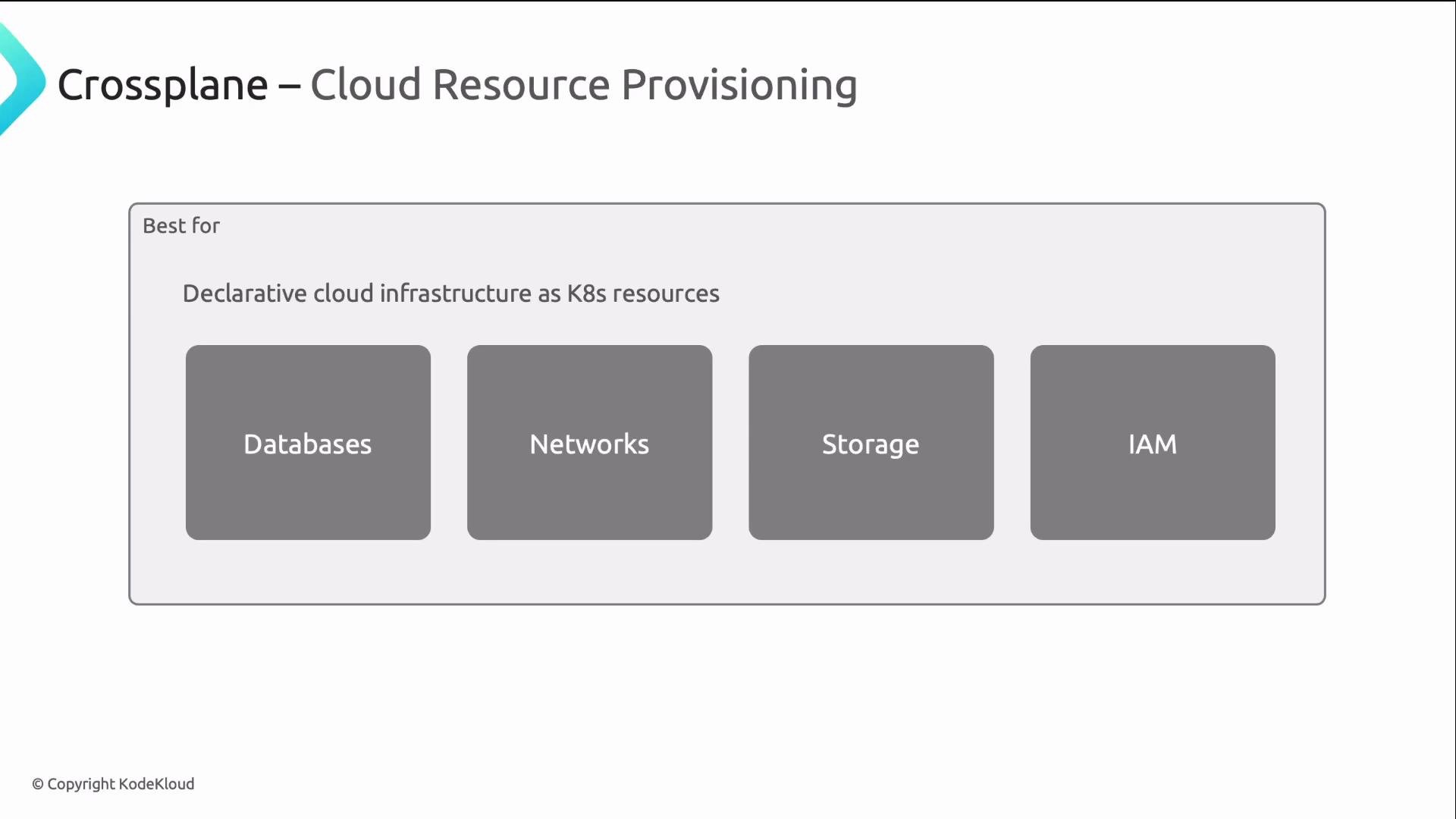
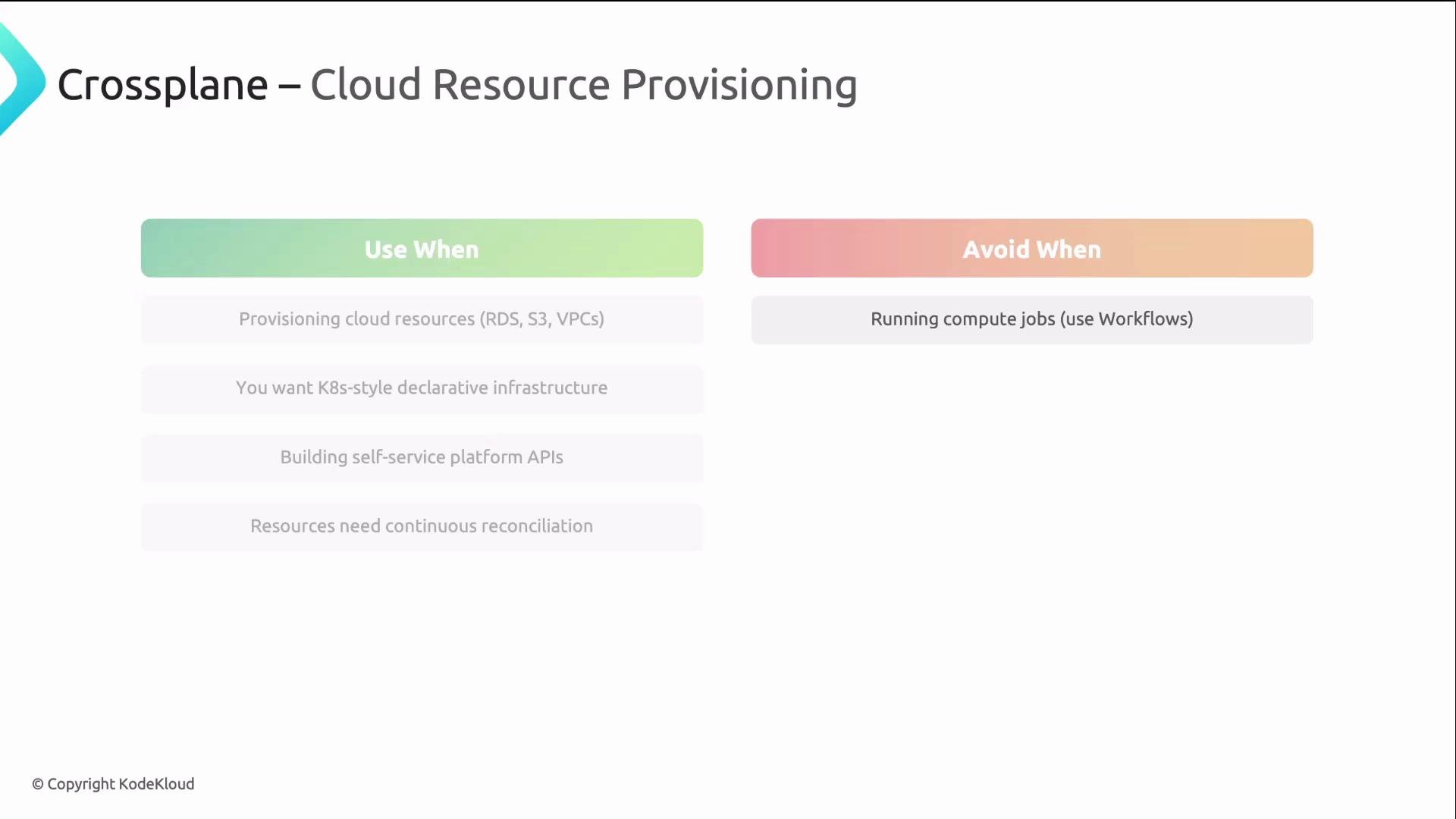
* Sweet spot: declarative cloud infrastructure exposed and managed as Kubernetes resources.
* Use when provisioning cloud resources (databases, VPCs, storage, IAM). Crossplane exposes cloud APIs as CRDs and reconciles cloud resources continuously.
* Use Crossplane to build self-service platform APIs (Compositions and XRDs) so developers can request cloud resources with Kubernetes-style `kubectl apply`.
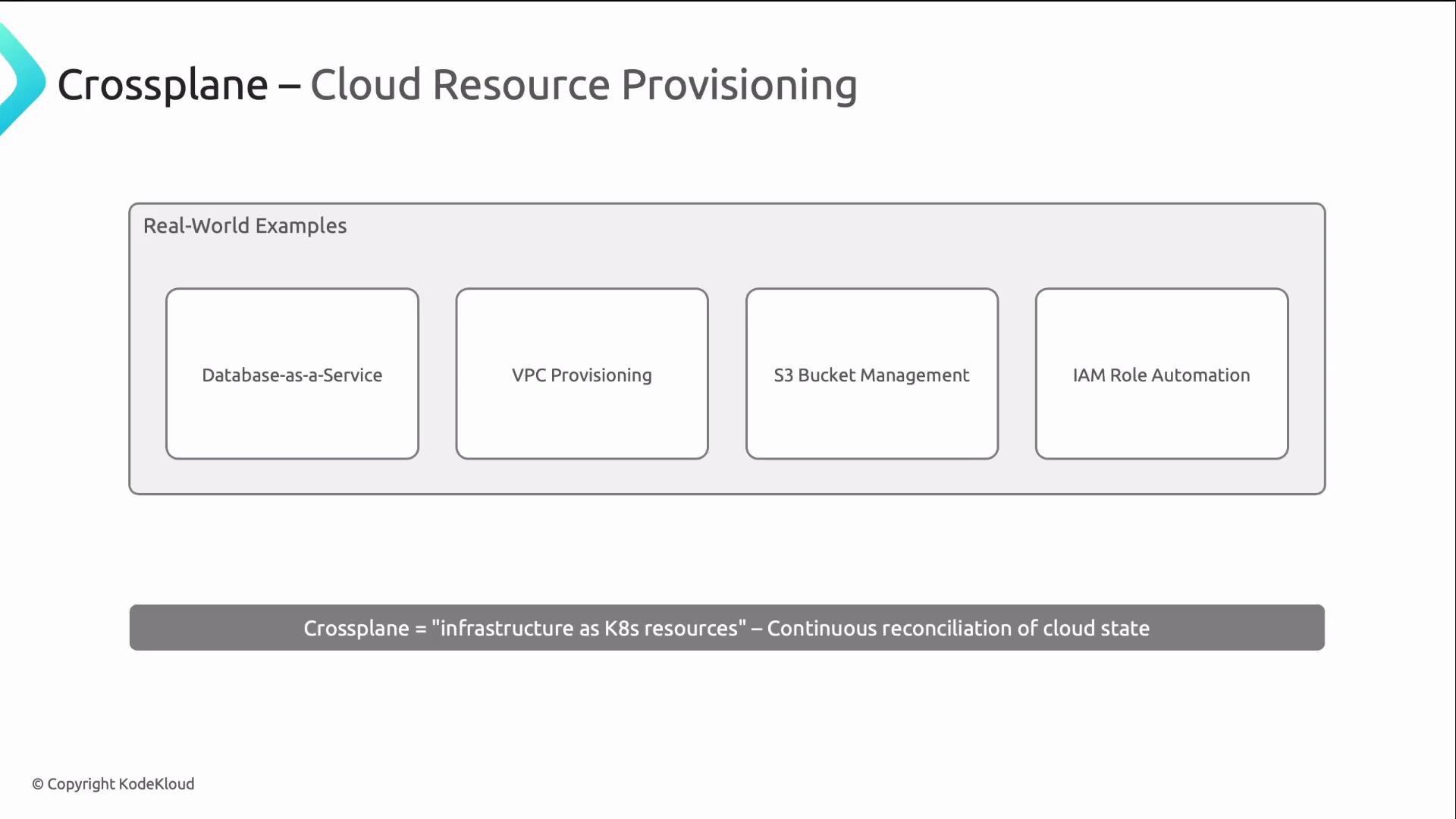
* Crossplane performs drift detection and self-healing for cloud resources.
* Anti-pattern: avoid Crossplane for ephemeral compute jobs or complex multi-step workflows; use an orchestration engine (Argo Workflows). For runtime lifecycle of stateful apps, prefer operators.
Real-world examples: RDS provisioning, VPC and subnet management, S3 bucket lifecycle, IAM role automation.
***
## Crossplane
* Sweet spot: declarative cloud infrastructure exposed and managed as Kubernetes resources.
* Use when provisioning cloud resources (databases, VPCs, storage, IAM). Crossplane exposes cloud APIs as CRDs and reconciles cloud resources continuously.
* Use Crossplane to build self-service platform APIs (Compositions and XRDs) so developers can request cloud resources with Kubernetes-style `kubectl apply`.
* Crossplane performs drift detection and self-healing for cloud resources.
* Anti-pattern: avoid Crossplane for ephemeral compute jobs or complex multi-step workflows; use an orchestration engine (Argo Workflows). For runtime lifecycle of stateful apps, prefer operators.
Real-world examples: RDS provisioning, VPC and subnet management, S3 bucket lifecycle, IAM role automation.
 Do not replace an operator's runtime reconciliation responsibilities with Crossplane. Crossplane manages cloud resources; operators manage runtime application behavior and complex operational logic.
***
## Quick Cheat-Sheet (execution model is the key)
* Operators and Crossplane: run continuously, reconcile state, and correct drift.
* Workflows (Argo Workflows): run to completion, execute a DAG of steps, then exit.
* If you need drift correction or long-lived reconciliation → Operator or Crossplane.
* If you need complex multi-step DAG logic → Workflow engine (Argo).
* If you need managed stateful application lifecycle → Operator.
* If you need declarative cloud resource provisioning → Crossplane.
Do not replace an operator's runtime reconciliation responsibilities with Crossplane. Crossplane manages cloud resources; operators manage runtime application behavior and complex operational logic.
***
## Quick Cheat-Sheet (execution model is the key)
* Operators and Crossplane: run continuously, reconcile state, and correct drift.
* Workflows (Argo Workflows): run to completion, execute a DAG of steps, then exit.
* If you need drift correction or long-lived reconciliation → Operator or Crossplane.
* If you need complex multi-step DAG logic → Workflow engine (Argo).
* If you need managed stateful application lifecycle → Operator.
* If you need declarative cloud resource provisioning → Crossplane.
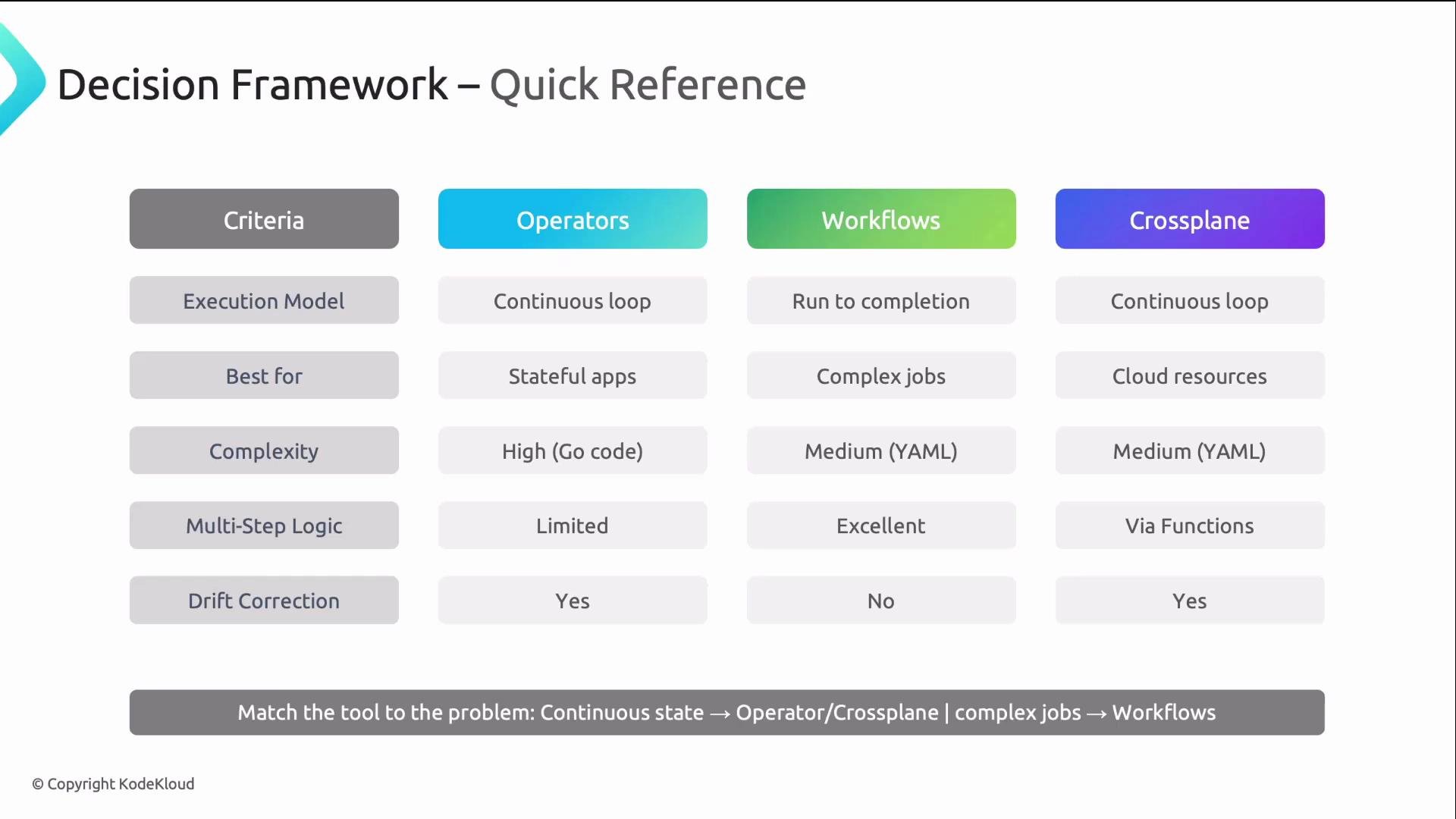 ***
## Comparison Table
| Dimension | Operators | Argo Workflows | Crossplane |
| -----------------------: | :----------------------------------------: | :---------------------------------------: | :-------------------------------------: |
| Execution model | Continuous reconciliation | Run-to-completion (DAG) | Continuous reconciliation |
| Best for | Stateful app lifecycle (backups, upgrades) | Complex jobs, ML/data pipelines, CI tasks | Declarative cloud infra (RDS, VPC, IAM) |
| Drift correction | Yes | No | Yes |
| Multi-step orchestration | Limited (possible but heavy) | Excellent (DAGs, retries, artifacts) | Not intended |
| Typical languages/tools | Go (Operator SDK), Helm, Ansible | YAML workflows, container tasks | YAML CRDs, Composition, Providers |
| Anti-pattern | One-off provisioning tasks | Managing continuous runtime state | Running compute pipelines |
***
## Decision Checklist (quick mapping)
| Question | If yes → Recommend |
| ------------------------------------------------------------ | ----------------------------------------- |
| Is the task long-lived and needs self-healing? | Operator or Crossplane (cloud vs runtime) |
| Is this cloud resource provisioning? | Crossplane |
| Is this a complex multi-step job with dependencies? | Argo Workflows |
| Is this runtime lifecycle management (DB backups, failover)? | Operator |
| Is the task single-run, ephemeral, or a batch job? | Argo Workflows or Kubernetes Job |
***
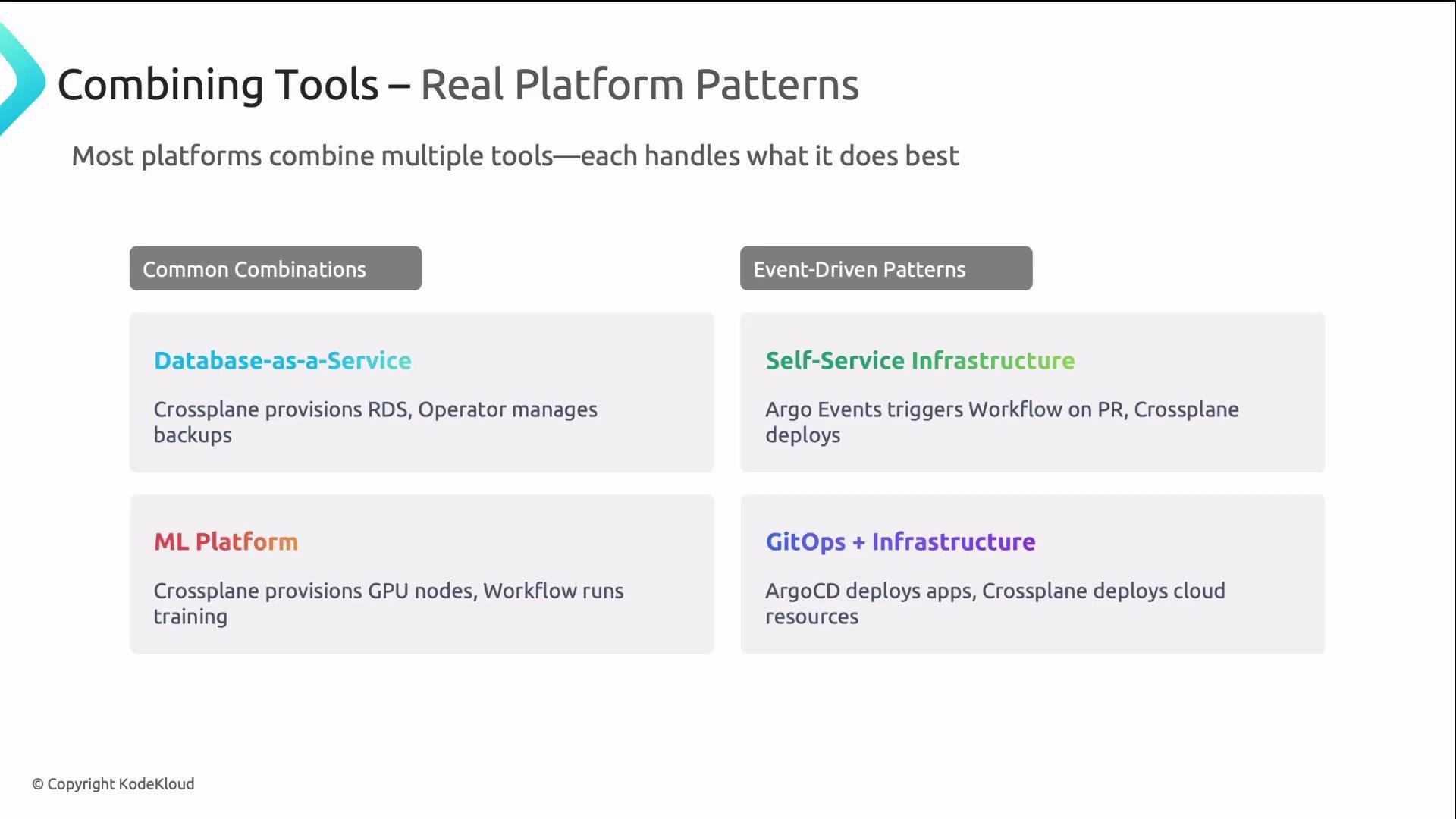
## Common Platform Patterns (combine tools)
* Database-as-a-Service: Crossplane provisions RDS; a PostgreSQL operator manages backups, failover, and schema migrations.
* ML platform: Crossplane provisions GPU nodes and object storage; Argo Workflows orchestrates training (data fetch → train → evaluate → upload).
* Self-service infra: Git/GitOps triggers validation workflows; on success, Crossplane provisions requested infrastructure to an environment.
* GitOps + infra: Argo CD deploys apps; Crossplane provisions cloud resources; both reconcile continuously.
***
## Comparison Table
| Dimension | Operators | Argo Workflows | Crossplane |
| -----------------------: | :----------------------------------------: | :---------------------------------------: | :-------------------------------------: |
| Execution model | Continuous reconciliation | Run-to-completion (DAG) | Continuous reconciliation |
| Best for | Stateful app lifecycle (backups, upgrades) | Complex jobs, ML/data pipelines, CI tasks | Declarative cloud infra (RDS, VPC, IAM) |
| Drift correction | Yes | No | Yes |
| Multi-step orchestration | Limited (possible but heavy) | Excellent (DAGs, retries, artifacts) | Not intended |
| Typical languages/tools | Go (Operator SDK), Helm, Ansible | YAML workflows, container tasks | YAML CRDs, Composition, Providers |
| Anti-pattern | One-off provisioning tasks | Managing continuous runtime state | Running compute pipelines |
***
## Decision Checklist (quick mapping)
| Question | If yes → Recommend |
| ------------------------------------------------------------ | ----------------------------------------- |
| Is the task long-lived and needs self-healing? | Operator or Crossplane (cloud vs runtime) |
| Is this cloud resource provisioning? | Crossplane |
| Is this a complex multi-step job with dependencies? | Argo Workflows |
| Is this runtime lifecycle management (DB backups, failover)? | Operator |
| Is the task single-run, ephemeral, or a batch job? | Argo Workflows or Kubernetes Job |
***
## Common Platform Patterns (combine tools)
* Database-as-a-Service: Crossplane provisions RDS; a PostgreSQL operator manages backups, failover, and schema migrations.
* ML platform: Crossplane provisions GPU nodes and object storage; Argo Workflows orchestrates training (data fetch → train → evaluate → upload).
* Self-service infra: Git/GitOps triggers validation workflows; on success, Crossplane provisions requested infrastructure to an environment.
* GitOps + infra: Argo CD deploys apps; Crossplane provisions cloud resources; both reconcile continuously.
 Think in layers:
* Infrastructure: Crossplane (declarative cloud resources)
* Orchestration: Argo Workflows (complex run-to-completion pipelines)
* Runtime management: Operators (stateful application lifecycle)
* Deployment: Argo CD / Tekton (CI/CD and GitOps)
***
## Key Takeaways
* Use operators for stateful application management and continuous reconciliation.
* Use workflows for complex multi-step, dependency-driven jobs that run to completion.
* Use Crossplane for declarative cloud resource provisioning and drift correction.
* Combine tools by layer: provision infra with Crossplane, orchestrate pipelines with Argo Workflows, manage runtime with operators, and deploy with GitOps/CI systems.
* Avoid over-engineering: match the execution model (continuous vs run-to-completion) to the problem.
Further reading and references:
* [Kubernetes Documentation](https://kubernetes.io/docs/)
* [Operator SDK](https://sdk.operatorframework.io/)
* [Argo Workflows](https://argoproj.github.io/argo-workflows/)
* [Crossplane](https://crossplane.io/)
* [Argo CD](https://argo-cd.readthedocs.io/)
* [Tekton](https://tekton.dev/)
Think in layers:
* Infrastructure: Crossplane (declarative cloud resources)
* Orchestration: Argo Workflows (complex run-to-completion pipelines)
* Runtime management: Operators (stateful application lifecycle)
* Deployment: Argo CD / Tekton (CI/CD and GitOps)
***
## Key Takeaways
* Use operators for stateful application management and continuous reconciliation.
* Use workflows for complex multi-step, dependency-driven jobs that run to completion.
* Use Crossplane for declarative cloud resource provisioning and drift correction.
* Combine tools by layer: provision infra with Crossplane, orchestrate pipelines with Argo Workflows, manage runtime with operators, and deploy with GitOps/CI systems.
* Avoid over-engineering: match the execution model (continuous vs run-to-completion) to the problem.
Further reading and references:
* [Kubernetes Documentation](https://kubernetes.io/docs/)
* [Operator SDK](https://sdk.operatorframework.io/)
* [Argo Workflows](https://argoproj.github.io/argo-workflows/)
* [Crossplane](https://crossplane.io/)
* [Argo CD](https://argo-cd.readthedocs.io/)
* [Tekton](https://tekton.dev/)