> ## Documentation Index
> Fetch the complete documentation index at: https://notes.kodekloud.com/llms.txt
> Use this file to discover all available pages before exploring further.
# Platform Networking Concepts
> Overview of Kubernetes networking covering Services, service types, Ingress versus Gateway API, load balancing, service discovery with CoreDNS, and NetworkPolicy for pod-level network security
We have covered platform organization, compute resource management, and storage. Now we connect everything together: networking.
Kubernetes networking answers three fundamental questions:
* How do Pods find each other inside the cluster? (service discovery)
* How does external traffic reach your applications? (Ingress / Gateway)
* How do you control which pods can talk to which other pods? (network security)
In this guide you will learn:
* The four Kubernetes Service types and when to use each
* How Services provide stable endpoints and load balancing for ephemeral pods
* When to use Ingress vs Gateway API for external traffic
* How NetworkPolicy implements pod-level firewalls (default-deny patterns)
* How CoreDNS enables service discovery via DNS
 Problem scenario (why Services matter)
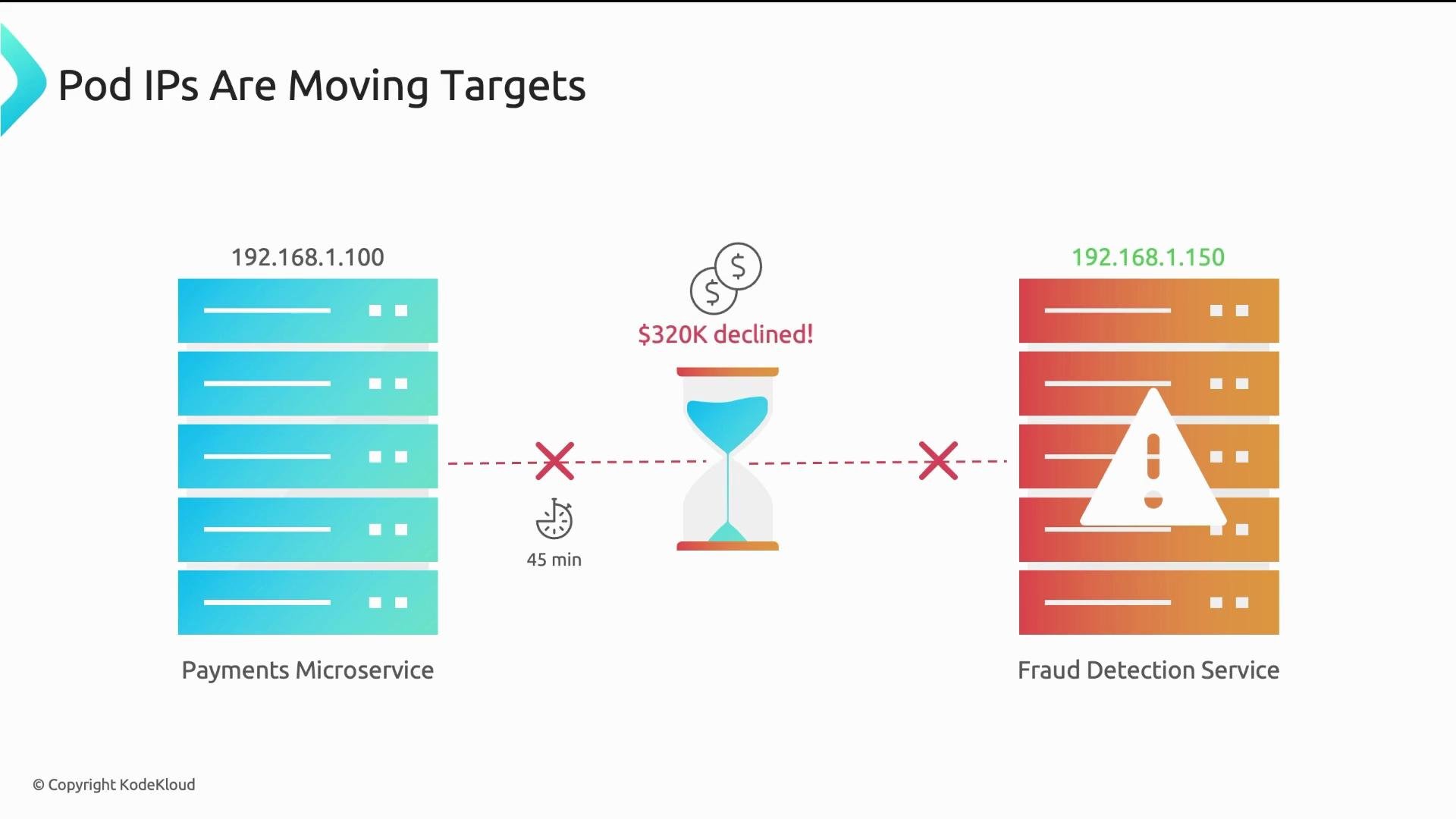
A payments microservice hardcoded the IP address of a downstream fraud-detection pod. After a routine deployment the fraud pod restarted, received a new IP, and the payments service could no longer reach it. Payment authorizations silently failed for 45 minutes before monitoring caught the issue, resulting in many declined legitimate transactions.
Problem scenario (why Services matter)
A payments microservice hardcoded the IP address of a downstream fraud-detection pod. After a routine deployment the fraud pod restarted, received a new IP, and the payments service could no longer reach it. Payment authorizations silently failed for 45 minutes before monitoring caught the issue, resulting in many declined legitimate transactions.
 Why this happened
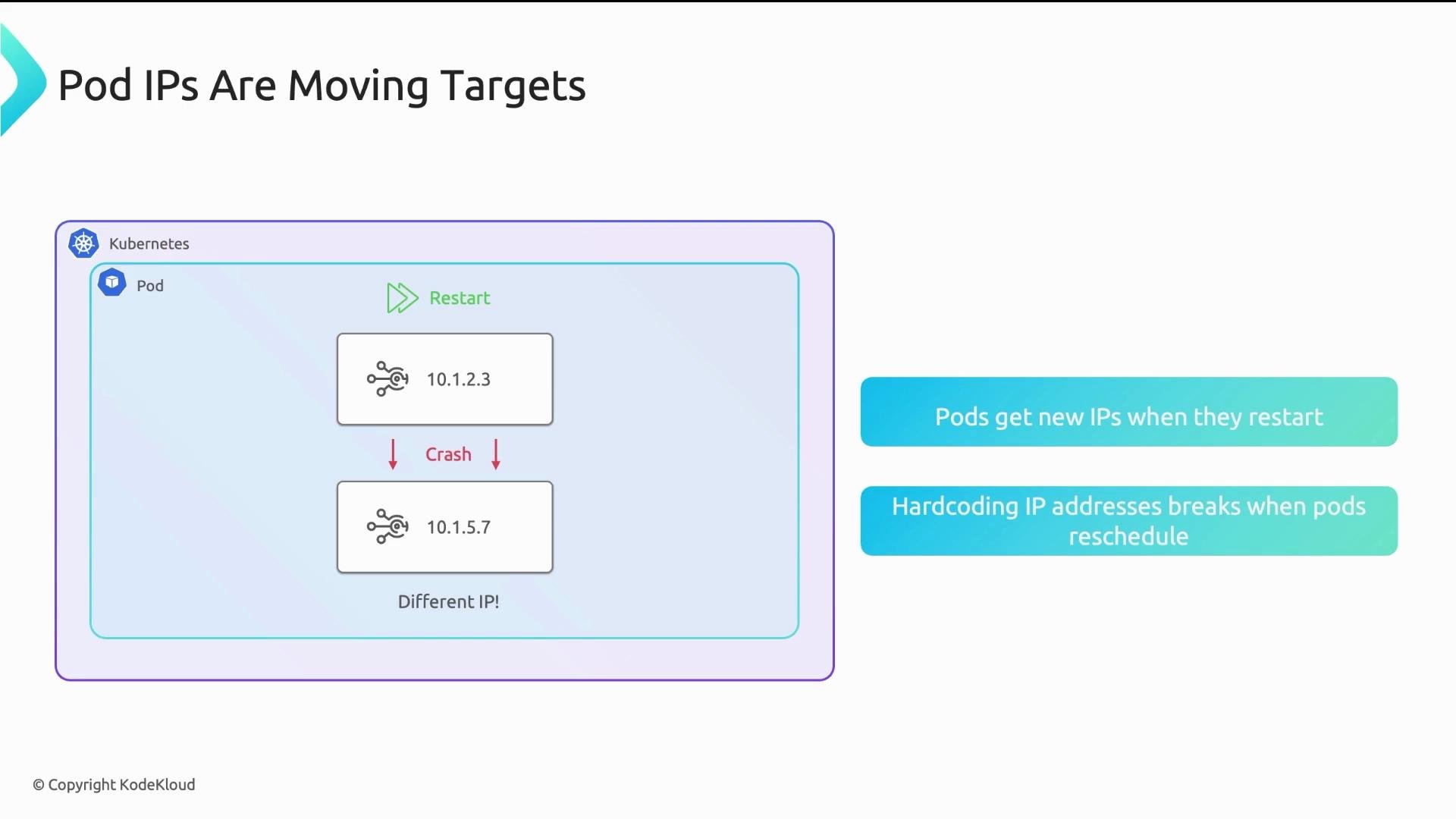
Each Pod gets its own IP, but Pod IPs are ephemeral — they change when a pod restarts, is rescheduled, or replaced during a rollout. Hard-coding a Pod IP works temporarily but fails silently when the pod’s IP changes (timeouts, connection refused), which is why we use higher-level abstractions.
Why this happened
Each Pod gets its own IP, but Pod IPs are ephemeral — they change when a pod restarts, is rescheduled, or replaced during a rollout. Hard-coding a Pod IP works temporarily but fails silently when the pod’s IP changes (timeouts, connection refused), which is why we use higher-level abstractions.
 Three core networking challenges
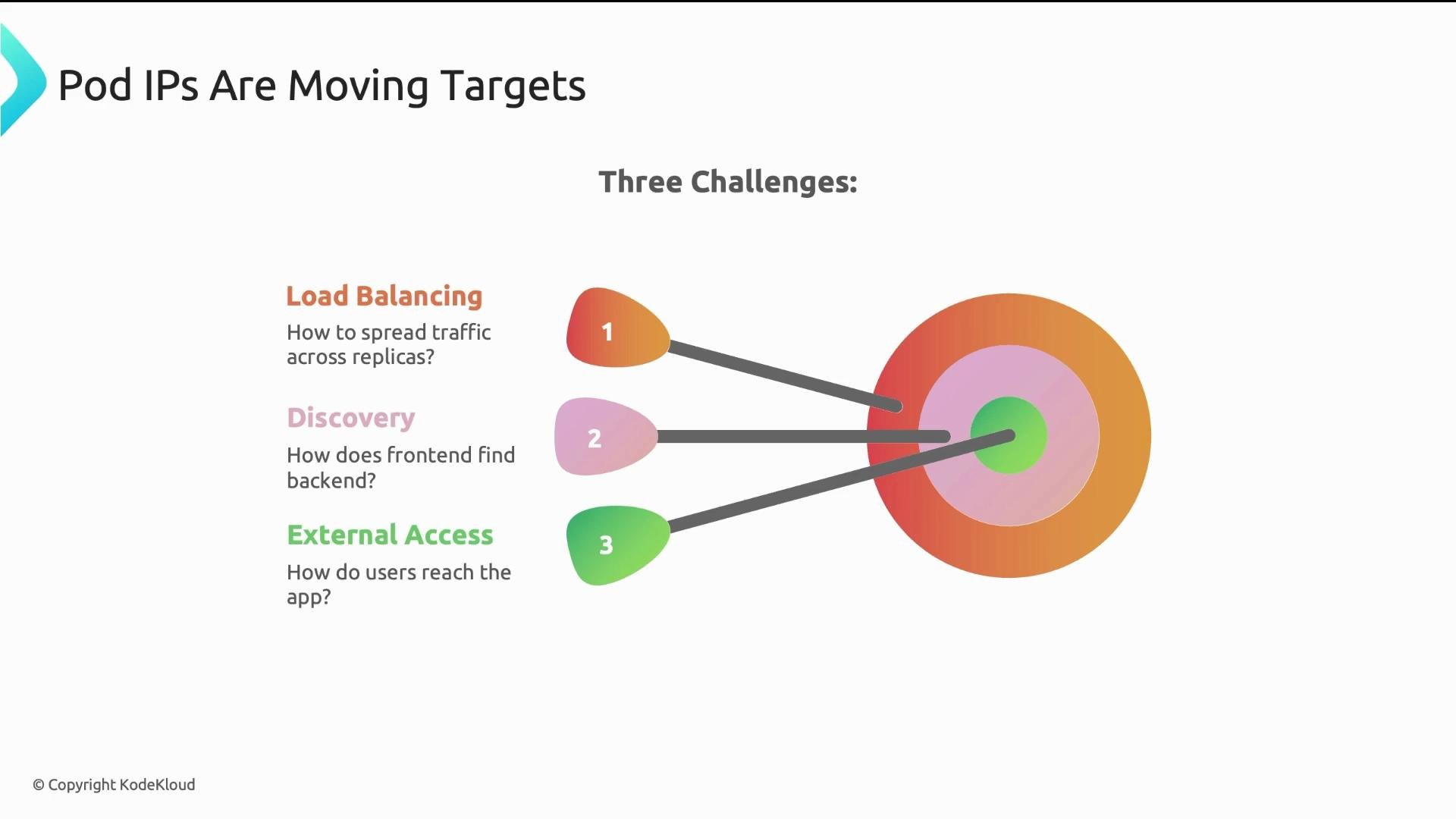
1. Load balancing — How does a frontend distribute traffic across multiple, dynamically changing backend replicas?
2. Service discovery — How does a frontend find backend replicas that may appear after the frontend is deployed?
3. External access — How do Internet users reach applications when pods have private, non-routable IPs?
Three core networking challenges
1. Load balancing — How does a frontend distribute traffic across multiple, dynamically changing backend replicas?
2. Service discovery — How does a frontend find backend replicas that may appear after the frontend is deployed?
3. External access — How do Internet users reach applications when pods have private, non-routable IPs?
 Services: stable endpoints for ephemeral pods
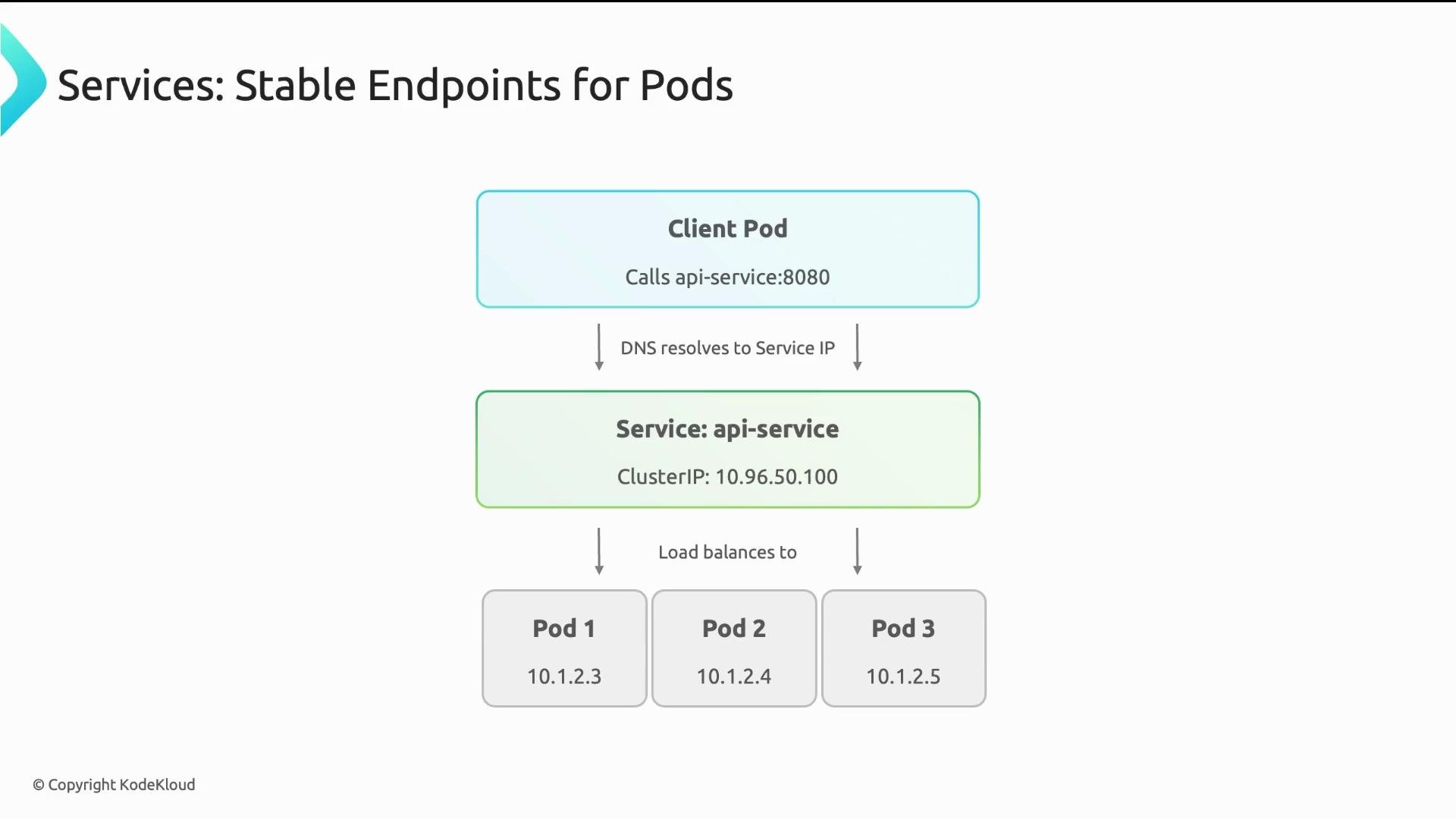
A Kubernetes Service gives you a stable network endpoint that load-balances to the current set of backend pods. Typical flow:
* Client pod calls a Service by DNS name (e.g., `api-service`).
* CoreDNS resolves that name to the Service’s ClusterIP (for example `10.96.50.100`).
* The Service holds a label selector to discover backend pods and maintains an endpoints list.
* A node-level proxy (kube-proxy or CNI equivalent) load-balances traffic sent to the ClusterIP across healthy pods.
Services: stable endpoints for ephemeral pods
A Kubernetes Service gives you a stable network endpoint that load-balances to the current set of backend pods. Typical flow:
* Client pod calls a Service by DNS name (e.g., `api-service`).
* CoreDNS resolves that name to the Service’s ClusterIP (for example `10.96.50.100`).
* The Service holds a label selector to discover backend pods and maintains an endpoints list.
* A node-level proxy (kube-proxy or CNI equivalent) load-balances traffic sent to the ClusterIP across healthy pods.
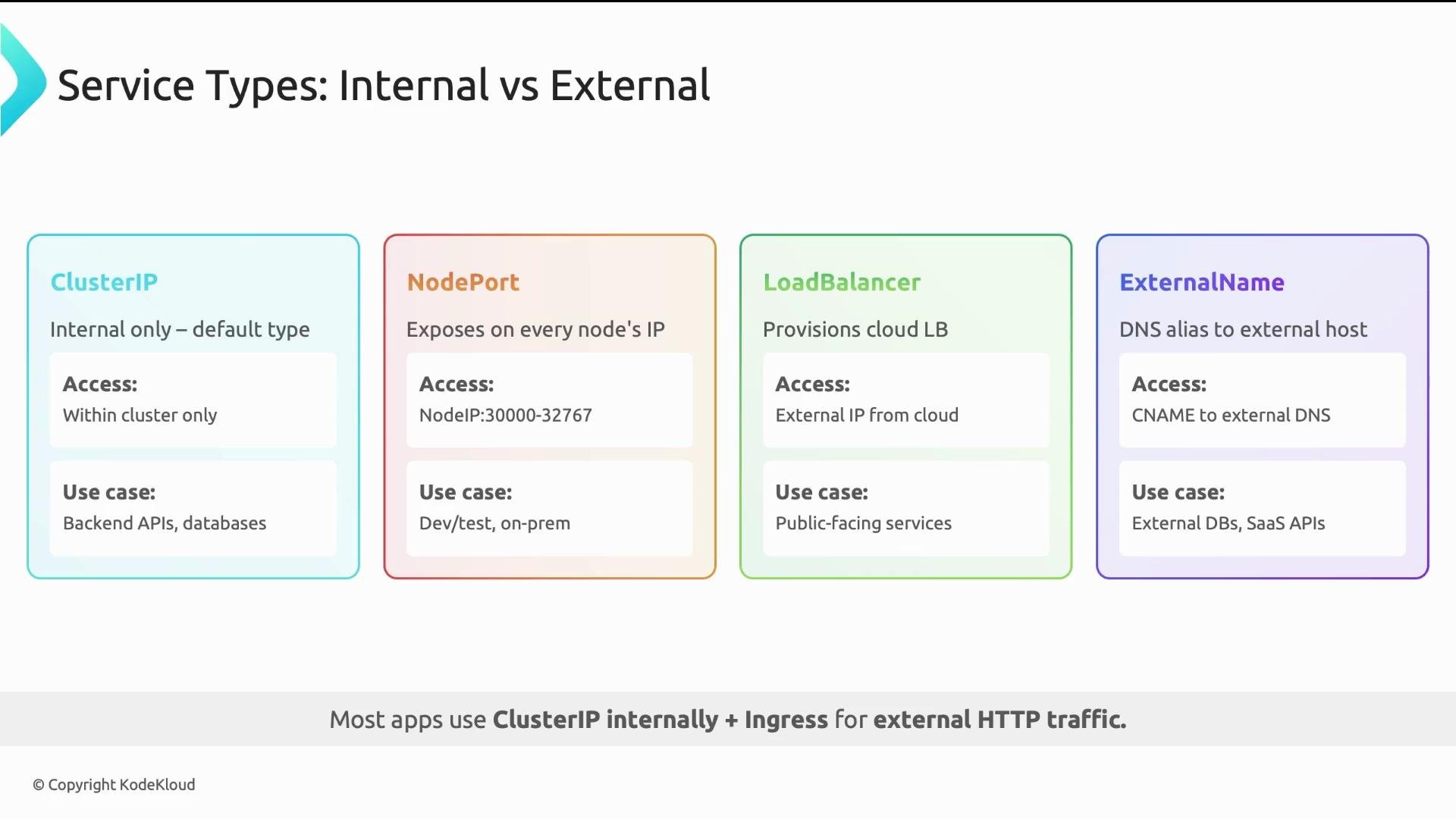
 Kubernetes Service types (comparison)
| Service Type | Where it is reachable | Typical use case | Notes |
| ------------------- | ------------------------------------ | ----------------------------------------------------------- | ------------------------------------------------------------------------------------ |
| ClusterIP (default) | Inside the cluster only | Internal APIs, databases | Most services (\~90–95%) should be ClusterIP |
| NodePort | `:` on every node | Development, on-prem clusters without cloud LB | Static port on nodes; limited routing features |
| LoadBalancer | External cloud load balancer IP | Cloud environments where a single service needs a public IP | Each LoadBalancer Service usually provisions a separate cloud LB (cost implications) |
| ExternalName | Resolves to an external hostname | Point a service name to an external DNS name (CNAME) | No proxying or load-balancing; DNS only |
Kubernetes Service types (comparison)
| Service Type | Where it is reachable | Typical use case | Notes |
| ------------------- | ------------------------------------ | ----------------------------------------------------------- | ------------------------------------------------------------------------------------ |
| ClusterIP (default) | Inside the cluster only | Internal APIs, databases | Most services (\~90–95%) should be ClusterIP |
| NodePort | `:` on every node | Development, on-prem clusters without cloud LB | Static port on nodes; limited routing features |
| LoadBalancer | External cloud load balancer IP | Cloud environments where a single service needs a public IP | Each LoadBalancer Service usually provisions a separate cloud LB (cost implications) |
| ExternalName | Resolves to an external hostname | Point a service name to an external DNS name (CNAME) | No proxying or load-balancing; DNS only |
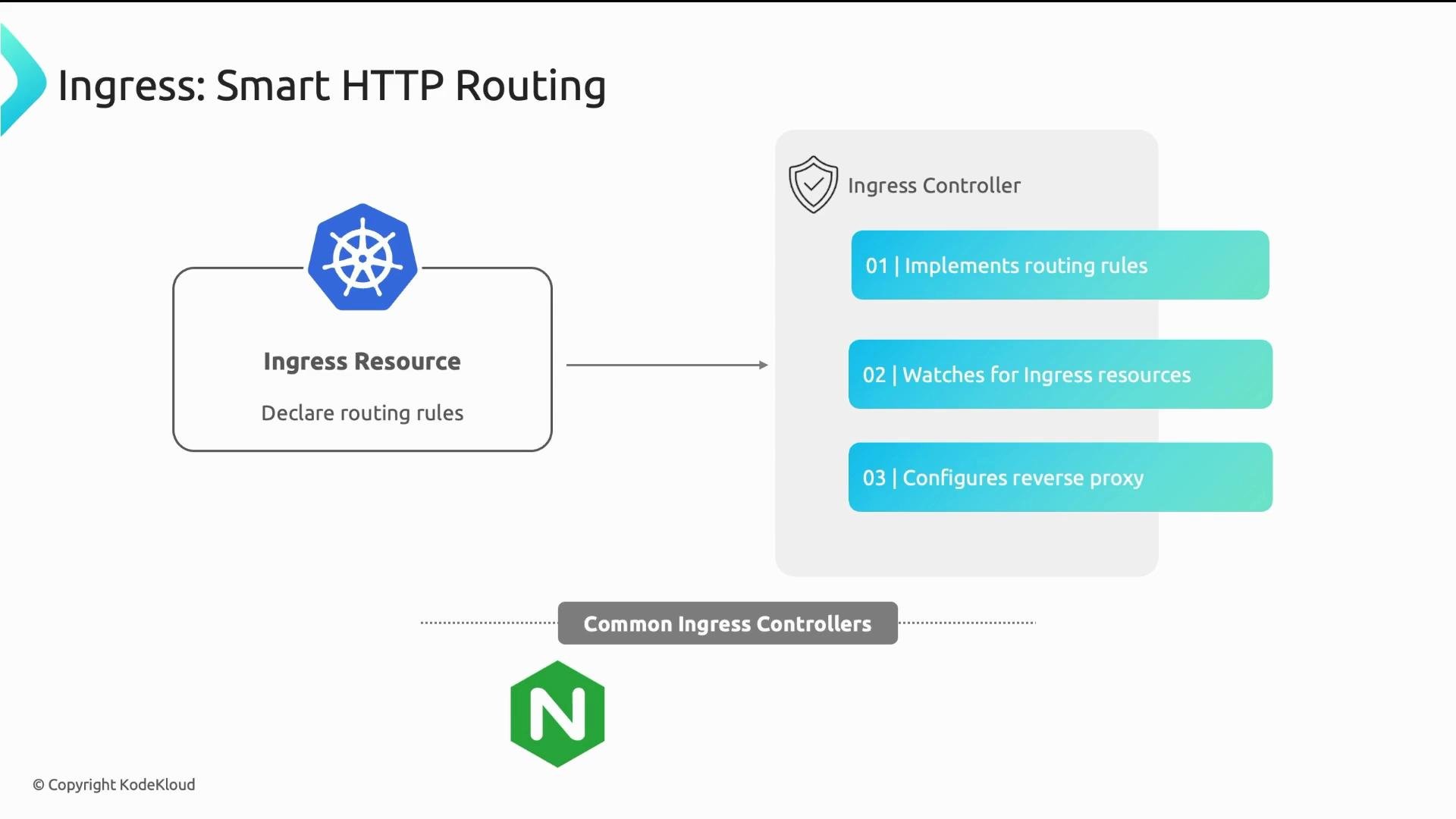
 Ingress vs Gateway API (external HTTP routing)
For external HTTP(S) traffic, prefer an Ingress controller over many LoadBalancer Services to reduce cost and centralize routing (host/path routing, TLS termination). An Ingress resource maps hosts/paths to backend Services; an Ingress controller implements the routing and configures a reverse proxy.
Example Ingress (path-based routing):
```yaml theme={null}
apiVersion: networking.k8s.io/v1
kind: Ingress
metadata:
name: app-ingress
spec:
rules:
- host: app.example.com
http:
paths:
- path: /api
pathType: Prefix
backend:
service:
name: api-svc
port:
number: 8080
- path: /web
pathType: Prefix
backend:
service:
name: web-svc
port:
number: 8080
```
Internet traffic to `app.example.com` arrives at the Ingress controller; `/api` routes to `api-svc` and `/web` routes to `web-svc`. Common controllers include ingress-nginx, Contour (Envoy), and Traefik.
Ingress vs Gateway API (external HTTP routing)
For external HTTP(S) traffic, prefer an Ingress controller over many LoadBalancer Services to reduce cost and centralize routing (host/path routing, TLS termination). An Ingress resource maps hosts/paths to backend Services; an Ingress controller implements the routing and configures a reverse proxy.
Example Ingress (path-based routing):
```yaml theme={null}
apiVersion: networking.k8s.io/v1
kind: Ingress
metadata:
name: app-ingress
spec:
rules:
- host: app.example.com
http:
paths:
- path: /api
pathType: Prefix
backend:
service:
name: api-svc
port:
number: 8080
- path: /web
pathType: Prefix
backend:
service:
name: web-svc
port:
number: 8080
```
Internet traffic to `app.example.com` arrives at the Ingress controller; `/api` routes to `api-svc` and `/web` routes to `web-svc`. Common controllers include ingress-nginx, Contour (Envoy), and Traefik.
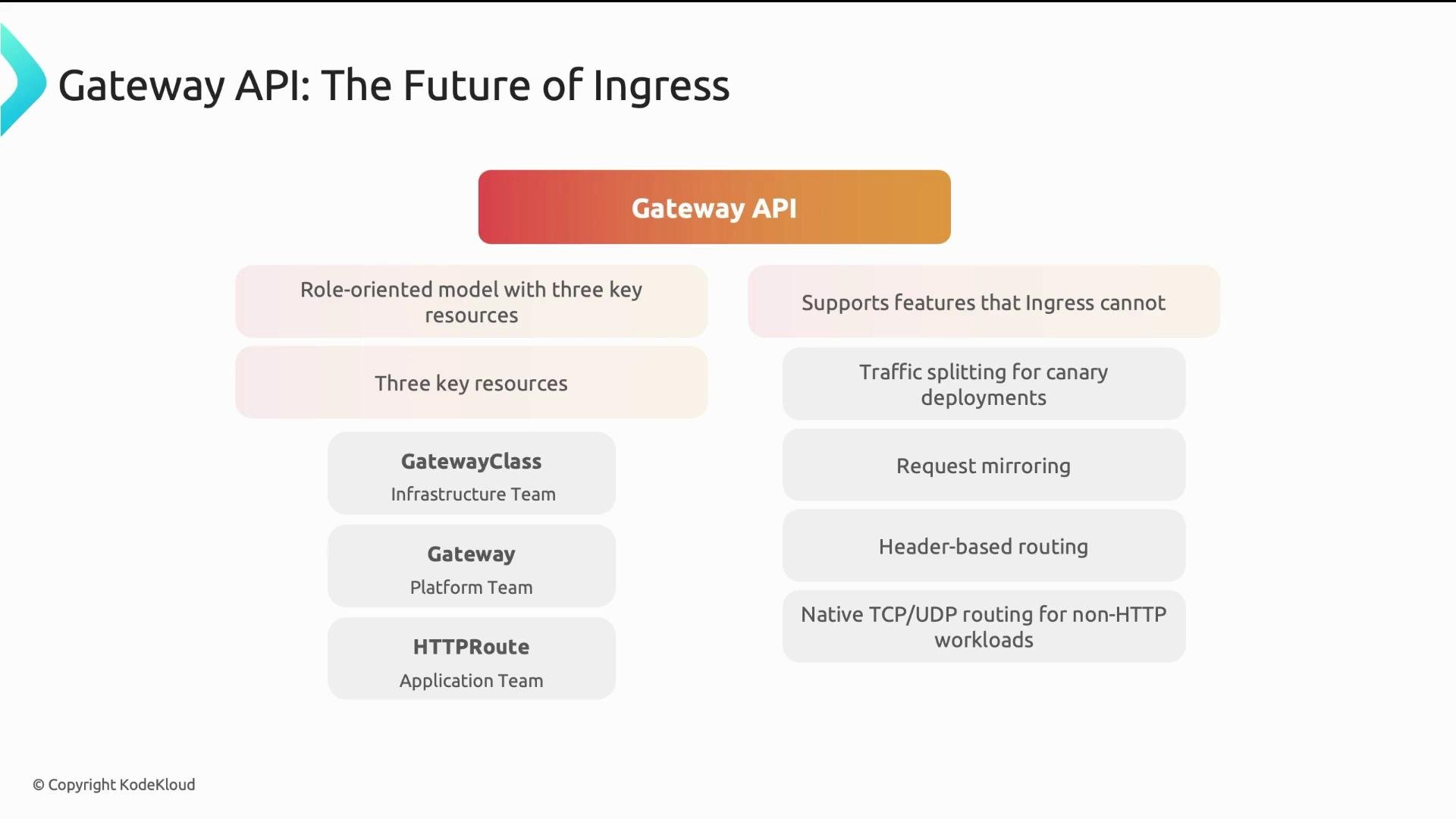
 Gateway API — modern replacement for Ingress
Gateway API is now generally available and solves many limitations of Ingress by offering:
* Better protocol support (HTTP, TCP, UDP, gRPC)
* Extensibility and richer traffic features (splitting, mirroring, header-based routing)
* Clear role separation between infrastructure, platform, and app teams
Example HTTPRoute with Gateway API:
```yaml theme={null}
apiVersion: gateway.networking.k8s.io/v1
kind: HTTPRoute
metadata:
name: api-route
spec:
parentRefs:
- name: my-gateway
rules:
- matches:
- path:
type: PathPrefix
value: /api
backendRefs:
- name: api-svc
port: 8080
```
Gateway API introduces three role-oriented resources:
* GatewayClass — chosen by infrastructure providers to define load balancer types (similar to StorageClass).
* Gateway — created by platform operators to instantiate LBs and listeners.
* Routes (HTTPRoute, TCPRoute, UDPRoute, etc.) — defined by application teams to express routing.
This model enables separation of responsibilities: infrastructure picks technology, platform manages exposure (ports/protocols), and app teams manage routing rules.
Gateway API — modern replacement for Ingress
Gateway API is now generally available and solves many limitations of Ingress by offering:
* Better protocol support (HTTP, TCP, UDP, gRPC)
* Extensibility and richer traffic features (splitting, mirroring, header-based routing)
* Clear role separation between infrastructure, platform, and app teams
Example HTTPRoute with Gateway API:
```yaml theme={null}
apiVersion: gateway.networking.k8s.io/v1
kind: HTTPRoute
metadata:
name: api-route
spec:
parentRefs:
- name: my-gateway
rules:
- matches:
- path:
type: PathPrefix
value: /api
backendRefs:
- name: api-svc
port: 8080
```
Gateway API introduces three role-oriented resources:
* GatewayClass — chosen by infrastructure providers to define load balancer types (similar to StorageClass).
* Gateway — created by platform operators to instantiate LBs and listeners.
* Routes (HTTPRoute, TCPRoute, UDPRoute, etc.) — defined by application teams to express routing.
This model enables separation of responsibilities: infrastructure picks technology, platform manages exposure (ports/protocols), and app teams manage routing rules.
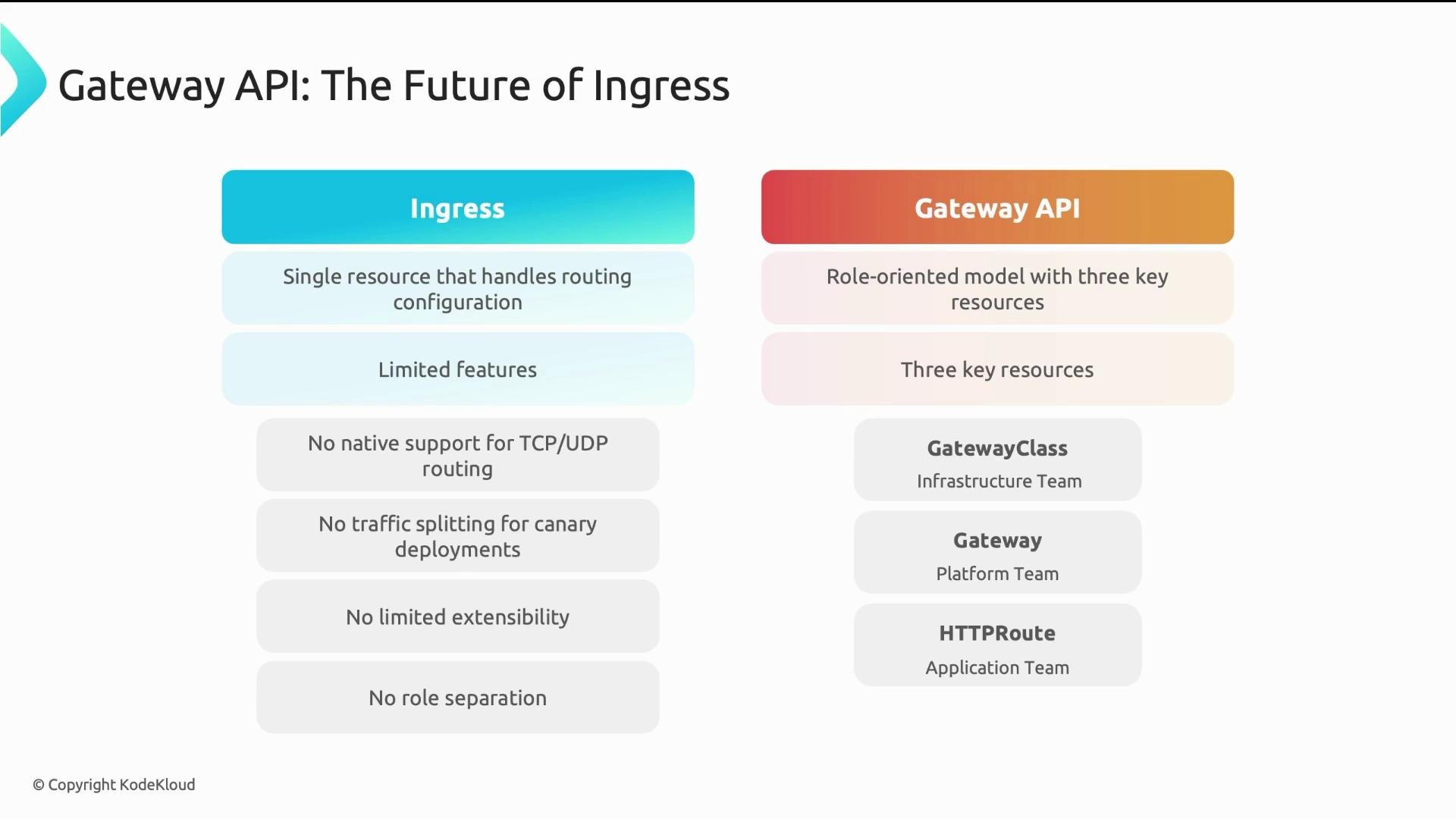 Gateway API supports advanced traffic features not available in Ingress: traffic splitting (canaries), request mirroring, header-based routing, and native TCP/UDP routing. Prefer Gateway API for new platform designs when supported by your controller.
 NetworkPolicy: pod-level firewalls
By default, pods can talk to any other pod in the cluster. NetworkPolicy provides pod-to-pod firewall rules so you can implement least privilege (default deny, explicit allow). Example: allow only frontend pods to reach backend pods on TCP/8080.
```yaml theme={null}
apiVersion: networking.k8s.io/v1
kind: NetworkPolicy
metadata:
name: backend-only-from-frontend
spec:
podSelector:
matchLabels:
app: backend
policyTypes:
- Ingress
ingress:
- from:
- podSelector:
matchLabels:
app: frontend
ports:
- protocol: TCP
port: 8080
```
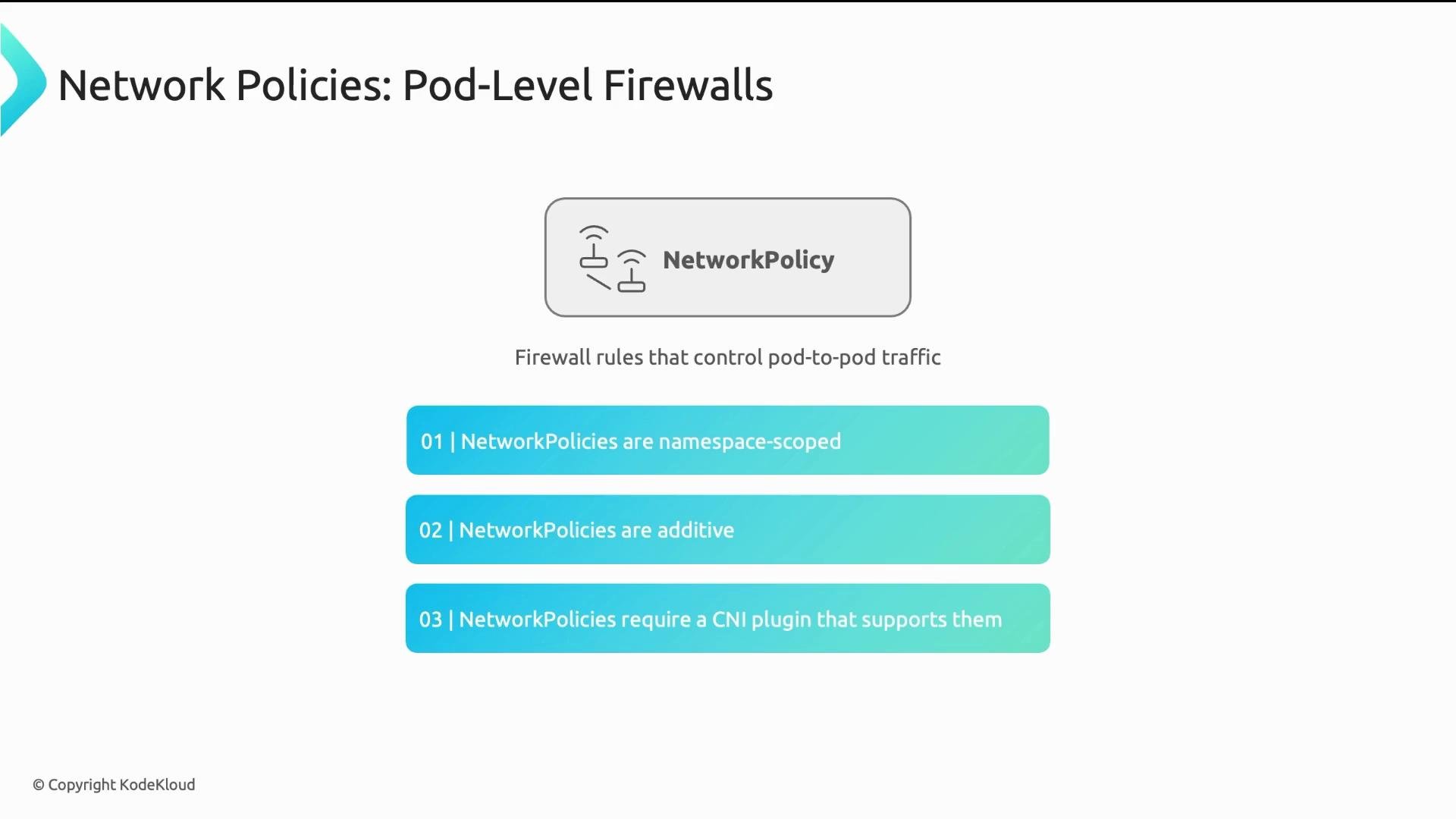
Key NetworkPolicy points:
* Namespace-scoped: policies in namespace A do not affect namespace B.
* Additive model: if any policy allows a connection, it is allowed. There is no explicit deny object — you deny by omission.
* Requires a CNI implementation that supports NetworkPolicy; otherwise policies are ignored.
NetworkPolicy: pod-level firewalls
By default, pods can talk to any other pod in the cluster. NetworkPolicy provides pod-to-pod firewall rules so you can implement least privilege (default deny, explicit allow). Example: allow only frontend pods to reach backend pods on TCP/8080.
```yaml theme={null}
apiVersion: networking.k8s.io/v1
kind: NetworkPolicy
metadata:
name: backend-only-from-frontend
spec:
podSelector:
matchLabels:
app: backend
policyTypes:
- Ingress
ingress:
- from:
- podSelector:
matchLabels:
app: frontend
ports:
- protocol: TCP
port: 8080
```
Key NetworkPolicy points:
* Namespace-scoped: policies in namespace A do not affect namespace B.
* Additive model: if any policy allows a connection, it is allowed. There is no explicit deny object — you deny by omission.
* Requires a CNI implementation that supports NetworkPolicy; otherwise policies are ignored.
 NetworkPolicy rules are only enforced if your CNI plugin implements them. Test policies in a non-production environment first — otherwise policies may have no effect and pods will remain fully open.
Service discovery with CoreDNS (DNS naming best practices)
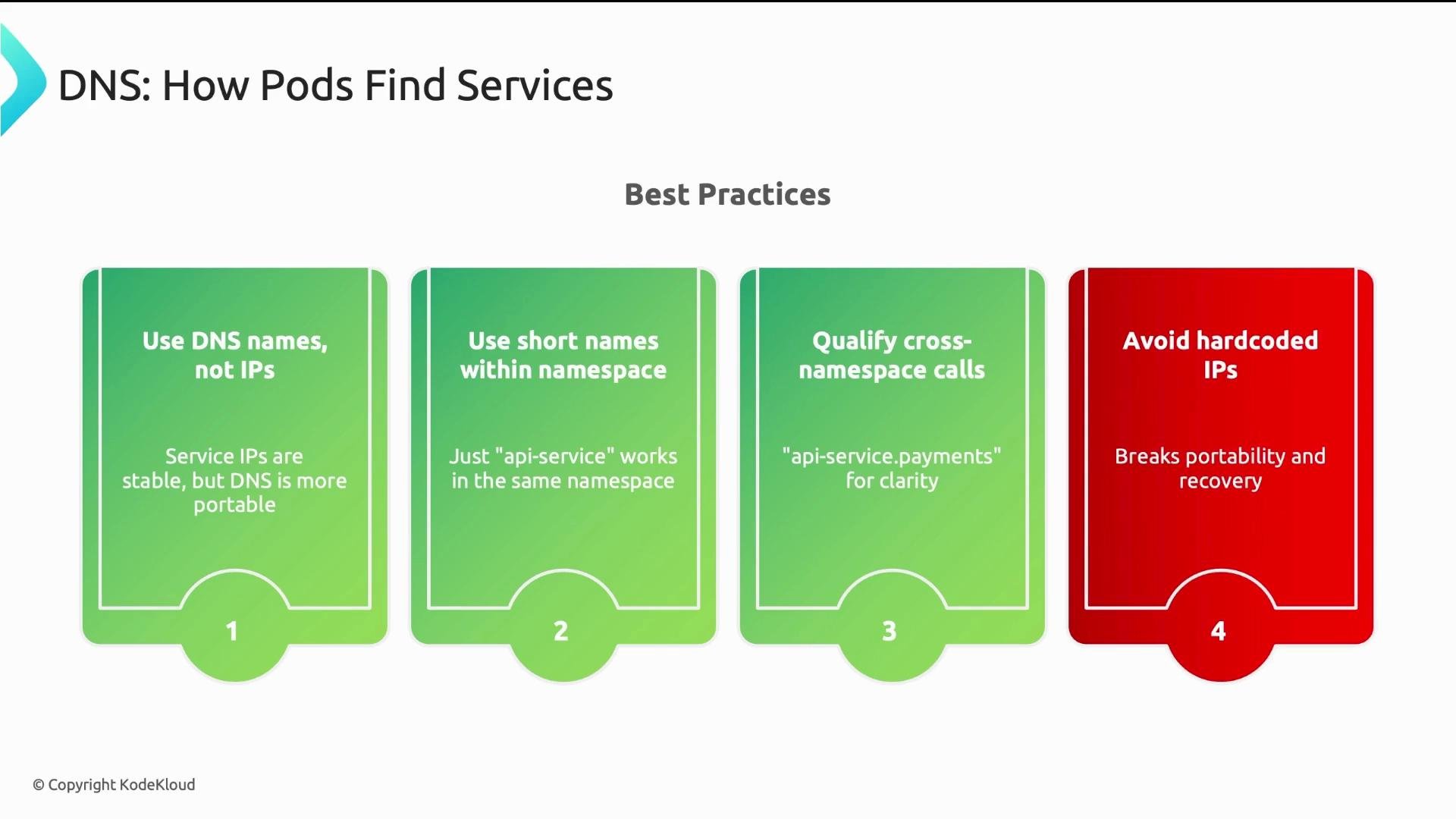
CoreDNS automatically creates DNS records for Services — this is the recommended way to discover services instead of using IPs. Three DNS name forms:
* Short name (same namespace): `api-service`
* Namespace-qualified (cross-namespace): `api-service.payments`
* Fully qualified domain name (FQDN): `api-service.payments.svc.cluster.local`
Examples:
```bash theme={null}
# Same namespace (convenient)
$ curl http://api-service:8080
# Cross-namespace (explicit)
$ curl http://api-service.payments:8080
# Fully qualified (unambiguous)
$ curl http://api-service.payments.svc.cluster.local:8080
```
CoreDNS resolves short names by appending the pod's namespace and cluster domain. Use short names inside a namespace for convenience; use namespace-qualified names for cross-namespace calls to avoid collisions; and use the FQDN in config or environment variables when you need absolute clarity.
NetworkPolicy rules are only enforced if your CNI plugin implements them. Test policies in a non-production environment first — otherwise policies may have no effect and pods will remain fully open.
Service discovery with CoreDNS (DNS naming best practices)
CoreDNS automatically creates DNS records for Services — this is the recommended way to discover services instead of using IPs. Three DNS name forms:
* Short name (same namespace): `api-service`
* Namespace-qualified (cross-namespace): `api-service.payments`
* Fully qualified domain name (FQDN): `api-service.payments.svc.cluster.local`
Examples:
```bash theme={null}
# Same namespace (convenient)
$ curl http://api-service:8080
# Cross-namespace (explicit)
$ curl http://api-service.payments:8080
# Fully qualified (unambiguous)
$ curl http://api-service.payments.svc.cluster.local:8080
```
CoreDNS resolves short names by appending the pod's namespace and cluster domain. Use short names inside a namespace for convenience; use namespace-qualified names for cross-namespace calls to avoid collisions; and use the FQDN in config or environment variables when you need absolute clarity.
 Best practices summary
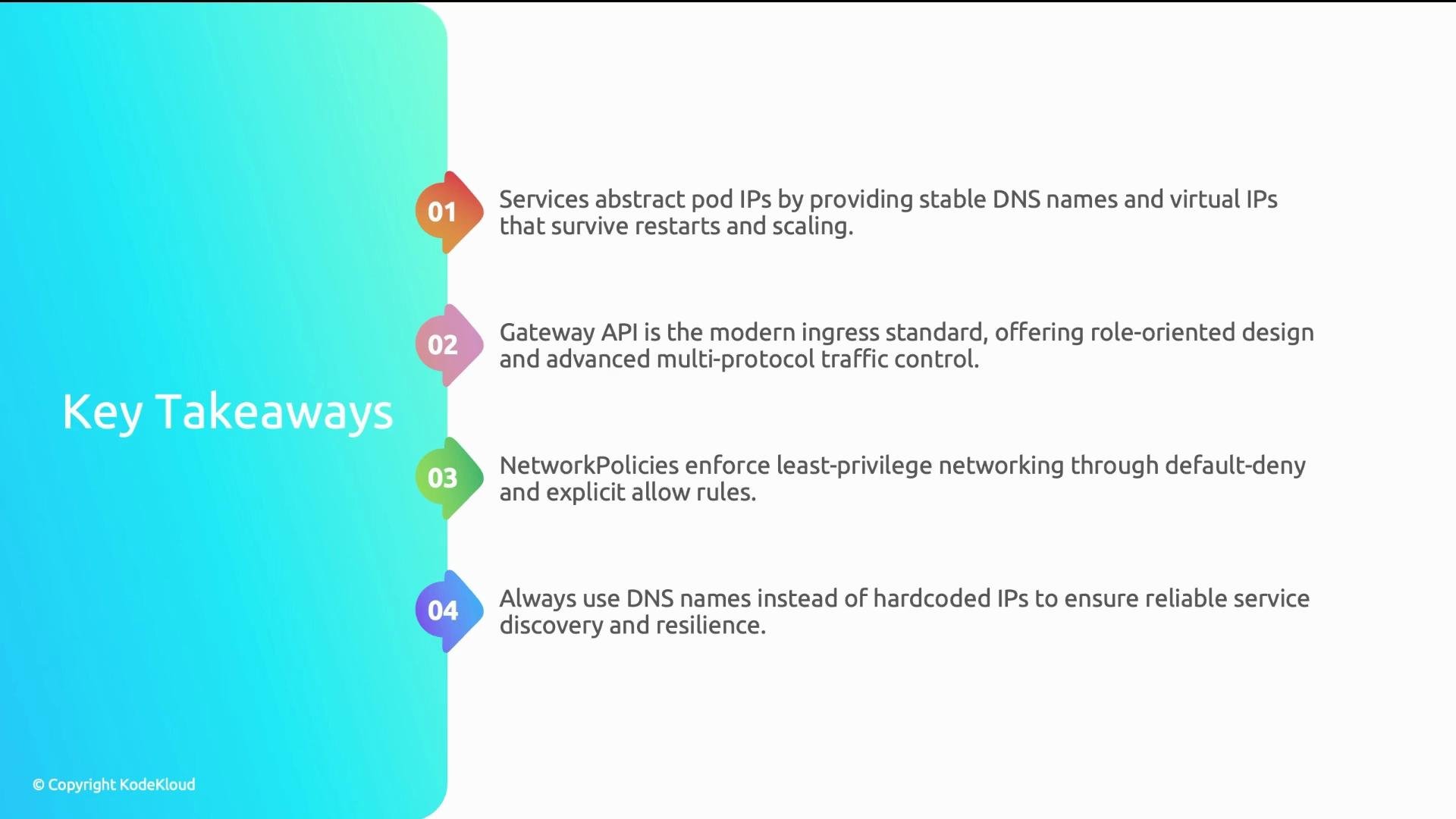
* Use Services (ClusterIP) to abstract pod IPs and enable stable DNS names and virtual IPs. Never hard-code Pod IPs.
* Prefer Gateway API for new platforms (role separation, protocol flexibility, advanced traffic controls). Ingress remains widely used and supported.
* Enforce least-privilege networking with NetworkPolicy: adopt a default-deny posture and add explicit allow rules. Confirm CNI support before enforcing policies.
* Use DNS names for service discovery: short names within a namespace, namespace-qualified names for cross-namespace calls, and FQDN for full clarity.
Best practices summary
* Use Services (ClusterIP) to abstract pod IPs and enable stable DNS names and virtual IPs. Never hard-code Pod IPs.
* Prefer Gateway API for new platforms (role separation, protocol flexibility, advanced traffic controls). Ingress remains widely used and supported.
* Enforce least-privilege networking with NetworkPolicy: adopt a default-deny posture and add explicit allow rules. Confirm CNI support before enforcing policies.
* Use DNS names for service discovery: short names within a namespace, namespace-qualified names for cross-namespace calls, and FQDN for full clarity.
 Links and references
* Kubernetes Services: [https://kubernetes.io/docs/concepts/services-networking/service/](https://kubernetes.io/docs/concepts/services-networking/service/)
* Ingress: [https://kubernetes.io/docs/concepts/services-networking/ingress/](https://kubernetes.io/docs/concepts/services-networking/ingress/)
* Gateway API: [https://gateway-api.sigs.k8s.io/](https://gateway-api.sigs.k8s.io/)
* NetworkPolicy: [https://kubernetes.io/docs/concepts/services-networking/network-policies/](https://kubernetes.io/docs/concepts/services-networking/network-policies/)
* CoreDNS: [https://coredns.io/](https://coredns.io/)
Links and references
* Kubernetes Services: [https://kubernetes.io/docs/concepts/services-networking/service/](https://kubernetes.io/docs/concepts/services-networking/service/)
* Ingress: [https://kubernetes.io/docs/concepts/services-networking/ingress/](https://kubernetes.io/docs/concepts/services-networking/ingress/)
* Gateway API: [https://gateway-api.sigs.k8s.io/](https://gateway-api.sigs.k8s.io/)
* NetworkPolicy: [https://kubernetes.io/docs/concepts/services-networking/network-policies/](https://kubernetes.io/docs/concepts/services-networking/network-policies/)
* CoreDNS: [https://coredns.io/](https://coredns.io/)