> ## Documentation Index
> Fetch the complete documentation index at: https://notes.kodekloud.com/llms.txt
> Use this file to discover all available pages before exploring further.
# Continuous Integration Fundamentals
> Overview of Continuous Integration fundamentals, CI pipeline stages, security and quality integration, platform options, KPIs, and best practices for producing immutable, reproducible artifacts and fast feedback
Welcome. In this lesson we cover the fundamentals of Continuous Integration (CI): why CI matters, the typical CI pipeline stages, how security and quality integrate into CI, and how CI supports platform engineering and GitOps workflows.
Continuous Integration is the first half of the CI/CD lifecycle. It ensures code changes are built, tested, and turned into a deployable, versioned artifact. This foundation enables reliable, repeatable software delivery and accelerates feature delivery across environments by providing rapid feedback and traceability from source to runtime.
To illustrate the overall flow from source to production, consider the high-level CI/CD pipeline below.
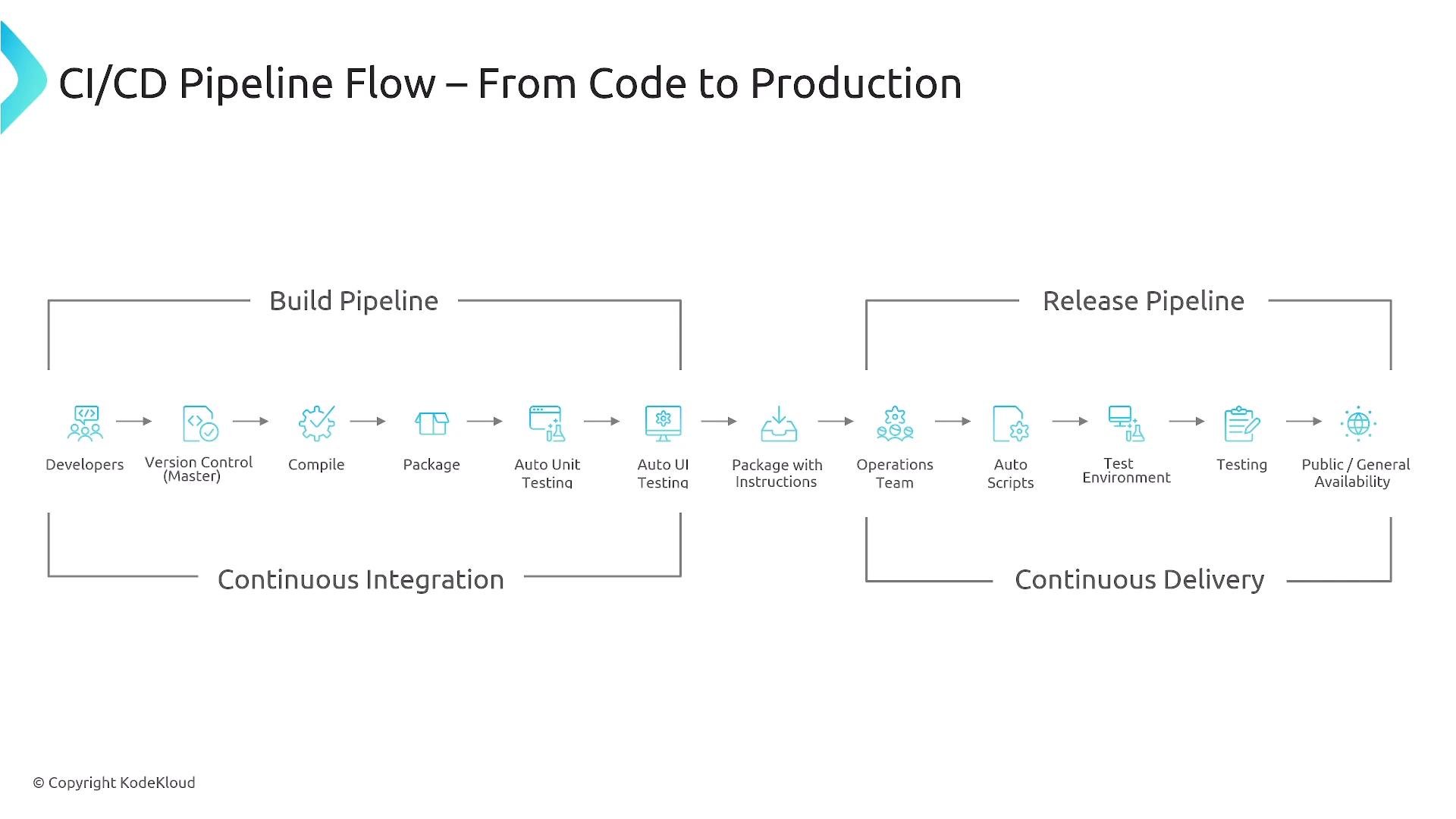 Overview: what CI is responsible for
* Fetch the exact code snapshot (commit SHA or tag) to ensure reproducible builds.
* Resolve and pin dependencies (lockfiles) to prevent version drift.
* Build/compile and package the application into a deployable artifact.
* Run automated static analysis, unit and integration tests, and lightweight security scans.
* Publish a versioned artifact only if it passes quality and security gates.
Automated quality gates and fast feedback are core to CI: the pipeline acts as an automated verifier for every change. Small batch sizes, deterministic builds, and rapid failure feedback enable teams to move confidently and iterate quickly.
Callouts and best practice highlights:
Aim for quick, deterministic feedback loops: optimize for build times under 5 minutes for most commits, keep tests isolated and parallelizable, and enforce strict dependency pinning (`lockfiles`) to avoid "works on my machine" issues.
Standard CI pipeline — eight critical stages
A typical CI pipeline can be split into common stages. Below is a standard eight-stage breakdown that many teams adopt as a baseline.
Overview: what CI is responsible for
* Fetch the exact code snapshot (commit SHA or tag) to ensure reproducible builds.
* Resolve and pin dependencies (lockfiles) to prevent version drift.
* Build/compile and package the application into a deployable artifact.
* Run automated static analysis, unit and integration tests, and lightweight security scans.
* Publish a versioned artifact only if it passes quality and security gates.
Automated quality gates and fast feedback are core to CI: the pipeline acts as an automated verifier for every change. Small batch sizes, deterministic builds, and rapid failure feedback enable teams to move confidently and iterate quickly.
Callouts and best practice highlights:
Aim for quick, deterministic feedback loops: optimize for build times under 5 minutes for most commits, keep tests isolated and parallelizable, and enforce strict dependency pinning (`lockfiles`) to avoid "works on my machine" issues.
Standard CI pipeline — eight critical stages
A typical CI pipeline can be split into common stages. Below is a standard eight-stage breakdown that many teams adopt as a baseline.
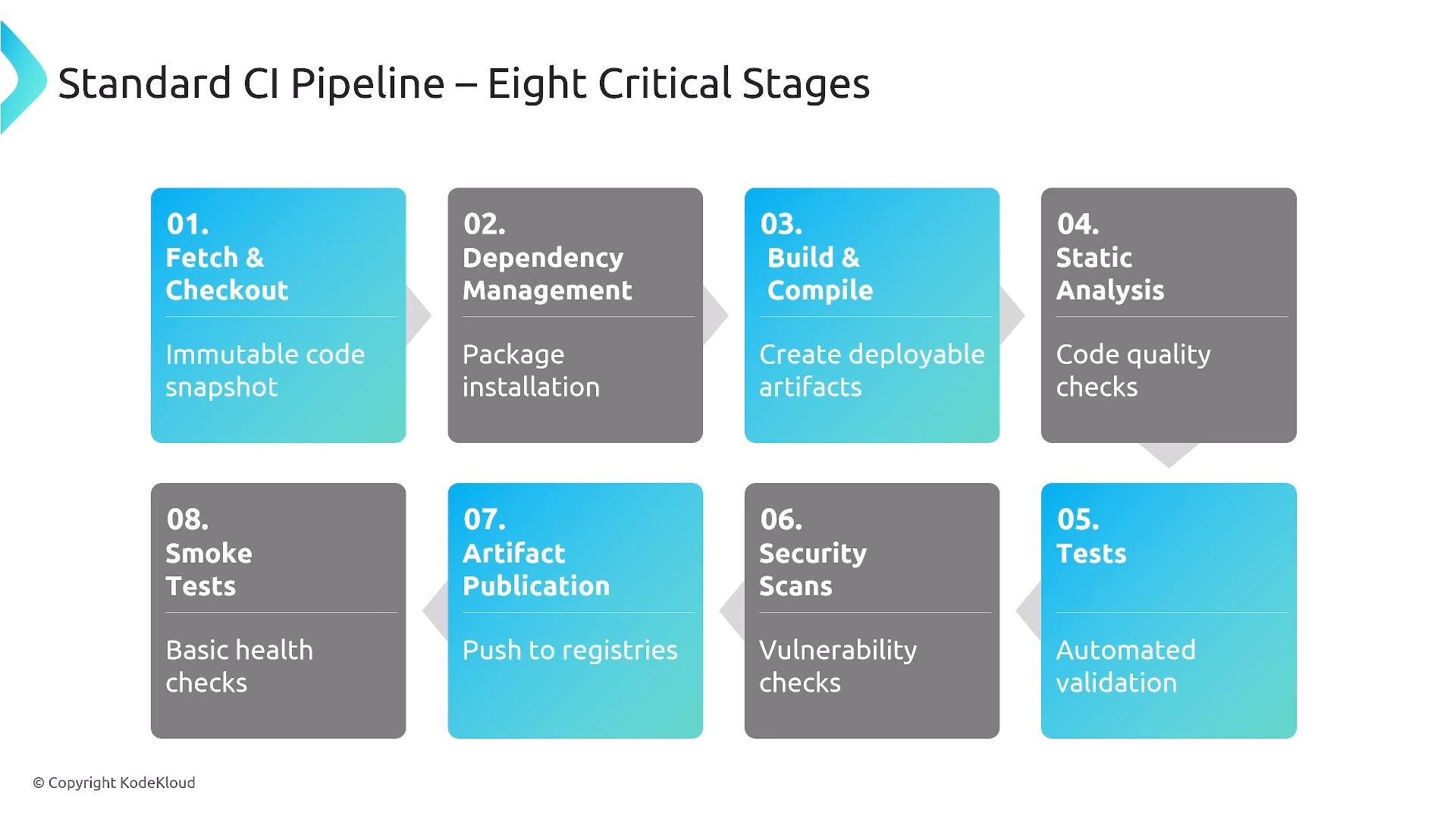 Quick reference table — CI pipeline stages
| Stage # | Stage name | Primary goal |
| -: | - | - |
| 01 | Fetch & Checkout | Get the exact commit SHA or tag to build from |
| 02 | Dependency Management | Install and pin dependencies (use lockfiles) |
| 03 | Build & Compile | Produce deterministic, versioned artifacts |
| 04 | Static Analysis | Linting and code quality checks (SAST basics) |
| 05 | Tests | Unit, integration, and parallelized test execution |
| 06 | Security Scans | Dependency scanning, IaC checks, SAST/DAST where applicable |
| 07 | Artifact Publication | Publish immutable, versioned artifacts to a registry |
| 08 | Smoke Tests | Lightweight runtime verification of the published artifact |
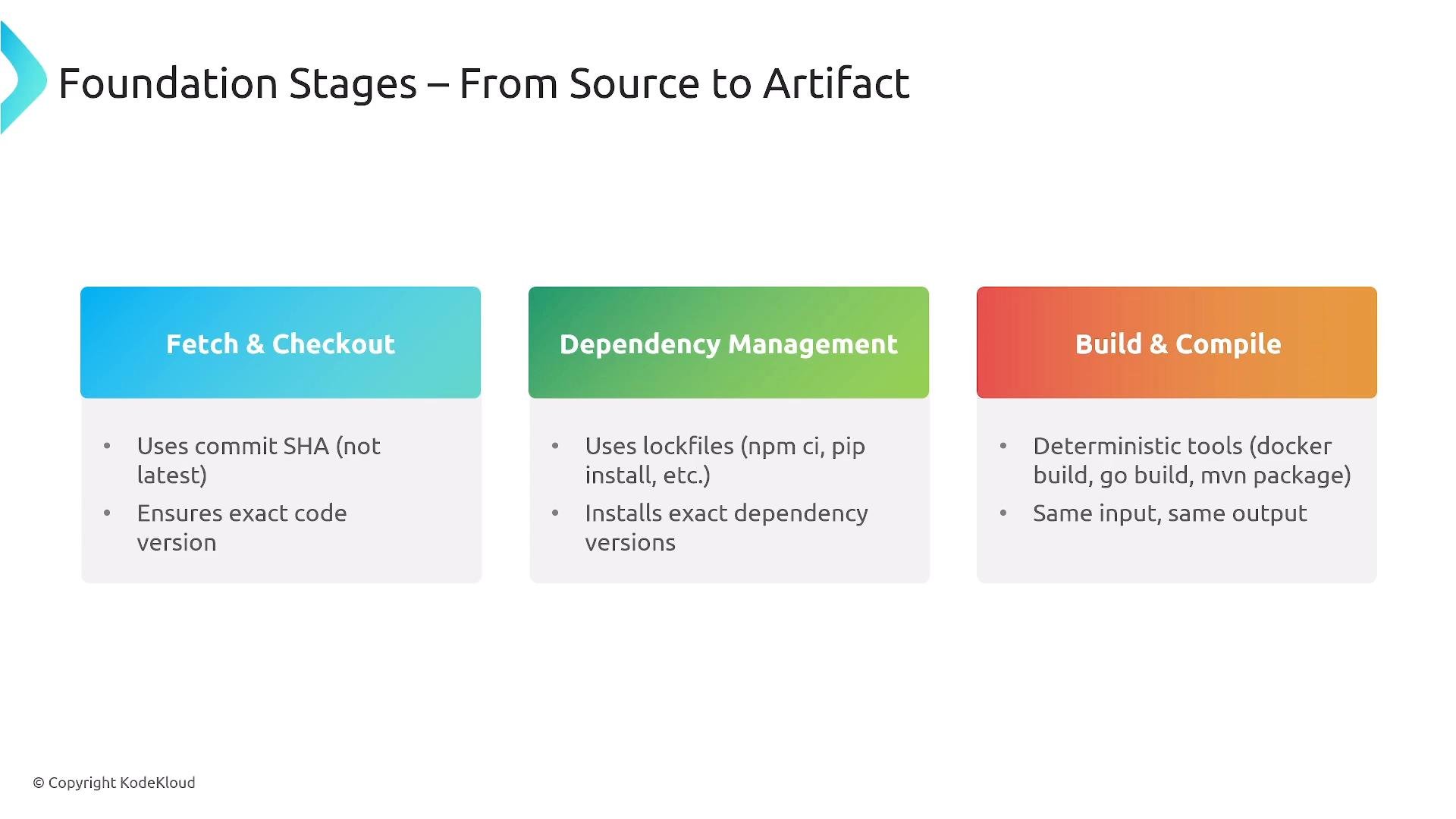
Foundation stages (1–3): producing an immutable artifact
Stages 1–3 focus on creating a deterministic artifact from source. Key practices include:
* Always build from an immutable code snapshot (`commit SHA` or tag).
* Use lockfiles (`package-lock.json`, `go.sum`, `Pipfile.lock`, etc.) to pin dependencies.
* Use deterministic build tools and reproducible build flags so identical inputs produce identical outputs.
Quick reference table — CI pipeline stages
| Stage # | Stage name | Primary goal |
| -: | - | - |
| 01 | Fetch & Checkout | Get the exact commit SHA or tag to build from |
| 02 | Dependency Management | Install and pin dependencies (use lockfiles) |
| 03 | Build & Compile | Produce deterministic, versioned artifacts |
| 04 | Static Analysis | Linting and code quality checks (SAST basics) |
| 05 | Tests | Unit, integration, and parallelized test execution |
| 06 | Security Scans | Dependency scanning, IaC checks, SAST/DAST where applicable |
| 07 | Artifact Publication | Publish immutable, versioned artifacts to a registry |
| 08 | Smoke Tests | Lightweight runtime verification of the published artifact |
Foundation stages (1–3): producing an immutable artifact
Stages 1–3 focus on creating a deterministic artifact from source. Key practices include:
* Always build from an immutable code snapshot (`commit SHA` or tag).
* Use lockfiles (`package-lock.json`, `go.sum`, `Pipfile.lock`, etc.) to pin dependencies.
* Use deterministic build tools and reproducible build flags so identical inputs produce identical outputs.
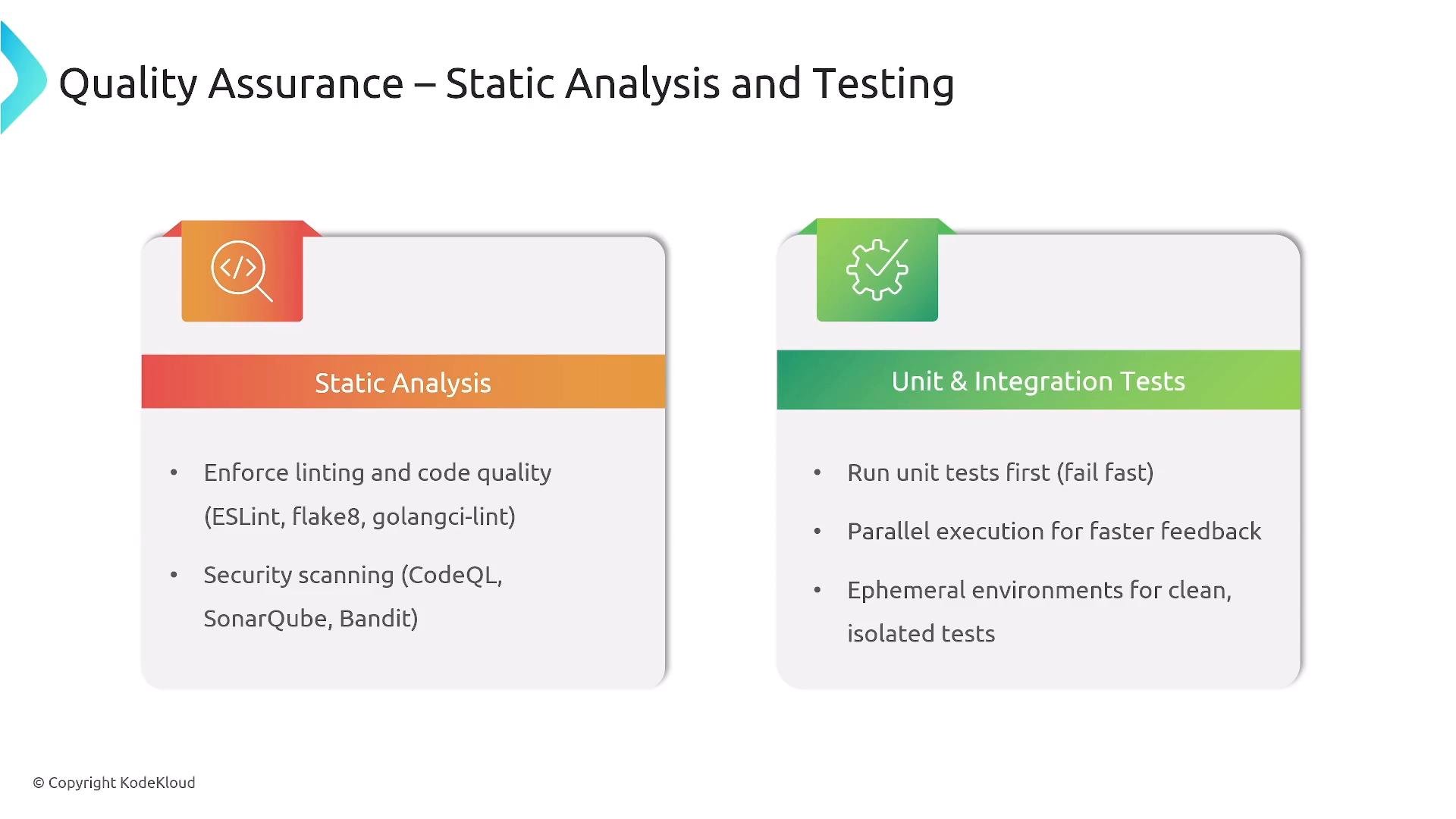
 Quality assurance in CI (stages 4–6)
CI should include automated quality and security verification. Typical components:
* Static analysis: linting, code-style checks, and basic SAST.
* Unit and integration tests: run unit tests first; parallelize tests where possible for speed.
* Security scans: dependency vulnerability scans, IaC scanning tools (e.g., for Terraform or CloudFormation).
* Fail-fast behavior: stop early on critical failures to save compute and surface issues quickly.
* Ephemeral test environments: create temporary environments for integration or end-to-end tests when needed.
Quality assurance in CI (stages 4–6)
CI should include automated quality and security verification. Typical components:
* Static analysis: linting, code-style checks, and basic SAST.
* Unit and integration tests: run unit tests first; parallelize tests where possible for speed.
* Security scans: dependency vulnerability scans, IaC scanning tools (e.g., for Terraform or CloudFormation).
* Fail-fast behavior: stop early on critical failures to save compute and surface issues quickly.
* Ephemeral test environments: create temporary environments for integration or end-to-end tests when needed.
 Security considerations in CI
Security in CI should cover both static checks and, where feasible, runtime or dynamic testing:
* SAST to detect code-level vulnerabilities early.
* Dependency scanning to identify known CVEs and supply-chain risks.
* Infrastructure-as-Code (IaC) scanning to catch misconfigurations before deployment.
* DAST or runtime checks when artifacts are exercised in ephemeral environments (often part of CD).
* Policy-as-code to automatically block or flag high-severity findings.
If a recurring vulnerability or misconfiguration has caused incidents before, add regression tests and targeted scans into your CI pipeline to prevent regressions.
Immutable container artifacts
Containers are a common artifact because of immutability: build an image, tag it (by SHA or version), push to a registry, and deploy the exact image from the registry for reproducible deployments.
Example of tagging and pushing a container image:
```bash theme={null}
docker tag pony-spawner:latest registry.spr.com/pony-spawner:sha-abc123def
docker push registry.spr.com/pony-spawner:sha-abc123def
```
Immutable artifacts (images, archives, or versioned bundles) provide traceability and remove “build roulette” where different builds produce different outputs.
CI platform options — choose by platform vision
There are many CI platforms. Choose the one that aligns with your team’s operational model and platform vision.
Security considerations in CI
Security in CI should cover both static checks and, where feasible, runtime or dynamic testing:
* SAST to detect code-level vulnerabilities early.
* Dependency scanning to identify known CVEs and supply-chain risks.
* Infrastructure-as-Code (IaC) scanning to catch misconfigurations before deployment.
* DAST or runtime checks when artifacts are exercised in ephemeral environments (often part of CD).
* Policy-as-code to automatically block or flag high-severity findings.
If a recurring vulnerability or misconfiguration has caused incidents before, add regression tests and targeted scans into your CI pipeline to prevent regressions.
Immutable container artifacts
Containers are a common artifact because of immutability: build an image, tag it (by SHA or version), push to a registry, and deploy the exact image from the registry for reproducible deployments.
Example of tagging and pushing a container image:
```bash theme={null}
docker tag pony-spawner:latest registry.spr.com/pony-spawner:sha-abc123def
docker push registry.spr.com/pony-spawner:sha-abc123def
```
Immutable artifacts (images, archives, or versioned bundles) provide traceability and remove “build roulette” where different builds produce different outputs.
CI platform options — choose by platform vision
There are many CI platforms. Choose the one that aligns with your team’s operational model and platform vision.
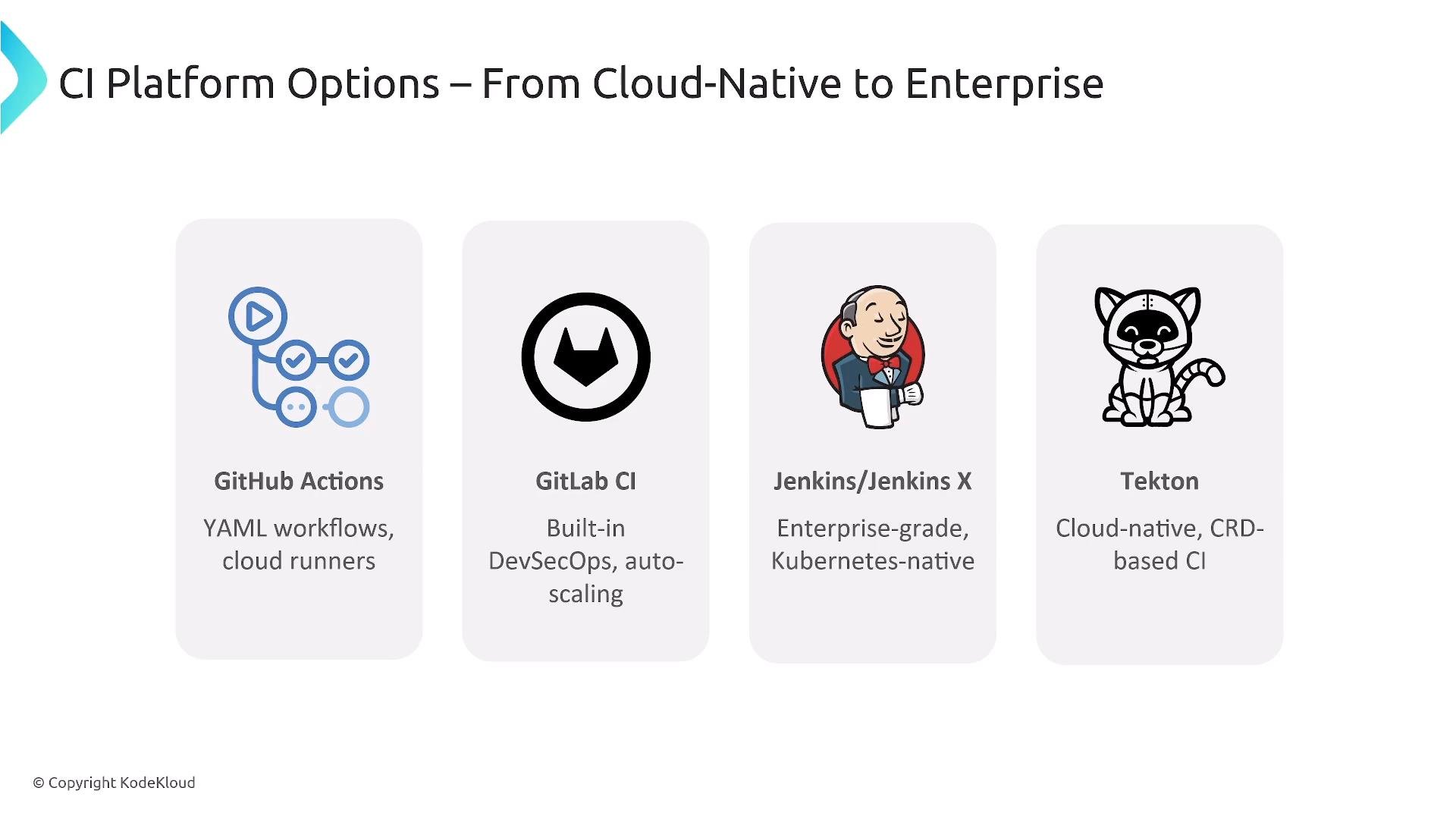 Platform options summary table
| Platform | Best fit / strengths | Learn more |
| - | - | - |
| GitHub Actions | Cloud-first, hosted runners, YAML workflows | [GitHub Actions docs](https://docs.github.com/actions) |
| GitLab CI | Integrated DevSecOps features, SaaS/on-prem options | [GitLab CI docs](https://docs.gitlab.com/ee/ci/) |
| Jenkins / Jenkins X | Highly extensible, often self-managed | [Jenkins](https://www.jenkins.io/) |
| Tekton | Kubernetes-native pipelines as CRDs — ideal for GitOps-based platform teams | [Tekton Pipelines](https://tekton.dev/) |
Tekton is particularly appealing for platform engineering teams adopting GitOps because pipelines are treated as declarative resources (CRDs), enabling pipeline lifecycle management with the same GitOps patterns used for application configuration.
Measuring CI effectiveness — KPIs
Track a focused set of KPIs to drive improvements in CI performance and developer experience:
Platform options summary table
| Platform | Best fit / strengths | Learn more |
| - | - | - |
| GitHub Actions | Cloud-first, hosted runners, YAML workflows | [GitHub Actions docs](https://docs.github.com/actions) |
| GitLab CI | Integrated DevSecOps features, SaaS/on-prem options | [GitLab CI docs](https://docs.gitlab.com/ee/ci/) |
| Jenkins / Jenkins X | Highly extensible, often self-managed | [Jenkins](https://www.jenkins.io/) |
| Tekton | Kubernetes-native pipelines as CRDs — ideal for GitOps-based platform teams | [Tekton Pipelines](https://tekton.dev/) |
Tekton is particularly appealing for platform engineering teams adopting GitOps because pipelines are treated as declarative resources (CRDs), enabling pipeline lifecycle management with the same GitOps patterns used for application configuration.
Measuring CI effectiveness — KPIs
Track a focused set of KPIs to drive improvements in CI performance and developer experience:
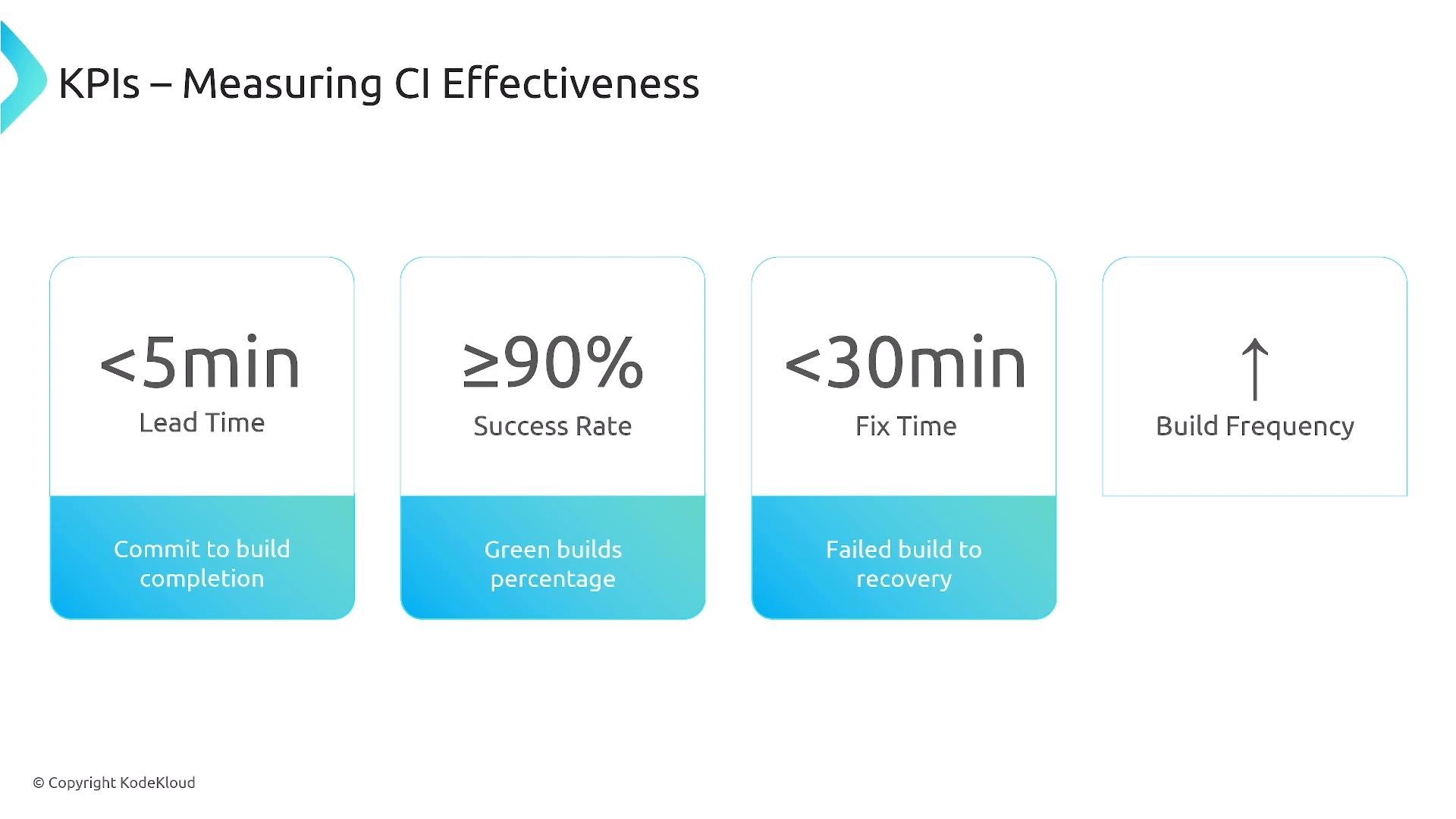 Key CI KPIs
| Metric | Target / Guideline |
| - | - |
| Lead time (commit → build completion) | Aim for \< 5 minutes for fast feedback on most changes |
| Success rate (green builds) | Target ≥ 90%; investigate common failure causes |
| Mean time to recover (failed build → fix) | Aim for \< 30 minutes |
| Build frequency | Higher frequency indicates smaller, safer change sets |
Optimize slow builds by splitting work, parallelizing tests, caching dependencies, and fixing flaky tests. Platform teams often surface these KPIs on dashboards (e.g., Grafana) to prioritize pipeline and test improvements.
Operational and platform best practices
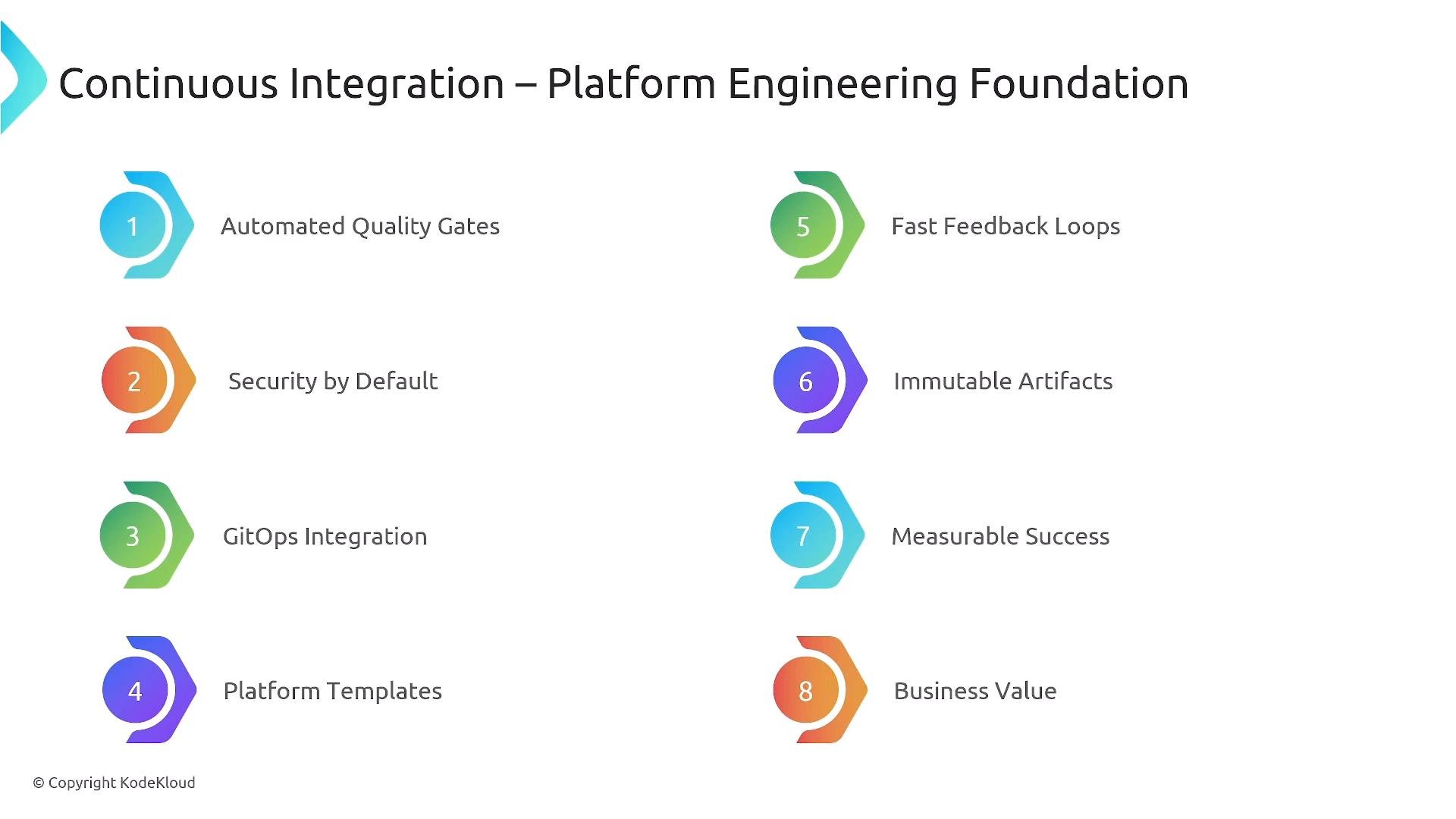
* Automate quality gates: linting, tests, and scans must be enforced by the CI pipeline.
* Security by default: embed policy-as-code and automated scanning into CI.
* GitOps-driven pipeline management: store pipeline definitions and templates in Git for auditability.
* Provide reusable templates: deliver application, infrastructure, and database templates to developer teams.
* Use immutable artifacts for traceability and reproducibility.
* Measure and iterate on KPIs to align CI with business outcomes.
Key CI KPIs
| Metric | Target / Guideline |
| - | - |
| Lead time (commit → build completion) | Aim for \< 5 minutes for fast feedback on most changes |
| Success rate (green builds) | Target ≥ 90%; investigate common failure causes |
| Mean time to recover (failed build → fix) | Aim for \< 30 minutes |
| Build frequency | Higher frequency indicates smaller, safer change sets |
Optimize slow builds by splitting work, parallelizing tests, caching dependencies, and fixing flaky tests. Platform teams often surface these KPIs on dashboards (e.g., Grafana) to prioritize pipeline and test improvements.
Operational and platform best practices
* Automate quality gates: linting, tests, and scans must be enforced by the CI pipeline.
* Security by default: embed policy-as-code and automated scanning into CI.
* GitOps-driven pipeline management: store pipeline definitions and templates in Git for auditability.
* Provide reusable templates: deliver application, infrastructure, and database templates to developer teams.
* Use immutable artifacts for traceability and reproducibility.
* Measure and iterate on KPIs to align CI with business outcomes.
 Guard secrets and credentials in CI: use the platform's secret-store features, rotate credentials regularly, and never hard-code secrets in pipeline definitions or repository files.
Next steps
* Study Continuous Delivery and GitOps fundamentals to learn how CI-produced artifacts are promoted and deployed across environments.
* Evaluate CI platforms against your team's operational model (hosted vs self-managed, Kubernetes-native, GitOps support).
* Start measuring the KPIs above and iterate to reduce lead time and improve reliability.
References and further reading
* [Continuous Integration (Wikipedia)](https://en.wikipedia.org/wiki/Continuous_integration)
* [GitHub Actions documentation](https://docs.github.com/actions)
* [GitLab CI documentation](https://docs.gitlab.com/ee/ci/)
* [Tekton Pipelines](https://tekton.dev/)
* [Jenkins project](https://www.jenkins.io/)
Thanks for reading.
This documentation is built and hosted on [Mintlify](https://mintlify.com), a developer documentation platform.
Guard secrets and credentials in CI: use the platform's secret-store features, rotate credentials regularly, and never hard-code secrets in pipeline definitions or repository files.
Next steps
* Study Continuous Delivery and GitOps fundamentals to learn how CI-produced artifacts are promoted and deployed across environments.
* Evaluate CI platforms against your team's operational model (hosted vs self-managed, Kubernetes-native, GitOps support).
* Start measuring the KPIs above and iterate to reduce lead time and improve reliability.
References and further reading
* [Continuous Integration (Wikipedia)](https://en.wikipedia.org/wiki/Continuous_integration)
* [GitHub Actions documentation](https://docs.github.com/actions)
* [GitLab CI documentation](https://docs.gitlab.com/ee/ci/)
* [Tekton Pipelines](https://tekton.dev/)
* [Jenkins project](https://www.jenkins.io/)
Thanks for reading.
This documentation is built and hosted on [Mintlify](https://mintlify.com), a developer documentation platform.