> ## Documentation Index
> Fetch the complete documentation index at: https://notes.kodekloud.com/llms.txt
> Use this file to discover all available pages before exploring further.
# Networking Considerations for Platform Engineers
> Networking guidance for platform engineers covering service exposure, Gateway API versus Ingress, discovery, observability, Zero Trust segmentation, multi cluster challenges, and resilient traffic management.
Welcome back. This lesson covers practical networking considerations for platform engineers: ingress vs. Gateway API, service types and discovery, traffic observability, segmentation, multi-cluster concerns, and patterns for resilient traffic management. We'll emphasize design approaches that enable observability, security, and self-service.
## Modern platform networking challenges
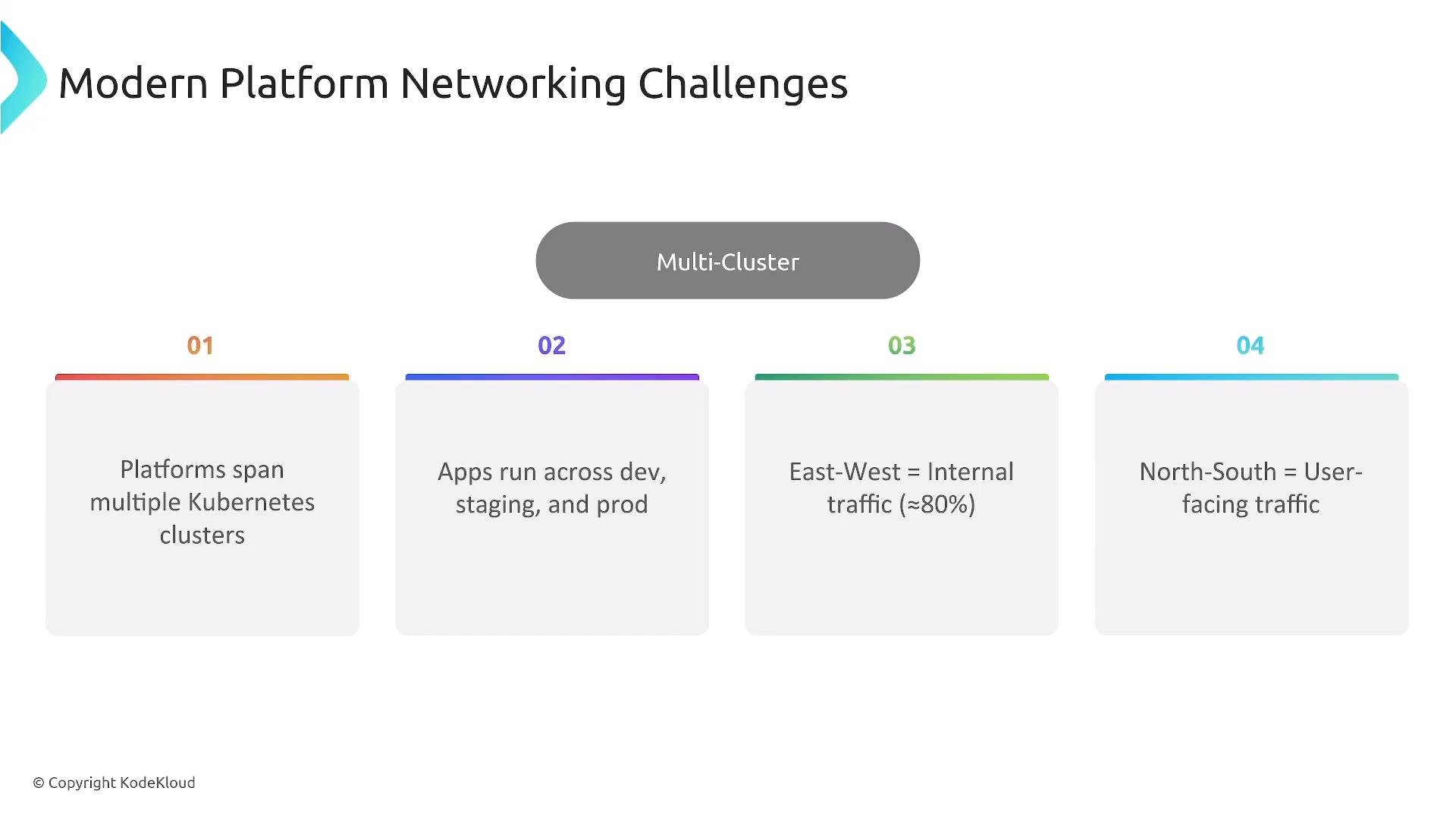
Platform networking is more complex today because workloads span clusters, environments, and traffic patterns (mostly east–west with north–south ingress). Observability at the network layer is critical for debugging, capacity planning, and security posture.
 ## Traffic observability and optimization
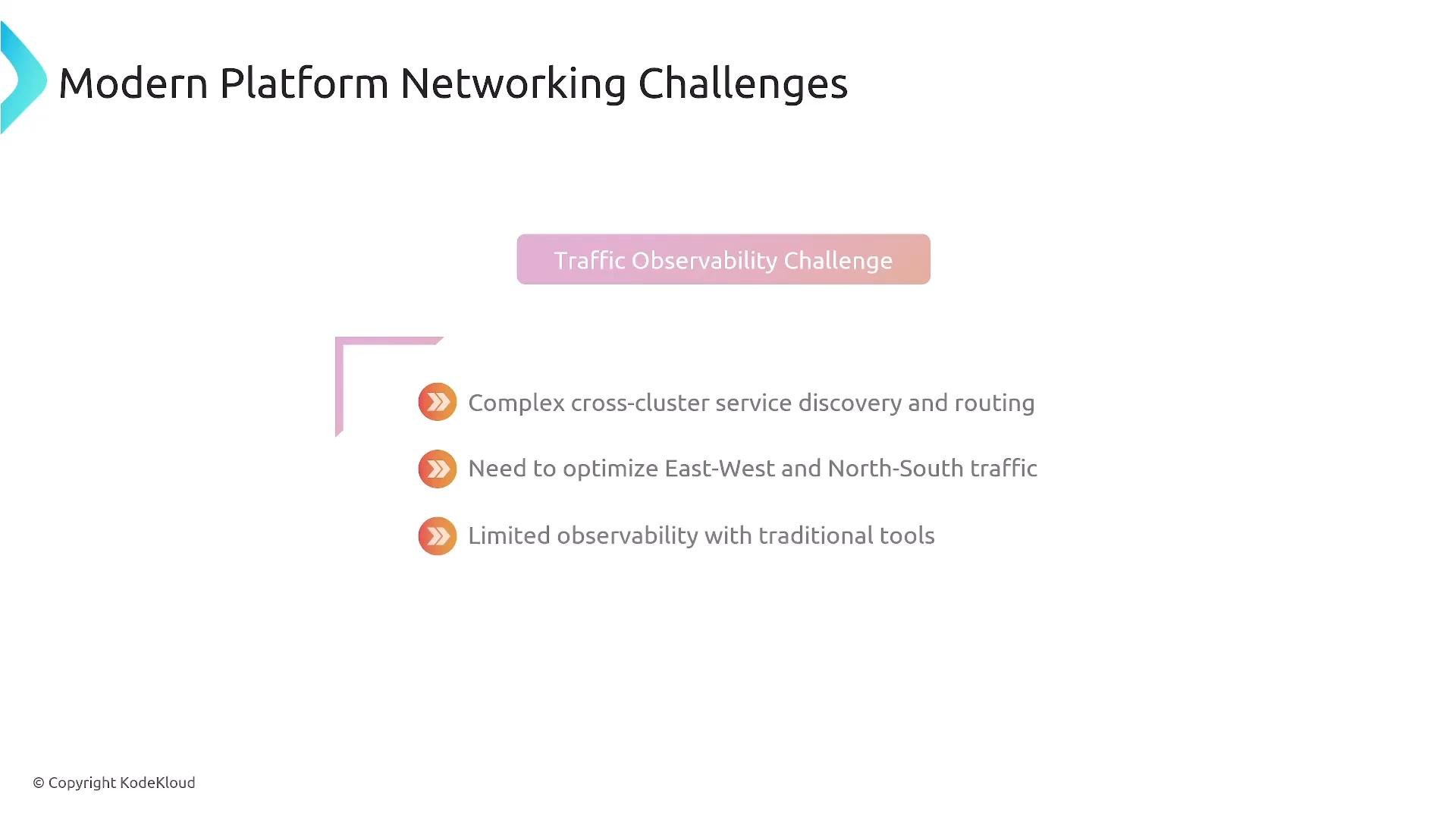
To optimize traffic (east–west and north–south) you must capture network-level logs, metrics, and traces across your routing topology. Extend existing monitoring tools to include network telemetry and distributed tracing to reason about routing complexity and performance bottlenecks.
## Traffic observability and optimization
To optimize traffic (east–west and north–south) you must capture network-level logs, metrics, and traces across your routing topology. Extend existing monitoring tools to include network telemetry and distributed tracing to reason about routing complexity and performance bottlenecks.
 ## Platform personas and requirements
In our example organization (Sparkle Pony Ranch) different personas require different platform responsibilities:
* Swati — focuses on SLAs, observability, and operational readiness.
* Alan — focuses on infrastructure efficiency and compliance.
* Phuong — wants self-service networking with sensible defaults and built-in security.
Design principle: enable application teams to self-serve routing and exposure while infrastructure teams enforce security and operational guardrails.
## Kubernetes service types and exposure options
Understand the trade-offs of each Kubernetes service type when exposing workloads:
| Service Type | Purpose | When to use | Example |
| - | - | - | - |
| ClusterIP | Internal-only service discovery | Default for internal services | `kubectl expose pod mypod --port=80 --target-port=8080` |
| NodePort | Expose a fixed port on each node | Quick dev/test or bare-metal setups; limited security | `kubectl expose deployment nginx --type=NodePort --port=80` |
| LoadBalancer | Cloud provider load balancer integration | Use when cloud LB is needed for ingress | Typically provisioned via `Service.type: LoadBalancer` |
| ExternalName | Map service to external DNS name | When a service resolves to an external hostname | `spec.externalName: example.com` |
| Ingress | L7 routing for HTTP(S) | Use Ingress controllers for L7 routing, TLS termination | Requires an Ingress Controller (NGINX, HAProxy, cloud ALB) |
Useful references:
* Kubernetes Services: [https://kubernetes.io/docs/concepts/services-networking/service/](https://kubernetes.io/docs/concepts/services-networking/service/)
* Ingress: [https://kubernetes.io/docs/concepts/services-networking/ingress/](https://kubernetes.io/docs/concepts/services-networking/ingress/)
## Service discovery in Kubernetes
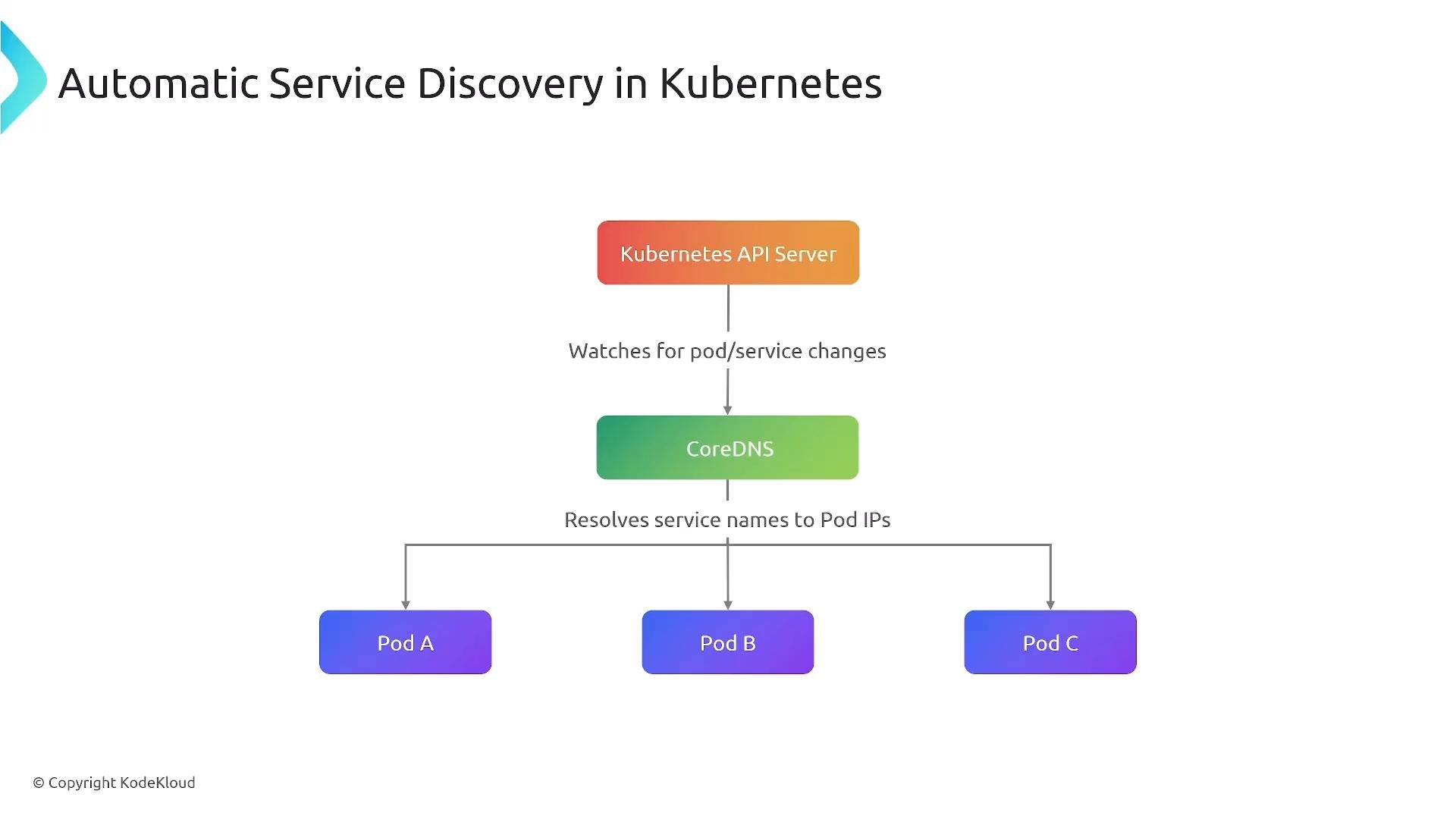
Kubernetes provides automated service discovery via DNS. CoreDNS watches the API server and serves DNS records for services so new services are reachable without manual configuration.
* Service FQDN pattern: `service.namespace.svc.cluster.local`
* CoreDNS resolves service names to the Service cluster IP and endpoints.
## Platform personas and requirements
In our example organization (Sparkle Pony Ranch) different personas require different platform responsibilities:
* Swati — focuses on SLAs, observability, and operational readiness.
* Alan — focuses on infrastructure efficiency and compliance.
* Phuong — wants self-service networking with sensible defaults and built-in security.
Design principle: enable application teams to self-serve routing and exposure while infrastructure teams enforce security and operational guardrails.
## Kubernetes service types and exposure options
Understand the trade-offs of each Kubernetes service type when exposing workloads:
| Service Type | Purpose | When to use | Example |
| - | - | - | - |
| ClusterIP | Internal-only service discovery | Default for internal services | `kubectl expose pod mypod --port=80 --target-port=8080` |
| NodePort | Expose a fixed port on each node | Quick dev/test or bare-metal setups; limited security | `kubectl expose deployment nginx --type=NodePort --port=80` |
| LoadBalancer | Cloud provider load balancer integration | Use when cloud LB is needed for ingress | Typically provisioned via `Service.type: LoadBalancer` |
| ExternalName | Map service to external DNS name | When a service resolves to an external hostname | `spec.externalName: example.com` |
| Ingress | L7 routing for HTTP(S) | Use Ingress controllers for L7 routing, TLS termination | Requires an Ingress Controller (NGINX, HAProxy, cloud ALB) |
Useful references:
* Kubernetes Services: [https://kubernetes.io/docs/concepts/services-networking/service/](https://kubernetes.io/docs/concepts/services-networking/service/)
* Ingress: [https://kubernetes.io/docs/concepts/services-networking/ingress/](https://kubernetes.io/docs/concepts/services-networking/ingress/)
## Service discovery in Kubernetes
Kubernetes provides automated service discovery via DNS. CoreDNS watches the API server and serves DNS records for services so new services are reachable without manual configuration.
* Service FQDN pattern: `service.namespace.svc.cluster.local`
* CoreDNS resolves service names to the Service cluster IP and endpoints.
 Example Service manifest (YAML)
```yaml theme={null}
apiVersion: v1
kind: Service
metadata:
name: pony-spawner
namespace: magical-creatures
spec:
selector:
app: pony-spawner
ports:
- port: 80
targetPort: 8080
```
The service FQDN would be:
`pony-spawner.magical-creatures.svc.cluster.local`
Understand conceptually how DNS and CoreDNS enable service discovery in Kubernetes (service FQDNs and how services resolve to endpoints). You don't need to memorize every internal detail, but know the role CoreDNS plays.
## Layer 7 ingress controllers and their limitations
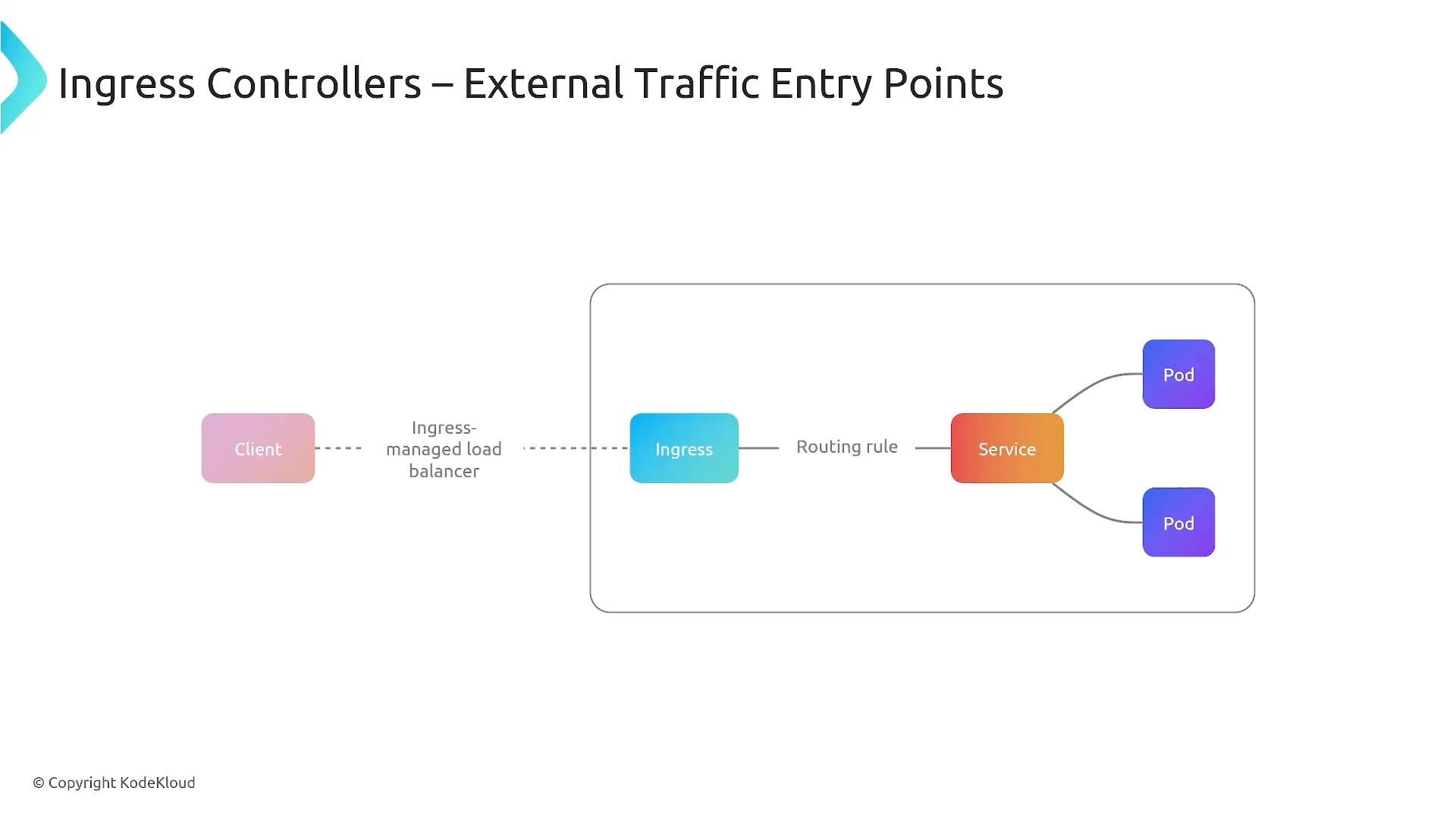
Ingress controllers provide L7 routing (HTTP/S) and commonly sit behind cloud or external load balancers.
Typical flow:
client → external load balancer → Ingress controller → Service → Pod
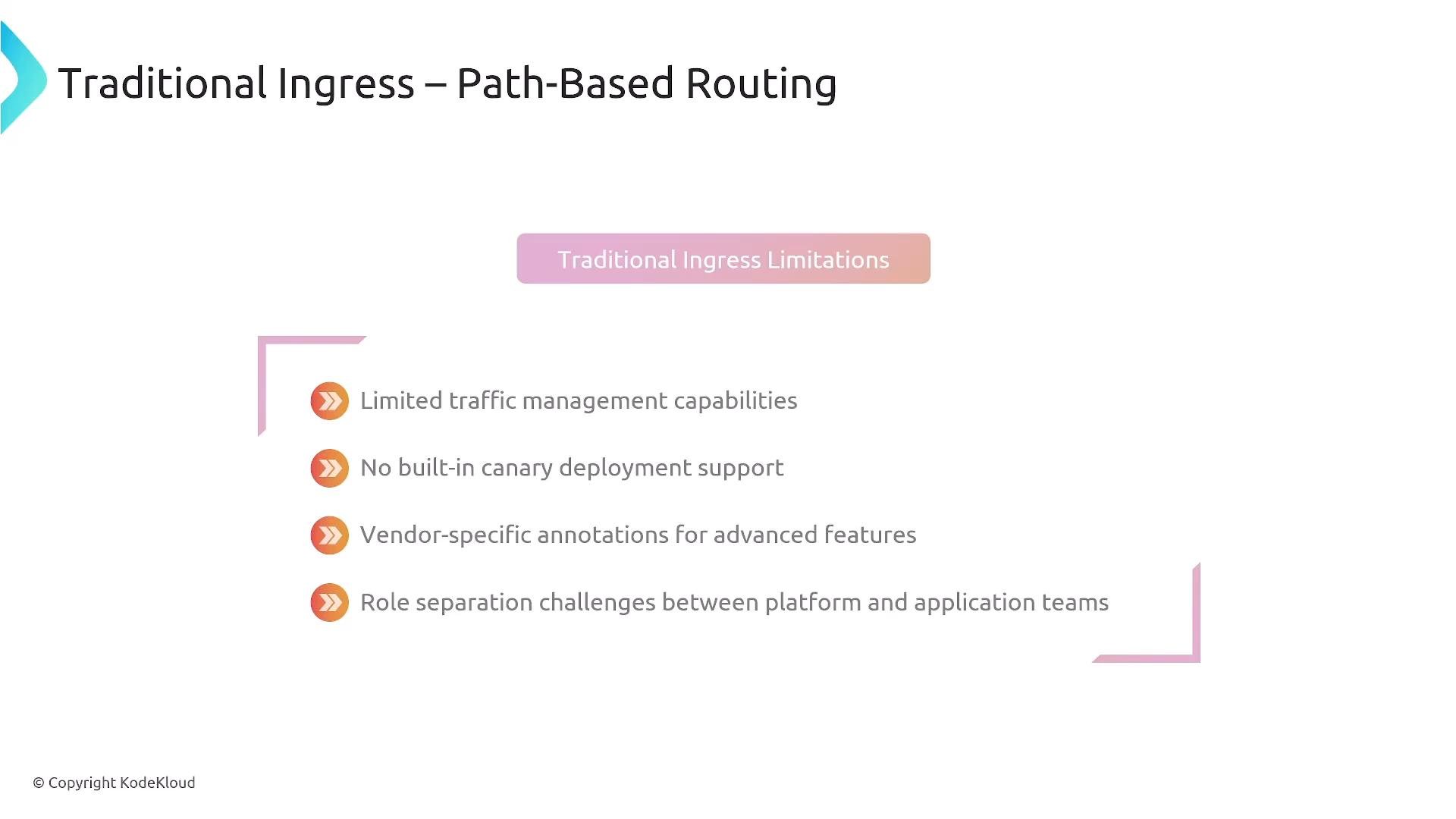
Common limitations:
* Limited or inconsistent traffic management (no native canary support).
* Advanced features often require vendor-specific annotations (reduces portability).
* Role separation between platform and application teams can be challenging.
Example Service manifest (YAML)
```yaml theme={null}
apiVersion: v1
kind: Service
metadata:
name: pony-spawner
namespace: magical-creatures
spec:
selector:
app: pony-spawner
ports:
- port: 80
targetPort: 8080
```
The service FQDN would be:
`pony-spawner.magical-creatures.svc.cluster.local`
Understand conceptually how DNS and CoreDNS enable service discovery in Kubernetes (service FQDNs and how services resolve to endpoints). You don't need to memorize every internal detail, but know the role CoreDNS plays.
## Layer 7 ingress controllers and their limitations
Ingress controllers provide L7 routing (HTTP/S) and commonly sit behind cloud or external load balancers.
Typical flow:
client → external load balancer → Ingress controller → Service → Pod
Common limitations:
* Limited or inconsistent traffic management (no native canary support).
* Advanced features often require vendor-specific annotations (reduces portability).
* Role separation between platform and application teams can be challenging.
 ## Gateway API — richer, role-based routing
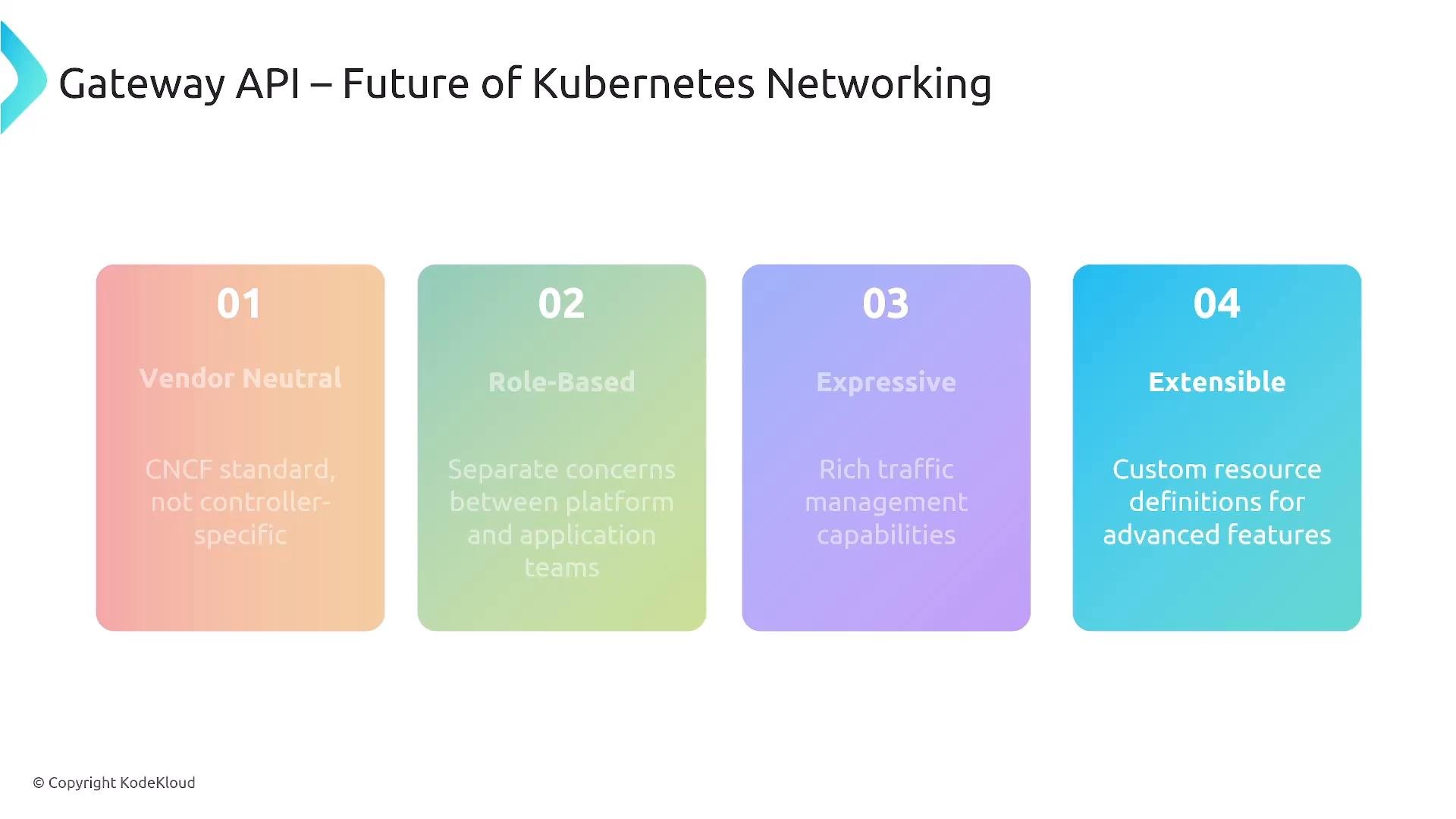
Gateway API is a newer, vendor-neutral Kubernetes API for expressive, role-based L4/L7 routing. It solves many of the limitations of traditional Ingress by separating responsibilities and providing richer traffic controls.
Benefits:
* Role separation: platform defines GatewayClass and Gateways; apps define HTTPRoute or equivalent.
* Rich traffic management: header-based routing, traffic splitting, request transforms, TLS policies.
* Extensibility: vendor-specific features via attachments while preserving portability.
Learn more: Gateway API spec — [https://gateway-api.sigs.k8s.io/](https://gateway-api.sigs.k8s.io/)
## Gateway API — richer, role-based routing
Gateway API is a newer, vendor-neutral Kubernetes API for expressive, role-based L4/L7 routing. It solves many of the limitations of traditional Ingress by separating responsibilities and providing richer traffic controls.
Benefits:
* Role separation: platform defines GatewayClass and Gateways; apps define HTTPRoute or equivalent.
* Rich traffic management: header-based routing, traffic splitting, request transforms, TLS policies.
* Extensibility: vendor-specific features via attachments while preserving portability.
Learn more: Gateway API spec — [https://gateway-api.sigs.k8s.io/](https://gateway-api.sigs.k8s.io/)
 ## Role-based model in Gateway API
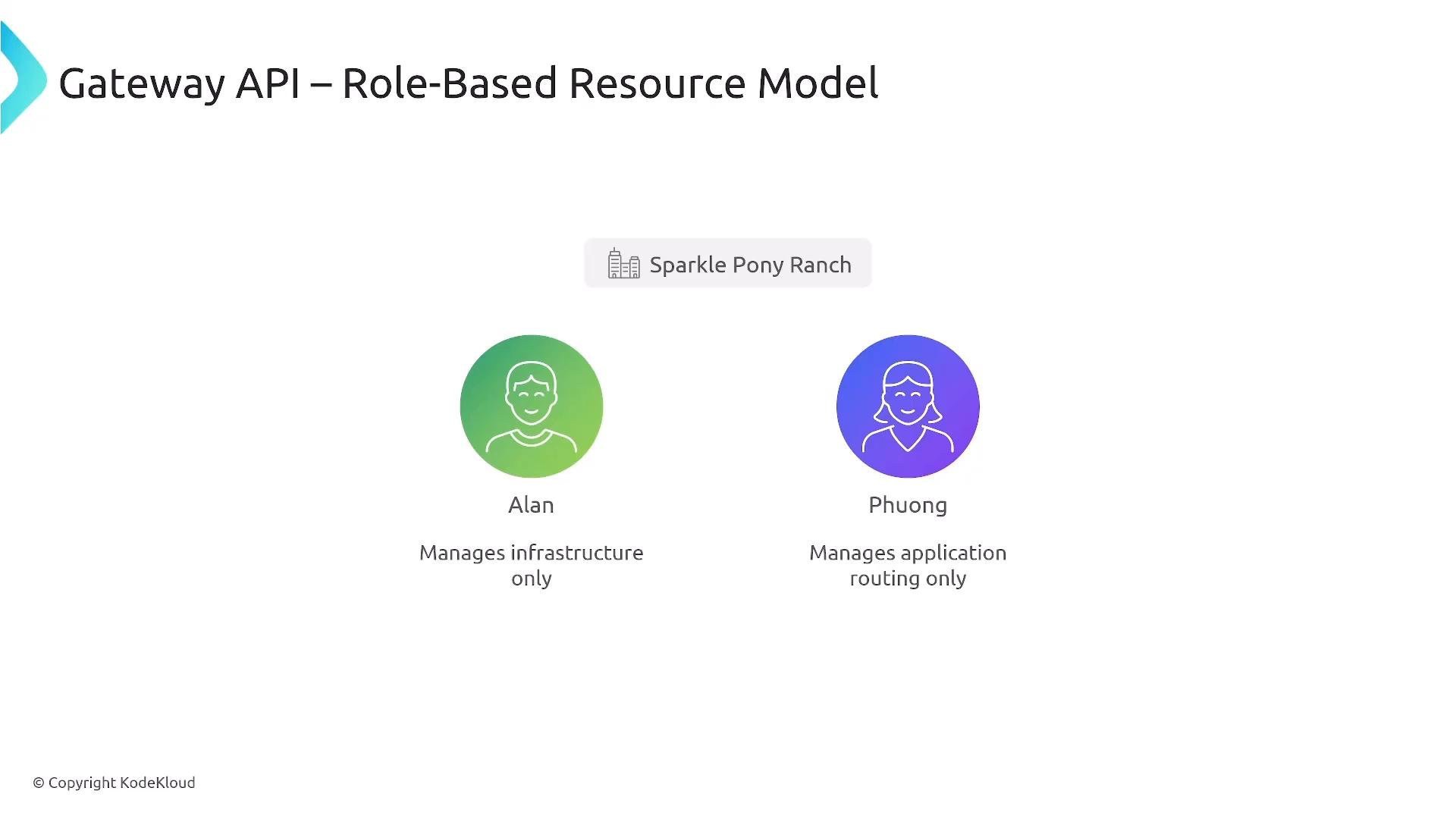
The Gateway API encourages platform-infrastructure separation:
* Platform teams: create GatewayClass and provision Gateways with listeners, protocols, TLS settings.
* Application teams: create HTTPRoute (or TCPRoute, TLSRoute) and attach/claim these routes to a Gateway to express application-level routing.
* Infrastructure can enforce backend TLS policies, routing constraints, and security guardrails while developers control application-specific routes.
## Role-based model in Gateway API
The Gateway API encourages platform-infrastructure separation:
* Platform teams: create GatewayClass and provision Gateways with listeners, protocols, TLS settings.
* Application teams: create HTTPRoute (or TCPRoute, TLSRoute) and attach/claim these routes to a Gateway to express application-level routing.
* Infrastructure can enforce backend TLS policies, routing constraints, and security guardrails while developers control application-specific routes.
 ## Advanced traffic management with Gateway API
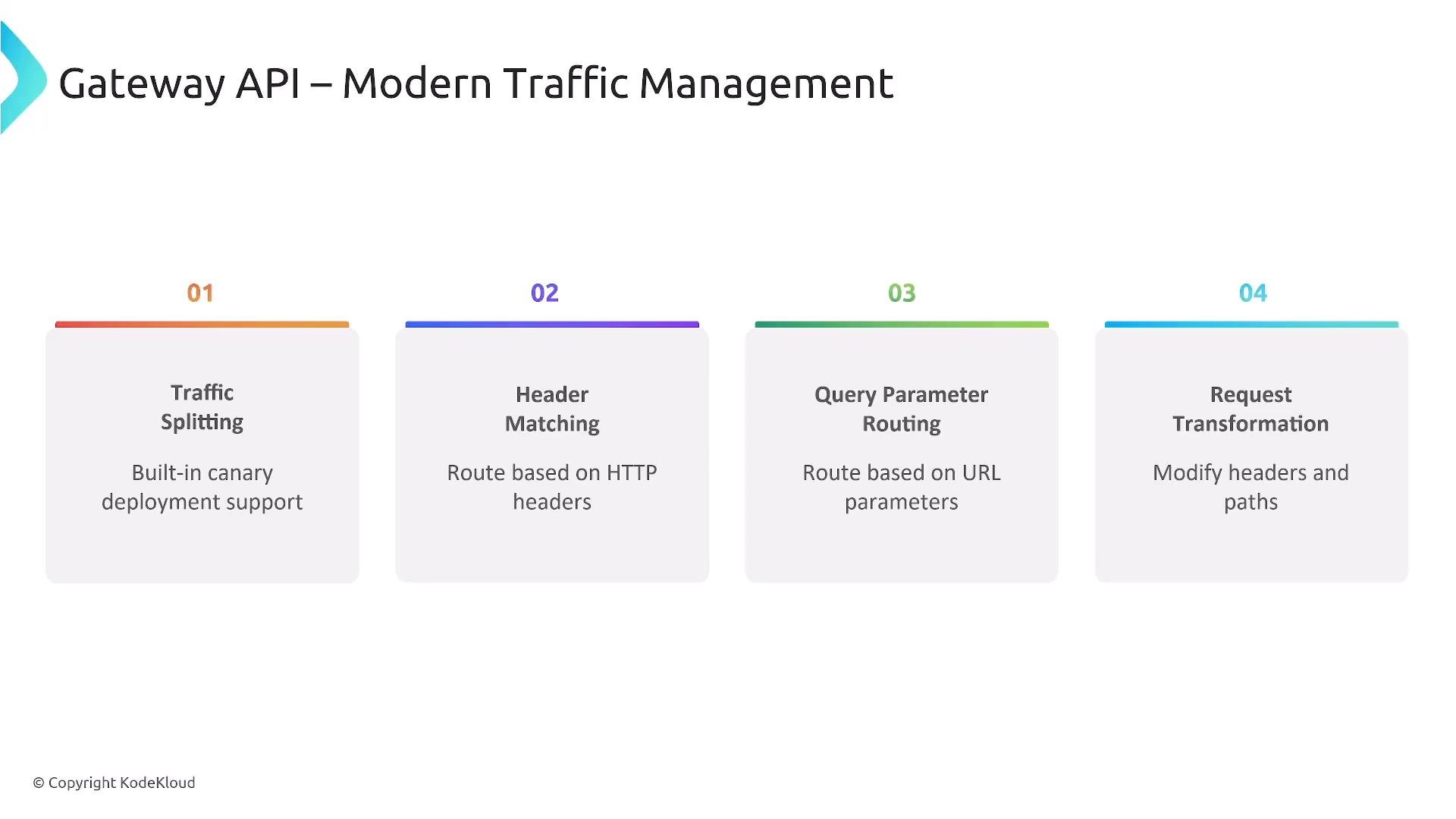
Gateway API supports built-in capabilities needed for modern release strategies:
* Traffic splitting for canaries and progressive rollouts.
* Header-based routing (A/B testing, multi-tenancy headers).
* Query-parameter routing and request/response transformations.
* Fine-grained TLS configuration per listener and backend.
## Advanced traffic management with Gateway API
Gateway API supports built-in capabilities needed for modern release strategies:
* Traffic splitting for canaries and progressive rollouts.
* Header-based routing (A/B testing, multi-tenancy headers).
* Query-parameter routing and request/response transformations.
* Fine-grained TLS configuration per listener and backend.
 ## Service mesh and integration
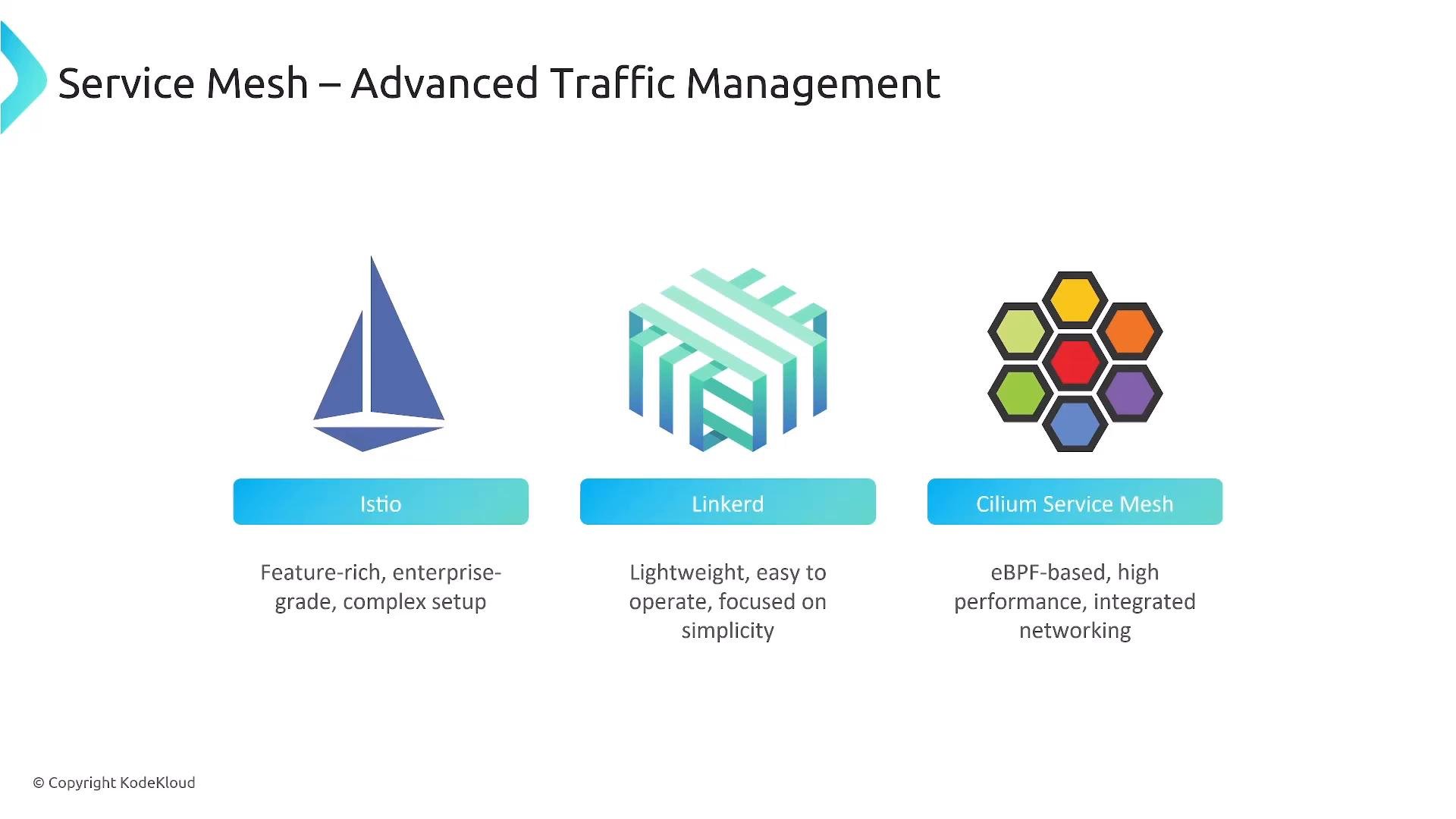
Gateway API can complement or integrate with service meshes (Istio, Linkerd, Envoy, Cilium) depending on needs. Choose a mesh when you require:
* mTLS identity and workload identity features
* Advanced telemetry and tracing
* Circuit breaking, retries, and rich L7 policies
* Complex cross-cluster routing and telemetry correlation
References:
* Istio: [https://istio.io/](https://istio.io/)
* Linkerd: [https://linkerd.io/](https://linkerd.io/)
* Cilium: [https://cilium.io/](https://cilium.io/)
## Service mesh and integration
Gateway API can complement or integrate with service meshes (Istio, Linkerd, Envoy, Cilium) depending on needs. Choose a mesh when you require:
* mTLS identity and workload identity features
* Advanced telemetry and tracing
* Circuit breaking, retries, and rich L7 policies
* Complex cross-cluster routing and telemetry correlation
References:
* Istio: [https://istio.io/](https://istio.io/)
* Linkerd: [https://linkerd.io/](https://linkerd.io/)
* Cilium: [https://cilium.io/](https://cilium.io/)
 ## Network segmentation and Zero Trust
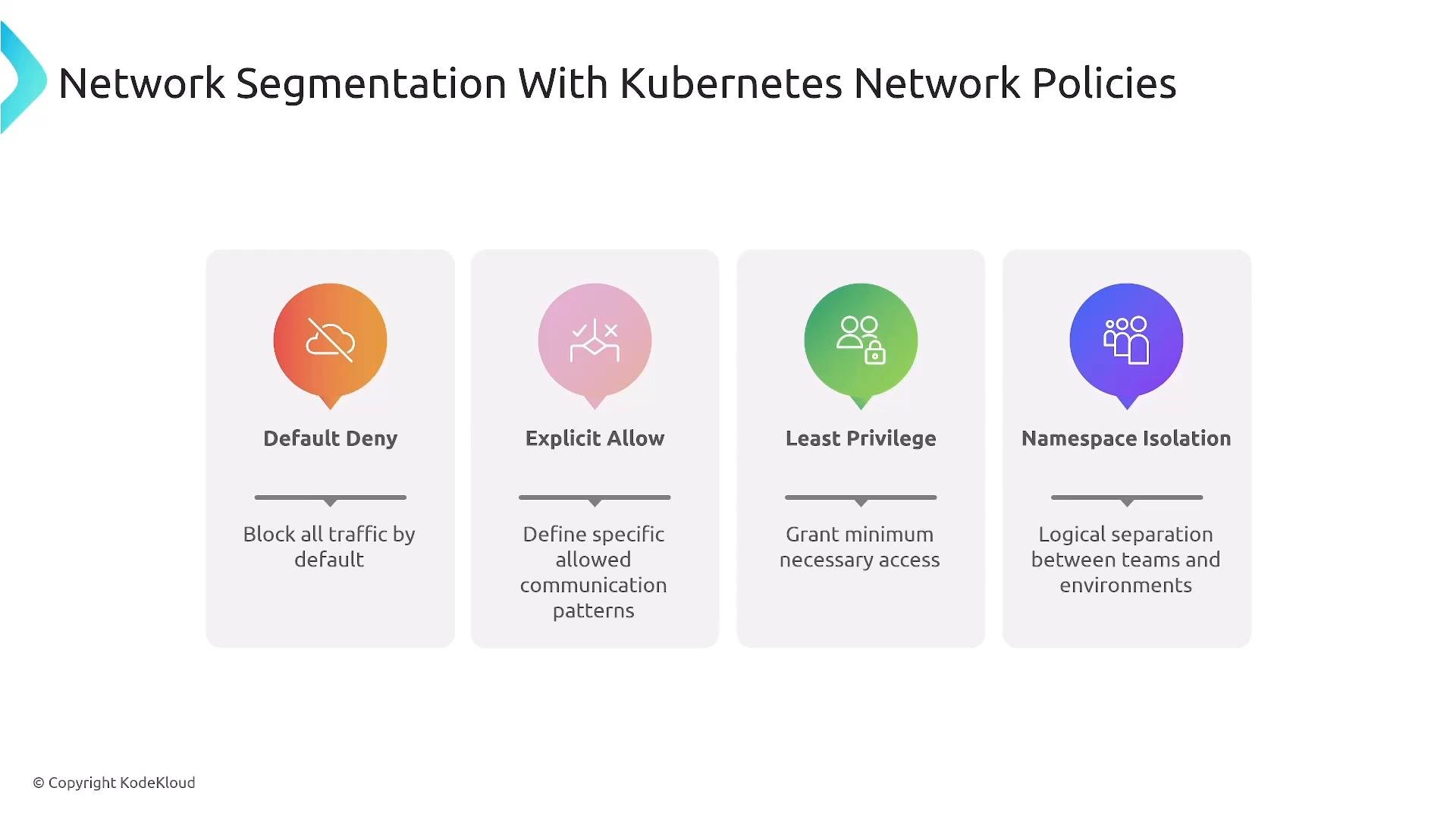
Adopt Zero Trust networking principles in Kubernetes:
* Default-deny by default and explicitly allow required flows.
* Least privilege: grant minimal access between namespaces and services.
* Micro-segmentation: use NetworkPolicies, service mesh policies, or CNI capabilities to isolate workloads.
Practical controls: Kubernetes NetworkPolicies, Cilium Network Policies, and service-mesh-level authorization.
## Network segmentation and Zero Trust
Adopt Zero Trust networking principles in Kubernetes:
* Default-deny by default and explicitly allow required flows.
* Least privilege: grant minimal access between namespaces and services.
* Micro-segmentation: use NetworkPolicies, service mesh policies, or CNI capabilities to isolate workloads.
Practical controls: Kubernetes NetworkPolicies, Cilium Network Policies, and service-mesh-level authorization.
 ## Cross-cluster communication concerns
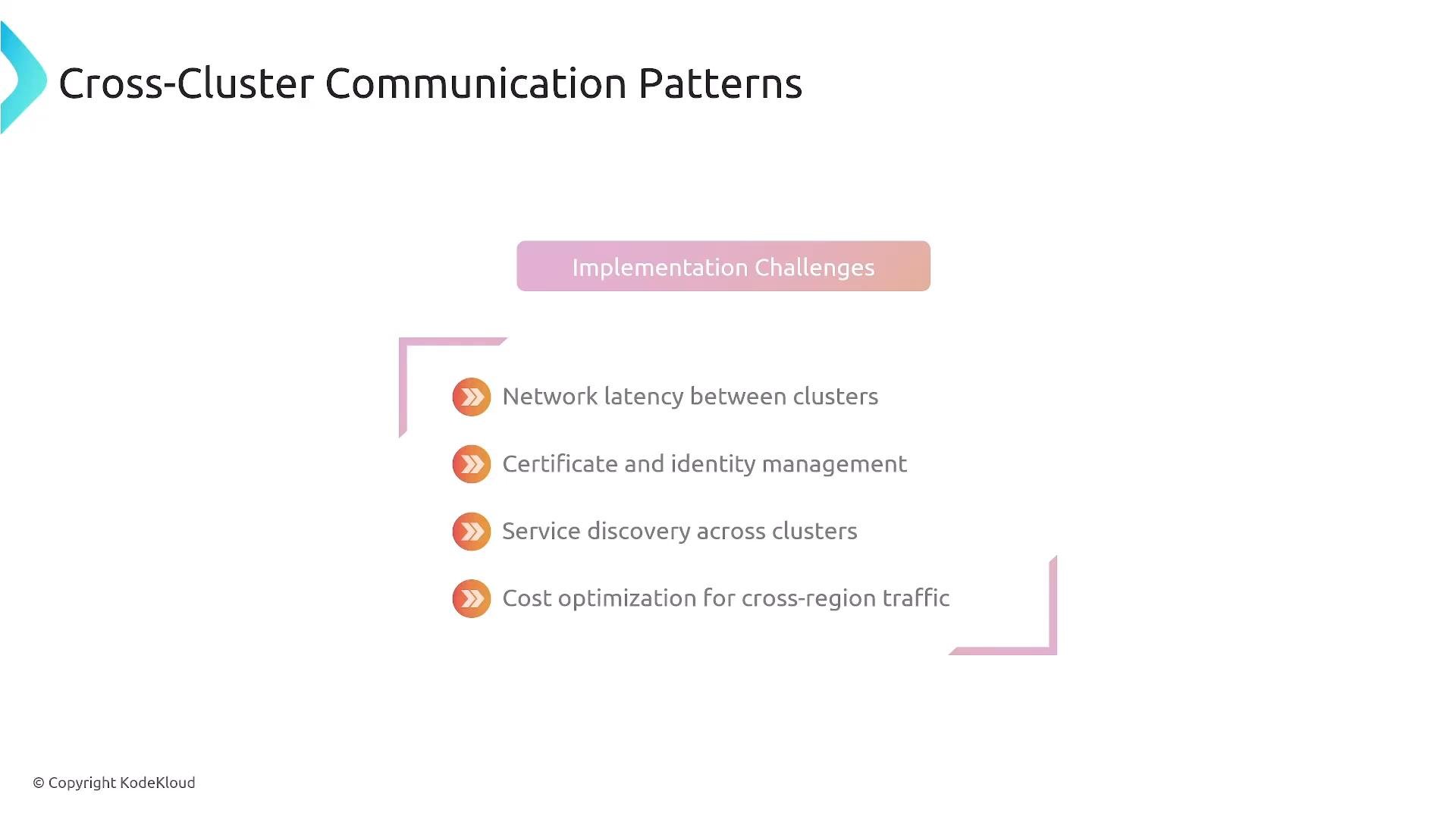
Multi-cluster and geo-distributed workloads introduce additional challenges:
* Network latency and throughput between clusters
* Certificate and identity management across clusters
* Multi-cluster service discovery and failover strategies
* Cost considerations for cross-region data transfer
Tools and patterns: Cilium multi-cluster, Istio multi-cluster, Submariner for cross-cluster networking, and cloud provider networking solutions.
## Cross-cluster communication concerns
Multi-cluster and geo-distributed workloads introduce additional challenges:
* Network latency and throughput between clusters
* Certificate and identity management across clusters
* Multi-cluster service discovery and failover strategies
* Cost considerations for cross-region data transfer
Tools and patterns: Cilium multi-cluster, Istio multi-cluster, Submariner for cross-cluster networking, and cloud provider networking solutions.
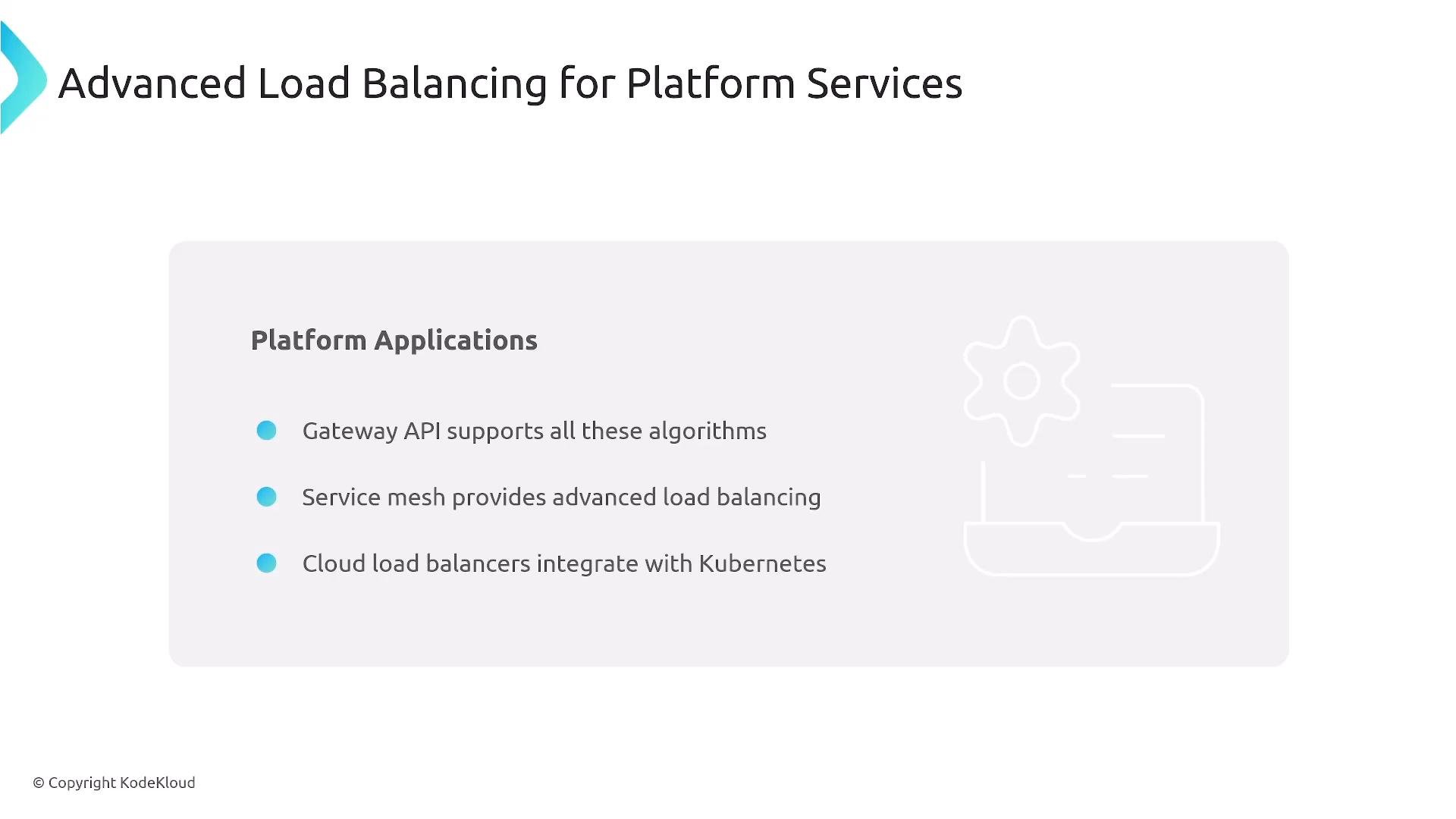
 ## Advanced load balancing and resiliency
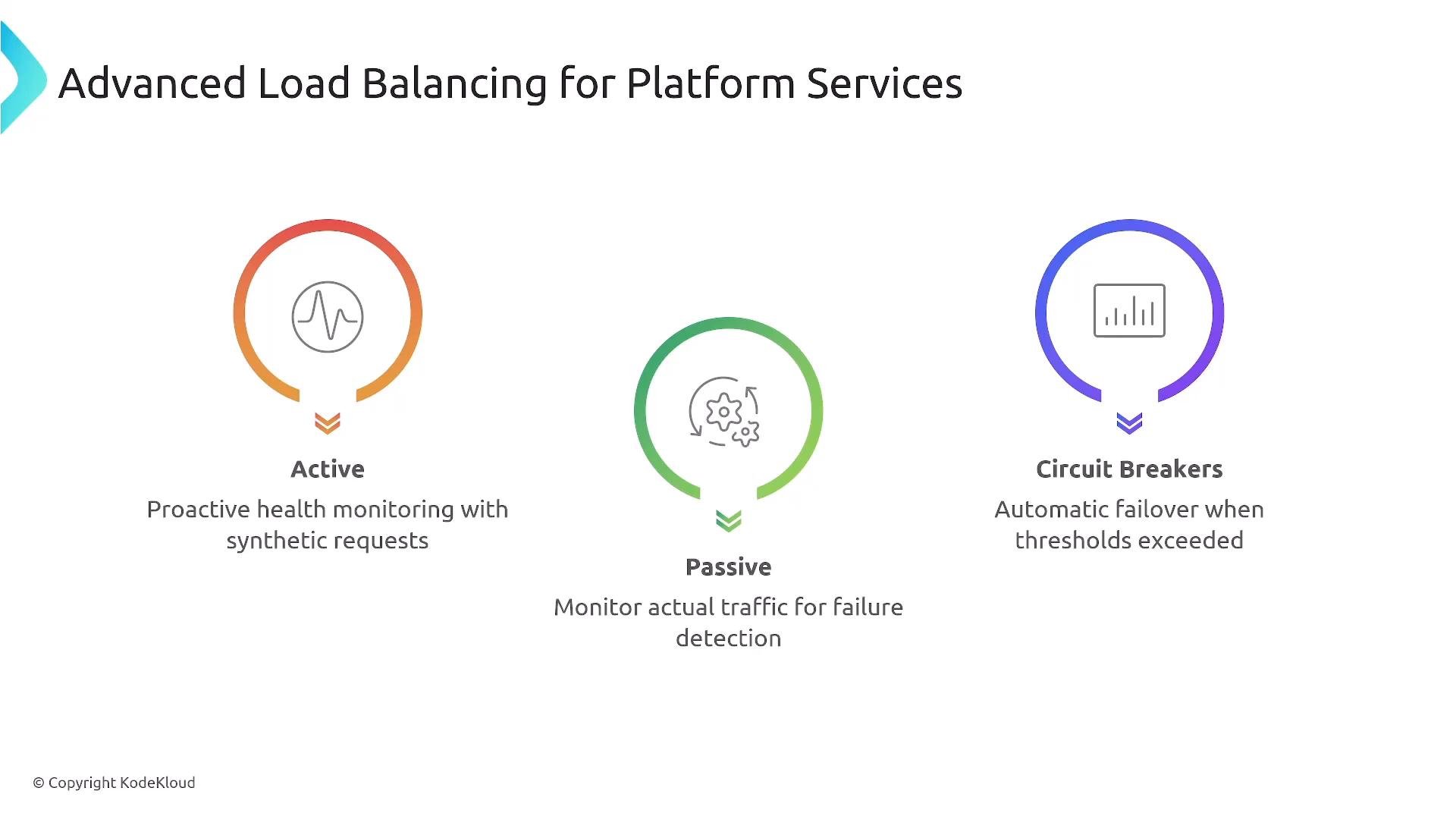
Design resilient traffic handling with a mix of active and passive checks, circuit breakers, and retry policies.
* Active health checks: periodic probes to endpoints.
* Passive health checks: observe failed requests and mark endpoints unhealthy.
* Circuit breakers and retry budgets: prevent cascading failures.
Service meshes and modern load balancers provide these capabilities; evaluate service mesh vs. cloud LB trade-offs based on features and operational cost.
## Advanced load balancing and resiliency
Design resilient traffic handling with a mix of active and passive checks, circuit breakers, and retry policies.
* Active health checks: periodic probes to endpoints.
* Passive health checks: observe failed requests and mark endpoints unhealthy.
* Circuit breakers and retry budgets: prevent cascading failures.
Service meshes and modern load balancers provide these capabilities; evaluate service mesh vs. cloud LB trade-offs based on features and operational cost.
 ## Deployment patterns that affect networking
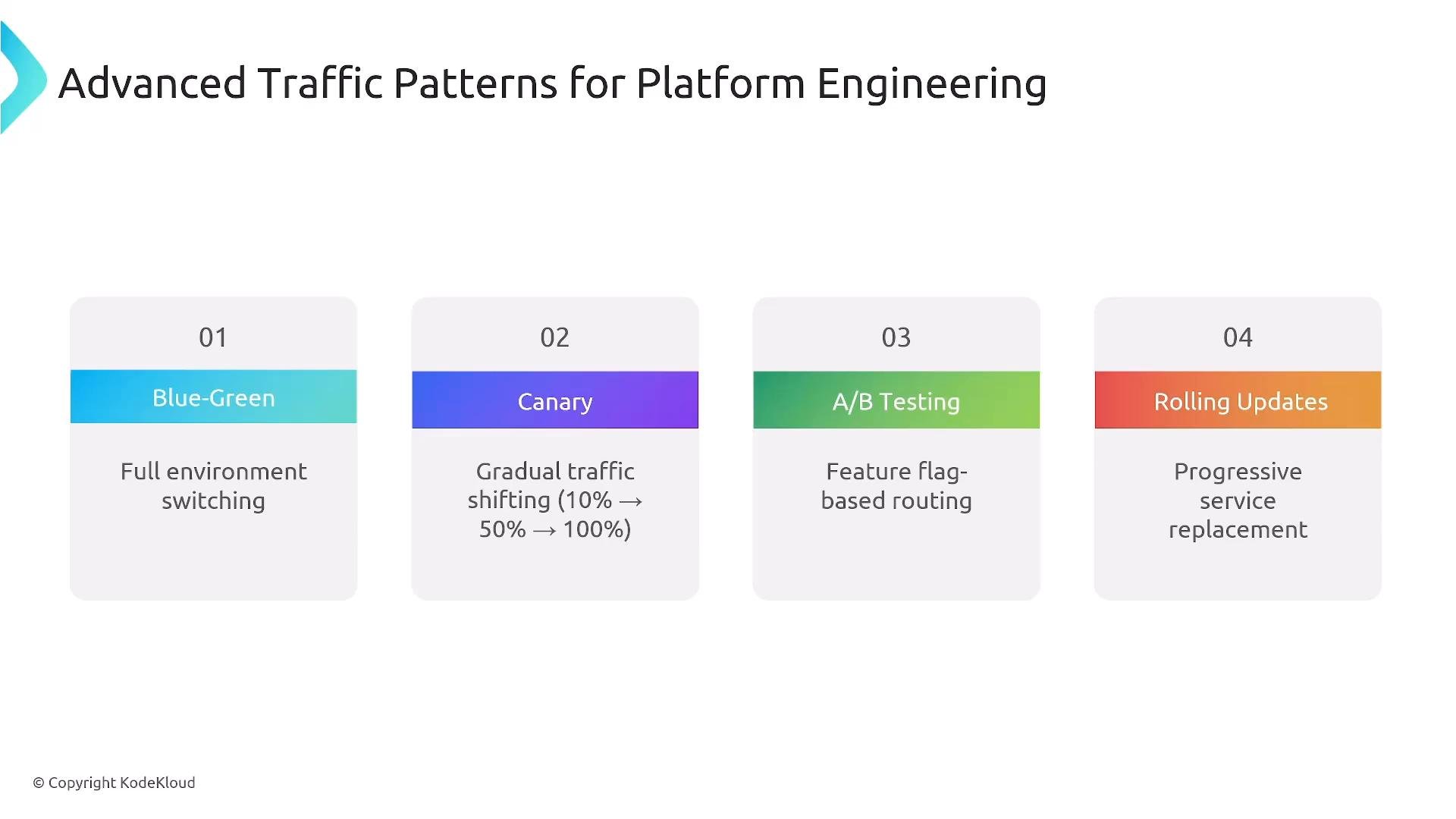
Traffic management patterns influence how you design routing and observability.
| Pattern | Purpose | How Gateway API / Mesh helps |
| - | - | - |
| Blue-Green | Switch traffic between full environments | Route switching via Gateways or external LBs |
| Canary | Gradual traffic shift to new versions | Traffic splitting, weight-based routes |
| A/B Testing | Route user subsets to features | Header/query routing and split rules |
| Rolling Updates | Zero-downtime pod replacement | Service + readiness probes + mesh-aware routing |
## Deployment patterns that affect networking
Traffic management patterns influence how you design routing and observability.
| Pattern | Purpose | How Gateway API / Mesh helps |
| - | - | - |
| Blue-Green | Switch traffic between full environments | Route switching via Gateways or external LBs |
| Canary | Gradual traffic shift to new versions | Traffic splitting, weight-based routes |
| A/B Testing | Route user subsets to features | Header/query routing and split rules |
| Rolling Updates | Zero-downtime pod replacement | Service + readiness probes + mesh-aware routing |
 ## Key takeaways for platform engineers
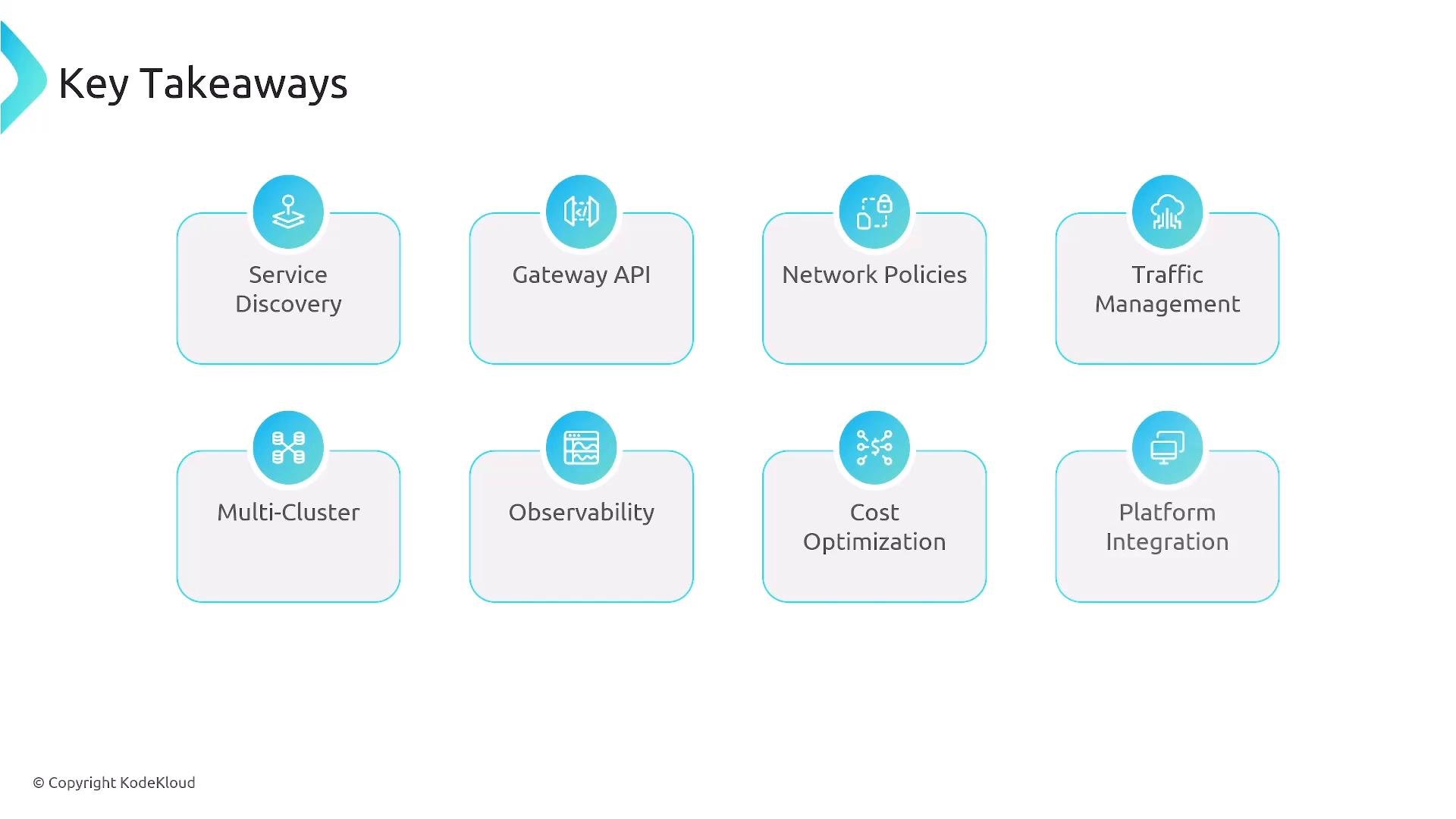
* Service discovery is fundamental: Kubernetes + CoreDNS provides FQDN-based service resolution.
* Gateway API provides role-based, portable L4/L7 routing and richer traffic management than traditional Ingress.
* Enforce Zero Trust: default-deny policies, explicit allows, and least privilege segmentation.
* Use canary, blue-green, A/B testing, and rolling updates for safer deployments; Gateway API and service meshes simplify implementation.
* Plan for multi-cluster and cross-region challenges (latency, identity federation, discovery, cost).
* Observability is essential: ensure network-level telemetry (logs, metrics, traces) for troubleshooting and capacity planning.
* Balance cost vs. complexity when choosing between Ingress, Gateway API, and a full service mesh.
## Key takeaways for platform engineers
* Service discovery is fundamental: Kubernetes + CoreDNS provides FQDN-based service resolution.
* Gateway API provides role-based, portable L4/L7 routing and richer traffic management than traditional Ingress.
* Enforce Zero Trust: default-deny policies, explicit allows, and least privilege segmentation.
* Use canary, blue-green, A/B testing, and rolling updates for safer deployments; Gateway API and service meshes simplify implementation.
* Plan for multi-cluster and cross-region challenges (latency, identity federation, discovery, cost).
* Observability is essential: ensure network-level telemetry (logs, metrics, traces) for troubleshooting and capacity planning.
* Balance cost vs. complexity when choosing between Ingress, Gateway API, and a full service mesh.
 ## Final thoughts
Design platforms to be as self-service as possible while enforcing security and operational boundaries. Abstract networking complexity from developers but expose role-based controls (routes, traffic rules) via APIs like Gateway API. Carefully weigh feature needs, operational complexity, and cost when selecting between Ingress controllers, Gateway API, and service meshes.
Thanks — stay engaged and apply these principles when designing real-world platform networking.
This documentation is built and hosted on [Mintlify](https://mintlify.com), a developer documentation platform.
## Final thoughts
Design platforms to be as self-service as possible while enforcing security and operational boundaries. Abstract networking complexity from developers but expose role-based controls (routes, traffic rules) via APIs like Gateway API. Carefully weigh feature needs, operational complexity, and cost when selecting between Ingress controllers, Gateway API, and service meshes.
Thanks — stay engaged and apply these principles when designing real-world platform networking.
This documentation is built and hosted on [Mintlify](https://mintlify.com), a developer documentation platform.