> ## Documentation Index
> Fetch the complete documentation index at: https://notes.kodekloud.com/llms.txt
> Use this file to discover all available pages before exploring further.
# Policy Engines Governance
> Overview of policy-as-code and policy engines like OPA Gatekeeper and Kyverno for automated governance admission control validation mutation and GitOps integration for secure scalable platform compliance
Welcome back, students.
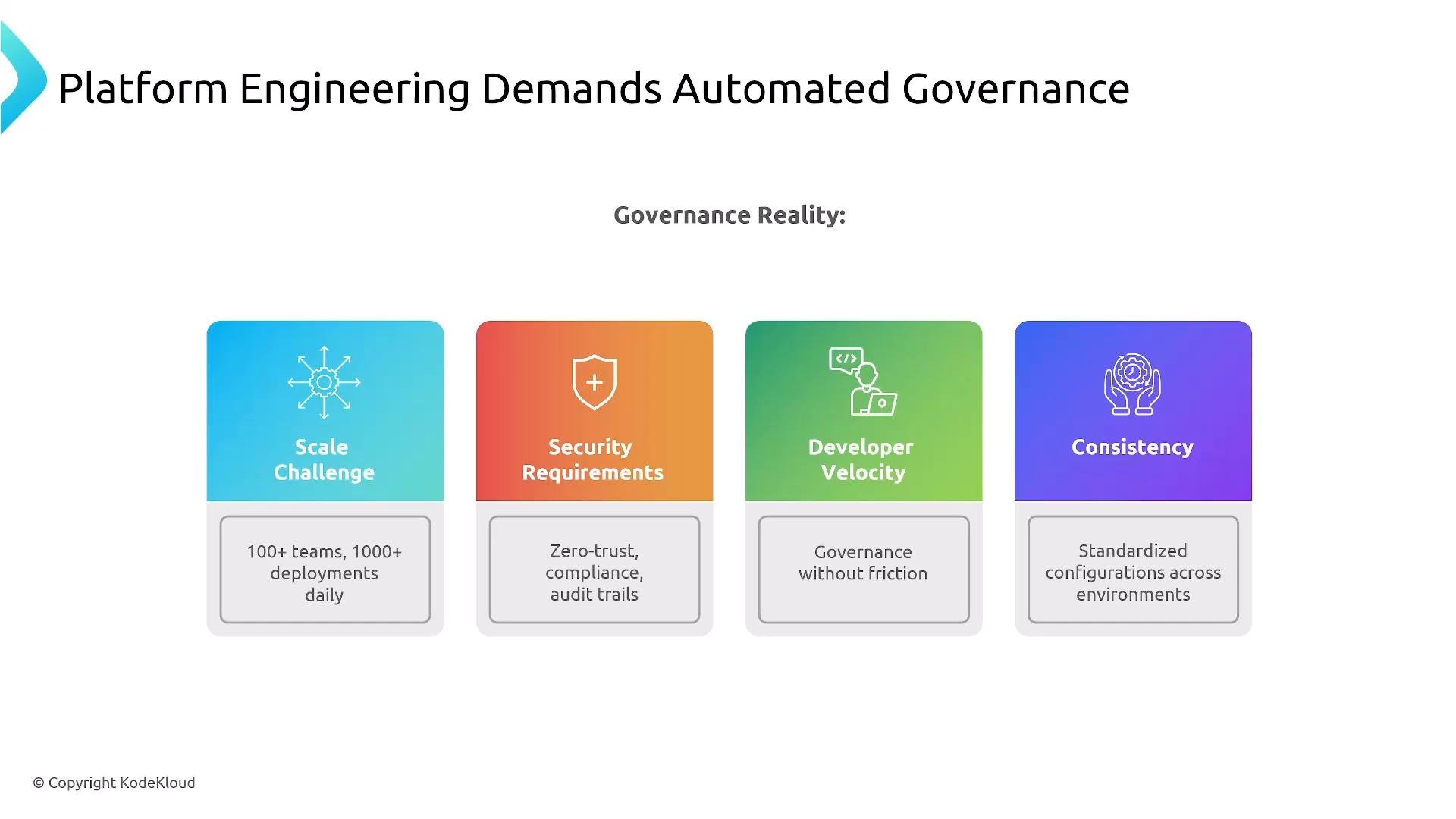
In this lesson/article we'll cover platform engineering practices for policy engines and automated governance. We'll skim core concepts such as policy-as-code, OPA, Gatekeeper, and Kyverno, and explain how modern platform teams automate security and compliance at scale. This topic focuses on automated governance.
 Why traditional governance doesn't scale
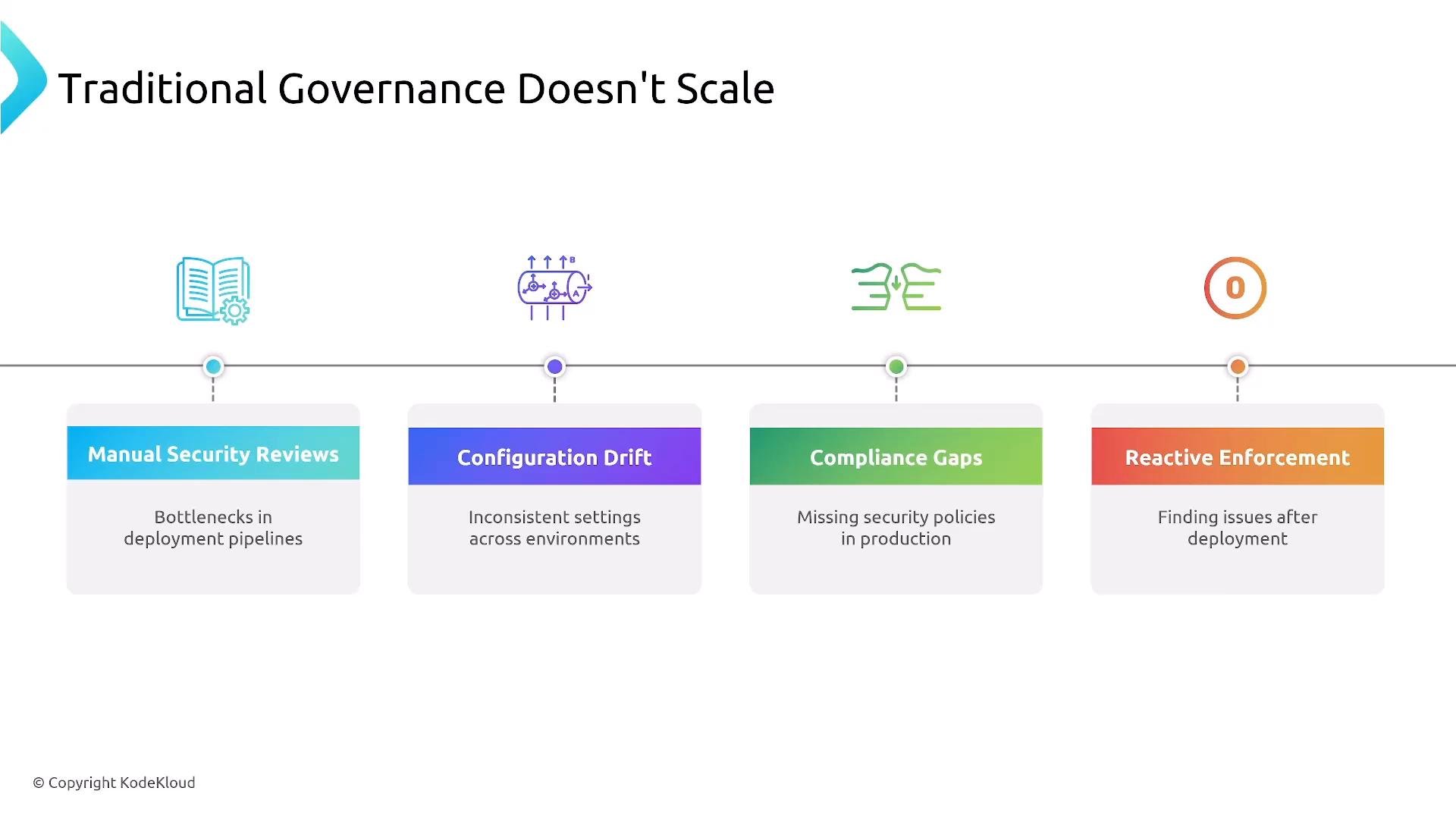
Manual security reviews, configuration drift, compliance gaps, and reactive enforcement create bottlenecks as teams grow. Platform engineers adopt policy engines so manual effort and human inconsistency no longer limit scale. Certain certification scenarios often present these pain points and expect you to identify policy engines as a scalable solution.
Why traditional governance doesn't scale
Manual security reviews, configuration drift, compliance gaps, and reactive enforcement create bottlenecks as teams grow. Platform engineers adopt policy engines so manual effort and human inconsistency no longer limit scale. Certain certification scenarios often present these pain points and expect you to identify policy engines as a scalable solution.
 Policy as code — core principles
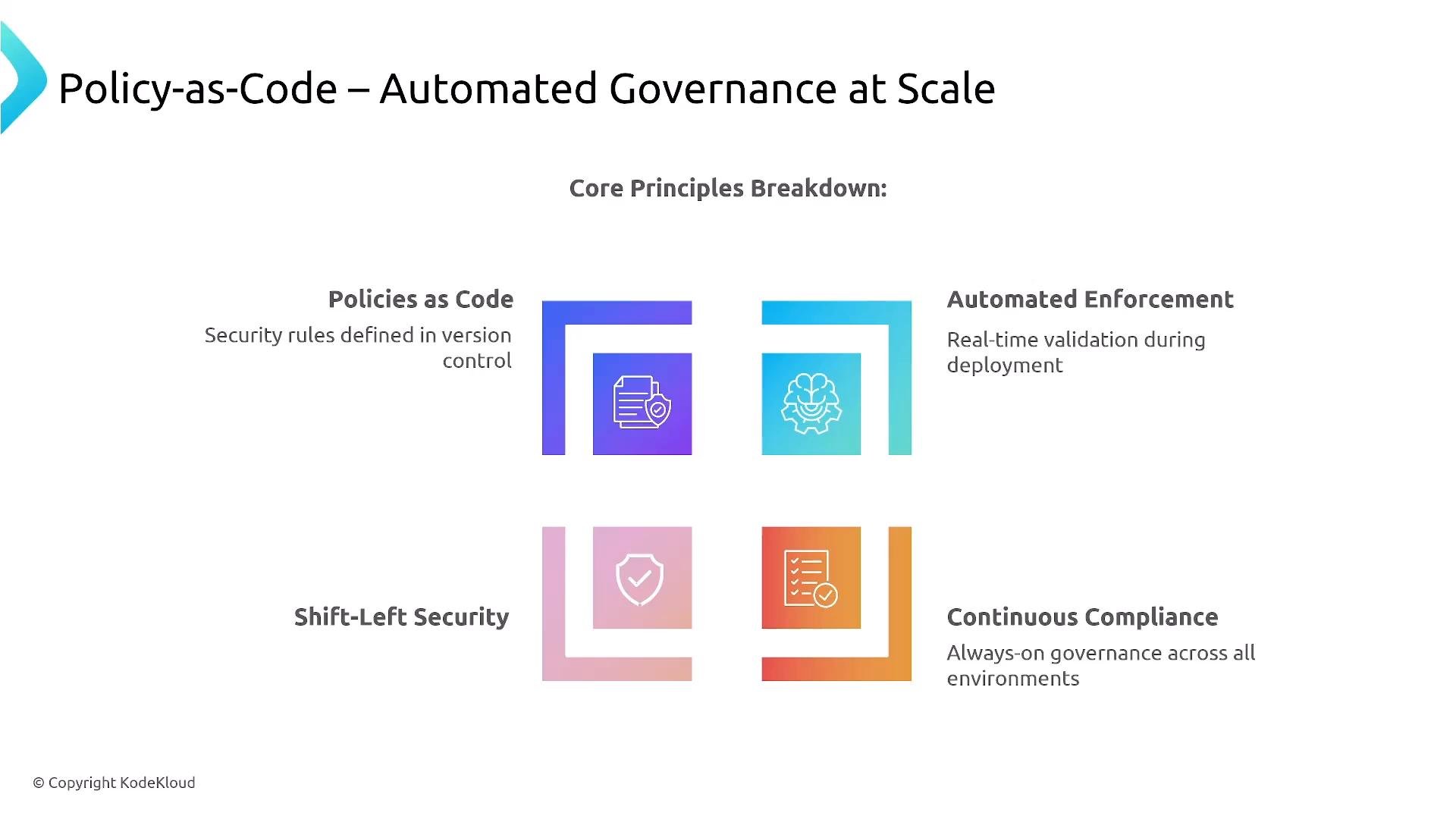
Policy-as-code means declaring security and governance rules as version-controlled code alongside the infrastructure. Key principles:
* Policies as code: rules are written, reviewed, and versioned like any other code.
* Automated enforcement: checks run continuously, often at admission-time.
* Shift-left security: catch defects early in the lifecycle (design/CI) instead of reacting later in production.
* Continuous compliance: maintain an auditable trail of enforcement and violations.
This approach transforms policy from a bottleneck into an enabler for developer velocity and platform reliability.
Policy as code — core principles
Policy-as-code means declaring security and governance rules as version-controlled code alongside the infrastructure. Key principles:
* Policies as code: rules are written, reviewed, and versioned like any other code.
* Automated enforcement: checks run continuously, often at admission-time.
* Shift-left security: catch defects early in the lifecycle (design/CI) instead of reacting later in production.
* Continuous compliance: maintain an auditable trail of enforcement and violations.
This approach transforms policy from a bottleneck into an enabler for developer velocity and platform reliability.
 Policy engine options (high level)
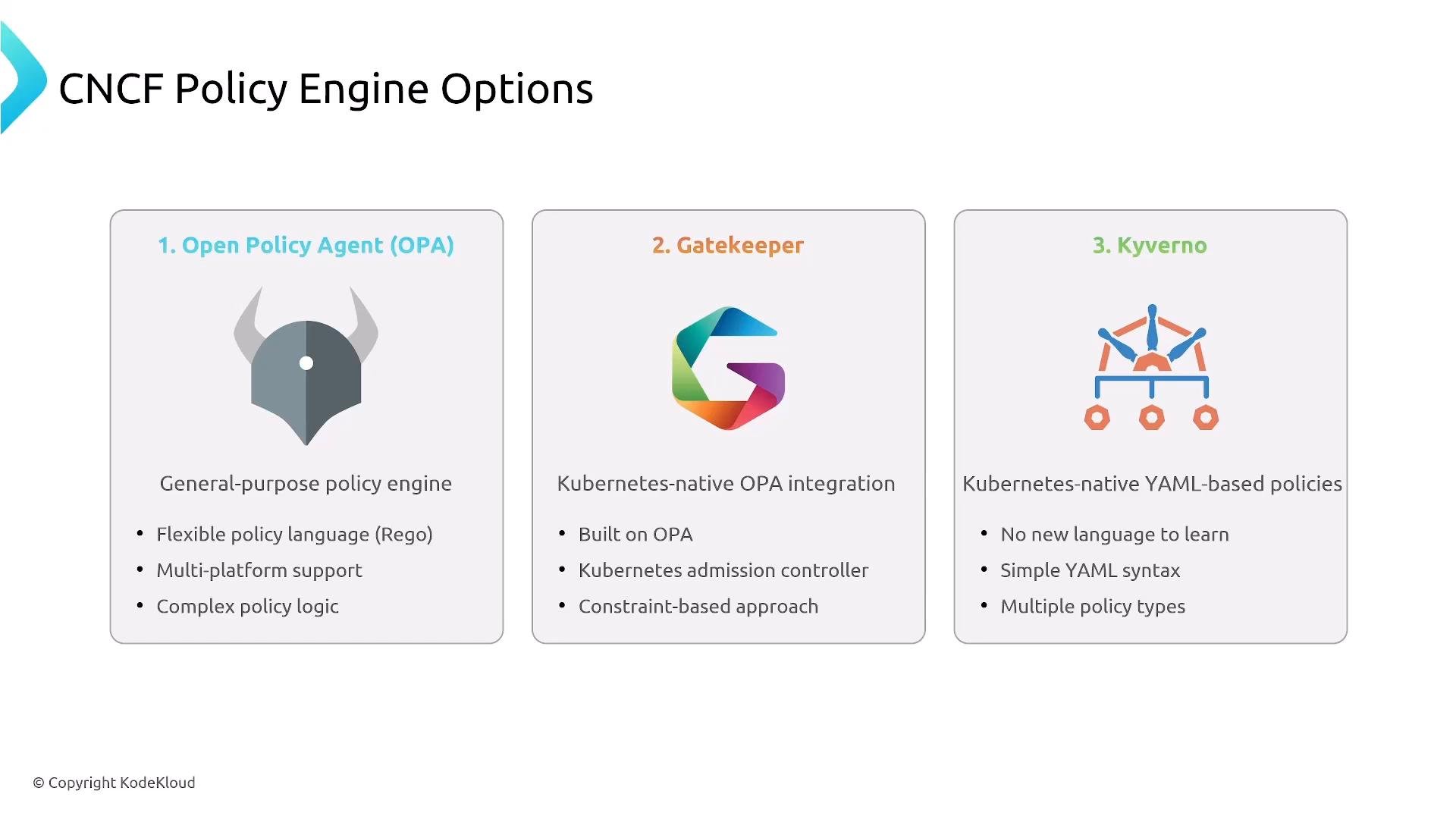
Common CNCF-centered policy engines and integrations include:
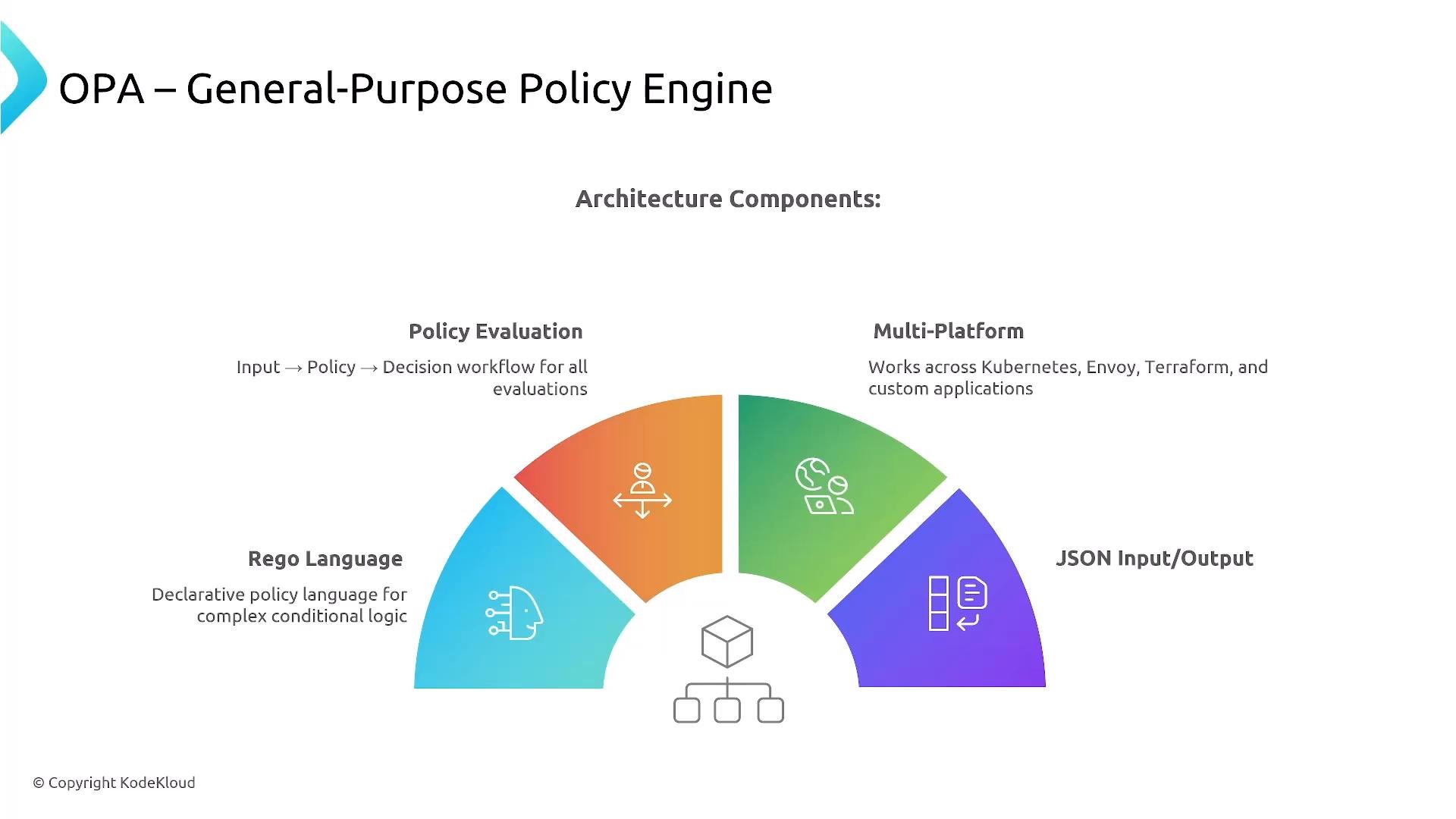
* Open Policy Agent (OPA): a general-purpose, multi-platform policy engine. Rego is OPA’s policy language. OPA takes JSON input and evaluates policies across systems.
* Gatekeeper: a Kubernetes-native integration that runs OPA as an admission controller. Gatekeeper introduces ConstraintTemplates (policy definitions) and Constraints (instances) to enforce policies in-cluster.
* Kyverno: a Kubernetes-native policy engine that uses YAML policies (no new language). Kyverno supports validate, mutate, generate, and cleanup modes and integrates naturally with kubectl and GitOps workflows.
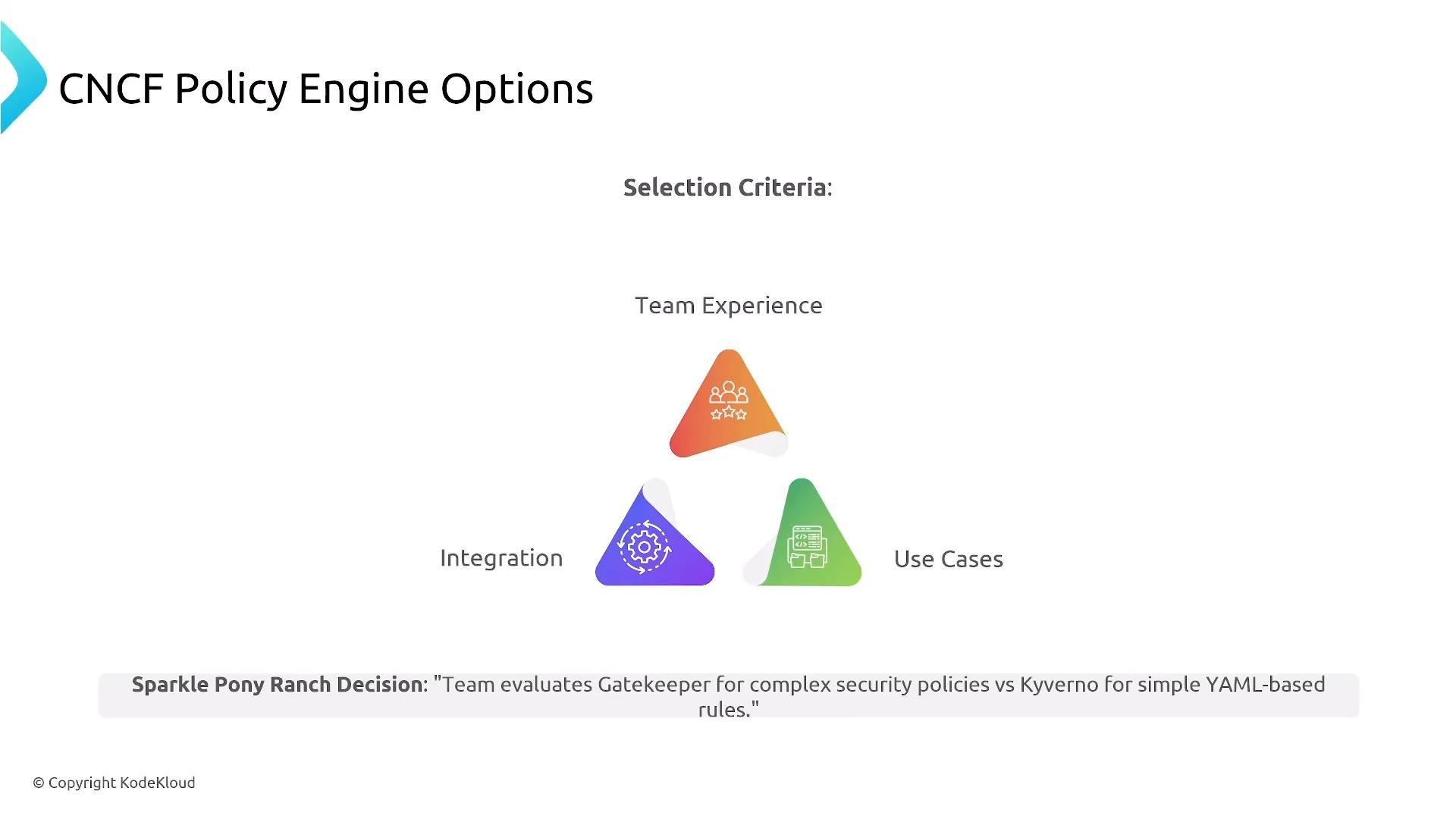
Choosing one depends on your team’s experience, required policy complexity, and the platforms you must support.
Policy engine options (high level)
Common CNCF-centered policy engines and integrations include:
* Open Policy Agent (OPA): a general-purpose, multi-platform policy engine. Rego is OPA’s policy language. OPA takes JSON input and evaluates policies across systems.
* Gatekeeper: a Kubernetes-native integration that runs OPA as an admission controller. Gatekeeper introduces ConstraintTemplates (policy definitions) and Constraints (instances) to enforce policies in-cluster.
* Kyverno: a Kubernetes-native policy engine that uses YAML policies (no new language). Kyverno supports validate, mutate, generate, and cleanup modes and integrates naturally with kubectl and GitOps workflows.
Choosing one depends on your team’s experience, required policy complexity, and the platforms you must support.
 Selecting a policy engine
* Teams that need advanced, cross-platform, conditional policies often choose OPA (Rego).
* Teams that prefer native Kubernetes CRDs and YAML-based policies often prefer Kyverno for faster adoption.
* Gatekeeper is a common OPA-based option when you want OPA’s power with a Kubernetes admission controller.
Selecting a policy engine
* Teams that need advanced, cross-platform, conditional policies often choose OPA (Rego).
* Teams that prefer native Kubernetes CRDs and YAML-based policies often prefer Kyverno for faster adoption.
* Gatekeeper is a common OPA-based option when you want OPA’s power with a Kubernetes admission controller.
 OPA basics
OPA receives input (for example, a Kubernetes manifest converted to JSON), evaluates Rego policies, and returns a decision (allow, deny, or additional data). OPA’s flexibility makes it suitable for complex if-then logic and multi-system policies.
OPA basics
OPA receives input (for example, a Kubernetes manifest converted to JSON), evaluates Rego policies, and returns a decision (allow, deny, or additional data). OPA’s flexibility makes it suitable for complex if-then logic and multi-system policies.
 OPA evaluation flow (conceptual)
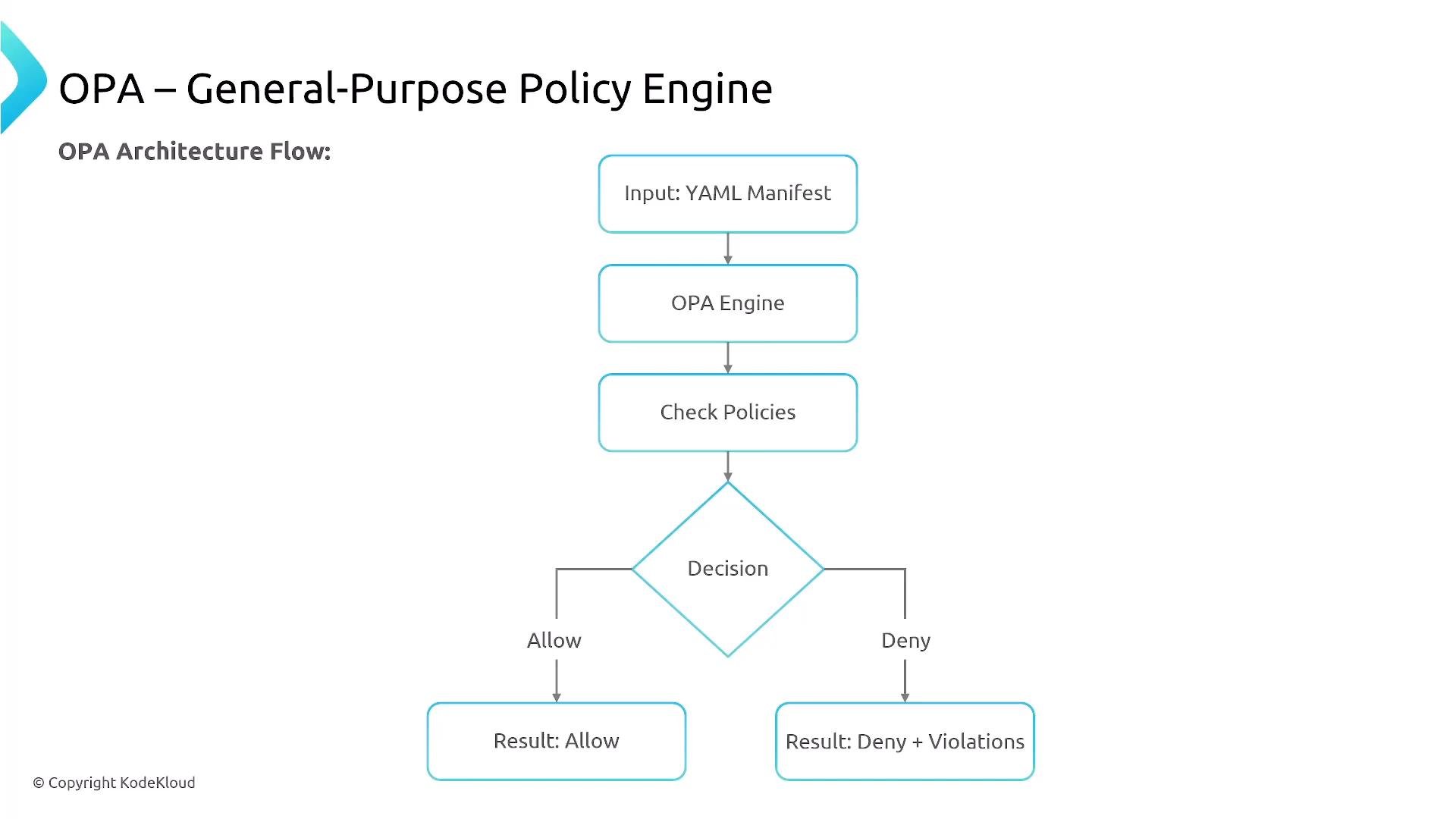
Typically: a YAML/manifest is converted to JSON and fed to the OPA engine → OPA checks defined policies → OPA returns a decision. That decision drives admission control or other enforcement mechanisms.
OPA evaluation flow (conceptual)
Typically: a YAML/manifest is converted to JSON and fed to the OPA engine → OPA checks defined policies → OPA returns a decision. That decision drives admission control or other enforcement mechanisms.
 Gatekeeper (OPA for Kubernetes)
Gatekeeper is an OPA-based implementation that adds Kubernetes-native primitives:
* ConstraintTemplate: reusable policy definition (template that contains Rego code).
* Constraint: an instance of that template with parameters (scoped to namespaces, labels, etc.).
* Admission controller: Gatekeeper enforces constraints at admission time (e.g., kubectl apply), rejecting or allowing resources.
* Violation reporting: Gatekeeper can report and list violations.
When a ConstraintTemplate is installed and a Constraint is created, Gatekeeper starts validating resources against the Constraint logic.
Gatekeeper (OPA for Kubernetes)
Gatekeeper is an OPA-based implementation that adds Kubernetes-native primitives:
* ConstraintTemplate: reusable policy definition (template that contains Rego code).
* Constraint: an instance of that template with parameters (scoped to namespaces, labels, etc.).
* Admission controller: Gatekeeper enforces constraints at admission time (e.g., kubectl apply), rejecting or allowing resources.
* Violation reporting: Gatekeeper can report and list violations.
When a ConstraintTemplate is installed and a Constraint is created, Gatekeeper starts validating resources against the Constraint logic.
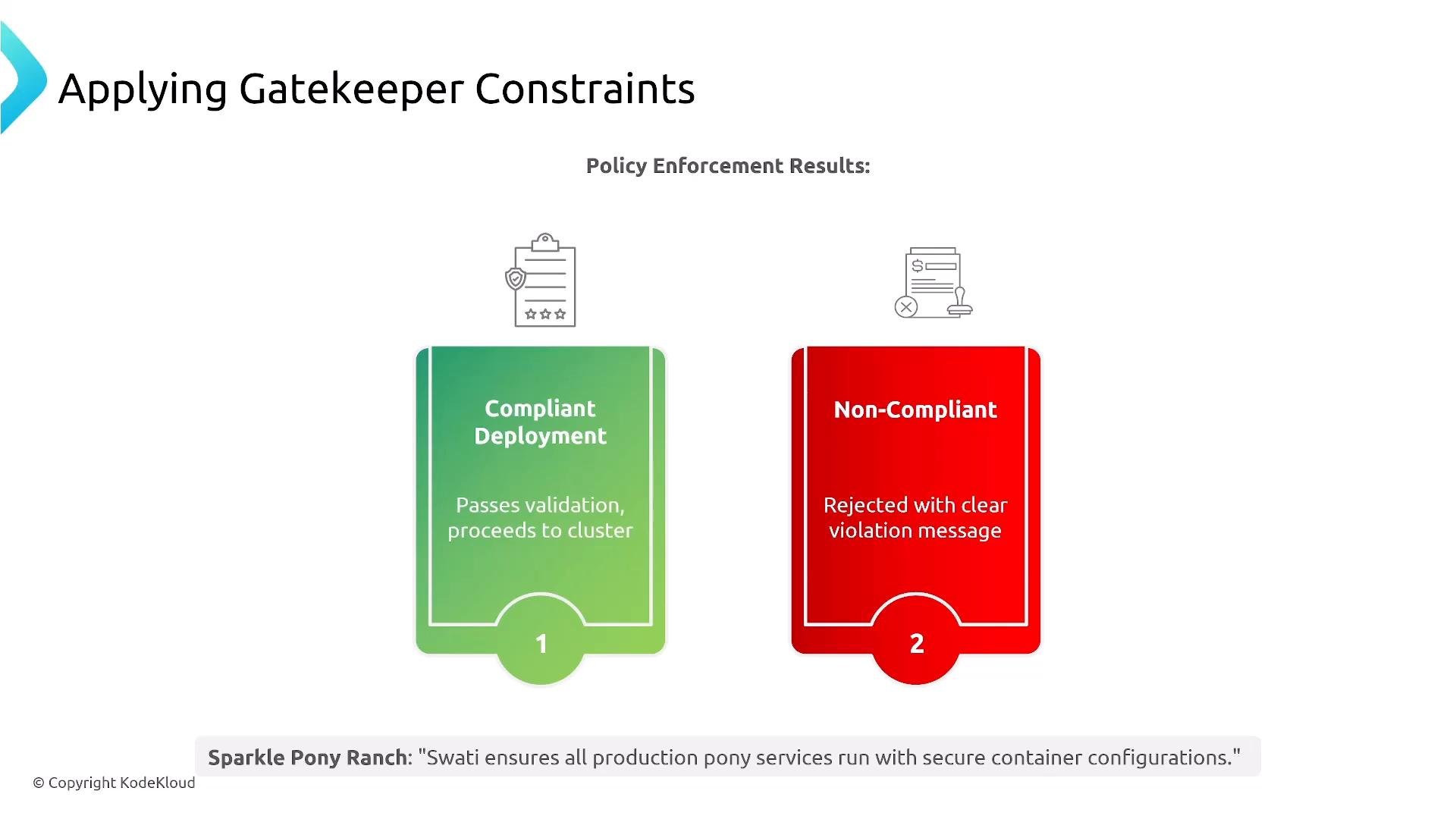
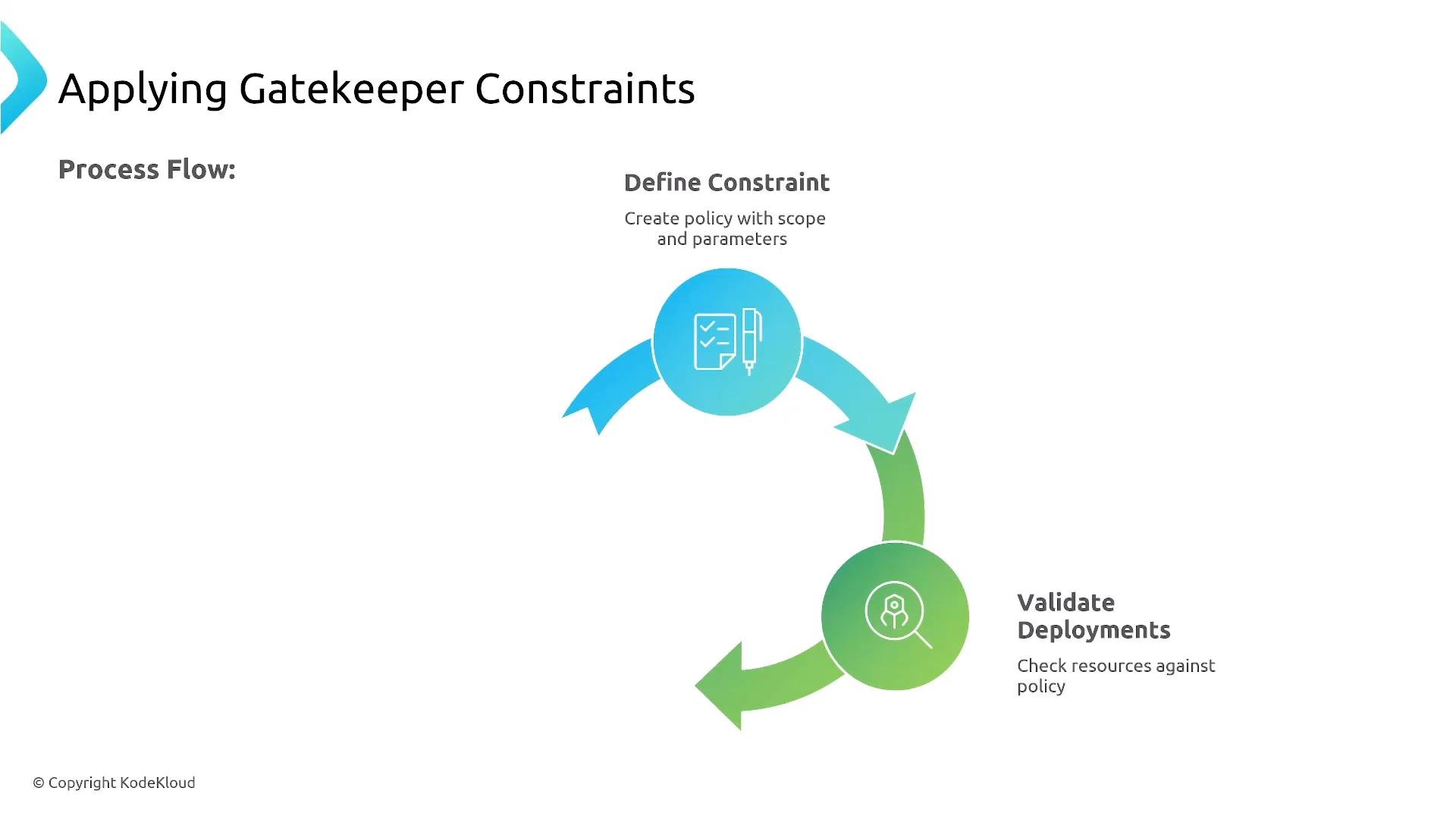 Gatekeeper outcomes are binary: either a deployment is compliant (passes validation) or it is rejected with a clear violation message.
 Kyverno — Kubernetes-native, YAML-first
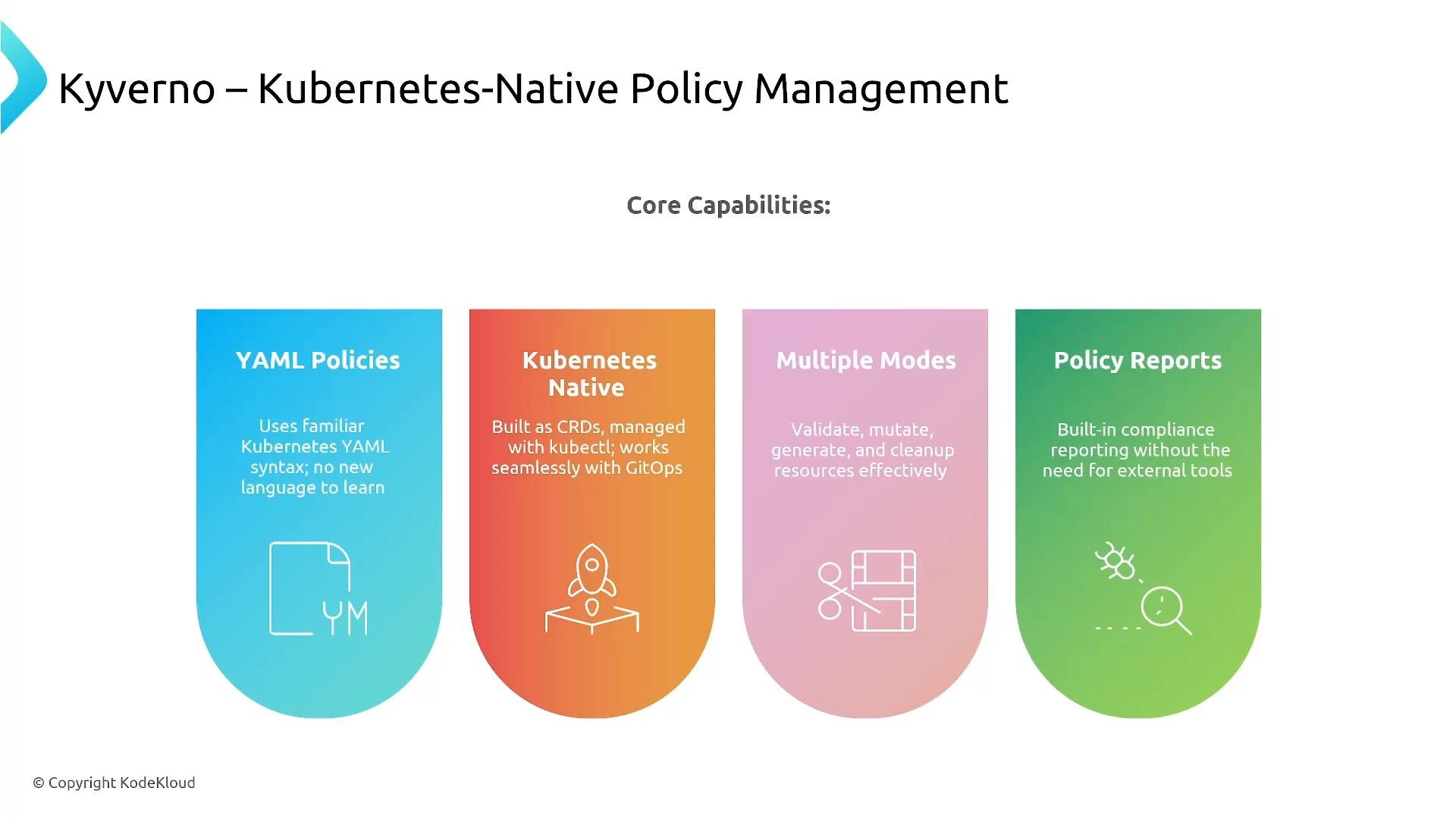
Kyverno is designed to be simple and Kubernetes-native:
* Policies are Kubernetes CRs using YAML (no new policy language).
* Modes: validate, mutate, generate, cleanup.
* Integrates with kubectl and GitOps workflows.
* Produces policy reports that can be collected and queried.
Kyverno is often chosen for accessibility and ease of adoption.
Kyverno — Kubernetes-native, YAML-first
Kyverno is designed to be simple and Kubernetes-native:
* Policies are Kubernetes CRs using YAML (no new policy language).
* Modes: validate, mutate, generate, cleanup.
* Integrates with kubectl and GitOps workflows.
* Produces policy reports that can be collected and queried.
Kyverno is often chosen for accessibility and ease of adoption.
 Kyverno policy example (validate non-root containers)
Below is a representative Kyverno ClusterPolicy that validates containers are configured to run as non-root in the `pony-production` namespace. This is a validation policy (it will accept or reject a resource) and demonstrates Kyverno's YAML-based pattern matching:
```yaml theme={null}
apiVersion: kyverno.io/v1
kind: ClusterPolicy
metadata:
name: require-non-root-containers
spec:
validationFailureAction: enforce
background: true
rules:
- name: check-non-root
match:
any:
- resources:
kinds:
- Deployment
namespaces:
- pony-production
validate:
message: "Containers must run as non-root user"
pattern:
spec:
template:
spec:
containers:
- securityContext:
runAsNonRoot: true
```
This YAML expresses the same intent you would achieve with a Gatekeeper constraint, but Kyverno uses YAML patterns rather than Rego.
Validation vs mutation
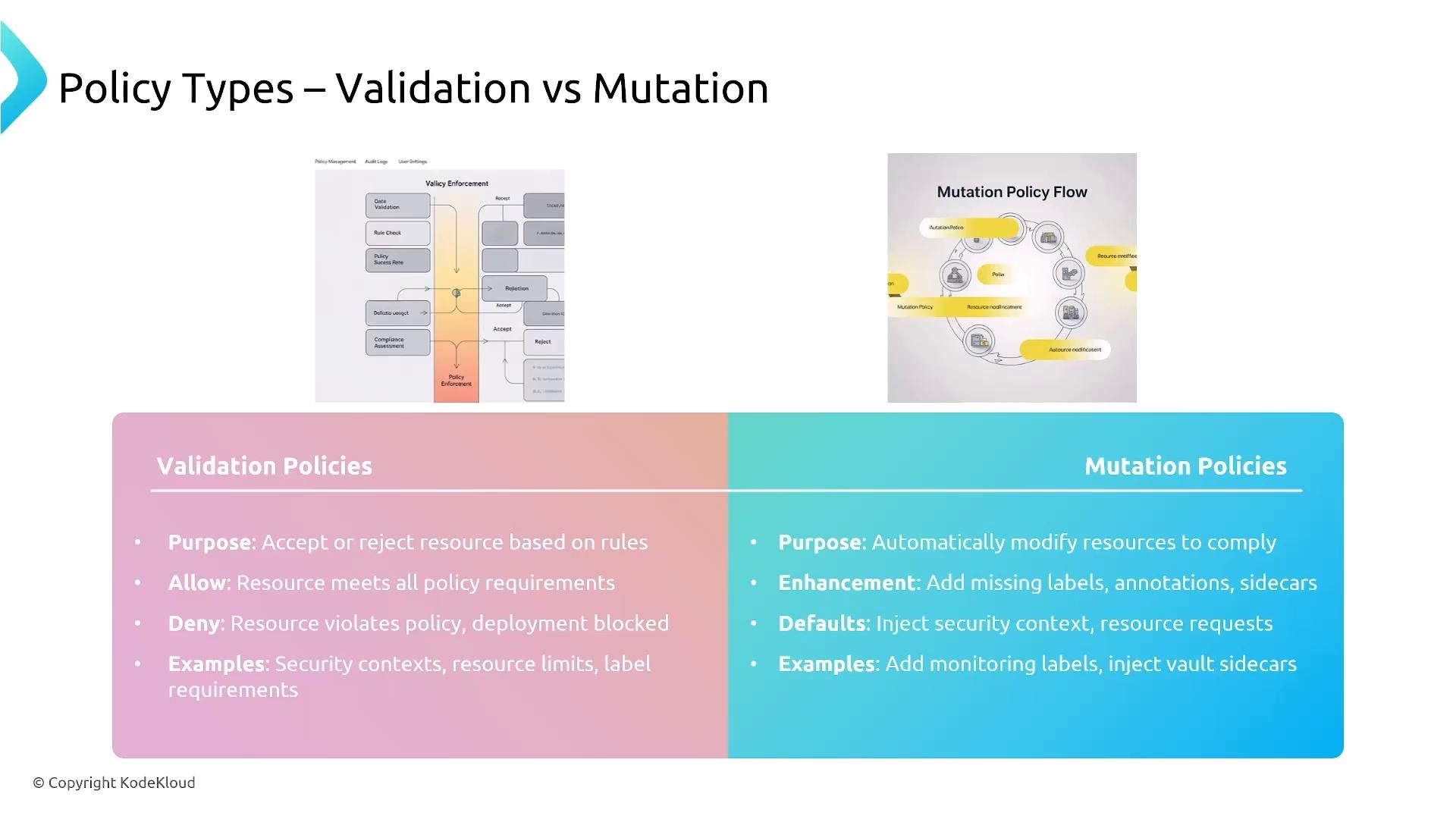
* Validation policies accept or reject resources based on rules (e.g., securityContext, resource limits, labels).
* Mutation policies modify resources at admission time to bring them into compliance (e.g., inject default resource requests/limits, add required labels, inject sidecars or monitoring annotations).
Validation enforces without altering resources; mutation updates resources automatically to meet standards when possible.
Kyverno policy example (validate non-root containers)
Below is a representative Kyverno ClusterPolicy that validates containers are configured to run as non-root in the `pony-production` namespace. This is a validation policy (it will accept or reject a resource) and demonstrates Kyverno's YAML-based pattern matching:
```yaml theme={null}
apiVersion: kyverno.io/v1
kind: ClusterPolicy
metadata:
name: require-non-root-containers
spec:
validationFailureAction: enforce
background: true
rules:
- name: check-non-root
match:
any:
- resources:
kinds:
- Deployment
namespaces:
- pony-production
validate:
message: "Containers must run as non-root user"
pattern:
spec:
template:
spec:
containers:
- securityContext:
runAsNonRoot: true
```
This YAML expresses the same intent you would achieve with a Gatekeeper constraint, but Kyverno uses YAML patterns rather than Rego.
Validation vs mutation
* Validation policies accept or reject resources based on rules (e.g., securityContext, resource limits, labels).
* Mutation policies modify resources at admission time to bring them into compliance (e.g., inject default resource requests/limits, add required labels, inject sidecars or monitoring annotations).
Validation enforces without altering resources; mutation updates resources automatically to meet standards when possible.
 Example: validating resource limits (Kyverno pattern)
The following Kyverno validate fragment checks that containers in matched resources include CPU and memory limits. This is a focused validation rule — it only checks the presence of limits, not their exact values.
```yaml theme={null}
validate:
message: "All pony services must have resource limits"
pattern:
spec:
template:
spec:
containers:
- resources:
limits:
memory: "?*"
cpu: "?*"
```
Mutation use cases
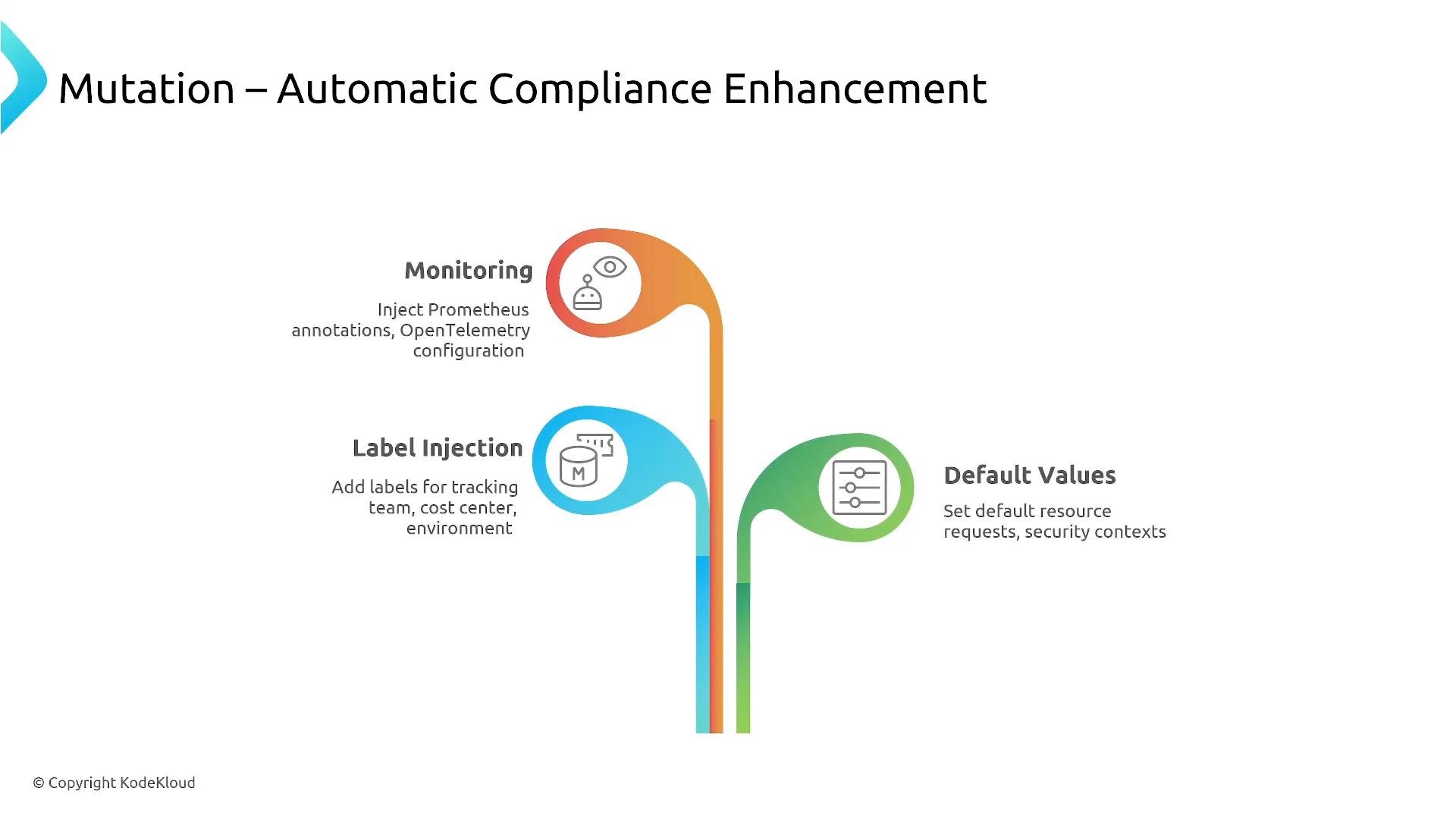
Mutation policies are useful to automatically enforce defaults and add operational or security configuration such as monitoring annotations, team/cost labels, resource requests, and security contexts. Mutation can dramatically reduce the number of rejected deployments by applying corrective changes automatically.
Example: validating resource limits (Kyverno pattern)
The following Kyverno validate fragment checks that containers in matched resources include CPU and memory limits. This is a focused validation rule — it only checks the presence of limits, not their exact values.
```yaml theme={null}
validate:
message: "All pony services must have resource limits"
pattern:
spec:
template:
spec:
containers:
- resources:
limits:
memory: "?*"
cpu: "?*"
```
Mutation use cases
Mutation policies are useful to automatically enforce defaults and add operational or security configuration such as monitoring annotations, team/cost labels, resource requests, and security contexts. Mutation can dramatically reduce the number of rejected deployments by applying corrective changes automatically.
 Integration into platform workflows
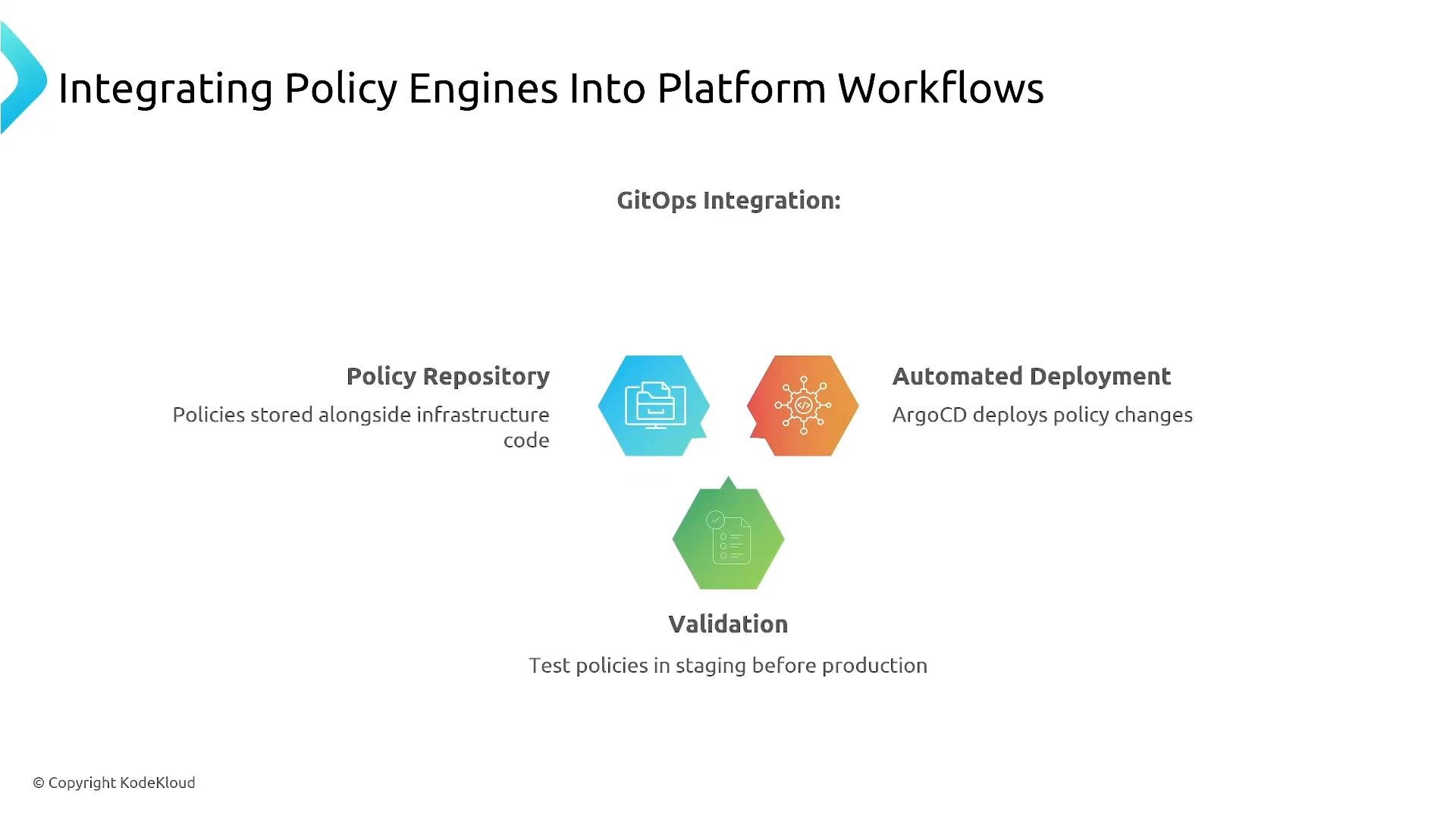
Treat policies as infrastructure: store policies in version control and apply CI/CD and GitOps patterns. A typical workflow:
* Policies stored in a repository (same repo as infra or a separate one).
* CI pipelines lint, test, and promote policy changes.
* GitOps tools (e.g., ArgoCD) deploy policies to clusters.
* Admission controllers (Gatekeeper/Kyverno) validate/mutate resources at deployment time.
* Audit and reporting collect violations for visibility.
This enables SREs to rely on versioned, tested, and automated governance.
Integration into platform workflows
Treat policies as infrastructure: store policies in version control and apply CI/CD and GitOps patterns. A typical workflow:
* Policies stored in a repository (same repo as infra or a separate one).
* CI pipelines lint, test, and promote policy changes.
* GitOps tools (e.g., ArgoCD) deploy policies to clusters.
* Admission controllers (Gatekeeper/Kyverno) validate/mutate resources at deployment time.
* Audit and reporting collect violations for visibility.
This enables SREs to rely on versioned, tested, and automated governance.
 Team benefits and personas
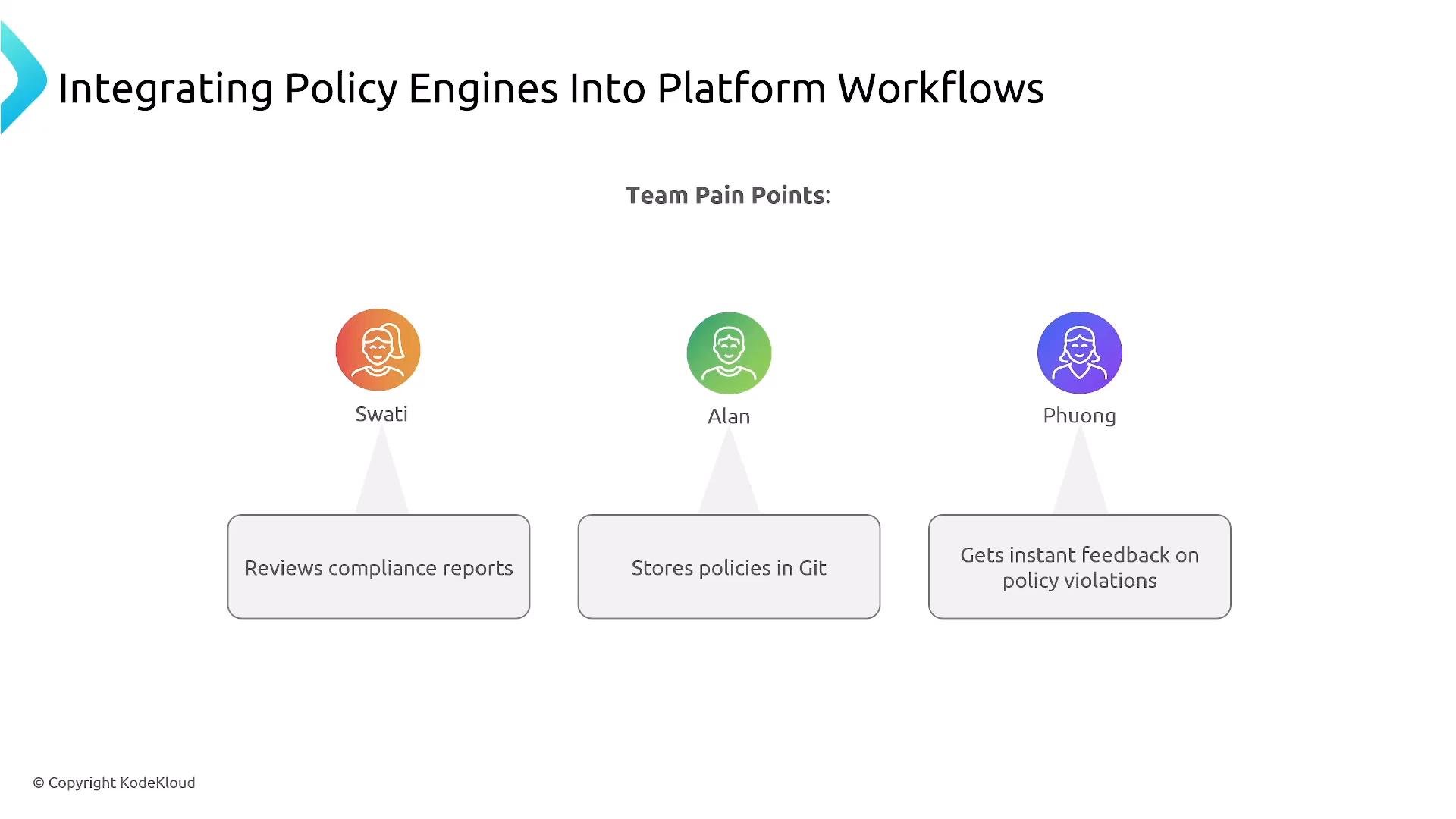
Platform engineers, SREs, and developers all benefit: policies are version-controlled, testable in CI, and provide immediate feedback on violations. A gradual rollout strategy — start with audit/warn mode before enforce — helps avoid breaking developer workflows.
Team benefits and personas
Platform engineers, SREs, and developers all benefit: policies are version-controlled, testable in CI, and provide immediate feedback on violations. A gradual rollout strategy — start with audit/warn mode before enforce — helps avoid breaking developer workflows.
 Integration benefits
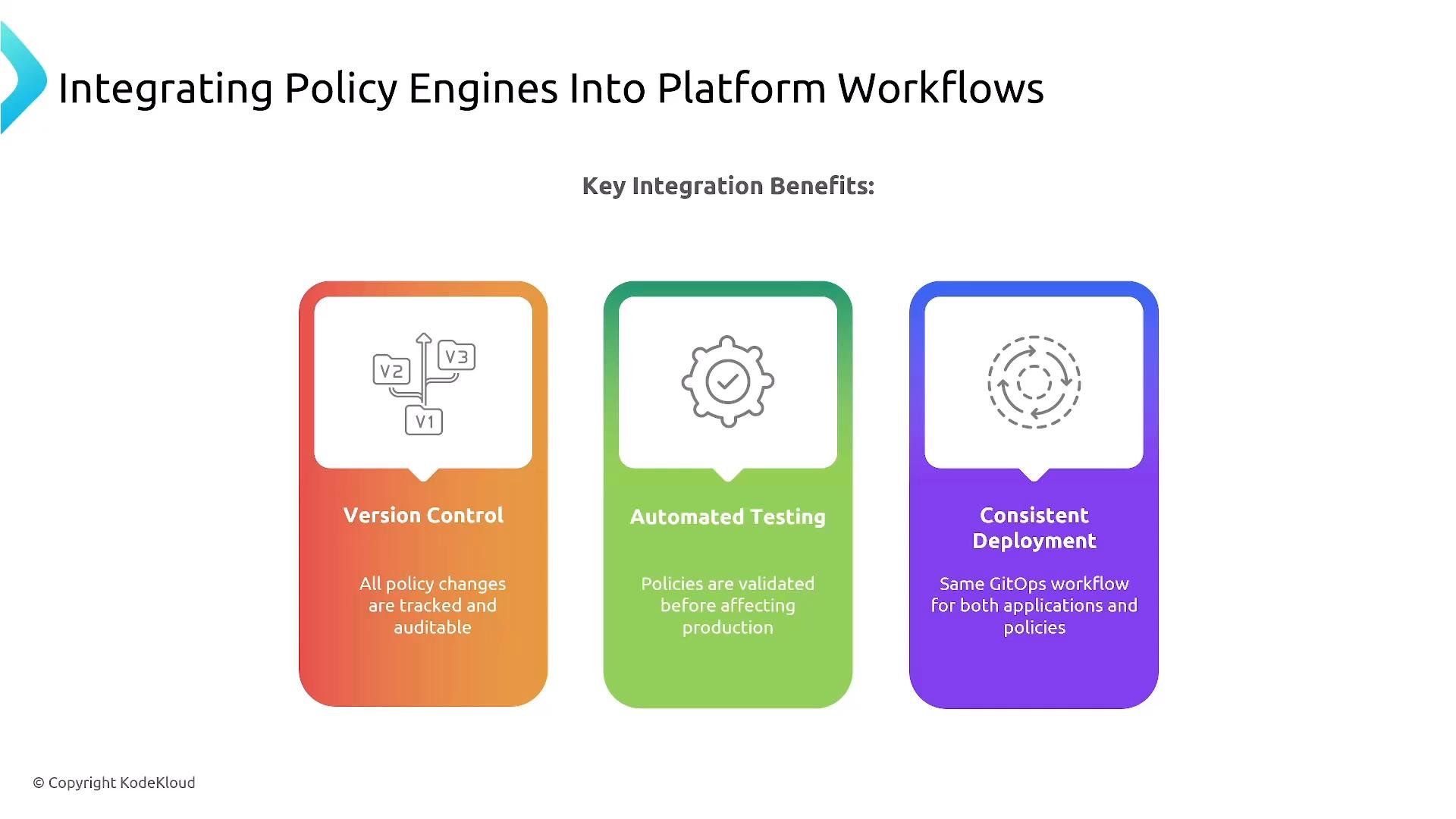
* Version control enables peer review and traceability.
* Automated testing lets you validate policy changes before production.
* Declarative policies provide consistent enforcement across environments.
Integration benefits
* Version control enables peer review and traceability.
* Automated testing lets you validate policy changes before production.
* Declarative policies provide consistent enforcement across environments.
 Testing policies before production
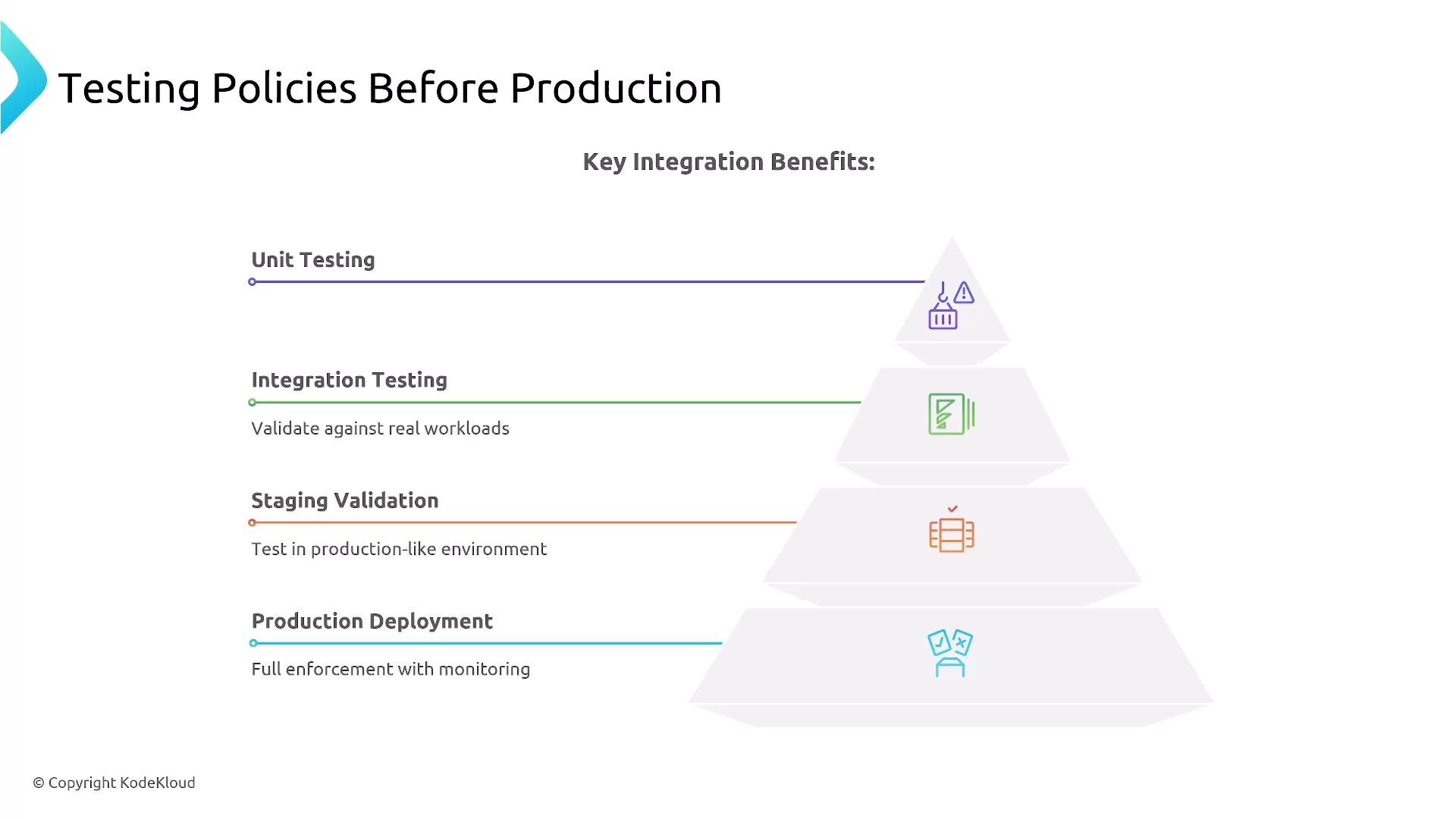
Apply standard software engineering testing practices to policy code:
* Unit tests: small, focused policy checks.
* Integration tests: validate policies against representative workloads or manifests.
* Staging validation: run policies in production-like environments.
* Production deployment: enforce policies with monitoring.
Testing lets you iterate safely, starting in audit/warn mode and progressing to enforcement.
Testing policies before production
Apply standard software engineering testing practices to policy code:
* Unit tests: small, focused policy checks.
* Integration tests: validate policies against representative workloads or manifests.
* Staging validation: run policies in production-like environments.
* Production deployment: enforce policies with monitoring.
Testing lets you iterate safely, starting in audit/warn mode and progressing to enforcement.
 Testing tools and example commands
Example commands for local policy testing:
```bash theme={null}
# Test Kubernetes manifests with conftest (Rego policies)
conftest test manifests/ --policy policies/
# Dry-run a Kyverno policy against a resource
kyverno apply policy.yaml --resource deployment.yaml
```
Kyverno provides dry-run and testing capabilities; OPA/Conftest can be used to unit-test Rego policies.
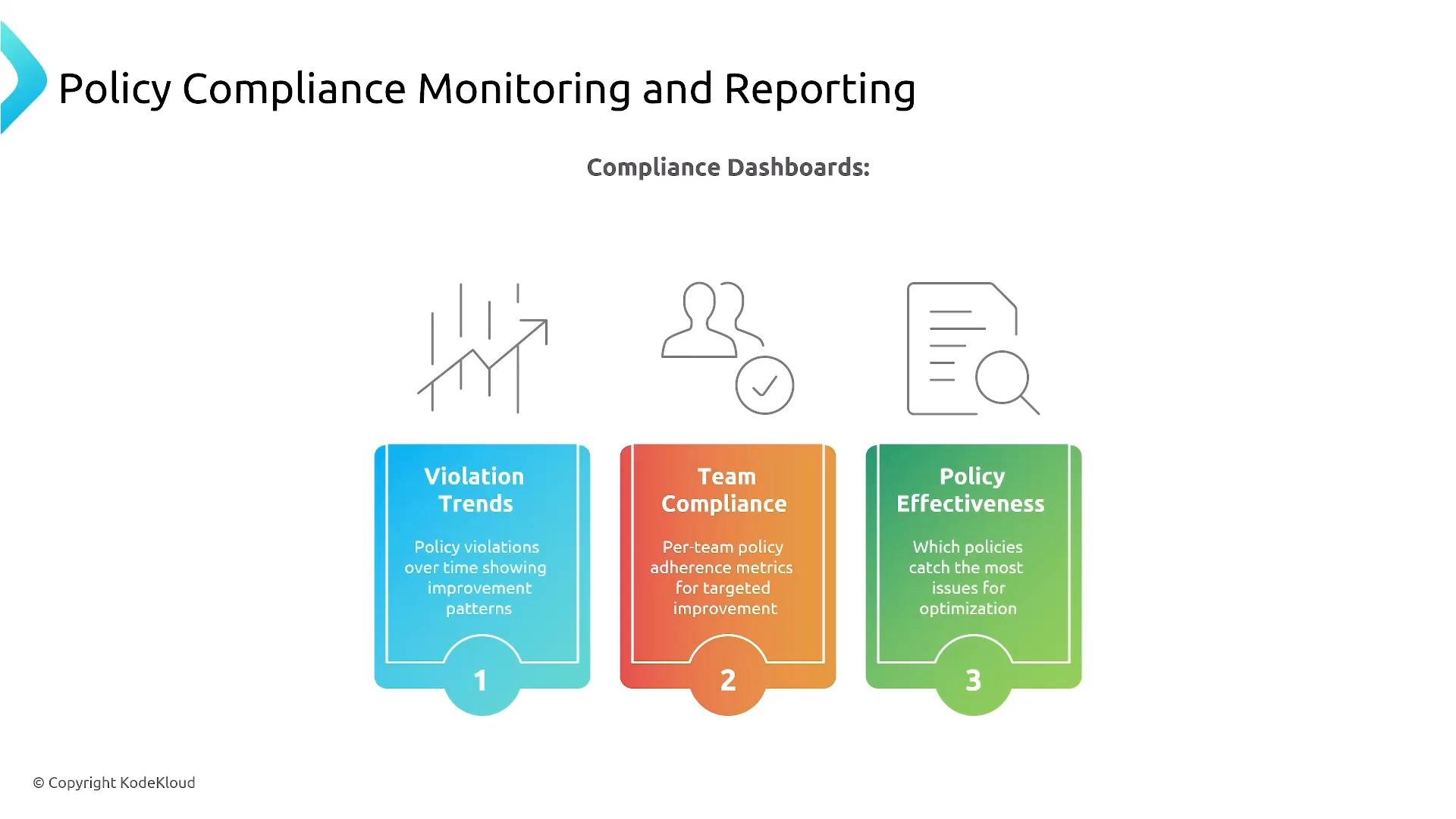
Policy compliance monitoring
Policy violation metrics and reports can be exported to monitoring stacks (Prometheus, OpenTelemetry, Grafana, Kibana) to visualize violation trends, team compliance, and policy effectiveness.
Testing tools and example commands
Example commands for local policy testing:
```bash theme={null}
# Test Kubernetes manifests with conftest (Rego policies)
conftest test manifests/ --policy policies/
# Dry-run a Kyverno policy against a resource
kyverno apply policy.yaml --resource deployment.yaml
```
Kyverno provides dry-run and testing capabilities; OPA/Conftest can be used to unit-test Rego policies.
Policy compliance monitoring
Policy violation metrics and reports can be exported to monitoring stacks (Prometheus, OpenTelemetry, Grafana, Kibana) to visualize violation trends, team compliance, and policy effectiveness.
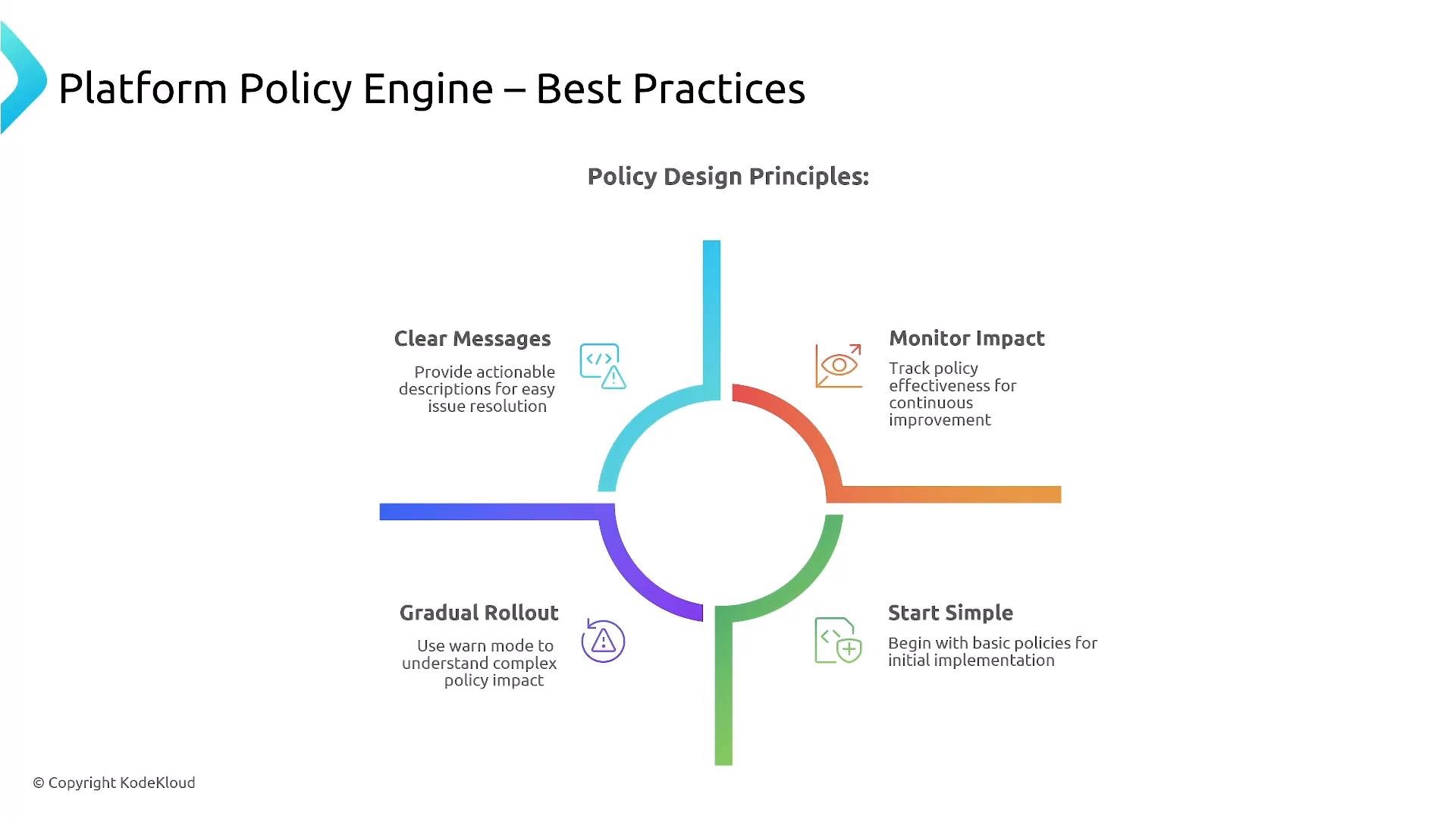
 Best practices
* Start simple and expand rules iteratively.
* Roll out policies gradually (audit/warn → enforce).
* Provide clear violation messages so developers know how to fix issues.
* Version-control policies and include them in CI pipelines.
* Define exception and error-handling workflows (living runbooks).
* Apply full lifecycle management: create → review → implement → test → monitor → improve.
Best practices
* Start simple and expand rules iteratively.
* Roll out policies gradually (audit/warn → enforce).
* Provide clear violation messages so developers know how to fix issues.
* Version-control policies and include them in CI pipelines.
* Define exception and error-handling workflows (living runbooks).
* Apply full lifecycle management: create → review → implement → test → monitor → improve.
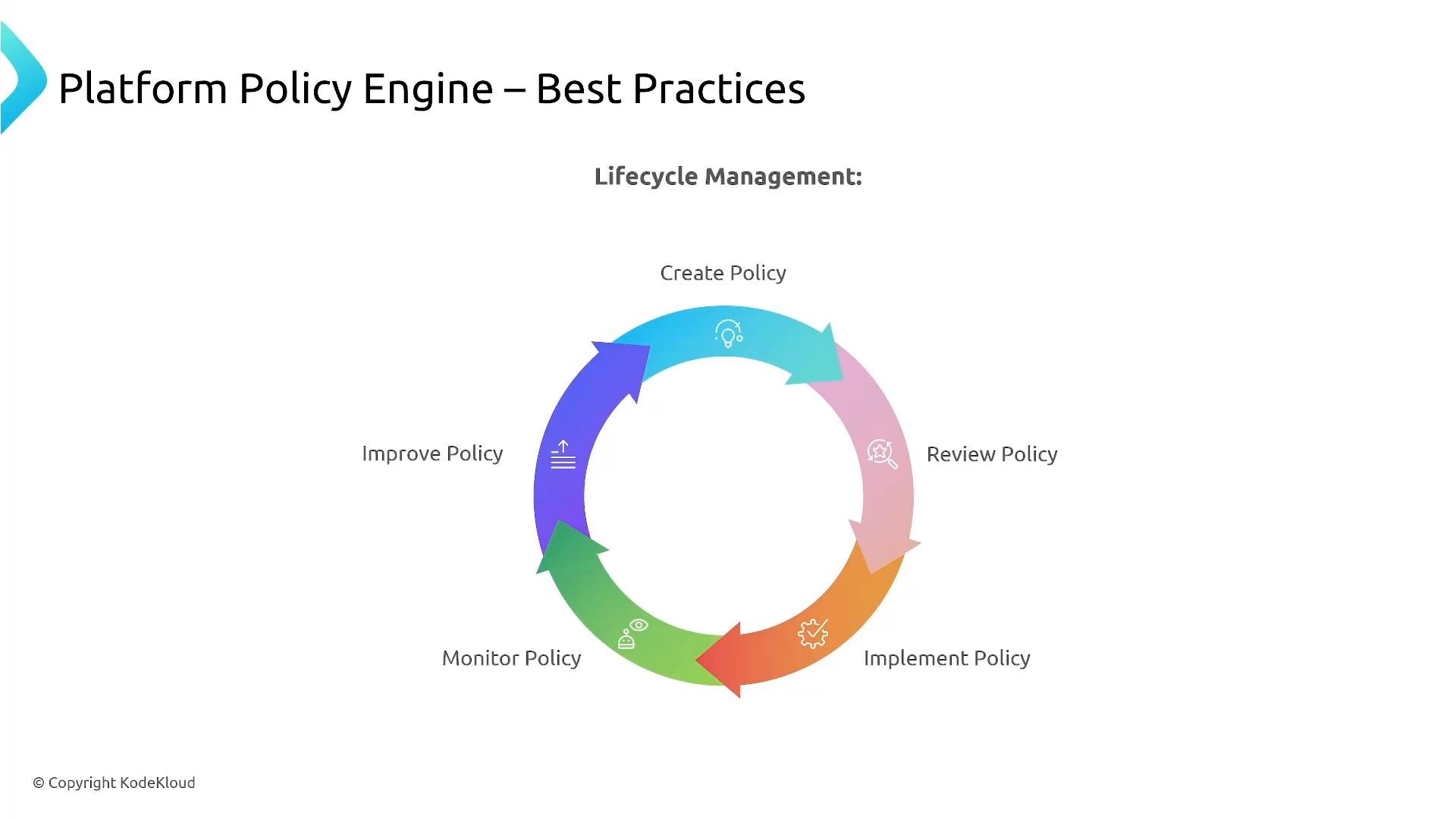
 Policy lifecycle
Treat policy management like any other product lifecycle: design, review, implement, test, monitor, and improve. This applies DevOps and platform engineering principles to governance.
Policy lifecycle
Treat policy management like any other product lifecycle: design, review, implement, test, monitor, and improve. This applies DevOps and platform engineering principles to governance.
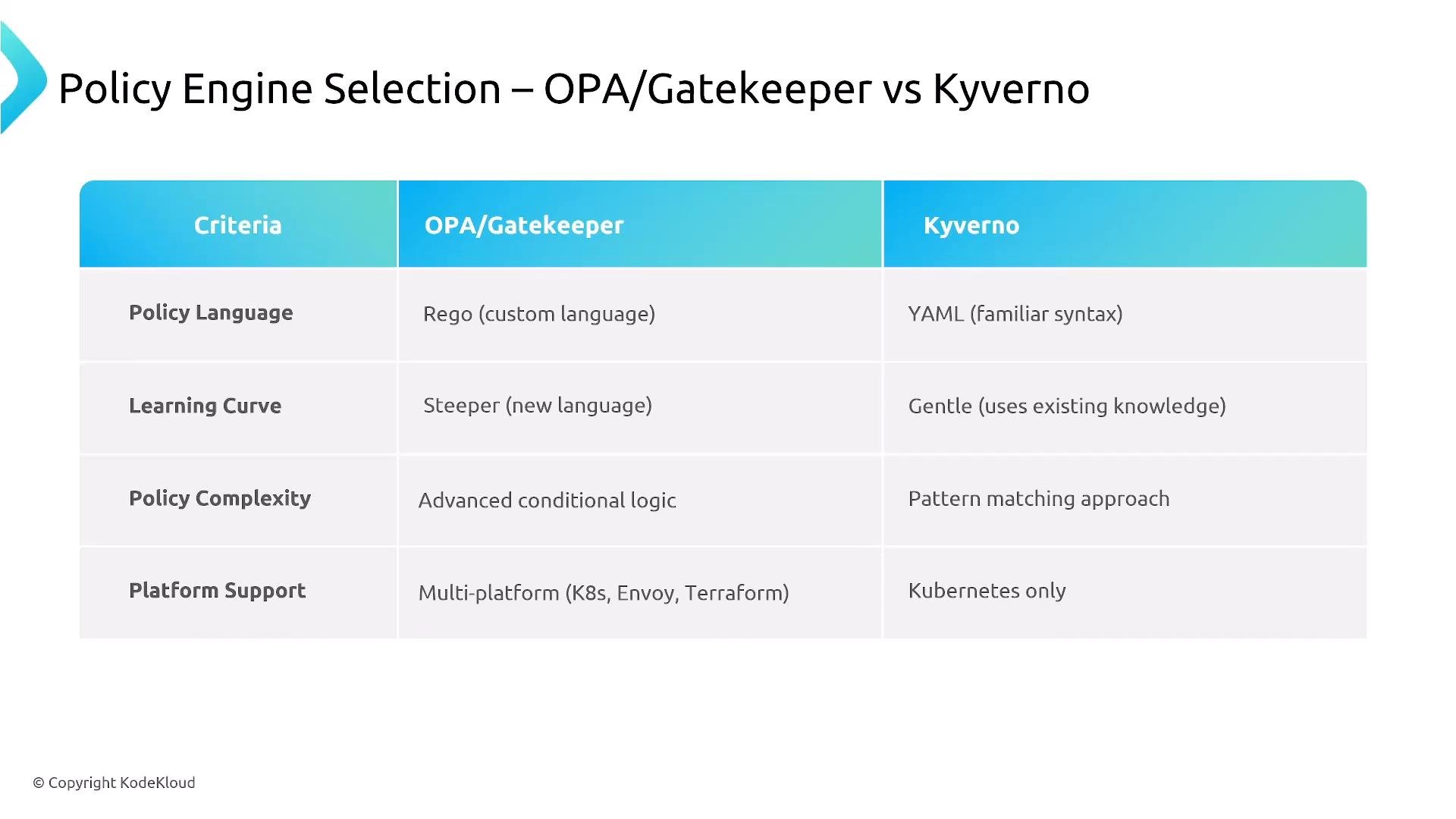
 Policy engine selection guidance
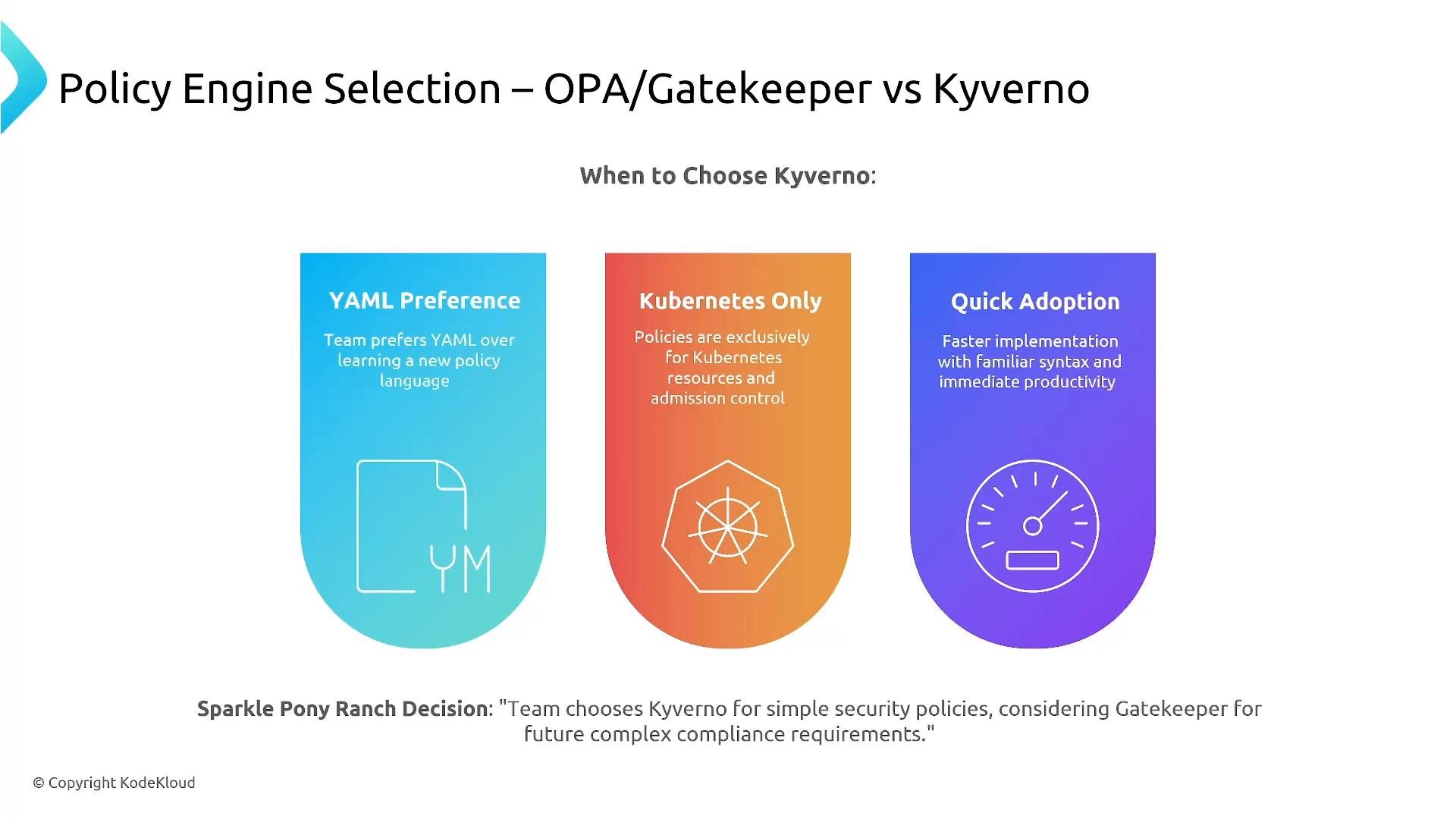
* Kyverno: YAML-first, Kubernetes-native, quick adoption — a great starting point for many teams.
* OPA/Gatekeeper: Rego-based, steeper learning curve, greater flexibility and cross-platform support — suitable when your policies become more complex or must apply to multiple systems.
Policy engine selection guidance
* Kyverno: YAML-first, Kubernetes-native, quick adoption — a great starting point for many teams.
* OPA/Gatekeeper: Rego-based, steeper learning curve, greater flexibility and cross-platform support — suitable when your policies become more complex or must apply to multiple systems.
 Kyverno adoption reasons
Teams that prefer YAML and Kubernetes-native CRDs or that want rapid adoption often choose Kyverno as a starting point; as policy needs grow in complexity, teams may adopt OPA for advanced use cases.
Kyverno adoption reasons
Teams that prefer YAML and Kubernetes-native CRDs or that want rapid adoption often choose Kyverno as a starting point; as policy needs grow in complexity, teams may adopt OPA for advanced use cases.
 Key takeaways
* Policy-as-code and admission controllers enable automated governance at scale.
* Validation policies enforce rules; mutation policies can automatically remediate resources to bring them into compliance.
* Kyverno offers YAML-first policies and fast adoption for Kubernetes-only use cases.
* OPA/Gatekeeper provides Rego-based flexibility and multi-platform policy evaluation for advanced scenarios.
* Integration with GitOps, CI/CD, testing, and monitoring closes the loop for safe, auditable governance.
* Start simple, test thoroughly, roll out gradually, and iterate on policies as part of a lifecycle process.
Key takeaways
* Policy-as-code and admission controllers enable automated governance at scale.
* Validation policies enforce rules; mutation policies can automatically remediate resources to bring them into compliance.
* Kyverno offers YAML-first policies and fast adoption for Kubernetes-only use cases.
* OPA/Gatekeeper provides Rego-based flexibility and multi-platform policy evaluation for advanced scenarios.
* Integration with GitOps, CI/CD, testing, and monitoring closes the loop for safe, auditable governance.
* Start simple, test thoroughly, roll out gradually, and iterate on policies as part of a lifecycle process.
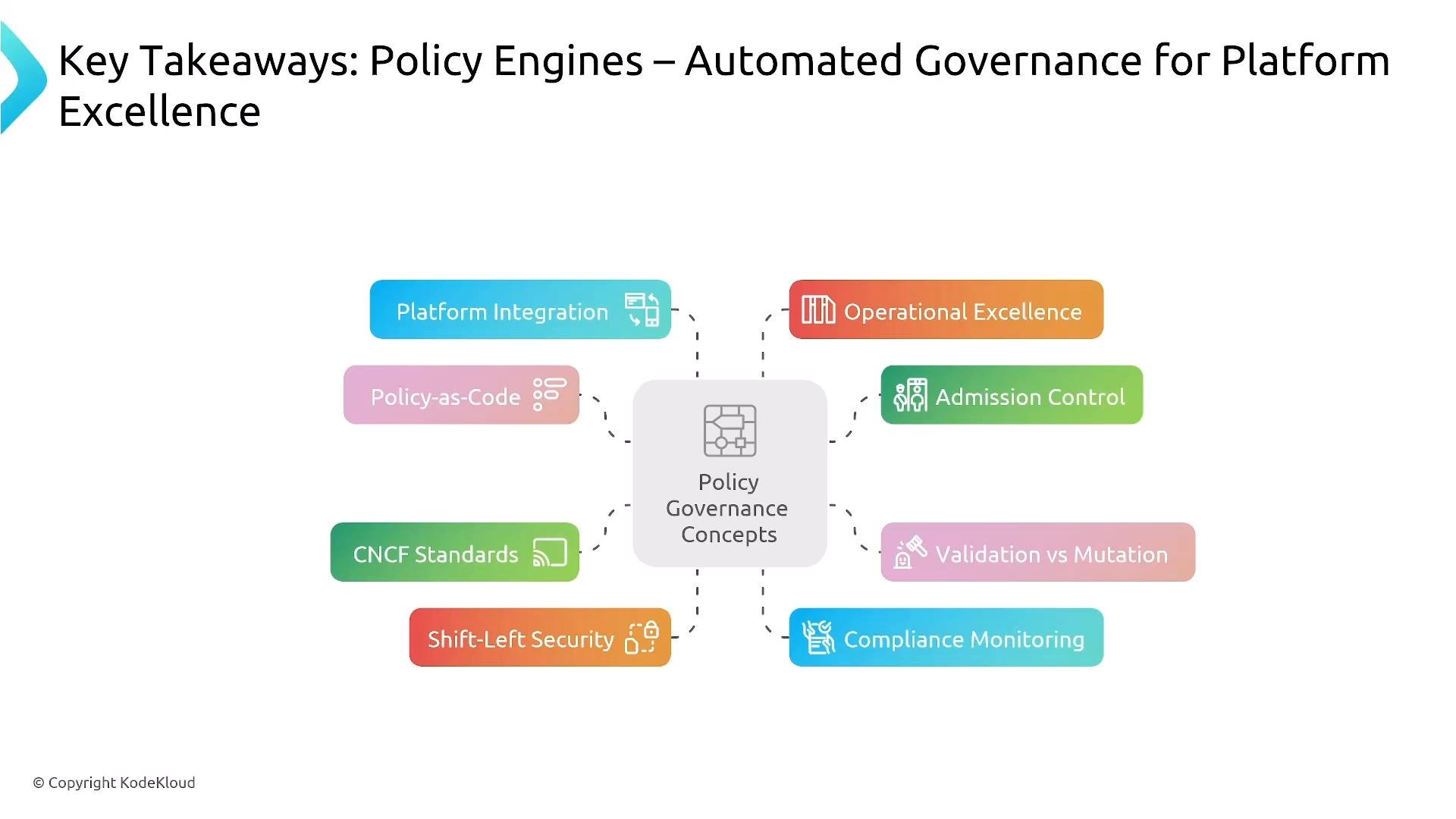 This lesson/article covered policy governance concepts, admission control, validation vs mutation, CNCF tools (OPA, Gatekeeper, Kyverno), and practical integration patterns for platform teams. These techniques help create operational excellence by enforcing governance in a way that is mostly invisible to users while improving security and consistency.
Next, we'll cover security essentials.
Appreciate you reading.
This documentation is built and hosted on [Mintlify](https://mintlify.com), a developer documentation platform.
This lesson/article covered policy governance concepts, admission control, validation vs mutation, CNCF tools (OPA, Gatekeeper, Kyverno), and practical integration patterns for platform teams. These techniques help create operational excellence by enforcing governance in a way that is mostly invisible to users while improving security and consistency.
Next, we'll cover security essentials.
Appreciate you reading.
This documentation is built and hosted on [Mintlify](https://mintlify.com), a developer documentation platform.