> ## Documentation Index
> Fetch the complete documentation index at: https://notes.kodekloud.com/llms.txt
> Use this file to discover all available pages before exploring further.
# Secure Service Communication
> Explains service meshes, mTLS, and eBPF for zero trust service communication in cloud native platforms, covering architectures, project comparisons, and L4 versus L7 trade offs.
Welcome back. This lesson covers secure service-to-service communication in cloud-native platforms — a core topic for platform engineering and cloud-native security certifications. You’ll learn why service meshes are used, how mutual TLS (mTLS) enables zero‑trust architectures, where eBPF fits in, and what trade-offs to expect between security and performance.
Key benefits of a service mesh:
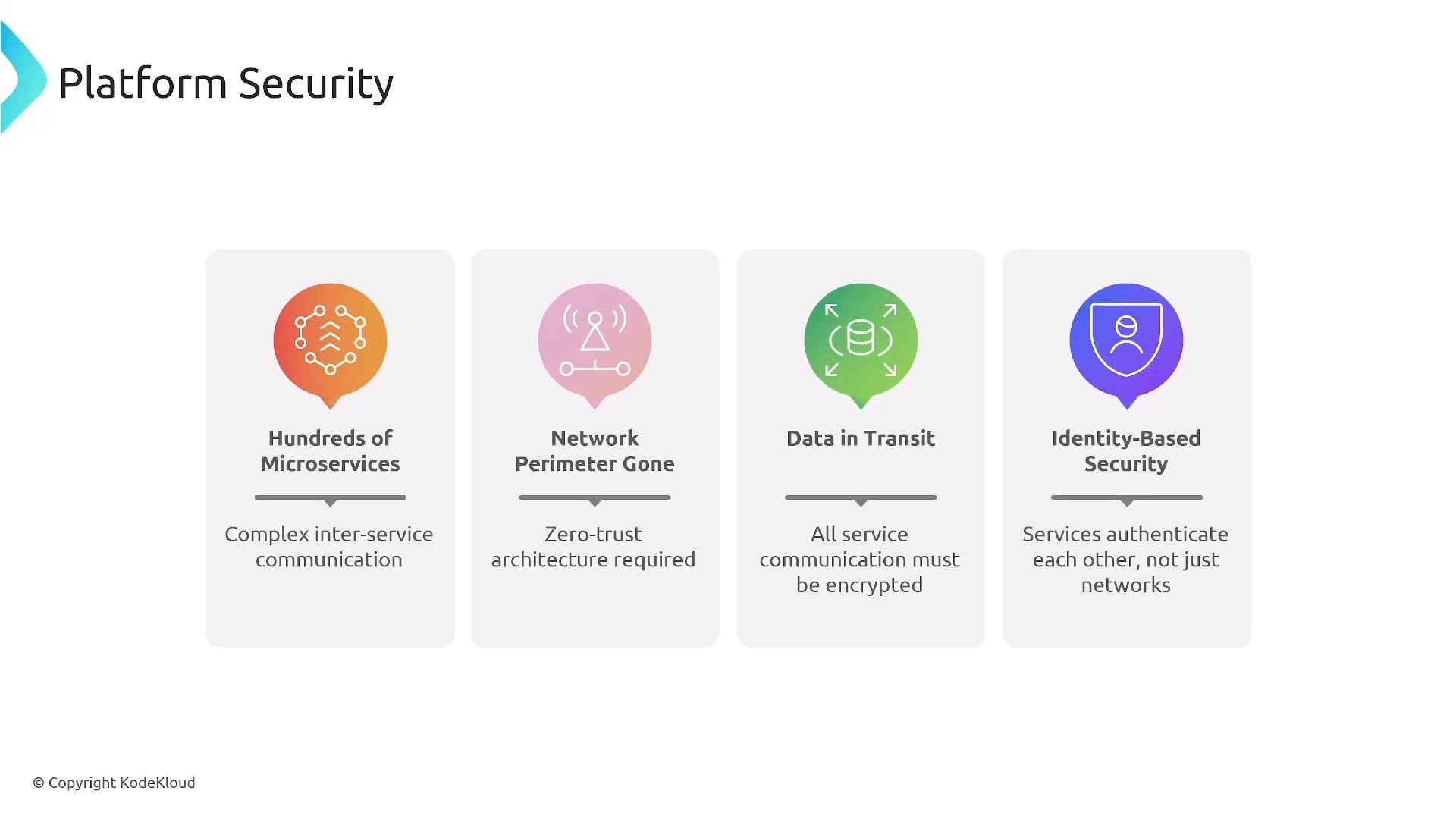
* Scales to hundreds of microservices with consistent security and traffic controls.
* Enables zero‑trust service identities and explicit allow policies.
* Encrypts data in transit and provides service-to-service identity verification, including across clusters.
* Implements policy-as-code for service communication, reducing brittle network-level controls.
 ## From perimeter security to service identity
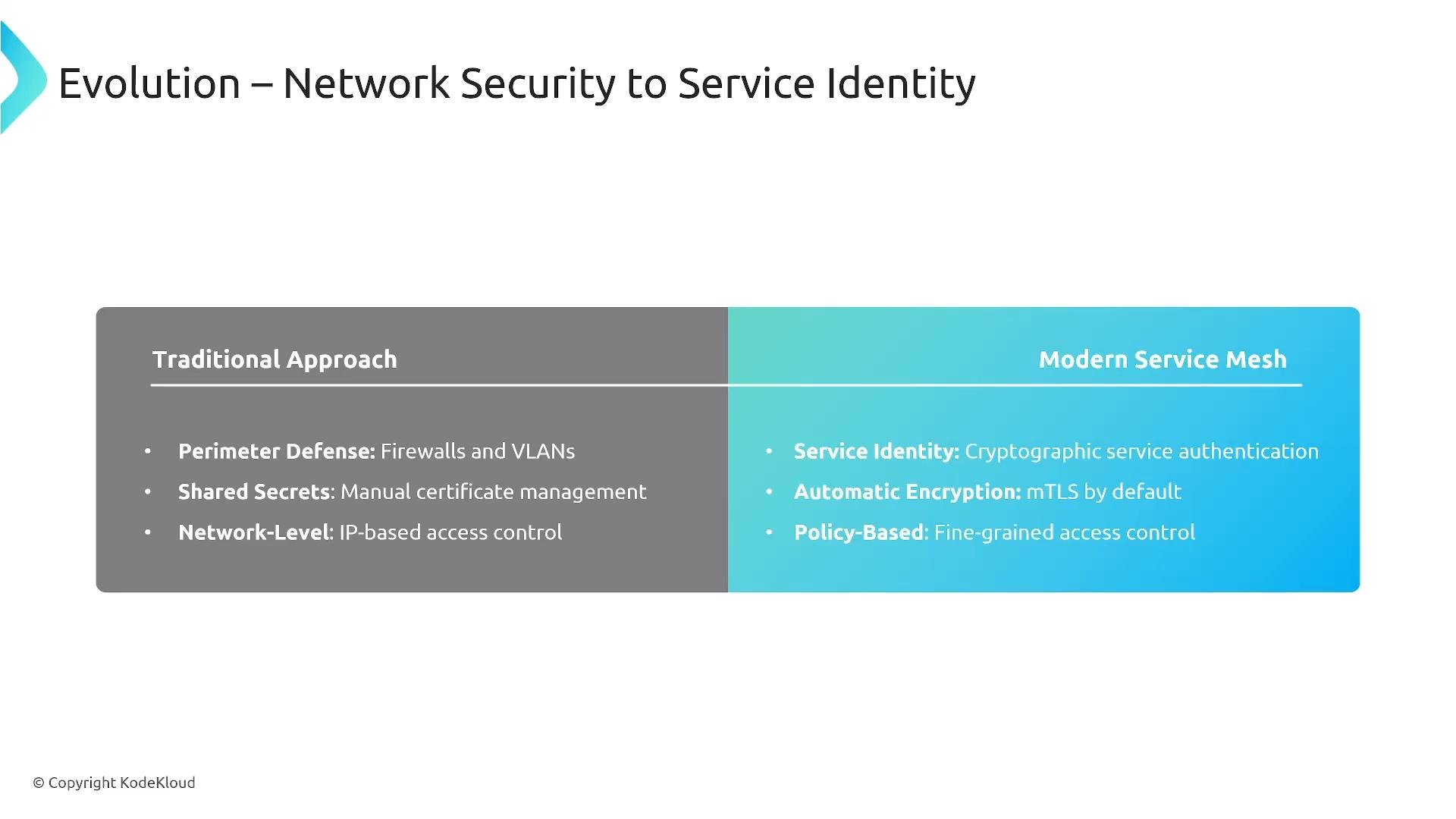
Modern cloud-native platforms move away from perimeter/IP-based controls toward cryptographic service identities, automatic encryption-in-transit, and centralized policy enforcement. In this zero‑trust model, every service interaction must be explicitly authenticated and authorized.
## From perimeter security to service identity
Modern cloud-native platforms move away from perimeter/IP-based controls toward cryptographic service identities, automatic encryption-in-transit, and centralized policy enforcement. In this zero‑trust model, every service interaction must be explicitly authenticated and authorized.
 Platform teams and developers both benefit from this separation of concerns:
* Platform engineers can provide centralized networking, identity, and security guarantees.
* Developers focus on business logic without embedding certificate handling into app code.
* The infrastructure transparently handles mTLS, certificate rotation, and policy enforcement.
## What is a service mesh?
A service mesh is an infrastructure layer that provides secure, observable, and controllable service-to-service communication. It is commonly implemented using sidecar proxies injected into application pods, or via ambient/injectionless modes.
Typical mesh components:
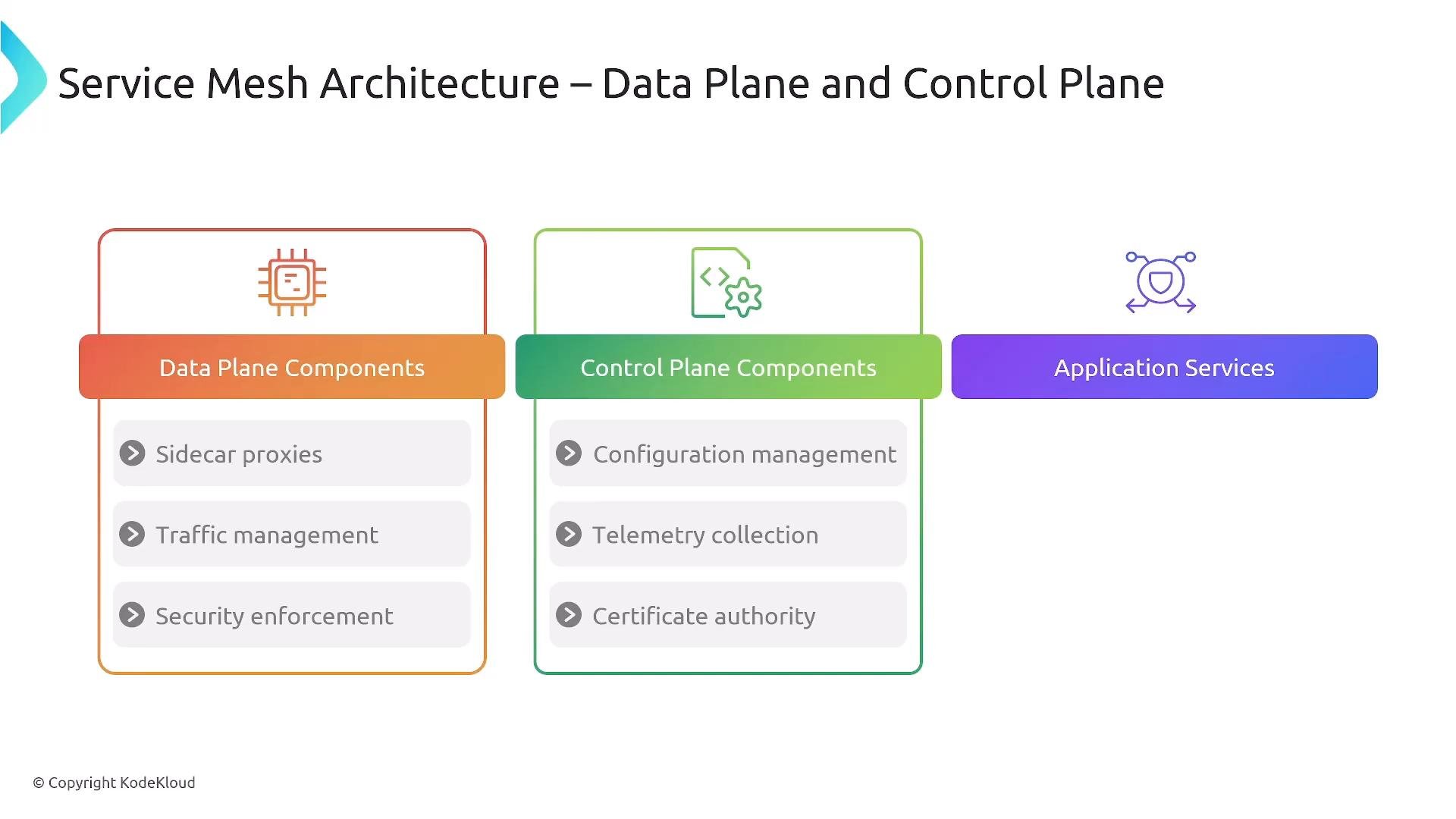
* Data plane: sidecar proxies that handle traffic, encryption, and enforcement.
* Control plane: manages configuration, issues certificates, and collects telemetry.
* Applications: run unmodified and rely on the mesh for communication features.
Platform teams and developers both benefit from this separation of concerns:
* Platform engineers can provide centralized networking, identity, and security guarantees.
* Developers focus on business logic without embedding certificate handling into app code.
* The infrastructure transparently handles mTLS, certificate rotation, and policy enforcement.
## What is a service mesh?
A service mesh is an infrastructure layer that provides secure, observable, and controllable service-to-service communication. It is commonly implemented using sidecar proxies injected into application pods, or via ambient/injectionless modes.
Typical mesh components:
* Data plane: sidecar proxies that handle traffic, encryption, and enforcement.
* Control plane: manages configuration, issues certificates, and collects telemetry.
* Applications: run unmodified and rely on the mesh for communication features.
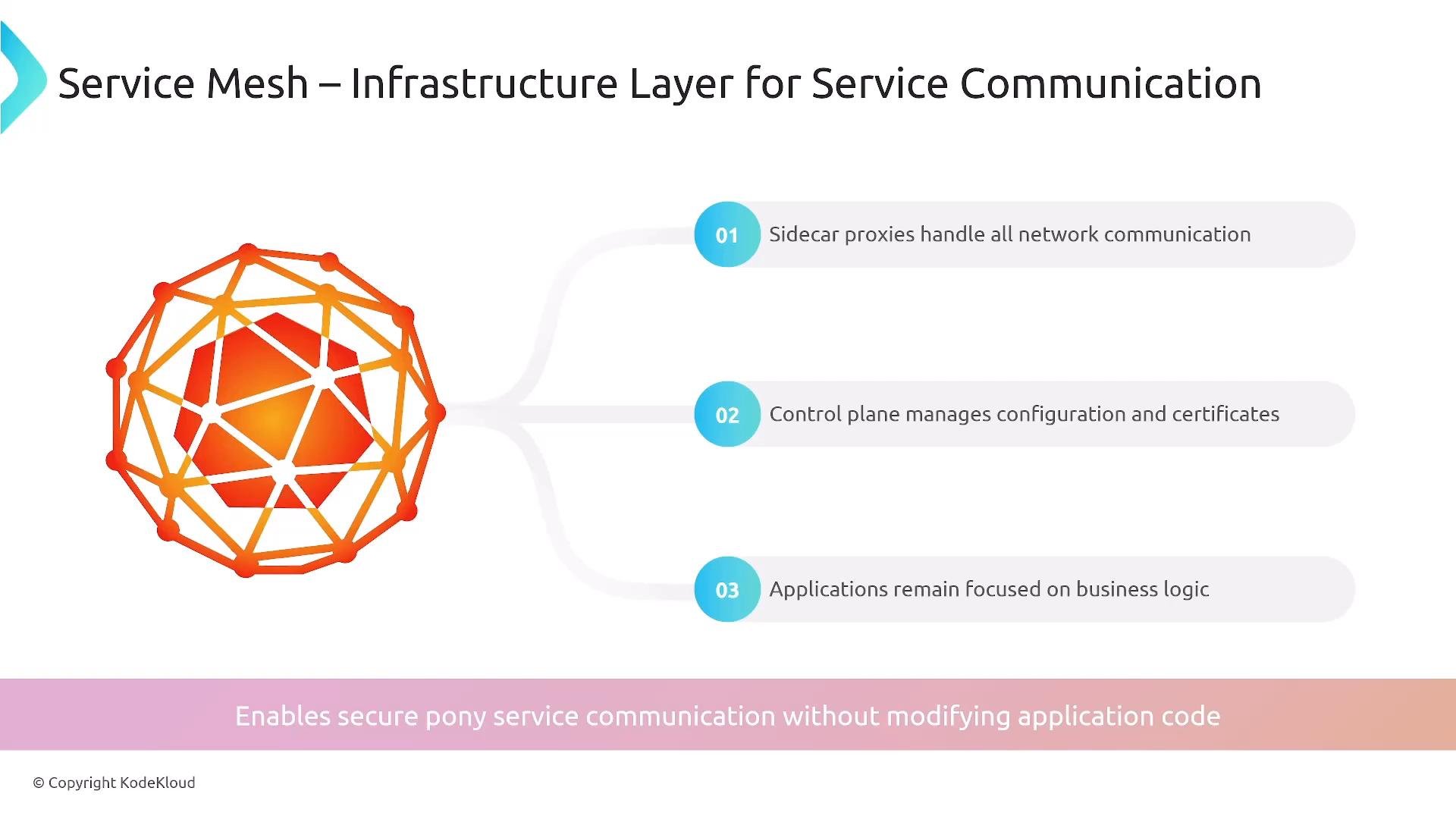 From an architecture viewpoint, the split between data plane and control plane delivers centralized policy and telemetry while keeping runtime overheads and application code unchanged.
 ## Mutual TLS (mTLS) — cryptographic service authentication
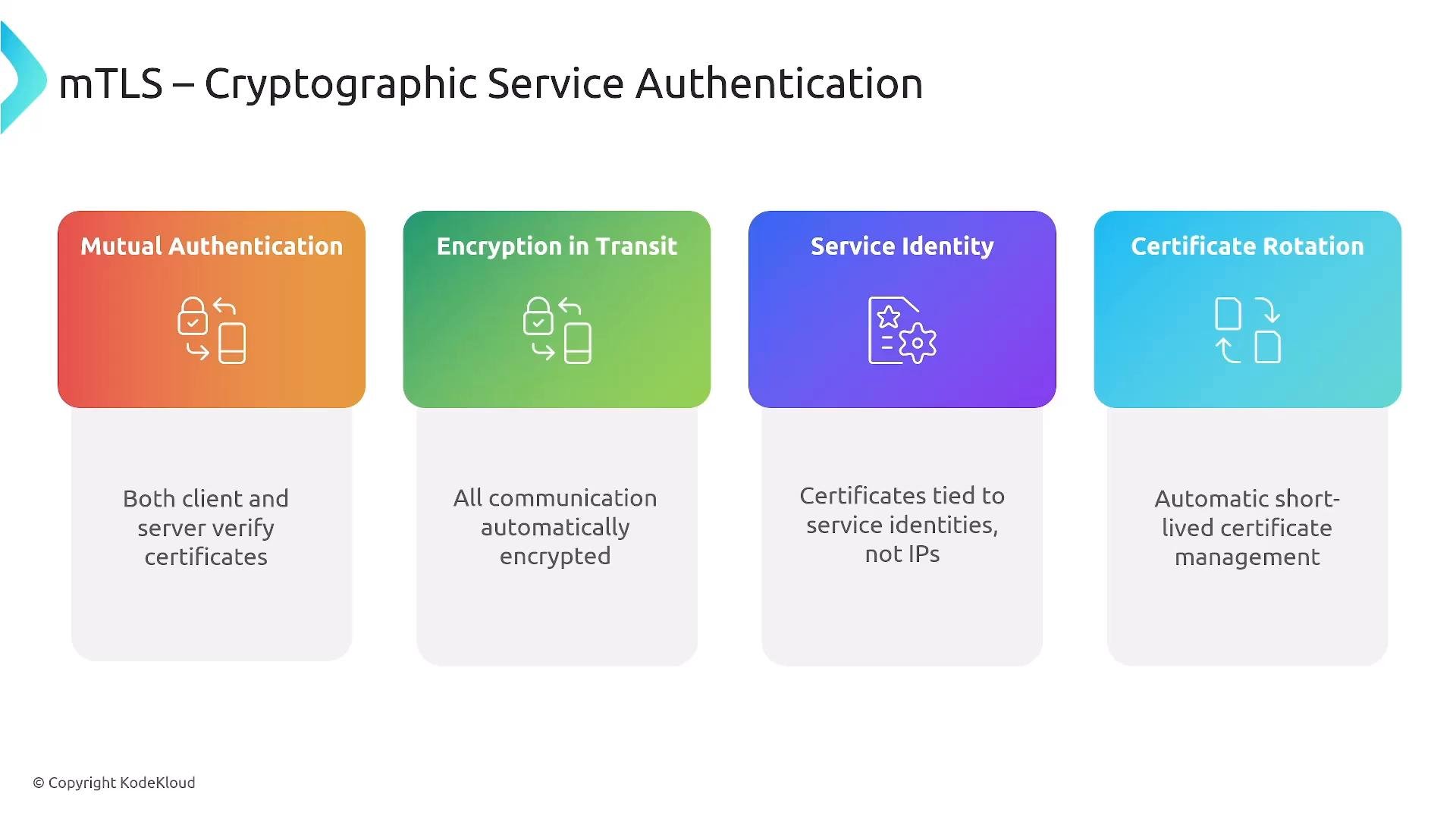
One of the most important security primitives provided by service meshes is mutual TLS (mTLS). mTLS provides:
* Mutual authentication (both client and server validate certificates).
* Encryption for data in transit.
* Service identity (certificates bind to service identities, not IPs).
* Automated short‑lived certificate issuance and rotation.
## Mutual TLS (mTLS) — cryptographic service authentication
One of the most important security primitives provided by service meshes is mutual TLS (mTLS). mTLS provides:
* Mutual authentication (both client and server validate certificates).
* Encryption for data in transit.
* Service identity (certificates bind to service identities, not IPs).
* Automated short‑lived certificate issuance and rotation.
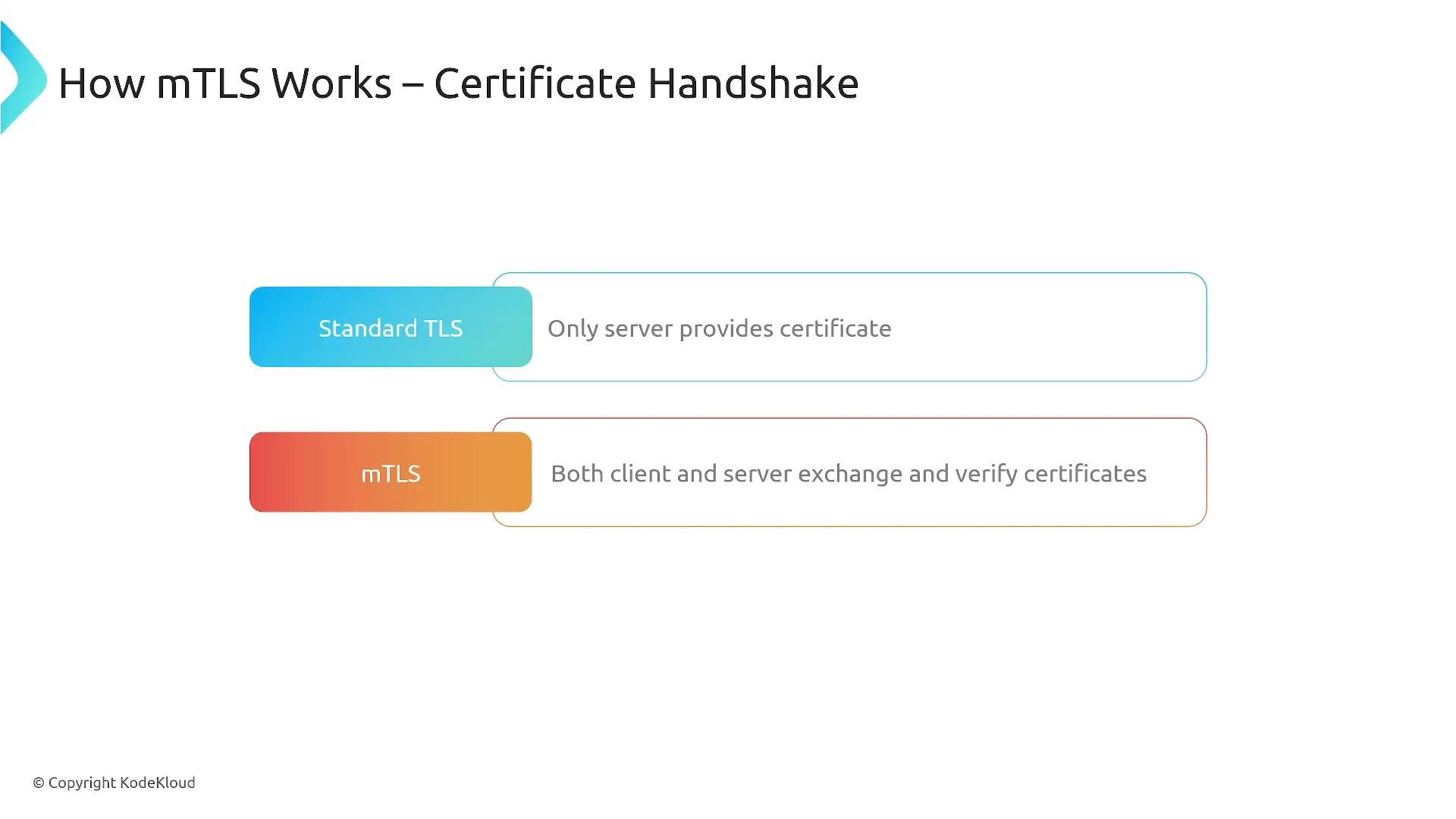
 How mTLS differs from standard TLS:
| Aspect | Standard TLS | Mutual TLS (mTLS) |
| - | - | - |
| Certificate exchange | Server presents cert; client verifies | Both client and server present and verify certs |
| Authentication | Server authenticated to client | Both endpoints authenticated to each other |
| Use case | HTTPS to browser/HTTP server | Inter-service authentication in zero‑trust meshes |
How mTLS differs from standard TLS:
| Aspect | Standard TLS | Mutual TLS (mTLS) |
| - | - | - |
| Certificate exchange | Server presents cert; client verifies | Both client and server present and verify certs |
| Authentication | Server authenticated to client | Both endpoints authenticated to each other |
| Use case | HTTPS to browser/HTTP server | Inter-service authentication in zero‑trust meshes |
 Example: when PonySpawnerService calls Magic Engine, the proxies for each service exchange and validate certificates. The result is cryptographic proof of the caller’s identity and encrypted communication, all without changing application code.
## Popular meshes and proxies
Understand the common projects and their trade-offs:
| Project | Type | Strengths | Link |
| - | - | - | - |
| Istio | Full-featured service mesh | Advanced traffic management, policy enforcement, telemetry, strong identity features; supports ambient modes | [https://istio.io](https://istio.io) |
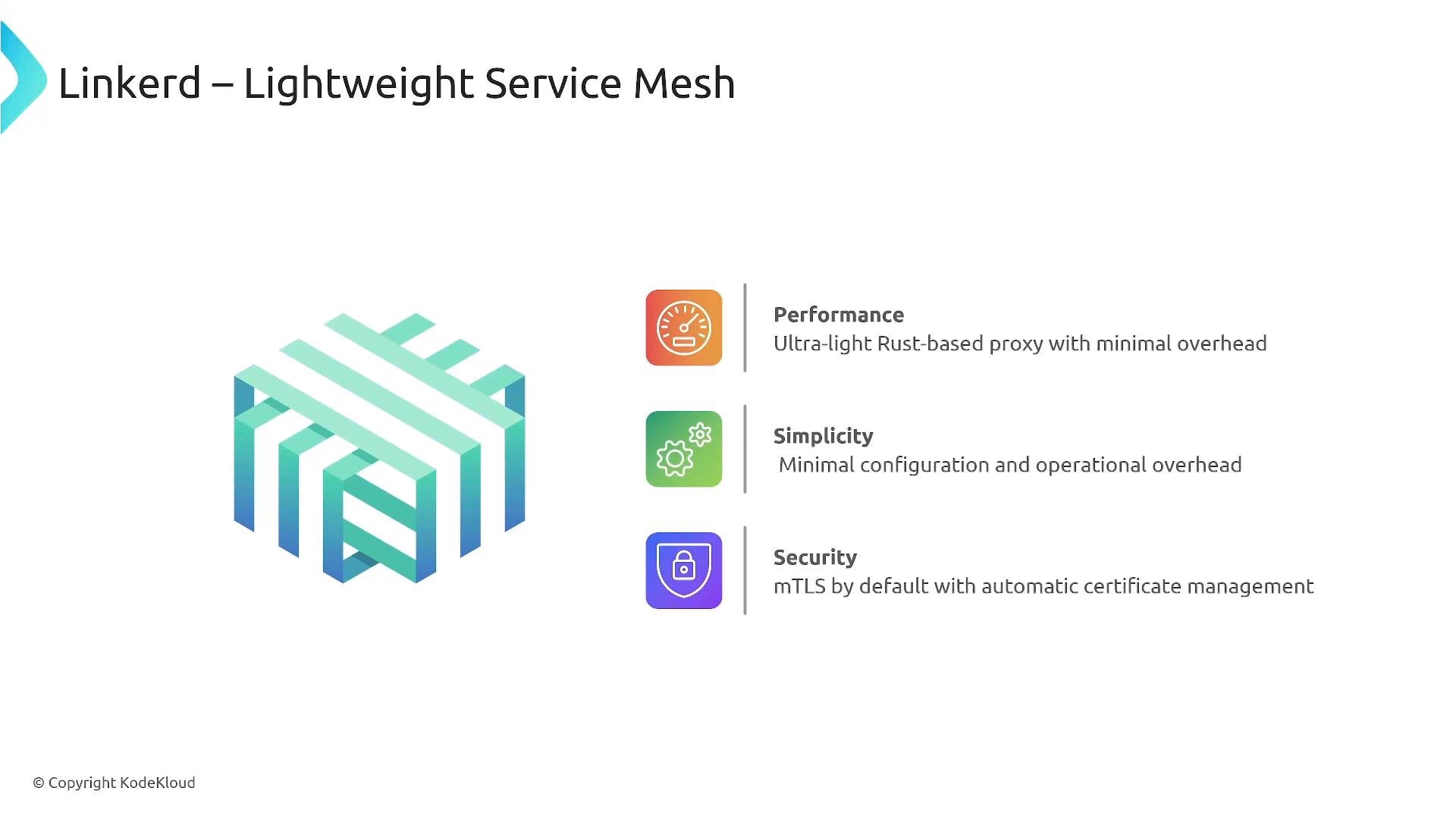
| Linkerd | Lightweight mesh | Simple, high performance, mTLS-by-default, low operational overhead | [https://linkerd.io](https://linkerd.io) |
| Envoy | High-performance proxy | Extensible data plane used by many meshes; excellent L7 capabilities | [https://www.envoyproxy.io](https://www.envoyproxy.io) |
Each choice involves trade-offs: choose Istio for advanced features, Linkerd for operational simplicity and performance, or Envoy if you need a flexible high-performance proxy.
Example: when PonySpawnerService calls Magic Engine, the proxies for each service exchange and validate certificates. The result is cryptographic proof of the caller’s identity and encrypted communication, all without changing application code.
## Popular meshes and proxies
Understand the common projects and their trade-offs:
| Project | Type | Strengths | Link |
| - | - | - | - |
| Istio | Full-featured service mesh | Advanced traffic management, policy enforcement, telemetry, strong identity features; supports ambient modes | [https://istio.io](https://istio.io) |
| Linkerd | Lightweight mesh | Simple, high performance, mTLS-by-default, low operational overhead | [https://linkerd.io](https://linkerd.io) |
| Envoy | High-performance proxy | Extensible data plane used by many meshes; excellent L7 capabilities | [https://www.envoyproxy.io](https://www.envoyproxy.io) |
Each choice involves trade-offs: choose Istio for advanced features, Linkerd for operational simplicity and performance, or Envoy if you need a flexible high-performance proxy.
 ## Network layer: L4 vs L7
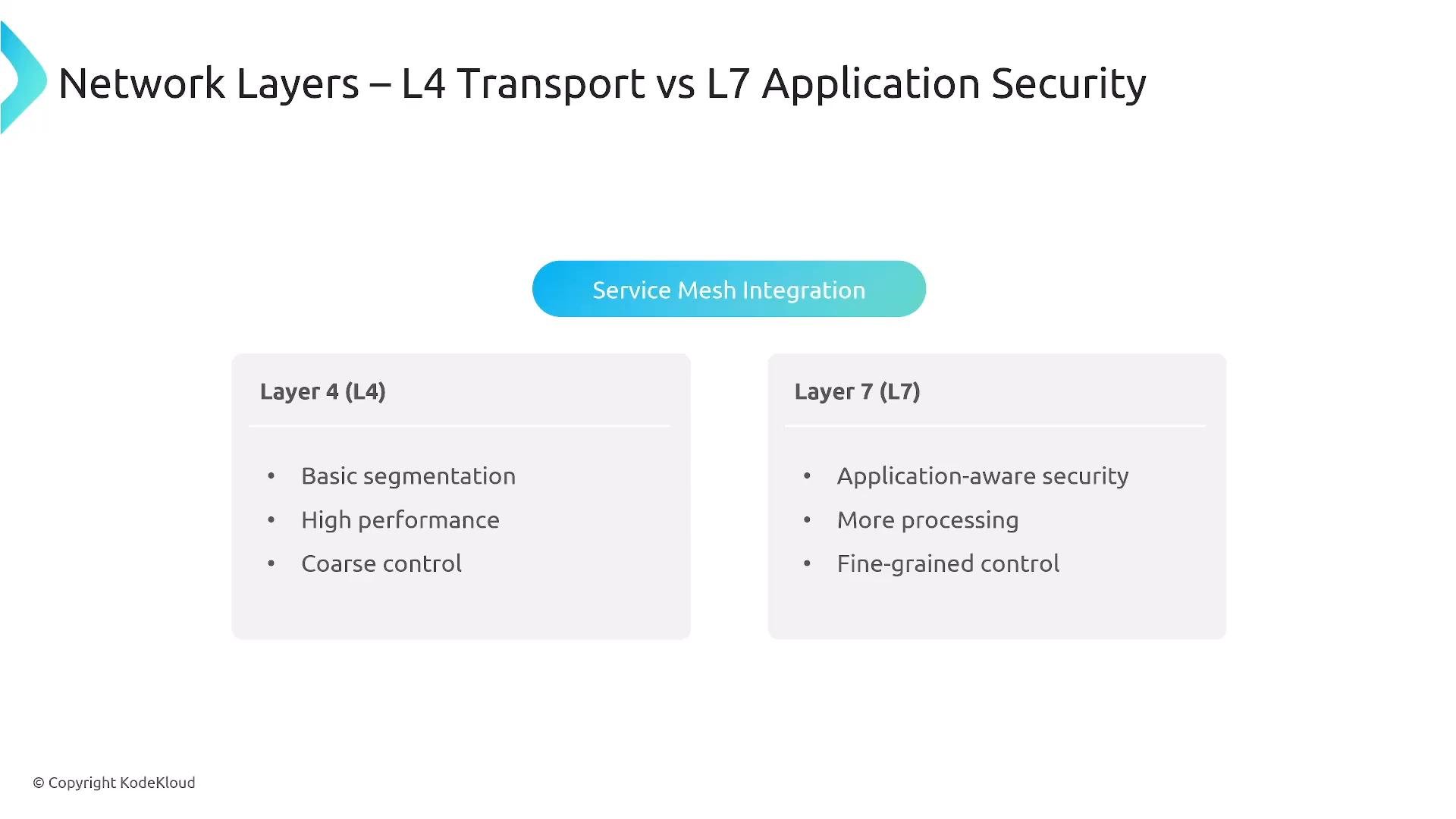
Service meshes and related controls can operate at different OSI layers. Choose the layer that matches your needs for performance and application awareness.
| Layer | Characteristics | When to use |
| - | - | - |
| L4 (Transport) | Lower overhead, coarser controls, faster | High-throughput services where application-level inspection is not required |
| L7 (Application) | Application-aware (headers, content), fine-grained policies, higher CPU cost | APIs requiring header-based routing, content inspection, or complex policy logic |
## Network layer: L4 vs L7
Service meshes and related controls can operate at different OSI layers. Choose the layer that matches your needs for performance and application awareness.
| Layer | Characteristics | When to use |
| - | - | - |
| L4 (Transport) | Lower overhead, coarser controls, faster | High-throughput services where application-level inspection is not required |
| L7 (Application) | Application-aware (headers, content), fine-grained policies, higher CPU cost | APIs requiring header-based routing, content inspection, or complex policy logic |
 Operational notes:
* Many meshes favor deny-by-default for east-west traffic; you should write explicit allow policies.
* Identity-based access control replaces brittle IP rules.
* The mesh control plane automates certificate issuance, rotation, and revocation; this is not an eBPF responsibility.
## eBPF — kernel-level observability and enforcement
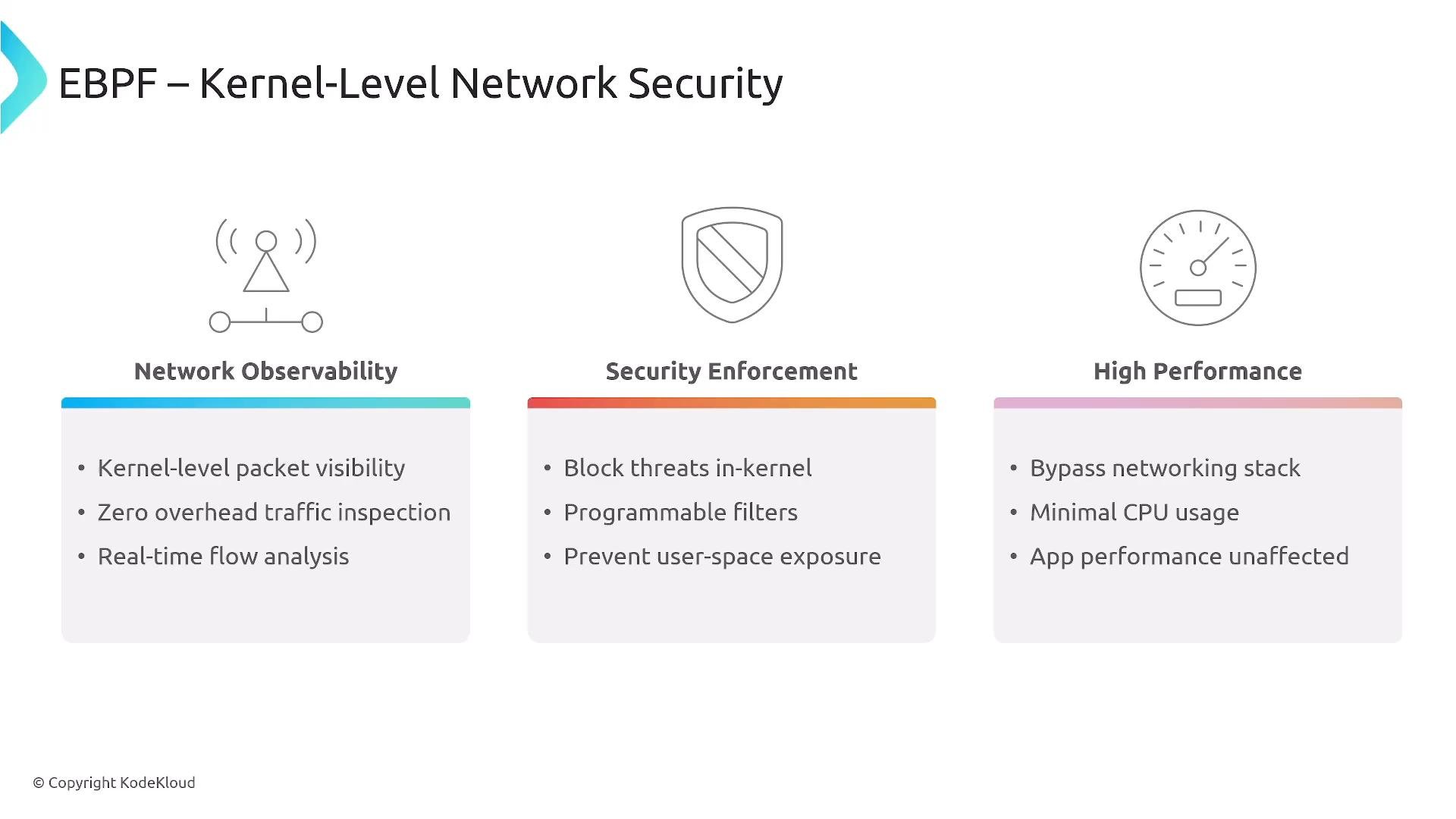
eBPF extends the kernel with safe, efficient programs allowing deep visibility and high-performance enforcement. eBPF complements service meshes by accelerating the data plane and providing visibility at the packet/process level.
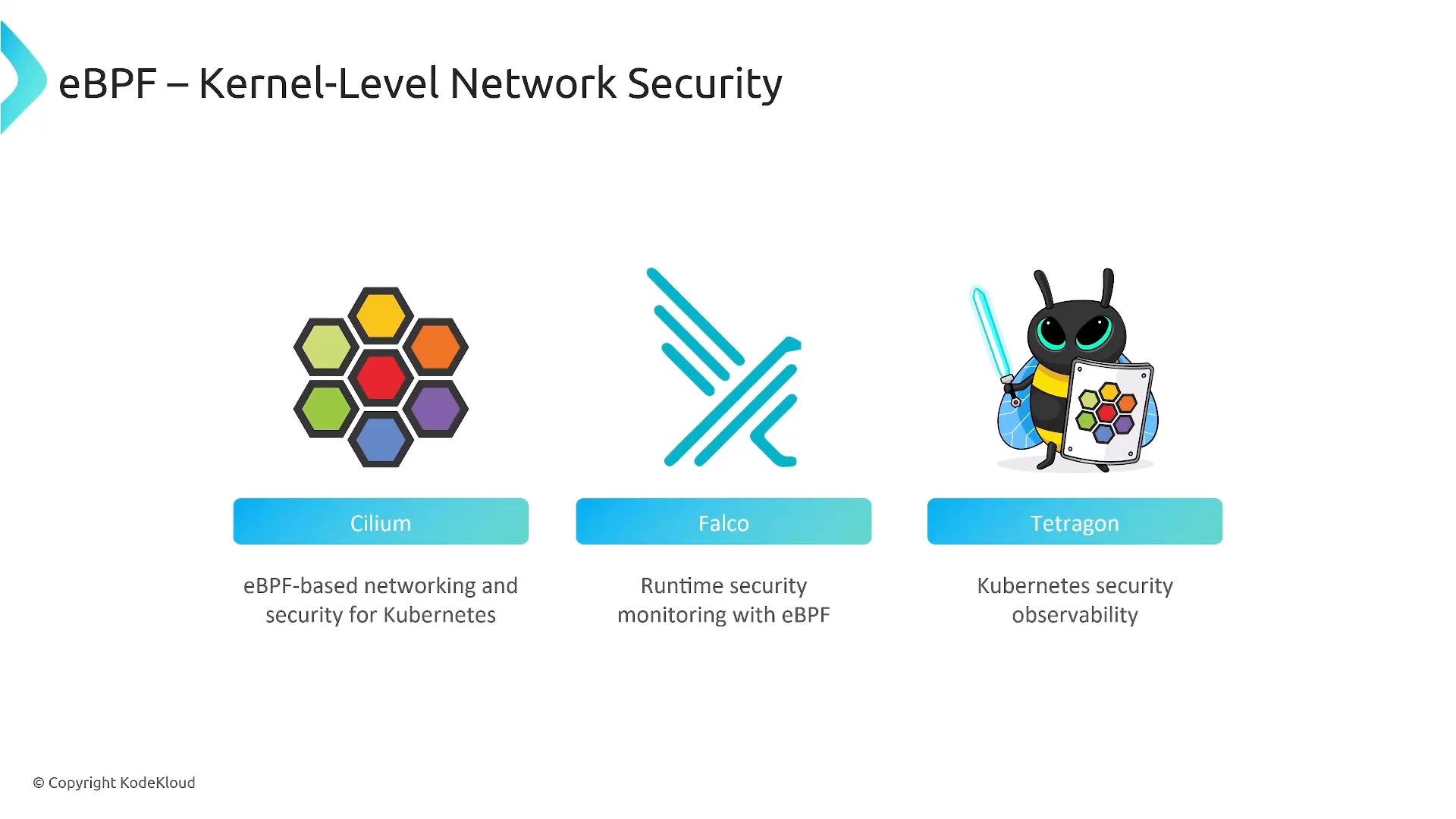
Common eBPF-based projects:
| Tool | Role |
| - | - |
| Cilium | eBPF-powered networking, observability, and policy enforcement for Kubernetes |
| Falco | Runtime security monitoring using kernel signals |
| Tetragon | Kernel-level telemetry for security and observability |
Operational notes:
* Many meshes favor deny-by-default for east-west traffic; you should write explicit allow policies.
* Identity-based access control replaces brittle IP rules.
* The mesh control plane automates certificate issuance, rotation, and revocation; this is not an eBPF responsibility.
## eBPF — kernel-level observability and enforcement
eBPF extends the kernel with safe, efficient programs allowing deep visibility and high-performance enforcement. eBPF complements service meshes by accelerating the data plane and providing visibility at the packet/process level.
Common eBPF-based projects:
| Tool | Role |
| - | - |
| Cilium | eBPF-powered networking, observability, and policy enforcement for Kubernetes |
| Falco | Runtime security monitoring using kernel signals |
| Tetragon | Kernel-level telemetry for security and observability |
 eBPF use cases and limits:
* Accelerates the data plane and provides deep packet/process visibility.
* Enables high-performance, kernel-level network policies that integrate with meshes.
* Does not manage certificate lifecycles — certificate management remains the mesh/control plane’s responsibility.
## Case study: Sparkle Pony Ranch (SPR)
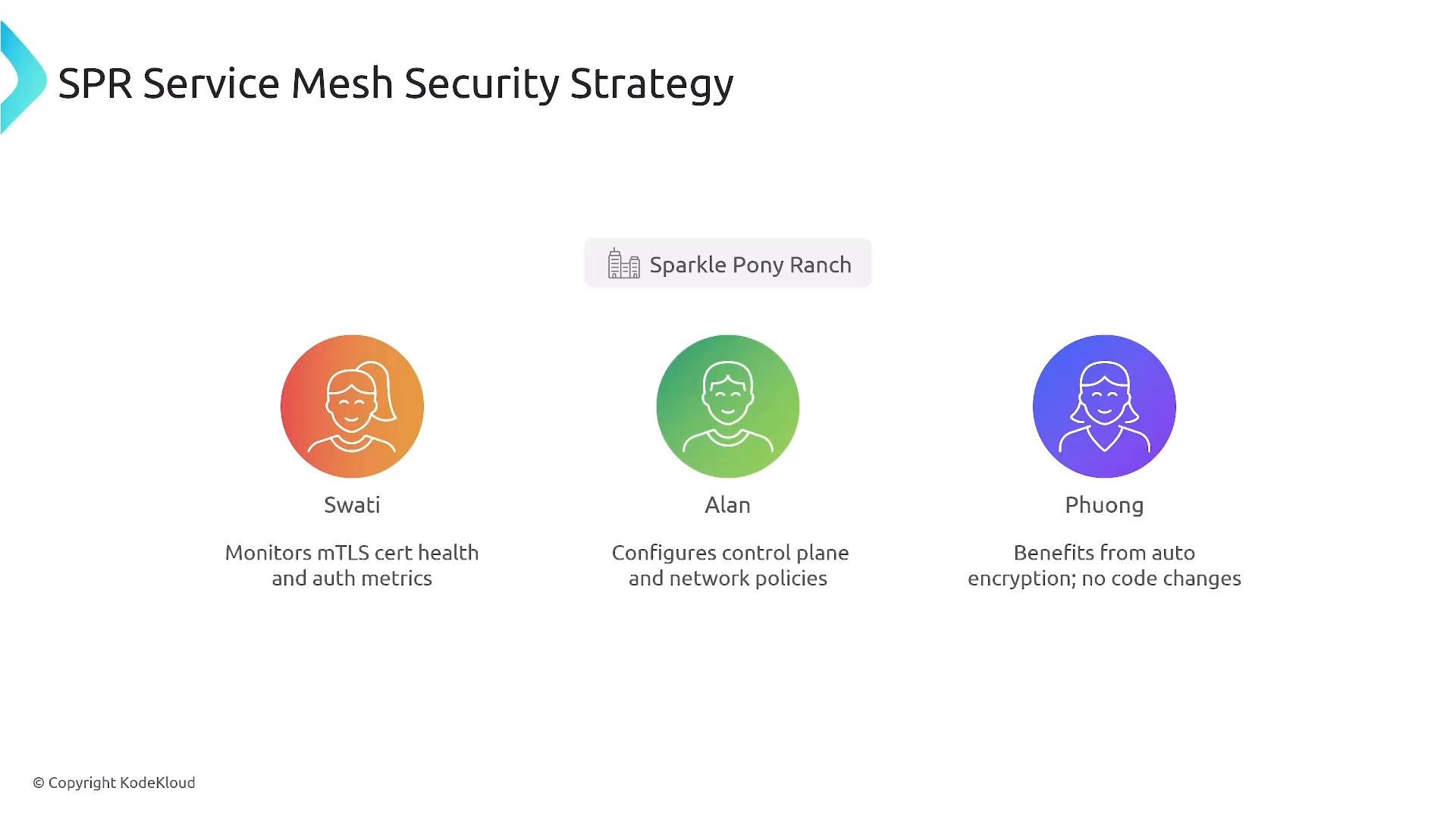
SPR’s plan is to deploy a mesh to provide mTLS, centralized policy-as-code, and to offload certificate management from application teams. Expected benefits include fewer incidents, better audit trails, and higher developer productivity.
eBPF use cases and limits:
* Accelerates the data plane and provides deep packet/process visibility.
* Enables high-performance, kernel-level network policies that integrate with meshes.
* Does not manage certificate lifecycles — certificate management remains the mesh/control plane’s responsibility.
## Case study: Sparkle Pony Ranch (SPR)
SPR’s plan is to deploy a mesh to provide mTLS, centralized policy-as-code, and to offload certificate management from application teams. Expected benefits include fewer incidents, better audit trails, and higher developer productivity.
 ## Summary — what to study for the exam
* Understand service mesh architecture (data plane vs control plane) and the value of sidecars or ambient modes.
* Know mTLS benefits: mutual authentication, encryption-in-transit, short-lived certs, and automated rotation.
* Be able to compare service mesh projects (Istio, Linkerd, Envoy) and eBPF tools (Cilium, Falco, Tetragon).
* Know L4 vs L7 trade-offs: performance vs application-aware control.
* Understand zero‑trust networking patterns: encrypt all traffic, authenticate services cryptographically, and use explicit allow policies.
## Summary — what to study for the exam
* Understand service mesh architecture (data plane vs control plane) and the value of sidecars or ambient modes.
* Know mTLS benefits: mutual authentication, encryption-in-transit, short-lived certs, and automated rotation.
* Be able to compare service mesh projects (Istio, Linkerd, Envoy) and eBPF tools (Cilium, Falco, Tetragon).
* Know L4 vs L7 trade-offs: performance vs application-aware control.
* Understand zero‑trust networking patterns: encrypt all traffic, authenticate services cryptographically, and use explicit allow policies.
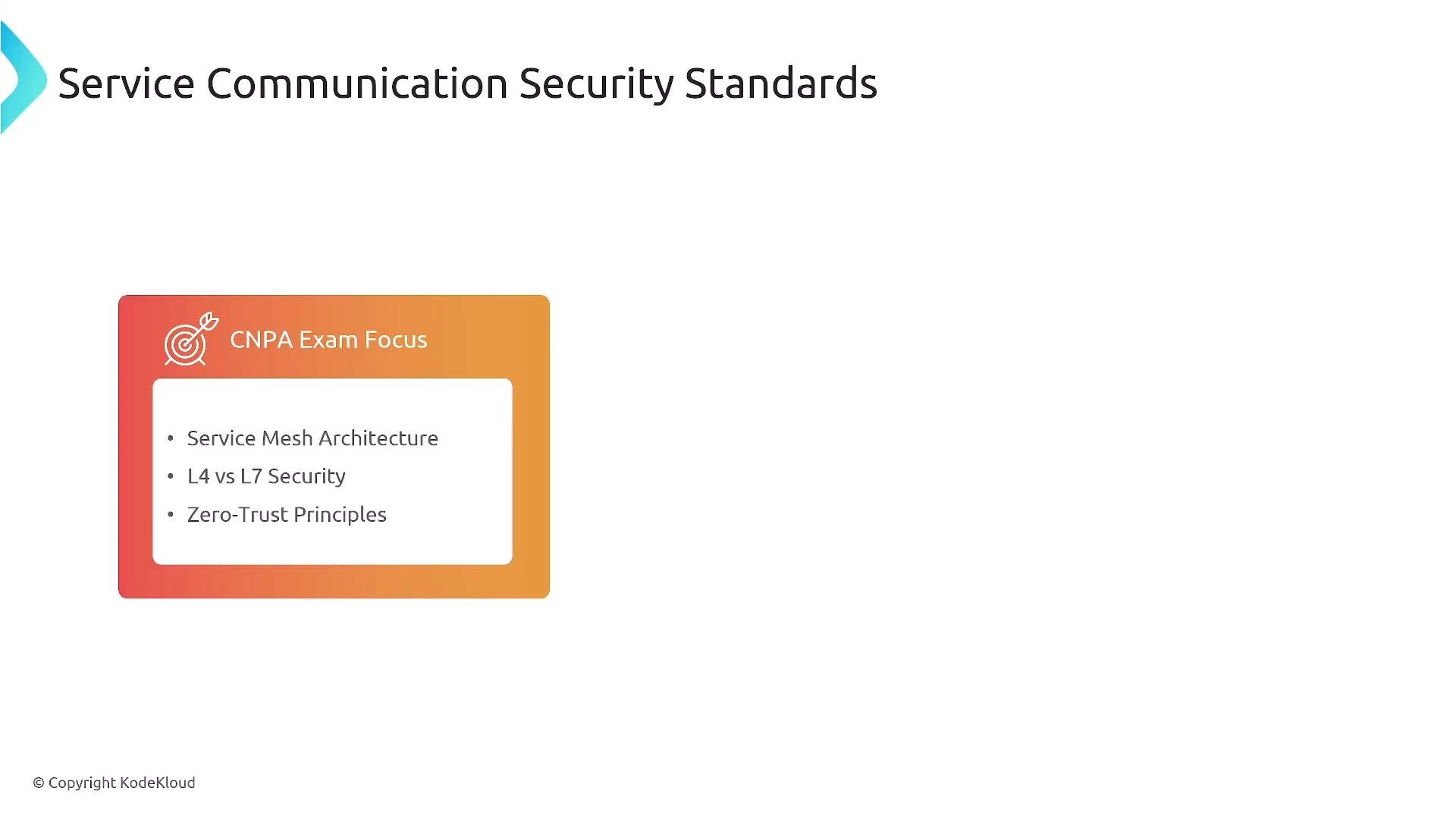 The exam emphasizes conceptual understanding and trade-offs (service mesh vs eBPF, mTLS benefits, L4 vs L7) rather than deep implementation details. Focus on the purpose, capabilities, and typical use cases of each technology.
## Links and references
* [Istio documentation](https://istio.io)
* [Linkerd documentation](https://linkerd.io)
* [Envoy proxy](https://www.envoyproxy.io)
* [eBPF project](https://ebpf.io)
* [Cilium](https://cilium.io)
* [Falco](https://falco.org)
* [Tetragon](https://tetragon.io)
This documentation is built and hosted on [Mintlify](https://mintlify.com), a developer documentation platform.
The exam emphasizes conceptual understanding and trade-offs (service mesh vs eBPF, mTLS benefits, L4 vs L7) rather than deep implementation details. Focus on the purpose, capabilities, and typical use cases of each technology.
## Links and references
* [Istio documentation](https://istio.io)
* [Linkerd documentation](https://linkerd.io)
* [Envoy proxy](https://www.envoyproxy.io)
* [eBPF project](https://ebpf.io)
* [Cilium](https://cilium.io)
* [Falco](https://falco.org)
* [Tetragon](https://tetragon.io)
This documentation is built and hosted on [Mintlify](https://mintlify.com), a developer documentation platform.