> ## Documentation Index
> Fetch the complete documentation index at: https://notes.kodekloud.com/llms.txt
> Use this file to discover all available pages before exploring further.
# Infrastructure Provisioning with Kubernetes
> Overview of Kubernetes-centric infrastructure provisioning comparing Crossplane, Terraform/OpenTofu and Cluster API for GitOps driven self-service platform engineering and cluster lifecycle management
All right — welcome to another core topic in CNPA Domain 4: Infrastructure Provisioning with Kubernetes.
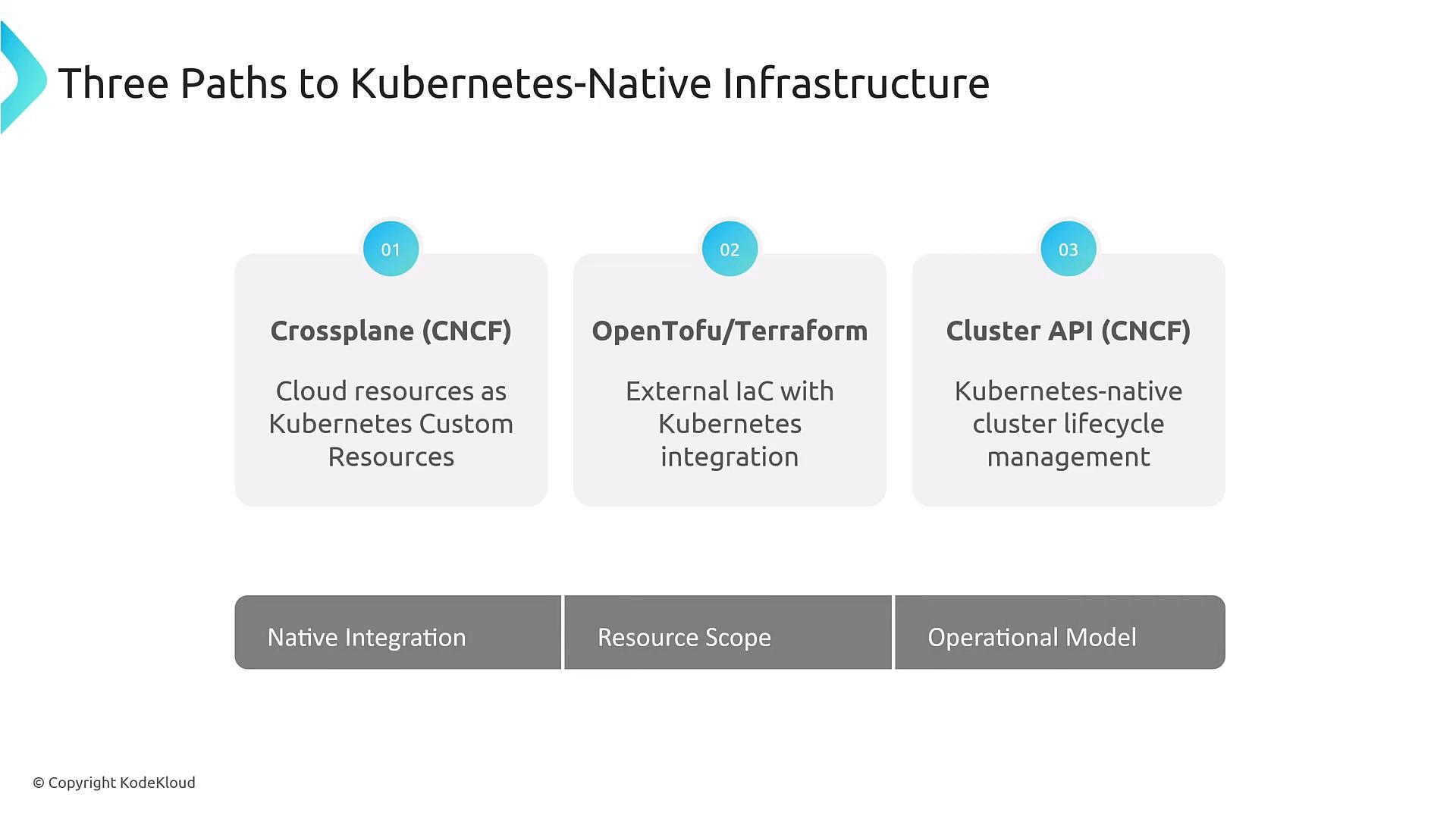
This is a foundational area for modern platform engineering. In this lesson we’ll cover three major approaches that platform teams use to manage cloud resources in a Kubernetes-centric environment: Crossplane, Terraform/OpenTofu, and Cluster API. These are important concepts for the CNPA exam and for real-world platform design.
This lesson focuses on Kubernetes-native patterns and trade-offs between Crossplane, Terraform/OpenTofu, and Cluster API. Understanding when to use each will help you design self-service, GitOps-driven platforms.
Why re-think traditional provisioning? Consider this common scenario: your platform supports multiple development teams across AWS and Azure and needs to provide self-service provisioning for databases, storage, and networking — fast, without tickets — and integrated into the same GitOps workflow developers use for applications. You also want consistent behavior across clouds and Kubernetes-native integration.
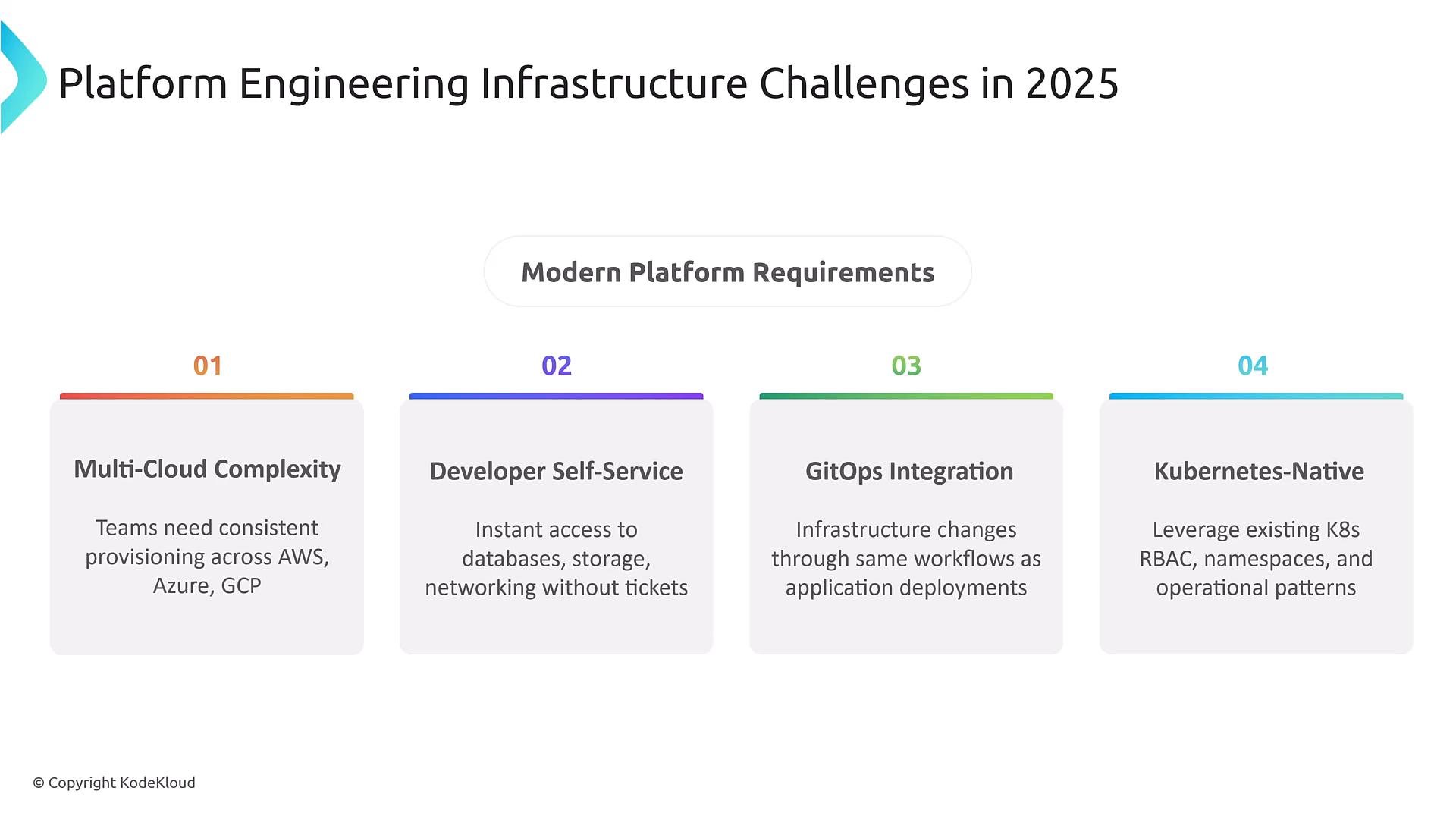 The core goal is a single source of truth and developer self-provisioning that is GitOps-friendly and, ideally, Kubernetes-native. Below we describe three common approaches and how they differ by native integration, resource scope, and operational model.
 ## Crossplane — Kubernetes-native infrastructure control
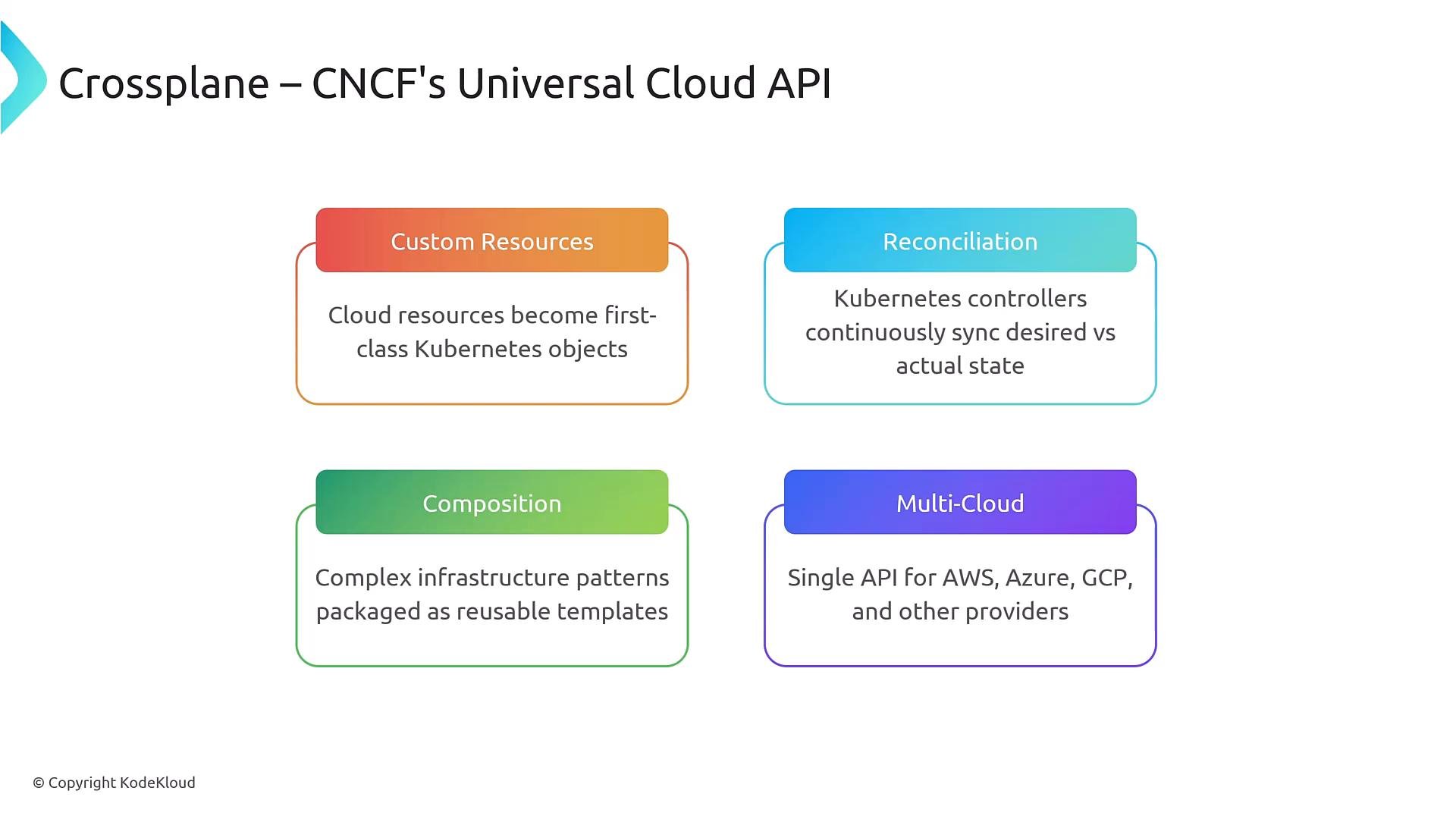
Crossplane is a CNCF project that treats cloud resources as Kubernetes custom resources (CRDs). It runs controllers in-cluster to reconcile those CRs against cloud provider APIs, enabling a Kubernetes-native control plane for external resources. You can compose reusable infrastructure patterns (Compositions) and expose developer-friendly claim APIs (CompositeResourceDefinitions, XRDs).
Benefits:
* Cloud resources become first-class Kubernetes objects with continuous reconciliation.
* Compositions let you package complex infrastructure patterns as templates.
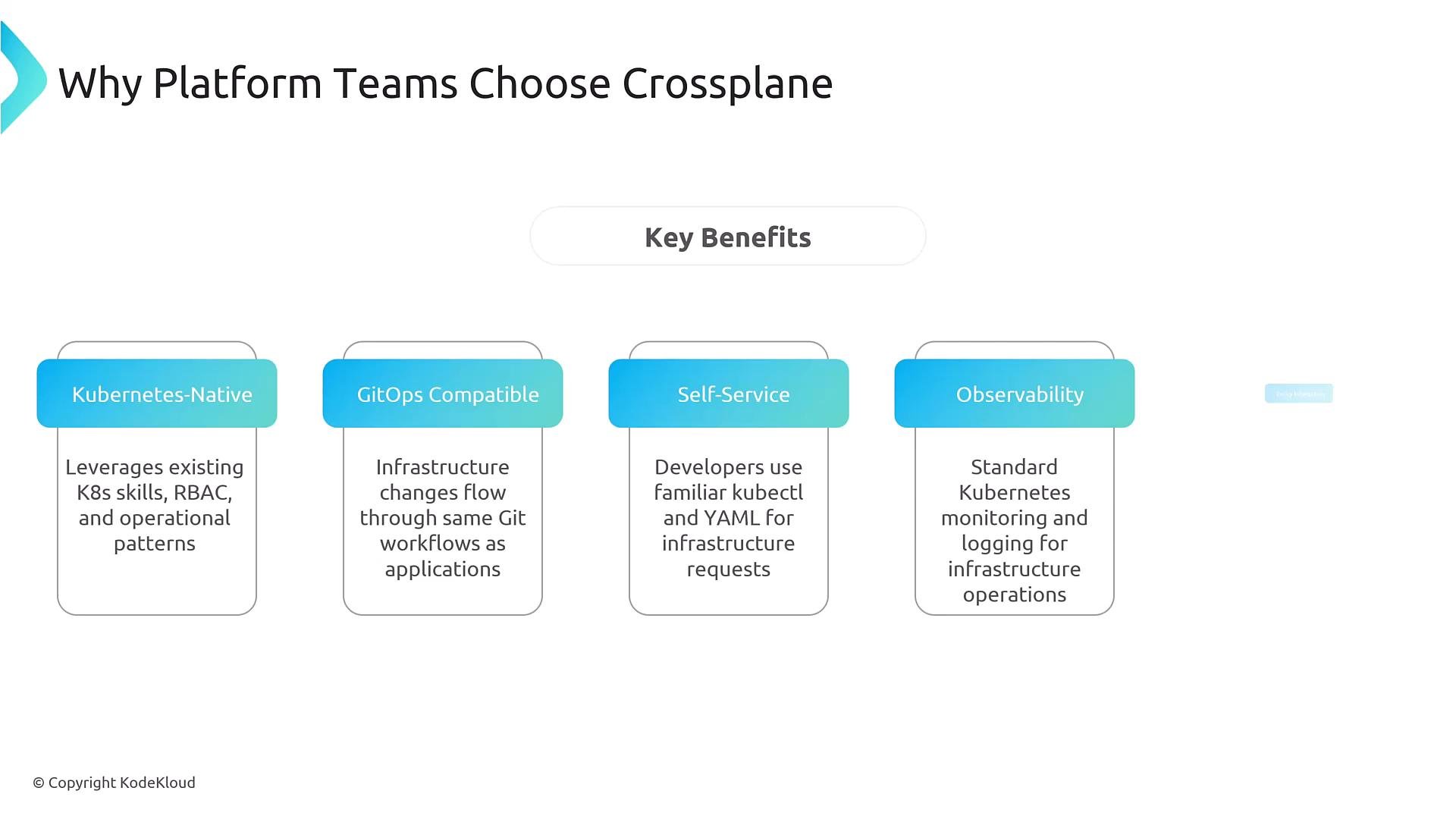
* GitOps-friendly and integrates with Kubernetes RBAC, admission controllers, and observability.
## Crossplane — Kubernetes-native infrastructure control
Crossplane is a CNCF project that treats cloud resources as Kubernetes custom resources (CRDs). It runs controllers in-cluster to reconcile those CRs against cloud provider APIs, enabling a Kubernetes-native control plane for external resources. You can compose reusable infrastructure patterns (Compositions) and expose developer-friendly claim APIs (CompositeResourceDefinitions, XRDs).
Benefits:
* Cloud resources become first-class Kubernetes objects with continuous reconciliation.
* Compositions let you package complex infrastructure patterns as templates.
* GitOps-friendly and integrates with Kubernetes RBAC, admission controllers, and observability.
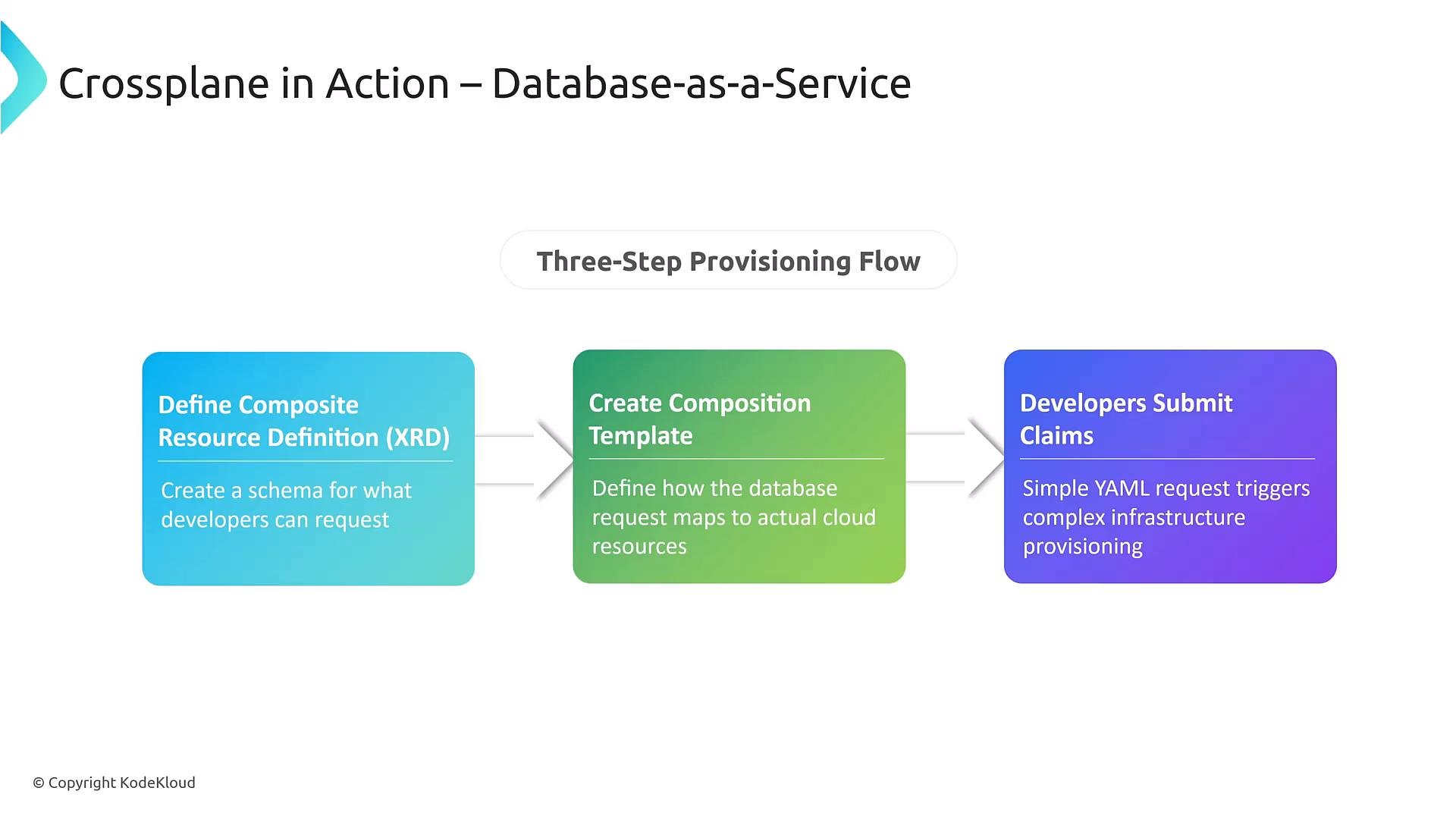
 Typical flow for a Database-as-a-Service with Crossplane:
1. Define a CompositeResourceDefinition (XRD) that models what developers can request.
2. Create a Composition template that maps the XRD to concrete cloud resources (e.g., RDS instance, network, secrets).
3. Developers submit a claim (instance of the XRD) and Crossplane reconciles the Composition to provision resources.
Typical flow for a Database-as-a-Service with Crossplane:
1. Define a CompositeResourceDefinition (XRD) that models what developers can request.
2. Create a Composition template that maps the XRD to concrete cloud resources (e.g., RDS instance, network, secrets).
3. Developers submit a claim (instance of the XRD) and Crossplane reconciles the Composition to provision resources.
 Example: install a Crossplane AWS provider using Kubernetes YAML.
```yaml theme={null}
# Provider: Connects to cloud APIs
apiVersion: pkg.crossplane.io/v1
kind: Provider
metadata:
name: provider-aws
spec:
package: xpkg.upbound.io/crossplane-contrib/provider-aws:v0.44.0
```
Example XRD (schema that defines what developers can request):
```yaml theme={null}
# XRD: Define what developers can request
apiVersion: apiextensions.crossplane.io/v1
kind: CompositeResourceDefinition
metadata:
name: xpostgresqlinstances.database.spr.com
spec:
group: database.spr.com
versions:
- name: v1alpha1
schema:
openAPIV3Schema:
properties:
spec:
properties:
storageGB:
type: integer
minimum: 20
engineVersion:
type: string
enum: ["13.7", "14.6", "15.1"]
```
Platform teams like Crossplane because it enforces Kubernetes patterns (reconciliation, RBAC, GitOps) across infrastructure, enabling self-service claims, templated compositions, and standard monitoring.
Example: install a Crossplane AWS provider using Kubernetes YAML.
```yaml theme={null}
# Provider: Connects to cloud APIs
apiVersion: pkg.crossplane.io/v1
kind: Provider
metadata:
name: provider-aws
spec:
package: xpkg.upbound.io/crossplane-contrib/provider-aws:v0.44.0
```
Example XRD (schema that defines what developers can request):
```yaml theme={null}
# XRD: Define what developers can request
apiVersion: apiextensions.crossplane.io/v1
kind: CompositeResourceDefinition
metadata:
name: xpostgresqlinstances.database.spr.com
spec:
group: database.spr.com
versions:
- name: v1alpha1
schema:
openAPIV3Schema:
properties:
spec:
properties:
storageGB:
type: integer
minimum: 20
engineVersion:
type: string
enum: ["13.7", "14.6", "15.1"]
```
Platform teams like Crossplane because it enforces Kubernetes patterns (reconciliation, RBAC, GitOps) across infrastructure, enabling self-service claims, templated compositions, and standard monitoring.
 ## Terraform / OpenTofu — mature IaC with operator integrations
Terraform (HashiCorp) is the long-standing infrastructure-as-code tool using HCL and a large provider ecosystem. Terraform’s license change led to community forks such as OpenTofu (a community-driven fork of Terraform); OpenTofu aims to preserve an open-source path while maintaining compatibility with Terraform modules and HCL.
Terraform/OpenTofu characteristics:
* Mature ecosystem and provider coverage.
* HCL language and state management (remote state backends).
* Often used outside the cluster (CI/CD pipelines) or integrated into-cluster via operators.
You can run Terraform from CI (recommended for many teams), or use an in-cluster Terraform Operator that exposes Terraform runs via CRs. A typical pattern is to keep Terraform modules as the canonical module source and trigger runs from a GitOps pipeline or operator.
Example of a Terraform custom resource that triggers an in-cluster Terraform operator:
```yaml theme={null}
# Terraform Operator in Kubernetes
apiVersion: tf.isaaguilar.com/v1alpha1
kind: Terraform
metadata:
name: pony-database-infrastructure
spec:
terraformModule:
source: "git::https://github.com/spr/terraform-modules//rds-postgres"
outputsToSecret:
name: pony-db-connection
```
Notes on trade-offs:
* Terraform/OpenTofu have broad provider coverage and module ecosystems.
* They are not inherently Kubernetes-native; you integrate them into GitOps workflows or run them from CI/CD.
* Crossplane provides tighter Kubernetes-native reconciliation, but Terraform has a lower initial learning curve for many teams and more mature provider modules.
## Cluster API — declarative cluster lifecycle management
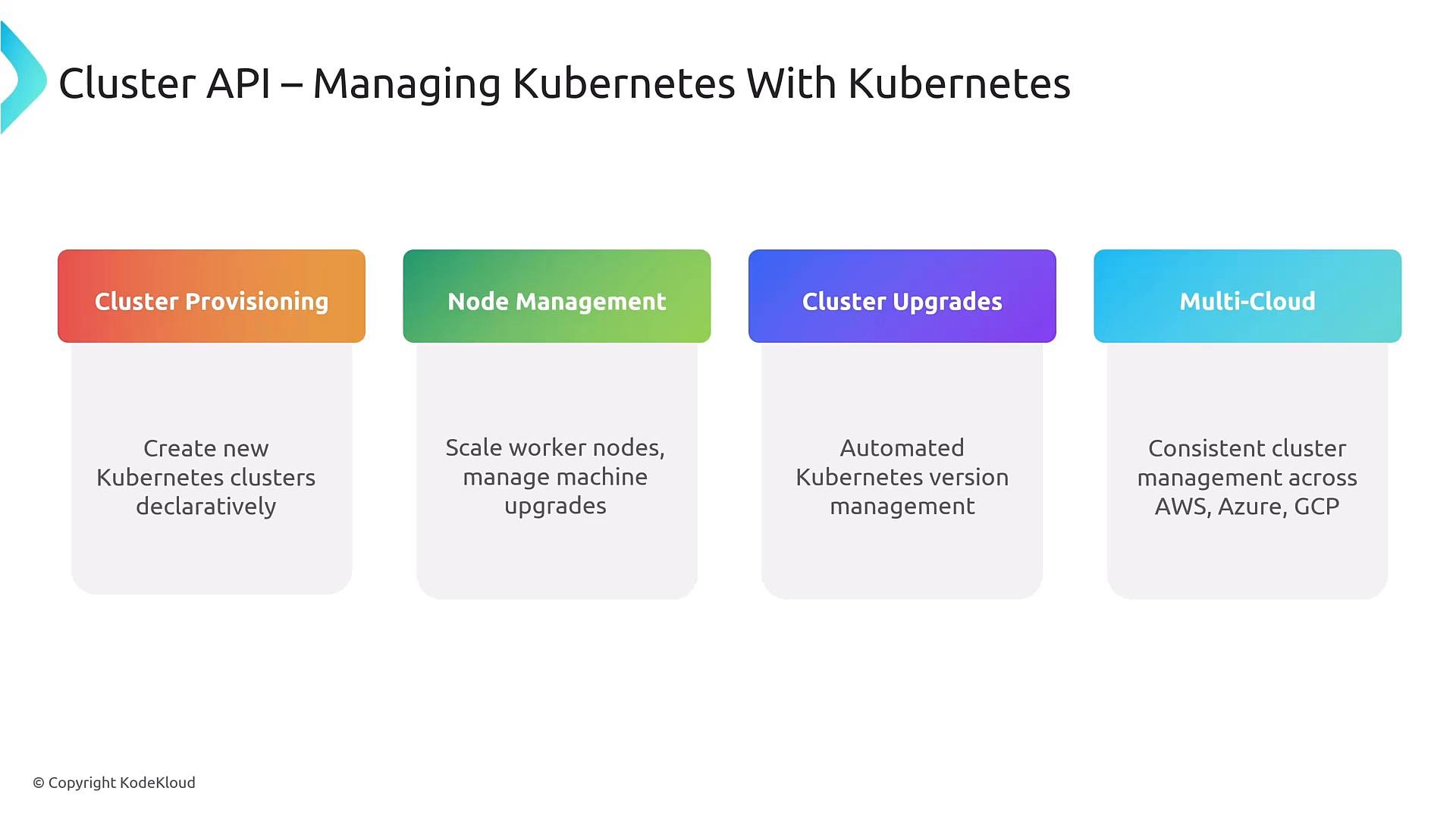
Cluster API (CAPI) is a CNCF project that focuses on Kubernetes cluster lifecycle management (provisioning, scaling, upgrades, machine lifecycle) using Kubernetes-style declarative APIs. It’s effectively “Kubernetes managing Kubernetes” — controllers in a management cluster reconcile Cluster and Machine CRs to provision and operate workload clusters.
## Terraform / OpenTofu — mature IaC with operator integrations
Terraform (HashiCorp) is the long-standing infrastructure-as-code tool using HCL and a large provider ecosystem. Terraform’s license change led to community forks such as OpenTofu (a community-driven fork of Terraform); OpenTofu aims to preserve an open-source path while maintaining compatibility with Terraform modules and HCL.
Terraform/OpenTofu characteristics:
* Mature ecosystem and provider coverage.
* HCL language and state management (remote state backends).
* Often used outside the cluster (CI/CD pipelines) or integrated into-cluster via operators.
You can run Terraform from CI (recommended for many teams), or use an in-cluster Terraform Operator that exposes Terraform runs via CRs. A typical pattern is to keep Terraform modules as the canonical module source and trigger runs from a GitOps pipeline or operator.
Example of a Terraform custom resource that triggers an in-cluster Terraform operator:
```yaml theme={null}
# Terraform Operator in Kubernetes
apiVersion: tf.isaaguilar.com/v1alpha1
kind: Terraform
metadata:
name: pony-database-infrastructure
spec:
terraformModule:
source: "git::https://github.com/spr/terraform-modules//rds-postgres"
outputsToSecret:
name: pony-db-connection
```
Notes on trade-offs:
* Terraform/OpenTofu have broad provider coverage and module ecosystems.
* They are not inherently Kubernetes-native; you integrate them into GitOps workflows or run them from CI/CD.
* Crossplane provides tighter Kubernetes-native reconciliation, but Terraform has a lower initial learning curve for many teams and more mature provider modules.
## Cluster API — declarative cluster lifecycle management
Cluster API (CAPI) is a CNCF project that focuses on Kubernetes cluster lifecycle management (provisioning, scaling, upgrades, machine lifecycle) using Kubernetes-style declarative APIs. It’s effectively “Kubernetes managing Kubernetes” — controllers in a management cluster reconcile Cluster and Machine CRs to provision and operate workload clusters.
 Cluster API is best suited for:
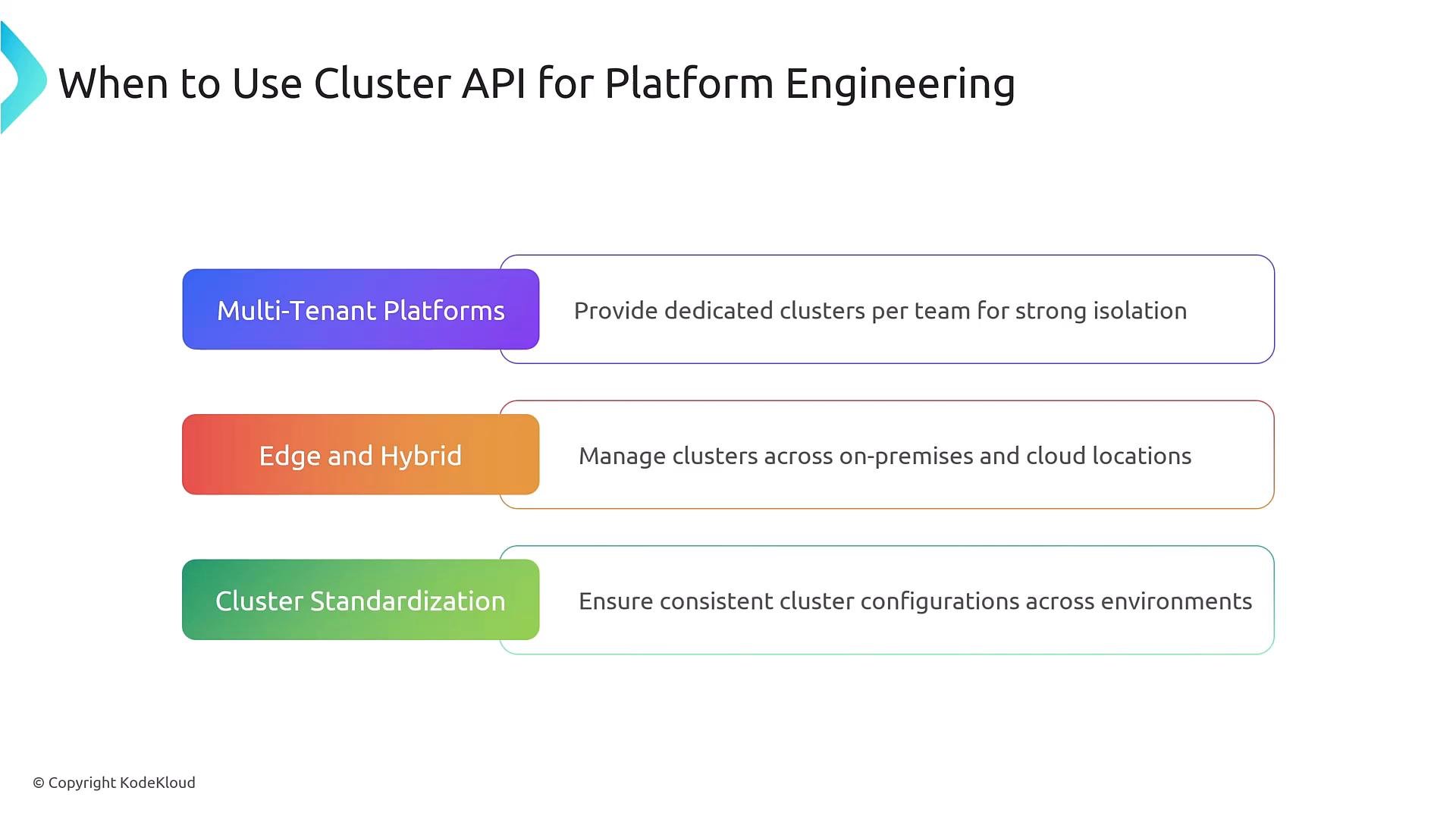
* Cluster lifecycle: creating, upgrading, and scaling Kubernetes clusters.
* Multi-cloud/hybrid/edge consistent cluster management.
* Use-cases where you want cluster standardization and automation of node and control-plane lifecycle.
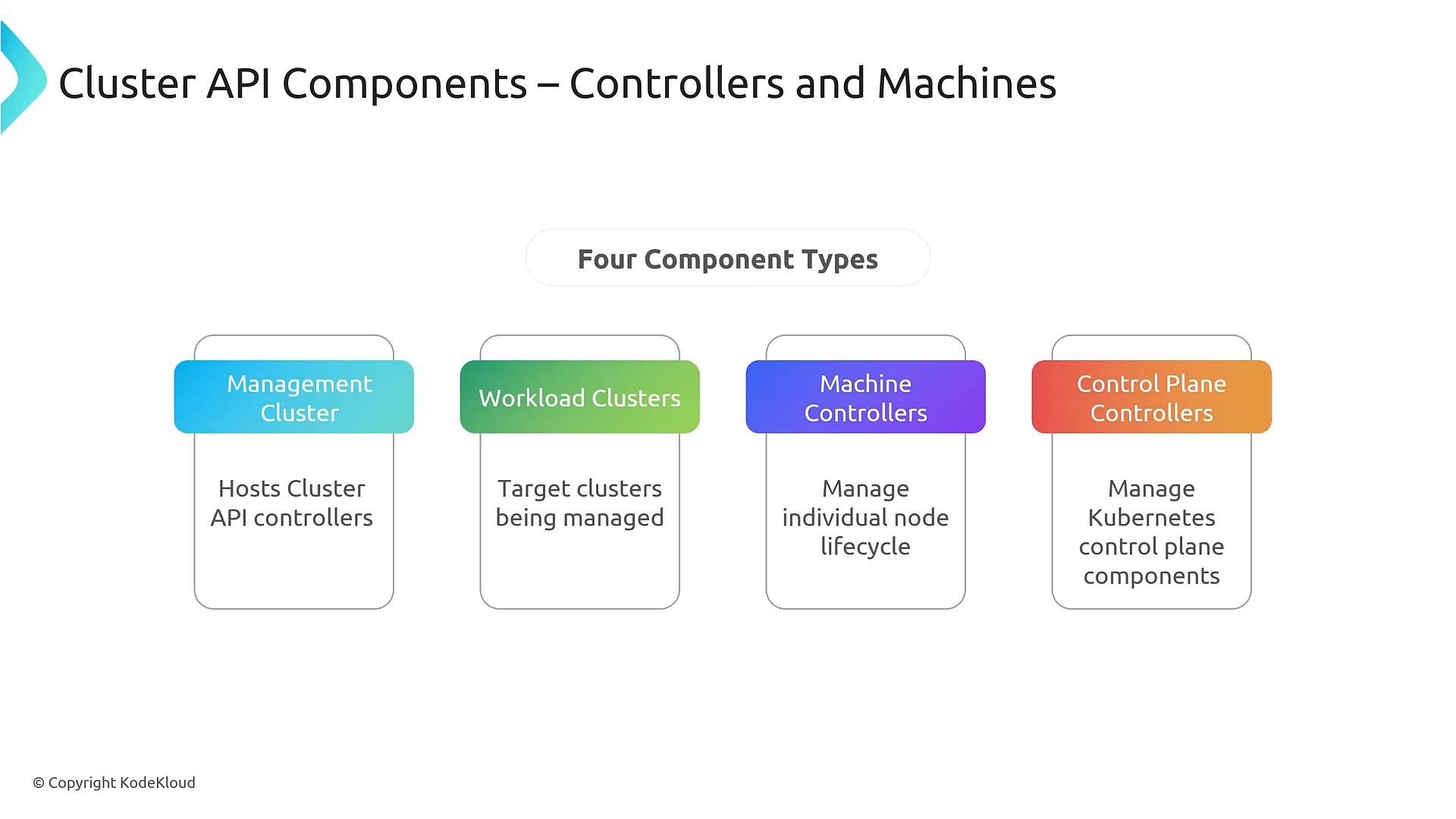
Cluster API components include management cluster controllers, control plane controllers, machine controllers, and MachineHealthCheck controllers that automate node lifecycle and control plane operations.
Cluster API is best suited for:
* Cluster lifecycle: creating, upgrading, and scaling Kubernetes clusters.
* Multi-cloud/hybrid/edge consistent cluster management.
* Use-cases where you want cluster standardization and automation of node and control-plane lifecycle.
Cluster API components include management cluster controllers, control plane controllers, machine controllers, and MachineHealthCheck controllers that automate node lifecycle and control plane operations.
 Cluster API example: a Cluster resource that references an AWS infrastructure provider to declare a Kubernetes cluster.
```yaml theme={null}
# Cluster API Cluster resource
apiVersion: cluster.x-k8s.io/v1beta1
kind: Cluster
metadata:
name: pony-production-cluster
spec:
clusterNetwork:
pods:
cidrBlocks: ["192.168.0.0/16"]
infrastructureRef:
apiVersion: infrastructure.cluster.x-k8s.io/v1beta2
kind: AWSCluster
name: pony-production-cluster
```
Key point: Cluster API is focused on clusters themselves. It is not a general-purpose cloud resource orchestrator like Crossplane or Terraform. You’ll often combine Cluster API with Crossplane or Terraform for underlying networking and cloud resources.
Cluster API example: a Cluster resource that references an AWS infrastructure provider to declare a Kubernetes cluster.
```yaml theme={null}
# Cluster API Cluster resource
apiVersion: cluster.x-k8s.io/v1beta1
kind: Cluster
metadata:
name: pony-production-cluster
spec:
clusterNetwork:
pods:
cidrBlocks: ["192.168.0.0/16"]
infrastructureRef:
apiVersion: infrastructure.cluster.x-k8s.io/v1beta2
kind: AWSCluster
name: pony-production-cluster
```
Key point: Cluster API is focused on clusters themselves. It is not a general-purpose cloud resource orchestrator like Crossplane or Terraform. You’ll often combine Cluster API with Crossplane or Terraform for underlying networking and cloud resources.
 ## Comparing the three approaches
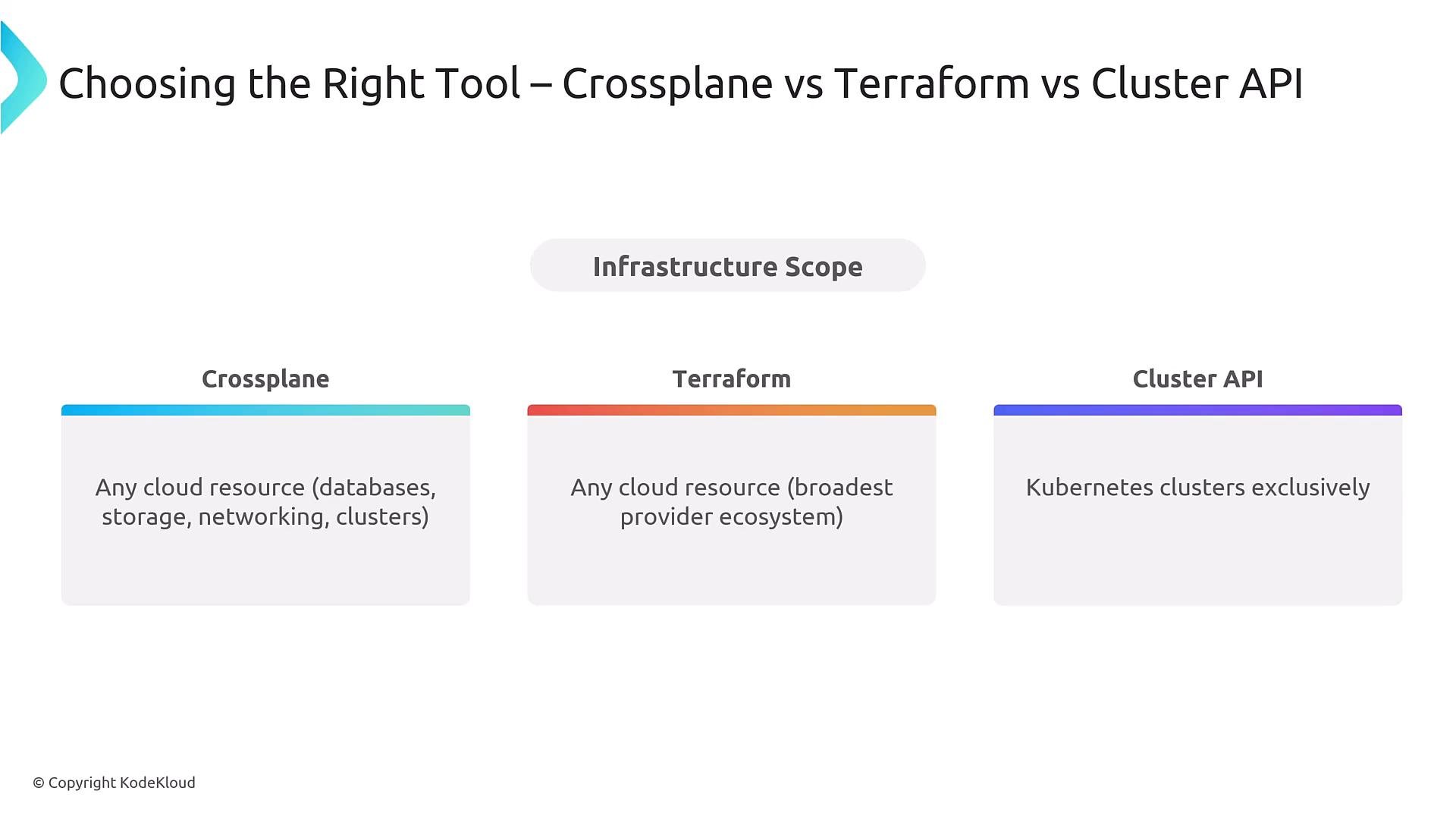
* Crossplane: Kubernetes-native, manages a wide range of cloud resources via CRDs and Compositions; excellent for GitOps-driven, self-service platforms. Requires deeper Kubernetes expertise to design compositions effectively.
* Terraform/OpenTofu: Mature IaC, extensive provider ecosystem and modules, generally managed outside the cluster (or integrated via operators). Familiar, approachable HCL workflow and broad community adoption.
* Cluster API: Specialized for Kubernetes cluster lifecycle management. Narrow scope but deep capability for cluster provisioning, scaling, and upgrades.
## Comparing the three approaches
* Crossplane: Kubernetes-native, manages a wide range of cloud resources via CRDs and Compositions; excellent for GitOps-driven, self-service platforms. Requires deeper Kubernetes expertise to design compositions effectively.
* Terraform/OpenTofu: Mature IaC, extensive provider ecosystem and modules, generally managed outside the cluster (or integrated via operators). Familiar, approachable HCL workflow and broad community adoption.
* Cluster API: Specialized for Kubernetes cluster lifecycle management. Narrow scope but deep capability for cluster provisioning, scaling, and upgrades.
 Team expertise considerations:
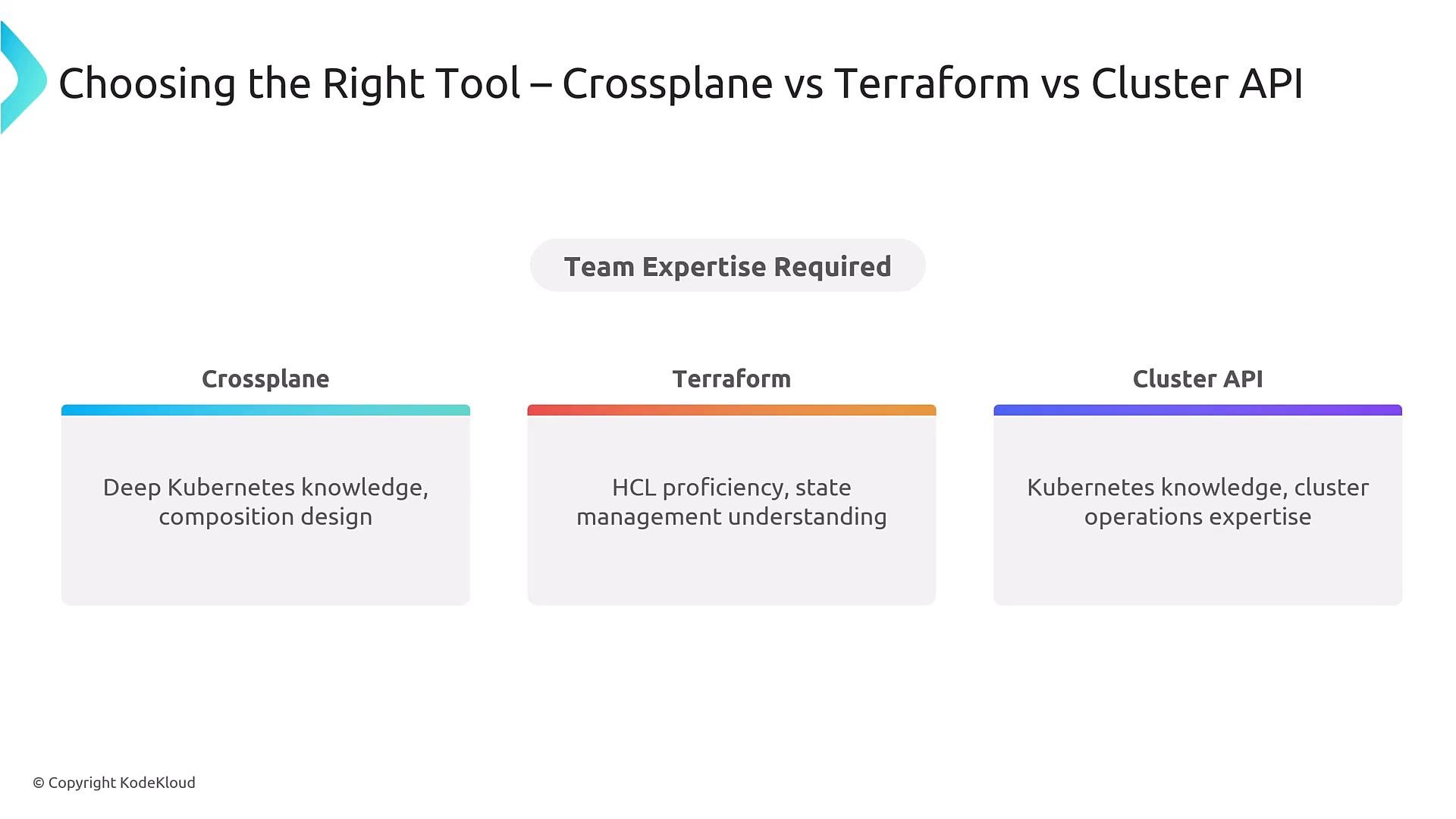 * Crossplane: deep Kubernetes skills, composition design, and provider wiring.
* Terraform/OpenTofu: HCL proficiency, state and module management; easier ramp for many teams.
* Cluster API: Kubernetes and cluster operations experience — focused but narrower in scope.
## Patterns and best practices (2025)
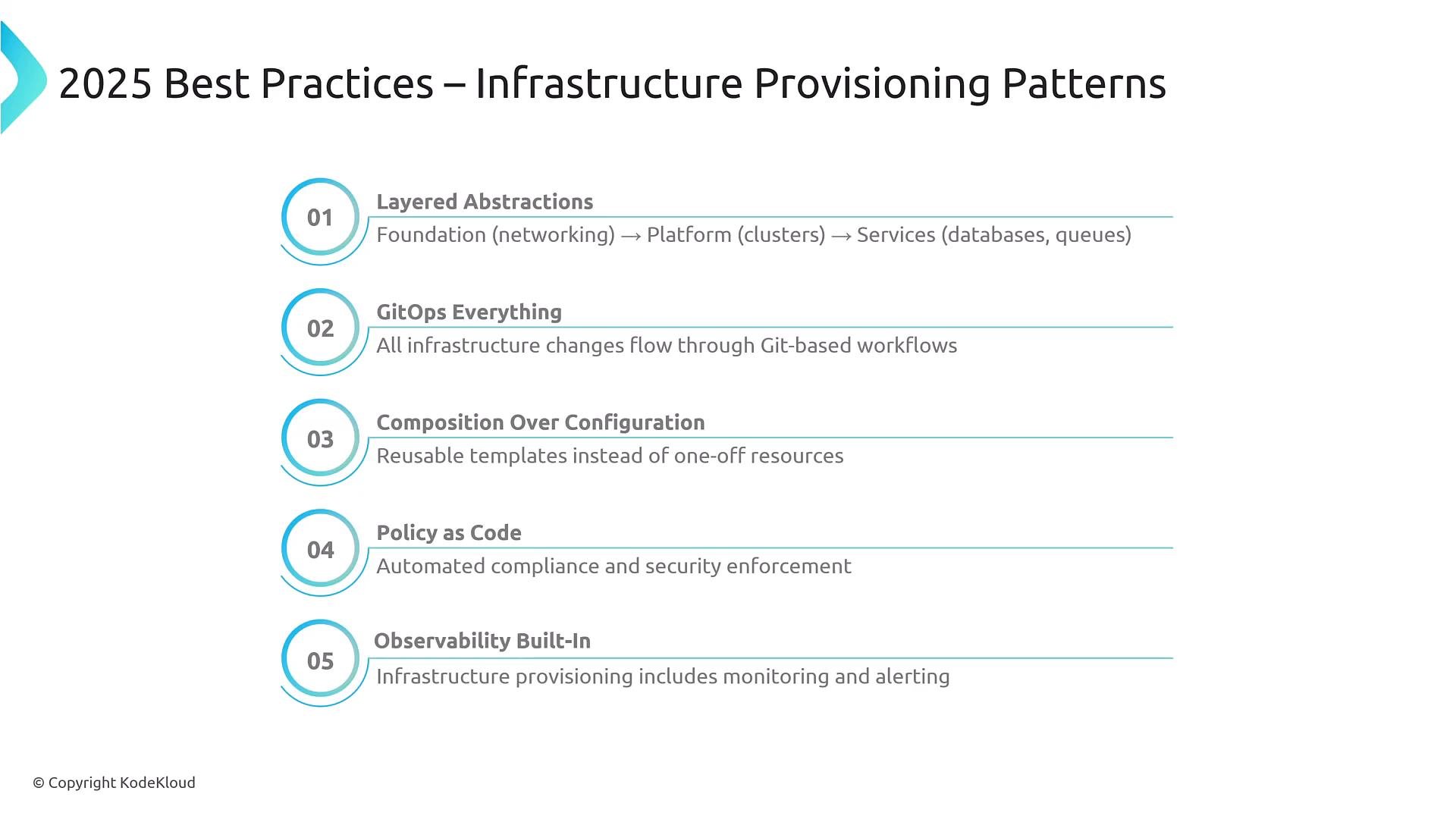
Aim for layered abstractions and GitOps-first workflows. Reusable compositions and modules reduce one-off “unicorns.” Policy-as-code and built-in observability ensure compliance and operational visibility across teams.
* Crossplane: deep Kubernetes skills, composition design, and provider wiring.
* Terraform/OpenTofu: HCL proficiency, state and module management; easier ramp for many teams.
* Cluster API: Kubernetes and cluster operations experience — focused but narrower in scope.
## Patterns and best practices (2025)
Aim for layered abstractions and GitOps-first workflows. Reusable compositions and modules reduce one-off “unicorns.” Policy-as-code and built-in observability ensure compliance and operational visibility across teams.
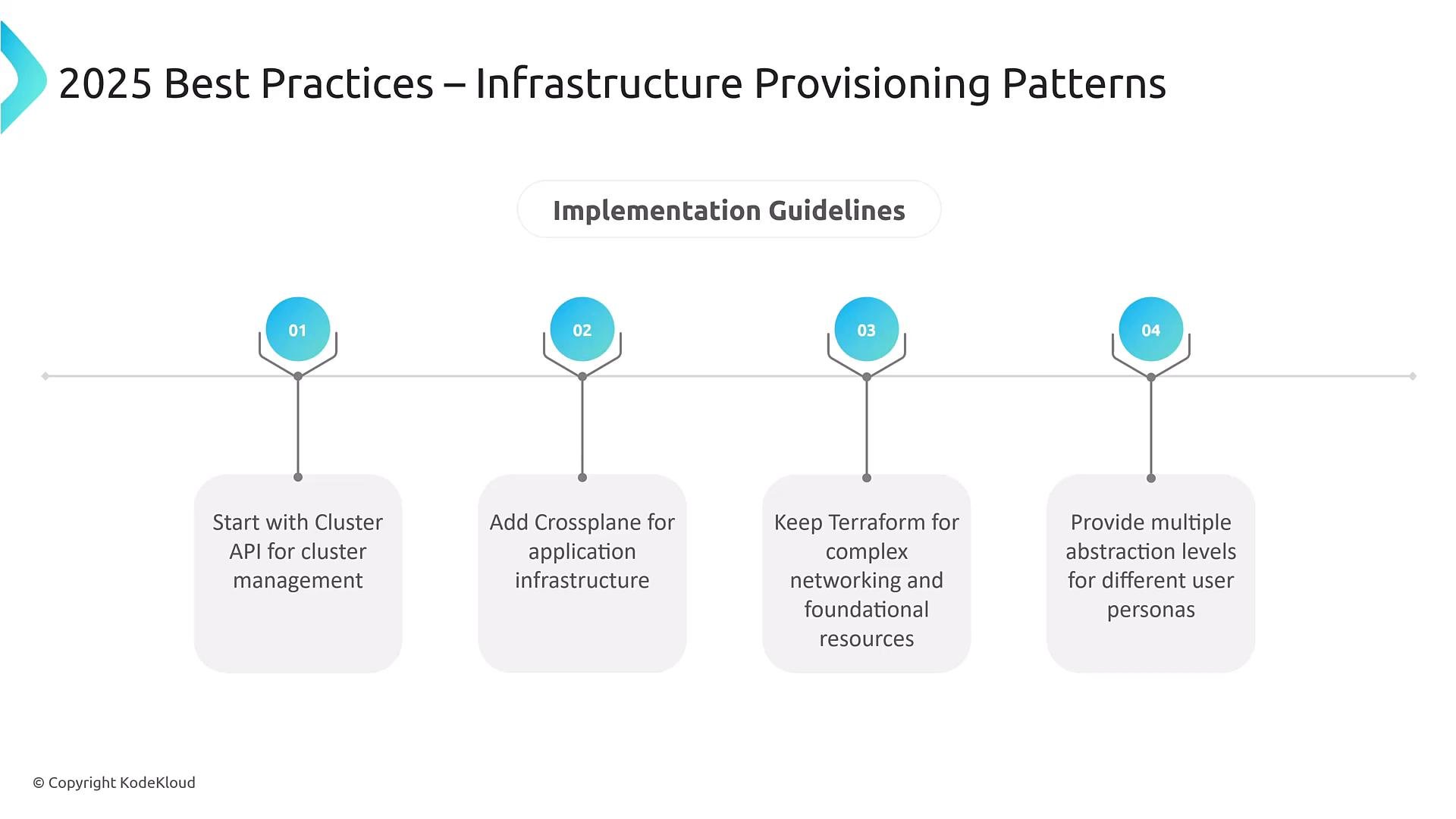
 Implementation guidance (example timeline):
1. Start experimenting with Cluster API to standardize and manage cluster lifecycles.
2. Add Crossplane to model application infrastructure as Kubernetes resources and provide self-service compositions.
3. Keep Terraform/OpenTofu for complex foundational networking, or for teams that already rely on a large Terraform module ecosystem.
4. Expose multiple abstraction levels (platform operators, SREs, and developers) according to persona.
Implementation guidance (example timeline):
1. Start experimenting with Cluster API to standardize and manage cluster lifecycles.
2. Add Crossplane to model application infrastructure as Kubernetes resources and provide self-service compositions.
3. Keep Terraform/OpenTofu for complex foundational networking, or for teams that already rely on a large Terraform module ecosystem.
4. Expose multiple abstraction levels (platform operators, SREs, and developers) according to persona.
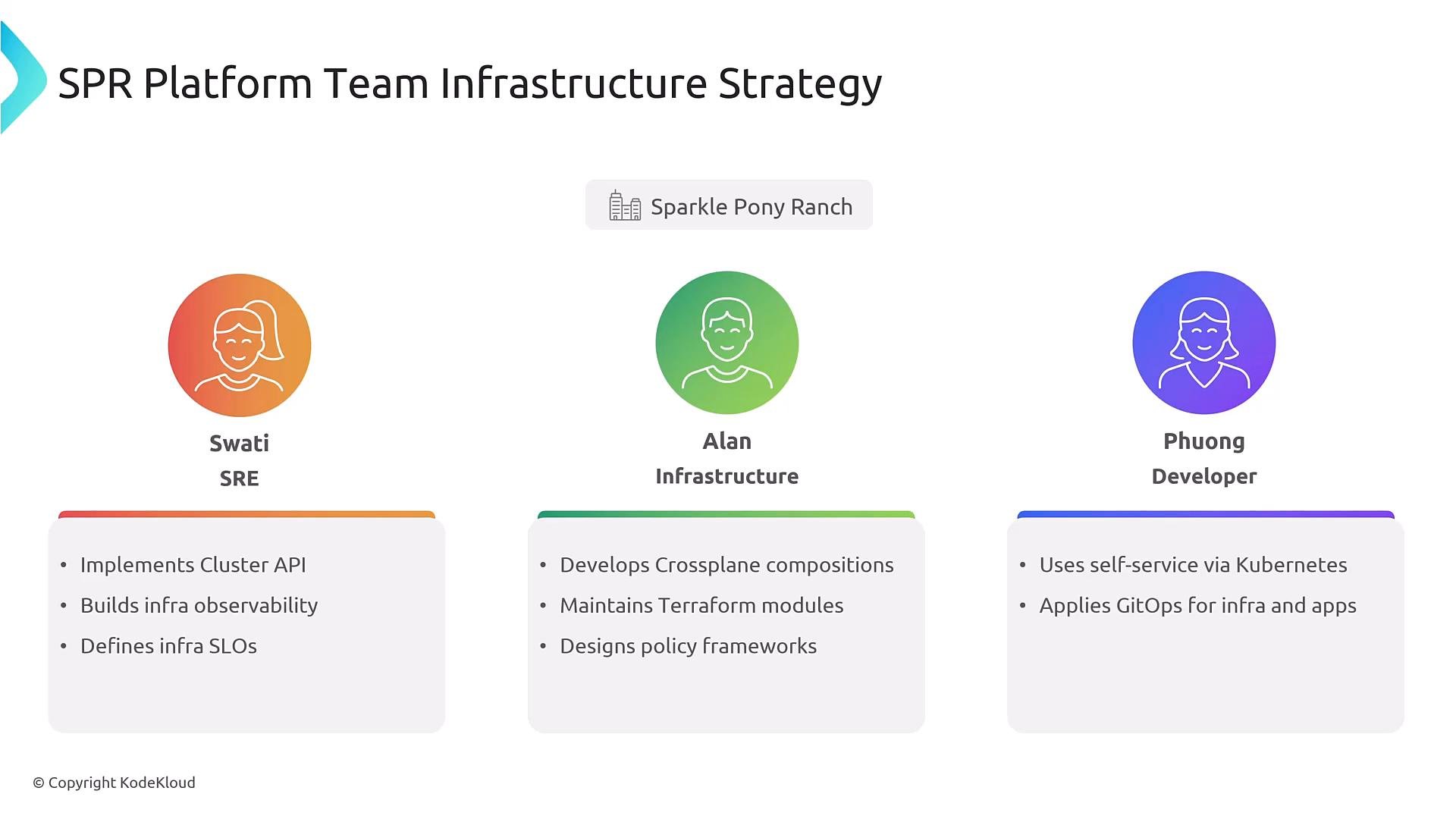
 At SparklePonyRanch, the team roles reflect these choices: Swati (SRE) focuses on SLOs/SLA and Cluster API for cluster operations; Alan (Infrastructure) maintains Terraform/OpenTofu modules and Crossplane compositions for application infrastructure; Phuong (Developer) consumes the self-service APIs and GitOps workflows.
 ## Key takeaways
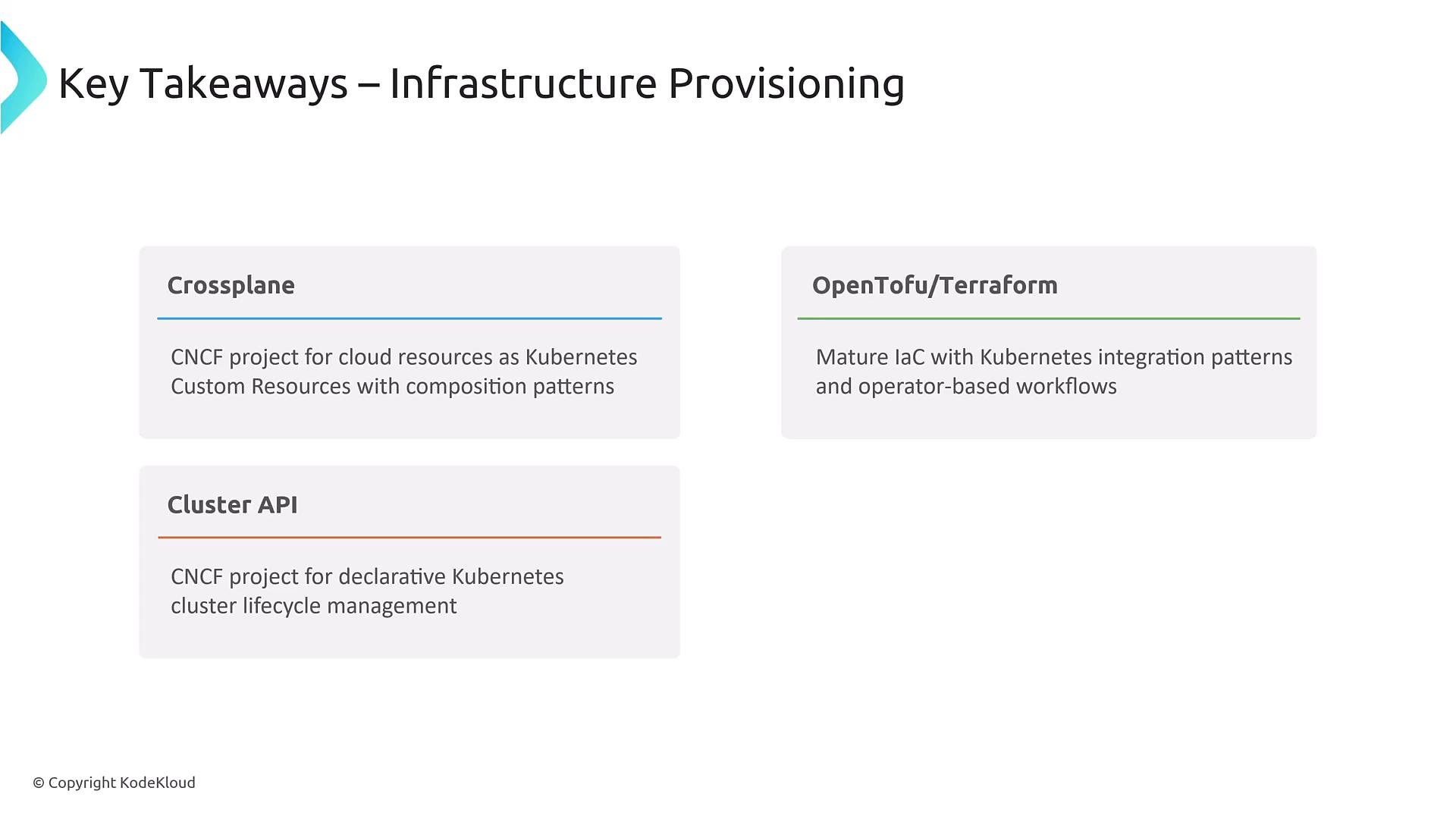
* Crossplane (CNCF): represents Kubernetes-native infrastructure control using CRDs and composition patterns; ideal when you want infrastructure as Kubernetes objects and tight GitOps integration.
* Terraform / OpenTofu: mature IaC ecosystem using HCL and modules; often the quickest way to adopt IaC at scale and has the largest provider coverage.
* Cluster API (CNCF): specialized for Kubernetes cluster lifecycle management — provisioning, upgrading, scaling — and not a general cloud resource orchestrator.
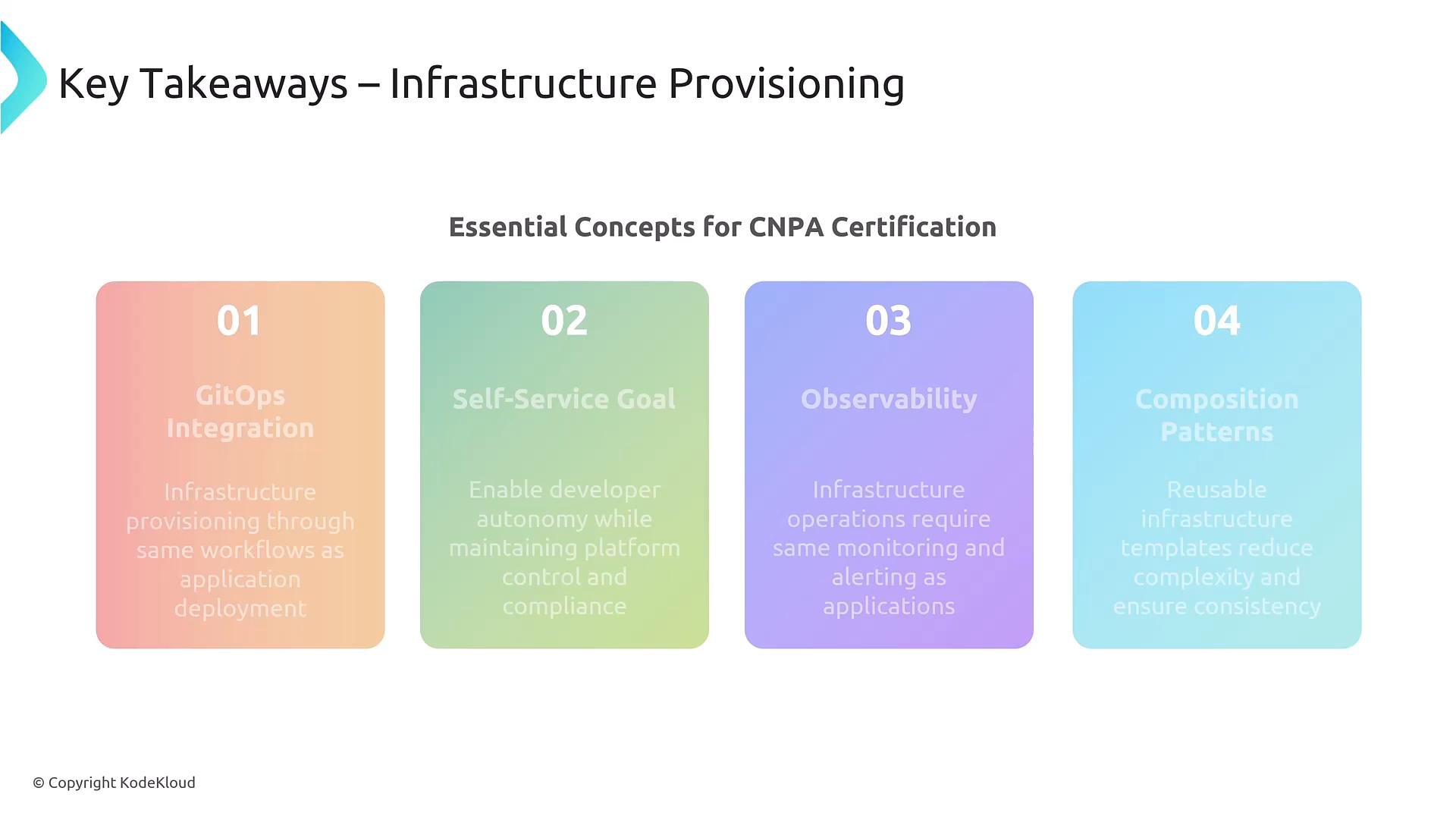
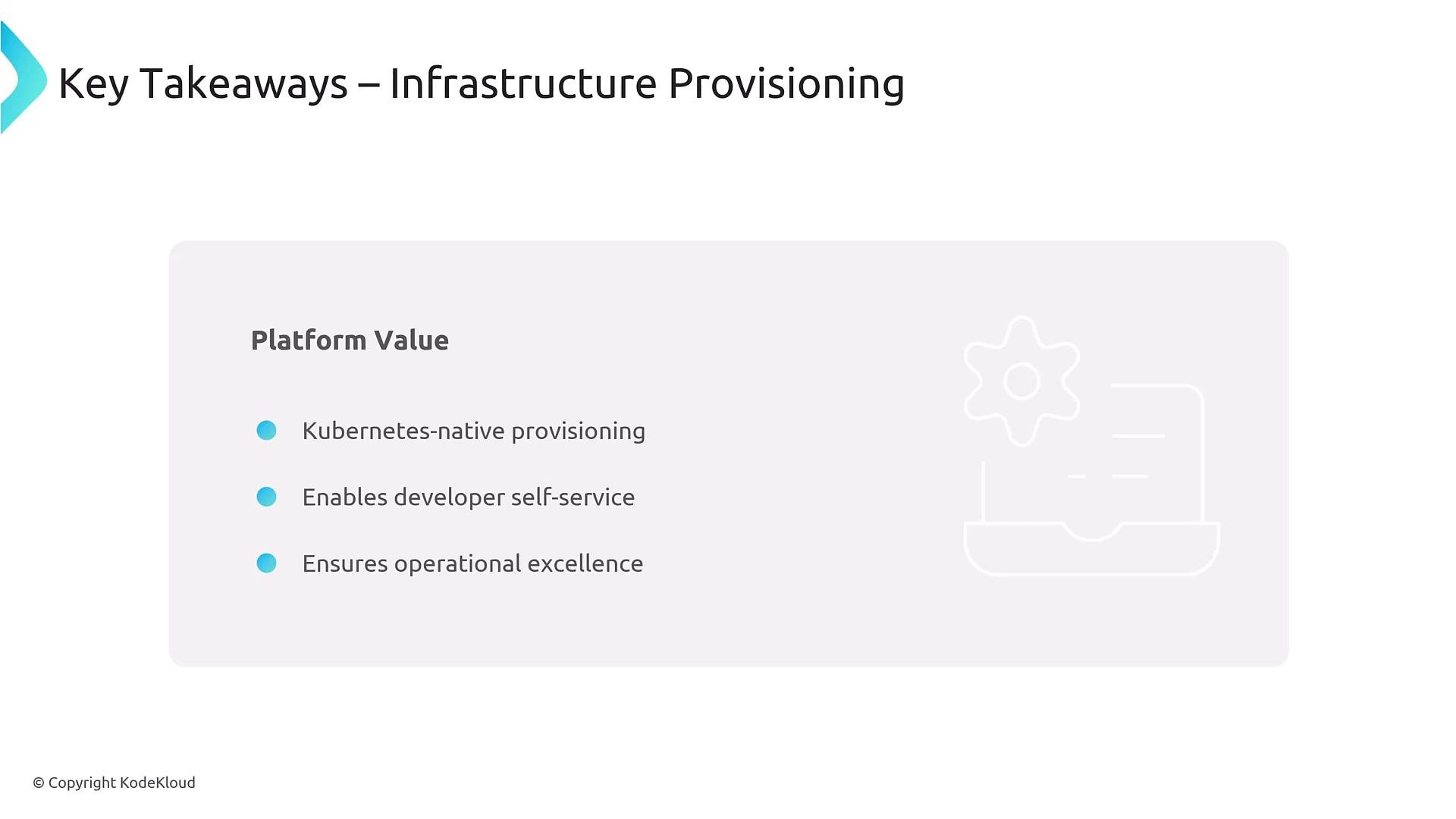
* Design your platform with layered abstractions, GitOps, policy-as-code, and observability to enable self-service while preserving security and compliance.
## Key takeaways
* Crossplane (CNCF): represents Kubernetes-native infrastructure control using CRDs and composition patterns; ideal when you want infrastructure as Kubernetes objects and tight GitOps integration.
* Terraform / OpenTofu: mature IaC ecosystem using HCL and modules; often the quickest way to adopt IaC at scale and has the largest provider coverage.
* Cluster API (CNCF): specialized for Kubernetes cluster lifecycle management — provisioning, upgrading, scaling — and not a general cloud resource orchestrator.
* Design your platform with layered abstractions, GitOps, policy-as-code, and observability to enable self-service while preserving security and compliance.
 Thanks for reading.
This documentation is built and hosted on [Mintlify](https://mintlify.com), a developer documentation platform.
Thanks for reading.
This documentation is built and hosted on [Mintlify](https://mintlify.com), a developer documentation platform.