> ## Documentation Index
> Fetch the complete documentation index at: https://notes.kodekloud.com/llms.txt
> Use this file to discover all available pages before exploring further.
# API Driven Portals
> Explains building API-driven developer portals for self-service discovery, automated provisioning, governance, RBAC, integrations like Backstage, GitOps, Crossplane, and observability to accelerate platform delivery.
In this lesson we explore API-driven portals — self-service interfaces that make platform services discoverable, requestable, and governable via standardized APIs. These portals reduce manual tickets and email chains, simplify provisioning, and enforce consistent policies across teams.
Common platform pain points:
* Discoverability: Where is the service I need?
* Documentation: Hard to keep current across teams.
* Access: Manual approvals and ticketing slow delivery.
* Governance: Enforcing quotas, budgets, and security constraints.
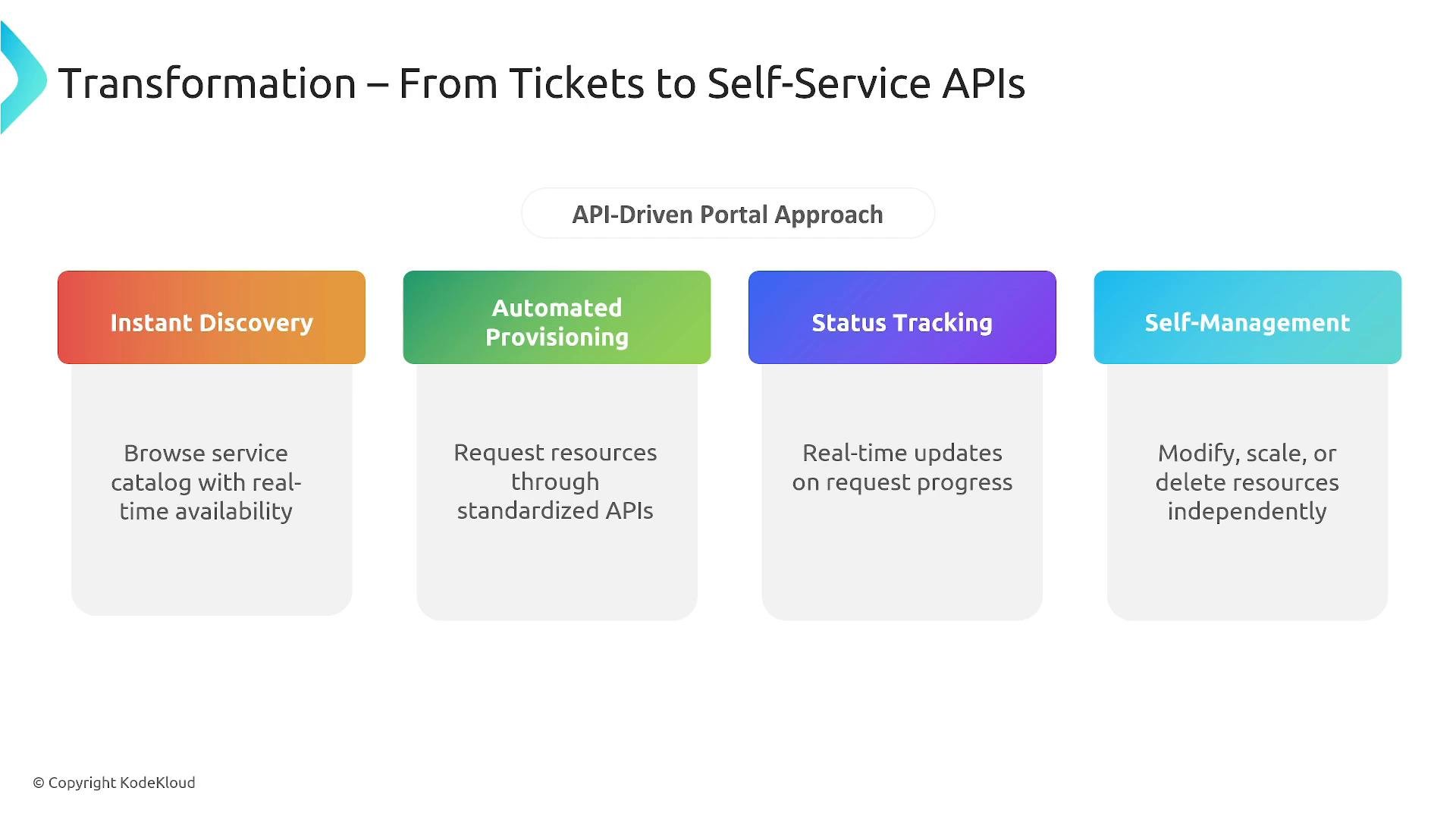
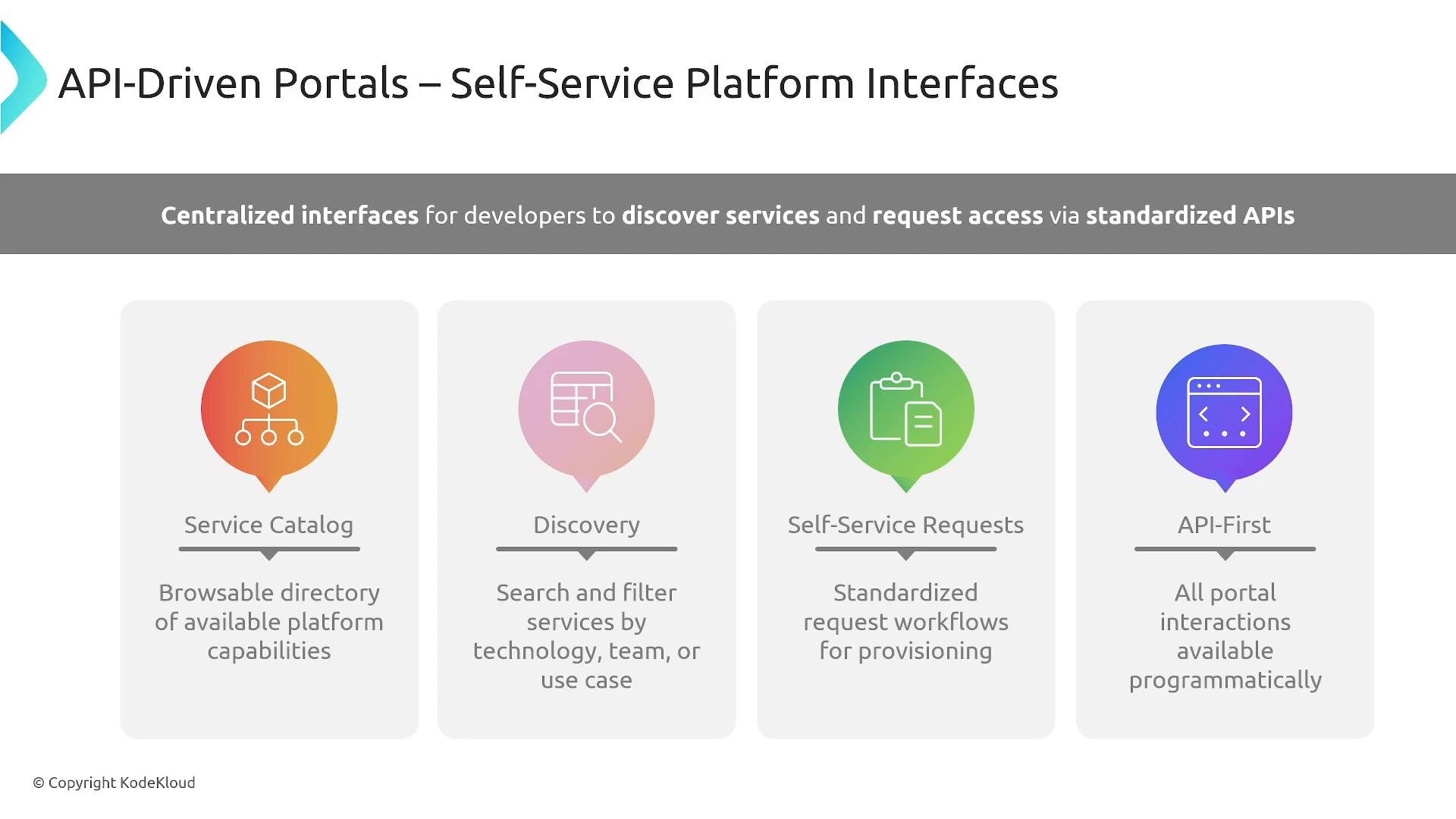 The objective of an API-driven portal is to replace ad-hoc processes with reliable, auditable APIs that support:
* Instant discovery of available capabilities
* Automated provisioning for routine, approved requests
* Status tracking, notifications, and credential delivery
* Self-management within policy and security boundaries
The objective of an API-driven portal is to replace ad-hoc processes with reliable, auditable APIs that support:
* Instant discovery of available capabilities
* Automated provisioning for routine, approved requests
* Status tracking, notifications, and credential delivery
* Self-management within policy and security boundaries
 Why standardize?
Platform teams should preserve human oversight for exceptional cases while removing manual bottlenecks for routine, approved operations. Standardizing offerings (for example, a single, supported database product) enables fully automated provisioning when checks (billing, quotas, environment constraints) are satisfied — reducing friction and accelerating delivery.
Service catalogs
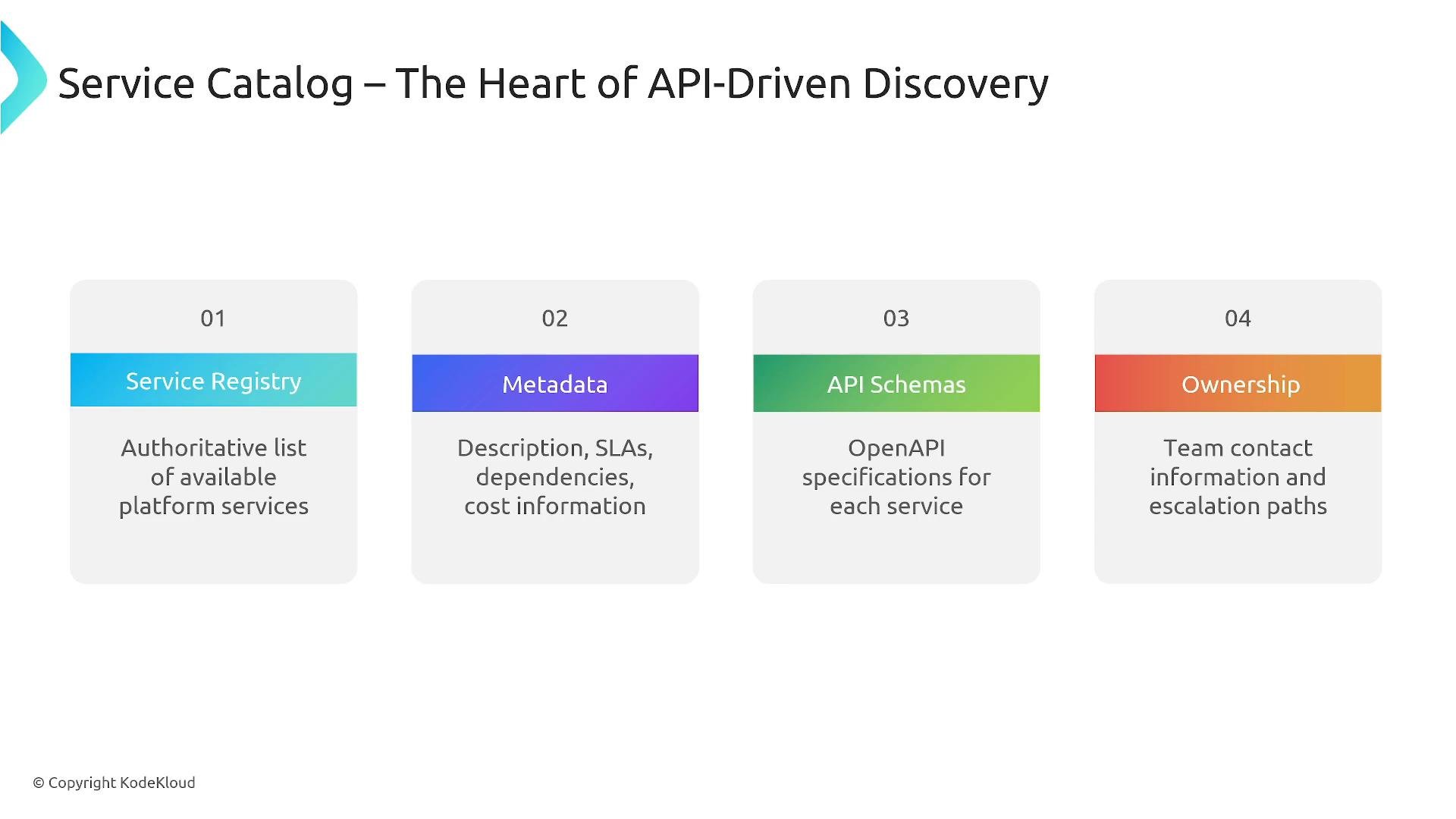
A service catalog is the authoritative registry for platform offerings. It stores metadata used by discovery and provisioning systems such as SLAs, dependencies, allowed environments, ownership, and API schemas (OpenAPI/Swagger). Catalog entries should include operational details (escalation paths, known issues) so consumers have a complete picture.
A well-modeled service catalog with OpenAPI schemas and clear ownership makes automation and integration — e.g., generating SDKs, validating configs, or scaffolding templates — far easier across teams.
Why standardize?
Platform teams should preserve human oversight for exceptional cases while removing manual bottlenecks for routine, approved operations. Standardizing offerings (for example, a single, supported database product) enables fully automated provisioning when checks (billing, quotas, environment constraints) are satisfied — reducing friction and accelerating delivery.
Service catalogs
A service catalog is the authoritative registry for platform offerings. It stores metadata used by discovery and provisioning systems such as SLAs, dependencies, allowed environments, ownership, and API schemas (OpenAPI/Swagger). Catalog entries should include operational details (escalation paths, known issues) so consumers have a complete picture.
A well-modeled service catalog with OpenAPI schemas and clear ownership makes automation and integration — e.g., generating SDKs, validating configs, or scaffolding templates — far easier across teams.
 Service discovery
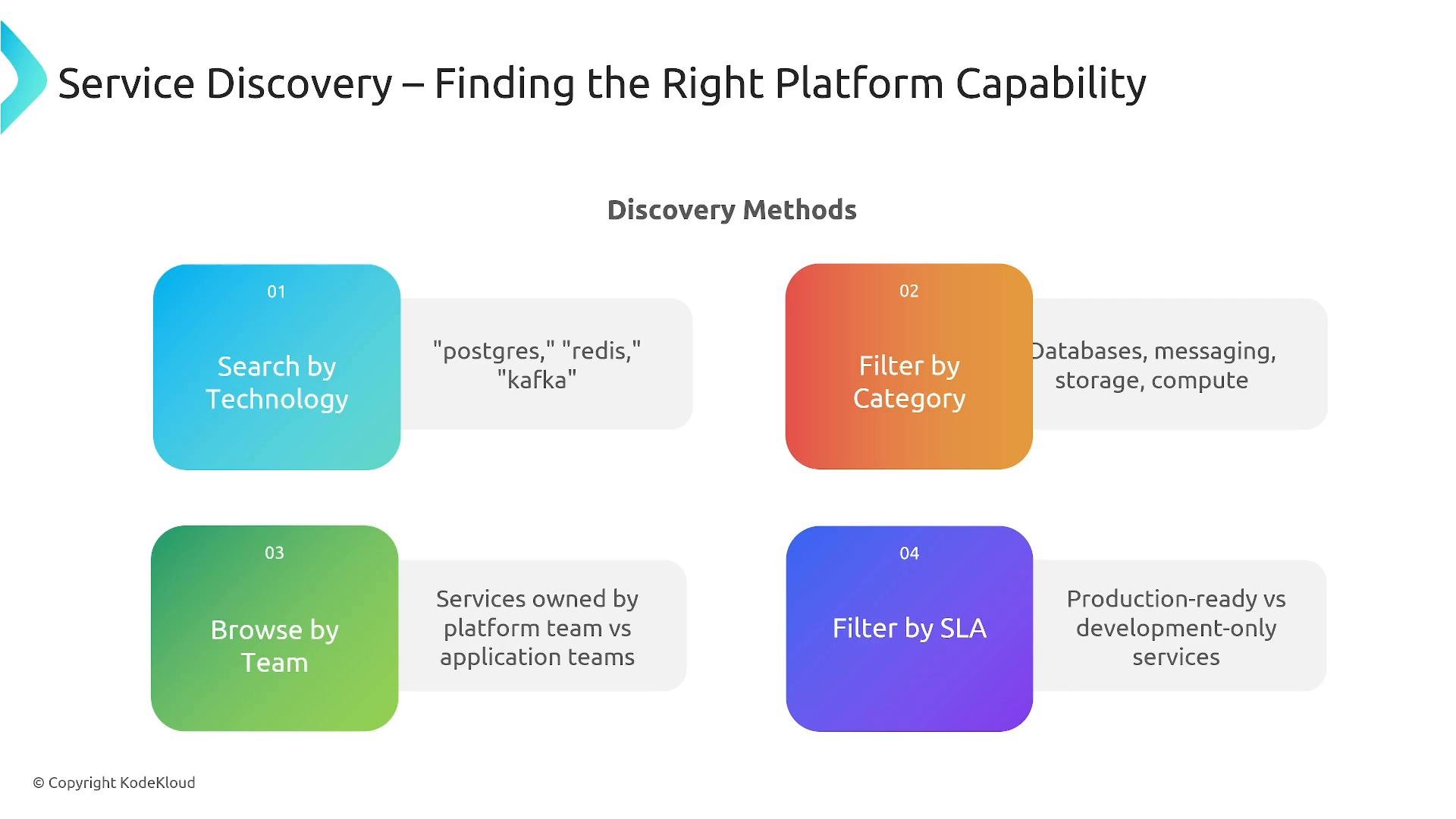
Discovery complements the catalog by helping users find the right capability quickly. Practical discovery features include:
* Search by technology keywords (e.g., `postgres`, `redis`, `kafka`)
* Faceted filters by category (databases, messaging), SLA, or environment (dev/staging/prod)
* Browse by owning team or team contact
* Version selection and favoriting for commonly used services
* Combined constraints (e.g., production-grade Postgres + backups + HA)
Service discovery
Discovery complements the catalog by helping users find the right capability quickly. Practical discovery features include:
* Search by technology keywords (e.g., `postgres`, `redis`, `kafka`)
* Faceted filters by category (databases, messaging), SLA, or environment (dev/staging/prod)
* Browse by owning team or team contact
* Version selection and favoriting for commonly used services
* Combined constraints (e.g., production-grade Postgres + backups + HA)
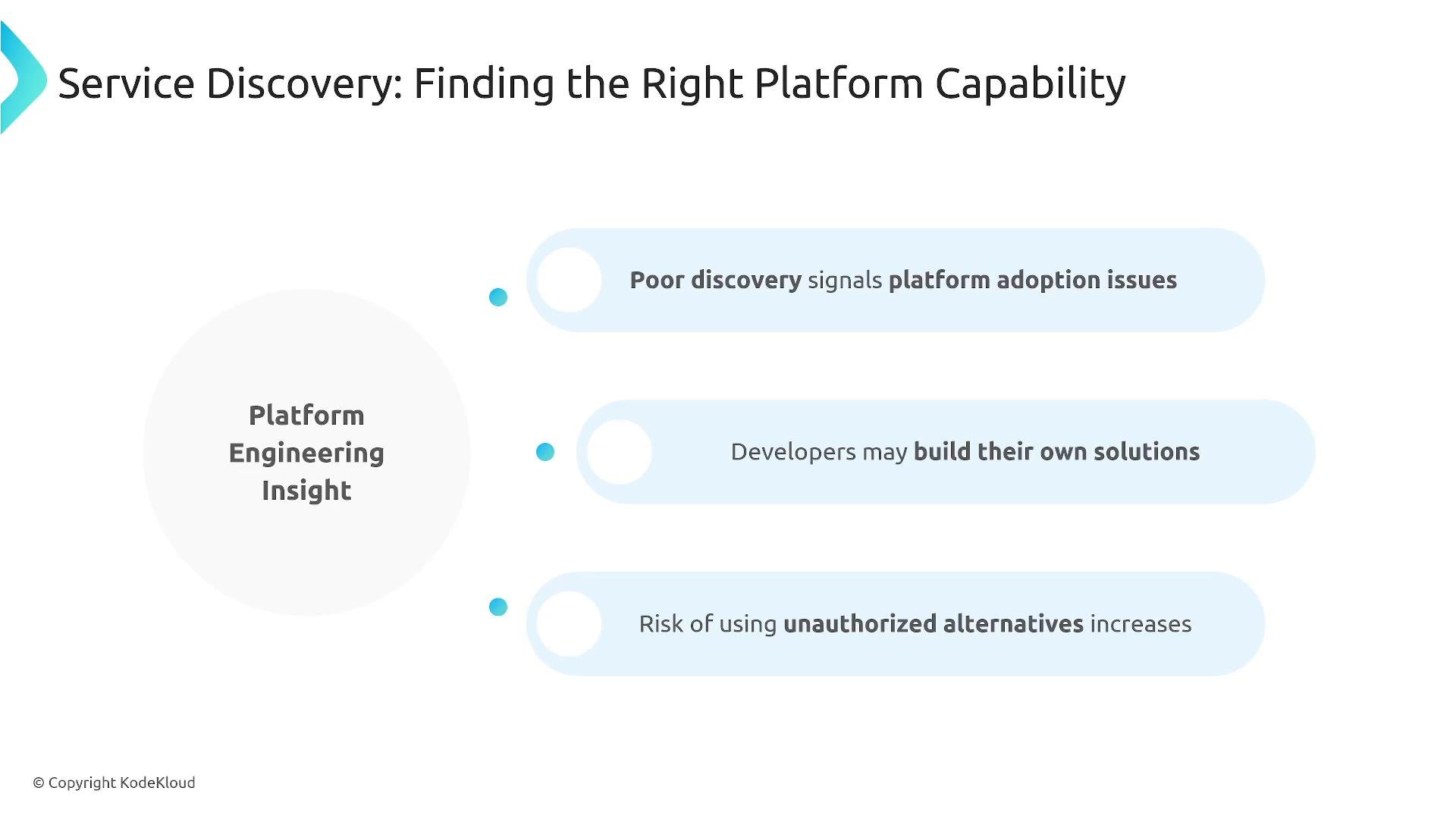
 Poor discovery correlates with low platform adoption: if teams can’t find acceptable options they often build shadow IT or use unauthorized alternatives. Improving discoverability and pricing/documentation reduces that risk.
 How APIs fit in
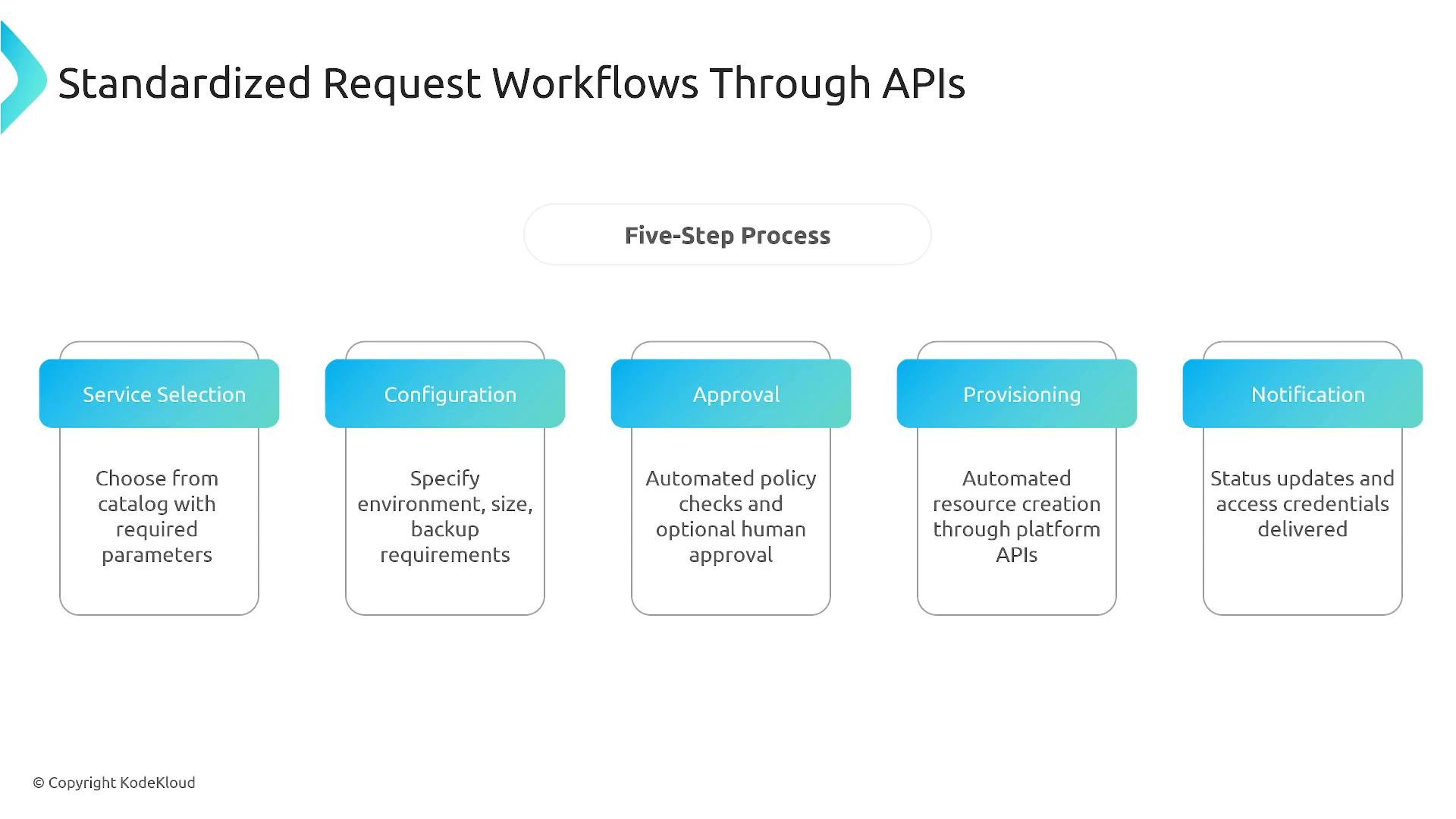
An API-driven portal standardizes the request lifecycle so every request follows consistent validation, approval, and provisioning steps. Typical workflow:
1. Service selection (choose from catalog)
2. Configuration (environment, size, backups, version)
3. Policy and approval checks (billing code, quotas)
4. Automated provisioning (invoke cloud or infra APIs)
5. Notification and delivery of credentials/endpoints
How APIs fit in
An API-driven portal standardizes the request lifecycle so every request follows consistent validation, approval, and provisioning steps. Typical workflow:
1. Service selection (choose from catalog)
2. Configuration (environment, size, backups, version)
3. Policy and approval checks (billing code, quotas)
4. Automated provisioning (invoke cloud or infra APIs)
5. Notification and delivery of credentials/endpoints
 Example API request (provision Postgres)
```http theme={null}
POST /api/v1/service-requests HTTP/1.1
Content-Type: application/json
{
"service_type": "postgresql",
"environment": "staging",
"size": "medium",
"backup_retention": "7_days"
}
```
The portal API should return a structured response with the provisioning status, progress links, and credentials (when available). Using a single API contract across teams enables consistent automation for monitoring, logging, and secrets management.
Access control and governance
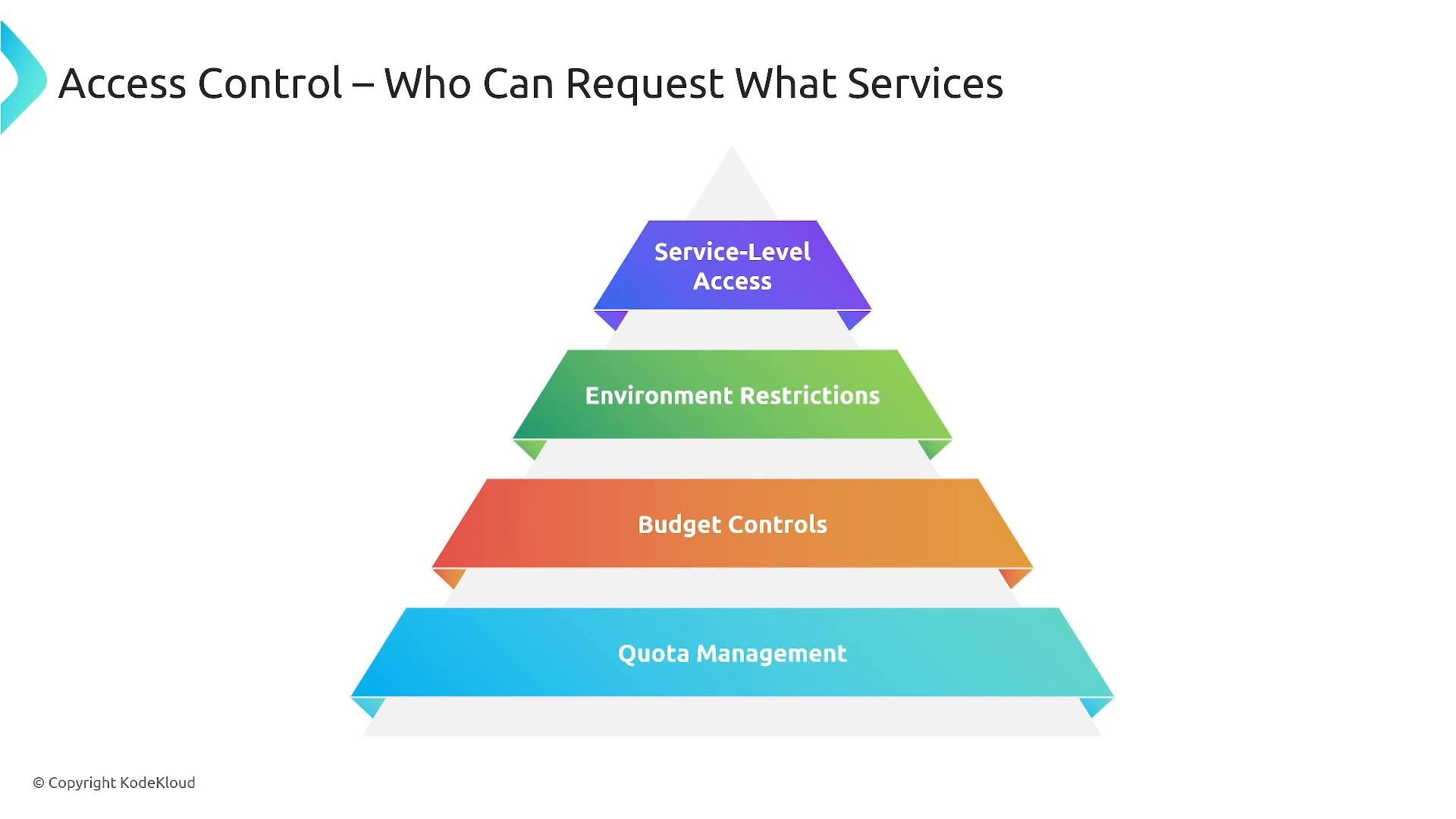
API-driven portals must enforce who can request which services and when. Common controls:
* RBAC and team-based ownership
* Environment restrictions (dev vs. prod)
* Budget and billing checks
* Quotas and rate limits
* Approval workflows for exceptions or elevated requests
Example API request (provision Postgres)
```http theme={null}
POST /api/v1/service-requests HTTP/1.1
Content-Type: application/json
{
"service_type": "postgresql",
"environment": "staging",
"size": "medium",
"backup_retention": "7_days"
}
```
The portal API should return a structured response with the provisioning status, progress links, and credentials (when available). Using a single API contract across teams enables consistent automation for monitoring, logging, and secrets management.
Access control and governance
API-driven portals must enforce who can request which services and when. Common controls:
* RBAC and team-based ownership
* Environment restrictions (dev vs. prod)
* Budget and billing checks
* Quotas and rate limits
* Approval workflows for exceptions or elevated requests
 Roles and typical controls
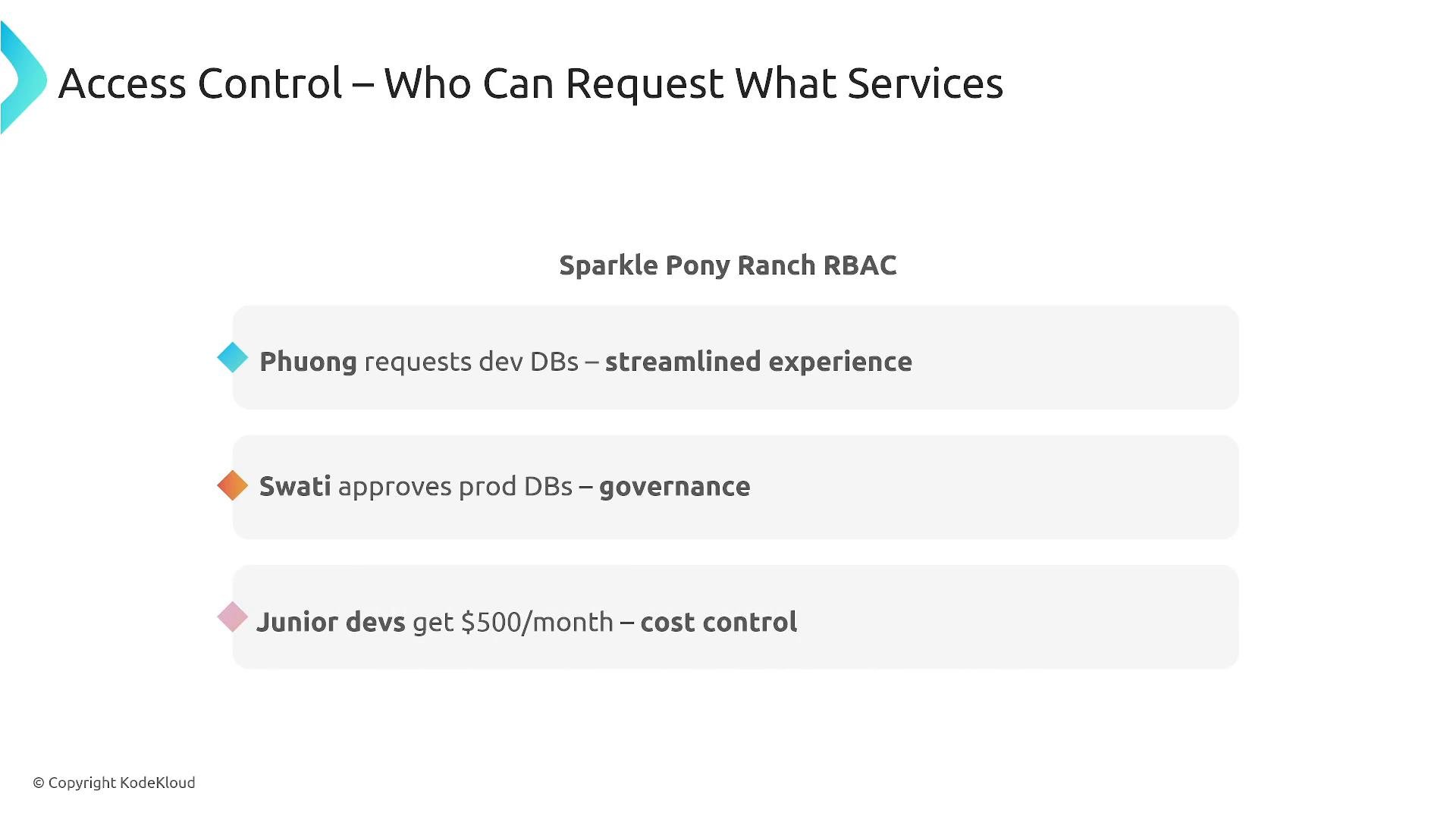
| Role | Typical Permissions | Approval / Controls |
| - | - | - |
| Developer | Provision dev resources, request staging with approval | Auto-approved for dev; team lead approval for staging |
| Team Lead / Manager | Approve staging/production requests, assign budgets | Sign-off for production; view cost dashboards |
| Platform SRE / Ops | Full provisioning and lifecycle operations | Governance and audit trails |
| Finance / Cost Owner | View and set budgets, cost attribution | Budget enforcement and alerts |
If many users request the same exceptions, consider making that capability a supported offering — frequent exceptions indicate the policy boundaries need revisiting.
Roles and typical controls
| Role | Typical Permissions | Approval / Controls |
| - | - | - |
| Developer | Provision dev resources, request staging with approval | Auto-approved for dev; team lead approval for staging |
| Team Lead / Manager | Approve staging/production requests, assign budgets | Sign-off for production; view cost dashboards |
| Platform SRE / Ops | Full provisioning and lifecycle operations | Governance and audit trails |
| Finance / Cost Owner | View and set budgets, cost attribution | Budget enforcement and alerts |
If many users request the same exceptions, consider making that capability a supported offering — frequent exceptions indicate the policy boundaries need revisiting.
 Avoid granting broad privileges to reduce blast radius. Prefer least privilege, scoped quotas, and short-lived credentials generated by the portal to limit risk.
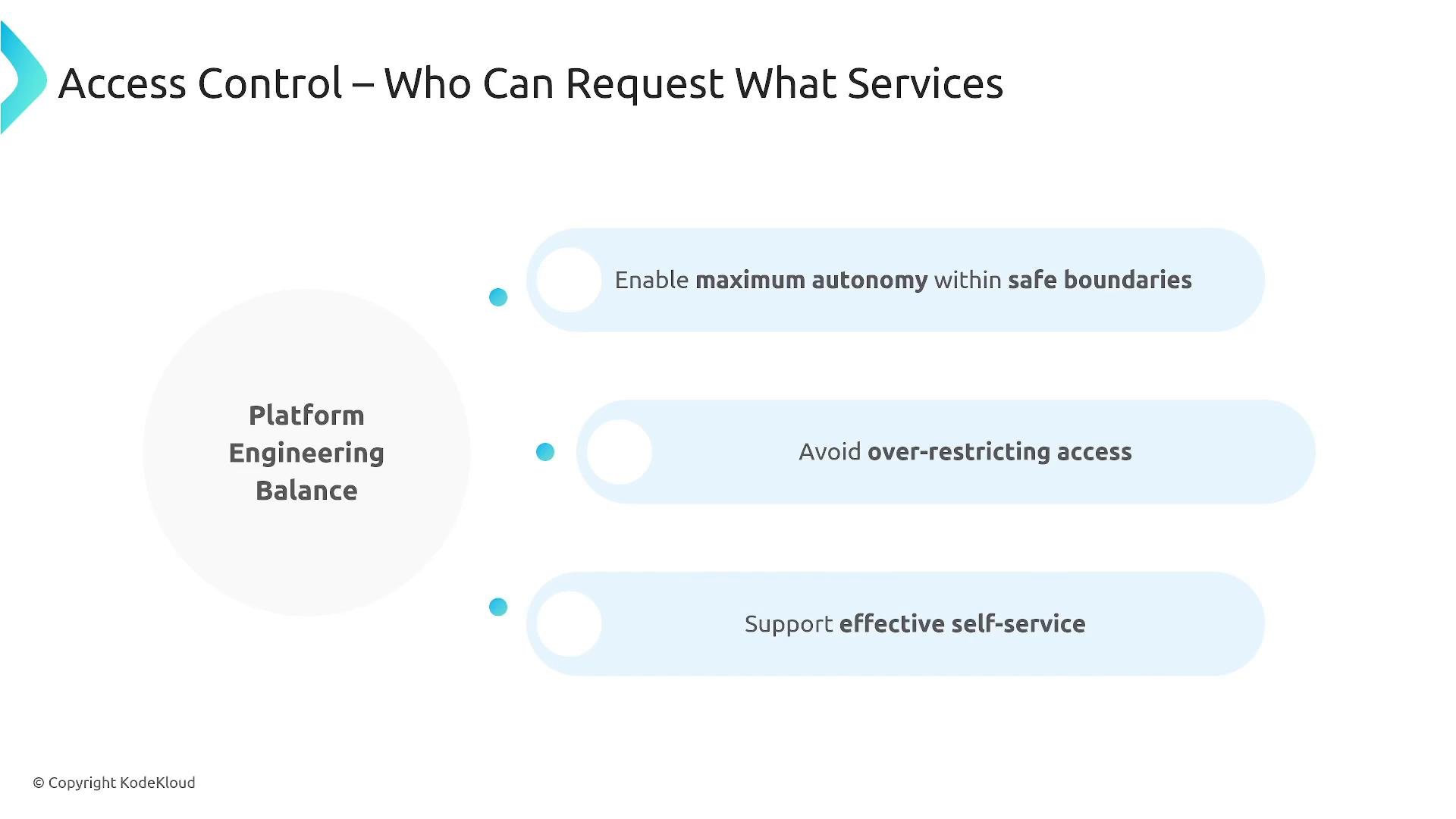
Balance autonomy and safety: enable as much self-service as possible while keeping guardrails for production systems.
Avoid granting broad privileges to reduce blast radius. Prefer least privilege, scoped quotas, and short-lived credentials generated by the portal to limit risk.
Balance autonomy and safety: enable as much self-service as possible while keeping guardrails for production systems.
 Backstage and extensible portals
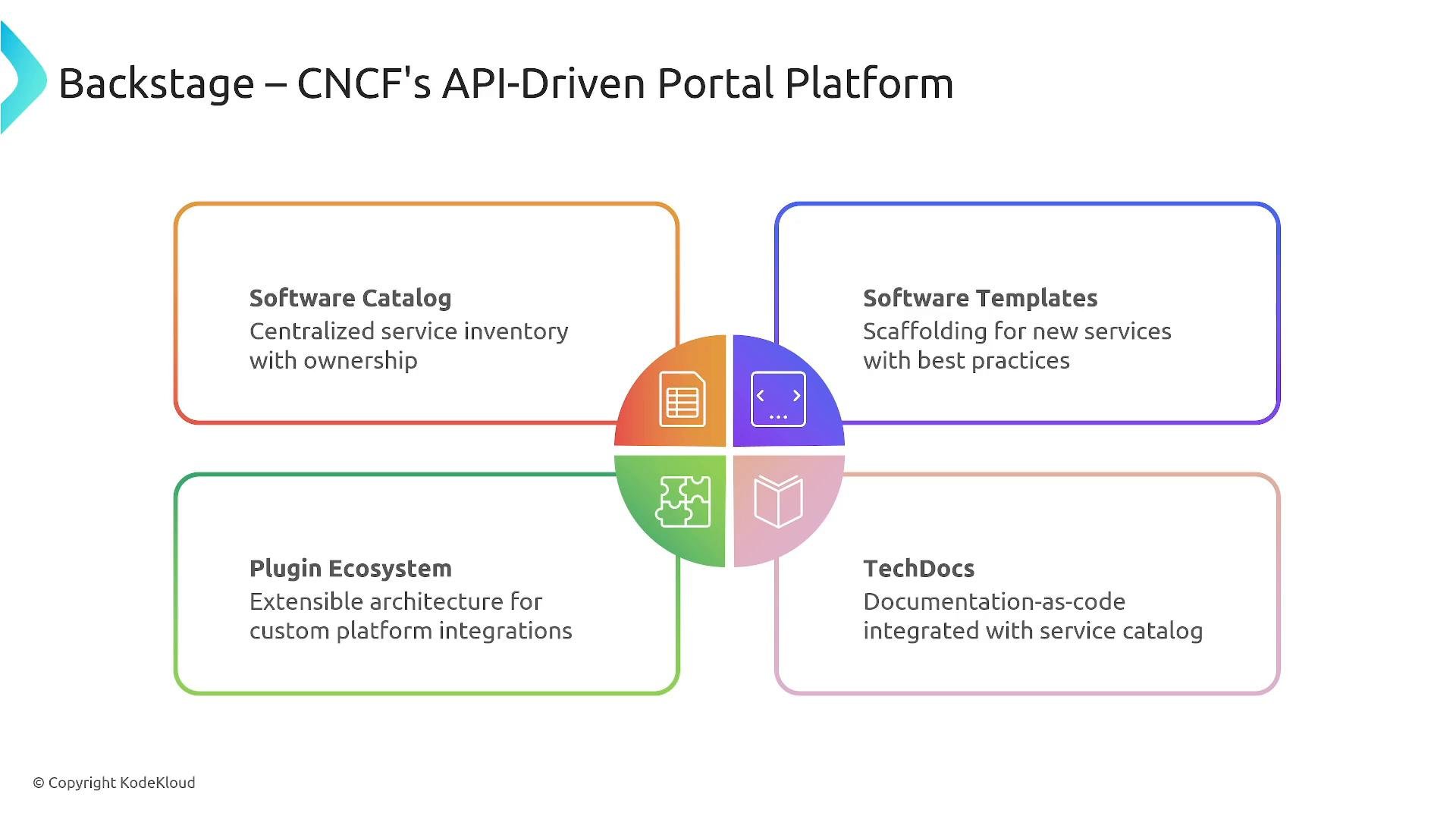
Backstage (CNCF) is a widely adopted framework for building developer portals. It provides:
* A software catalog for services and components
* Software templates (scaffolding) to standardize new services
* TechDocs (documentation-as-code)
* A plugin ecosystem for CI/CD, monitoring, and cloud integrations
Backstage supports REST and GraphQL for catalog APIs, webhooks for updates, and many community plugins to integrate platform tooling.
Backstage and extensible portals
Backstage (CNCF) is a widely adopted framework for building developer portals. It provides:
* A software catalog for services and components
* Software templates (scaffolding) to standardize new services
* TechDocs (documentation-as-code)
* A plugin ecosystem for CI/CD, monitoring, and cloud integrations
Backstage supports REST and GraphQL for catalog APIs, webhooks for updates, and many community plugins to integrate platform tooling.
 Integration patterns
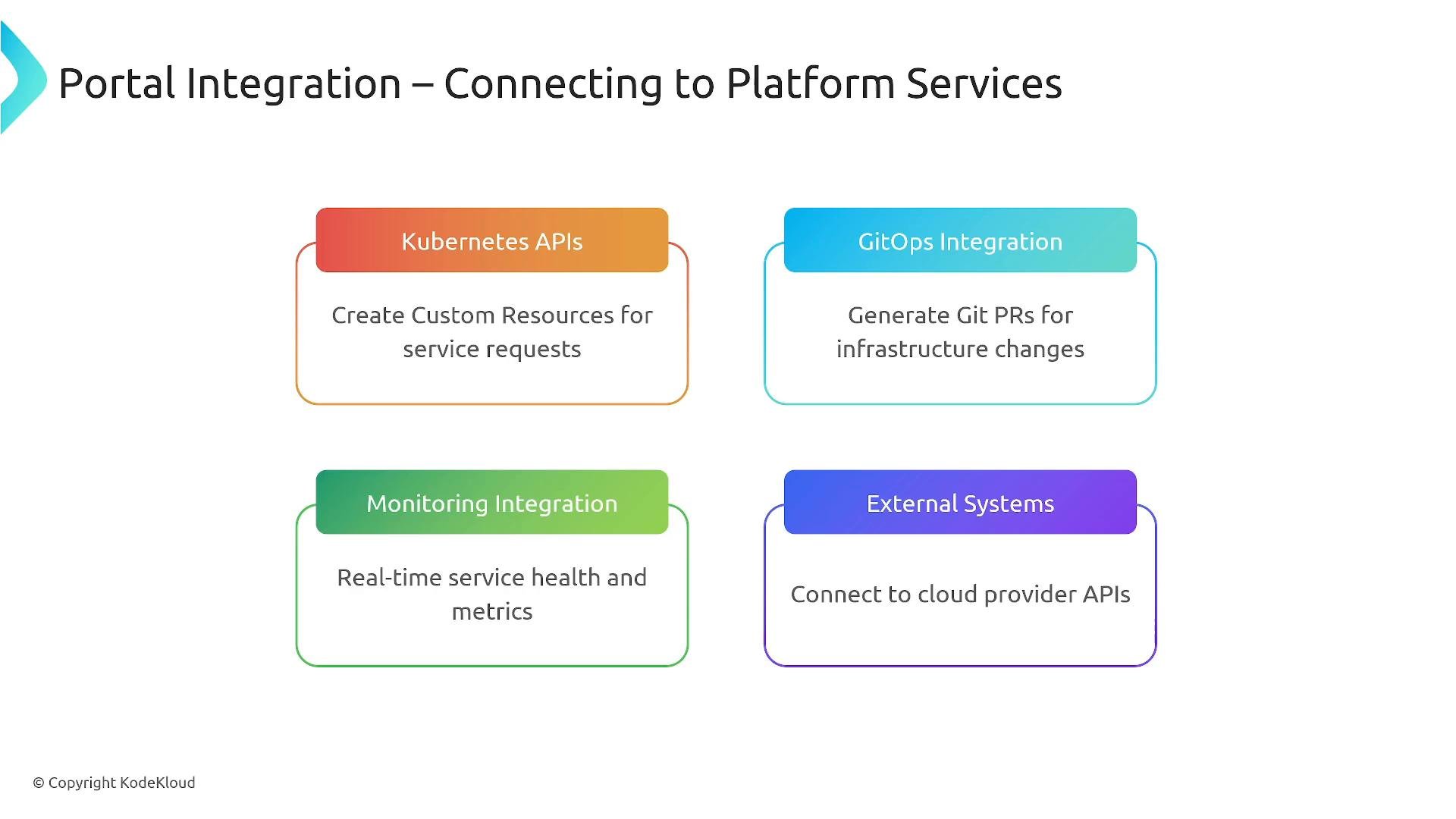
Backstage or a custom portal typically acts as the UI / orchestration layer, while GitOps, operators, and cloud APIs perform provisioning and lifecycle tasks. Common integrations:
* GitOps controllers (Argo CD) for declarative deployments
* Crossplane for cloud-agnostic provisioning
* Kubernetes operators/controllers for in-cluster resources
* Secrets management and vault integrations
Integration patterns
Backstage or a custom portal typically acts as the UI / orchestration layer, while GitOps, operators, and cloud APIs perform provisioning and lifecycle tasks. Common integrations:
* GitOps controllers (Argo CD) for declarative deployments
* Crossplane for cloud-agnostic provisioning
* Kubernetes operators/controllers for in-cluster resources
* Secrets management and vault integrations
 Architecture and interfaces
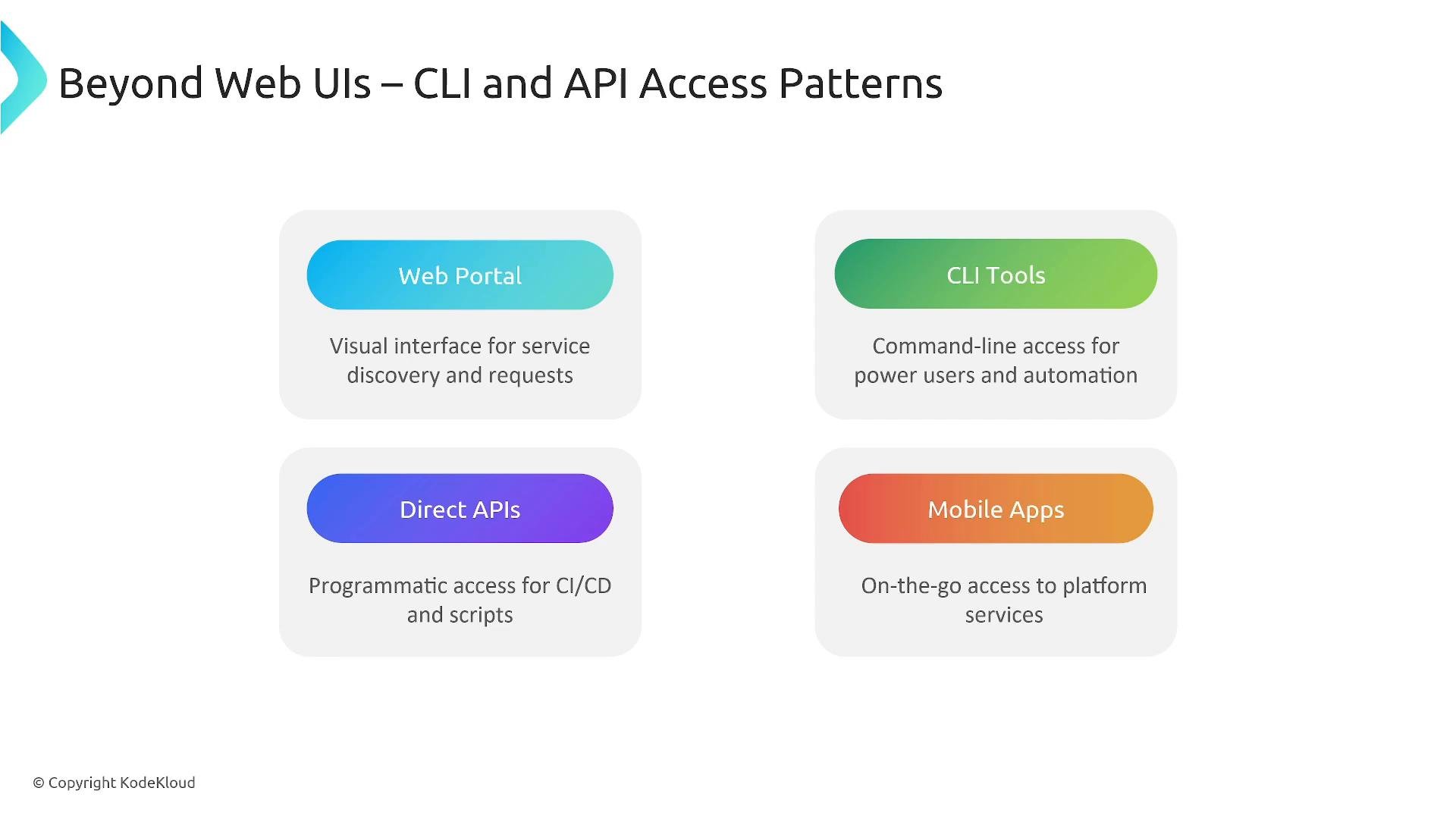
A portal provides a single, consistent interface and supports multiple access patterns:
* Web UI (Backstage or custom)
* CLI (e.g., `platctl`, `platformctl`) that calls the same APIs
* Direct API access for CI/CD pipelines and automation
* Mobile or lightweight workflows for notifications and approvals
Using shared APIs across UI, CLI, and automation ensures consistent behavior and auditability.
Architecture and interfaces
A portal provides a single, consistent interface and supports multiple access patterns:
* Web UI (Backstage or custom)
* CLI (e.g., `platctl`, `platformctl`) that calls the same APIs
* Direct API access for CI/CD pipelines and automation
* Mobile or lightweight workflows for notifications and approvals
Using shared APIs across UI, CLI, and automation ensures consistent behavior and auditability.
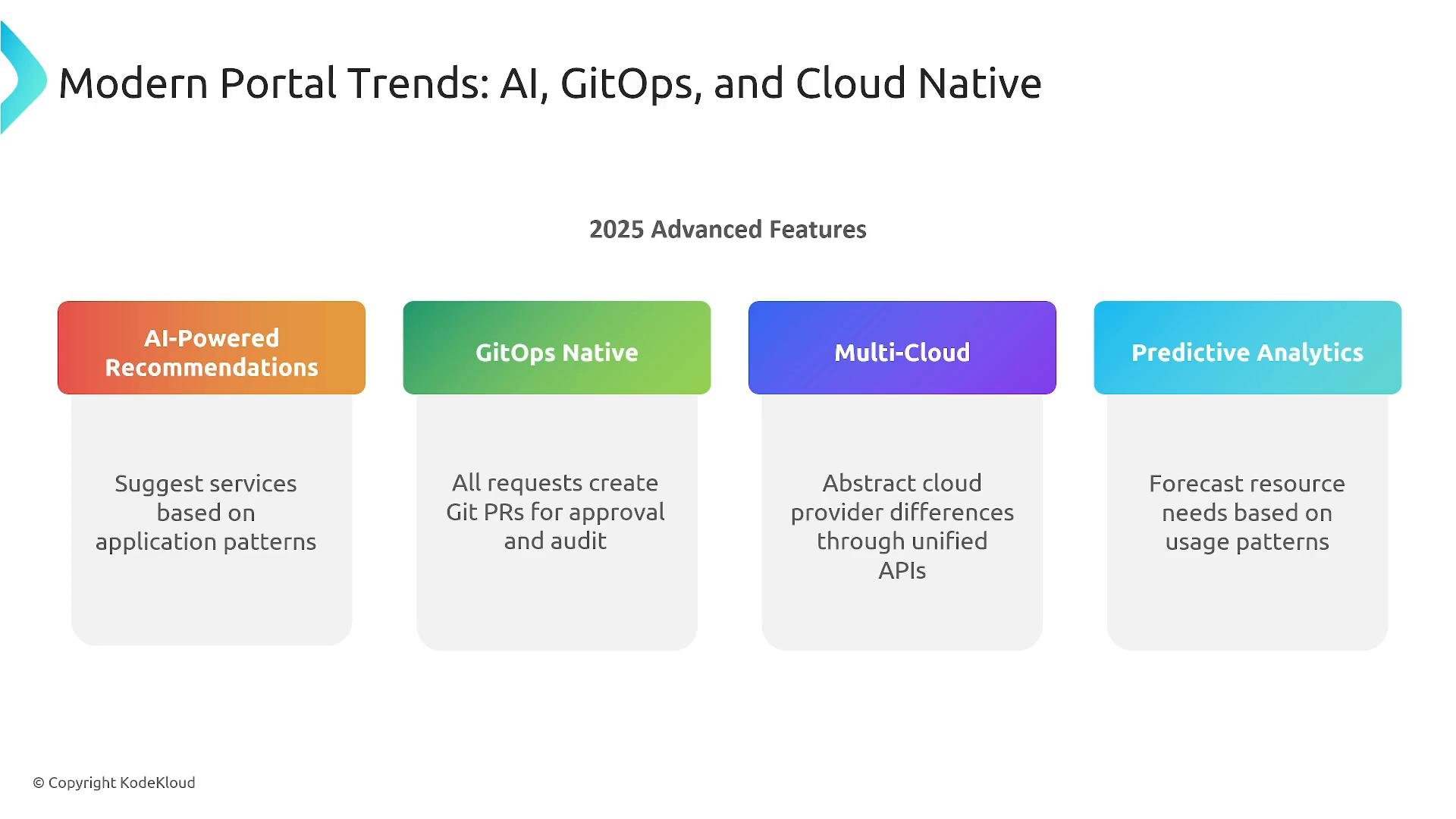
 Modern portal trends
Trends shaping API-driven portals include:
* AI and AIOps: anomaly detection, predictive alerts, and intelligent recommendations
* GitOps-native workflows: PR-driven environment configuration as the source of truth
* Multi-cloud and cloud-agnostic provisioning: templatize offerings per cloud
* Predictive analytics and richer observability using distributed tracing and metrics
These trends are API-centric: portals create Git PRs, call cloud APIs, and generate telemetry that feeds analytics and AI systems.
Modern portal trends
Trends shaping API-driven portals include:
* AI and AIOps: anomaly detection, predictive alerts, and intelligent recommendations
* GitOps-native workflows: PR-driven environment configuration as the source of truth
* Multi-cloud and cloud-agnostic provisioning: templatize offerings per cloud
* Predictive analytics and richer observability using distributed tracing and metrics
These trends are API-centric: portals create Git PRs, call cloud APIs, and generate telemetry that feeds analytics and AI systems.
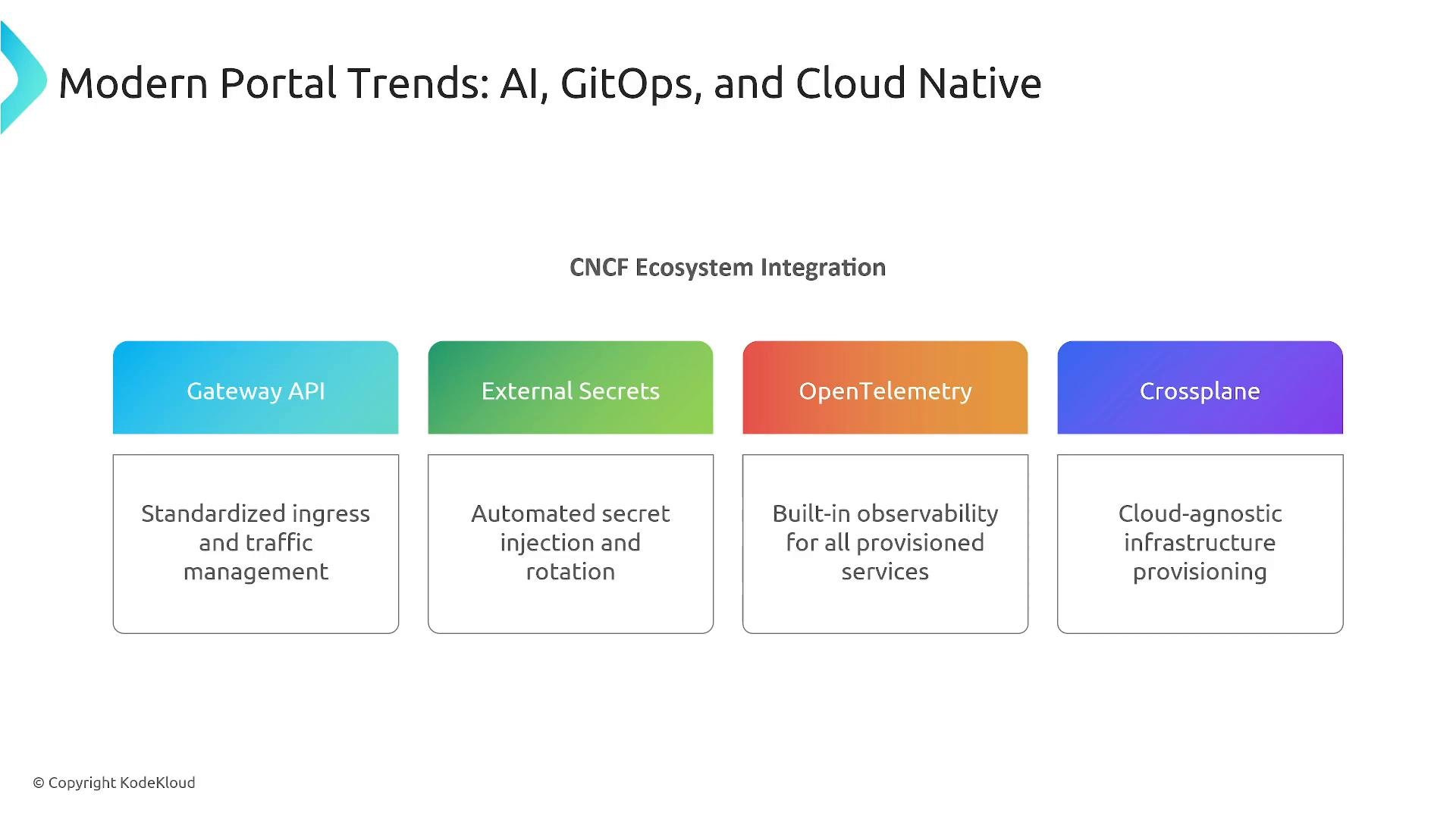
 CNCF and ecosystem integrations commonly used in portals:
* Gateway API — standardized ingress and traffic management on Kubernetes
* External Secrets — secure injection of provider secrets
* OpenTelemetry — observability and distributed tracing
* Crossplane — cloud-agnostic provisioning through APIs
CNCF and ecosystem integrations commonly used in portals:
* Gateway API — standardized ingress and traffic management on Kubernetes
* External Secrets — secure injection of provider secrets
* OpenTelemetry — observability and distributed tracing
* Crossplane — cloud-agnostic provisioning through APIs
 Key takeaways
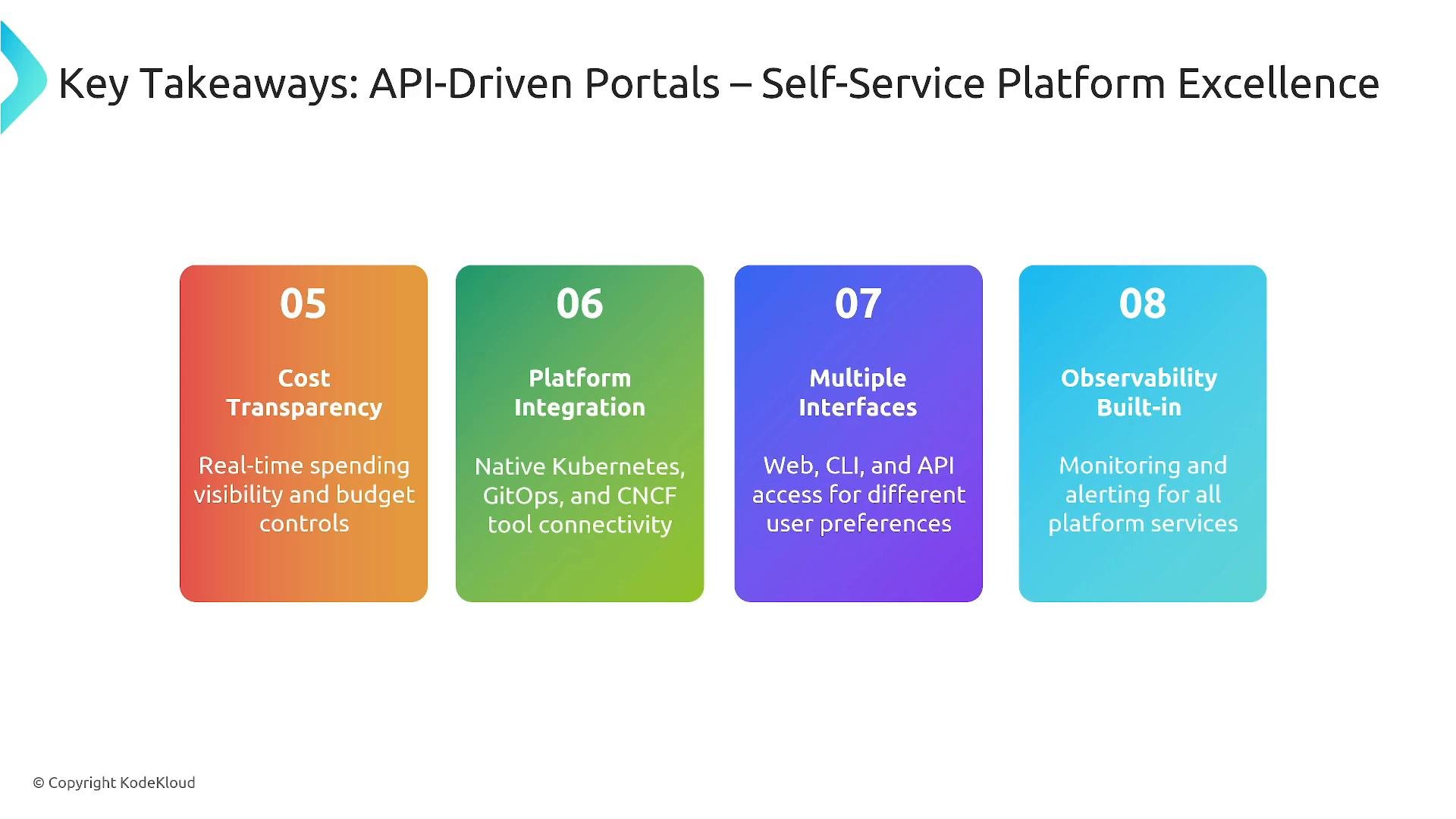
* Service discovery is essential — make it easy for developers to find what they need.
* Offer self-service APIs with RBAC, quotas, and lifecycle management (request → provision → decommission).
* Make cost attribution and budget transparency visible to drive adoption.
* Integrate the portal with GitOps, cloud provider APIs, and observability systems.
* Support multiple interfaces (web, CLI, APIs, mobile) and design observability into every action.
Key takeaways
* Service discovery is essential — make it easy for developers to find what they need.
* Offer self-service APIs with RBAC, quotas, and lifecycle management (request → provision → decommission).
* Make cost attribution and budget transparency visible to drive adoption.
* Integrate the portal with GitOps, cloud provider APIs, and observability systems.
* Support multiple interfaces (web, CLI, APIs, mobile) and design observability into every action.
 Platform value
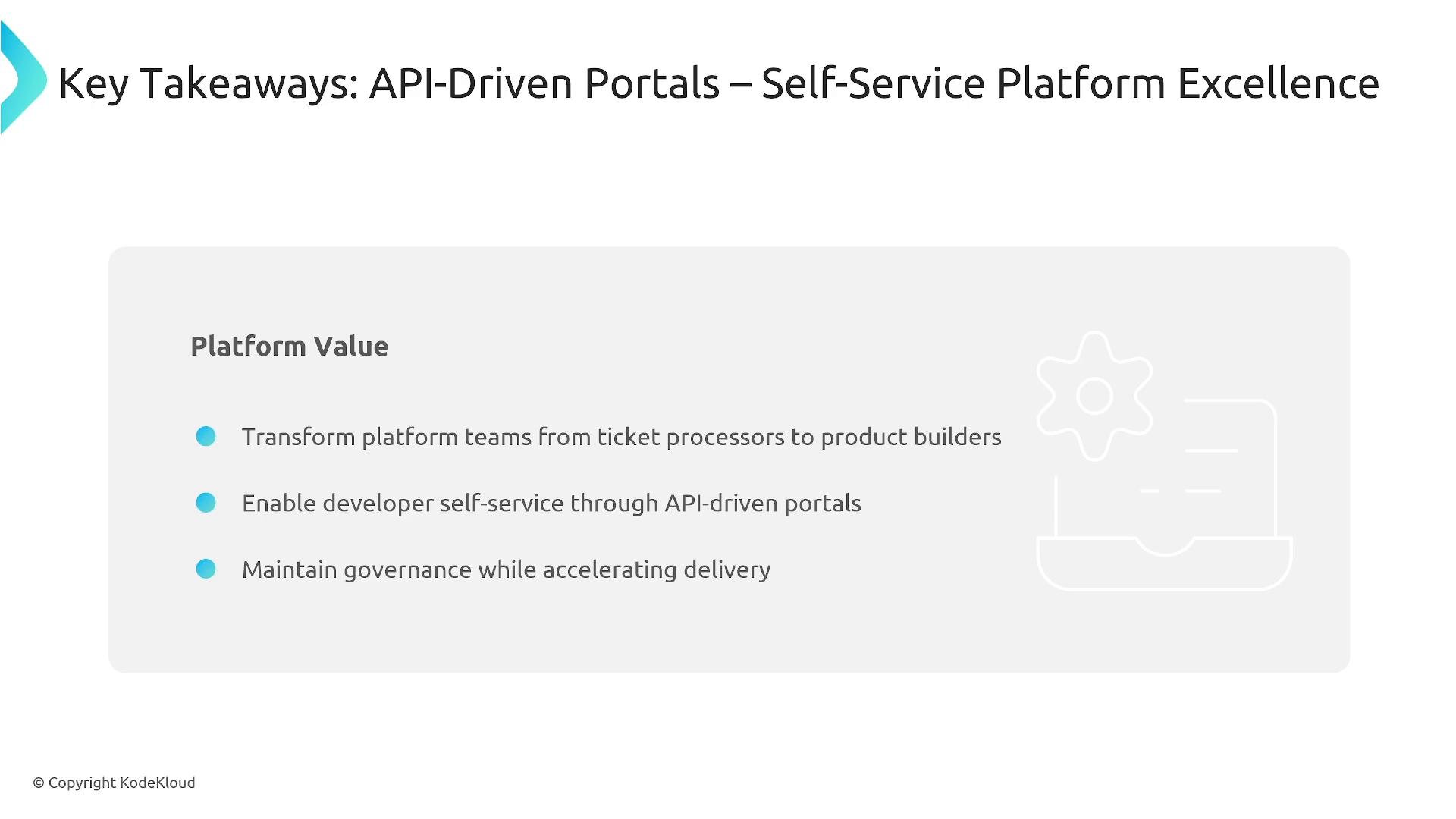
A mature API-driven portal transforms platform teams from ticket processors into product teams, empowers developers with self-service while maintaining governance, and aligns operations and security with developer workflows to accelerate delivery.
Platform value
A mature API-driven portal transforms platform teams from ticket processors into product teams, empowers developers with self-service while maintaining governance, and aligns operations and security with developer workflows to accelerate delivery.
 Further reading and references
* [Backstage (CNCF)](https://learn.kodekloud.com/user/courses/certified-backstage-associate-cba) — developer portal framework
* [Crossplane](https://learn.kodekloud.com/user/courses/learn-by-doing-crossplane) — cloud-agnostic control plane
* [Argo CD / GitOps](https://learn.kodekloud.com/user/courses/gitops-with-argocd) — GitOps continuous delivery
* [Gateway API](https://learn.kodekloud.com/user/courses/gateway-api-with-nginx-fabric-gateway) — Kubernetes ingress/traffic standard
* [OpenTelemetry](https://learn.kodekloud.com/user/courses/workshop-opentelemetry) — observability and tracing
* [External Secrets](https://external-secrets.io/) — secret management integrations
Thanks for reading.
This documentation is built and hosted on [Mintlify](https://mintlify.com), a developer documentation platform.
Further reading and references
* [Backstage (CNCF)](https://learn.kodekloud.com/user/courses/certified-backstage-associate-cba) — developer portal framework
* [Crossplane](https://learn.kodekloud.com/user/courses/learn-by-doing-crossplane) — cloud-agnostic control plane
* [Argo CD / GitOps](https://learn.kodekloud.com/user/courses/gitops-with-argocd) — GitOps continuous delivery
* [Gateway API](https://learn.kodekloud.com/user/courses/gateway-api-with-nginx-fabric-gateway) — Kubernetes ingress/traffic standard
* [OpenTelemetry](https://learn.kodekloud.com/user/courses/workshop-opentelemetry) — observability and tracing
* [External Secrets](https://external-secrets.io/) — secret management integrations
Thanks for reading.
This documentation is built and hosted on [Mintlify](https://mintlify.com), a developer documentation platform.