> ## Documentation Index
> Fetch the complete documentation index at: https://notes.kodekloud.com/llms.txt
> Use this file to discover all available pages before exploring further.
# Network Policy Limitations
> Explains limitations of Kubernetes native NetworkPolicy and why extended engines like Cilium add CRDs for L7 filtering, FQDN rules, richer selectors, explicit deny and cluster scoped policies.
In this lesson we examine the limitations of the standard Kubernetes NetworkPolicy API and explain why extended policy engines (for example, Cilium) introduce CRDs to fill those gaps. Understanding these constraints helps when you design secure cluster networking and select a CNI or policy engine that meets your requirements.
## What native Kubernetes NetworkPolicy supports
Kubernetes NetworkPolicy works at Layer 3 (IP) and Layer 4 (TCP/UDP/SCTP). It can restrict traffic using pod selectors, namespace selectors, IPBlocks, and ports. A common L3/L4 NetworkPolicy looks like this:
```yaml theme={null}
apiVersion: networking.k8s.io/v1
kind: NetworkPolicy
metadata:
name: test-network-policy
spec:
policyTypes:
- Ingress
podSelector:
matchLabels:
role: db
ingress:
- from:
- ipBlock:
cidr: 172.17.0.0/16
- podSelector:
matchLabels:
role: frontend
ports:
- protocol: TCP
port: 6379
```
Standard NetworkPolicy is L3/L4-only. It cannot inspect or filter Layer 7 protocol semantics (for example, HTTP method or HTTP path), and it does not support DNS/FQDN-based matching, service-account selectors, or cluster-wide policies out of the box.
## Key limitations of networking.k8s.io/v1 NetworkPolicy
* No Layer 7 (L7) protocol awareness
* Native NetworkPolicy cannot express rules such as “allow only HTTP GET to /users.” It can allow TCP port 80, but it cannot validate HTTP methods, paths, headers, or other L7 attributes.
Conceptual (illustrative) L7-aware policy example — not supported by native NetworkPolicy:
```yaml theme={null}
# Conceptual example (not supported by native networking.k8s.io/v1 NetworkPolicy)
apiVersion: networking.k8s.io/v1
kind: NetworkPolicy
metadata:
name: allow-http-get-users
spec:
policyTypes:
- Ingress
podSelector:
matchLabels:
app: web
ingress:
- from:
- podSelector:
matchLabels:
role: frontend
ports:
- protocol: TCP
port: 80
# Native NetworkPolicy cannot specify HTTP method/path here
# This block is a conceptual L7 match: method GET, path /users
```
* DNS / FQDN matching limitations
* NetworkPolicy cannot match on DNS names or FQDNs. To allow egress to an external service that resolves to multiple IPs, you must enumerate all IPs in ipBlock entries and update the policy whenever DNS resolves to new addresses.
Conceptual FQDN match (native NetworkPolicy does not support this):
```yaml theme={null}
# Conceptual example (native NetworkPolicy does not support fqdn)
apiVersion: networking.k8s.io/v1
kind: NetworkPolicy
metadata:
name: test-network-policy
namespace: default
spec:
podSelector:
matchLabels:
role: db
policyTypes:
- Ingress
ingress:
- from:
- fqdn:
matchDNS: external-service.com
ports:
- protocol: TCP
port: 6379
```
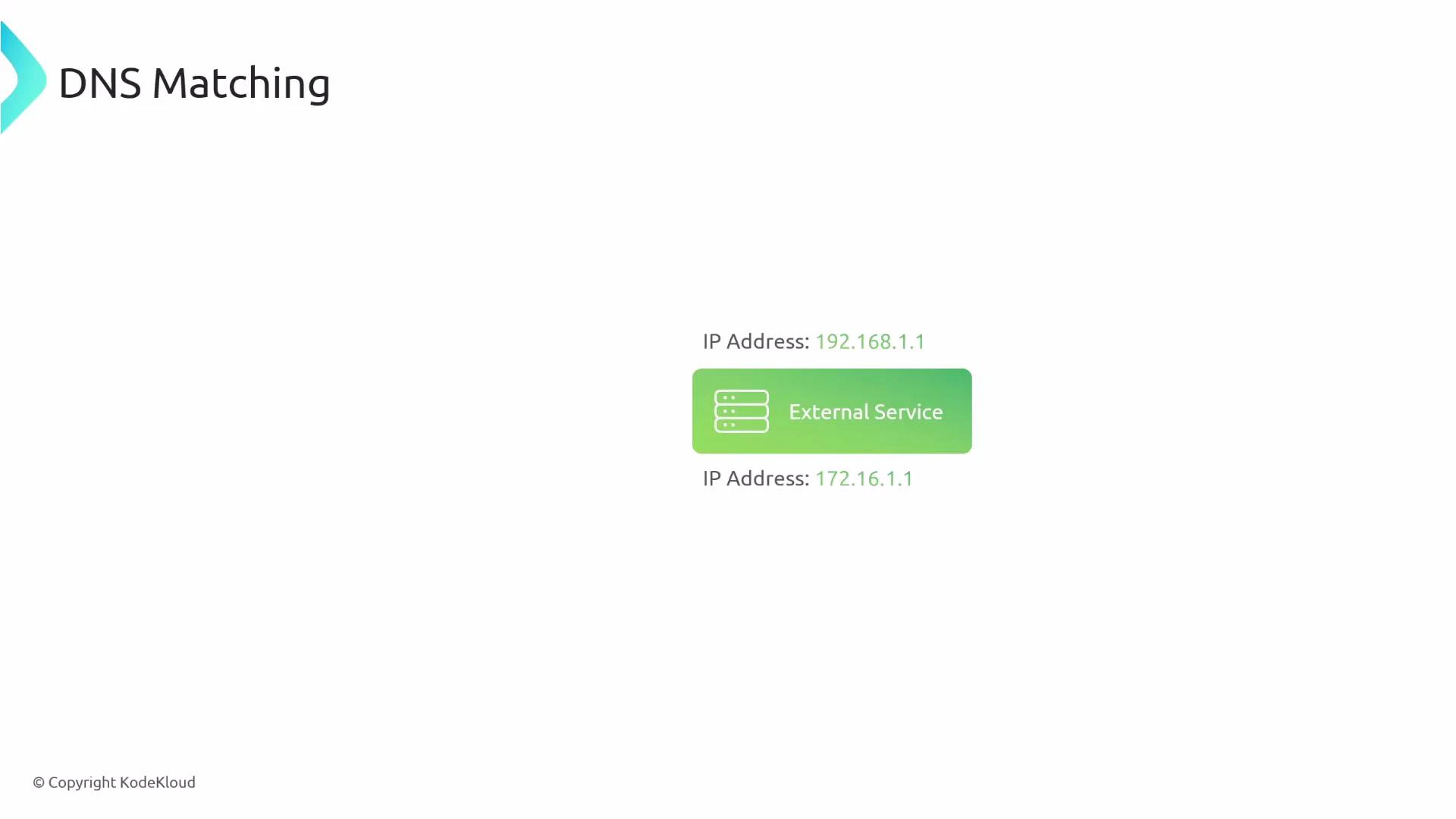
To illustrate the problem: suppose external-service.com resolves to multiple IPs (e.g., 192.168.1.1 and 172.16.1.1). With native policies you must list those IPs explicitly, and update the policy when the service endpoints change.
 * Limited pod attribute selectors
* Native NetworkPolicy can only match pods by labels and namespaces. It cannot select by other pod attributes such as serviceAccountName, or match richer metadata fields without label workarounds.
* Protocol matching constraints
* The protocol field supports TCP, UDP, and SCTP in the Kubernetes API. ICMP or other protocol-specific matches and application-protocol-specific filtering (for example, DNS query matching) are not standardized in networking.k8s.io/v1. Some CNIs may extend behavior, but it is not portable.
* No explicit deny rules
* Native NetworkPolicy is primarily a whitelist model: you define what is allowed. It does not provide explicit deny rules that take precedence. You cannot express “allow everything from X except pods labeled env=staging” using only networking.k8s.io/v1 constructs.
Conceptual deny model (illustrative; not supported by native NetworkPolicy):
```yaml theme={null}
# Conceptual/extended policy model (native NetworkPolicy can't express 'ingressDeny')
apiVersion: cilium.io/v2
kind: CiliumNetworkPolicy
metadata:
name: backend-policy-with-deny
spec:
endpointSelector:
matchLabels:
app: backend
ingress:
- fromEndpoints:
- matchLabels:
app: frontend
ingressDeny:
- fromEndpoints:
- matchLabels:
env: staging
```
* Namespace scoping (no cluster-scoped NetworkPolicy)
* NetworkPolicy objects are namespace-scoped. To apply the same policy across multiple namespaces, you must replicate the object in each namespace. There is no native cluster-scoped NetworkPolicy in networking.k8s.io/v1.
* Multi-cluster awareness
* NetworkPolicy is cluster-local. It cannot inherently distinguish source cluster origin across multiple clusters; cross-cluster policies require labeling and replication strategies outside the API.
Example of a cluster-local policy (works within a single cluster only):
```yaml theme={null}
# This is a cluster-local NetworkPolicy example - it does not express cross-cluster origin
apiVersion: networking.k8s.io/v1
kind: NetworkPolicy
metadata:
name: allow-from-project-and-cluster1
spec:
podSelector:
matchLabels:
role: db
policyTypes:
- Ingress
ingress:
- from:
- namespaceSelector:
matchLabels:
project: myproject
- podSelector:
matchLabels:
cluster: cluster1
ports:
- protocol: TCP
port: 6379
```
## Summary comparison: native NetworkPolicy vs extended policy engines
| Feature | networking.k8s.io/v1 NetworkPolicy | Cilium (CiliumNetworkPolicy / CiliumClusterwideNetworkPolicy) |
| -------------------------------- | ---------------------------------: | ------------------------------------------------------------- |
| L3/L4 filtering | Yes | Yes |
| L7 filtering (HTTP, gRPC, Kafka) | No | Yes (methods, paths, headers) |
| FQDN / DNS-based rules | No | Yes (toFQDNs) |
| Service account selection | No | Yes |
| Explicit deny semantics | No | Yes (ingressDeny/egressDeny) |
| Cluster-scoped policies | No | Yes (CiliumClusterwideNetworkPolicy) |
| Protocol variety | TCP/UDP/SCTP | Extended support depending on Cilium features |
## Why Cilium and other enhanced engines exist
Cilium provides CRDs such as CiliumNetworkPolicy and CiliumClusterwideNetworkPolicy to address the functional gaps in native NetworkPolicy:
* L7-aware rules: match HTTP methods, paths, headers; support for gRPC and Kafka.
* FQDN-based egress: toFQDNs allow DNS-driven policies that follow changing IPs.
* Rich selectors: service accounts, identity-based selectors, and metadata-aware matching.
* Explicit deny semantics and more flexible precedence models.
* Cluster-wide policies for consistent rules across namespaces and clusters.
### Cilium policy examples (illustrative of capabilities)
* L7 HTTP allow (Cilium can match method/path):
```yaml theme={null}
apiVersion: cilium.io/v2
kind: CiliumNetworkPolicy
metadata:
name: allow-frontend-http
spec:
endpointSelector:
matchLabels:
app: myservice
ingress:
- fromEndpoints:
- matchLabels:
app: frontend
toPorts:
- ports:
- port: "80"
protocol: TCP
rules:
http:
- method: "GET"
path: "/users"
```
* FQDN-based egress (toFQDNs):
```yaml theme={null}
apiVersion: cilium.io/v2
kind: CiliumNetworkPolicy
metadata:
name: allow-external-service
spec:
endpointSelector:
matchLabels:
role: db
egress:
- toFQDNs:
- matchName: "external-service.com"
toPorts:
- ports:
- port: "6379"
protocol: TCP
```
* Deny and advanced matching:
```yaml theme={null}
apiVersion: cilium.io/v2
kind: CiliumNetworkPolicy
metadata:
name: backend-policy-with-deny
spec:
endpointSelector:
matchLabels:
app: backend
ingress:
- fromEndpoints:
- matchLabels:
app: frontend
ingressDeny:
- fromEndpoints:
- matchLabels:
env: staging
```
* Cluster-scoped policy example placeholder:
```yaml theme={null}
apiVersion: "cilium.io/v2"
kind: CiliumClusterwideNetworkPolicy
metadata:
name: example-clusterwide-policy
spec:
# spec similar to CiliumNetworkPolicy, applied cluster-wide
```
## Final notes
* Native Kubernetes NetworkPolicy is intentionally simple and broadly supported by many CNIs. That simplicity means it is portable but functionally limited (no L7, no FQDN matching, limited selectors, no explicit deny, no cluster-scoped definitions).
* If your security requirements include L7 filtering, DNS-aware egress, service-account selectors, explicit denies, or cluster-wide rules, evaluate an extended policy engine such as Cilium and its CRDs: CiliumNetworkPolicy and CiliumClusterwideNetworkPolicy.
## Links and references
* [Kubernetes NetworkPolicy documentation](https://kubernetes.io/docs/concepts/services-networking/network-policies/)
* [Cilium documentation](https://docs.cilium.io/)
* [CiliumNetworkPolicy reference](https://docs.cilium.io/en/stable/policy/language/)
* [CiliumClusterwideNetworkPolicy reference](https://docs.cilium.io/en/stable/policy/clusterwide/)
```yaml theme={null}
apiVersion: cilium.io/v2
kind: CiliumNetworkPolicy
apiVersion: "cilium.io/v2"
kind: CiliumClusterwideNetworkPolicy
```
* Limited pod attribute selectors
* Native NetworkPolicy can only match pods by labels and namespaces. It cannot select by other pod attributes such as serviceAccountName, or match richer metadata fields without label workarounds.
* Protocol matching constraints
* The protocol field supports TCP, UDP, and SCTP in the Kubernetes API. ICMP or other protocol-specific matches and application-protocol-specific filtering (for example, DNS query matching) are not standardized in networking.k8s.io/v1. Some CNIs may extend behavior, but it is not portable.
* No explicit deny rules
* Native NetworkPolicy is primarily a whitelist model: you define what is allowed. It does not provide explicit deny rules that take precedence. You cannot express “allow everything from X except pods labeled env=staging” using only networking.k8s.io/v1 constructs.
Conceptual deny model (illustrative; not supported by native NetworkPolicy):
```yaml theme={null}
# Conceptual/extended policy model (native NetworkPolicy can't express 'ingressDeny')
apiVersion: cilium.io/v2
kind: CiliumNetworkPolicy
metadata:
name: backend-policy-with-deny
spec:
endpointSelector:
matchLabels:
app: backend
ingress:
- fromEndpoints:
- matchLabels:
app: frontend
ingressDeny:
- fromEndpoints:
- matchLabels:
env: staging
```
* Namespace scoping (no cluster-scoped NetworkPolicy)
* NetworkPolicy objects are namespace-scoped. To apply the same policy across multiple namespaces, you must replicate the object in each namespace. There is no native cluster-scoped NetworkPolicy in networking.k8s.io/v1.
* Multi-cluster awareness
* NetworkPolicy is cluster-local. It cannot inherently distinguish source cluster origin across multiple clusters; cross-cluster policies require labeling and replication strategies outside the API.
Example of a cluster-local policy (works within a single cluster only):
```yaml theme={null}
# This is a cluster-local NetworkPolicy example - it does not express cross-cluster origin
apiVersion: networking.k8s.io/v1
kind: NetworkPolicy
metadata:
name: allow-from-project-and-cluster1
spec:
podSelector:
matchLabels:
role: db
policyTypes:
- Ingress
ingress:
- from:
- namespaceSelector:
matchLabels:
project: myproject
- podSelector:
matchLabels:
cluster: cluster1
ports:
- protocol: TCP
port: 6379
```
## Summary comparison: native NetworkPolicy vs extended policy engines
| Feature | networking.k8s.io/v1 NetworkPolicy | Cilium (CiliumNetworkPolicy / CiliumClusterwideNetworkPolicy) |
| -------------------------------- | ---------------------------------: | ------------------------------------------------------------- |
| L3/L4 filtering | Yes | Yes |
| L7 filtering (HTTP, gRPC, Kafka) | No | Yes (methods, paths, headers) |
| FQDN / DNS-based rules | No | Yes (toFQDNs) |
| Service account selection | No | Yes |
| Explicit deny semantics | No | Yes (ingressDeny/egressDeny) |
| Cluster-scoped policies | No | Yes (CiliumClusterwideNetworkPolicy) |
| Protocol variety | TCP/UDP/SCTP | Extended support depending on Cilium features |
## Why Cilium and other enhanced engines exist
Cilium provides CRDs such as CiliumNetworkPolicy and CiliumClusterwideNetworkPolicy to address the functional gaps in native NetworkPolicy:
* L7-aware rules: match HTTP methods, paths, headers; support for gRPC and Kafka.
* FQDN-based egress: toFQDNs allow DNS-driven policies that follow changing IPs.
* Rich selectors: service accounts, identity-based selectors, and metadata-aware matching.
* Explicit deny semantics and more flexible precedence models.
* Cluster-wide policies for consistent rules across namespaces and clusters.
### Cilium policy examples (illustrative of capabilities)
* L7 HTTP allow (Cilium can match method/path):
```yaml theme={null}
apiVersion: cilium.io/v2
kind: CiliumNetworkPolicy
metadata:
name: allow-frontend-http
spec:
endpointSelector:
matchLabels:
app: myservice
ingress:
- fromEndpoints:
- matchLabels:
app: frontend
toPorts:
- ports:
- port: "80"
protocol: TCP
rules:
http:
- method: "GET"
path: "/users"
```
* FQDN-based egress (toFQDNs):
```yaml theme={null}
apiVersion: cilium.io/v2
kind: CiliumNetworkPolicy
metadata:
name: allow-external-service
spec:
endpointSelector:
matchLabels:
role: db
egress:
- toFQDNs:
- matchName: "external-service.com"
toPorts:
- ports:
- port: "6379"
protocol: TCP
```
* Deny and advanced matching:
```yaml theme={null}
apiVersion: cilium.io/v2
kind: CiliumNetworkPolicy
metadata:
name: backend-policy-with-deny
spec:
endpointSelector:
matchLabels:
app: backend
ingress:
- fromEndpoints:
- matchLabels:
app: frontend
ingressDeny:
- fromEndpoints:
- matchLabels:
env: staging
```
* Cluster-scoped policy example placeholder:
```yaml theme={null}
apiVersion: "cilium.io/v2"
kind: CiliumClusterwideNetworkPolicy
metadata:
name: example-clusterwide-policy
spec:
# spec similar to CiliumNetworkPolicy, applied cluster-wide
```
## Final notes
* Native Kubernetes NetworkPolicy is intentionally simple and broadly supported by many CNIs. That simplicity means it is portable but functionally limited (no L7, no FQDN matching, limited selectors, no explicit deny, no cluster-scoped definitions).
* If your security requirements include L7 filtering, DNS-aware egress, service-account selectors, explicit denies, or cluster-wide rules, evaluate an extended policy engine such as Cilium and its CRDs: CiliumNetworkPolicy and CiliumClusterwideNetworkPolicy.
## Links and references
* [Kubernetes NetworkPolicy documentation](https://kubernetes.io/docs/concepts/services-networking/network-policies/)
* [Cilium documentation](https://docs.cilium.io/)
* [CiliumNetworkPolicy reference](https://docs.cilium.io/en/stable/policy/language/)
* [CiliumClusterwideNetworkPolicy reference](https://docs.cilium.io/en/stable/policy/clusterwide/)
```yaml theme={null}
apiVersion: cilium.io/v2
kind: CiliumNetworkPolicy
apiVersion: "cilium.io/v2"
kind: CiliumClusterwideNetworkPolicy
```