> ## Documentation Index
> Fetch the complete documentation index at: https://notes.kodekloud.com/llms.txt
> Use this file to discover all available pages before exploring further.
# Security Introduction
> Guide to restricting Kubernetes pod communication using NetworkPolicy and Cilium's eBPF-based identity and L7 policies for least privilege enforcement.
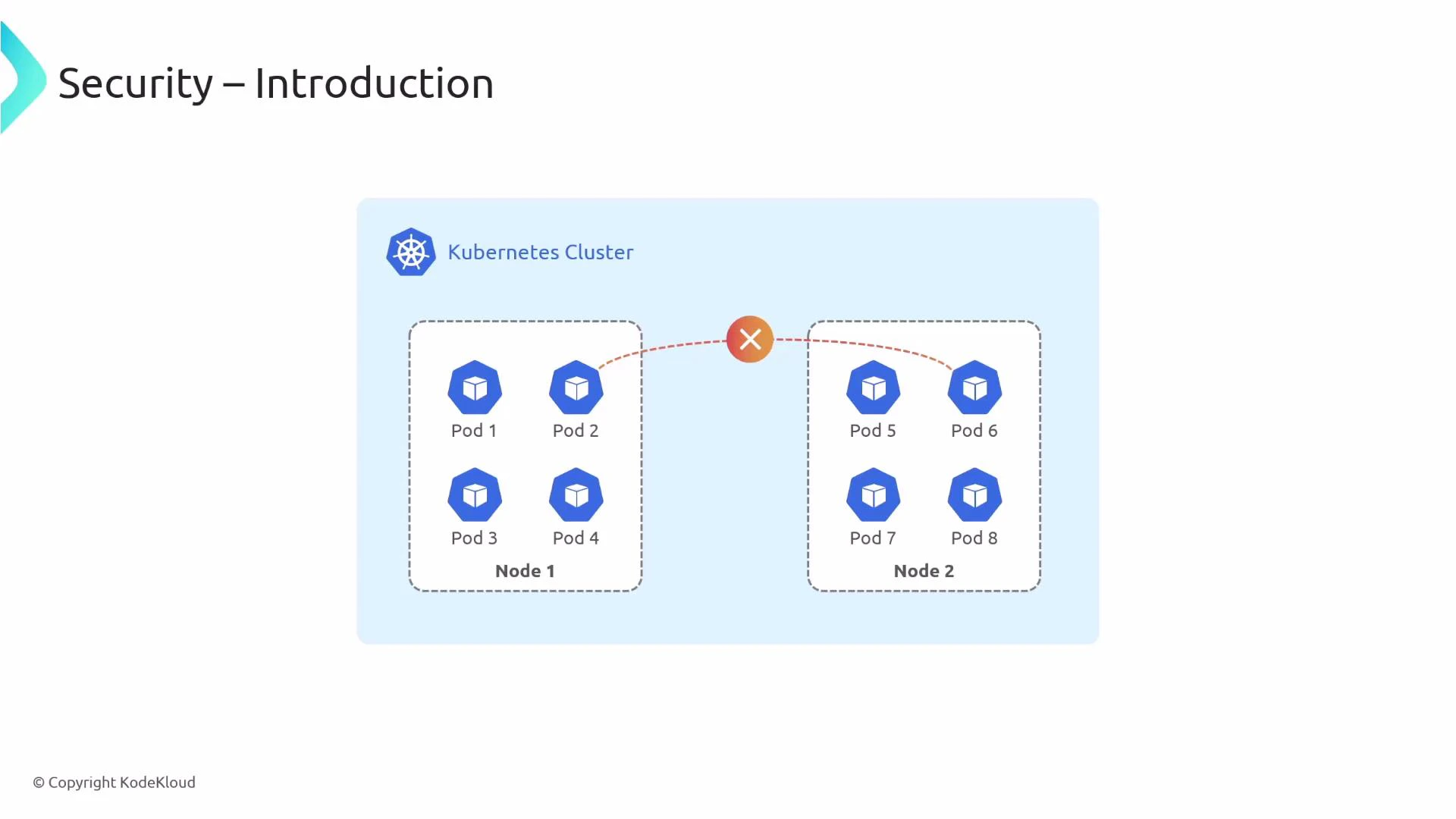
This guide explains how to restrict which workloads can communicate inside a Kubernetes cluster using both the native Kubernetes NetworkPolicy API and Cilium’s enhanced policy primitives. By default, Kubernetes clusters permit pod-to-pod communication across the cluster. To adopt a least-privilege posture you must explicitly express which traffic is allowed — for example, preventing Pod 2 from talking to Pod 6. Cilium builds on Kubernetes NetworkPolicy with eBPF-powered enforcement, richer selectors, and L7 controls to make those restrictions more powerful and observable.
 What this page covers:
* Kubernetes NetworkPolicy — the native API for expressing allowed traffic between pods, namespaces, and IP blocks.
* Cilium NetworkPolicy (CNP) and Clusterwide CiliumNetworkPolicy (CCNP) — Cilium’s extended, eBPF-based policy types that add identity-based selectors, richer L7 rules, and cluster-scoped enforcement.
Kubernetes NetworkPolicy is opt-in: if no policies select a pod, that pod remains reachable by other pods. When a pod is selected by one or more NetworkPolicy resources, traffic is restricted according to those policies, allowing you to adopt a least-privilege model for the selected pods.
Why use Cilium for network security
* Kernel-level enforcement with eBPF for high performance and precise policy enforcement (including inter-node traffic).
* Identity-based policies using labels (and integrating with external identity providers) rather than relying solely on IP addresses, which improves policy stability as pods move.
* L7 filtering and visibility (HTTP, gRPC, Kafka, DNS, etc.) so you can write policies based on HTTP paths, methods, or Kafka topics, not just ports.
* Both namespace-scoped (`CiliumNetworkPolicy`, CNP) and cluster-scoped (`CiliumClusterwideNetworkPolicy`, CCNP) objects to express either granular or broad policies.
Policy type comparison
| Resource Type | Scope | Use Case | Example CLI |
| ---------------------------------------------- | --------------------------------------- | ---------------------------------------------------------------------------- | ------------------------------------- |
| Kubernetes `NetworkPolicy` | Namespace-scoped | Allow/deny traffic based on pod selectors, namespace selectors, and IPBlocks | `kubectl apply -f networkpolicy.yaml` |
| Cilium `CiliumNetworkPolicy` (CNP) | Namespace-scoped with Cilium extensions | Identity-based policies, L7 rules, richer match semantics | `kubectl apply -f cnp.yaml` |
| Cilium `CiliumClusterwideNetworkPolicy` (CCNP) | Cluster-scoped | Apply consistent policies across namespaces or the whole cluster | `kubectl apply -f ccnp.yaml` |
Authoring tips
* Start with a default deny for critical workloads, then add explicit allow rules for required traffic.
* Use label-based selectors (identities) where possible so policies remain correct as IPs change.
* Combine L4 (ports/protocols) and L7 filters (HTTP methods, paths) to enforce intent at the application layer.
* Test policies incrementally in a staging environment and use observability tools (Cilium Hubble, cilium monitor) to validate enforcement.
Next sections (in this guide) show:
* Example `NetworkPolicy` YAML and how it behaves in a cluster.
* Example `CiliumNetworkPolicy` and `CiliumClusterwideNetworkPolicy` demonstrating identity-based and L7 rules.
* How Cilium enforces policies at the eBPF level (including inter-node enforcement as illustrated above).
* Techniques to implement and verify a least-privilege network posture.
Links and references
* [Kubernetes NetworkPolicy documentation](https://kubernetes.io/docs/concepts/services-networking/network-policies/)
* [Cilium Network Policy concepts](https://docs.cilium.io/en/stable/policy/)
* [Cilium Hubble observability](https://docs.cilium.io/en/stable/gettingstarted/hubble/)
Tip: Use `kubectl describe` and Cilium’s `hubble` tools to observe which policy matches traffic during testing. This helps iterate policies without risking production outages.
What this page covers:
* Kubernetes NetworkPolicy — the native API for expressing allowed traffic between pods, namespaces, and IP blocks.
* Cilium NetworkPolicy (CNP) and Clusterwide CiliumNetworkPolicy (CCNP) — Cilium’s extended, eBPF-based policy types that add identity-based selectors, richer L7 rules, and cluster-scoped enforcement.
Kubernetes NetworkPolicy is opt-in: if no policies select a pod, that pod remains reachable by other pods. When a pod is selected by one or more NetworkPolicy resources, traffic is restricted according to those policies, allowing you to adopt a least-privilege model for the selected pods.
Why use Cilium for network security
* Kernel-level enforcement with eBPF for high performance and precise policy enforcement (including inter-node traffic).
* Identity-based policies using labels (and integrating with external identity providers) rather than relying solely on IP addresses, which improves policy stability as pods move.
* L7 filtering and visibility (HTTP, gRPC, Kafka, DNS, etc.) so you can write policies based on HTTP paths, methods, or Kafka topics, not just ports.
* Both namespace-scoped (`CiliumNetworkPolicy`, CNP) and cluster-scoped (`CiliumClusterwideNetworkPolicy`, CCNP) objects to express either granular or broad policies.
Policy type comparison
| Resource Type | Scope | Use Case | Example CLI |
| ---------------------------------------------- | --------------------------------------- | ---------------------------------------------------------------------------- | ------------------------------------- |
| Kubernetes `NetworkPolicy` | Namespace-scoped | Allow/deny traffic based on pod selectors, namespace selectors, and IPBlocks | `kubectl apply -f networkpolicy.yaml` |
| Cilium `CiliumNetworkPolicy` (CNP) | Namespace-scoped with Cilium extensions | Identity-based policies, L7 rules, richer match semantics | `kubectl apply -f cnp.yaml` |
| Cilium `CiliumClusterwideNetworkPolicy` (CCNP) | Cluster-scoped | Apply consistent policies across namespaces or the whole cluster | `kubectl apply -f ccnp.yaml` |
Authoring tips
* Start with a default deny for critical workloads, then add explicit allow rules for required traffic.
* Use label-based selectors (identities) where possible so policies remain correct as IPs change.
* Combine L4 (ports/protocols) and L7 filters (HTTP methods, paths) to enforce intent at the application layer.
* Test policies incrementally in a staging environment and use observability tools (Cilium Hubble, cilium monitor) to validate enforcement.
Next sections (in this guide) show:
* Example `NetworkPolicy` YAML and how it behaves in a cluster.
* Example `CiliumNetworkPolicy` and `CiliumClusterwideNetworkPolicy` demonstrating identity-based and L7 rules.
* How Cilium enforces policies at the eBPF level (including inter-node enforcement as illustrated above).
* Techniques to implement and verify a least-privilege network posture.
Links and references
* [Kubernetes NetworkPolicy documentation](https://kubernetes.io/docs/concepts/services-networking/network-policies/)
* [Cilium Network Policy concepts](https://docs.cilium.io/en/stable/policy/)
* [Cilium Hubble observability](https://docs.cilium.io/en/stable/gettingstarted/hubble/)
Tip: Use `kubectl describe` and Cilium’s `hubble` tools to observe which policy matches traffic during testing. This helps iterate policies without risking production outages.