> ## Documentation Index
> Fetch the complete documentation index at: https://notes.kodekloud.com/llms.txt
> Use this file to discover all available pages before exploring further.
# mTLS
> Explains how Cilium uses SPIFFE and SPIRE to provide node‑agent mutual TLS with eBPF enforcement, and how to enable, enforce, observe, and troubleshoot mTLS in Kubernetes
In this lesson we explain how mutual TLS (mTLS) is implemented in Cilium and how to enable, enforce, and debug it. mTLS provides authenticity, integrity, and confidentiality between two communicating endpoints by requiring both client and server to present and validate certificates.
Cilium integrates mTLS using the SPIFFE identity framework. SPIRE is the most common open-source SPIFFE implementation and is used by Cilium to issue identities (SVIDs) and certificates that agents use to establish mTLS sessions.
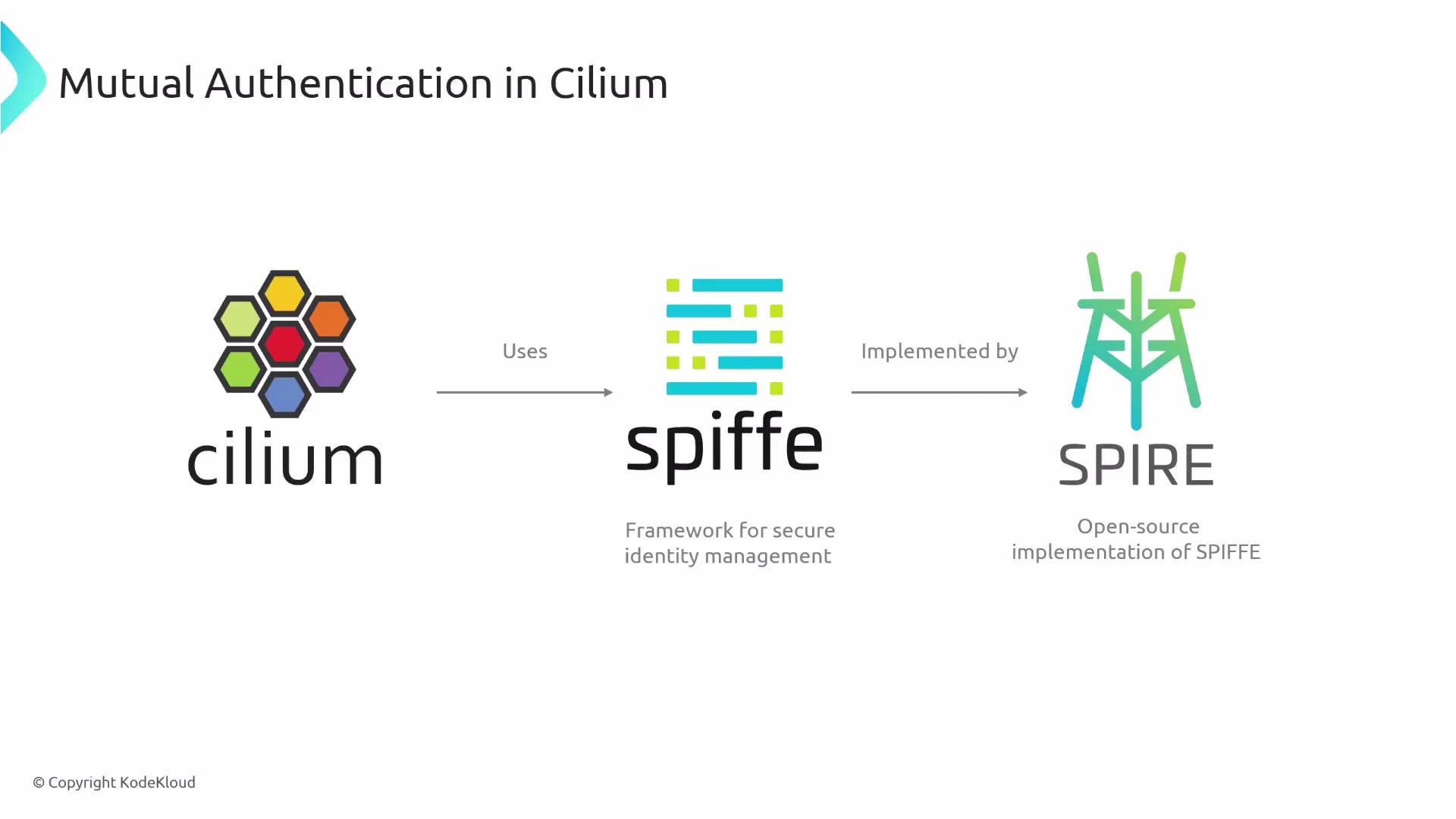 Quick overview: Cilium performs mTLS at the node-agent level. The Cilium agent uses SPIRE-issued SPIFFE identities (SVIDs) to establish TLS sessions with other node agents. Pods are not directly involved in the certificate exchange; the node agents handle authentication on their behalf.
## How mTLS works in a cluster
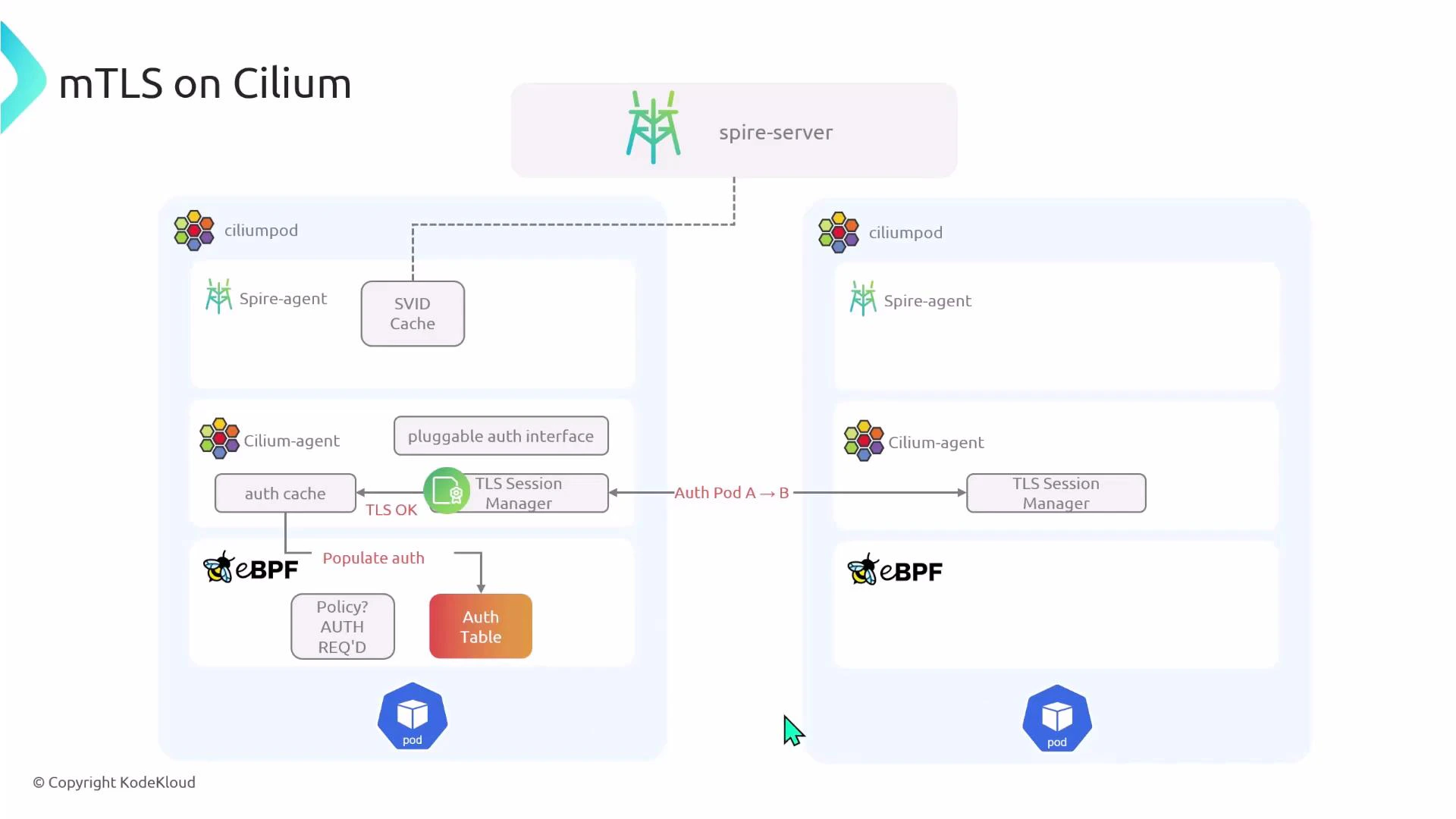
High-level components:
* Spire server (control plane) — issues SVIDs.
* Spire agent — runs on each node and obtains SVIDs from the Spire server.
* Cilium agent — performs TLS session management on behalf of pods.
* eBPF programs — enforce policies and maintain an auth table used to decide whether traffic is authenticated.
Typical sequence when a pod on Node A sends traffic to a pod on Node B:
1. eBPF looks up the auth table and policy to decide if authentication is required.
2. If authentication is required but not yet established, the initial packet is dropped by eBPF.
3. eBPF notifies the local Cilium agent that authentication is needed.
4. The Cilium agent requests SVIDs from its local Spire agent. The agent may contact the Spire server to obtain certificates.
5. Cilium TLS session managers on the two nodes establish a mutual TLS session using those certificates. (Cilium agents perform the TLS handshake; pods do not.)
6. After successful authentication, the auth table is updated and subsequent packets matching the same policy are allowed and forwarded.
This node-agent-based approach centralizes authentication at the host level rather than inside each pod, simplifying certificate management and reducing workload changes.
Quick overview: Cilium performs mTLS at the node-agent level. The Cilium agent uses SPIRE-issued SPIFFE identities (SVIDs) to establish TLS sessions with other node agents. Pods are not directly involved in the certificate exchange; the node agents handle authentication on their behalf.
## How mTLS works in a cluster
High-level components:
* Spire server (control plane) — issues SVIDs.
* Spire agent — runs on each node and obtains SVIDs from the Spire server.
* Cilium agent — performs TLS session management on behalf of pods.
* eBPF programs — enforce policies and maintain an auth table used to decide whether traffic is authenticated.
Typical sequence when a pod on Node A sends traffic to a pod on Node B:
1. eBPF looks up the auth table and policy to decide if authentication is required.
2. If authentication is required but not yet established, the initial packet is dropped by eBPF.
3. eBPF notifies the local Cilium agent that authentication is needed.
4. The Cilium agent requests SVIDs from its local Spire agent. The agent may contact the Spire server to obtain certificates.
5. Cilium TLS session managers on the two nodes establish a mutual TLS session using those certificates. (Cilium agents perform the TLS handshake; pods do not.)
6. After successful authentication, the auth table is updated and subsequent packets matching the same policy are allowed and forwarded.
This node-agent-based approach centralizes authentication at the host level rather than inside each pod, simplifying certificate management and reducing workload changes.
 ## Key components and their roles
| Component | Role |
| ------------: | ------------------------------------------------------------------------------------------------ |
| Cilium agent | Manages TLS sessions and enforces policies on behalf of pods. |
| eBPF programs | Enforce network policy and maintain an auth table used to decide forwarding vs. triggering auth. |
| Spire server | Issues SPIFFE Verifiable Identity Documents (SVIDs) to agents. |
| Spire agent | Runs on each node, obtains SVIDs from the Spire server for local workloads. |
| SPIFFE | Identity framework used to represent workload identities (URI-based). |
Useful links:
* [Cilium](https://cilium.io/)
* [SPIFFE](https://spiffe.io/)
* [SPIRE](https://spiffe.io/spire/)
* [eBPF](https://ebpf.io/)
* [CiliumNetworkPolicy language](https://docs.cilium.io/en/stable/policy/language/)
## Enabling mTLS in Cilium
At a minimum you must:
1. Enable encryption for node-to-node traffic (IPsec or WireGuard).
2. Enable Cilium authentication and the SPIRE integration.
3. Optionally allow Cilium to install SPIRE for you (convenience install).
Example Helm / operator values snippet to enable encryption and SPIRE integration:
```yaml theme={null}
encryption:
enabled: true
type: ipsec
authentication:
enabled: true
mutual:
spire:
# Enable SPIRE integration (beta)
enabled: true
install:
# Enable SPIRE installation (only takes effect if
# authentication.mutual.spire.enabled is true)
enabled: true
```
After deployment you should see one Spire agent per node and a Spire server:
```bash theme={null}
› kubectl get pod -A
NAMESPACE NAME READY STATUS RESTARTS AGE
cilium-spire spire-agent-cx9h6 1/1 Running 0 68m
cilium-spire spire-agent-hrkrm 1/1 Running 0 68m
cilium-spire spire-agent-zvpfn 1/1 Running 0 68m
cilium-spire spire-server-0 2/2 Running 0 68m
› kubectl get svc -A
NAMESPACE NAME TYPE CLUSTER-IP EXTERNAL-IP PORT(S) AGE
cilium-spire spire-server ClusterIP 10.96.75.71 8081/TCP 69m
```
## Enforcing mTLS for specific traffic
To require mTLS, create a CiliumNetworkPolicy that matches the traffic and sets authentication mode to required. You only need one matching policy in one direction: either an ingress policy on the destination or an egress policy on the source.
Example: require authentication for ingress on port 80 to pods labeled app=pod2
```yaml theme={null}
apiVersion: cilium.io/v2
kind: CiliumNetworkPolicy
metadata:
name: all-server
spec:
endpointSelector:
matchLabels:
app: pod2
ingress:
- toPorts:
- ports:
- port: "80"
protocol: TCP
authentication:
mode: required
```
This policy only allows TCP traffic to port 80 for pods with label app=pod2 when a mutual authentication session exists between the endpoints.
Cilium agents perform the mTLS authentication on behalf of pods. Pods themselves do not exchange certificates — Cilium's TLS session managers handle authentication between node agents.
## Observability — checking logs and debugging
Enable debug logging in Cilium (via Helm values or CiliumConfig) to see the authentication flow in agent logs. Useful commands:
```bash theme={null}
# List Cilium agent pods (namespace may vary)
kubectl -n kube-system get pods -l k8s-app=cilium
# Tail logs for a Cilium agent
kubectl -n kube-system logs -c cilium --tail=200
```
Representative log lines you may see:
```bash theme={null}
level=info msg="Policy requires authentication for connection" source="policy"
level=info msg="Auth table miss; dropping initial packet and triggering auth" source="ebpf"
level=info msg="Requesting SVID from local Spire agent" source="cilium-agent"
level=info msg="TLS session established between agents, auth cache updated" source="tls-session-manager"
```
To inspect SPIRE components:
```bash theme={null}
kubectl -n cilium-spire logs spire-server-0 -c spire-server
kubectl -n cilium-spire logs spire-agent-cx9h6 -c spire-agent
```
These logs reveal SVID issuance, agent handshakes, and other details of identity issuance and renewal.
## Troubleshooting checklist
* Confirm encryption (IPsec/WireGuard) is enabled.
* Verify Spire server and agents are running in the cluster.
* Ensure Cilium has authentication.mutual.spire.enabled set to true.
* Check Cilium agent logs for auth/table misses and TLS session events.
* Inspect spire-server and spire-agent logs for SVID issuance problems.
* Confirm your CiliumNetworkPolicy matches the correct endpoints and ports.
## Summary
* Cilium implements mTLS using SPIFFE identities and SPIRE as a common SPIFFE implementation.
* Mutual authentication happens at the Cilium agent level; pods do not perform certificate exchange.
* Enable encryption and authentication in your Cilium configuration and deploy SPIRE (or let Cilium install it).
* Protect traffic by creating a CiliumNetworkPolicy with authentication.mode: required.
* Use Cilium and SPIRE logs to observe and debug the authentication flow.
Further reading and references:
* [Cilium Documentation](https://docs.cilium.io/)
* [SPIFFE](https://spiffe.io/)
* [SPIRE](https://spiffe.io/spire/)
* [eBPF](https://ebpf.io/)
* [Kubernetes Documentation](https://kubernetes.io/docs/)
## Key components and their roles
| Component | Role |
| ------------: | ------------------------------------------------------------------------------------------------ |
| Cilium agent | Manages TLS sessions and enforces policies on behalf of pods. |
| eBPF programs | Enforce network policy and maintain an auth table used to decide forwarding vs. triggering auth. |
| Spire server | Issues SPIFFE Verifiable Identity Documents (SVIDs) to agents. |
| Spire agent | Runs on each node, obtains SVIDs from the Spire server for local workloads. |
| SPIFFE | Identity framework used to represent workload identities (URI-based). |
Useful links:
* [Cilium](https://cilium.io/)
* [SPIFFE](https://spiffe.io/)
* [SPIRE](https://spiffe.io/spire/)
* [eBPF](https://ebpf.io/)
* [CiliumNetworkPolicy language](https://docs.cilium.io/en/stable/policy/language/)
## Enabling mTLS in Cilium
At a minimum you must:
1. Enable encryption for node-to-node traffic (IPsec or WireGuard).
2. Enable Cilium authentication and the SPIRE integration.
3. Optionally allow Cilium to install SPIRE for you (convenience install).
Example Helm / operator values snippet to enable encryption and SPIRE integration:
```yaml theme={null}
encryption:
enabled: true
type: ipsec
authentication:
enabled: true
mutual:
spire:
# Enable SPIRE integration (beta)
enabled: true
install:
# Enable SPIRE installation (only takes effect if
# authentication.mutual.spire.enabled is true)
enabled: true
```
After deployment you should see one Spire agent per node and a Spire server:
```bash theme={null}
› kubectl get pod -A
NAMESPACE NAME READY STATUS RESTARTS AGE
cilium-spire spire-agent-cx9h6 1/1 Running 0 68m
cilium-spire spire-agent-hrkrm 1/1 Running 0 68m
cilium-spire spire-agent-zvpfn 1/1 Running 0 68m
cilium-spire spire-server-0 2/2 Running 0 68m
› kubectl get svc -A
NAMESPACE NAME TYPE CLUSTER-IP EXTERNAL-IP PORT(S) AGE
cilium-spire spire-server ClusterIP 10.96.75.71 8081/TCP 69m
```
## Enforcing mTLS for specific traffic
To require mTLS, create a CiliumNetworkPolicy that matches the traffic and sets authentication mode to required. You only need one matching policy in one direction: either an ingress policy on the destination or an egress policy on the source.
Example: require authentication for ingress on port 80 to pods labeled app=pod2
```yaml theme={null}
apiVersion: cilium.io/v2
kind: CiliumNetworkPolicy
metadata:
name: all-server
spec:
endpointSelector:
matchLabels:
app: pod2
ingress:
- toPorts:
- ports:
- port: "80"
protocol: TCP
authentication:
mode: required
```
This policy only allows TCP traffic to port 80 for pods with label app=pod2 when a mutual authentication session exists between the endpoints.
Cilium agents perform the mTLS authentication on behalf of pods. Pods themselves do not exchange certificates — Cilium's TLS session managers handle authentication between node agents.
## Observability — checking logs and debugging
Enable debug logging in Cilium (via Helm values or CiliumConfig) to see the authentication flow in agent logs. Useful commands:
```bash theme={null}
# List Cilium agent pods (namespace may vary)
kubectl -n kube-system get pods -l k8s-app=cilium
# Tail logs for a Cilium agent
kubectl -n kube-system logs -c cilium --tail=200
```
Representative log lines you may see:
```bash theme={null}
level=info msg="Policy requires authentication for connection" source="policy"
level=info msg="Auth table miss; dropping initial packet and triggering auth" source="ebpf"
level=info msg="Requesting SVID from local Spire agent" source="cilium-agent"
level=info msg="TLS session established between agents, auth cache updated" source="tls-session-manager"
```
To inspect SPIRE components:
```bash theme={null}
kubectl -n cilium-spire logs spire-server-0 -c spire-server
kubectl -n cilium-spire logs spire-agent-cx9h6 -c spire-agent
```
These logs reveal SVID issuance, agent handshakes, and other details of identity issuance and renewal.
## Troubleshooting checklist
* Confirm encryption (IPsec/WireGuard) is enabled.
* Verify Spire server and agents are running in the cluster.
* Ensure Cilium has authentication.mutual.spire.enabled set to true.
* Check Cilium agent logs for auth/table misses and TLS session events.
* Inspect spire-server and spire-agent logs for SVID issuance problems.
* Confirm your CiliumNetworkPolicy matches the correct endpoints and ports.
## Summary
* Cilium implements mTLS using SPIFFE identities and SPIRE as a common SPIFFE implementation.
* Mutual authentication happens at the Cilium agent level; pods do not perform certificate exchange.
* Enable encryption and authentication in your Cilium configuration and deploy SPIRE (or let Cilium install it).
* Protect traffic by creating a CiliumNetworkPolicy with authentication.mode: required.
* Use Cilium and SPIRE logs to observe and debug the authentication flow.
Further reading and references:
* [Cilium Documentation](https://docs.cilium.io/)
* [SPIFFE](https://spiffe.io/)
* [SPIRE](https://spiffe.io/spire/)
* [eBPF](https://ebpf.io/)
* [Kubernetes Documentation](https://kubernetes.io/docs/)