> ## Documentation Index
> Fetch the complete documentation index at: https://notes.kodekloud.com/llms.txt
> Use this file to discover all available pages before exploring further.
# Cloud Forecasting Challenges
> Guide to cloud cost forecasting challenges and FinOps solutions covering dynamic pricing, elastic consumption, service evolution, and best practices for rolling forecasts, pricing integration, and scenario modeling
Welcome back.
In this lesson we analyze a real-world FinOps business case to show how FinOps adds value when organizations manage cloud spend. We’ll use a mid-sized company spending roughly \$500k per month to illustrate the common roadblocks in cloud forecasting and practical ways to improve accuracy and actionability.
Be honest—who hasn’t opened a cloud bill and wondered where the costs came from? Cloud forecasting is challenging because pricing, consumption, and product offerings change rapidly. Below we break those forces into the most common forecasting challenges and concrete mitigations.
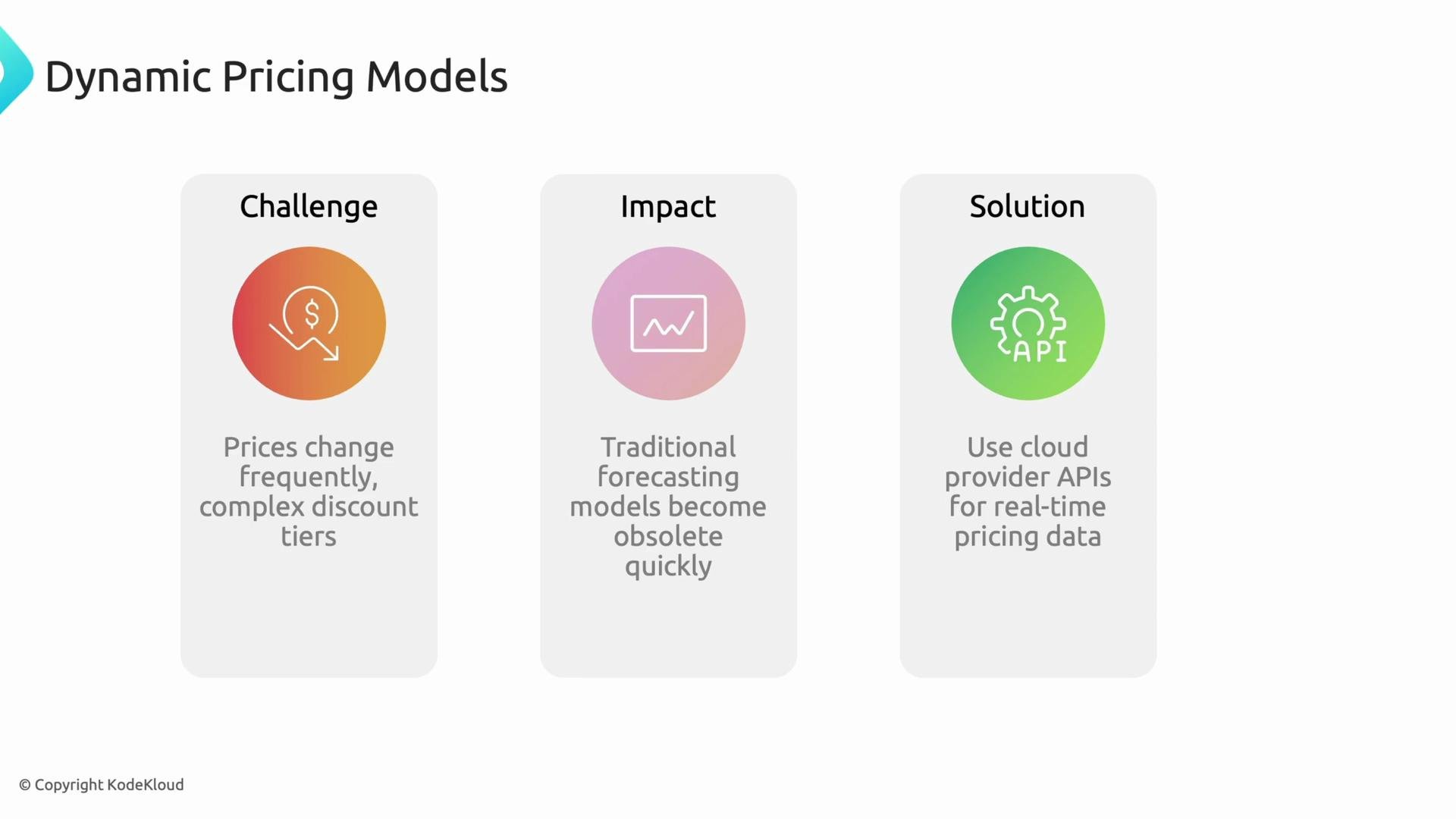
## Dynamic pricing models
Challenge
* Cloud providers change pricing frequently: new discounts, pricing tiers, and rate updates (sometimes with little notice).
Impact
* Static forecasting techniques—historical averages and fixed multipliers—lose accuracy quickly because pricing is a moving target.
Solution
* Integrate provider pricing APIs into your forecasting pipeline to ingest up-to-date unit prices. Treat pricing updates as a first-class input and surface them in forecast variance reports so teams can see whether cost changes came from usage or price shifts.
 Forecasting should evolve with the market and your infrastructure—not lag behind either.
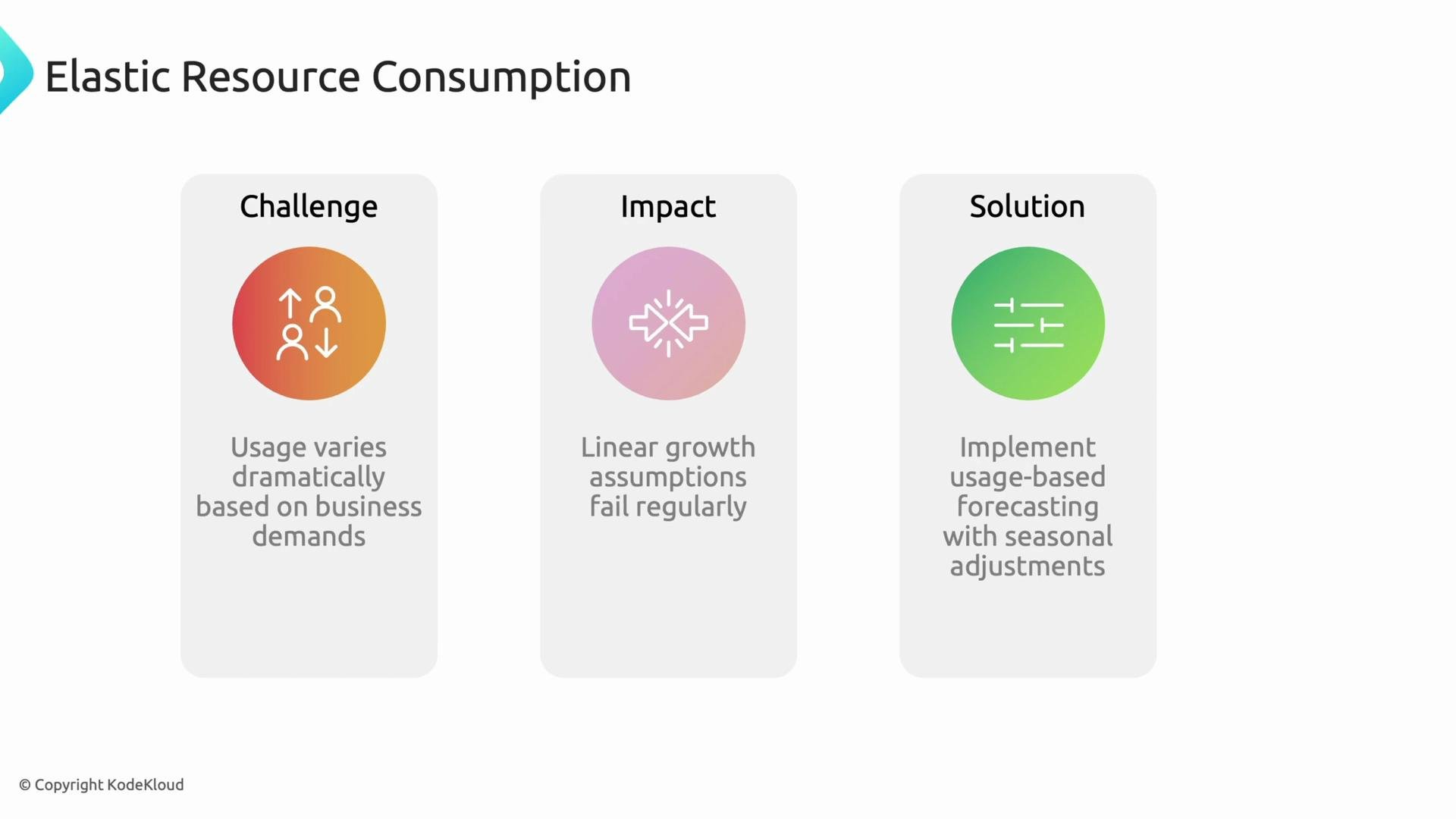
## Elastic resource consumption
Challenge
* Cloud consumption is elastic and driven by business activity. Usage spikes for launches, promotions, or seasonal demand and then reverts.
Impact
* Linear-growth assumptions produce large forecast errors. Consumption follows spikes, dips, and seasonality rather than steady ramps.
Solution
* Move to usage-driven forecasting that includes:
* Seasonal adjustments and calendar-aware models.
* Anomaly detection to identify one-offs vs. true trend shifts.
* Short-term signals (marketing calendars, release schedules) as model inputs so the forecast aligns with business initiatives.
Forecasting should evolve with the market and your infrastructure—not lag behind either.
## Elastic resource consumption
Challenge
* Cloud consumption is elastic and driven by business activity. Usage spikes for launches, promotions, or seasonal demand and then reverts.
Impact
* Linear-growth assumptions produce large forecast errors. Consumption follows spikes, dips, and seasonality rather than steady ramps.
Solution
* Move to usage-driven forecasting that includes:
* Seasonal adjustments and calendar-aware models.
* Anomaly detection to identify one-offs vs. true trend shifts.
* Short-term signals (marketing calendars, release schedules) as model inputs so the forecast aligns with business initiatives.
 Think of it like forecasting electricity: you account for weekdays vs weekends, seasonal demand, and single-event spikes.
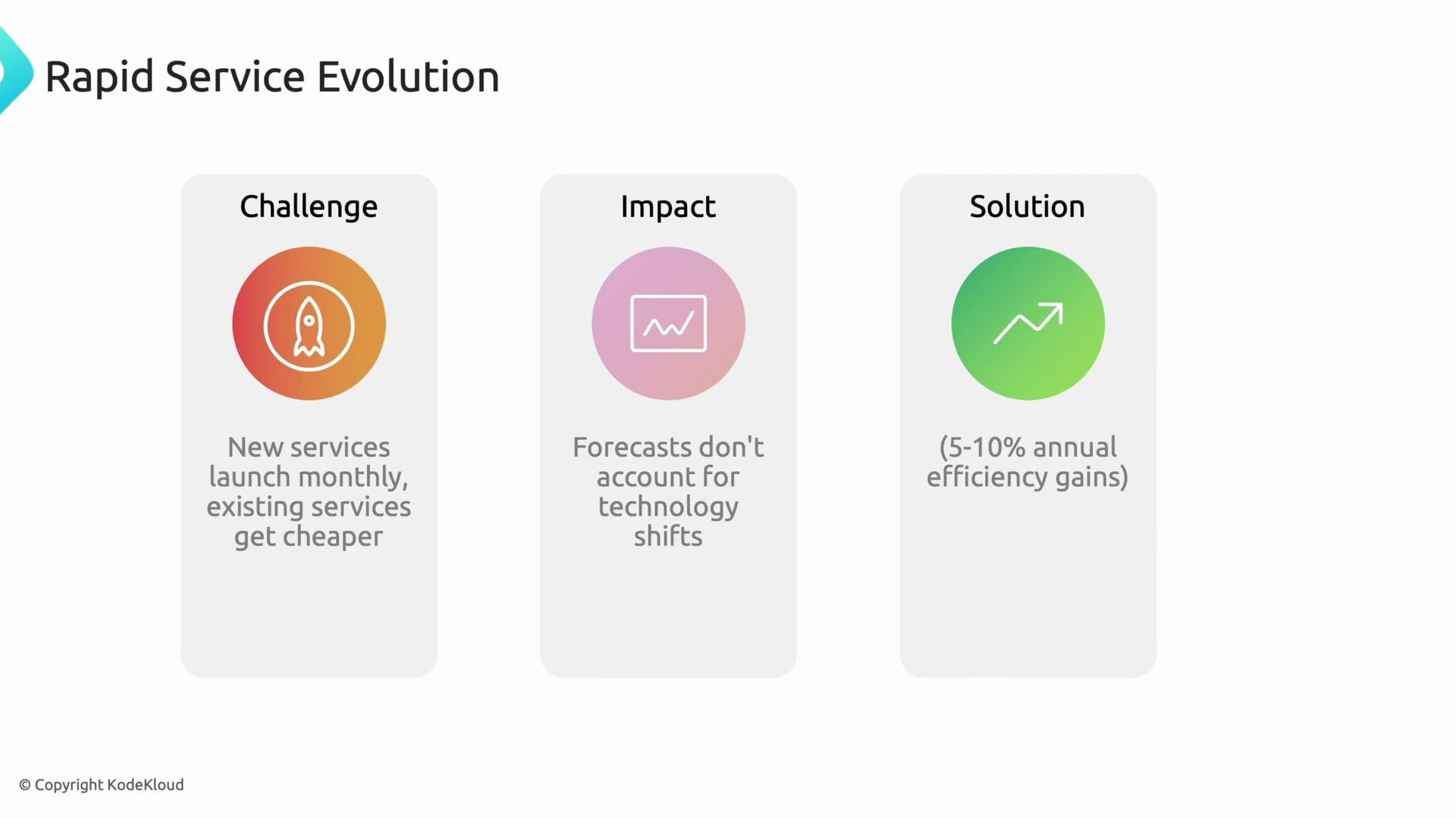
## Rapid service evolution
Challenge
* Cloud providers release new services and more efficient instance types often. These can displace older offerings and change cost profiles.
Impact
* Forecasts that ignore technology shifts miss savings opportunities or migration costs, producing biased projections.
Solution
* Include expected efficiency gains in forecasts (a reasonable heuristic: 5–10% per year) and perform periodic architecture reviews to evaluate migration paths to newer, cheaper services. Treat architectural change as an explicit forecast variable.
Think of it like forecasting electricity: you account for weekdays vs weekends, seasonal demand, and single-event spikes.
## Rapid service evolution
Challenge
* Cloud providers release new services and more efficient instance types often. These can displace older offerings and change cost profiles.
Impact
* Forecasts that ignore technology shifts miss savings opportunities or migration costs, producing biased projections.
Solution
* Include expected efficiency gains in forecasts (a reasonable heuristic: 5–10% per year) and perform periodic architecture reviews to evaluate migration paths to newer, cheaper services. Treat architectural change as an explicit forecast variable.
 Assume incremental efficiency improvements and validate them with engineering and architecture reviews.
## Quick reference: Challenges, impacts, and solutions
| Challenge | Impact on Forecasts | Practical Solutions |
| ---------------------------- | ----------------------------------------: | -------------------------------------------------------------------- |
| Dynamic pricing models | Historical models go stale quickly | Integrate cloud pricing APIs; surface price vs usage variance |
| Elastic resource consumption | Large errors from linear assumptions | Usage-based models, seasonality, anomaly detection, business signals |
| Rapid service evolution | Missed efficiency gains or migration cost | Bake in efficiency improvements; review architecture regularly |
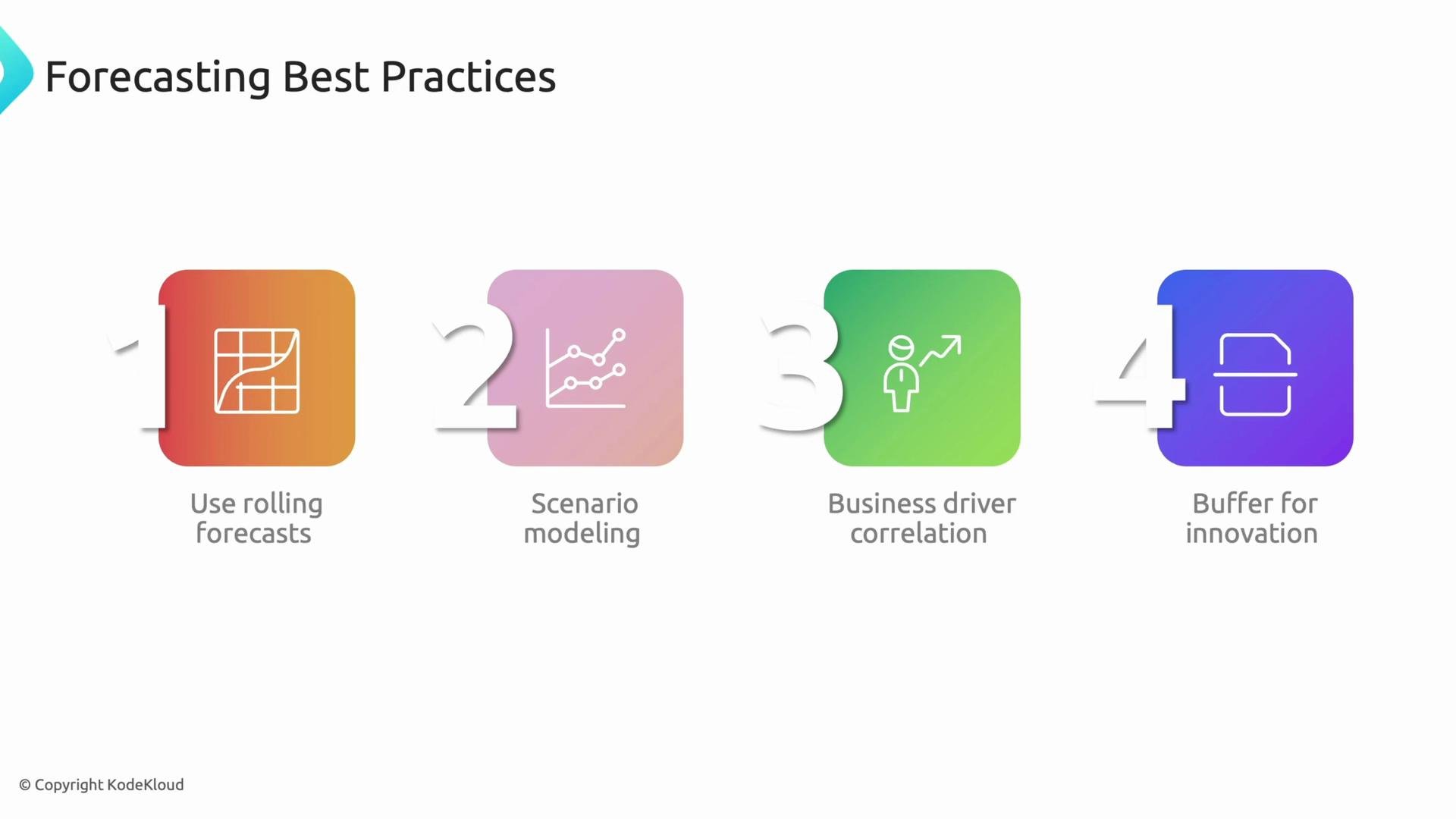
## Forecasting best practices
Adopt agile forecasting: update frequently, test scenarios, and tie forecasts to measurable business drivers so finance and engineering share the same signal.
* Rolling forecasts: Refresh forecasts weekly or monthly so they reflect current usage and pricing.
* Scenario-based modeling: Run what-if scenarios (e.g., traffic doubling, product launch, marketing blitz) to estimate spend ranges and prepare contingencies.
* Link to business drivers: Correlate forecasts to user growth, campaign schedules, release plans, and SLA requirements so inputs are explainable and actionable.
* Buffer for innovation: Reserve budget for experimentation and unexpected growth—clouds are flexible, and budgets should allow for that.
Assume incremental efficiency improvements and validate them with engineering and architecture reviews.
## Quick reference: Challenges, impacts, and solutions
| Challenge | Impact on Forecasts | Practical Solutions |
| ---------------------------- | ----------------------------------------: | -------------------------------------------------------------------- |
| Dynamic pricing models | Historical models go stale quickly | Integrate cloud pricing APIs; surface price vs usage variance |
| Elastic resource consumption | Large errors from linear assumptions | Usage-based models, seasonality, anomaly detection, business signals |
| Rapid service evolution | Missed efficiency gains or migration cost | Bake in efficiency improvements; review architecture regularly |
## Forecasting best practices
Adopt agile forecasting: update frequently, test scenarios, and tie forecasts to measurable business drivers so finance and engineering share the same signal.
* Rolling forecasts: Refresh forecasts weekly or monthly so they reflect current usage and pricing.
* Scenario-based modeling: Run what-if scenarios (e.g., traffic doubling, product launch, marketing blitz) to estimate spend ranges and prepare contingencies.
* Link to business drivers: Correlate forecasts to user growth, campaign schedules, release plans, and SLA requirements so inputs are explainable and actionable.
* Buffer for innovation: Reserve budget for experimentation and unexpected growth—clouds are flexible, and budgets should allow for that.
 These practices reinforce one core point: cloud forecasting needs agile, data-driven methods—not annual, static IT budgeting.
## Summary and next steps
Cloud forecasting is difficult because three moving pieces interact: pricing, consumption patterns, and product evolution. The practical response is:
* Automate pricing ingestion from providers,
* Model usage with seasonal and scenario-aware approaches, and
* Include reasonable efficiency gains in near-term projections and validate them with engineering.
A related subject is commitment-based discounts (Reserved Instances, Savings Plans). These can reduce risk and lower costs but introduce commitment complexity that must be reflected in forecasts and governance.
Commitments (e.g., RIs, Savings Plans) reduce unit costs but add forecast and execution risk. Model commitments explicitly, track utilization, and maintain a governance process for purchasing and unwinding commitments.
Next steps:
* Start by ingesting pricing and usage into a single analytics layer.
* Build rolling forecasts tied to business calendars and signals.
* Run scenarios and report ranges (best/most/least likely) to stakeholders.
* Use forecasts to inform commitment decisions and optimization efforts.
## Links and references
* [FinOps Foundation](https://www.finops.org/)
* [Cloud Pricing APIs — AWS, GCP, Azure](https://cloud.google.com/billing/docs/reference/rest) (example: provider pricing endpoints)
* [Seasonality and Anomaly Detection Techniques](https://en.wikipedia.org/wiki/Seasonality)
That's it for this lesson.
These practices reinforce one core point: cloud forecasting needs agile, data-driven methods—not annual, static IT budgeting.
## Summary and next steps
Cloud forecasting is difficult because three moving pieces interact: pricing, consumption patterns, and product evolution. The practical response is:
* Automate pricing ingestion from providers,
* Model usage with seasonal and scenario-aware approaches, and
* Include reasonable efficiency gains in near-term projections and validate them with engineering.
A related subject is commitment-based discounts (Reserved Instances, Savings Plans). These can reduce risk and lower costs but introduce commitment complexity that must be reflected in forecasts and governance.
Commitments (e.g., RIs, Savings Plans) reduce unit costs but add forecast and execution risk. Model commitments explicitly, track utilization, and maintain a governance process for purchasing and unwinding commitments.
Next steps:
* Start by ingesting pricing and usage into a single analytics layer.
* Build rolling forecasts tied to business calendars and signals.
* Run scenarios and report ranges (best/most/least likely) to stakeholders.
* Use forecasts to inform commitment decisions and optimization efforts.
## Links and references
* [FinOps Foundation](https://www.finops.org/)
* [Cloud Pricing APIs — AWS, GCP, Azure](https://cloud.google.com/billing/docs/reference/rest) (example: provider pricing endpoints)
* [Seasonality and Anomaly Detection Techniques](https://en.wikipedia.org/wiki/Seasonality)
That's it for this lesson.