> ## Documentation Index
> Fetch the complete documentation index at: https://notes.kodekloud.com/llms.txt
> Use this file to discover all available pages before exploring further.
# Fault Injection
> Explains Istio fault injection for testing microservice resilience by injecting delays and aborts, configuring VirtualService rules, examples, best practices and safety precautions.
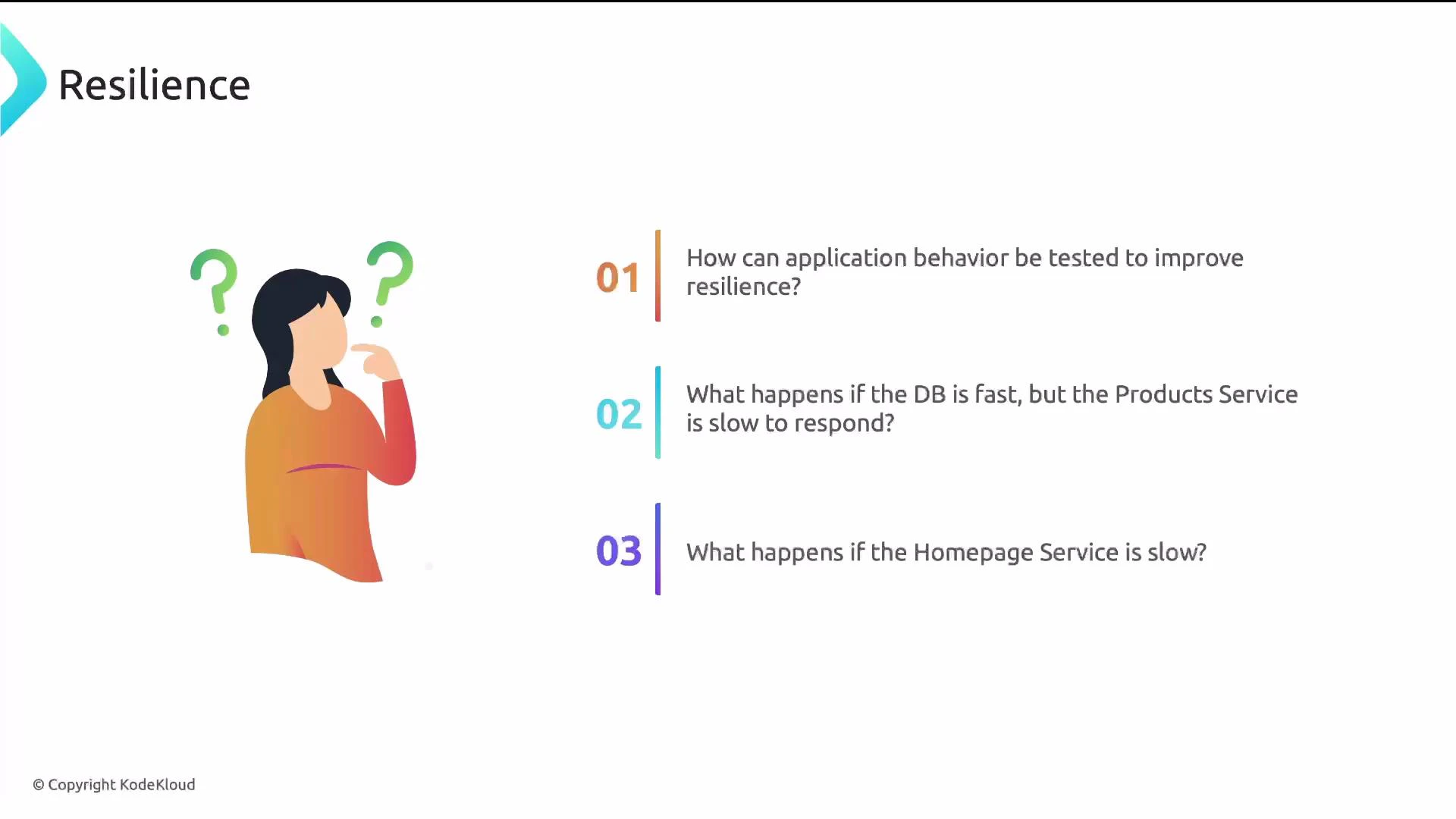
Circuit breaking and fault injection are essential resilience techniques for microservices. Fault injection lets you safely simulate downstream failures—such as slow databases or unresponsive services—so you can validate how your system behaves and recovers before real incidents occur.
What happens if the product service is slow to respond? What if the homepage service starts returning errors? These are important scenarios to test when hardening your architecture for production.
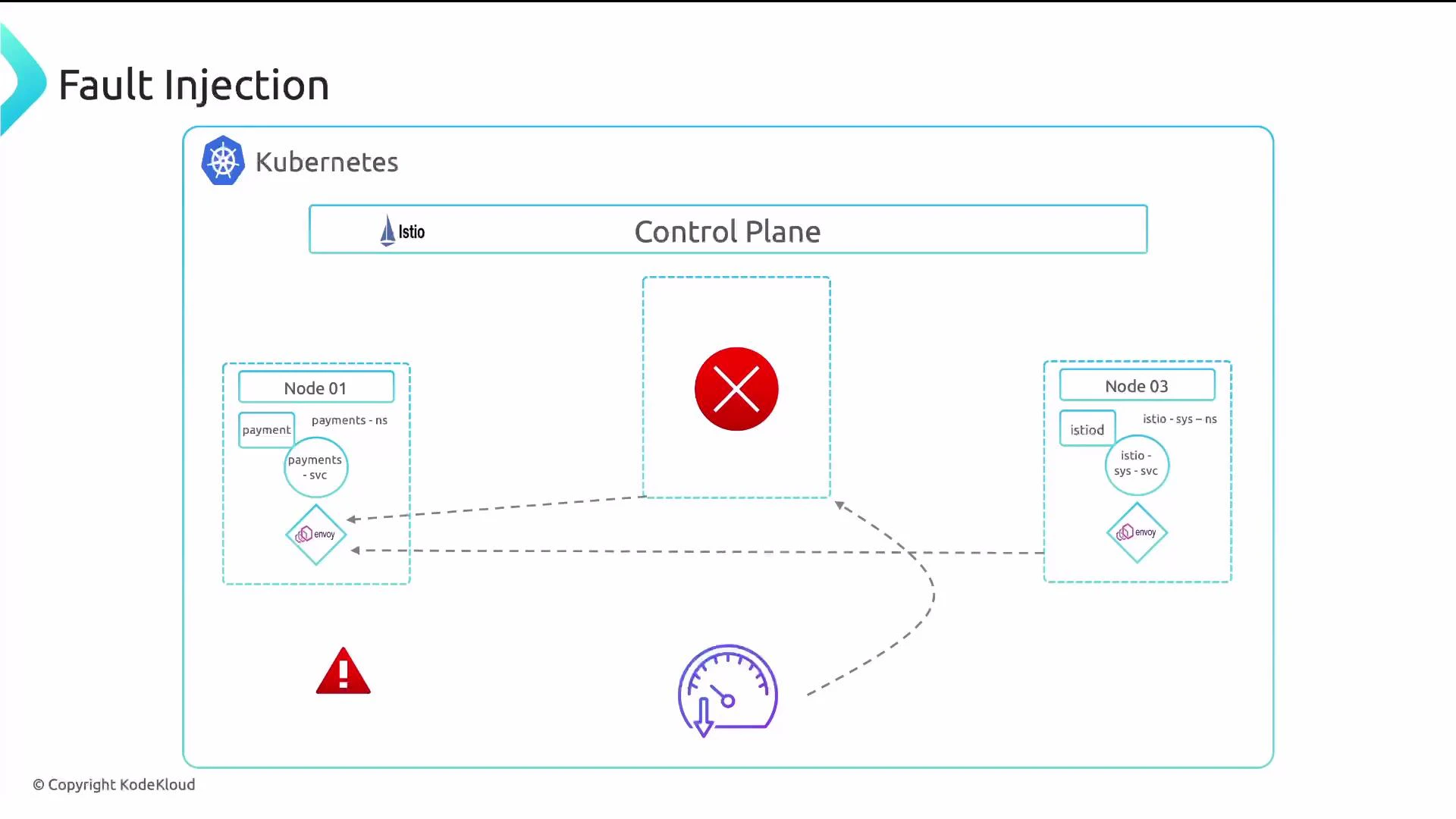
 If your organization runs periodic fire drills to prepare people for emergencies, fault injection in an Istio service mesh is the equivalent for your microservices: intentionally inject delays or errors between services to observe real application behavior and validate recovery strategies.
 Why use fault injection?
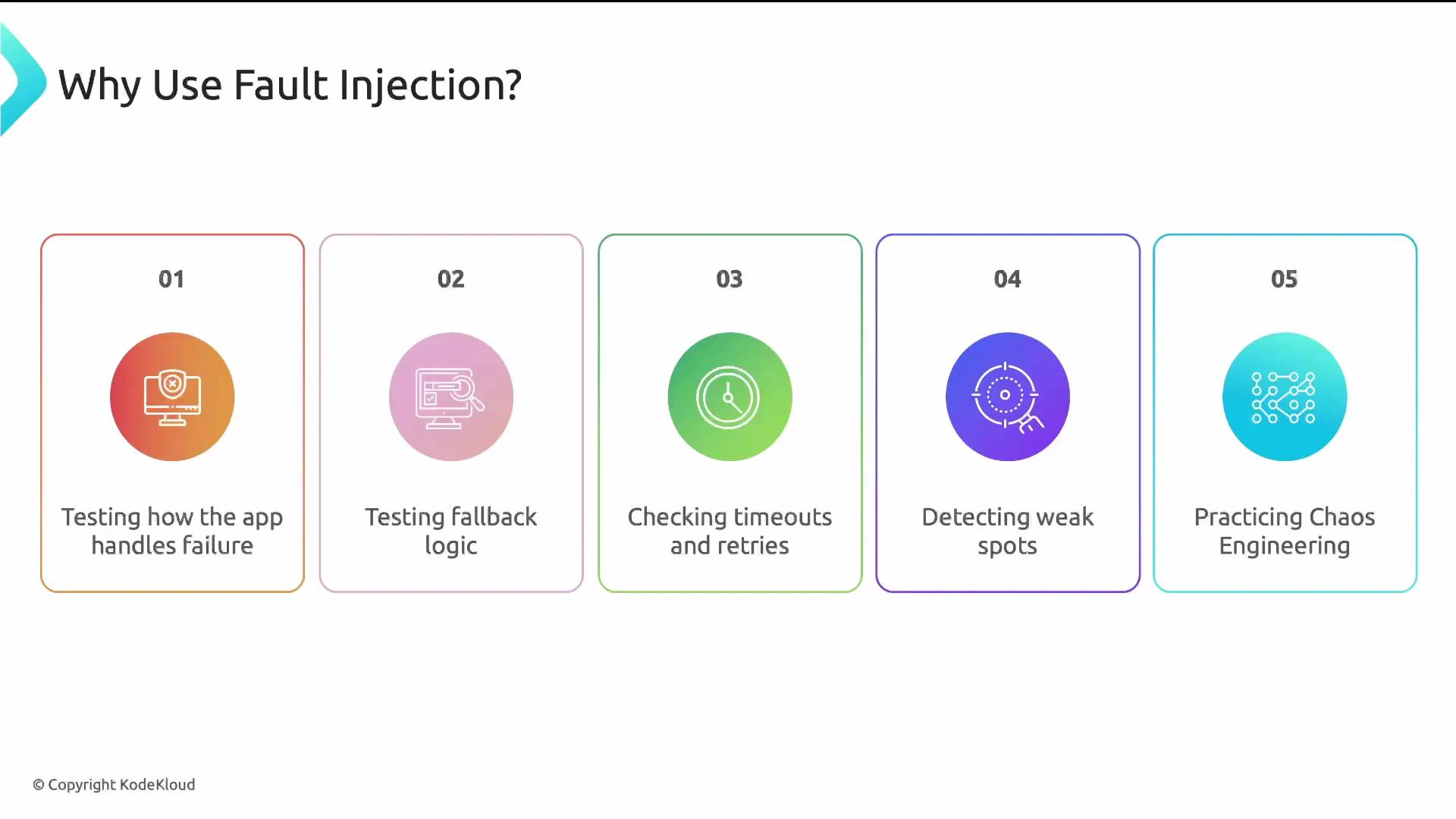
* Validate how applications respond to slow or failing dependencies.
* Test fallback logic and ensure graceful degradation (e.g., return cached results, use a backup service, or return a friendly error).
* Ensure timeouts and retry policies prevent cascading failures.
* Detect bugs, misconfigurations, and missing error handling early in the CI/CD pipeline.
* Build confidence in resilience through repeatable experiments (chaos engineering). A well-known example is Netflix’s Chaos Monkey.
Why use fault injection?
* Validate how applications respond to slow or failing dependencies.
* Test fallback logic and ensure graceful degradation (e.g., return cached results, use a backup service, or return a friendly error).
* Ensure timeouts and retry policies prevent cascading failures.
* Detect bugs, misconfigurations, and missing error handling early in the CI/CD pipeline.
* Build confidence in resilience through repeatable experiments (chaos engineering). A well-known example is Netflix’s Chaos Monkey.
 Fault injection provides a safe, repeatable way to validate reliability, fallbacks, and recovery strategies before a real outage occurs.
How Istio configures fault injection
Fault injection is not a separate Istio resource. Instead, you configure faults inside a VirtualService using the `fault` section on `http` routes. The two primary types are:
* Delay: injects artificial latency (e.g., `fixedDelay: 5s`) for a percentage of requests.
* Abort: returns an HTTP error code (e.g., `httpStatus: 400`) or a gRPC status for a percentage of requests.
Table: quick comparison
| Fault Type | Purpose | Key fields | Typical use |
| ---------- | -------------------------- | ------------------------------------------------------------------------ | ------------------------------------------------------------- |
| Delay | Simulate increased latency | `fault.delay.fixedDelay`, `percentage.value` | Test timeouts, circuit breakers, and slow downstream services |
| Abort | Simulate error responses | `fault.abort.httpStatus` or `fault.abort.grpcStatus`, `percentage.value` | Test error handling, fallbacks, and retry logic |
Example: inject a 5-second delay for 100% of requests to `app-svc` in the `frontend` namespace:
```yaml theme={null}
apiVersion: networking.istio.io/v1
kind: VirtualService
metadata:
name: app-vs
namespace: frontend
spec:
hosts:
- app-svc
http:
- fault:
delay:
percentage:
value: 100.0
fixedDelay: 5s
route:
- destination:
host: app-svc.frontend.svc.cluster.local
port:
number: 80
subset: v1
```
Example: abort 50% of requests with HTTP 400 to test client error handling:
```yaml theme={null}
apiVersion: networking.istio.io/v1
kind: VirtualService
metadata:
name: app-vs-abort
namespace: frontend
spec:
hosts:
- app-svc
http:
- fault:
abort:
percentage:
value: 50.0
httpStatus: 400
route:
- destination:
host: app-svc.frontend.svc.cluster.local
port:
number: 80
subset: v1
```
Additional common scenarios
* Abort a small percentage to simulate intermittent client errors.
* Inject delays only for traffic from specific sources (e.g., production labeled traffic) to limit blast radius.
Examples:
* `ratings-route`: abort 10% of requests with HTTP 400.
* `reviews-route`: inject a 5-second delay for 10% of requests coming from sources labeled `env: prod`.
```yaml theme={null}
apiVersion: networking.istio.io/v1
kind: VirtualService
metadata:
name: ratings-route
spec:
hosts:
- ratings.prod.svc.cluster.local
http:
- route:
- destination:
host: ratings.prod.svc.cluster.local
subset: v1
fault:
abort:
percentage:
value: 10.0
httpStatus: 400
```
```yaml theme={null}
apiVersion: networking.istio.io/v1
kind: VirtualService
metadata:
name: reviews-route
spec:
hosts:
- reviews.prod.svc.cluster.local
http:
- match:
- sourceLabels:
env: prod
route:
- destination:
host: reviews.prod.svc.cluster.local
subset: v1
fault:
delay:
percentage:
value: 10.0
fixedDelay: 5s
```
Important notes
* Use `percentage.value` to control the blast radius. Start small (e.g., 1–5%) when testing in production-like environments.
* Combine fault injection with observability (metrics, logs, tracing) so you can measure impact and validate fallback behavior.
* Prefer targeted matches (source labels, headers, or subsets) to limit scope.
Be careful when running fault injection in production. Always limit the impact with percentage-based targeting, source filters, and monitoring. Do not enable broad, 100% faults against critical services without coordinated rollback plans.
For more details, examples, and edge-case behaviors, see the official Istio documentation:
* Istio Fault Injection: [https://istio.io/latest/docs/tasks/traffic-management/fault-injection/](https://istio.io/latest/docs/tasks/traffic-management/fault-injection/)
* Chaos engineering inspiration: Netflix Chaos Monkey — [https://netflix.github.io/chaosmonkey/](https://netflix.github.io/chaosmonkey/)
Let's head over to a demo.
Fault injection provides a safe, repeatable way to validate reliability, fallbacks, and recovery strategies before a real outage occurs.
How Istio configures fault injection
Fault injection is not a separate Istio resource. Instead, you configure faults inside a VirtualService using the `fault` section on `http` routes. The two primary types are:
* Delay: injects artificial latency (e.g., `fixedDelay: 5s`) for a percentage of requests.
* Abort: returns an HTTP error code (e.g., `httpStatus: 400`) or a gRPC status for a percentage of requests.
Table: quick comparison
| Fault Type | Purpose | Key fields | Typical use |
| ---------- | -------------------------- | ------------------------------------------------------------------------ | ------------------------------------------------------------- |
| Delay | Simulate increased latency | `fault.delay.fixedDelay`, `percentage.value` | Test timeouts, circuit breakers, and slow downstream services |
| Abort | Simulate error responses | `fault.abort.httpStatus` or `fault.abort.grpcStatus`, `percentage.value` | Test error handling, fallbacks, and retry logic |
Example: inject a 5-second delay for 100% of requests to `app-svc` in the `frontend` namespace:
```yaml theme={null}
apiVersion: networking.istio.io/v1
kind: VirtualService
metadata:
name: app-vs
namespace: frontend
spec:
hosts:
- app-svc
http:
- fault:
delay:
percentage:
value: 100.0
fixedDelay: 5s
route:
- destination:
host: app-svc.frontend.svc.cluster.local
port:
number: 80
subset: v1
```
Example: abort 50% of requests with HTTP 400 to test client error handling:
```yaml theme={null}
apiVersion: networking.istio.io/v1
kind: VirtualService
metadata:
name: app-vs-abort
namespace: frontend
spec:
hosts:
- app-svc
http:
- fault:
abort:
percentage:
value: 50.0
httpStatus: 400
route:
- destination:
host: app-svc.frontend.svc.cluster.local
port:
number: 80
subset: v1
```
Additional common scenarios
* Abort a small percentage to simulate intermittent client errors.
* Inject delays only for traffic from specific sources (e.g., production labeled traffic) to limit blast radius.
Examples:
* `ratings-route`: abort 10% of requests with HTTP 400.
* `reviews-route`: inject a 5-second delay for 10% of requests coming from sources labeled `env: prod`.
```yaml theme={null}
apiVersion: networking.istio.io/v1
kind: VirtualService
metadata:
name: ratings-route
spec:
hosts:
- ratings.prod.svc.cluster.local
http:
- route:
- destination:
host: ratings.prod.svc.cluster.local
subset: v1
fault:
abort:
percentage:
value: 10.0
httpStatus: 400
```
```yaml theme={null}
apiVersion: networking.istio.io/v1
kind: VirtualService
metadata:
name: reviews-route
spec:
hosts:
- reviews.prod.svc.cluster.local
http:
- match:
- sourceLabels:
env: prod
route:
- destination:
host: reviews.prod.svc.cluster.local
subset: v1
fault:
delay:
percentage:
value: 10.0
fixedDelay: 5s
```
Important notes
* Use `percentage.value` to control the blast radius. Start small (e.g., 1–5%) when testing in production-like environments.
* Combine fault injection with observability (metrics, logs, tracing) so you can measure impact and validate fallback behavior.
* Prefer targeted matches (source labels, headers, or subsets) to limit scope.
Be careful when running fault injection in production. Always limit the impact with percentage-based targeting, source filters, and monitoring. Do not enable broad, 100% faults against critical services without coordinated rollback plans.
For more details, examples, and edge-case behaviors, see the official Istio documentation:
* Istio Fault Injection: [https://istio.io/latest/docs/tasks/traffic-management/fault-injection/](https://istio.io/latest/docs/tasks/traffic-management/fault-injection/)
* Chaos engineering inspiration: Netflix Chaos Monkey — [https://netflix.github.io/chaosmonkey/](https://netflix.github.io/chaosmonkey/)
Let's head over to a demo.