> ## Documentation Index
> Fetch the complete documentation index at: https://notes.kodekloud.com/llms.txt
> Use this file to discover all available pages before exploring further.
# Summary
> Overview of Istio traffic management concepts including sidecars, mTLS, VirtualService and DestinationRule roles, mirroring, circuit breaking, egress control, and waypoint proxies
Well done — that was a long module. Here’s a compact, organized recap of the Istio traffic-management concepts you learned, with guidance about where to place configuration and what to expect on the exam.
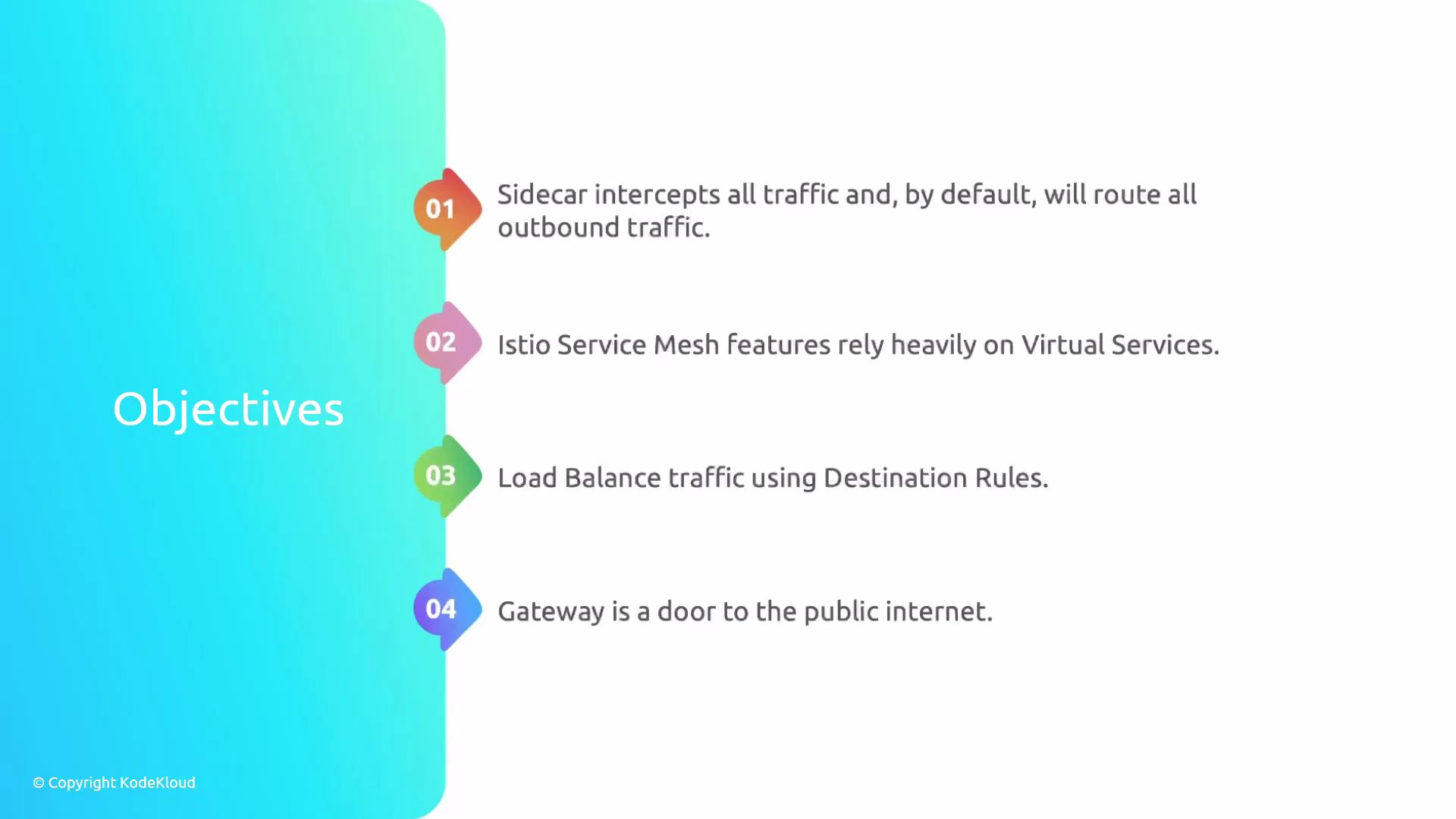
* Sidecar proxy: intercepts inbound and outbound traffic for a workload. By default it can route all outbound traffic. Use a `Sidecar` resource to restrict egress and limit which services a workload may reach.
* Mutual TLS (mTLS): enable mesh-wide or namespace/workload-level mTLS with `PeerAuthentication` and `mode: STRICT`.
* VirtualService: controls runtime routing behavior — retries, timeouts, traffic mirroring/shadowing, fault injection (delays/aborts), and routing rules (weights, headers).
* DestinationRule: complements VirtualService by defining subsets, load-balancing policy, connection pools, and circuit-breaking/outlier detection.
* EgressGateway and ServiceEntry: control traffic leaving the mesh and allow external services to be part of the service registry so policies and telemetry apply.
Below is a small example for enabling strict mTLS in a namespace:
```yaml theme={null}
apiVersion: security.istio.io/v1beta1
kind: PeerAuthentication
metadata:
name: namespace-strict
namespace: my-namespace
spec:
mtls:
mode: STRICT
```
 ## VirtualService vs DestinationRule — what goes where
Use VirtualService to express how requests should be routed and manipulated at runtime:
* Traffic splitting (weights), header-based routing, path rewrites.
* Fault injection (delays, aborts), retries, timeouts, and mirroring via the `mirror` field.
Use DestinationRule to configure destination behavior:
* Define `subsets` (e.g., v1, v2) that VirtualService can target.
* Set `trafficPolicy` for load balancing, connection pools, and circuit breakers (outlier detection, max connections, max pending requests).
Table: quick mapping of Istio resource responsibilities
| Resource | Primary Responsibility | Example / Notes |
| -------------------: | ----------------------------------------------------------- | --------------------------------------------------------------- |
| `VirtualService` | Routing, fault injection, retries, timeouts, mirroring | Use `mirror` to shadow traffic to a candidate service |
| `DestinationRule` | Subsets, load balancing, connection pools, circuit breaking | `trafficPolicy.connectionPool` and `outlierDetection` live here |
| `PeerAuthentication` | mTLS enforcement | `mode: STRICT` enforces mTLS for target workloads/namespaces |
| `Sidecar` | Limit egress and configure proxy scope for workloads | Controls which services the sidecar can reach |
| `ServiceEntry` | Add external services to Istio service registry | Required to apply policies/telemetry to external endpoints |
| `EgressGateway` | Centralized control of outbound traffic | Useful when you must inspect, filter, or monitor egress traffic |
## VirtualService vs DestinationRule — what goes where
Use VirtualService to express how requests should be routed and manipulated at runtime:
* Traffic splitting (weights), header-based routing, path rewrites.
* Fault injection (delays, aborts), retries, timeouts, and mirroring via the `mirror` field.
Use DestinationRule to configure destination behavior:
* Define `subsets` (e.g., v1, v2) that VirtualService can target.
* Set `trafficPolicy` for load balancing, connection pools, and circuit breakers (outlier detection, max connections, max pending requests).
Table: quick mapping of Istio resource responsibilities
| Resource | Primary Responsibility | Example / Notes |
| -------------------: | ----------------------------------------------------------- | --------------------------------------------------------------- |
| `VirtualService` | Routing, fault injection, retries, timeouts, mirroring | Use `mirror` to shadow traffic to a candidate service |
| `DestinationRule` | Subsets, load balancing, connection pools, circuit breaking | `trafficPolicy.connectionPool` and `outlierDetection` live here |
| `PeerAuthentication` | mTLS enforcement | `mode: STRICT` enforces mTLS for target workloads/namespaces |
| `Sidecar` | Limit egress and configure proxy scope for workloads | Controls which services the sidecar can reach |
| `ServiceEntry` | Add external services to Istio service registry | Required to apply policies/telemetry to external endpoints |
| `EgressGateway` | Centralized control of outbound traffic | Useful when you must inspect, filter, or monitor egress traffic |
 ## Mirroring, circuit breaking, and egress
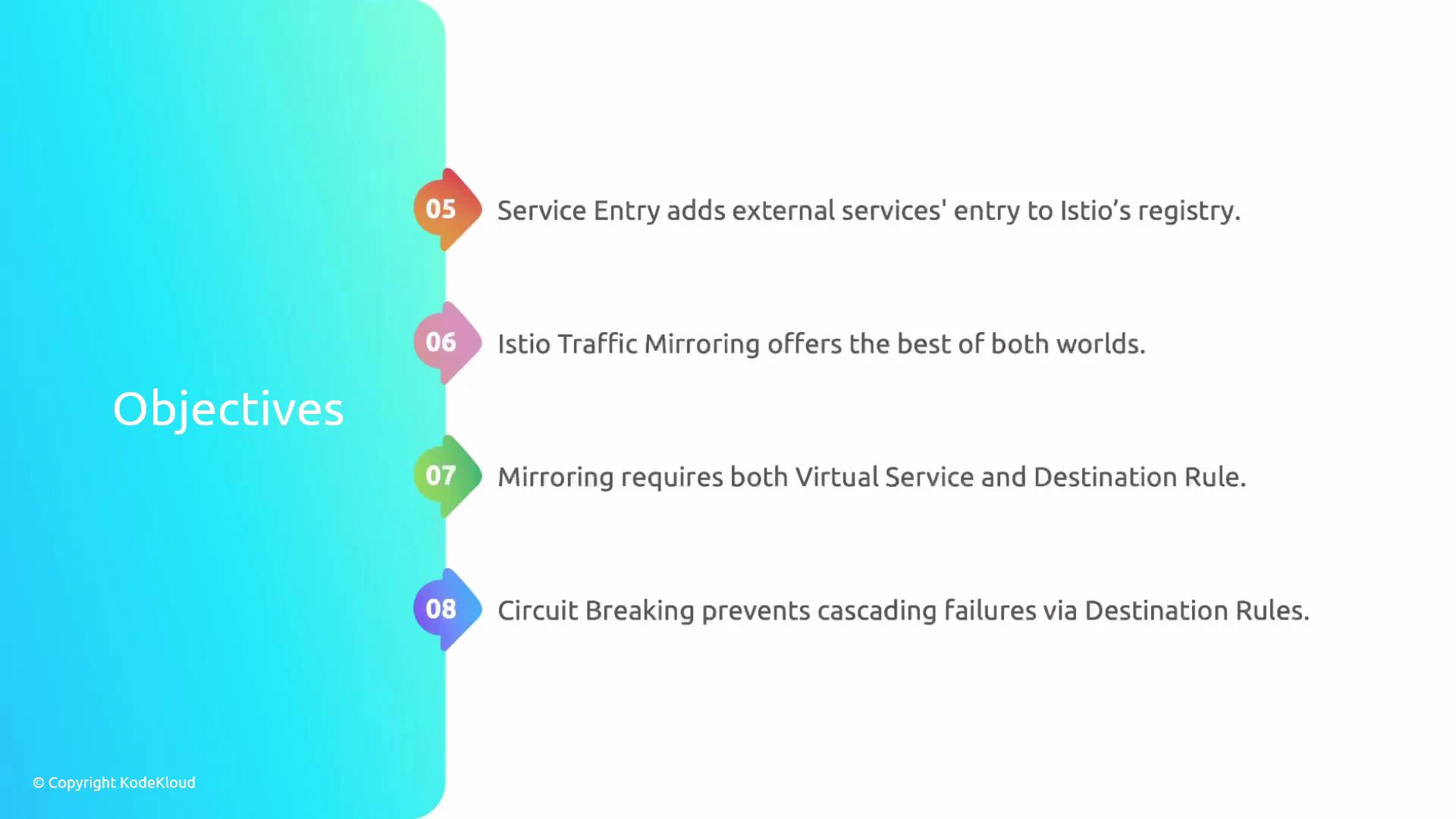
* Traffic mirroring (also called traffic shadowing) lets you send a copy of production traffic to a candidate service without affecting responses to users. Configure mirroring in the `VirtualService` using the `mirror` field; destination subsets can be defined in a `DestinationRule` if needed.
* Circuit breaking prevents cascading failures. Configure limits such as `maxConnections`, `maxPendingRequests`, and `outlierDetection` in a `DestinationRule` under `trafficPolicy`.
* To observe and control traffic leaving the mesh, use an `EgressGateway`. To bring an external service under Istio control (policies, telemetry), create a `ServiceEntry`.
## Connection limits, rate limiting, and fault injection
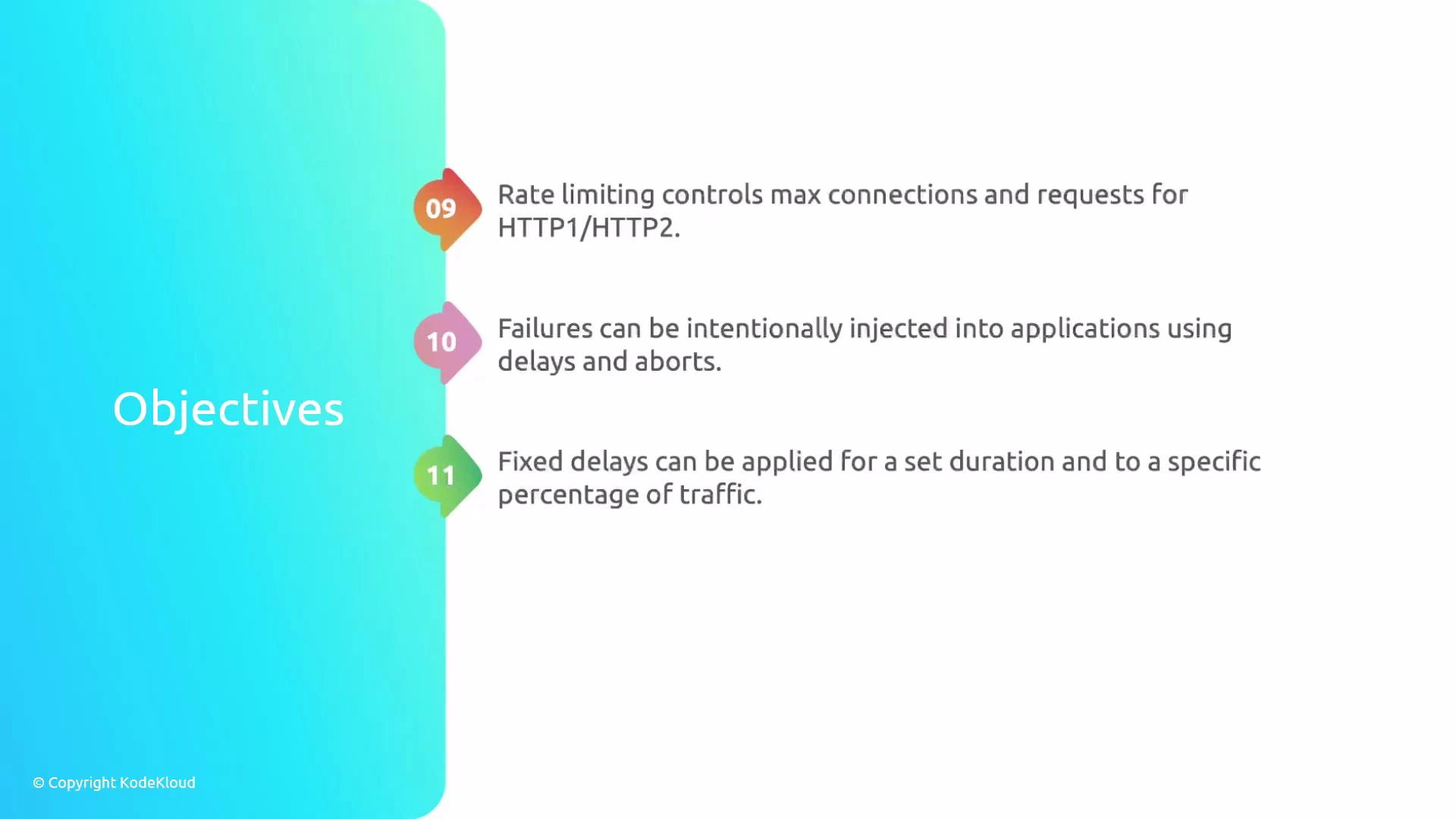
* Connection limits live in `DestinationRule` under `trafficPolicy.connectionPool`. Examples:
* `tcp.maxConnections`
* `http.http2MaxRequests`
* `http.http1MaxPendingRequests` (for HTTP/1)
* Request-rate limiting is typically implemented via Envoy rate-limit filters or an external rate-limit service integrated via Envoy filters — not directly via VirtualService/DestinationRule fields.
* Fault injection belongs to `VirtualService`. You can:
* Inject fixed delays (seconds) for a given percentage of traffic.
* Abort requests with a specified HTTP status code for some traffic percentage.
## Mirroring, circuit breaking, and egress
* Traffic mirroring (also called traffic shadowing) lets you send a copy of production traffic to a candidate service without affecting responses to users. Configure mirroring in the `VirtualService` using the `mirror` field; destination subsets can be defined in a `DestinationRule` if needed.
* Circuit breaking prevents cascading failures. Configure limits such as `maxConnections`, `maxPendingRequests`, and `outlierDetection` in a `DestinationRule` under `trafficPolicy`.
* To observe and control traffic leaving the mesh, use an `EgressGateway`. To bring an external service under Istio control (policies, telemetry), create a `ServiceEntry`.
## Connection limits, rate limiting, and fault injection
* Connection limits live in `DestinationRule` under `trafficPolicy.connectionPool`. Examples:
* `tcp.maxConnections`
* `http.http2MaxRequests`
* `http.http1MaxPendingRequests` (for HTTP/1)
* Request-rate limiting is typically implemented via Envoy rate-limit filters or an external rate-limit service integrated via Envoy filters — not directly via VirtualService/DestinationRule fields.
* Fault injection belongs to `VirtualService`. You can:
* Inject fixed delays (seconds) for a given percentage of traffic.
* Abort requests with a specified HTTP status code for some traffic percentage.
 ## Waypoint proxies and HTTPRoute (brief)
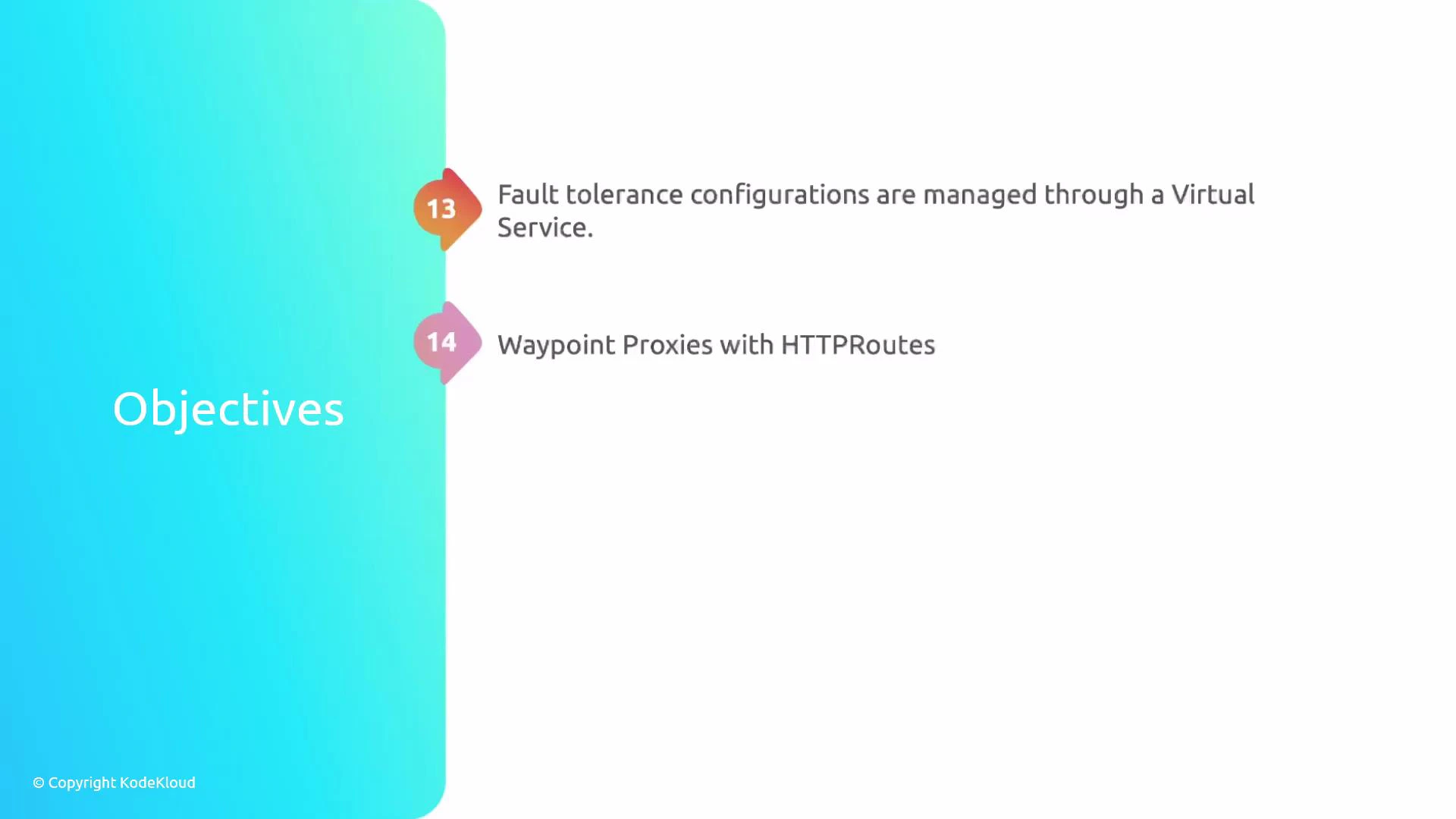
* Waypoint proxies provide a single, centralized hop for traffic entering or leaving a namespace. They are often used in larger deployments for observability and policy enforcement.
* HTTPRoute (part of the Gateway API) can be used for advanced routing scenarios alongside waypoint proxies.
* For exam-level coverage ([ICA exam course](/user/courses/istio-service-mesh) or the KodeKloud course referenced in the module), you may only be asked to install and label namespaces or waypoint proxy namespaces to opt-in. Make sure to:
* Label namespaces appropriately when using ambient mode.
* Install and label waypoint-proxy namespaces when opting workloads into waypoint behavior.
## Waypoint proxies and HTTPRoute (brief)
* Waypoint proxies provide a single, centralized hop for traffic entering or leaving a namespace. They are often used in larger deployments for observability and policy enforcement.
* HTTPRoute (part of the Gateway API) can be used for advanced routing scenarios alongside waypoint proxies.
* For exam-level coverage ([ICA exam course](/user/courses/istio-service-mesh) or the KodeKloud course referenced in the module), you may only be asked to install and label namespaces or waypoint proxy namespaces to opt-in. Make sure to:
* Label namespaces appropriately when using ambient mode.
* Install and label waypoint-proxy namespaces when opting workloads into waypoint behavior.
 Great work completing this module — take a break, you’ve earned it.
Tip: For exam prep and practical use, memorize where each behavior belongs: VirtualService for routing/faults/mirroring, DestinationRule for subsets/circuit-breaking/connection pools, PeerAuthentication for mTLS, and Sidecar for egress scoping.
I’ll see you in the next section.
Great work completing this module — take a break, you’ve earned it.
Tip: For exam prep and practical use, memorize where each behavior belongs: VirtualService for routing/faults/mirroring, DestinationRule for subsets/circuit-breaking/connection pools, PeerAuthentication for mTLS, and Sidecar for egress scoping.
I’ll see you in the next section.