> ## Documentation Index
> Fetch the complete documentation index at: https://notes.kodekloud.com/llms.txt
> Use this file to discover all available pages before exploring further.
# Section Introduction
> Explains Kyverno policy exceptions to allow scoped, auditable exceptions for workloads while preserving cluster security, with examples and best practices.
You can enforce cluster policies using Kyverno's `validate`, `mutate`, and `generate` rules. In practice, though, there are always exceptions—applications or third‑party tools that legitimately cannot comply with a rule. Kyverno provides a built‑in mechanism to handle those cases: policy exceptions.
This lesson explains Kyverno policy exceptions and demonstrates a safe, auditable workflow to allow exceptional workloads without weakening cluster security.
Alex's story: a real-world example
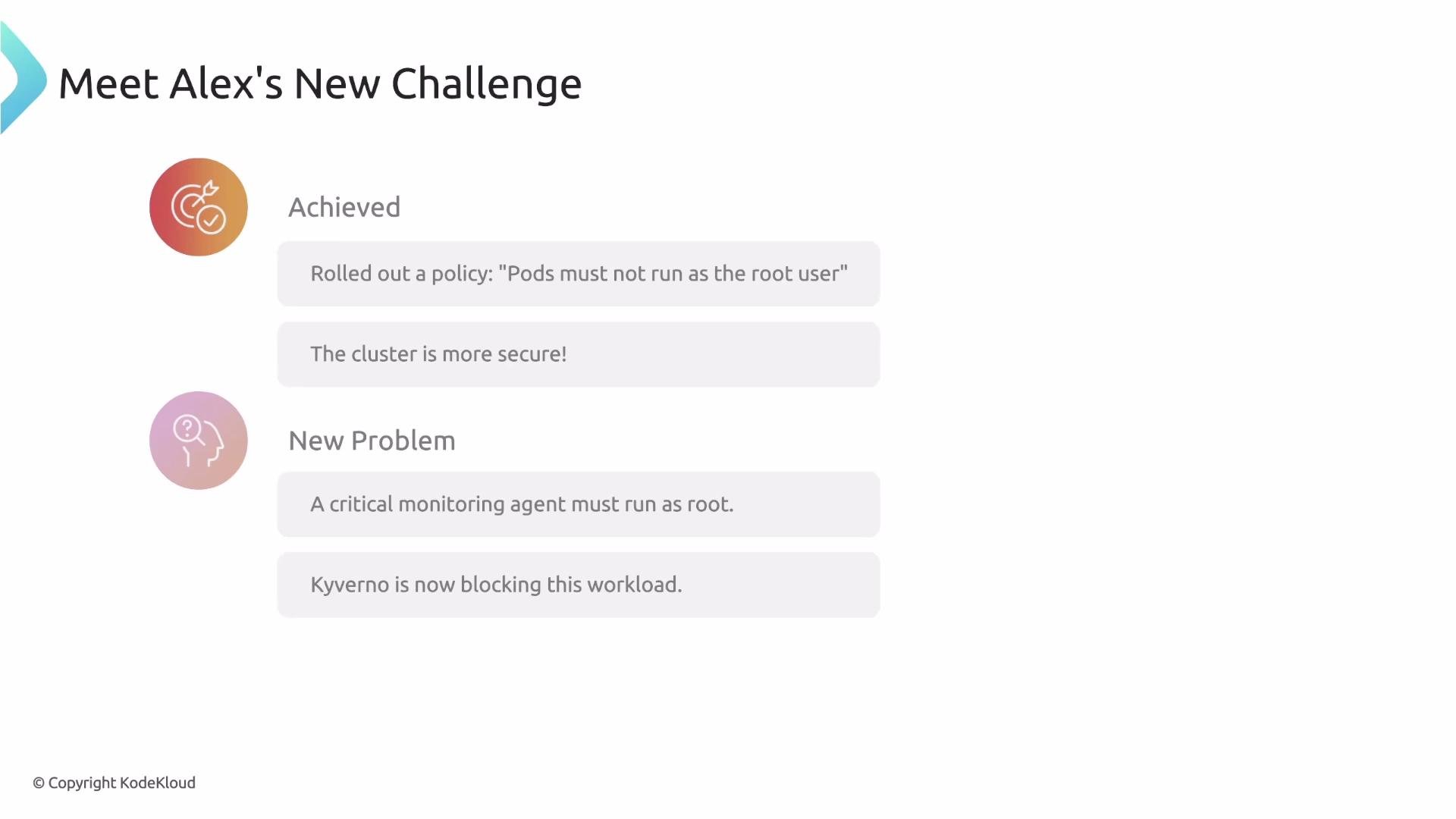
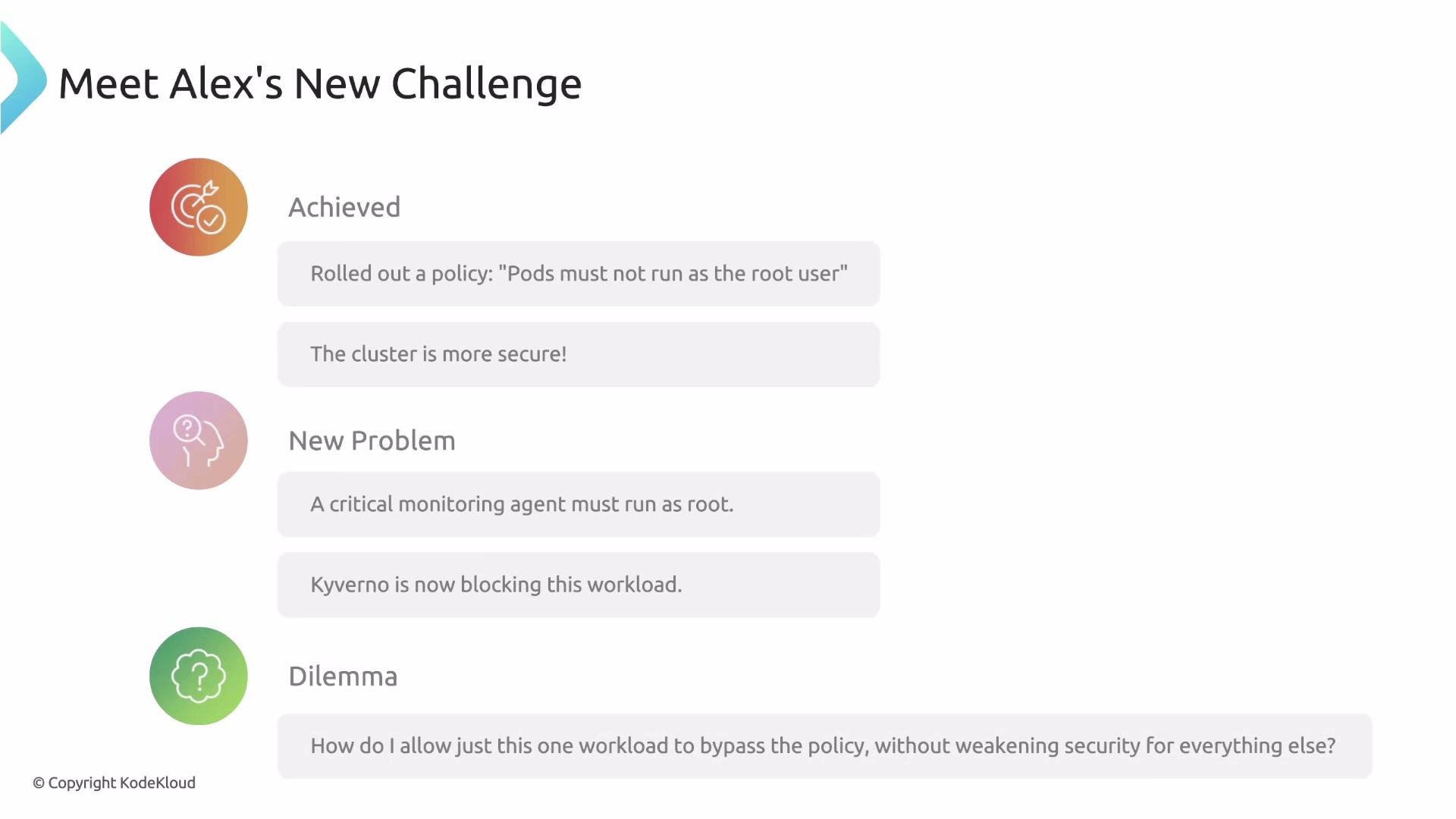
* Alex implemented a `validate` rule to ensure all new Pods run as a non‑root user — a common and important security best practice.
* The security team is happy and the cluster is locked down.
* Then the operations team needs to deploy a high‑priority monitoring agent (Alloy). The agent is a third‑party binary Alex cannot modify and it requires root privileges to operate.
* Because of the `validate` rule, Kyverno blocks the workload. Alex cannot change the agent, and he must avoid disabling the policy cluster‑wide.
 Temporarily disabling the policy to allow the agent is an option — but it introduces a security gap and is error‑prone. Policy exceptions provide a better approach: allow a narrowly scoped exception that is auditable and does not weaken the policy for other workloads.
 What this section covers
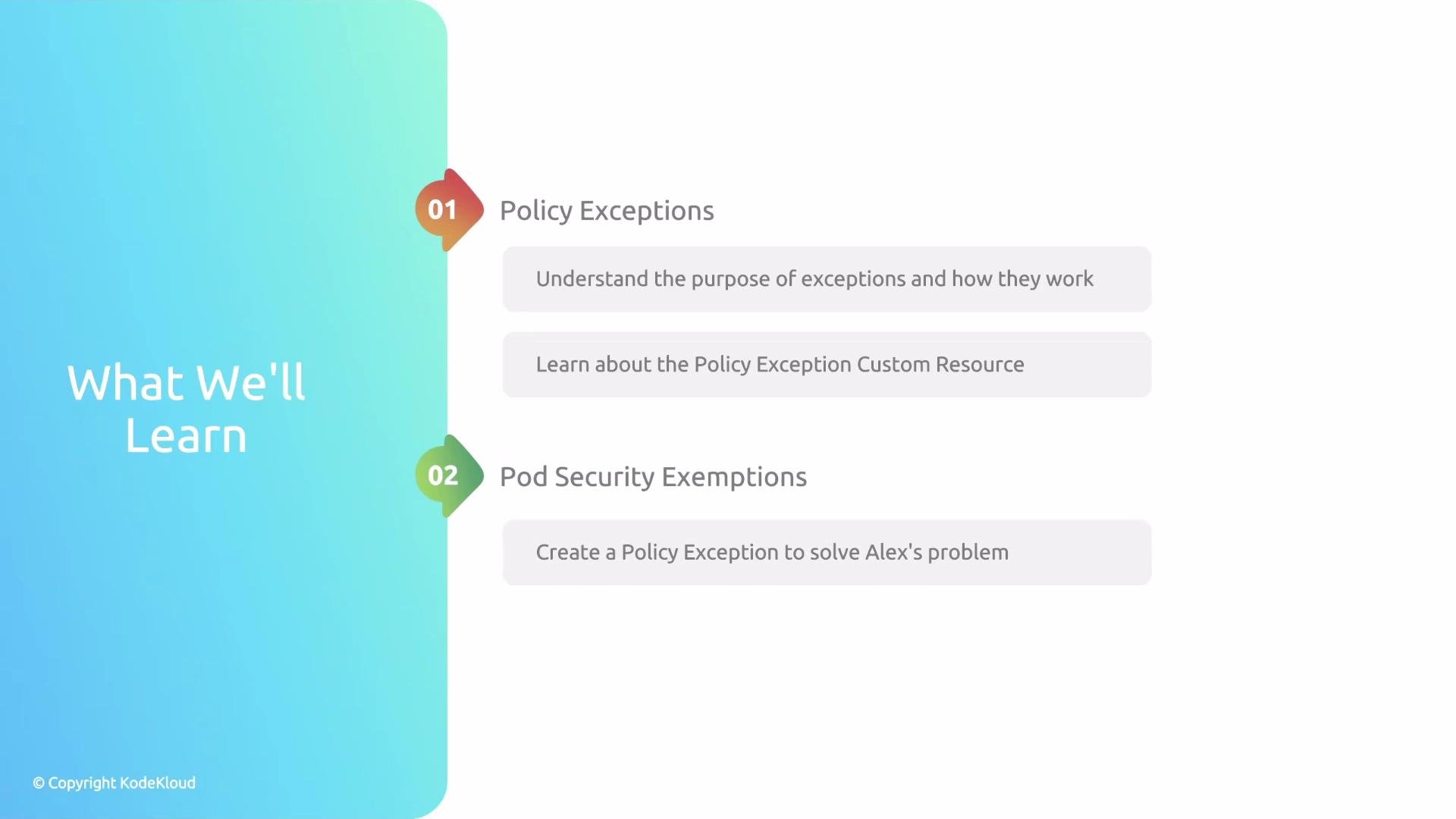
* What a policy exception is and the custom resource used to create one.
* A step‑by‑step hands‑on example: create an exception that allows Alloy’s monitoring agent to run as root while keeping the global non‑root `validate` rule in place.
* How to use exceptions specifically for Pod Security exemptions and other targeted cases.
* Best practices for safely creating, reviewing, and auditing exceptions.
What this section covers
* What a policy exception is and the custom resource used to create one.
* A step‑by‑step hands‑on example: create an exception that allows Alloy’s monitoring agent to run as root while keeping the global non‑root `validate` rule in place.
* How to use exceptions specifically for Pod Security exemptions and other targeted cases.
* Best practices for safely creating, reviewing, and auditing exceptions.
 This article defines the Exception CRD, shows how to author an exception resource, and walks through managing exceptions safely (scoping, approval, and audit trails).
Policy exceptions are implemented via a custom resource (the Exception CR). Use exceptions sparingly: prefer narrowly scoped rules that target specific namespaces, labels, or service accounts before resorting to exceptions.
Key benefits of using Kyverno policy exceptions
* Granular: scope exceptions to a particular namespace, workload, or label.
* Auditable: exceptions are Kubernetes resources and can be reviewed, versioned, and tracked.
* Reversible: remove the exception when it is no longer needed; global policies remain intact.
* Safe: avoids the risky practice of disabling policies cluster‑wide.
Recommended reading and references
* Kyverno documentation: [https://kyverno.io/docs/](https://kyverno.io/docs/)
* Kubernetes Pod Security admission: [https://kubernetes.io/docs/concepts/security/pod-security-admission/](https://kubernetes.io/docs/concepts/security/pod-security-admission/)
Table — What you’ll learn in this section
| Topic | Description |
| ----------------------- | -------------------------------------------------------------------------------------------------- |
| What is an exception? | How Kyverno models exceptions and why they’re safer than disabling policies. |
| Exception CRD | The custom resource used to create and manage exceptions. |
| Hands‑on example | Step‑by‑step: allow Alloy’s monitoring agent to run as root without disabling the non‑root policy. |
| Pod Security exemptions | How exceptions relate to Pod Security and best practices for exemptions. |
Avoid blanket exceptions. Always scope exceptions as narrowly as possible (namespace, label selector, or specific workload) and follow an approval process to minimize risk.
This article defines the Exception CRD, shows how to author an exception resource, and walks through managing exceptions safely (scoping, approval, and audit trails).
Policy exceptions are implemented via a custom resource (the Exception CR). Use exceptions sparingly: prefer narrowly scoped rules that target specific namespaces, labels, or service accounts before resorting to exceptions.
Key benefits of using Kyverno policy exceptions
* Granular: scope exceptions to a particular namespace, workload, or label.
* Auditable: exceptions are Kubernetes resources and can be reviewed, versioned, and tracked.
* Reversible: remove the exception when it is no longer needed; global policies remain intact.
* Safe: avoids the risky practice of disabling policies cluster‑wide.
Recommended reading and references
* Kyverno documentation: [https://kyverno.io/docs/](https://kyverno.io/docs/)
* Kubernetes Pod Security admission: [https://kubernetes.io/docs/concepts/security/pod-security-admission/](https://kubernetes.io/docs/concepts/security/pod-security-admission/)
Table — What you’ll learn in this section
| Topic | Description |
| ----------------------- | -------------------------------------------------------------------------------------------------- |
| What is an exception? | How Kyverno models exceptions and why they’re safer than disabling policies. |
| Exception CRD | The custom resource used to create and manage exceptions. |
| Hands‑on example | Step‑by‑step: allow Alloy’s monitoring agent to run as root without disabling the non‑root policy. |
| Pod Security exemptions | How exceptions relate to Pod Security and best practices for exemptions. |
Avoid blanket exceptions. Always scope exceptions as narrowly as possible (namespace, label selector, or specific workload) and follow an approval process to minimize risk.