> ## Documentation Index
> Fetch the complete documentation index at: https://notes.kodekloud.com/llms.txt
> Use this file to discover all available pages before exploring further.
# CEL Expressions Part 1
> Introducing CEL usage in Kyverno for concise admission-time validation rules and namespace aware policies
Kyverno makes it straightforward to implement Pod Security Standards and other admission-time controls. In this lesson we introduce the `validate.cel` sub-rule to create concise, powerful validation logic using CEL (Common Expression Language).
What is CEL?
CEL (Common Expression Language) is an open-source, embeddable expression language from Google. It is designed for safe, fast evaluation inside critical components like admission controllers and API servers. CEL deliberately avoids Turing-completeness so expressions are guaranteed to terminate quickly, preventing runaway CPU or memory usage. Its guiding principles are simplicity, security, portability, and performance—qualities that make it a natural fit for policy and validation in Kubernetes.
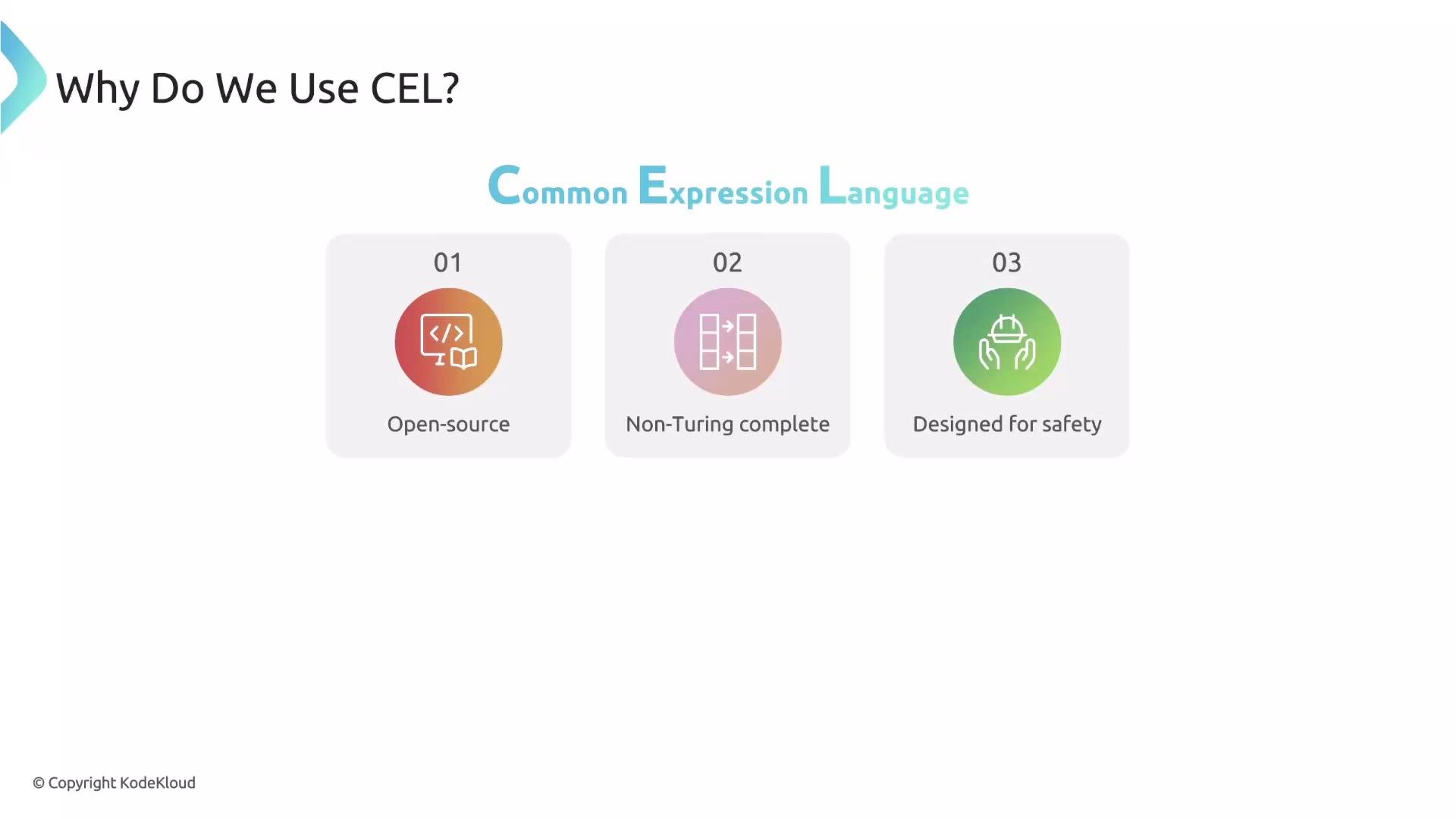 CEL is being adopted across the Kubernetes ecosystem for CRD validation, validating admission policies, and mutating admission policies. Learning CEL for Kyverno gives you a transferable skill set for writing policies across Kubernetes tooling.
Using CEL in Kyverno
Kyverno exposes CEL via the `validate.cel` sub-rule. Inside a rule's `validate` block you add a `cel` block containing a list of expressions. Each expression must include:
* `expression`: a CEL expression that must evaluate to `true` for the request to be allowed.
* `message`: the user-facing error message shown when the expression evaluates to `false`.
Example — require Deployment replicas to be less than 4:
```yaml theme={null}
rules:
- name: deployment-replicas-limit
match:
resources:
kinds:
- Deployment
validate:
failureAction: Enforce
cel:
expressions:
- expression: "object.spec.replicas < 4"
message: "Deployment spec.replicas must be less than 4."
```
This example uses the `object` variable, which represents the full resource being submitted to the API server. We access `object.spec.replicas` to inspect the Deployment replica count.
CEL expressions must evaluate to a boolean. If an expression returns `false` (or a non-boolean that cannot be interpreted as true), the request is rejected and the provided `message` is shown.
Namespace-aware validation
Policy decisions often depend on where a resource will be created. Kyverno exposes `namespaceObject` to make namespace-aware checks straightforward. While `object` is the resource being created (for example, a StatefulSet), `namespaceObject` contains the full Namespace resource where the object will live.
Example — allow StatefulSets only in the `production` namespace:
```yaml theme={null}
rules:
- name: statefulset-namespace
match:
any:
- resources:
kinds:
- StatefulSet
validate:
failureAction: Enforce
cel:
expressions:
- expression: "namespaceObject.metadata.name == 'production'"
message: "StatefulSets must be in the 'production' namespace."
```
If a user attempts to create a StatefulSet in a different namespace (e.g., `default`), that expression evaluates to `false` and the request is blocked.
CEL variables available in Kyverno
The most commonly used variables in Kyverno CEL expressions provide runtime context for expressive policies:
CEL is being adopted across the Kubernetes ecosystem for CRD validation, validating admission policies, and mutating admission policies. Learning CEL for Kyverno gives you a transferable skill set for writing policies across Kubernetes tooling.
Using CEL in Kyverno
Kyverno exposes CEL via the `validate.cel` sub-rule. Inside a rule's `validate` block you add a `cel` block containing a list of expressions. Each expression must include:
* `expression`: a CEL expression that must evaluate to `true` for the request to be allowed.
* `message`: the user-facing error message shown when the expression evaluates to `false`.
Example — require Deployment replicas to be less than 4:
```yaml theme={null}
rules:
- name: deployment-replicas-limit
match:
resources:
kinds:
- Deployment
validate:
failureAction: Enforce
cel:
expressions:
- expression: "object.spec.replicas < 4"
message: "Deployment spec.replicas must be less than 4."
```
This example uses the `object` variable, which represents the full resource being submitted to the API server. We access `object.spec.replicas` to inspect the Deployment replica count.
CEL expressions must evaluate to a boolean. If an expression returns `false` (or a non-boolean that cannot be interpreted as true), the request is rejected and the provided `message` is shown.
Namespace-aware validation
Policy decisions often depend on where a resource will be created. Kyverno exposes `namespaceObject` to make namespace-aware checks straightforward. While `object` is the resource being created (for example, a StatefulSet), `namespaceObject` contains the full Namespace resource where the object will live.
Example — allow StatefulSets only in the `production` namespace:
```yaml theme={null}
rules:
- name: statefulset-namespace
match:
any:
- resources:
kinds:
- StatefulSet
validate:
failureAction: Enforce
cel:
expressions:
- expression: "namespaceObject.metadata.name == 'production'"
message: "StatefulSets must be in the 'production' namespace."
```
If a user attempts to create a StatefulSet in a different namespace (e.g., `default`), that expression evaluates to `false` and the request is blocked.
CEL variables available in Kyverno
The most commonly used variables in Kyverno CEL expressions provide runtime context for expressive policies:
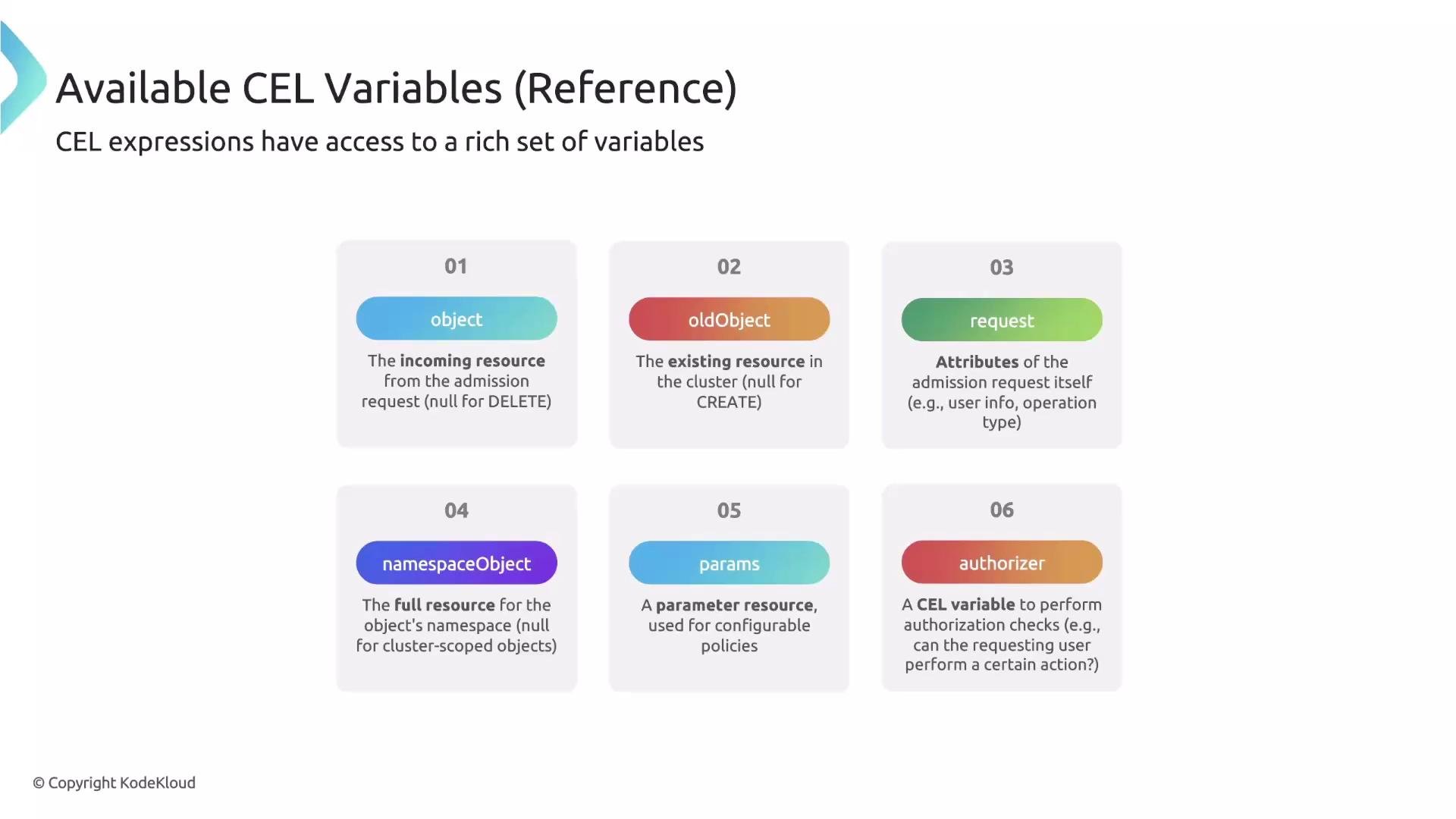 * object\
The incoming resource manifest being created or updated. Example: `object.spec.replicas`.
Note: For delete operations, `object` is `null` because there is no incoming resource body.
* oldObject\
The current cluster version of the resource (available for updates). Use this to compare previous and new state.
* request\
Metadata about the admission request (user identity, operation type, `dryRun` flag, etc.). Useful for policies that depend on who performed the action or how it was requested.
* namespaceObject\
The Namespace resource where the object will be created. Useful to read labels, annotations, or the namespace name itself.
* params\
External parameters injected into the policy (for example, via a ConfigMap or Kyverno params binding). Use `params` to avoid hard-coding values and make policies reusable.
* authorizer\
Provides on-the-fly authorization checks (advanced). For example, validate that the requester has permission to `get` a referenced Secret. See Kyverno docs for details: [https://kyverno.io/docs/](https://kyverno.io/docs/)
Quick reference table
| Variable | What it contains | Common example usage |
| ----------------: | -------------------------------------------------- | ------------------------------------------------------------------------------- |
| `object` | Incoming resource being created or updated | `object.metadata.labels.owner == 'team-a'` |
| `oldObject` | Resource version stored in cluster (for updates) | `object.spec.replicas > oldObject.spec.replicas` |
| `request` | Admission request metadata | `request.userInfo.username == 'admin'` |
| `namespaceObject` | The Namespace resource for the target namespace | `namespaceObject.metadata.labels.environment == 'prod'` |
| `params` | External parameters passed into the policy | `object.spec.replicas <= params.maxReplicas` |
| `authorizer` | Authorization helper for dynamic permission checks | `authorizer.resourceAllowed('get', 'v1', 'Secret', object.spec.tls.secretName)` |
Summary
* CEL is a safe, performant expression language well-suited for admission-time validation.
* Kyverno exposes CEL through `validate.cel`, letting you author concise validation rules that run on admission.
* Use variables like `object`, `oldObject`, `request`, `namespaceObject`, `params`, and `authorizer` to write context-aware policies.
* Keep expressions simple and boolean-returning; use `params` for reusable policies and `namespaceObject` for namespace-scoped constraints.
* object\
The incoming resource manifest being created or updated. Example: `object.spec.replicas`.
Note: For delete operations, `object` is `null` because there is no incoming resource body.
* oldObject\
The current cluster version of the resource (available for updates). Use this to compare previous and new state.
* request\
Metadata about the admission request (user identity, operation type, `dryRun` flag, etc.). Useful for policies that depend on who performed the action or how it was requested.
* namespaceObject\
The Namespace resource where the object will be created. Useful to read labels, annotations, or the namespace name itself.
* params\
External parameters injected into the policy (for example, via a ConfigMap or Kyverno params binding). Use `params` to avoid hard-coding values and make policies reusable.
* authorizer\
Provides on-the-fly authorization checks (advanced). For example, validate that the requester has permission to `get` a referenced Secret. See Kyverno docs for details: [https://kyverno.io/docs/](https://kyverno.io/docs/)
Quick reference table
| Variable | What it contains | Common example usage |
| ----------------: | -------------------------------------------------- | ------------------------------------------------------------------------------- |
| `object` | Incoming resource being created or updated | `object.metadata.labels.owner == 'team-a'` |
| `oldObject` | Resource version stored in cluster (for updates) | `object.spec.replicas > oldObject.spec.replicas` |
| `request` | Admission request metadata | `request.userInfo.username == 'admin'` |
| `namespaceObject` | The Namespace resource for the target namespace | `namespaceObject.metadata.labels.environment == 'prod'` |
| `params` | External parameters passed into the policy | `object.spec.replicas <= params.maxReplicas` |
| `authorizer` | Authorization helper for dynamic permission checks | `authorizer.resourceAllowed('get', 'v1', 'Secret', object.spec.tls.secretName)` |
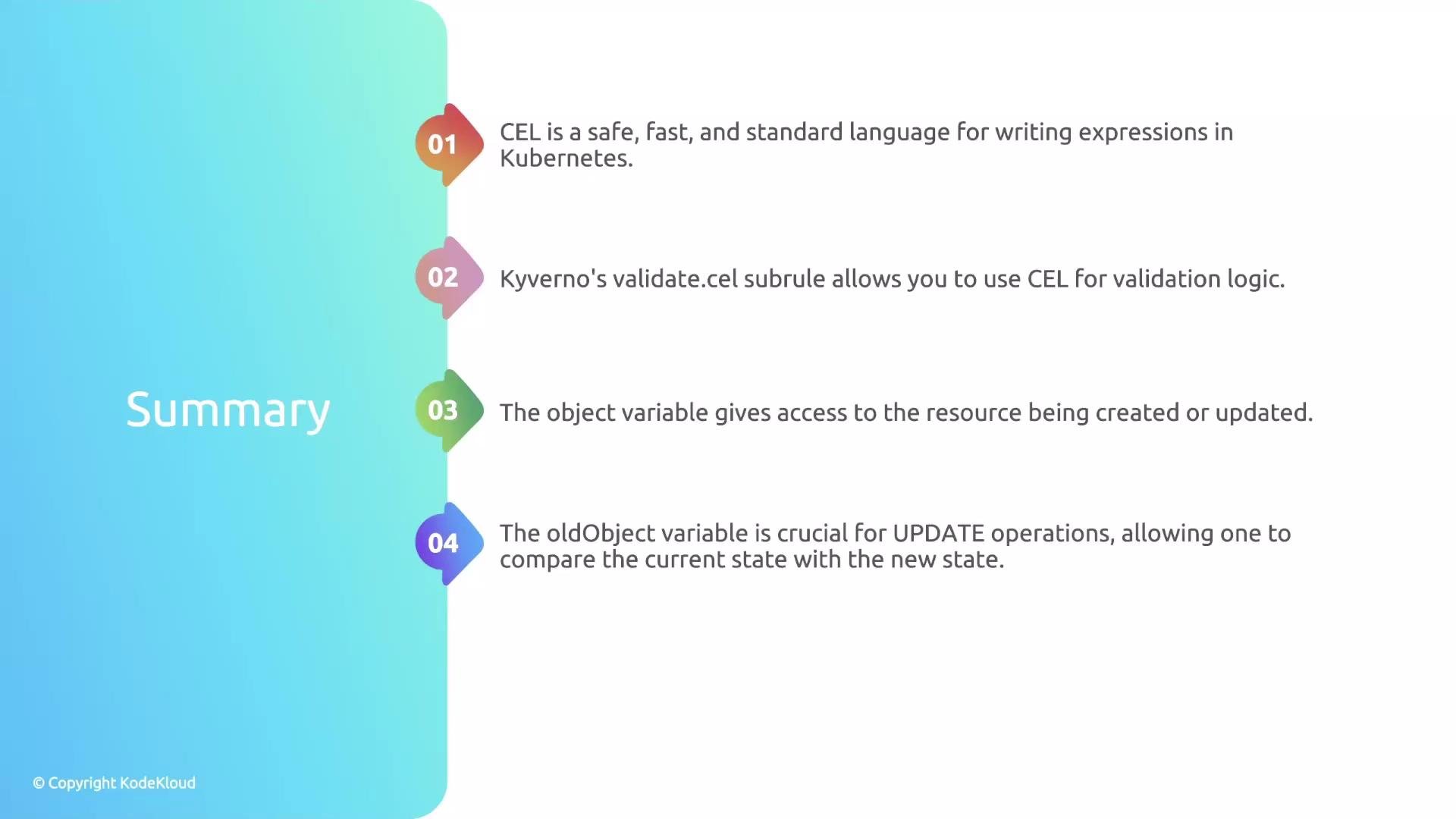
Summary
* CEL is a safe, performant expression language well-suited for admission-time validation.
* Kyverno exposes CEL through `validate.cel`, letting you author concise validation rules that run on admission.
* Use variables like `object`, `oldObject`, `request`, `namespaceObject`, `params`, and `authorizer` to write context-aware policies.
* Keep expressions simple and boolean-returning; use `params` for reusable policies and `namespaceObject` for namespace-scoped constraints.
 Further reading and references
* Kyverno documentation: [https://kyverno.io/docs/](https://kyverno.io/docs/)
* Kubernetes CRD validation and CEL: [https://kubernetes.io/docs/tasks/extend-kubernetes/custom-resources/custom-resource-definitions/#validation](https://kubernetes.io/docs/tasks/extend-kubernetes/custom-resources/custom-resource-definitions/#validation)
That's it for this lesson.
Further reading and references
* Kyverno documentation: [https://kyverno.io/docs/](https://kyverno.io/docs/)
* Kubernetes CRD validation and CEL: [https://kubernetes.io/docs/tasks/extend-kubernetes/custom-resources/custom-resource-definitions/#validation](https://kubernetes.io/docs/tasks/extend-kubernetes/custom-resources/custom-resource-definitions/#validation)
That's it for this lesson.